🗊 Презентация Global economy and World Economic Relations (WER)

Нажмите для полного просмотра!
Global economy and World Economic Relations (WER), слайд №1 Global economy and World Economic Relations (WER), слайд №2 Global economy and World Economic Relations (WER), слайд №3 Global economy and World Economic Relations (WER), слайд №4 Global economy and World Economic Relations (WER), слайд №5 Global economy and World Economic Relations (WER), слайд №6 Global economy and World Economic Relations (WER), слайд №7 Global economy and World Economic Relations (WER), слайд №8 Global economy and World Economic Relations (WER), слайд №9 Global economy and World Economic Relations (WER), слайд №10 Global economy and World Economic Relations (WER), слайд №11 Global economy and World Economic Relations (WER), слайд №12 Global economy and World Economic Relations (WER), слайд №13 Global economy and World Economic Relations (WER), слайд №14 Global economy and World Economic Relations (WER), слайд №15 Global economy and World Economic Relations (WER), слайд №16 Global economy and World Economic Relations (WER), слайд №17 Global economy and World Economic Relations (WER), слайд №18 Global economy and World Economic Relations (WER), слайд №19 Global economy and World Economic Relations (WER), слайд №20 Global economy and World Economic Relations (WER), слайд №21 Global economy and World Economic Relations (WER), слайд №22 Global economy and World Economic Relations (WER), слайд №23 Global economy and World Economic Relations (WER), слайд №24 Global economy and World Economic Relations (WER), слайд №25 Global economy and World Economic Relations (WER), слайд №26 Global economy and World Economic Relations (WER), слайд №27 Global economy and World Economic Relations (WER), слайд №28 Global economy and World Economic Relations (WER), слайд №29 Global economy and World Economic Relations (WER), слайд №30 Global economy and World Economic Relations (WER), слайд №31 Global economy and World Economic Relations (WER), слайд №32 Global economy and World Economic Relations (WER), слайд №33 Global economy and World Economic Relations (WER), слайд №34 Global economy and World Economic Relations (WER), слайд №35 Global economy and World Economic Relations (WER), слайд №36 Global economy and World Economic Relations (WER), слайд №37 Global economy and World Economic Relations (WER), слайд №38 Global economy and World Economic Relations (WER), слайд №39 Global economy and World Economic Relations (WER), слайд №40 Global economy and World Economic Relations (WER), слайд №41 Global economy and World Economic Relations (WER), слайд №42 Global economy and World Economic Relations (WER), слайд №43 Global economy and World Economic Relations (WER), слайд №44 Global economy and World Economic Relations (WER), слайд №45 Global economy and World Economic Relations (WER), слайд №46 Global economy and World Economic Relations (WER), слайд №47 Global economy and World Economic Relations (WER), слайд №48 Global economy and World Economic Relations (WER), слайд №49 Global economy and World Economic Relations (WER), слайд №50 Global economy and World Economic Relations (WER), слайд №51 Global economy and World Economic Relations (WER), слайд №52 Global economy and World Economic Relations (WER), слайд №53 Global economy and World Economic Relations (WER), слайд №54 Global economy and World Economic Relations (WER), слайд №55 Global economy and World Economic Relations (WER), слайд №56 Global economy and World Economic Relations (WER), слайд №57 Global economy and World Economic Relations (WER), слайд №58 Global economy and World Economic Relations (WER), слайд №59 Global economy and World Economic Relations (WER), слайд №60 Global economy and World Economic Relations (WER), слайд №61 Global economy and World Economic Relations (WER), слайд №62 Global economy and World Economic Relations (WER), слайд №63 Global economy and World Economic Relations (WER), слайд №64 Global economy and World Economic Relations (WER), слайд №65 Global economy and World Economic Relations (WER), слайд №66 Global economy and World Economic Relations (WER), слайд №67 Global economy and World Economic Relations (WER), слайд №68 Global economy and World Economic Relations (WER), слайд №69 Global economy and World Economic Relations (WER), слайд №70

Содержание
Вы можете ознакомиться и скачать презентацию на тему Global economy and World Economic Relations (WER). Доклад-сообщение содержит 70 слайдов. Презентации для любого класса можно скачать бесплатно. Если материал и наш сайт презентаций Mypresentation Вам понравились – поделитесь им с друзьями с помощью социальных кнопок и добавьте в закладки в своем браузере.
Слайды и текст этой презентации


Слайд 1


Global economy and World Economic Relations (WER), слайд №1
Описание слайда:
Слайд 2


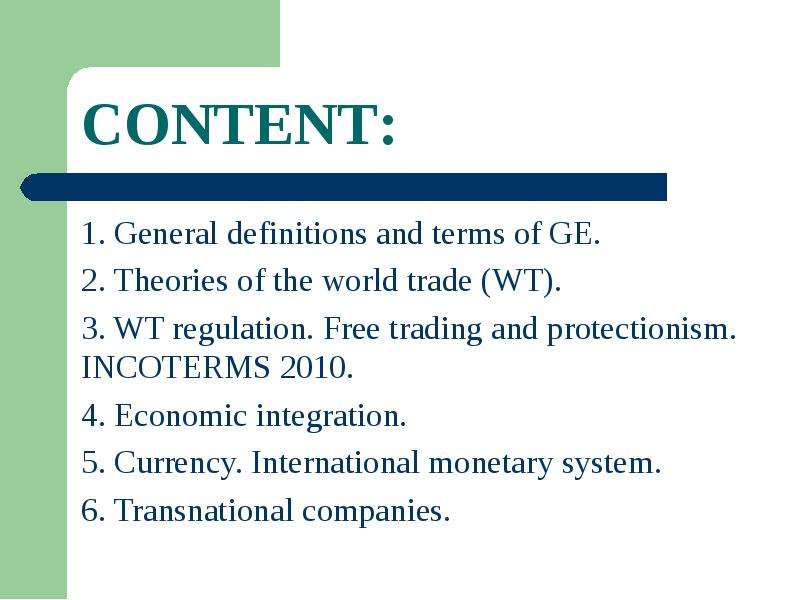
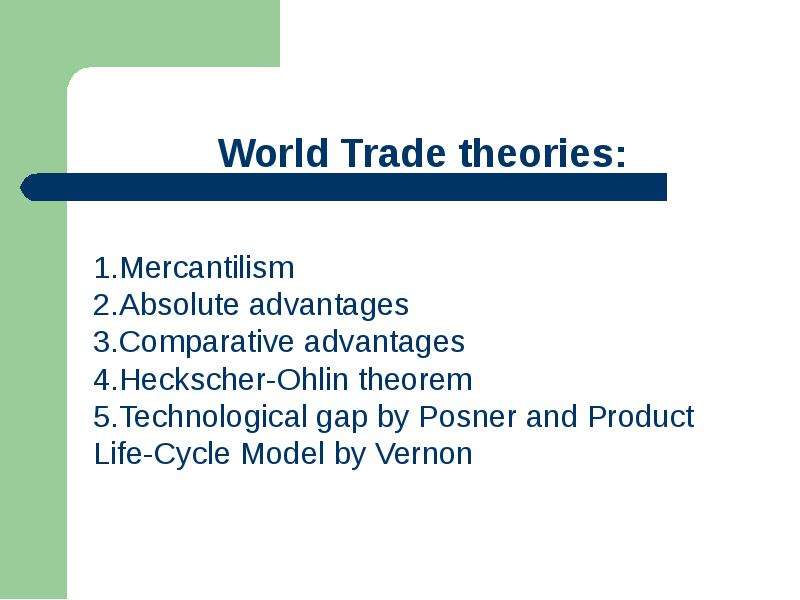
1. General definitions and terms of GE. 1. General definitions and terms of GE. 2. Theories of the world trade (WT). 3. WT regulation. Free trading...
Описание слайда:
1. General definitions and terms of GE. 1. General definitions and terms of GE. 2. Theories of the world trade (WT). 3. WT regulation. Free trading and protectionism. INCOTERMS 2010. 4. Economic integration. 5. Currency. International monetary system. 6. Transnational companies.

Слайд 3


Global economy and World Economic Relations (WER), слайд №3
Описание слайда:

Слайд 4


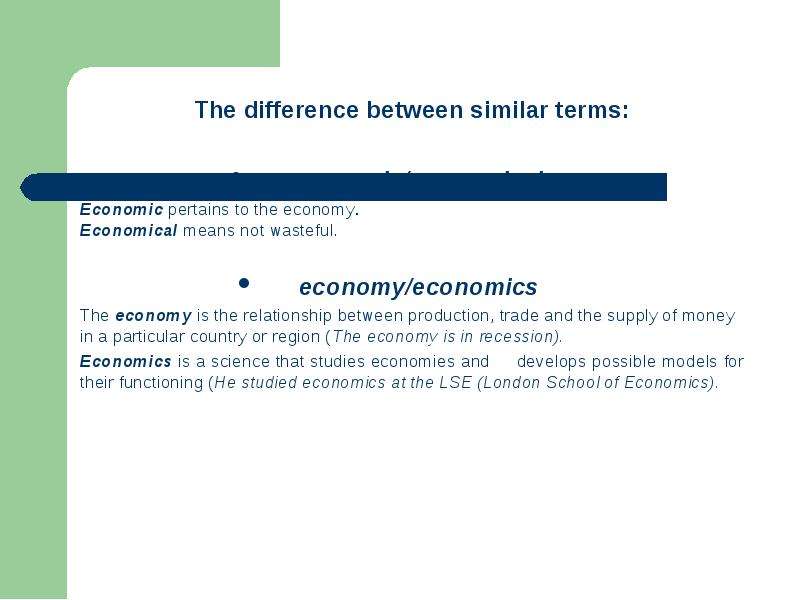
The difference between similar terms: economic/economical Economic pertains to the economy. Economical means not wasteful. economy/economics The...
Описание слайда:

The difference between similar terms: economic/economical Economic pertains to the economy. Economical means not wasteful. economy/economics The economy is the relationship between production, trade and the supply of money in a particular country or region (The economy is in recession). Economics is a science that studies economies and develops possible models for their functioning (He studied economics at the LSE (London School of Economics).

Слайд 5


The world economy or global economy is the economy of the world, considered as the international exchange of goods and services that is expressed in...
Описание слайда:
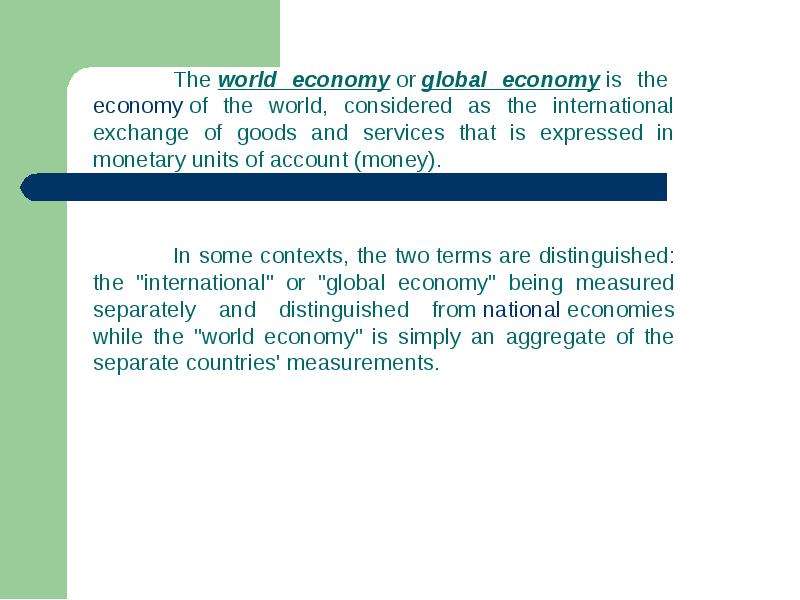
The world economy or global economy is the economy of the world, considered as the international exchange of goods and services that is expressed in monetary units of account (money). In some contexts, the two terms are distinguished: the "international" or "global economy" being measured separately and distinguished from national economies while the "world economy" is simply an aggregate of the separate countries' measurements.

Слайд 6


A subject matter of GE is WER. A subject matter of GE is WER. WER: trade of goods and services; capital flow; labour migration; intellectual property...
Описание слайда:
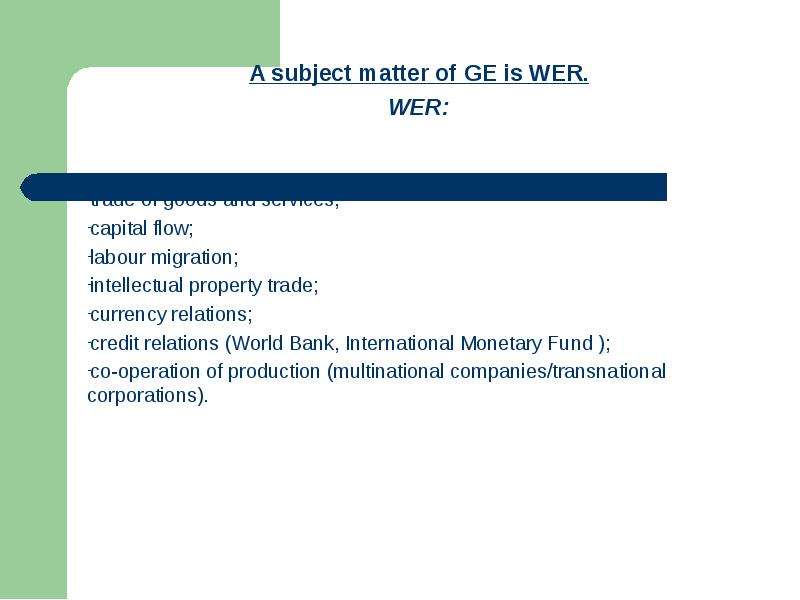
A subject matter of GE is WER. A subject matter of GE is WER. WER: trade of goods and services; capital flow; labour migration; intellectual property trade; currency relations; credit relations (World Bank, International Monetary Fund ); co-operation of production (multinational companies/transnational corporations).

Слайд 7


Global economy and World Economic Relations (WER), слайд №7
Описание слайда:

Слайд 8


IDL - the allocation of various parts of the production process to different places in the world. IDL - the allocation of various parts of the...
Описание слайда:
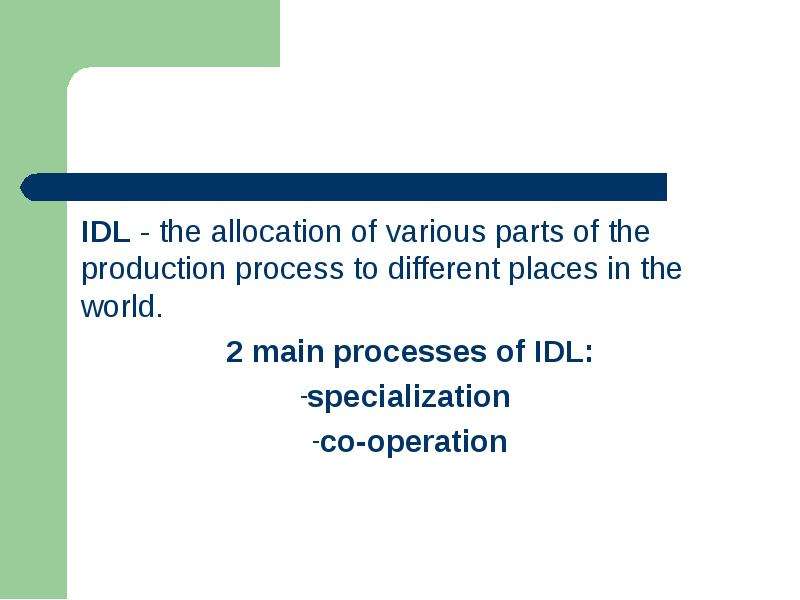
IDL - the allocation of various parts of the production process to different places in the world. IDL - the allocation of various parts of the production process to different places in the world. 2 main processes of IDL: specialization co-operation

Слайд 9


a system of world economic relations, national economies` cooperation; A combination of different economic sectors and branches of national...
Описание слайда:
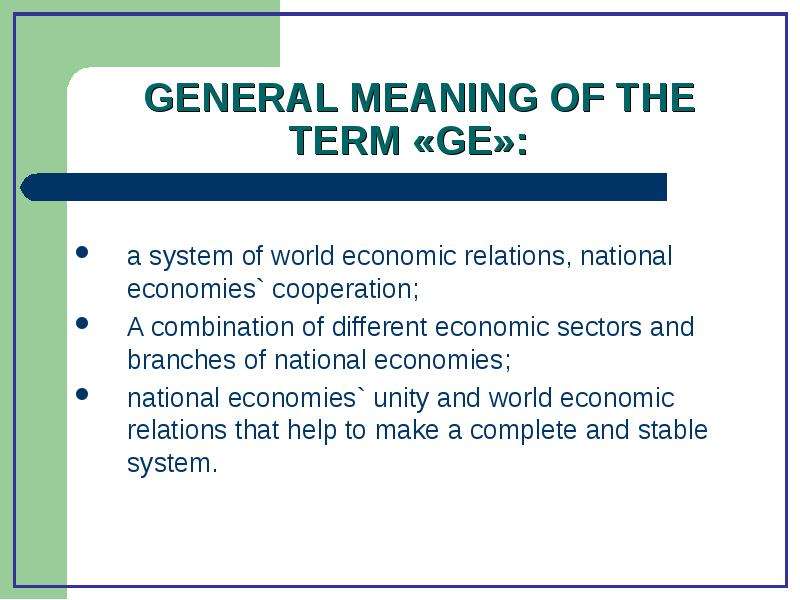
a system of world economic relations, national economies` cooperation; A combination of different economic sectors and branches of national economies; national economies` unity and world economic relations that help to make a complete and stable system.

Слайд 10


Stages of GE’s formation: Stages of GE’s formation: Age of Discovery Before the 1st World War Between 2 World Wars From the 2nd World War to the 80th...
Описание слайда:
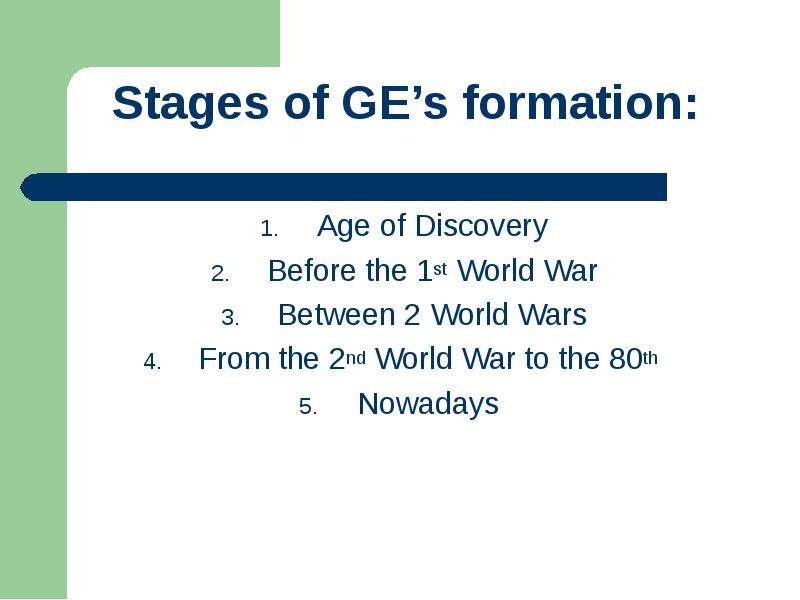
Stages of GE’s formation: Stages of GE’s formation: Age of Discovery Before the 1st World War Between 2 World Wars From the 2nd World War to the 80th Nowadays

Слайд 11


Global economy and World Economic Relations (WER), слайд №11
Описание слайда:

Слайд 12


Entirety/ unity Hierarchy |ˈhʌɪərɑːki| Self-adjustment/ self-regulation Adaptation
Описание слайда:
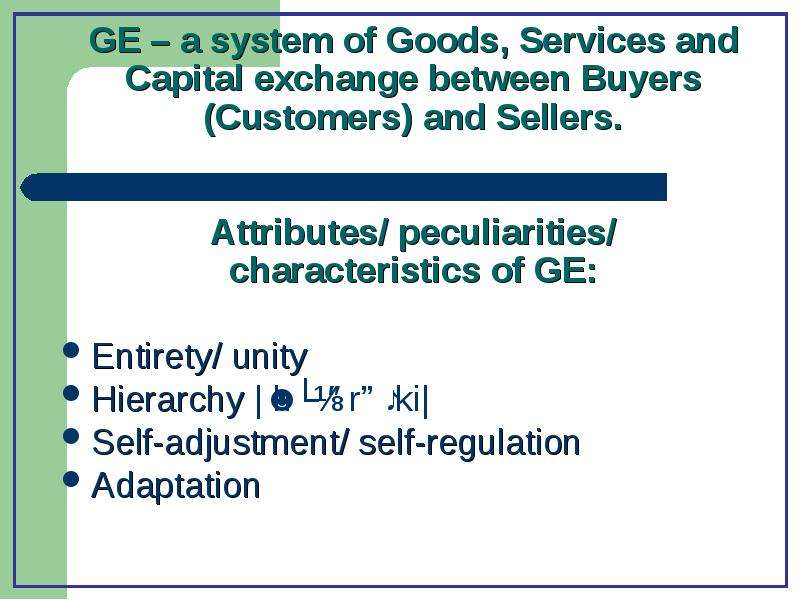
Entirety/ unity Hierarchy |ˈhʌɪərɑːki| Self-adjustment/ self-regulation Adaptation

Слайд 13


Global economy and World Economic Relations (WER), слайд №13
Описание слайда:

Слайд 14


Global economy and World Economic Relations (WER), слайд №14
Описание слайда:

Слайд 15


Global economy and World Economic Relations (WER), слайд №15
Описание слайда:

Слайд 16


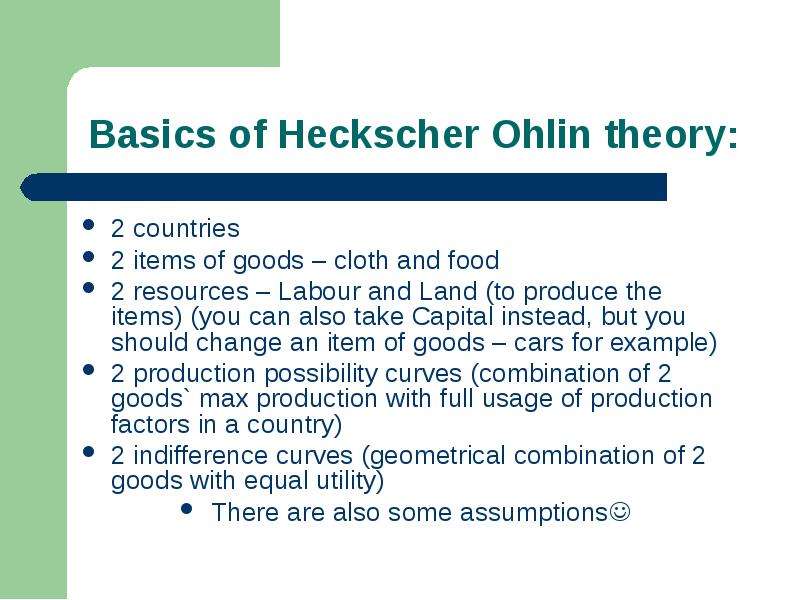
2 countries 2 countries 2 items of goods – cloth and food 2 resources – Labour and Land (to produce the items) (you can also take Capital instead,...
Описание слайда:
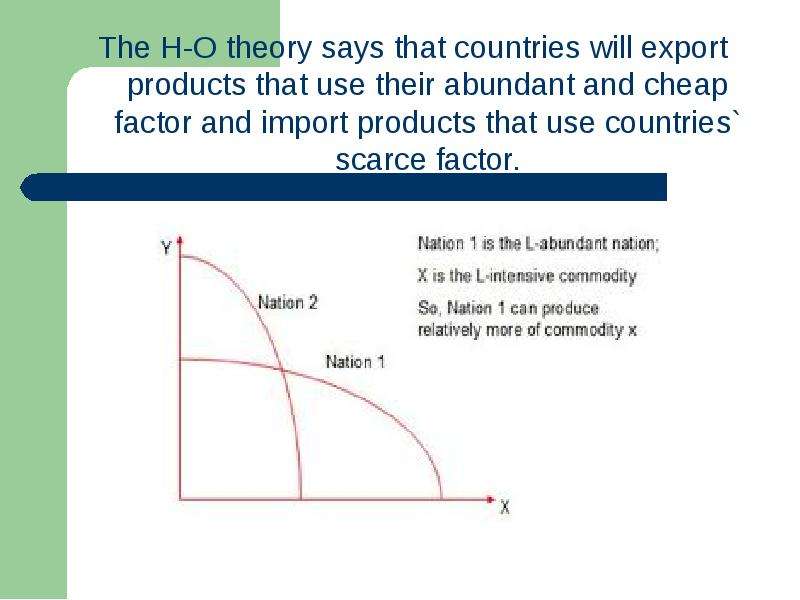
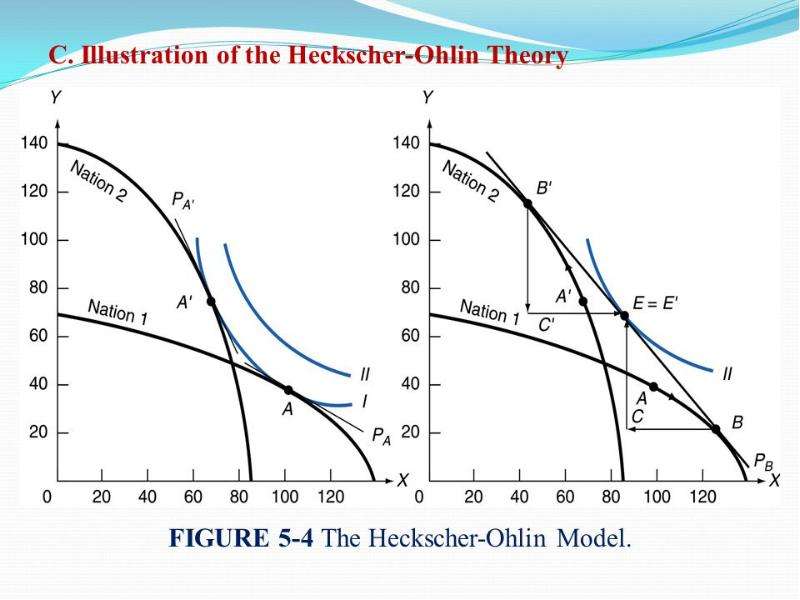
2 countries 2 countries 2 items of goods – cloth and food 2 resources – Labour and Land (to produce the items) (you can also take Capital instead, but you should change an item of goods – cars for example) 2 production possibility curves (combination of 2 goods` max production with full usage of production factors in a country) 2 indifference curves (geometrical combination of 2 goods with equal utility) There are also some assumptions

Слайд 17


The H-O theory says that countries will export products that use their abundant and cheap factor and import products that use countries` scarce...
Описание слайда:
The H-O theory says that countries will export products that use their abundant and cheap factor and import products that use countries` scarce factor. The H-O theory says that countries will export products that use their abundant and cheap factor and import products that use countries` scarce factor.

Слайд 18


Global economy and World Economic Relations (WER), слайд №18
Описание слайда:

Слайд 19


Global economy and World Economic Relations (WER), слайд №19
Описание слайда:

Слайд 20


Global economy and World Economic Relations (WER), слайд №20
Описание слайда:

Слайд 21


PROS PROS
Описание слайда:
PROS PROS

Слайд 22


PROS PROS
Описание слайда:
PROS PROS

Слайд 23


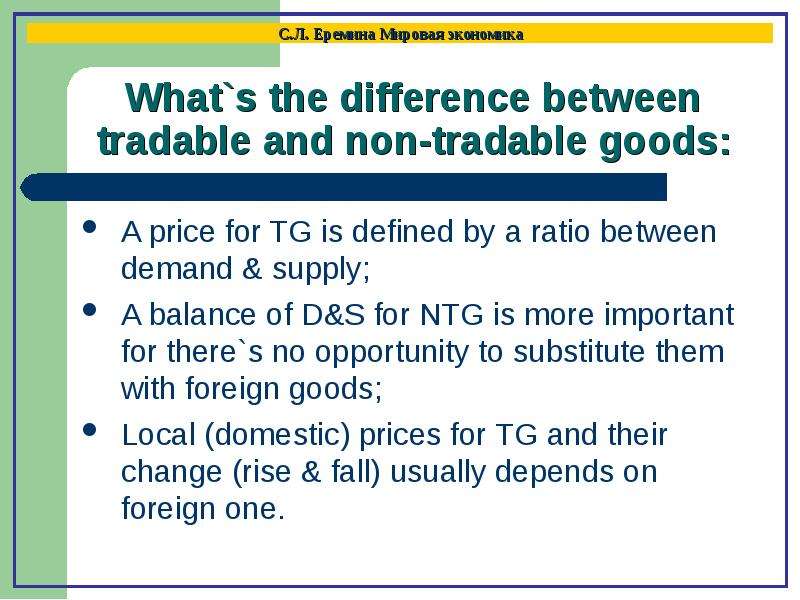
A price for TG is defined by a ratio between demand & supply; A price for TG is defined by a ratio between demand & supply; A balance of D&S for NTG...
Описание слайда:
A price for TG is defined by a ratio between demand & supply; A price for TG is defined by a ratio between demand & supply; A balance of D&S for NTG is more important for there`s no opportunity to substitute them with foreign goods; Local (domestic) prices for TG and their change (rise & fall) usually depends on foreign one.

Слайд 24


Global economy and World Economic Relations (WER), слайд №24
Описание слайда:

Слайд 25


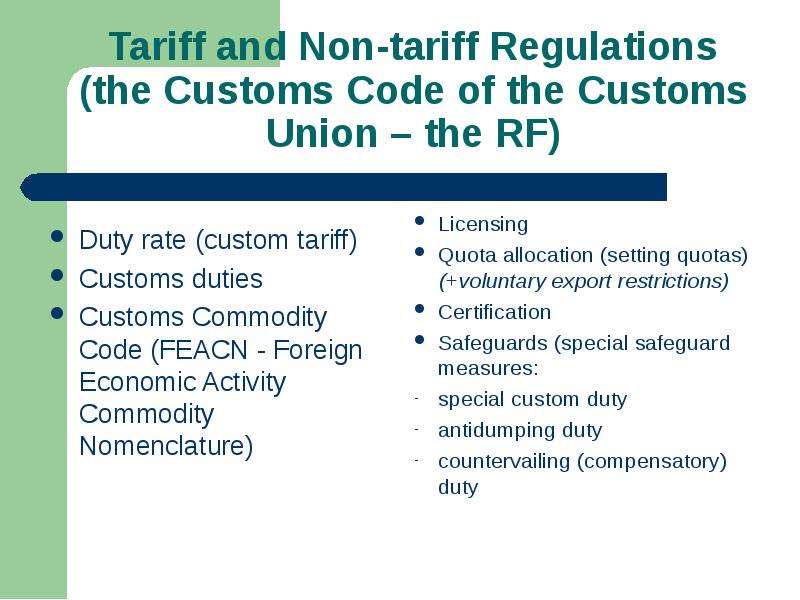
Duty rate (custom tariff) Duty rate (custom tariff) Customs duties Customs Commodity Code (FEACN - Foreign Economic Activity Commodity Nomenclature)
Описание слайда:
Duty rate (custom tariff) Duty rate (custom tariff) Customs duties Customs Commodity Code (FEACN - Foreign Economic Activity Commodity Nomenclature)

Слайд 26


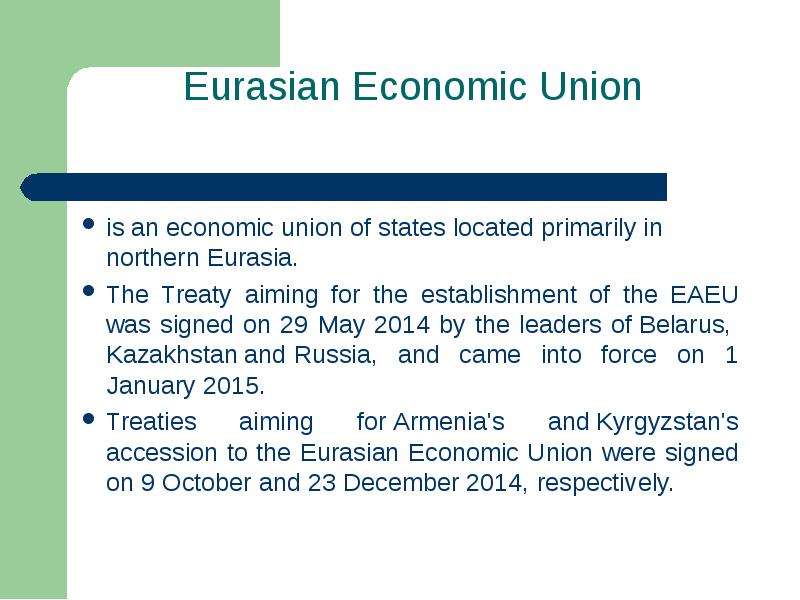
is an economic union of states located primarily in northern Eurasia. is an economic union of states located primarily in northern Eurasia. The...
Описание слайда:
is an economic union of states located primarily in northern Eurasia. is an economic union of states located primarily in northern Eurasia. The Treaty aiming for the establishment of the EAEU was signed on 29 May 2014 by the leaders of Belarus, Kazakhstan and Russia, and came into force on 1 January 2015. Treaties aiming for Armenia's and Kyrgyzstan's accession to the Eurasian Economic Union were signed on 9 October and 23 December 2014, respectively.

Слайд 27


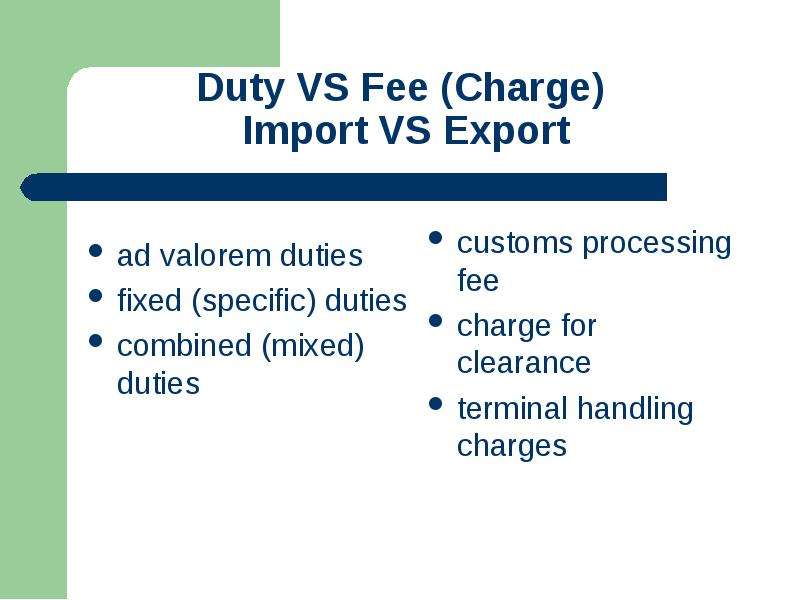
ad valorem duties ad valorem duties fixed (specific) duties combined (mixed) duties
Описание слайда:
ad valorem duties ad valorem duties fixed (specific) duties combined (mixed) duties

Слайд 28


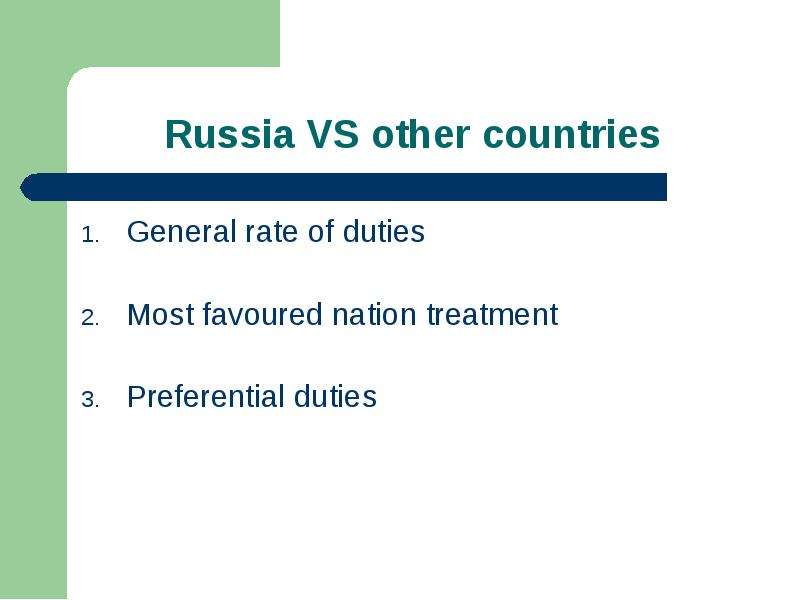
General rate of duties General rate of duties Most favoured nation treatment Preferential duties
Описание слайда:
General rate of duties General rate of duties Most favoured nation treatment Preferential duties

Слайд 29


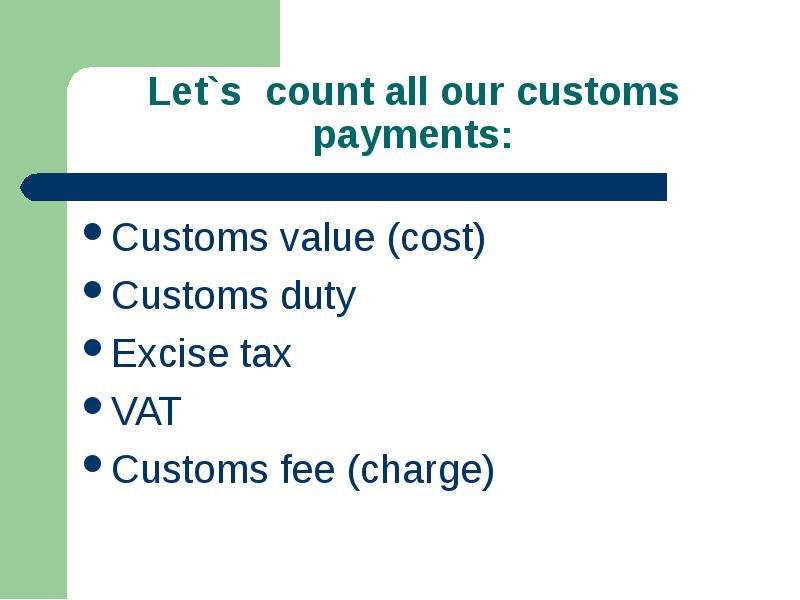
Customs value (cost) Customs value (cost) Customs duty Excise tax VAT Customs fee (charge)
Описание слайда:
Customs value (cost) Customs value (cost) Customs duty Excise tax VAT Customs fee (charge)

Слайд 30


Global economy and World Economic Relations (WER), слайд №30
Описание слайда:

Слайд 31


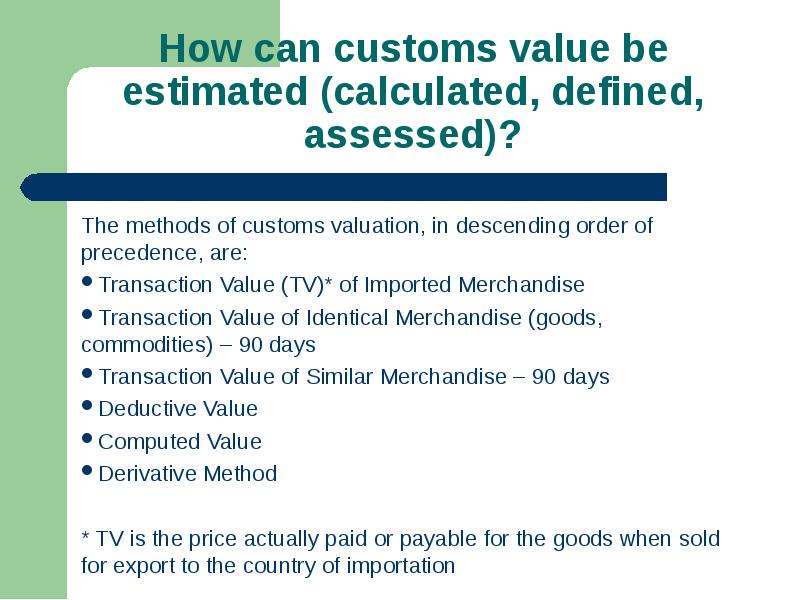
The methods of customs valuation, in descending order of precedence, are: The methods of customs valuation, in descending order of precedence, are:...
Описание слайда:
The methods of customs valuation, in descending order of precedence, are: The methods of customs valuation, in descending order of precedence, are: Transaction Value (TV)* of Imported Merchandise Transaction Value of Identical Merchandise (goods, commodities) – 90 days Transaction Value of Similar Merchandise – 90 days Deductive Value Computed Value Derivative Method * TV is the price actually paid or payable for the goods when sold for export to the country of importation

Слайд 32


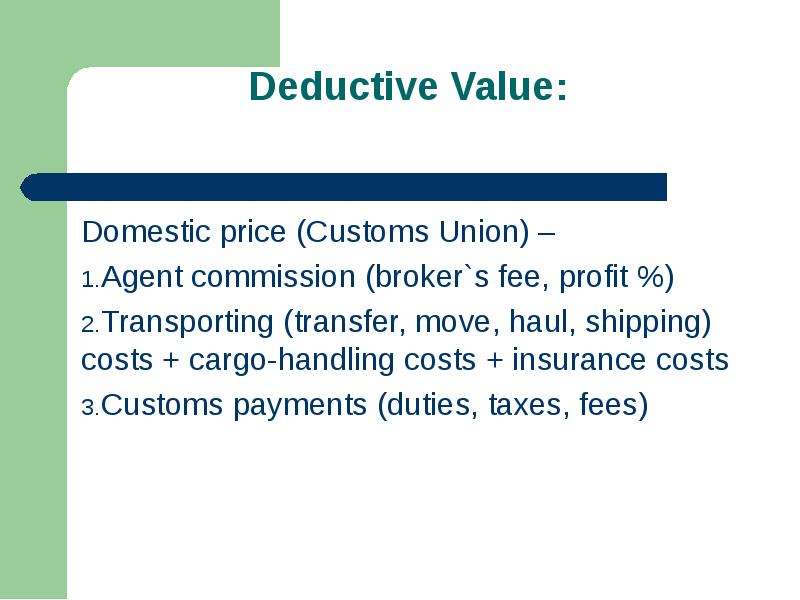
Domestic price (Customs Union) – Domestic price (Customs Union) – Agent commission (broker`s fee, profit %) Transporting (transfer, move, haul,...
Описание слайда:
Domestic price (Customs Union) – Domestic price (Customs Union) – Agent commission (broker`s fee, profit %) Transporting (transfer, move, haul, shipping) costs + cargo-handling costs + insurance costs Customs payments (duties, taxes, fees)

Слайд 33


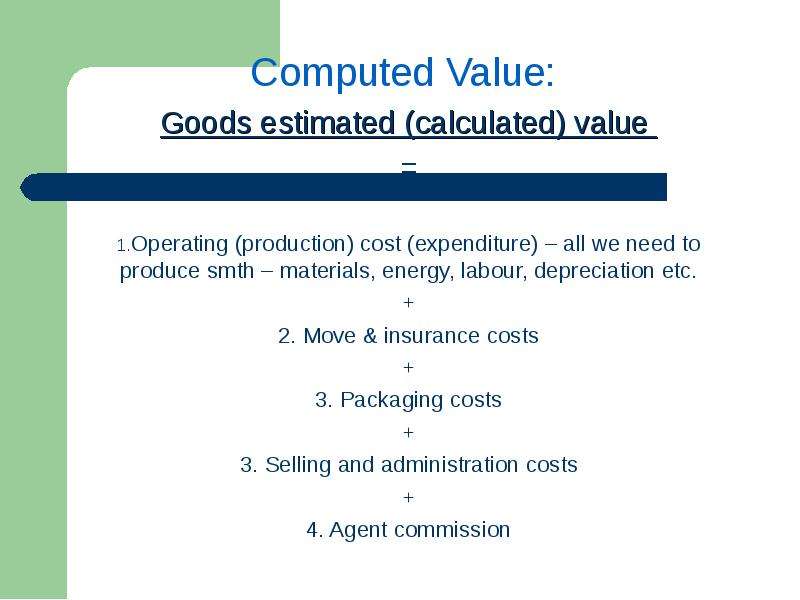
Computed Value: Computed Value: Goods estimated (calculated) value = Operating (production) cost (expenditure) – all we need to produce smth –...
Описание слайда:
Computed Value: Computed Value: Goods estimated (calculated) value = Operating (production) cost (expenditure) – all we need to produce smth – materials, energy, labour, depreciation etc. + 2. Move & insurance costs + 3. Packaging costs + 3. Selling and administration costs + 4. Agent commission

Слайд 34


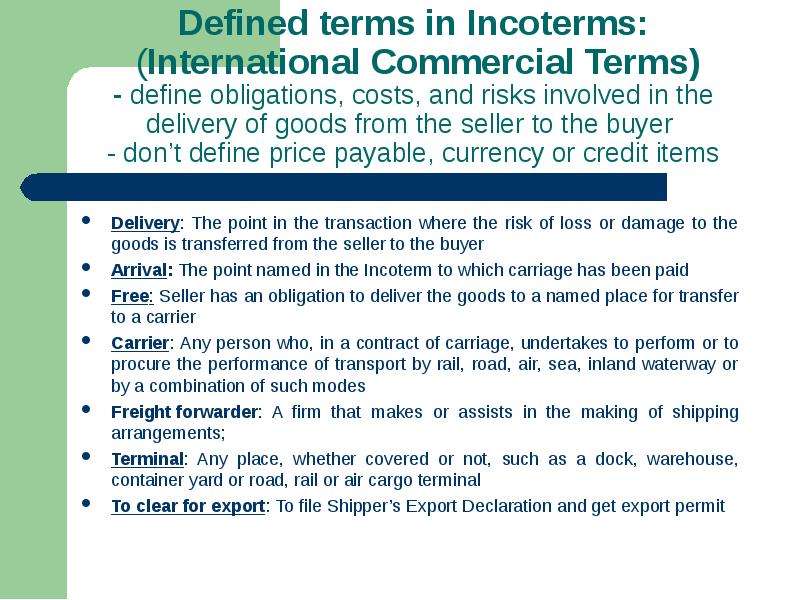
Delivery: The point in the transaction where the risk of loss or damage to the goods is transferred from the seller to the buyer Delivery: The point...
Описание слайда:
Delivery: The point in the transaction where the risk of loss or damage to the goods is transferred from the seller to the buyer Delivery: The point in the transaction where the risk of loss or damage to the goods is transferred from the seller to the buyer Arrival: The point named in the Incoterm to which carriage has been paid Free: Seller has an obligation to deliver the goods to a named place for transfer to a carrier Carrier: Any person who, in a contract of carriage, undertakes to perform or to procure the performance of transport by rail, road, air, sea, inland waterway or by a combination of such modes Freight forwarder: A firm that makes or assists in the making of shipping arrangements; Terminal: Any place, whether covered or not, such as a dock, warehouse, container yard or road, rail or air cargo terminal To clear for export: To file Shipper’s Export Declaration and get export permit

Слайд 35


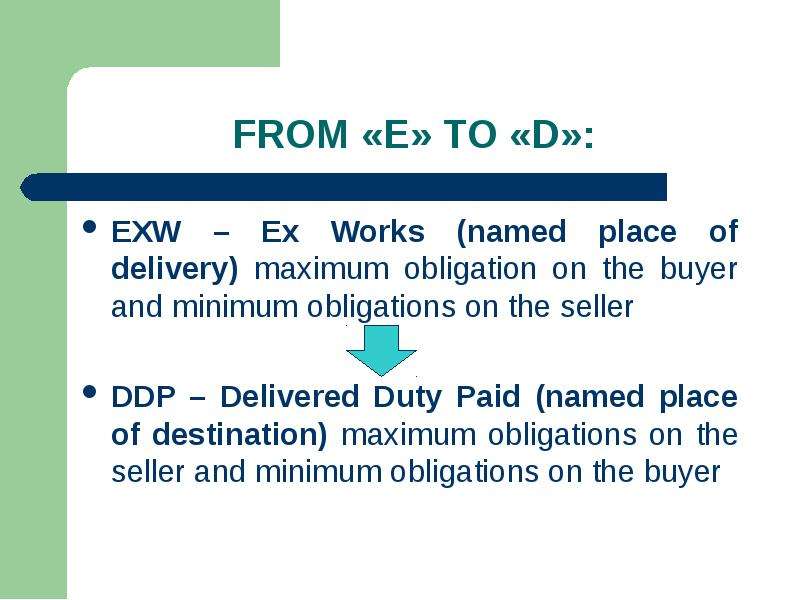
EXW – Ex Works (named place of delivery) maximum obligation on the buyer and minimum obligations on the seller EXW – Ex Works (named place of...
Описание слайда:
EXW – Ex Works (named place of delivery) maximum obligation on the buyer and minimum obligations on the seller EXW – Ex Works (named place of delivery) maximum obligation on the buyer and minimum obligations on the seller DDP – Delivered Duty Paid (named place of destination) maximum obligations on the seller and minimum obligations on the buyer

Слайд 36


The Economic Integration between two countries is a measure of how much two or more countries work together, or give preference to each other. The...
Описание слайда:
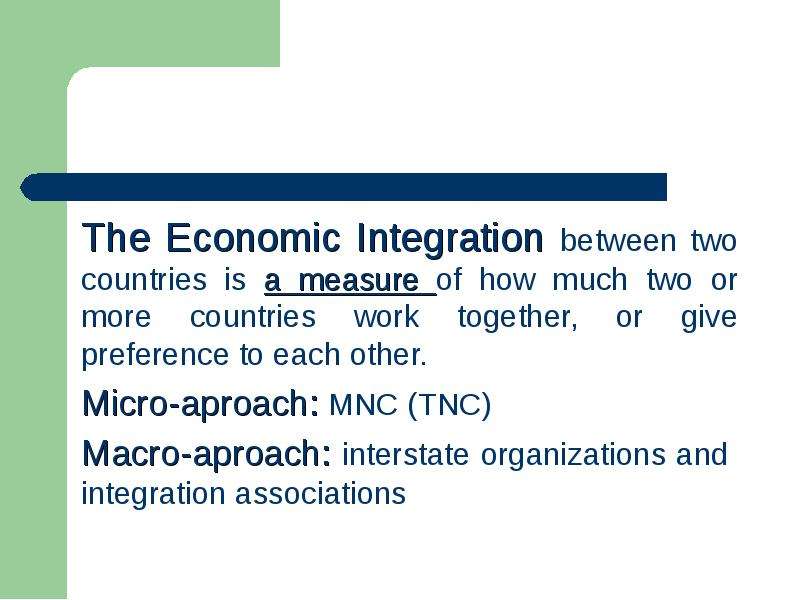
The Economic Integration between two countries is a measure of how much two or more countries work together, or give preference to each other. The Economic Integration between two countries is a measure of how much two or more countries work together, or give preference to each other. Micro-aproach: MNC (TNC) Macro-aproach: interstate organizations and integration associations

Слайд 37


Global economy and World Economic Relations (WER), слайд №37
Описание слайда:

Слайд 38


is the unification of economic policies between different states; is the unification of economic policies between different states; the partial or...
Описание слайда:
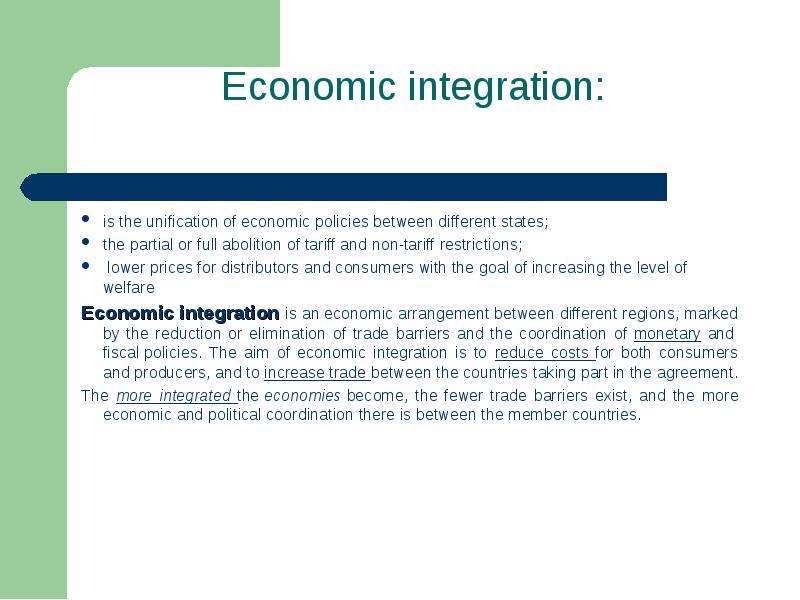
is the unification of economic policies between different states; is the unification of economic policies between different states; the partial or full abolition of tariff and non-tariff restrictions; lower prices for distributors and consumers with the goal of increasing the level of welfare Economic integration is an economic arrangement between different regions, marked by the reduction or elimination of trade barriers and the coordination of monetary and fiscal policies. The aim of economic integration is to reduce costs for both consumers and producers, and to increase trade between the countries taking part in the agreement. The more integrated the economies become, the fewer trade barriers exist, and the more economic and political coordination there is between the member countries.

Слайд 39


Comparative advantage refers to the ability of a person or a country to produce a particular good or service at a lower marginal and opportunity...
Описание слайда:
Comparative advantage refers to the ability of a person or a country to produce a particular good or service at a lower marginal and opportunity (alternative) cost over another. Comparative advantage refers to the ability of a person or a country to produce a particular good or service at a lower marginal and opportunity (alternative) cost over another. Economies of scale refers to the cost advantages that an enterprise obtains due to expansion. There are factors that cause a producer’s average cost per unit to fall as the scale of output is increased. Economies of scale is a long run concept and refers to reductions in unit cost as the size of a facility and the usage levels of other inputs increase.

Слайд 40


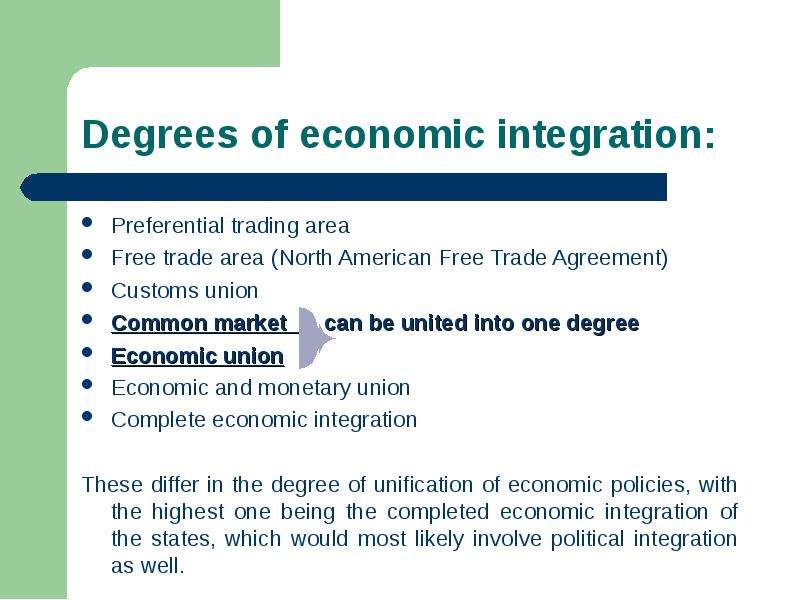
Preferential trading area Preferential trading area Free trade area (North American Free Trade Agreement) Customs union Common market can be united...
Описание слайда:
Preferential trading area Preferential trading area Free trade area (North American Free Trade Agreement) Customs union Common market can be united into one degree Economic union Economic and monetary union Complete economic integration These differ in the degree of unification of economic policies, with the highest one being the completed economic integration of the states, which would most likely involve political integration as well.

Слайд 41


A "free trade area" (FTA) is formed when at least two states partially or fully abolish custom tariffs on their inner border. To exclude...
Описание слайда:
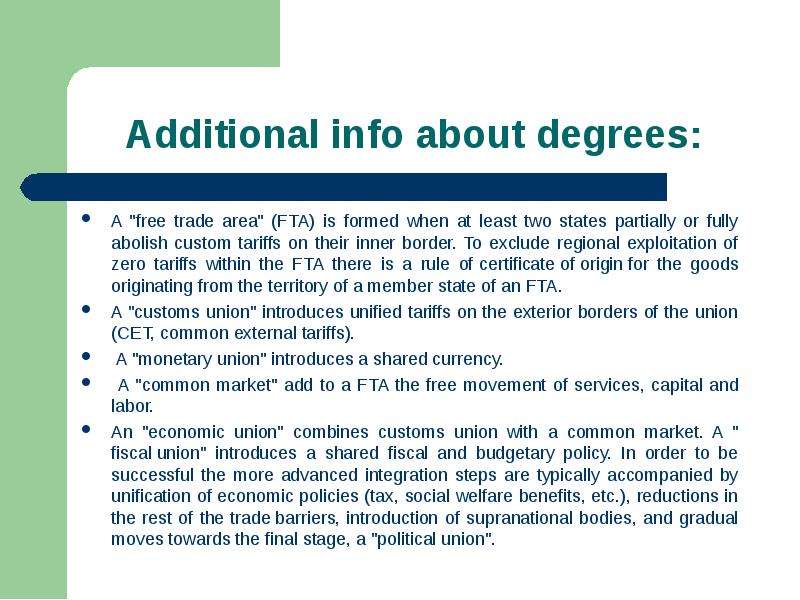
A "free trade area" (FTA) is formed when at least two states partially or fully abolish custom tariffs on their inner border. To exclude regional exploitation of zero tariffs within the FTA there is a rule of certificate of origin for the goods originating from the territory of a member state of an FTA. A "free trade area" (FTA) is formed when at least two states partially or fully abolish custom tariffs on their inner border. To exclude regional exploitation of zero tariffs within the FTA there is a rule of certificate of origin for the goods originating from the territory of a member state of an FTA. A "customs union" introduces unified tariffs on the exterior borders of the union (CET, common external tariffs). A "monetary union" introduces a shared currency. A "common market" add to a FTA the free movement of services, capital and labor. An "economic union" combines customs union with a common market. A "fiscal union" introduces a shared fiscal and budgetary policy. In order to be successful the more advanced integration steps are typically accompanied by unification of economic policies (tax, social welfare benefits, etc.), reductions in the rest of the trade barriers, introduction of supranational bodies, and gradual moves towards the final stage, a "political union".

Слайд 42


Trade benefits: Trade benefits: a reduction in the trade cost; an improved availability and wider selection of goods and services; a greater...
Описание слайда:
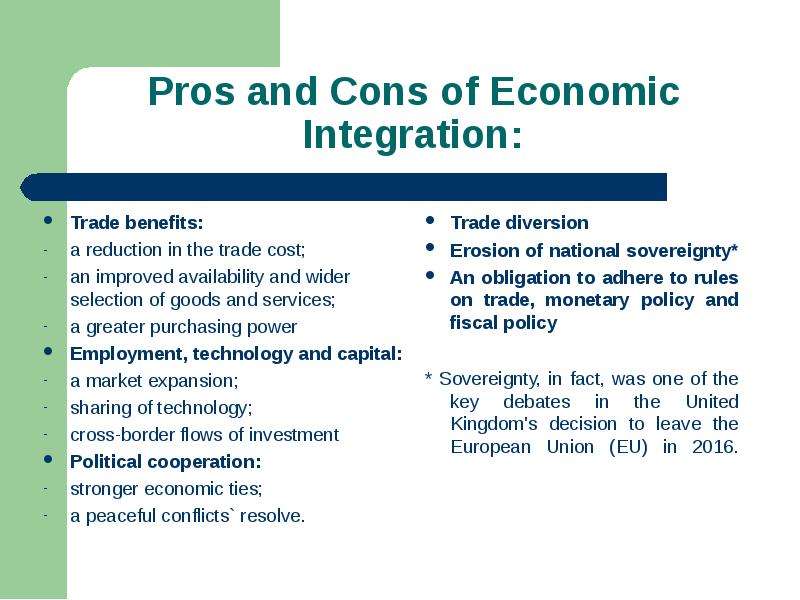
Trade benefits: Trade benefits: a reduction in the trade cost; an improved availability and wider selection of goods and services; a greater purchasing power Employment, technology and capital: a market expansion; sharing of technology; cross-border flows of investment Political cooperation: stronger economic ties; a peaceful conflicts` resolve.

Слайд 43


The methodology for measuring economic integration typically involves the combination of multiple economic indicators, including: The methodology for...
Описание слайда:
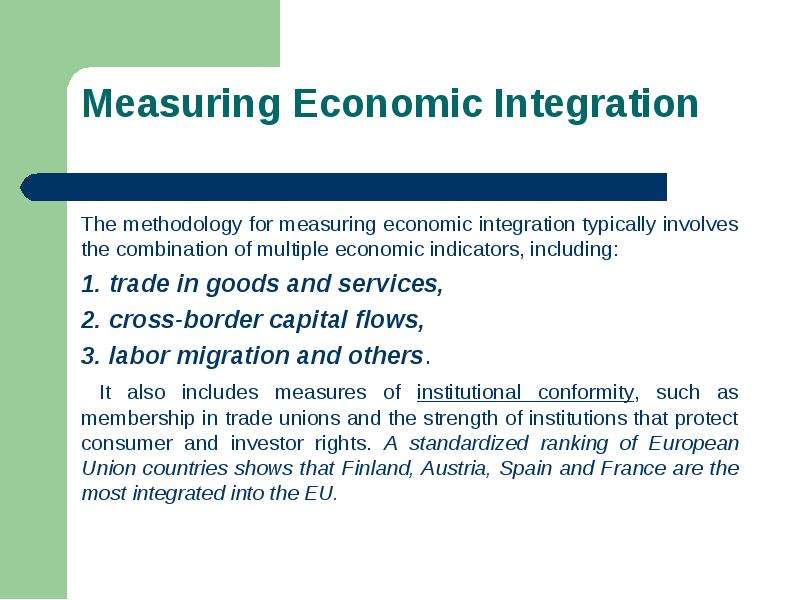
The methodology for measuring economic integration typically involves the combination of multiple economic indicators, including: The methodology for measuring economic integration typically involves the combination of multiple economic indicators, including: 1. trade in goods and services, 2. cross-border capital flows, 3. labor migration and others. It also includes measures of institutional conformity, such as membership in trade unions and the strength of institutions that protect consumer and investor rights. A standardized ranking of European Union countries shows that Finland, Austria, Spain and France are the most integrated into the EU.

Слайд 44


Global economy and World Economic Relations (WER), слайд №44
Описание слайда:

Слайд 45


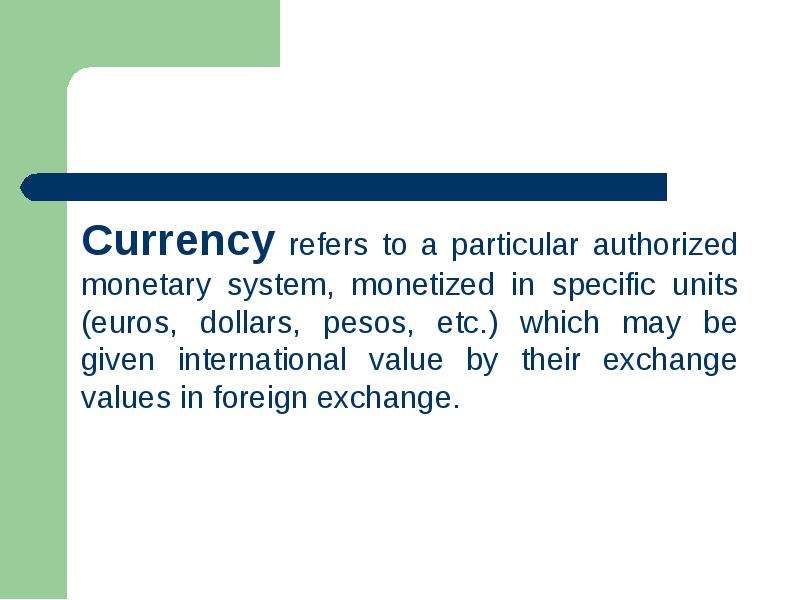
Currency refers to a particular authorized monetary system, monetized in specific units (euros, dollars, pesos, etc.) which may be given...
Описание слайда:
Currency refers to a particular authorized monetary system, monetized in specific units (euros, dollars, pesos, etc.) which may be given international value by their exchange values in foreign exchange. Currency refers to a particular authorized monetary system, monetized in specific units (euros, dollars, pesos, etc.) which may be given international value by their exchange values in foreign exchange.

Слайд 46


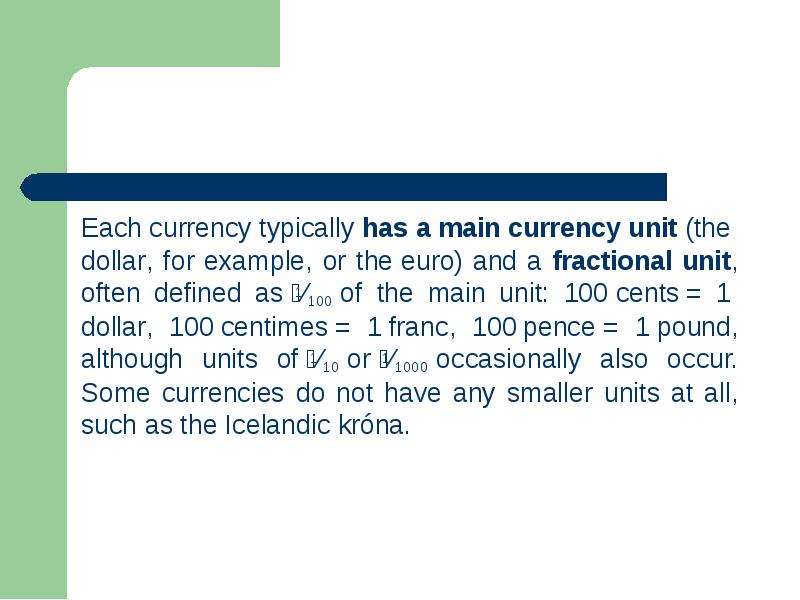
Each currency typically has a main currency unit (the dollar, for example, or the euro) and a fractional unit, often defined as  1⁄100 of the main...
Описание слайда:
Each currency typically has a main currency unit (the dollar, for example, or the euro) and a fractional unit, often defined as  1⁄100 of the main unit: 100 cents = 1 dollar, 100 centimes = 1 franc, 100 pence = 1 pound, although units of  1⁄10 or  1⁄1000 occasionally also occur. Some currencies do not have any smaller units at all, such as the Icelandic króna. Each currency typically has a main currency unit (the dollar, for example, or the euro) and a fractional unit, often defined as  1⁄100 of the main unit: 100 cents = 1 dollar, 100 centimes = 1 franc, 100 pence = 1 pound, although units of  1⁄10 or  1⁄1000 occasionally also occur. Some currencies do not have any smaller units at all, such as the Icelandic króna.

Слайд 47


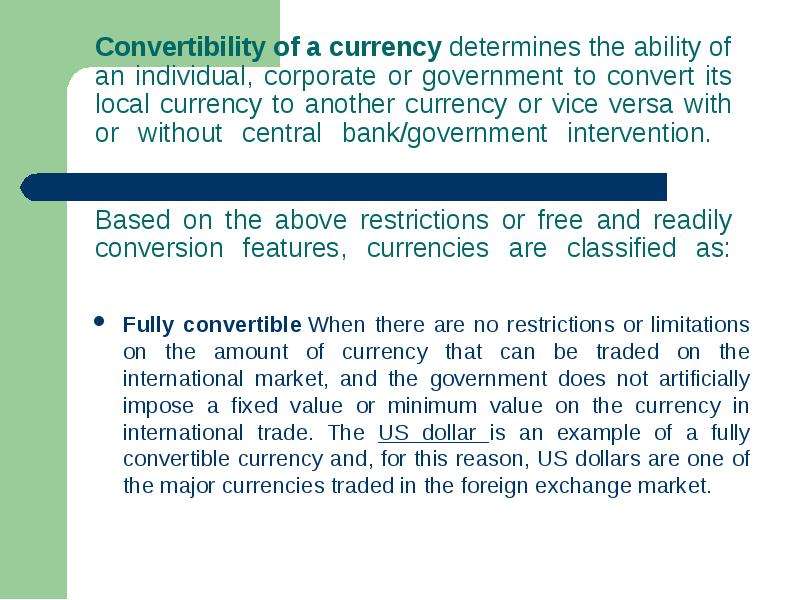
Fully convertible When there are no restrictions or limitations on the amount of currency that can be traded on the international market, and the...
Описание слайда:
Fully convertible When there are no restrictions or limitations on the amount of currency that can be traded on the international market, and the government does not artificially impose a fixed value or minimum value on the currency in international trade. The US dollar is an example of a fully convertible currency and, for this reason, US dollars are one of the major currencies traded in the foreign exchange market. Fully convertible When there are no restrictions or limitations on the amount of currency that can be traded on the international market, and the government does not artificially impose a fixed value or minimum value on the currency in international trade. The US dollar is an example of a fully convertible currency and, for this reason, US dollars are one of the major currencies traded in the foreign exchange market.

Слайд 48


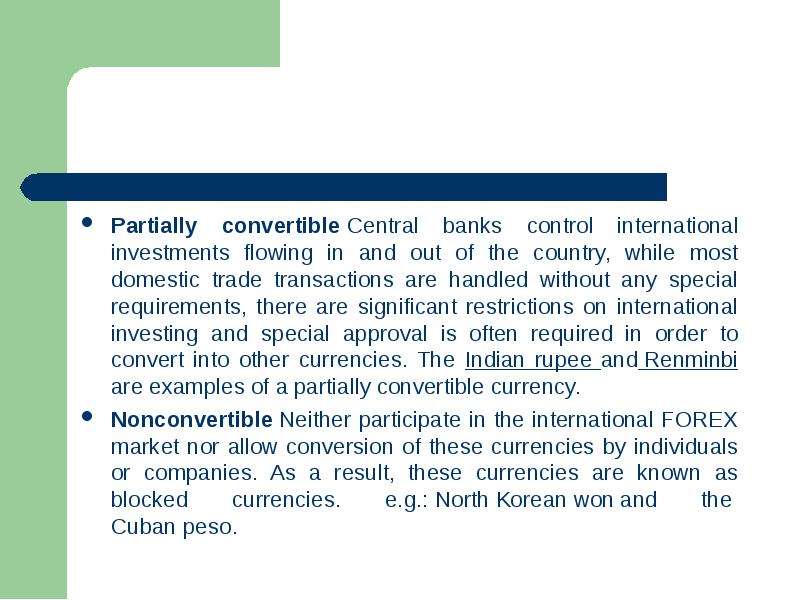
Partially convertible Central banks control international investments flowing in and out of the country, while most domestic trade transactions are...
Описание слайда:
Partially convertible Central banks control international investments flowing in and out of the country, while most domestic trade transactions are handled without any special requirements, there are significant restrictions on international investing and special approval is often required in order to convert into other currencies. The Indian rupee and Renminbi are examples of a partially convertible currency. Partially convertible Central banks control international investments flowing in and out of the country, while most domestic trade transactions are handled without any special requirements, there are significant restrictions on international investing and special approval is often required in order to convert into other currencies. The Indian rupee and Renminbi are examples of a partially convertible currency. Nonconvertible Neither participate in the international FOREX market nor allow conversion of these currencies by individuals or companies. As a result, these currencies are known as blocked currencies. e.g.: North Korean won and the Cuban peso.

Слайд 49


Global economy and World Economic Relations (WER), слайд №49
Описание слайда:

Слайд 50


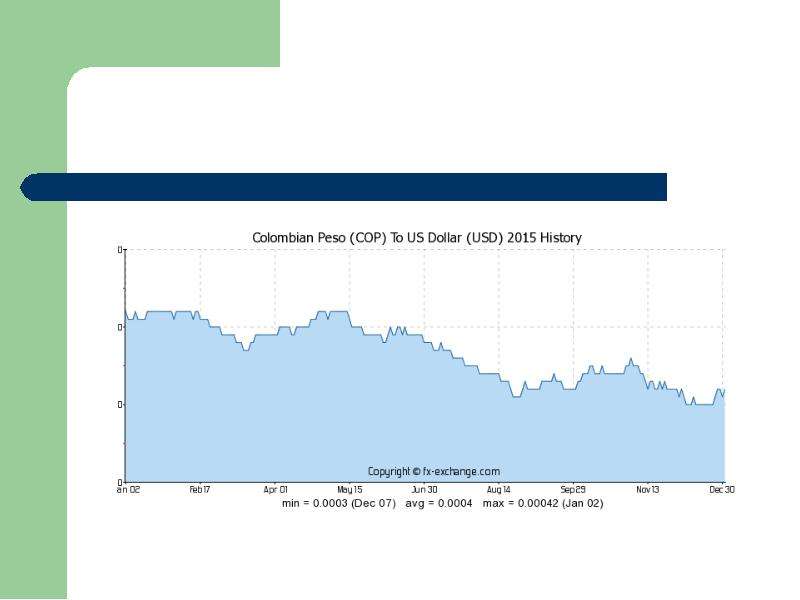
Russian ruble is the national currency. Russian ruble is the national currency. Direct quotation is 57,03 USD/RUB which means you can buy1$ for 57...
Описание слайда:
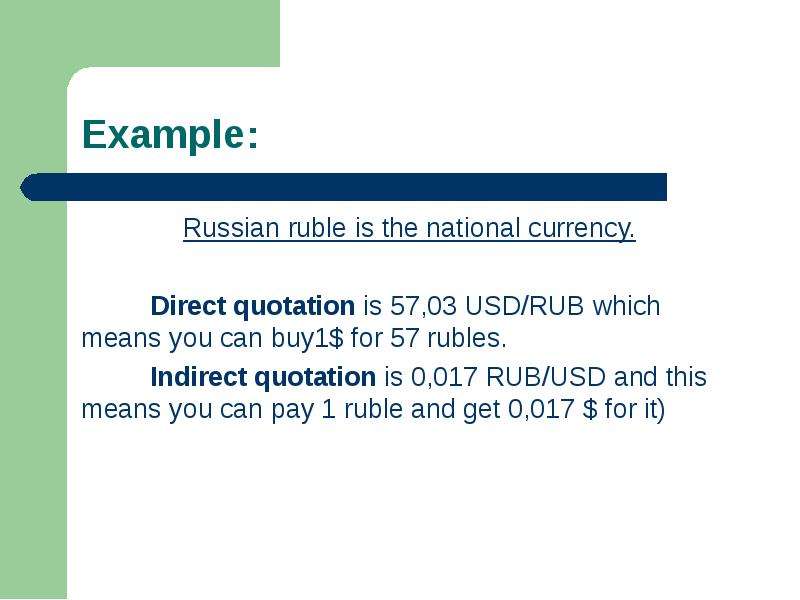
Russian ruble is the national currency. Russian ruble is the national currency. Direct quotation is 57,03 USD/RUB which means you can buy1$ for 57 rubles. Indirect quotation is 0,017 RUB/USD and this means you can pay 1 ruble and get 0,017 $ for it)

Слайд 51


The C-R is an exchange rate between two currencies, in which the home country's currency is not included. In the U.S.A., the euro/yen rate would be...
Описание слайда:
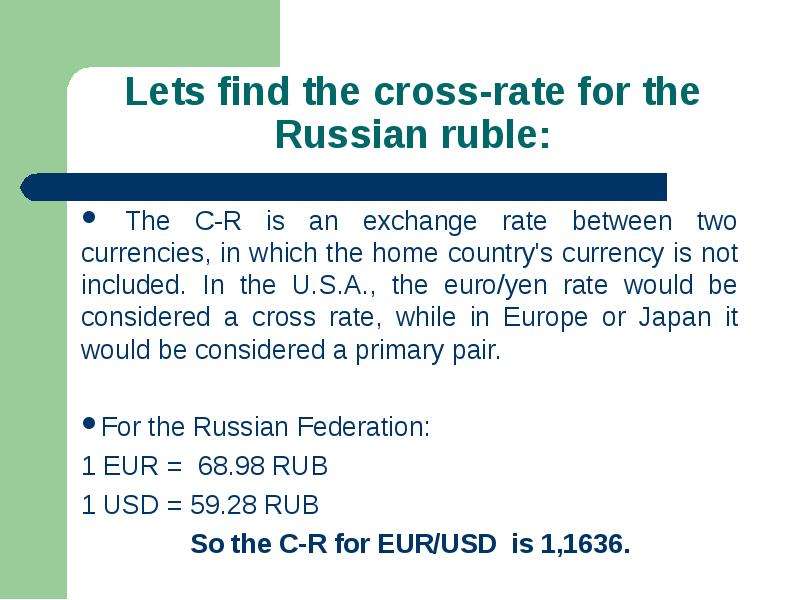
The C-R is an exchange rate between two currencies, in which the home country's currency is not included. In the U.S.A., the euro/yen rate would be considered a cross rate, while in Europe or Japan it would be considered a primary pair. For the Russian Federation: 1 EUR = 68.98 RUB 1 USD = 59.28 RUB So the C-R for EUR/USD is 1,1636.

Слайд 52


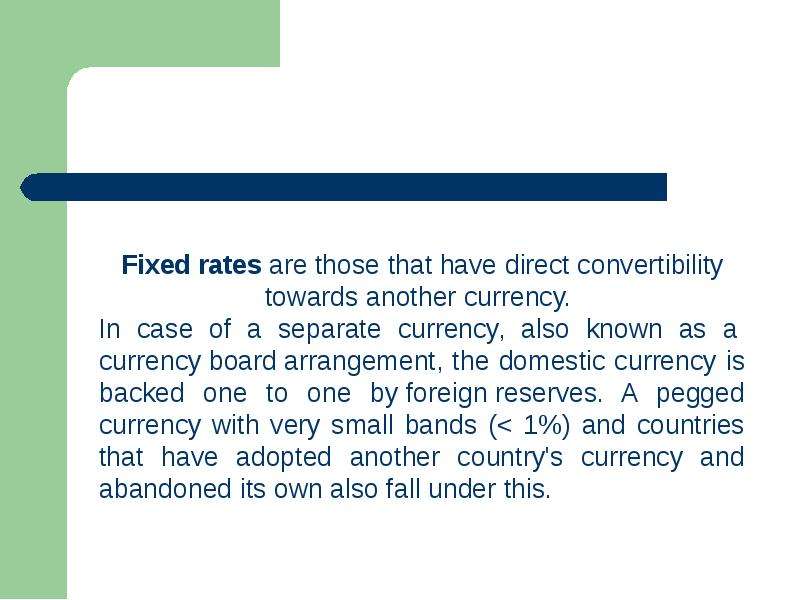
is the way an authority manages its currency in relation to other currencies and the foreign exchange market. It is closely related to monetary...
Описание слайда:
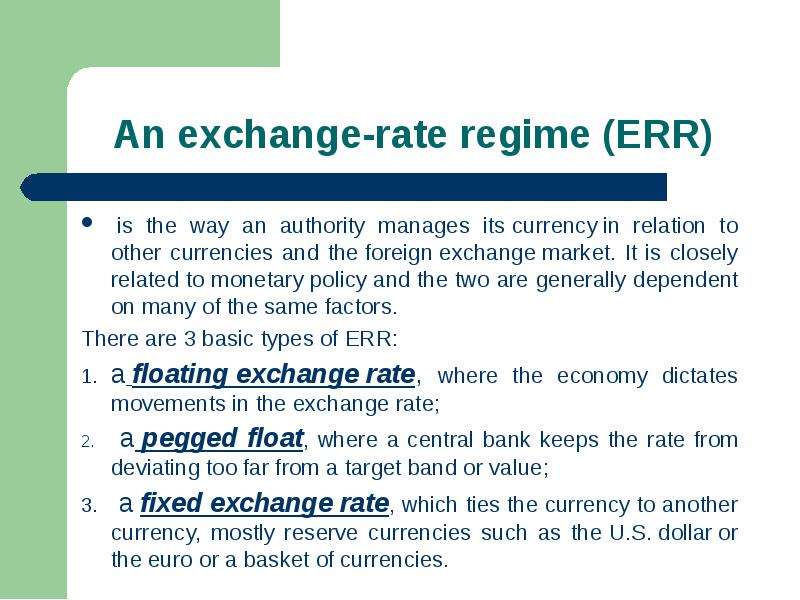
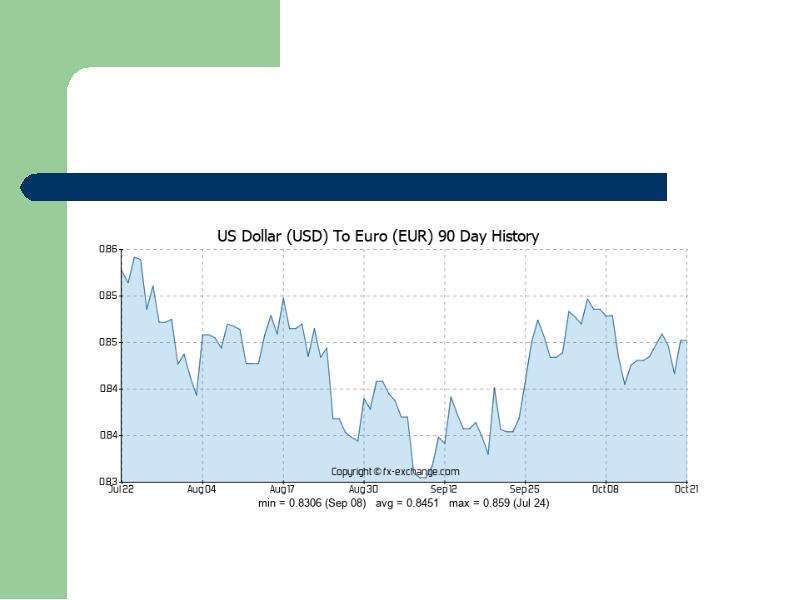
is the way an authority manages its currency in relation to other currencies and the foreign exchange market. It is closely related to monetary policy and the two are generally dependent on many of the same factors. is the way an authority manages its currency in relation to other currencies and the foreign exchange market. It is closely related to monetary policy and the two are generally dependent on many of the same factors. There are 3 basic types of ERR: a floating exchange rate, where the economy dictates movements in the exchange rate; a pegged float, where a central bank keeps the rate from deviating too far from a target band or value; a fixed exchange rate, which ties the currency to another currency, mostly reserve currencies such as the U.S. dollar or the euro or a basket of currencies.

Слайд 53


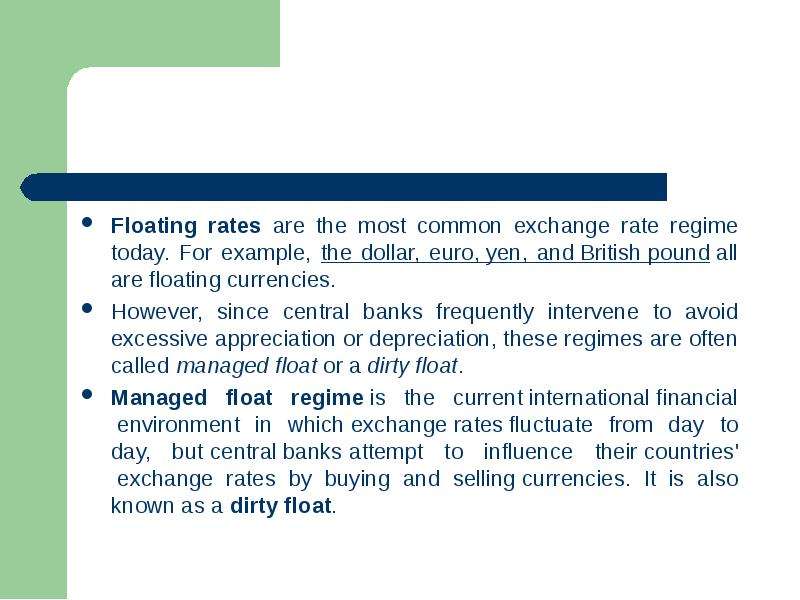
Floating rates are the most common exchange rate regime today. For example, the dollar, euro, yen, and British pound all are floating currencies....
Описание слайда:
Floating rates are the most common exchange rate regime today. For example, the dollar, euro, yen, and British pound all are floating currencies. Floating rates are the most common exchange rate regime today. For example, the dollar, euro, yen, and British pound all are floating currencies. However, since central banks frequently intervene to avoid excessive appreciation or depreciation, these regimes are often called managed float or a dirty float. Managed float regime is the current international financial environment in which exchange rates fluctuate from day to day, but central banks attempt to influence their countries' exchange rates by buying and selling currencies. It is also known as a dirty float.

Слайд 54


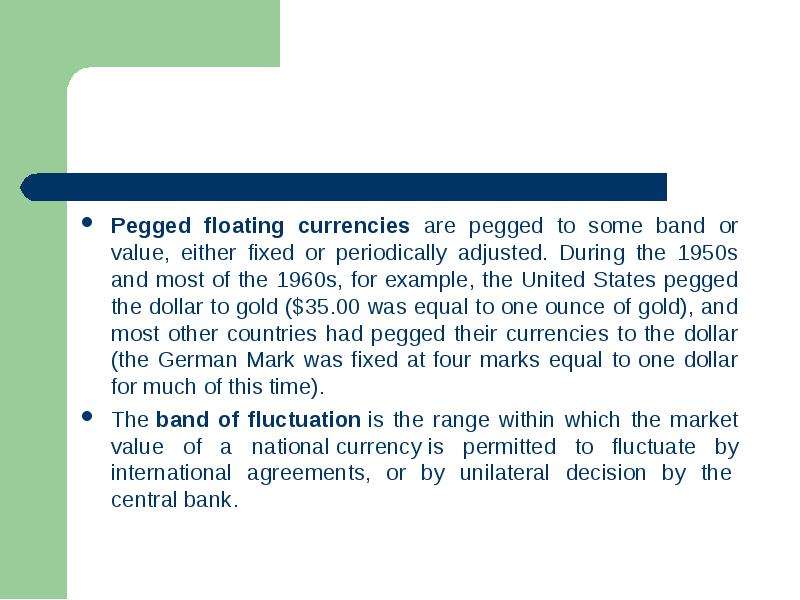
Pegged floating currencies are pegged to some band or value, either fixed or periodically adjusted. During the 1950s and most of the 1960s, for...
Описание слайда:
Pegged floating currencies are pegged to some band or value, either fixed or periodically adjusted. During the 1950s and most of the 1960s, for example, the United States pegged the dollar to gold ($35.00 was equal to one ounce of gold), and most other countries had pegged their currencies to the dollar (the German Mark was fixed at four marks equal to one dollar for much of this time). Pegged floating currencies are pegged to some band or value, either fixed or periodically adjusted. During the 1950s and most of the 1960s, for example, the United States pegged the dollar to gold ($35.00 was equal to one ounce of gold), and most other countries had pegged their currencies to the dollar (the German Mark was fixed at four marks equal to one dollar for much of this time). The band of fluctuation is the range within which the market value of a national currency is permitted to fluctuate by international agreements, or by unilateral decision by the central bank.

Слайд 55


Global economy and World Economic Relations (WER), слайд №55
Описание слайда:

Слайд 56


Global economy and World Economic Relations (WER), слайд №56
Описание слайда:

Слайд 57


Global economy and World Economic Relations (WER), слайд №57
Описание слайда:

Слайд 58


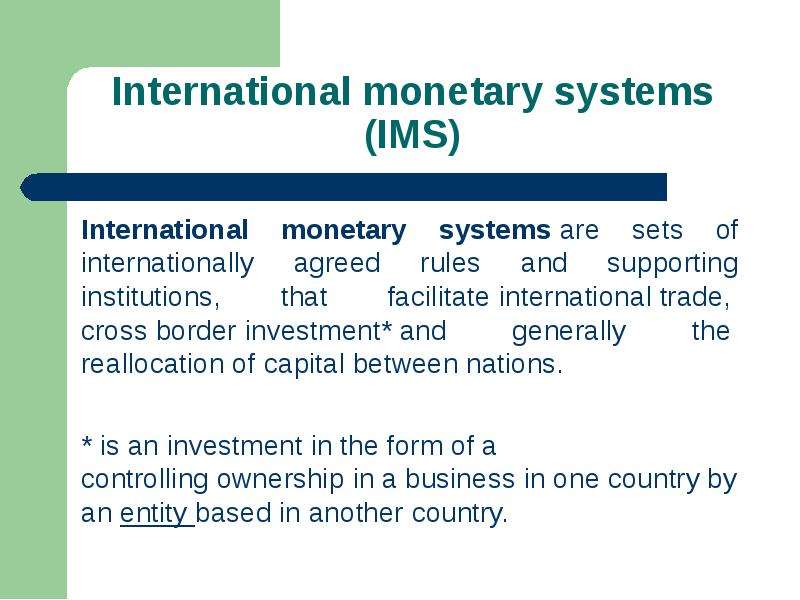
International monetary systems are sets of internationally agreed rules and supporting institutions, that facilitate international trade, cross...
Описание слайда:
International monetary systems are sets of internationally agreed rules and supporting institutions, that facilitate international trade, cross border investment* and generally the reallocation of capital between nations. International monetary systems are sets of internationally agreed rules and supporting institutions, that facilitate international trade, cross border investment* and generally the reallocation of capital between nations. * is an investment in the form of a controlling ownership in a business in one country by an entity based in another country.

Слайд 59


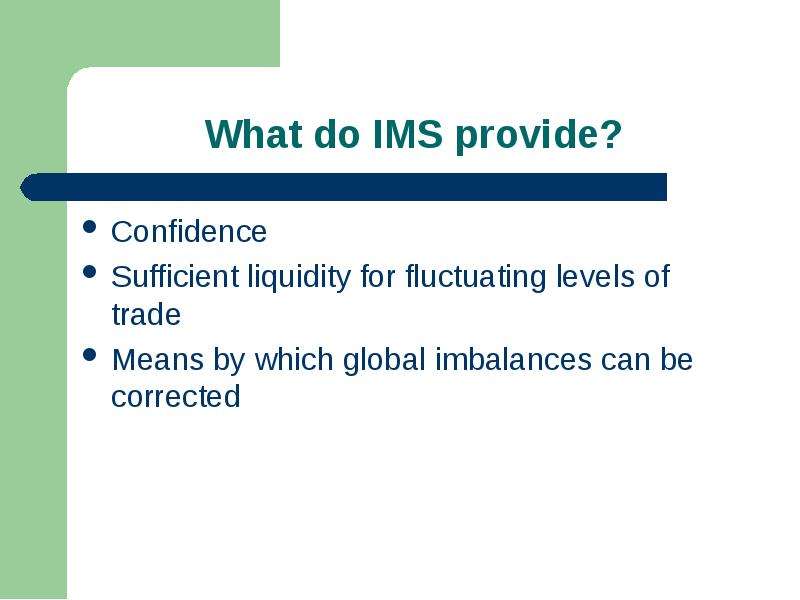
Confidence Confidence Sufficient liquidity for fluctuating levels of trade Means by which global imbalances can be corrected
Описание слайда:
Confidence Confidence Sufficient liquidity for fluctuating levels of trade Means by which global imbalances can be corrected

Слайд 60


Global economy and World Economic Relations (WER), слайд №60
Описание слайда:

Слайд 61


Global economy and World Economic Relations (WER), слайд №61
Описание слайда:

Слайд 62


As for the ruble, in spite of high oil prices it`s under pressure: As for the ruble, in spite of high oil prices it`s under pressure: Low demand for...
Описание слайда:
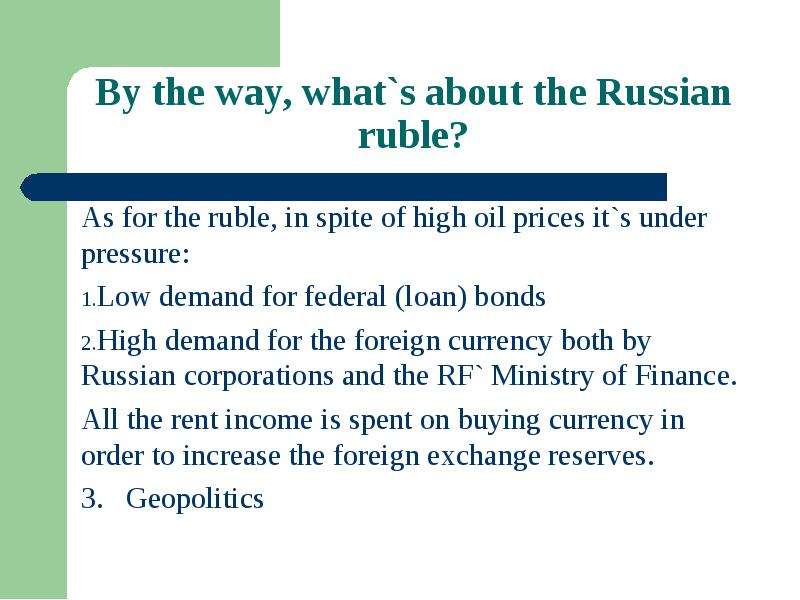
As for the ruble, in spite of high oil prices it`s under pressure: As for the ruble, in spite of high oil prices it`s under pressure: Low demand for federal (loan) bonds High demand for the foreign currency both by Russian corporations and the RF` Ministry of Finance. All the rent income is spent on buying currency in order to increase the foreign exchange reserves. 3. Geopolitics

Слайд 63


Global economy and World Economic Relations (WER), слайд №63
Описание слайда:

Слайд 64


Global economy and World Economic Relations (WER), слайд №64
Описание слайда:

Слайд 65


Their 270,000 foreign affiliates account for most of the world's industrial capacity, technological knowledge, international financial transactions,...
Описание слайда:
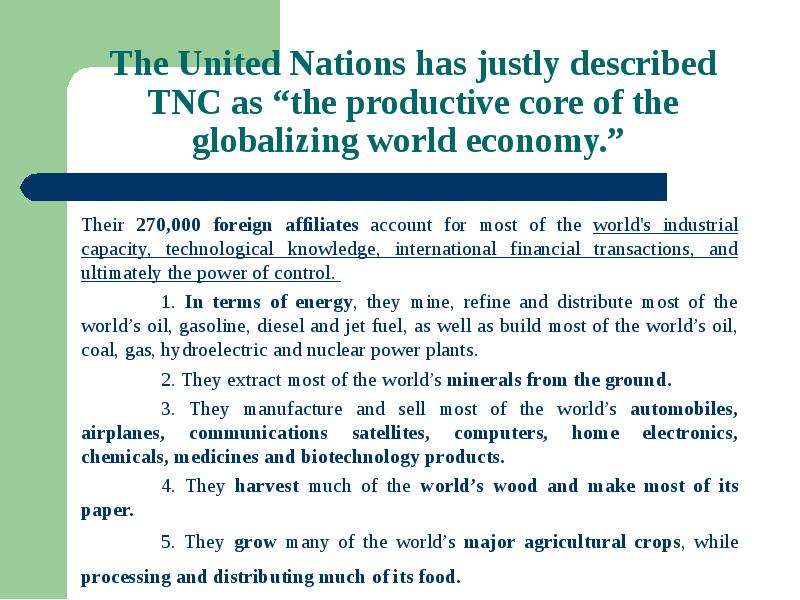
Their 270,000 foreign affiliates account for most of the world's industrial capacity, technological knowledge, international financial transactions, and ultimately the power of control. Their 270,000 foreign affiliates account for most of the world's industrial capacity, technological knowledge, international financial transactions, and ultimately the power of control. 1. In terms of energy, they mine, refine and distribute most of the world’s oil, gasoline, diesel and jet fuel, as well as build most of the world’s oil, coal, gas, hydroelectric and nuclear power plants. 2. They extract most of the world’s minerals from the ground. 3. They manufacture and sell most of the world’s automobiles, airplanes, communications satellites, computers, home electronics, chemicals, medicines and biotechnology products. 4. They harvest much of the world’s wood and make most of its paper. 5. They grow many of the world’s major agricultural crops, while processing and distributing much of its food.

Слайд 66


The globalization of economic activity in general, and the growing role of transnational corporations (TNCs) in particular, have increasingly...
Описание слайда:
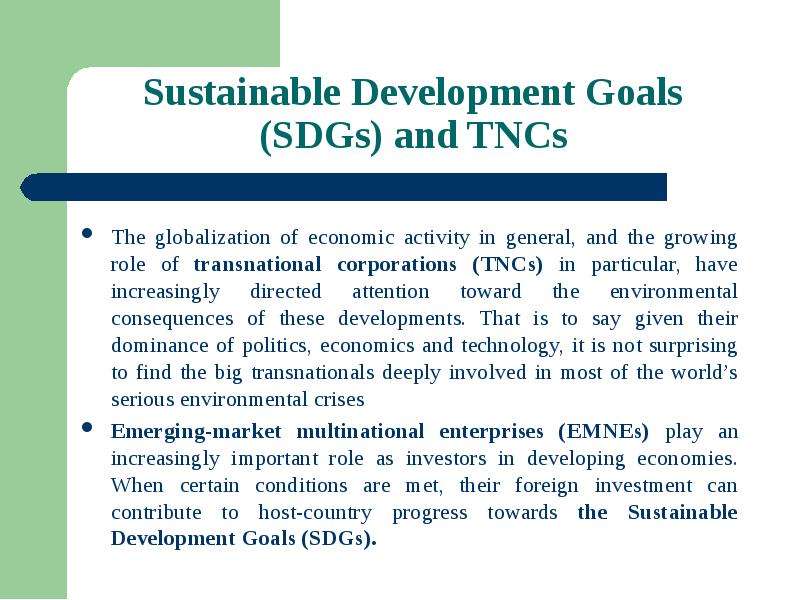
The globalization of economic activity in general, and the growing role of transnational corporations (TNCs) in particular, have increasingly directed attention toward the environmental consequences of these developments. That is to say given their dominance of politics, economics and technology, it is not surprising to find the big transnationals deeply involved in most of the world’s serious environmental crises Emerging-market multinational enterprises (EMNEs) play an increasingly important role as investors in developing economies. When certain conditions are met, their foreign investment can contribute to host-country progress towards the Sustainable Development Goals (SDGs).

Слайд 67


Goal 1: No Poverty Goal 1: No Poverty Goal 2: Zero Hunger Goal 3: Good Health and Well-Being Goal 4: Quality Education Goal 5: Gender Equality Goal...
Описание слайда:
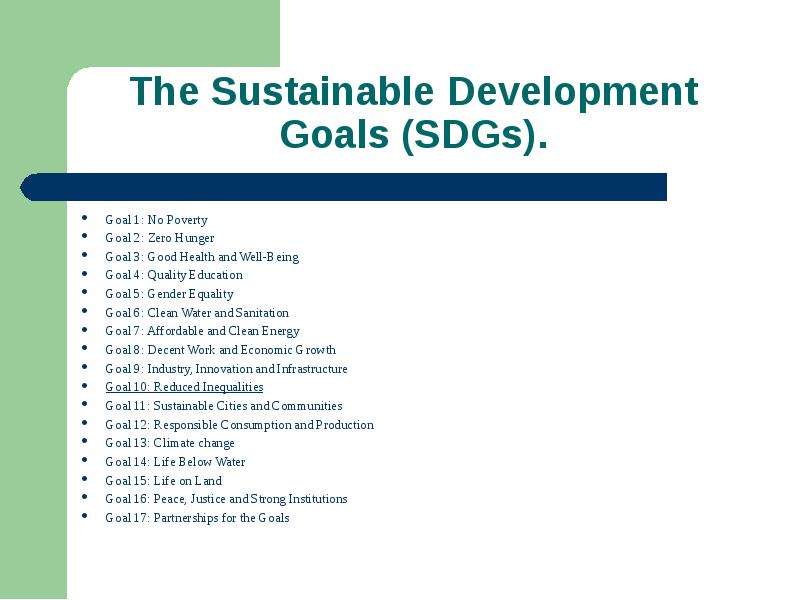
Goal 1: No Poverty Goal 1: No Poverty Goal 2: Zero Hunger Goal 3: Good Health and Well-Being Goal 4: Quality Education Goal 5: Gender Equality Goal 6: Clean Water and Sanitation Goal 7: Affordable and Clean Energy Goal 8: Decent Work and Economic Growth Goal 9: Industry, Innovation and Infrastructure Goal 10: Reduced Inequalities Goal 11: Sustainable Cities and Communities Goal 12: Responsible Consumption and Production Goal 13: Climate change Goal 14: Life Below Water Goal 15: Life on Land Goal 16: Peace, Justice and Strong Institutions Goal 17: Partnerships for the Goals

Слайд 68


Importing and exporting goods and services Importing and exporting goods and services Making significant investments in a foreign country Buying and...
Описание слайда:
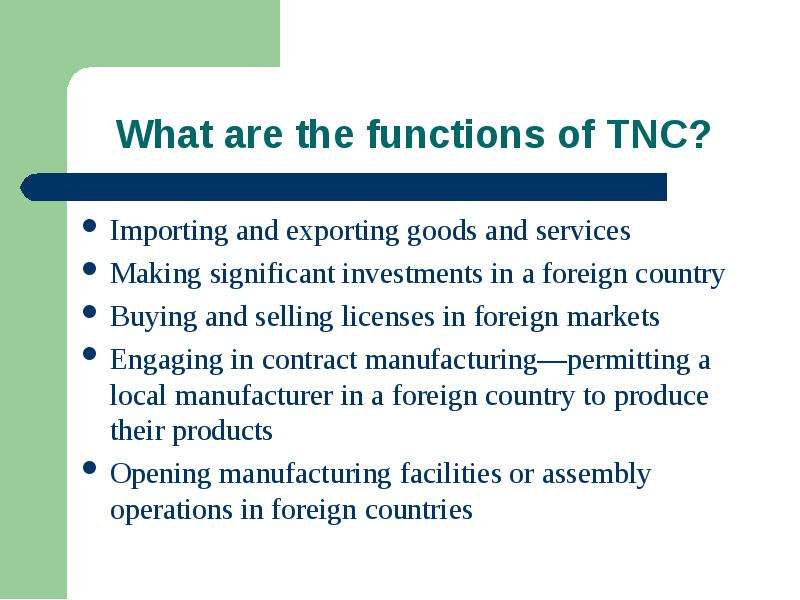
Importing and exporting goods and services Importing and exporting goods and services Making significant investments in a foreign country Buying and selling licenses in foreign markets Engaging in contract manufacturing—permitting a local manufacturer in a foreign country to produce their products Opening manufacturing facilities or assembly operations in foreign countries

Слайд 69


1. The Market Dominance of Multinational Corporations - The market dominance of multinational corporations makes it hard for the local small firms to...
Описание слайда:
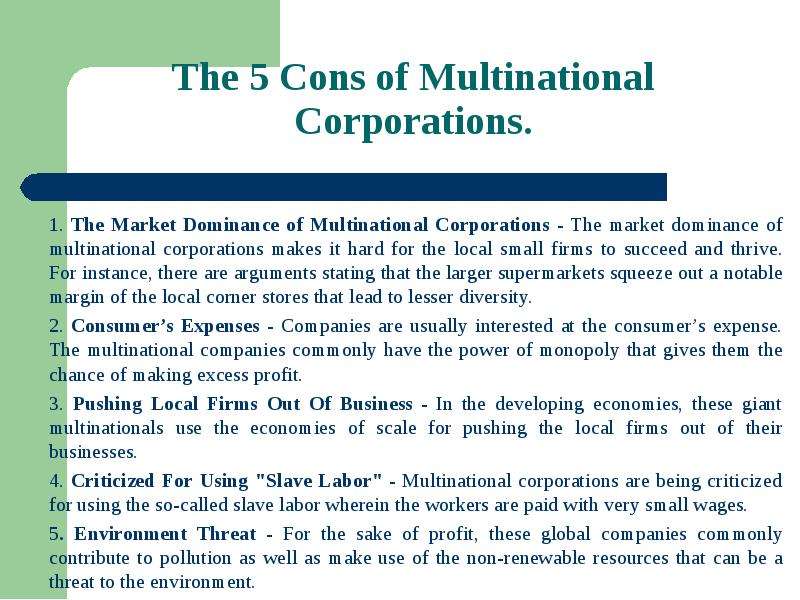
1. The Market Dominance of Multinational Corporations - The market dominance of multinational corporations makes it hard for the local small firms to succeed and thrive. For instance, there are arguments stating that the larger supermarkets squeeze out a notable margin of the local corner stores that lead to lesser diversity. 1. The Market Dominance of Multinational Corporations - The market dominance of multinational corporations makes it hard for the local small firms to succeed and thrive. For instance, there are arguments stating that the larger supermarkets squeeze out a notable margin of the local corner stores that lead to lesser diversity. 2. Consumer’s Expenses - Companies are usually interested at the consumer’s expense. The multinational companies commonly have the power of monopoly that gives them the chance of making excess profit. 3. Pushing Local Firms Out Of Business - In the developing economies, these giant multinationals use the economies of scale for pushing the local firms out of their businesses. 4. Criticized For Using "Slave Labor" - Multinational corporations are being criticized for using the so-called slave labor wherein the workers are paid with very small wages. 5. Environment Threat - For the sake of profit, these global companies commonly contribute to pollution as well as make use of the non-renewable resources that can be a threat to the environment.

Слайд 70


Global economy and World Economic Relations (WER), слайд №70
Описание слайда:


Похожие презентации
Mypresentation.ru
Загрузить презентацию