🗊 Презентация Install Apache Cassandra on Ubuntu. Work with Cassandra and Python

Нажмите для полного просмотра!
Install Apache Cassandra on Ubuntu. Work with Cassandra and Python, слайд №1 Install Apache Cassandra on Ubuntu. Work with Cassandra and Python, слайд №2 Install Apache Cassandra on Ubuntu. Work with Cassandra and Python, слайд №3 Install Apache Cassandra on Ubuntu. Work with Cassandra and Python, слайд №4 Install Apache Cassandra on Ubuntu. Work with Cassandra and Python, слайд №5 Install Apache Cassandra on Ubuntu. Work with Cassandra and Python, слайд №6 Install Apache Cassandra on Ubuntu. Work with Cassandra and Python, слайд №7 Install Apache Cassandra on Ubuntu. Work with Cassandra and Python, слайд №8 Install Apache Cassandra on Ubuntu. Work with Cassandra and Python, слайд №9 Install Apache Cassandra on Ubuntu. Work with Cassandra and Python, слайд №10 Install Apache Cassandra on Ubuntu. Work with Cassandra and Python, слайд №11 Install Apache Cassandra on Ubuntu. Work with Cassandra and Python, слайд №12 Install Apache Cassandra on Ubuntu. Work with Cassandra and Python, слайд №13 Install Apache Cassandra on Ubuntu. Work with Cassandra and Python, слайд №14 Install Apache Cassandra on Ubuntu. Work with Cassandra and Python, слайд №15 Install Apache Cassandra on Ubuntu. Work with Cassandra and Python, слайд №16 Install Apache Cassandra on Ubuntu. Work with Cassandra and Python, слайд №17 Install Apache Cassandra on Ubuntu. Work with Cassandra and Python, слайд №18 Install Apache Cassandra on Ubuntu. Work with Cassandra and Python, слайд №19 Install Apache Cassandra on Ubuntu. Work with Cassandra and Python, слайд №20 Install Apache Cassandra on Ubuntu. Work with Cassandra and Python, слайд №21 Install Apache Cassandra on Ubuntu. Work with Cassandra and Python, слайд №22 Install Apache Cassandra on Ubuntu. Work with Cassandra and Python, слайд №23 Install Apache Cassandra on Ubuntu. Work with Cassandra and Python, слайд №24 Install Apache Cassandra on Ubuntu. Work with Cassandra and Python, слайд №25 Install Apache Cassandra on Ubuntu. Work with Cassandra and Python, слайд №26 Install Apache Cassandra on Ubuntu. Work with Cassandra and Python, слайд №27 Install Apache Cassandra on Ubuntu. Work with Cassandra and Python, слайд №28 Install Apache Cassandra on Ubuntu. Work with Cassandra and Python, слайд №29 Install Apache Cassandra on Ubuntu. Work with Cassandra and Python, слайд №30 Install Apache Cassandra on Ubuntu. Work with Cassandra and Python, слайд №31 Install Apache Cassandra on Ubuntu. Work with Cassandra and Python, слайд №32 Install Apache Cassandra on Ubuntu. Work with Cassandra and Python, слайд №33

Вы можете ознакомиться и скачать презентацию на тему Install Apache Cassandra on Ubuntu. Work with Cassandra and Python. Доклад-сообщение содержит 33 слайдов. Презентации для любого класса можно скачать бесплатно. Если материал и наш сайт презентаций Mypresentation Вам понравились – поделитесь им с друзьями с помощью социальных кнопок и добавьте в закладки в своем браузере.

Слайды и текст этой презентации


Слайд 1


Apache Cassandra
Описание слайда:

Apache Cassandra

Слайд 2


Week plan 1. What is Cassandra? 2. Install Apache Cassandra on Ubuntu 3. Work with Cassandra and Python
Описание слайда:

Week plan 1. What is Cassandra? 2. Install Apache Cassandra on Ubuntu 3. Work with Cassandra and Python

Слайд 3


Tutorial
Описание слайда:

Tutorial

Слайд 4


What is Cassandra? Apache Cassandra is a top level Apache project born at Facebook and built on Amazon’s Dynamo and Google’s BigTable, is a...
Описание слайда:

What is Cassandra? Apache Cassandra is a top level Apache project born at Facebook and built on Amazon’s Dynamo and Google’s BigTable, is a distributed database for managing large amounts of structured data across many commodity servers, while providing highly available service and no single point of failure.

Слайд 5


What is Cassandra? Cassandra’s architecture is responsible for its ability to scale, perform, and offer continuous uptime. Rather than using a legacy...
Описание слайда:
What is Cassandra? Cassandra’s architecture is responsible for its ability to scale, perform, and offer continuous uptime. Rather than using a legacy master-slave or a manual and difficult-to-maintain sharded architecture, Cassandra has a masterless “ring” design that is elegant, easy to setup, and easy to maintain.

Слайд 6


What is Cassandra? In Cassandra, all nodes are equal, which means no master node, no master-slave relationships between nodes, no sharded system....
Описание слайда:
What is Cassandra? In Cassandra, all nodes are equal, which means no master node, no master-slave relationships between nodes, no sharded system. Cassandra’s scalable architecture allows it to handle large amounts of data, thousands of user, and a great number of operations per second with ease. Even across multiple data storages. Absence of master nodes and shards makes Cassandra resilient for node failures (no single point of weakness) and enables small uptime.

Слайд 7


Features of Cassandra Elastic scalability - add more nodes to accommodate more clients for data easily. Always on architecture - Business-critical...
Описание слайда:
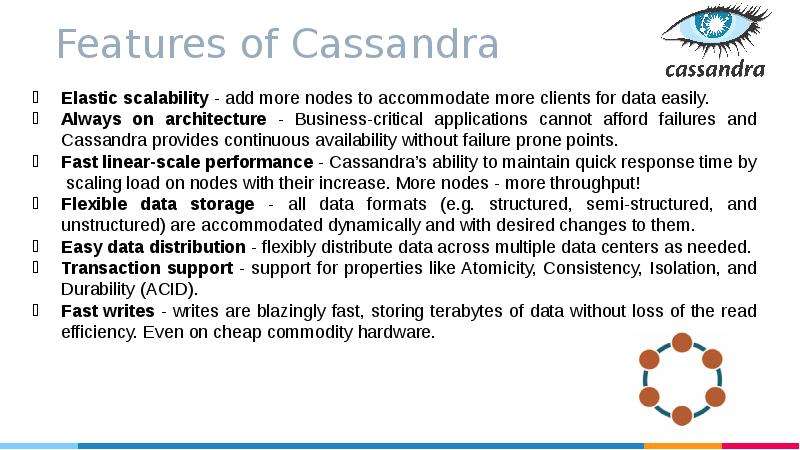
Features of Cassandra Elastic scalability - add more nodes to accommodate more clients for data easily. Always on architecture - Business-critical applications cannot afford failures and Cassandra provides continuous availability without failure prone points. Fast linear-scale performance - Cassandra’s ability to maintain quick response time by scaling load on nodes with their increase. More nodes - more throughput! Flexible data storage - all data formats (e.g. structured, semi-structured, and unstructured) are accommodated dynamically and with desired changes to them. Easy data distribution - flexibly distribute data across multiple data centers as needed. Transaction support - support for properties like Atomicity, Consistency, Isolation, and Durability (ACID). Fast writes - writes are blazingly fast, storing terabytes of data without loss of the read efficiency. Even on cheap commodity hardware.

Слайд 8


Disadvantages With all its shiny parts, Cassandra still has some let downs: A range scan implementation is far from perfect. A lot of adjustments are...
Описание слайда:
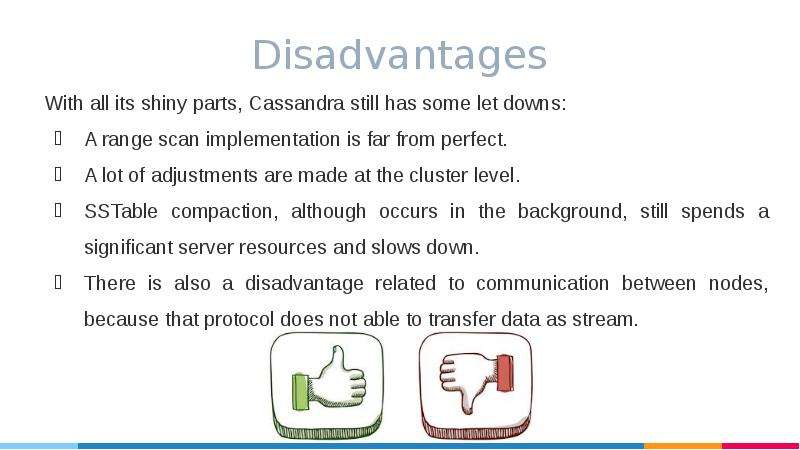
Disadvantages With all its shiny parts, Cassandra still has some let downs: A range scan implementation is far from perfect. A lot of adjustments are made at the cluster level. SSTable compaction, although occurs in the background, still spends a significant server resources and slows down. There is also a disadvantage related to communication between nodes, because that protocol does not able to transfer data as stream.

Слайд 9


Data Replication in Cassandra In Cassandra, replicas for a given piece of data are distributed on one or more of the nodes in a cluster. If it is...
Описание слайда:
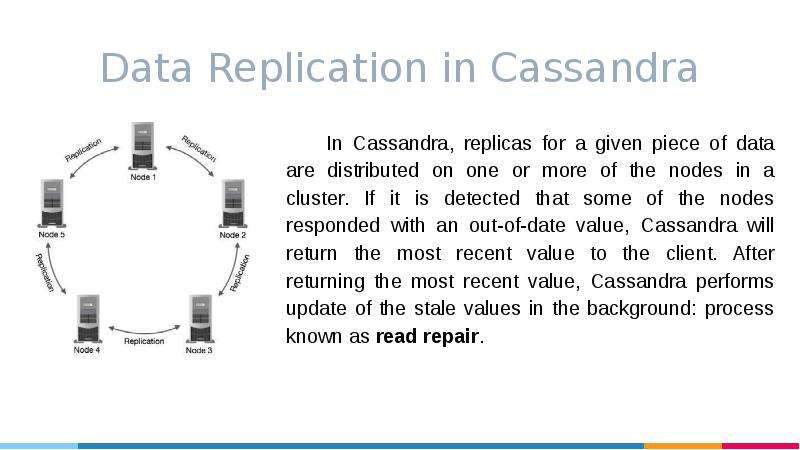
Data Replication in Cassandra In Cassandra, replicas for a given piece of data are distributed on one or more of the nodes in a cluster. If it is detected that some of the nodes responded with an out-of-date value, Cassandra will return the most recent value to the client. After returning the most recent value, Cassandra performs update of the stale values in the background: process known as read repair.

Слайд 10


Components of Cassandra Node − It is the place where data is stored, single machine. Data center − It is a collection of related nodes. Cluster − A...
Описание слайда:
Components of Cassandra Node − It is the place where data is stored, single machine. Data center − It is a collection of related nodes. Cluster − A cluster is a component that contains one or more data centers. Commit log − The commit log is a crash-recovery mechanism in Cassandra. Every write operation is written to the commit log. Mem-table − A mem-table is a memory-resident data structure. After commit log, the data will be written to the mem-table. Sometimes, for a single-column family, there will be multiple mem-tables. SSTable − It is a disk file to which the data is flushed from the mem-table when its contents reach a threshold value. Bloom filter − These are nothing but quick, nondeterministic, algorithms for testing whether an element is a member of a set. It is a special kind of cache. Bloom filters are accessed after every query.

Слайд 11


Cassandra Architecture
Описание слайда:
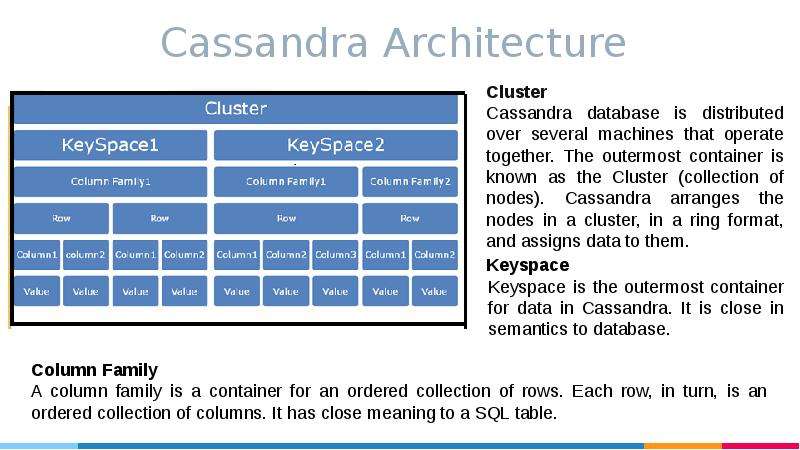
Cassandra Architecture

Слайд 12


Cassandra Query Language The Cassandra Query Language (CQL) is the primary language for communicating with the Cassandra database. CQL is...
Описание слайда:
Cassandra Query Language The Cassandra Query Language (CQL) is the primary language for communicating with the Cassandra database. CQL is purposefully similar to Structured Query Language (SQL) used in relational databases like MySQL and Postgres. This similarity lowers the barrier of entry for users familiar with relational databases. Many queries are very similar in these two. In fact, a lot of basic things are even exactly the same. But Cassandra is a non-relational database, and so uses different concepts to store and retrieve data. Simplistically, a Cassandra keyspace is a SQL database, and a Cassandra column family is a SQL table (CQL allows you to interchange the words “TABLE” and “COLUMNFAMILY” for convenience).

Слайд 13


Cassandra Operations Let’s find out how querying in Cassandra works.
Описание слайда:
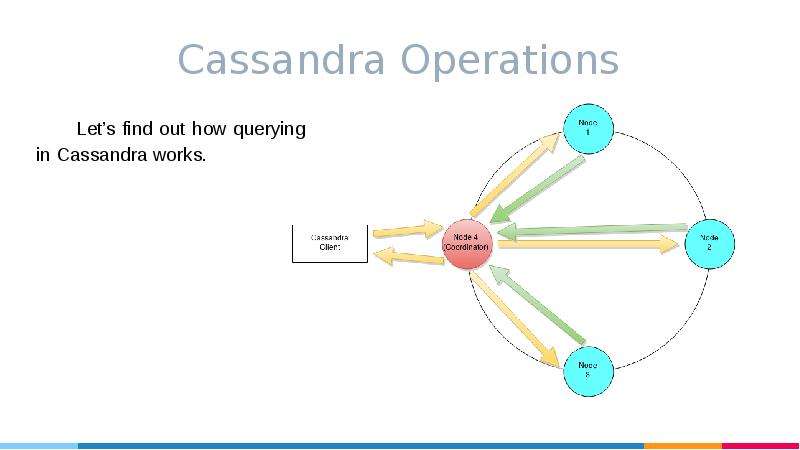
Cassandra Operations Let’s find out how querying in Cassandra works.

Слайд 14


Write Operation When write request comes to the node, first of all, it logs to the commit log. Then, Cassandra writes the data in the memtable....
Описание слайда:
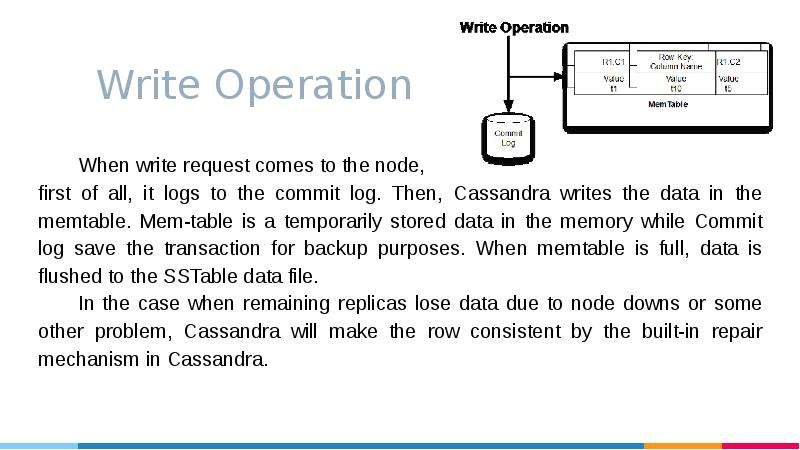
Write Operation When write request comes to the node, first of all, it logs to the commit log. Then, Cassandra writes the data in the memtable. Mem-table is a temporarily stored data in the memory while Commit log save the transaction for backup purposes. When memtable is full, data is flushed to the SSTable data file. In the case when remaining replicas lose data due to node downs or some other problem, Cassandra will make the row consistent by the built-in repair mechanism in Cassandra.

Слайд 15


Read Operation There are three types of read requests that are sent to replicas by a coordinator node. Direct request Digest request Read repair...
Описание слайда:
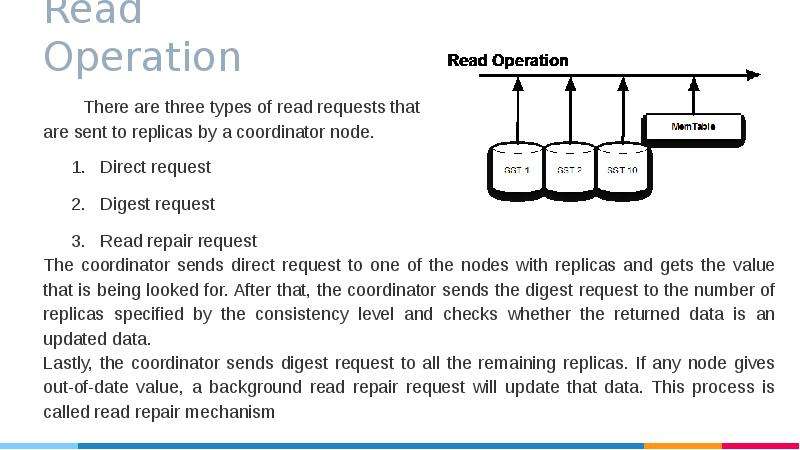
Read Operation There are three types of read requests that are sent to replicas by a coordinator node. Direct request Digest request Read repair request The coordinator sends direct request to one of the nodes with replicas and gets the value that is being looked for. After that, the coordinator sends the digest request to the number of replicas specified by the consistency level and checks whether the returned data is an updated data. Lastly, the coordinator sends digest request to all the remaining replicas. If any node gives out-of-date value, a background read repair request will update that data. This process is called read repair mechanism

Слайд 16


Install Java on Ubuntu Before installing Cassandra, make sure that Java is already installed on your computer. To make the Oracle JRE package...
Описание слайда:
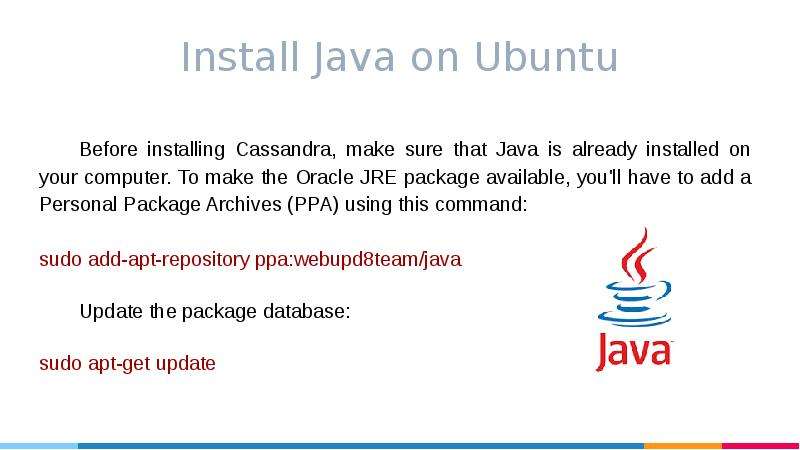
Install Java on Ubuntu Before installing Cassandra, make sure that Java is already installed on your computer. To make the Oracle JRE package available, you'll have to add a Personal Package Archives (PPA) using this command: sudo add-apt-repository ppa:webupd8team/java Update the package database: sudo apt-get update

Слайд 17


Install Java on Ubuntu Then, install the Oracle JRE. Installing this particular package not only installs it but also makes it the default JRE. When...
Описание слайда:
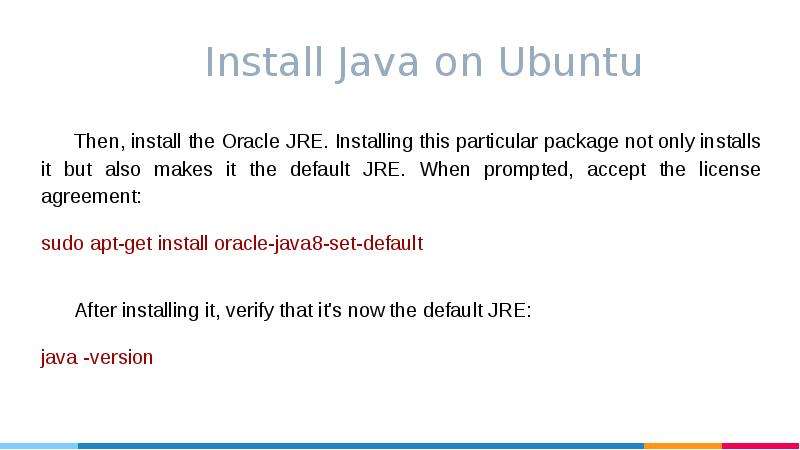
Install Java on Ubuntu Then, install the Oracle JRE. Installing this particular package not only installs it but also makes it the default JRE. When prompted, accept the license agreement: sudo apt-get install oracle-java8-set-default After installing it, verify that it's now the default JRE: java -version

Слайд 18


Install Apache Cassandra on Ubuntu We will use DataStax Community repository with a few simple steps to install Cassandra: 1. Add the DataStax...
Описание слайда:
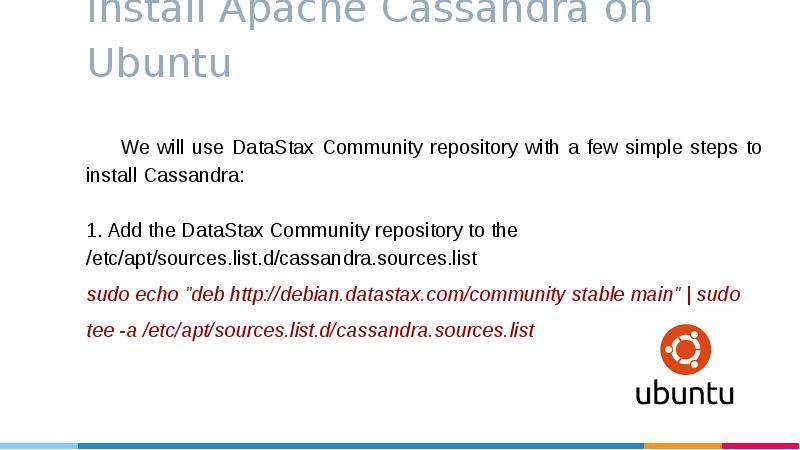
Install Apache Cassandra on Ubuntu We will use DataStax Community repository with a few simple steps to install Cassandra: 1. Add the DataStax Community repository to the /etc/apt/sources.list.d/cassandra.sources.list sudo echo "deb stable main" | sudo tee -a /etc/apt/sources.list.d/cassandra.sources.list

Слайд 19


Install Apache Cassandra on Ubuntu 2. Add the DataStax repository key to your aptitude trusted keys sudo curl -L | sudo apt-key add - 3. Install the...
Описание слайда:
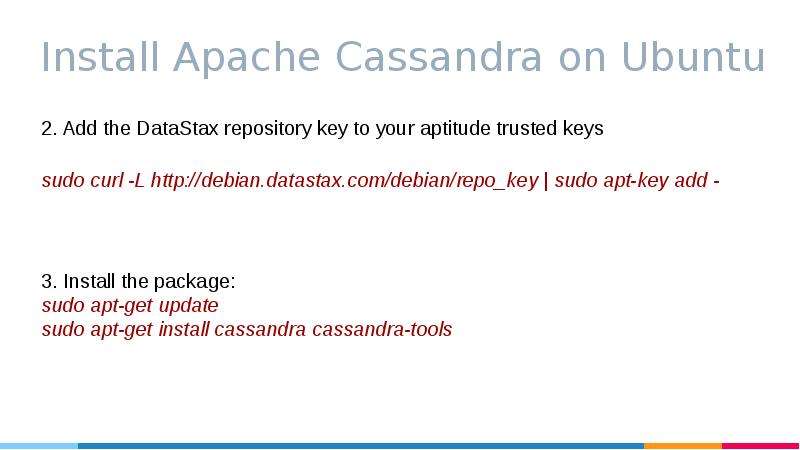
Install Apache Cassandra on Ubuntu 2. Add the DataStax repository key to your aptitude trusted keys sudo curl -L | sudo apt-key add - 3. Install the package: sudo apt-get update sudo apt-get install cassandra cassandra-tools

Слайд 20


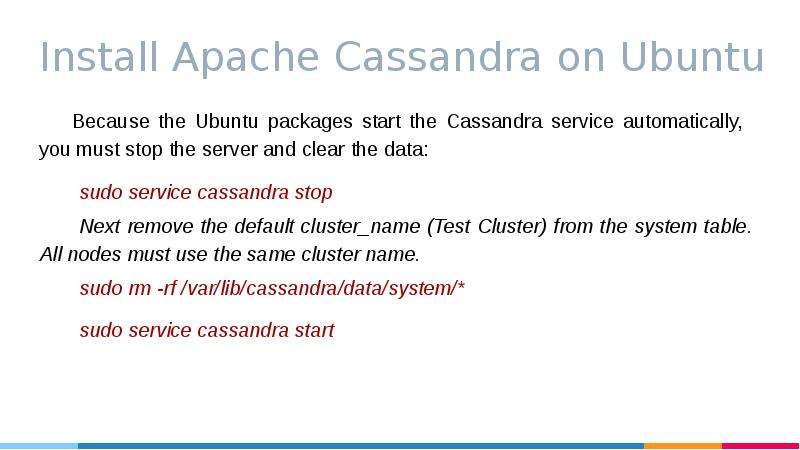
Install Apache Cassandra on Ubuntu Because the Ubuntu packages start the Cassandra service automatically, you must stop the server and clear the...
Описание слайда:
Install Apache Cassandra on Ubuntu Because the Ubuntu packages start the Cassandra service automatically, you must stop the server and clear the data: sudo service cassandra stop Next remove the default cluster_name (Test Cluster) from the system table. All nodes must use the same cluster name. sudo rm -rf /var/lib/cassandra/data/system/* sudo service cassandra start

Слайд 21


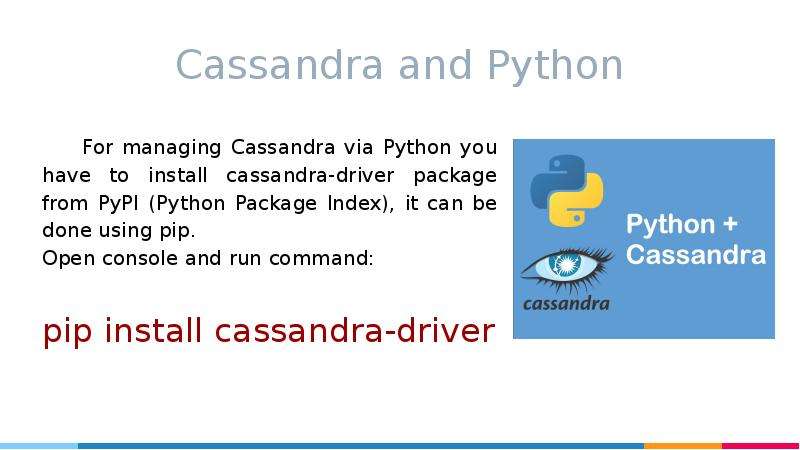
Cassandra and Python For managing Cassandra via Python you have to install cassandra-driver package from PyPI (Python Package Index), it can be done...
Описание слайда:
Cassandra and Python For managing Cassandra via Python you have to install cassandra-driver package from PyPI (Python Package Index), it can be done using pip. Open console and run command: pip install cassandra-driver

Слайд 22


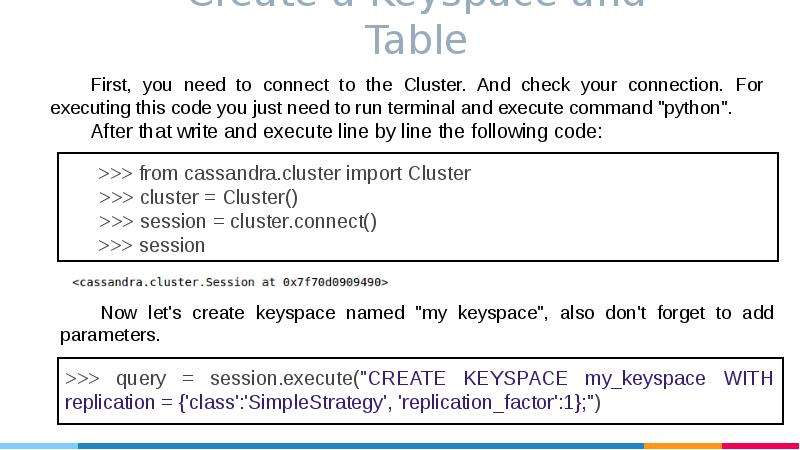
Create a Keyspace and Table
Описание слайда:
Create a Keyspace and Table

Слайд 23


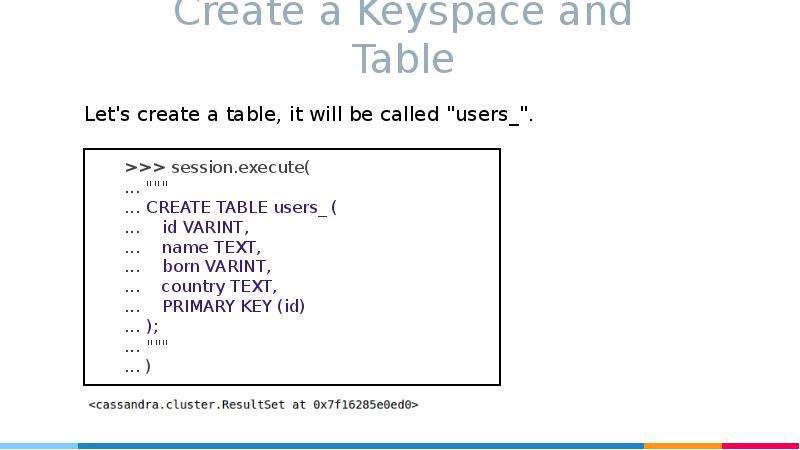
Create a Keyspace and Table Let's create a table, it will be called "users_".
Описание слайда:
Create a Keyspace and Table Let's create a table, it will be called "users_".

Слайд 24


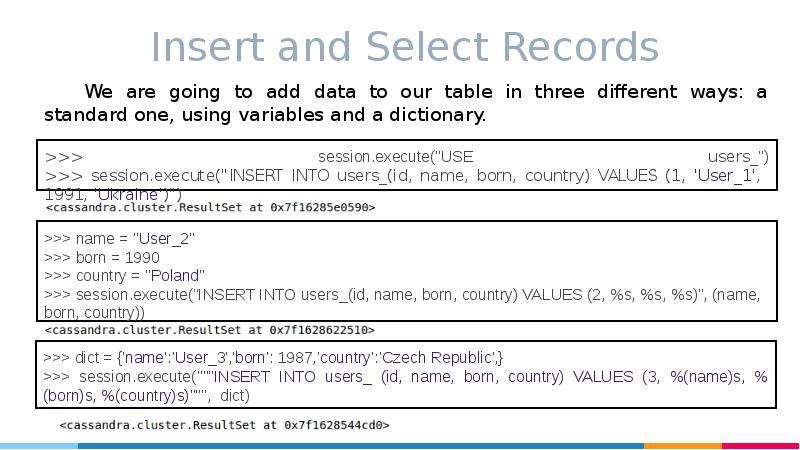
Insert and Select Records We are going to add data to our table in three different ways: a standard one, using variables and a dictionary.
Описание слайда:
Insert and Select Records We are going to add data to our table in three different ways: a standard one, using variables and a dictionary.

Слайд 25


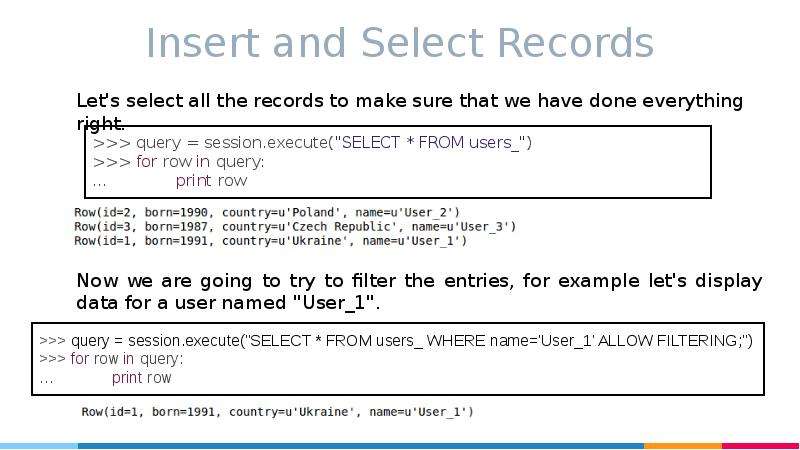
Insert and Select Records Let's select all the records to make sure that we have done everything right.
Описание слайда:
Insert and Select Records Let's select all the records to make sure that we have done everything right.

Слайд 26


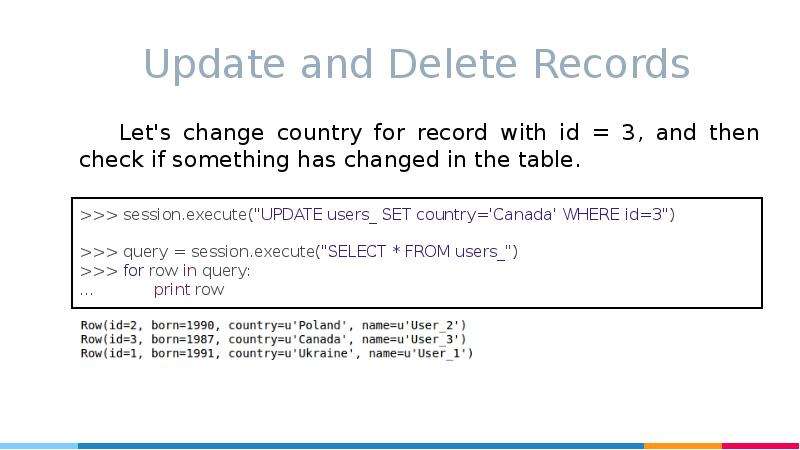
Update and Delete Records Let's change country for record with id = 3, and then check if something has changed in the table.
Описание слайда:
Update and Delete Records Let's change country for record with id = 3, and then check if something has changed in the table.

Слайд 27


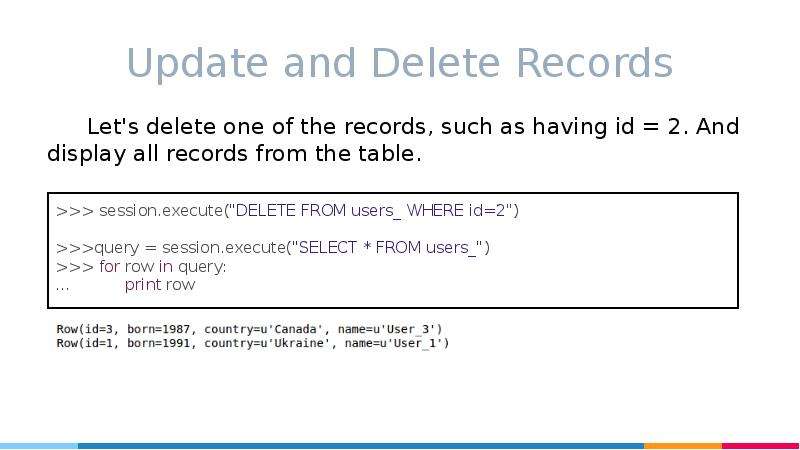
Update and Delete Records Let's delete one of the records, such as having id = 2. And display all records from the table.
Описание слайда:
Update and Delete Records Let's delete one of the records, such as having id = 2. And display all records from the table.

Слайд 28


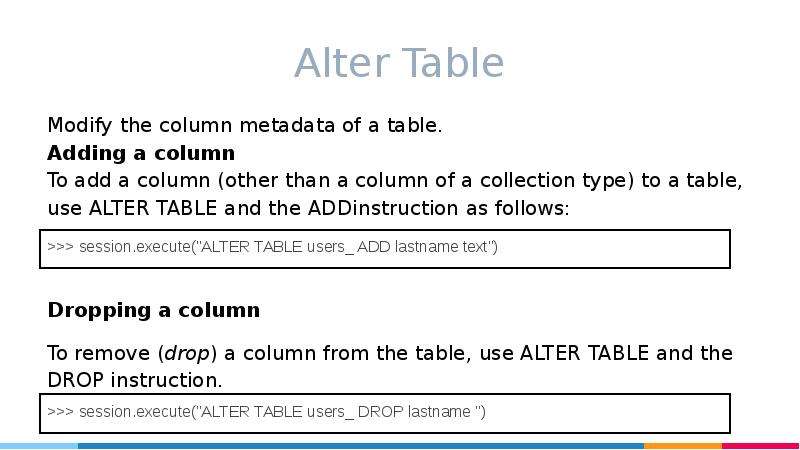
Alter Table Modify the column metadata of a table. Adding a column To add a column (other than a column of a collection type) to a table, use ALTER...
Описание слайда:
Alter Table Modify the column metadata of a table. Adding a column To add a column (other than a column of a collection type) to a table, use ALTER TABLE and the ADDinstruction as follows: Dropping a column To remove (drop) a column from the table, use ALTER TABLE and the DROP instruction.

Слайд 29


Exercises
Описание слайда:
Exercises

Слайд 30


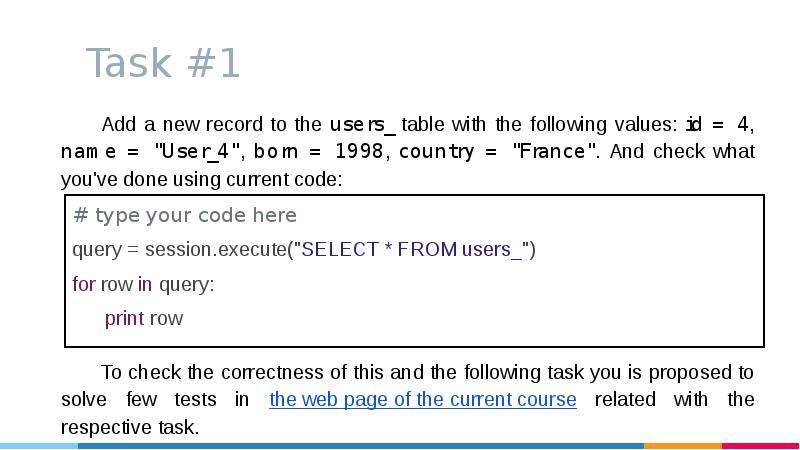
Task #1 Add a new record to the users_ table with the following values: id = 4, name = "User_4", born = 1998, country = "France"....
Описание слайда:
Task #1 Add a new record to the users_ table with the following values: id = 4, name = "User_4", born = 1998, country = "France". And check what you've done using current code: To check the correctness of this and the following task you is proposed to solve few tests in the web page of the current course related with the respective task.

Слайд 31


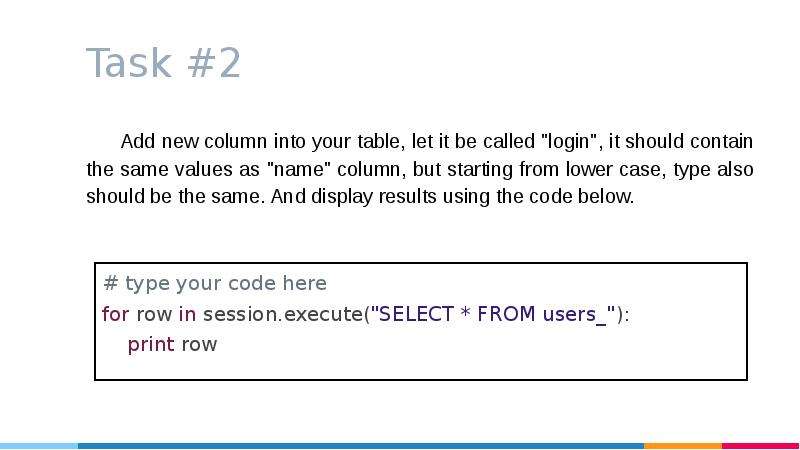
Task #2 Add new column into your table, let it be called "login", it should contain the same values as "name" column, but...
Описание слайда:
Task #2 Add new column into your table, let it be called "login", it should contain the same values as "name" column, but starting from lower case, type also should be the same. And display results using the code below.

Слайд 32


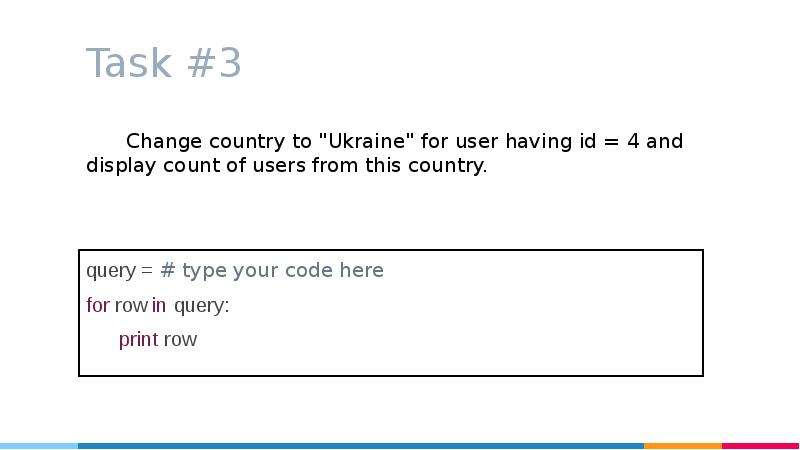
Task #3 Change country to "Ukraine" for user having id = 4 and display count of users from this country.
Описание слайда:
Task #3 Change country to "Ukraine" for user having id = 4 and display count of users from this country.

Слайд 33


Thank for your attention
Описание слайда:
Thank for your attention


Похожие презентации
Mypresentation.ru
Загрузить презентацию