🗊 Презентация Scala. Java to Scala

Нажмите для полного просмотра!
Scala. Java to Scala, слайд №1 Scala. Java to Scala, слайд №2 Scala. Java to Scala, слайд №3 Scala. Java to Scala, слайд №4 Scala. Java to Scala, слайд №5 Scala. Java to Scala, слайд №6 Scala. Java to Scala, слайд №7 Scala. Java to Scala, слайд №8 Scala. Java to Scala, слайд №9 Scala. Java to Scala, слайд №10 Scala. Java to Scala, слайд №11 Scala. Java to Scala, слайд №12 Scala. Java to Scala, слайд №13 Scala. Java to Scala, слайд №14 Scala. Java to Scala, слайд №15 Scala. Java to Scala, слайд №16 Scala. Java to Scala, слайд №17 Scala. Java to Scala, слайд №18 Scala. Java to Scala, слайд №19 Scala. Java to Scala, слайд №20 Scala. Java to Scala, слайд №21 Scala. Java to Scala, слайд №22 Scala. Java to Scala, слайд №23 Scala. Java to Scala, слайд №24 Scala. Java to Scala, слайд №25 Scala. Java to Scala, слайд №26 Scala. Java to Scala, слайд №27 Scala. Java to Scala, слайд №28 Scala. Java to Scala, слайд №29 Scala. Java to Scala, слайд №30 Scala. Java to Scala, слайд №31 Scala. Java to Scala, слайд №32 Scala. Java to Scala, слайд №33 Scala. Java to Scala, слайд №34

Содержание
Вы можете ознакомиться и скачать презентацию на тему Scala. Java to Scala. Доклад-сообщение содержит 34 слайдов. Презентации для любого класса можно скачать бесплатно. Если материал и наш сайт презентаций Mypresentation Вам понравились – поделитесь им с друзьями с помощью социальных кнопок и добавьте в закладки в своем браузере.
Слайды и текст этой презентации


Слайд 1


Java to Scala
Описание слайда:
Java to Scala

Слайд 2


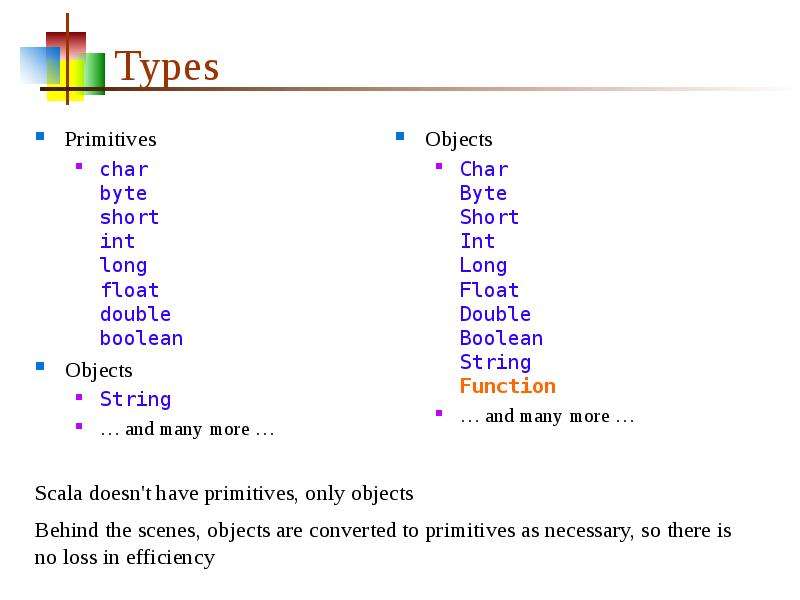
Types Primitives char byte short int long float double boolean Objects String … and many more …
Описание слайда:
Types Primitives char byte short int long float double boolean Objects String … and many more …

Слайд 3


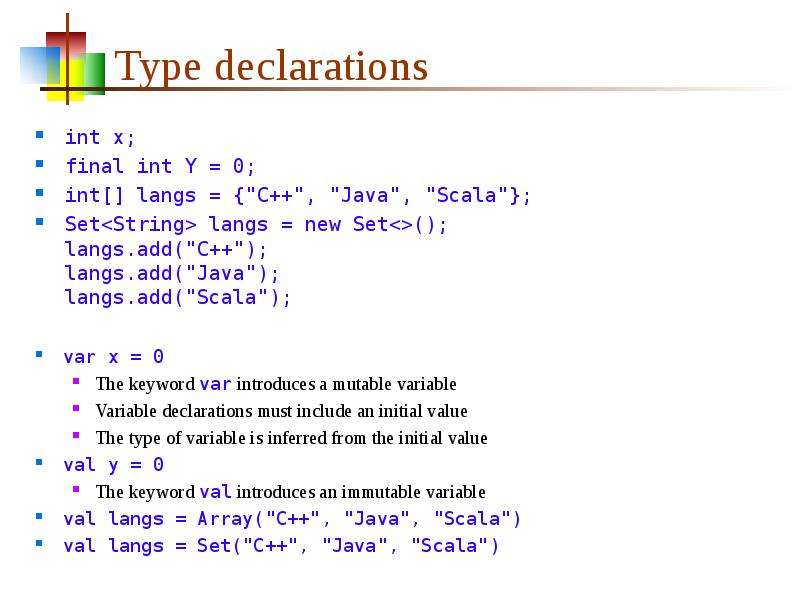
Type declarations int x; final int Y = 0; int[] langs = {"C++", "Java", "Scala"}; Set langs = new Set();...
Описание слайда:
Type declarations int x; final int Y = 0; int[] langs = {"C++", "Java", "Scala"}; Set langs = new Set(); langs.add("C++"); langs.add("Java"); langs.add("Scala");

Слайд 4


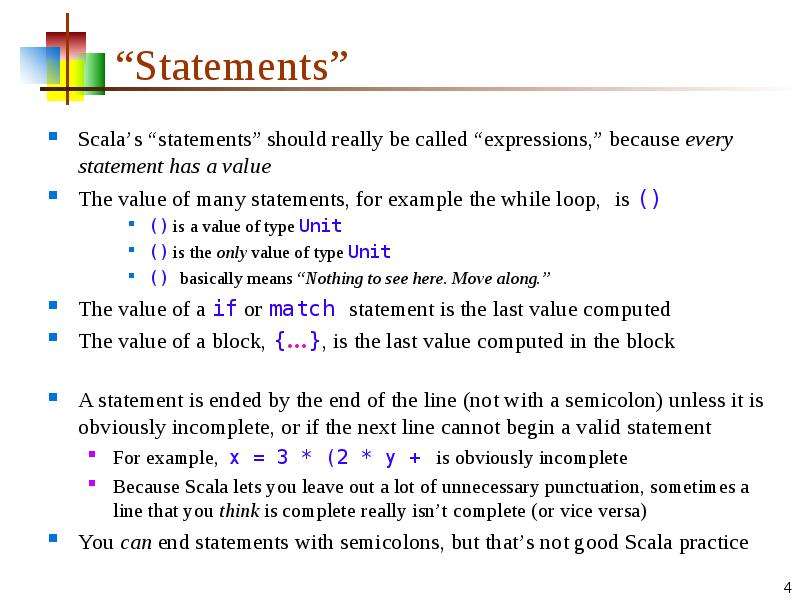
“Statements” Scala’s “statements” should really be called “expressions,” because every statement has a value The value of many statements, for...
Описание слайда:
“Statements” Scala’s “statements” should really be called “expressions,” because every statement has a value The value of many statements, for example the while loop, is () () is a value of type Unit () is the only value of type Unit () basically means “Nothing to see here. Move along.” The value of a if or match statement is the last value computed The value of a block, {…}, is the last value computed in the block A statement is ended by the end of the line (not with a semicolon) unless it is obviously incomplete, or if the next line cannot begin a valid statement For example, x = 3 * (2 * y + is obviously incomplete Because Scala lets you leave out a lot of unnecessary punctuation, sometimes a line that you think is complete really isn’t complete (or vice versa) You can end statements with semicolons, but that’s not good Scala practice

Слайд 5


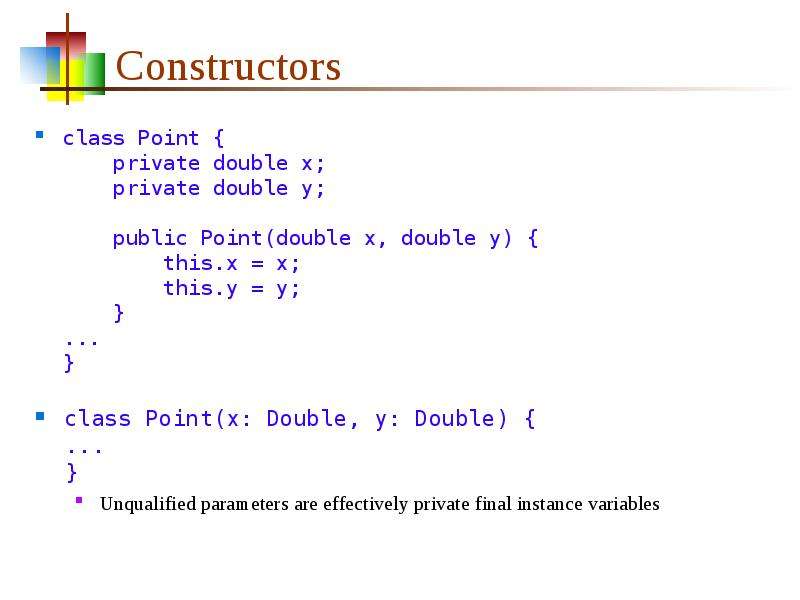
Constructors class Point { private double x; private double y; public Point(double x, double y) { this.x = x; this.y = y; } ... }
Описание слайда:
Constructors class Point { private double x; private double y; public Point(double x, double y) { this.x = x; this.y = y; } ... }

Слайд 6


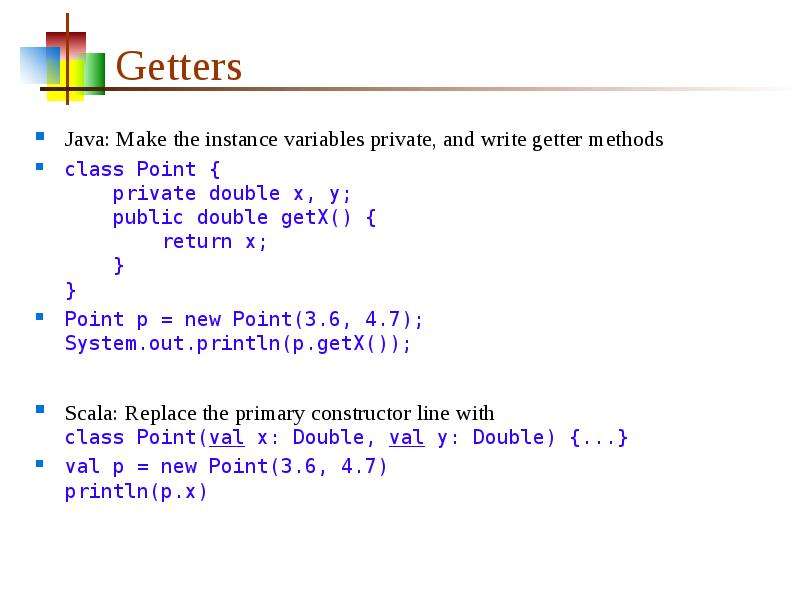
Getters Java: Make the instance variables private, and write getter methods class Point { private double x, y; public double getX() { return x; } }...
Описание слайда:
Getters Java: Make the instance variables private, and write getter methods class Point { private double x, y; public double getX() { return x; } } Point p = new Point(3.6, 4.7); System.out.println(p.getX());

Слайд 7


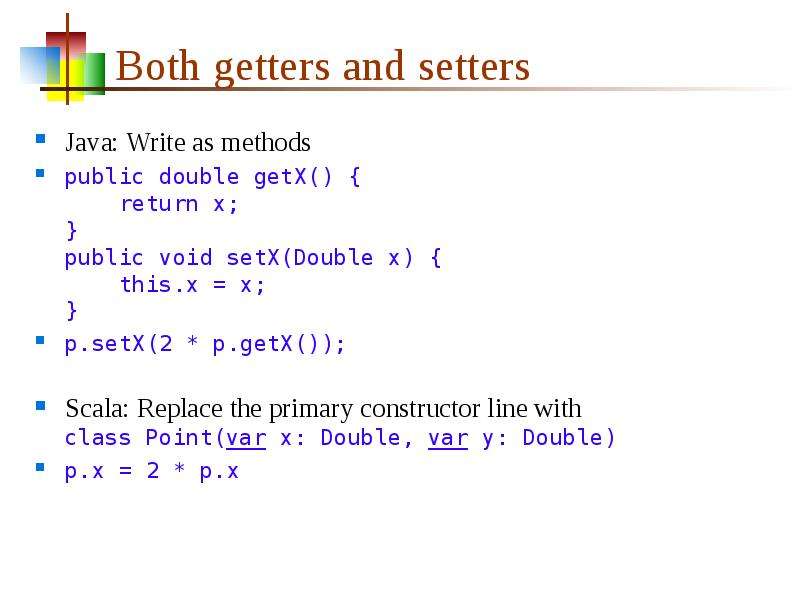
Both getters and setters Java: Write as methods public double getX() { return x; } public void setX(Double x) { this.x = x; } p.setX(2 * p.getX());
Описание слайда:
Both getters and setters Java: Write as methods public double getX() { return x; } public void setX(Double x) { this.x = x; } p.setX(2 * p.getX());

Слайд 8


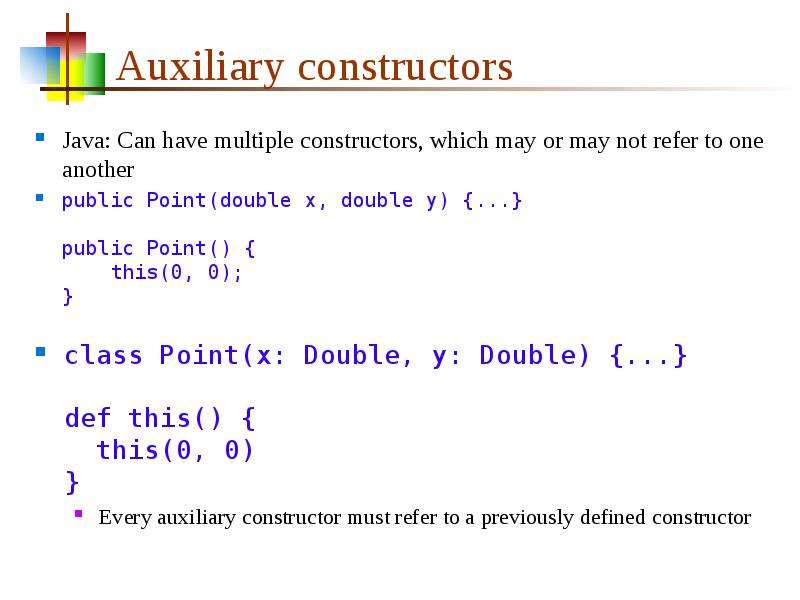
Auxiliary constructors Java: Can have multiple constructors, which may or may not refer to one another public Point(double x, double y) {...} public...
Описание слайда:
Auxiliary constructors Java: Can have multiple constructors, which may or may not refer to one another public Point(double x, double y) {...} public Point() { this(0, 0); }

Слайд 9


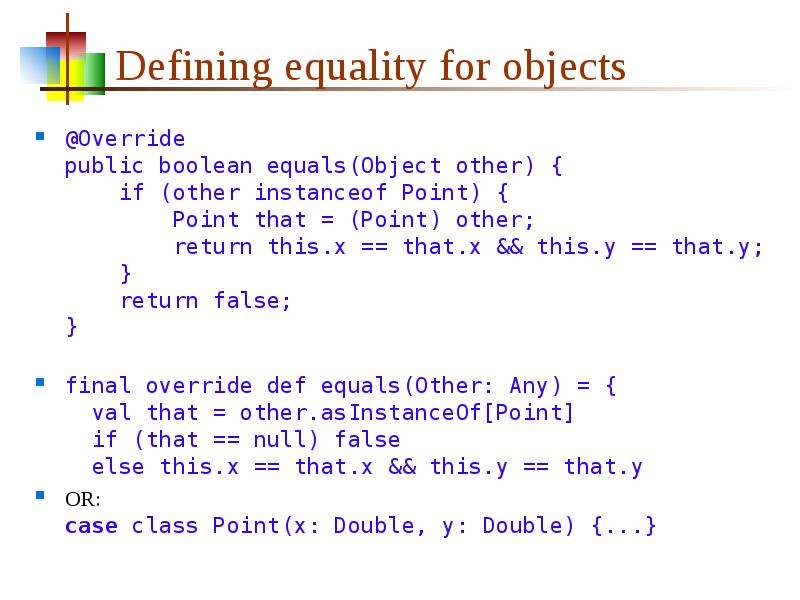
Defining equality for objects @Override public boolean equals(Object other) { if (other instanceof Point) { Point that = (Point) other; return this.x...
Описание слайда:
Defining equality for objects @Override public boolean equals(Object other) { if (other instanceof Point) { Point that = (Point) other; return this.x == that.x && this.y == that.y; } return false; }

Слайд 10


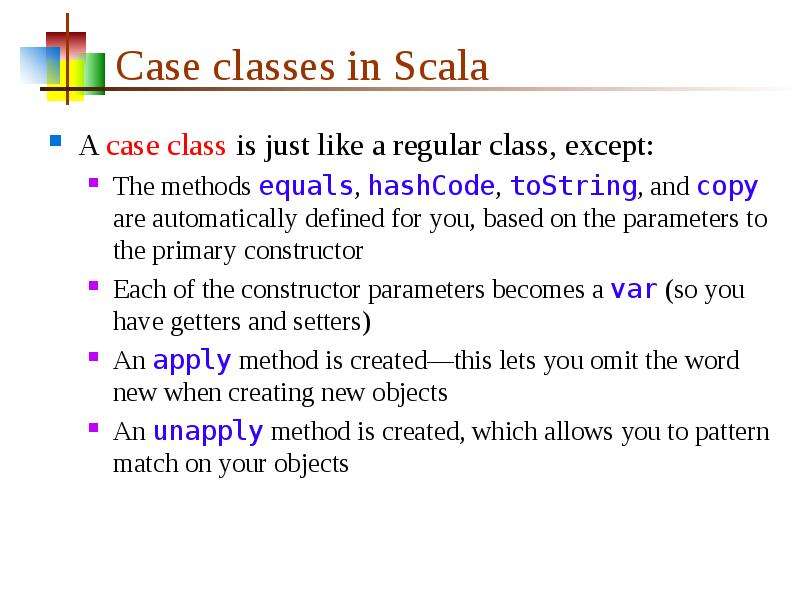
Case classes in Scala A case class is just like a regular class, except: The methods equals, hashCode, toString, and copy are automatically defined...
Описание слайда:
Case classes in Scala A case class is just like a regular class, except: The methods equals, hashCode, toString, and copy are automatically defined for you, based on the parameters to the primary constructor Each of the constructor parameters becomes a var (so you have getters and setters) An apply method is created—this lets you omit the word new when creating new objects An unapply method is created, which allows you to pattern match on your objects

Слайд 11


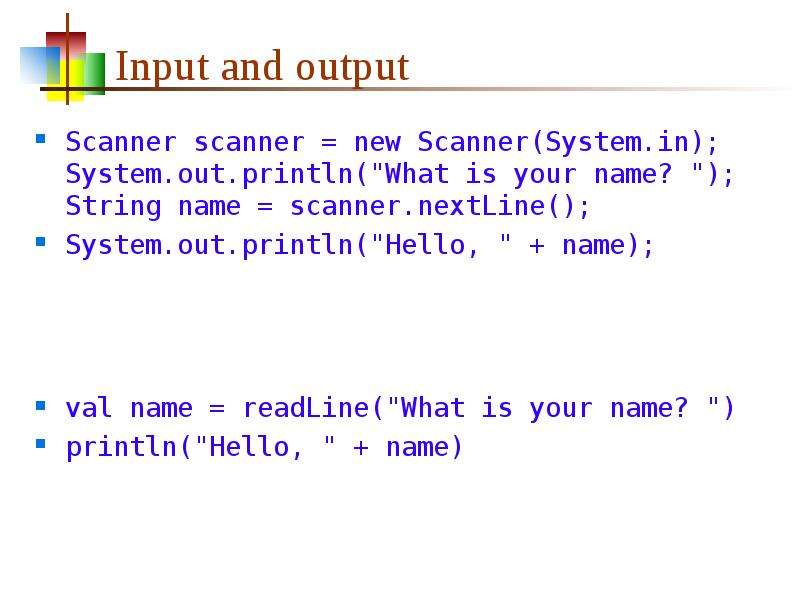
Input and output Scanner scanner = new Scanner(System.in); System.out.println("What is your name? "); String name = scanner.nextLine();...
Описание слайда:
Input and output Scanner scanner = new Scanner(System.in); System.out.println("What is your name? "); String name = scanner.nextLine(); System.out.println("Hello, " + name);

Слайд 12


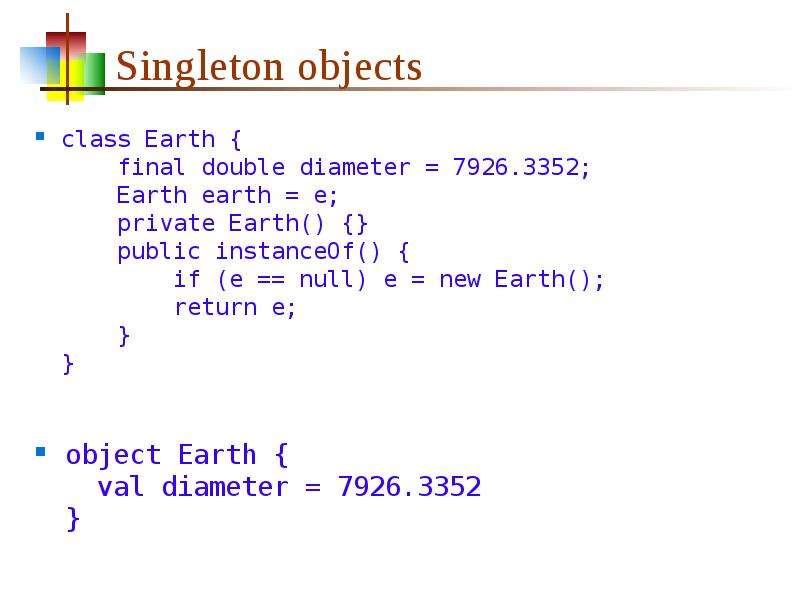
Singleton objects class Earth { final double diameter = 7926.3352; Earth earth = e; private Earth() {} public instanceOf() { if (e == null) e = new...
Описание слайда:
Singleton objects class Earth { final double diameter = 7926.3352; Earth earth = e; private Earth() {} public instanceOf() { if (e == null) e = new Earth(); return e; } }

Слайд 13


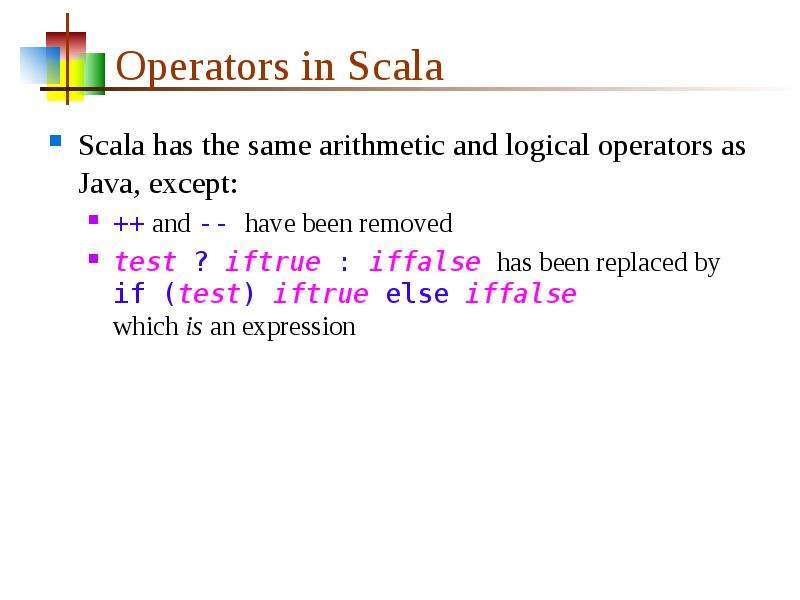
Operators in Scala Scala has the same arithmetic and logical operators as Java, except: ++ and -- have been removed test ? iftrue : iffalse has been...
Описание слайда:
Operators in Scala Scala has the same arithmetic and logical operators as Java, except: ++ and -- have been removed test ? iftrue : iffalse has been replaced by if (test) iftrue else iffalse which is an expression

Слайд 14


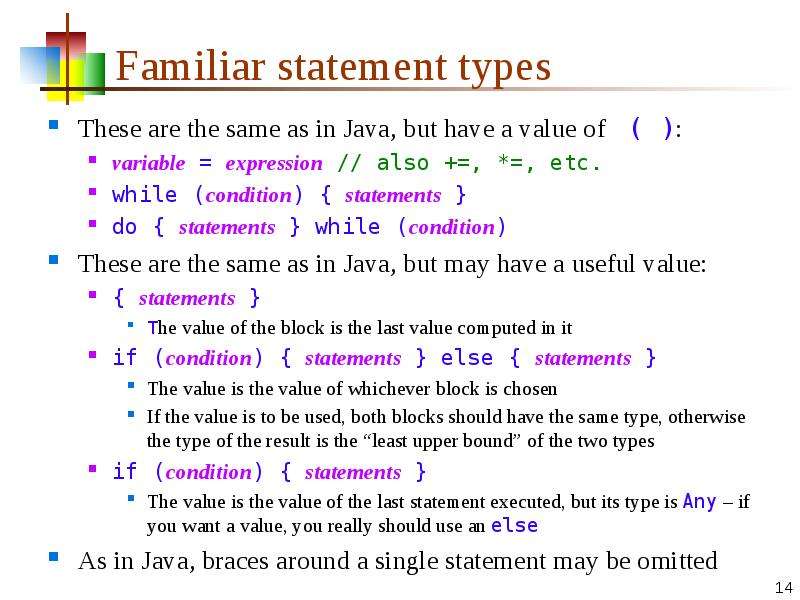
Familiar statement types These are the same as in Java, but have a value of ( ): variable = expression // also +=, *=, etc. while (condition) {...
Описание слайда:
Familiar statement types These are the same as in Java, but have a value of ( ): variable = expression // also +=, *=, etc. while (condition) { statements } do { statements } while (condition) These are the same as in Java, but may have a useful value: { statements } The value of the block is the last value computed in it if (condition) { statements } else { statements } The value is the value of whichever block is chosen If the value is to be used, both blocks should have the same type, otherwise the type of the result is the “least upper bound” of the two types if (condition) { statements } The value is the value of the last statement executed, but its type is Any – if you want a value, you really should use an else As in Java, braces around a single statement may be omitted

Слайд 15


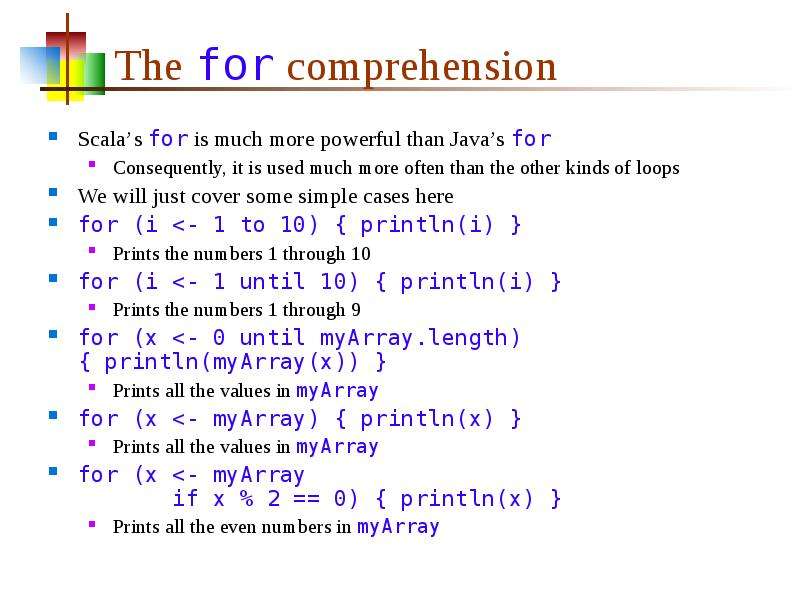
The for comprehension Scala’s for is much more powerful than Java’s for Consequently, it is used much more often than the other kinds of loops We...
Описание слайда:
The for comprehension Scala’s for is much more powerful than Java’s for Consequently, it is used much more often than the other kinds of loops We will just cover some simple cases here for (i

Слайд 16


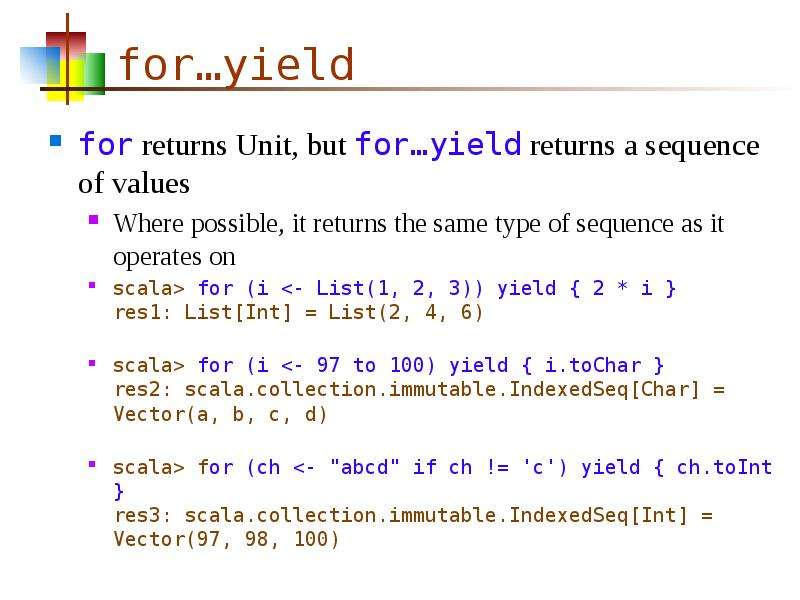
for…yield for returns Unit, but for…yield returns a sequence of values Where possible, it returns the same type of sequence as it operates on scala>...
Описание слайда:
for…yield for returns Unit, but for…yield returns a sequence of values Where possible, it returns the same type of sequence as it operates on scala> for (i for (i for (ch

Слайд 17


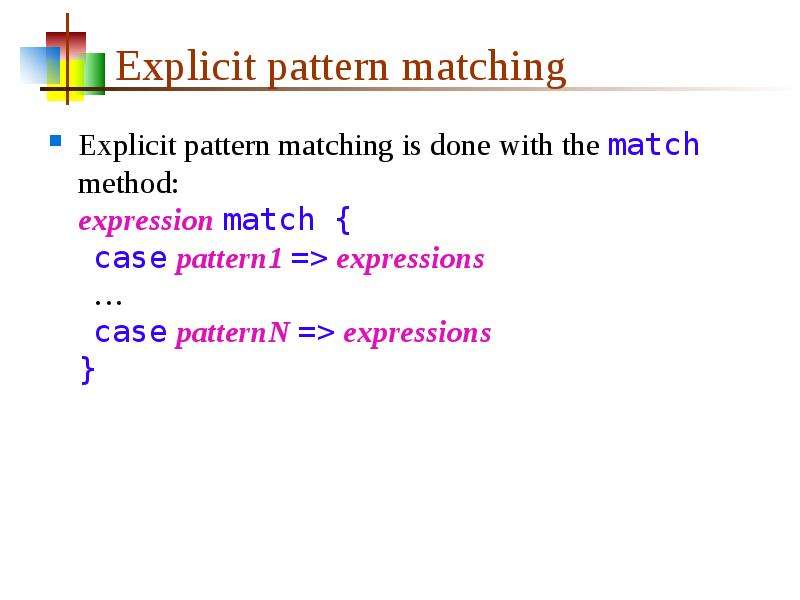
Explicit pattern matching Explicit pattern matching is done with the match method: expression match { case pattern1 => expressions … case patternN =>...
Описание слайда:
Explicit pattern matching Explicit pattern matching is done with the match method: expression match { case pattern1 => expressions … case patternN => expressions }

Слайд 18


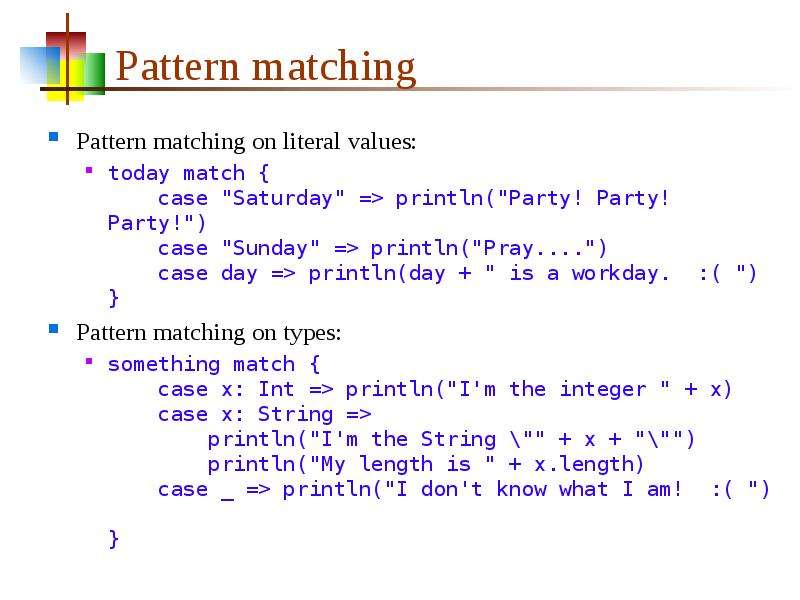
Pattern matching Pattern matching on literal values: today match { case "Saturday" => println("Party! Party! Party!") case...
Описание слайда:
Pattern matching Pattern matching on literal values: today match { case "Saturday" => println("Party! Party! Party!") case "Sunday" => println("Pray....") case day => println(day + " is a workday. :( ") } Pattern matching on types: something match { case x: Int => println("I'm the integer " + x) case x: String => println("I'm the String \"" + x + "\"") println("My length is " + x.length) case _ => println("I don't know what I am! :( ") }

Слайд 19


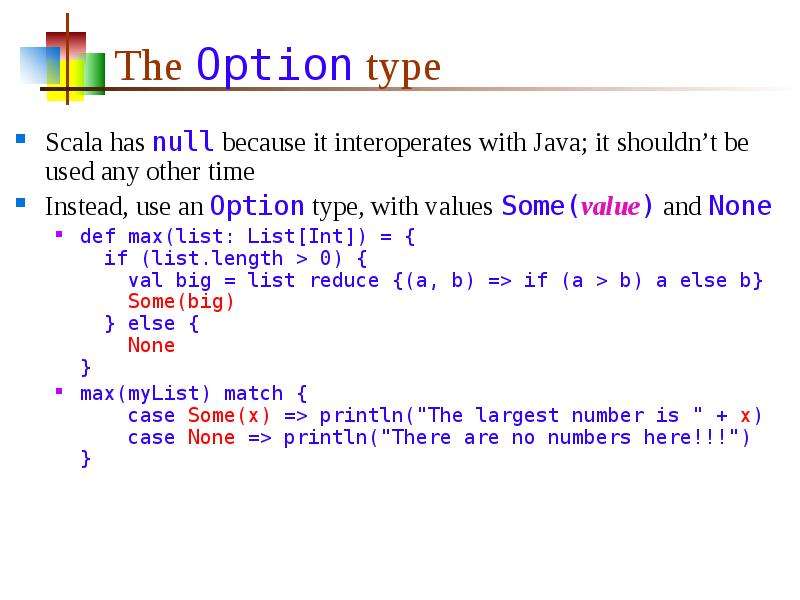
The Option type Scala has null because it interoperates with Java; it shouldn’t be used any other time Instead, use an Option type, with values...
Описание слайда:
The Option type Scala has null because it interoperates with Java; it shouldn’t be used any other time Instead, use an Option type, with values Some(value) and None def max(list: List[Int]) = { if (list.length > 0) { val big = list reduce {(a, b) => if (a > b) a else b} Some(big) } else { None } max(myList) match { case Some(x) => println("The largest number is " + x) case None => println("There are no numbers here!!!") }

Слайд 20


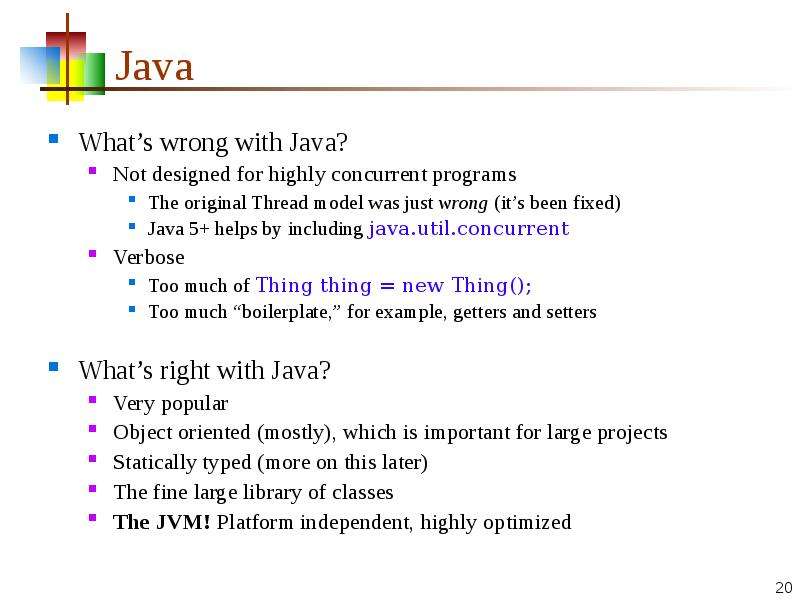
Java What’s wrong with Java? Not designed for highly concurrent programs The original Thread model was just wrong (it’s been fixed) Java 5+ helps by...
Описание слайда:
Java What’s wrong with Java? Not designed for highly concurrent programs The original Thread model was just wrong (it’s been fixed) Java 5+ helps by including java.util.concurrent Verbose Too much of Thing thing = new Thing(); Too much “boilerplate,” for example, getters and setters What’s right with Java? Very popular Object oriented (mostly), which is important for large projects Statically typed (more on this later) The fine large library of classes The JVM! Platform independent, highly optimized

Слайд 21


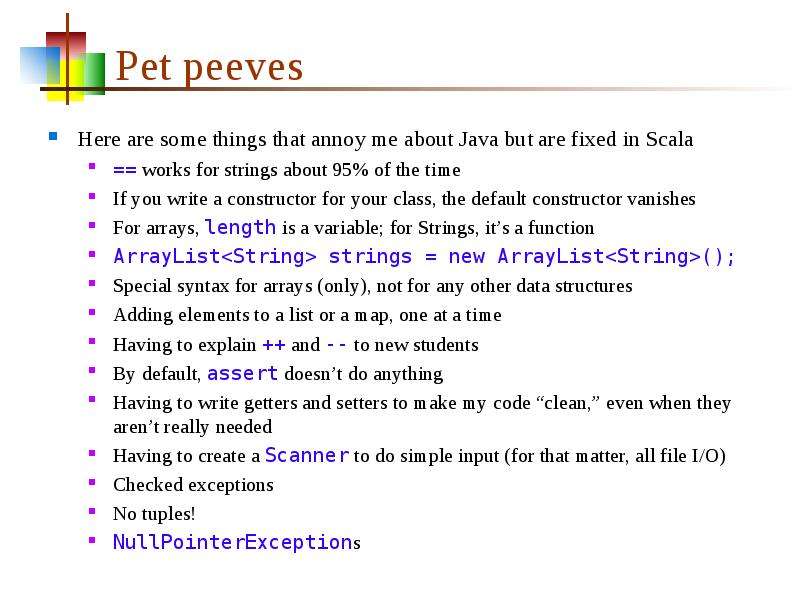
Pet peeves Here are some things that annoy me about Java but are fixed in Scala == works for strings about 95% of the time If you write a constructor...
Описание слайда:
Pet peeves Here are some things that annoy me about Java but are fixed in Scala == works for strings about 95% of the time If you write a constructor for your class, the default constructor vanishes For arrays, length is a variable; for Strings, it’s a function ArrayList strings = new ArrayList(); Special syntax for arrays (only), not for any other data structures Adding elements to a list or a map, one at a time Having to explain ++ and -- to new students By default, assert doesn’t do anything Having to write getters and setters to make my code “clean,” even when they aren’t really needed Having to create a Scanner to do simple input (for that matter, all file I/O) Checked exceptions No tuples! NullPointerExceptions

Слайд 22


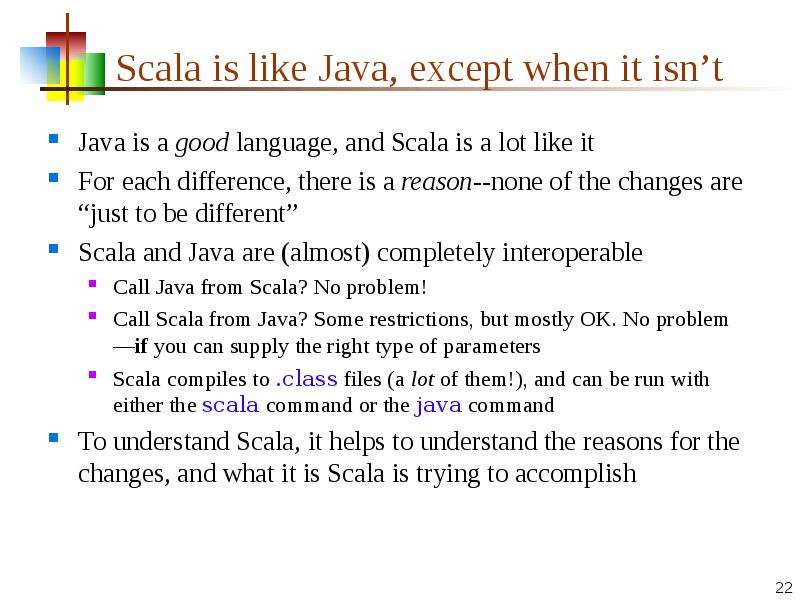
Scala is like Java, except when it isn’t Java is a good language, and Scala is a lot like it For each difference, there is a reason--none of the...
Описание слайда:
Scala is like Java, except when it isn’t Java is a good language, and Scala is a lot like it For each difference, there is a reason--none of the changes are “just to be different” Scala and Java are (almost) completely interoperable Call Java from Scala? No problem! Call Scala from Java? Some restrictions, but mostly OK. No problem—if you can supply the right type of parameters Scala compiles to .class files (a lot of them!), and can be run with either the scala command or the java command To understand Scala, it helps to understand the reasons for the changes, and what it is Scala is trying to accomplish

Слайд 23


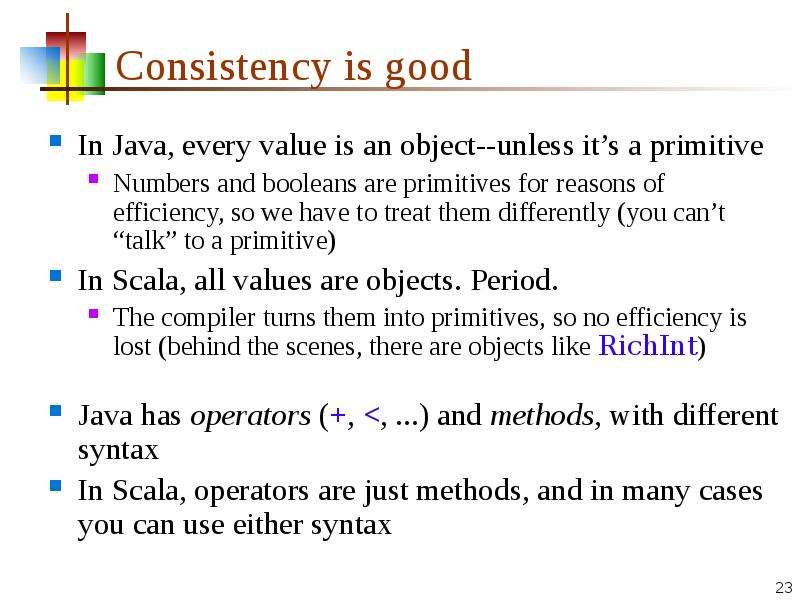
Consistency is good In Java, every value is an object--unless it’s a primitive Numbers and booleans are primitives for reasons of efficiency, so we...
Описание слайда:
Consistency is good In Java, every value is an object--unless it’s a primitive Numbers and booleans are primitives for reasons of efficiency, so we have to treat them differently (you can’t “talk” to a primitive) In Scala, all values are objects. Period. The compiler turns them into primitives, so no efficiency is lost (behind the scenes, there are objects like RichInt) Java has operators (+,

Слайд 24


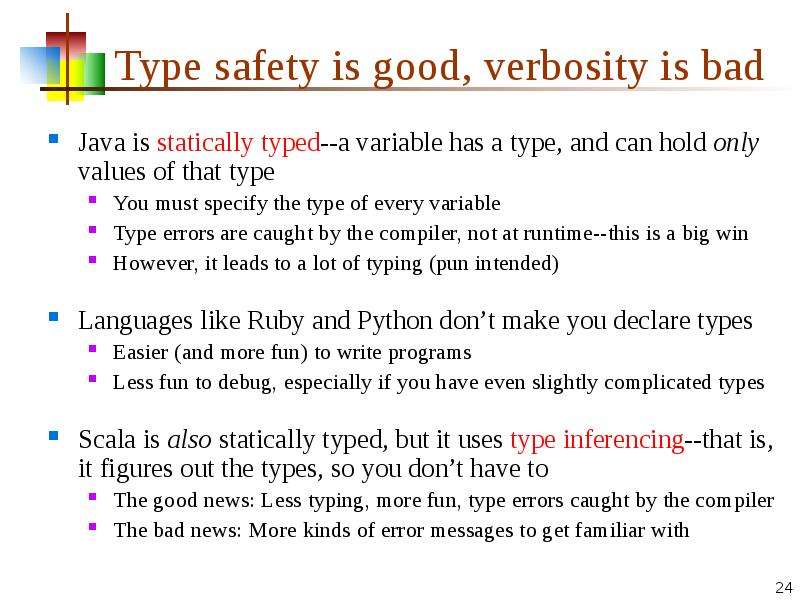
Type safety is good, verbosity is bad Java is statically typed--a variable has a type, and can hold only values of that type You must specify the...
Описание слайда:
Type safety is good, verbosity is bad Java is statically typed--a variable has a type, and can hold only values of that type You must specify the type of every variable Type errors are caught by the compiler, not at runtime--this is a big win However, it leads to a lot of typing (pun intended) Languages like Ruby and Python don’t make you declare types Easier (and more fun) to write programs Less fun to debug, especially if you have even slightly complicated types Scala is also statically typed, but it uses type inferencing--that is, it figures out the types, so you don’t have to The good news: Less typing, more fun, type errors caught by the compiler The bad news: More kinds of error messages to get familiar with

Слайд 25


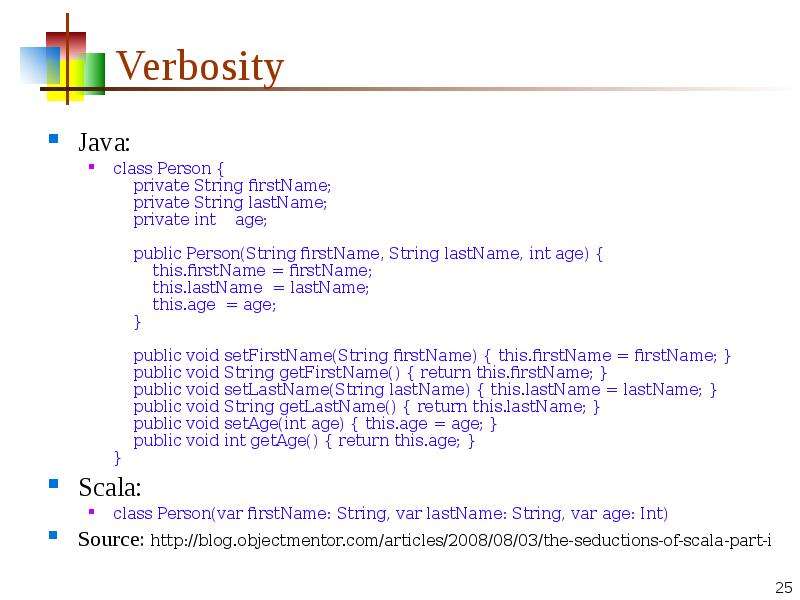
Verbosity Java: class Person { private String firstName; private String lastName; private int age; public Person(String firstName, String lastName,...
Описание слайда:
Verbosity Java: class Person { private String firstName; private String lastName; private int age; public Person(String firstName, String lastName, int age) { this.firstName = firstName; this.lastName = lastName; this.age = age; } public void setFirstName(String firstName) { this.firstName = firstName; } public void String getFirstName() { return this.firstName; } public void setLastName(String lastName) { this.lastName = lastName; } public void String getLastName() { return this.lastName; } public void setAge(int age) { this.age = age; } public void int getAge() { return this.age; } } Scala: class Person(var firstName: String, var lastName: String, var age: Int) Source:

Слайд 26


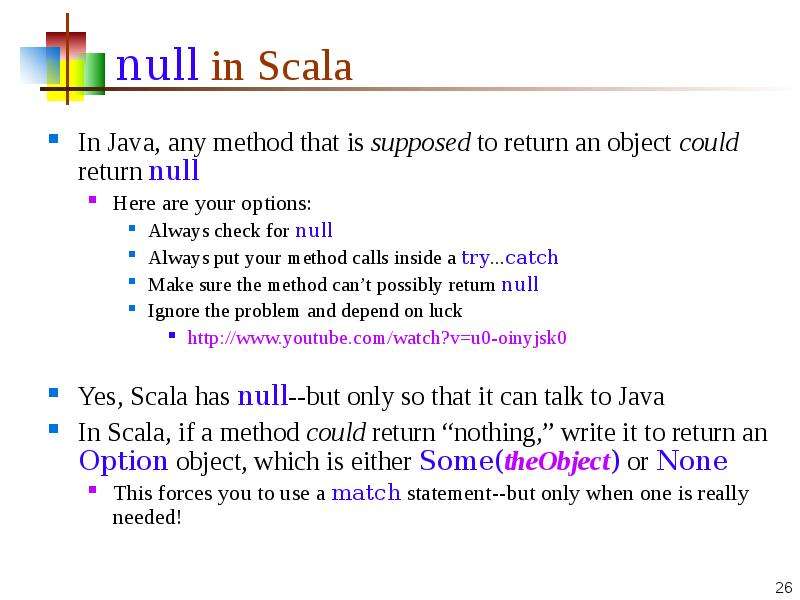
null in Scala In Java, any method that is supposed to return an object could return null Here are your options: Always check for null Always put your...
Описание слайда:
null in Scala In Java, any method that is supposed to return an object could return null Here are your options: Always check for null Always put your method calls inside a try...catch Make sure the method can’t possibly return null Ignore the problem and depend on luck Yes, Scala has null--but only so that it can talk to Java In Scala, if a method could return “nothing,” write it to return an Option object, which is either Some(theObject) or None This forces you to use a match statement--but only when one is really needed!

Слайд 27


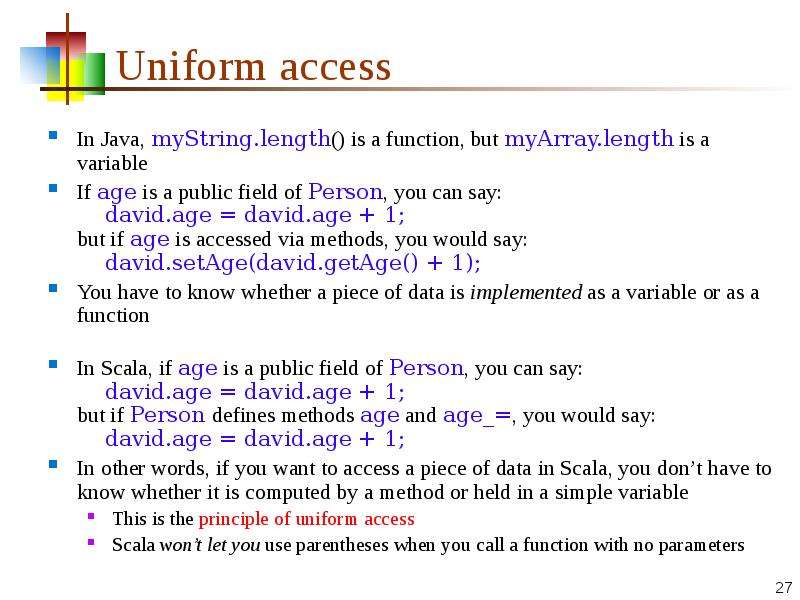
Uniform access In Java, myString.length() is a function, but myArray.length is a variable If age is a public field of Person, you can say: david.age...
Описание слайда:
Uniform access In Java, myString.length() is a function, but myArray.length is a variable If age is a public field of Person, you can say: david.age = david.age + 1; but if age is accessed via methods, you would say: david.setAge(david.getAge() + 1); You have to know whether a piece of data is implemented as a variable or as a function In Scala, if age is a public field of Person, you can say: david.age = david.age + 1; but if Person defines methods age and age_=, you would say: david.age = david.age + 1; In other words, if you want to access a piece of data in Scala, you don’t have to know whether it is computed by a method or held in a simple variable This is the principle of uniform access Scala won’t let you use parentheses when you call a function with no parameters

Слайд 28


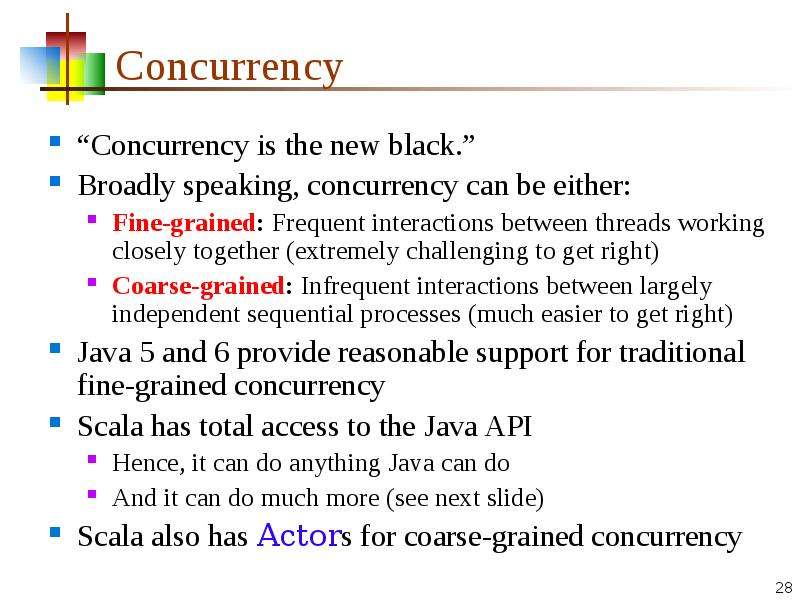
Concurrency “Concurrency is the new black.” Broadly speaking, concurrency can be either: Fine-grained: Frequent interactions between threads working...
Описание слайда:
Concurrency “Concurrency is the new black.” Broadly speaking, concurrency can be either: Fine-grained: Frequent interactions between threads working closely together (extremely challenging to get right) Coarse-grained: Infrequent interactions between largely independent sequential processes (much easier to get right) Java 5 and 6 provide reasonable support for traditional fine-grained concurrency Scala has total access to the Java API Hence, it can do anything Java can do And it can do much more (see next slide) Scala also has Actors for coarse-grained concurrency

Слайд 29


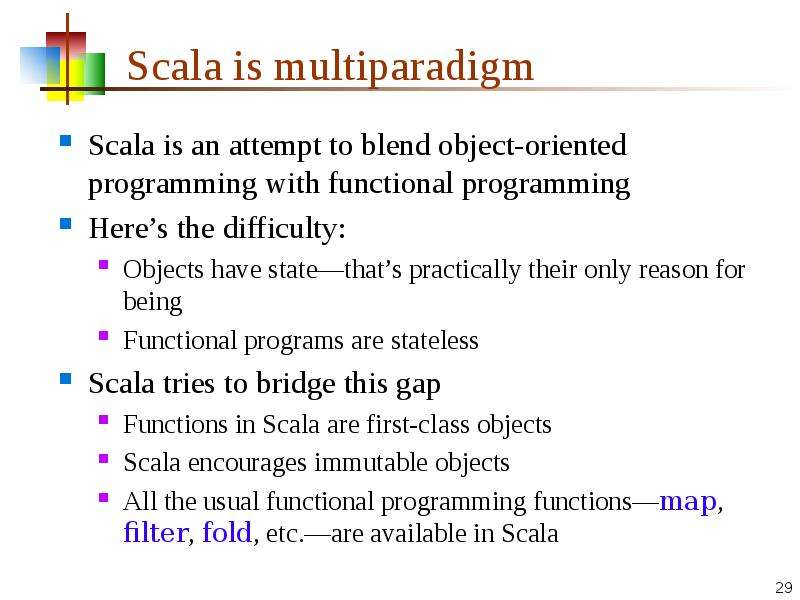
Scala is multiparadigm Scala is an attempt to blend object-oriented programming with functional programming Here’s the difficulty: Objects have...
Описание слайда:
Scala is multiparadigm Scala is an attempt to blend object-oriented programming with functional programming Here’s the difficulty: Objects have state—that’s practically their only reason for being Functional programs are stateless Scala tries to bridge this gap Functions in Scala are first-class objects Scala encourages immutable objects All the usual functional programming functions—map, filter, fold, etc.—are available in Scala

Слайд 30


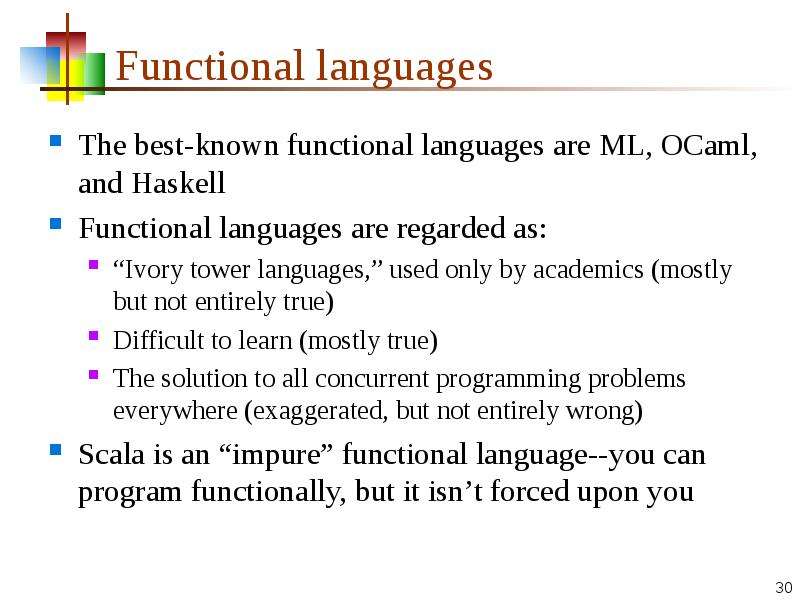
Functional languages The best-known functional languages are ML, OCaml, and Haskell Functional languages are regarded as: “Ivory tower languages,”...
Описание слайда:
Functional languages The best-known functional languages are ML, OCaml, and Haskell Functional languages are regarded as: “Ivory tower languages,” used only by academics (mostly but not entirely true) Difficult to learn (mostly true) The solution to all concurrent programming problems everywhere (exaggerated, but not entirely wrong) Scala is an “impure” functional language--you can program functionally, but it isn’t forced upon you

Слайд 31


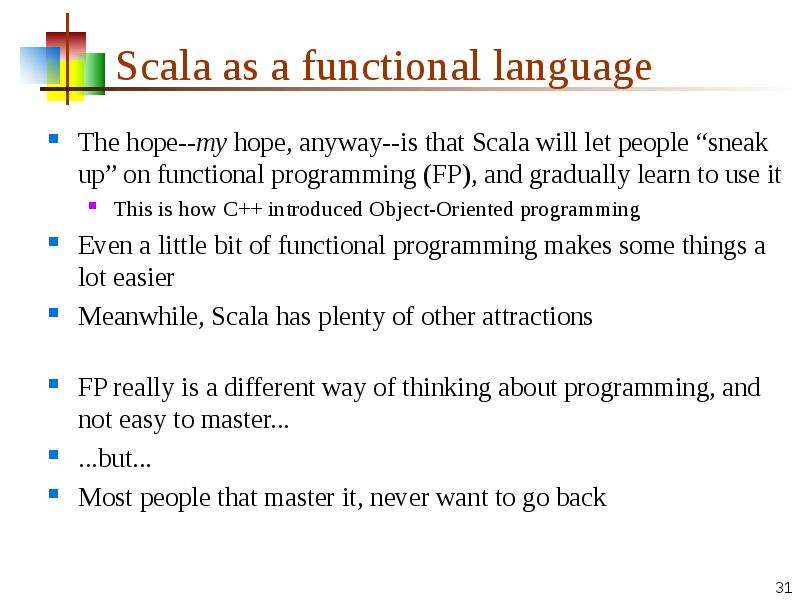
Scala as a functional language The hope--my hope, anyway--is that Scala will let people “sneak up” on functional programming (FP), and gradually...
Описание слайда:
Scala as a functional language The hope--my hope, anyway--is that Scala will let people “sneak up” on functional programming (FP), and gradually learn to use it This is how C++ introduced Object-Oriented programming Even a little bit of functional programming makes some things a lot easier Meanwhile, Scala has plenty of other attractions FP really is a different way of thinking about programming, and not easy to master... ...but... Most people that master it, never want to go back

Слайд 32


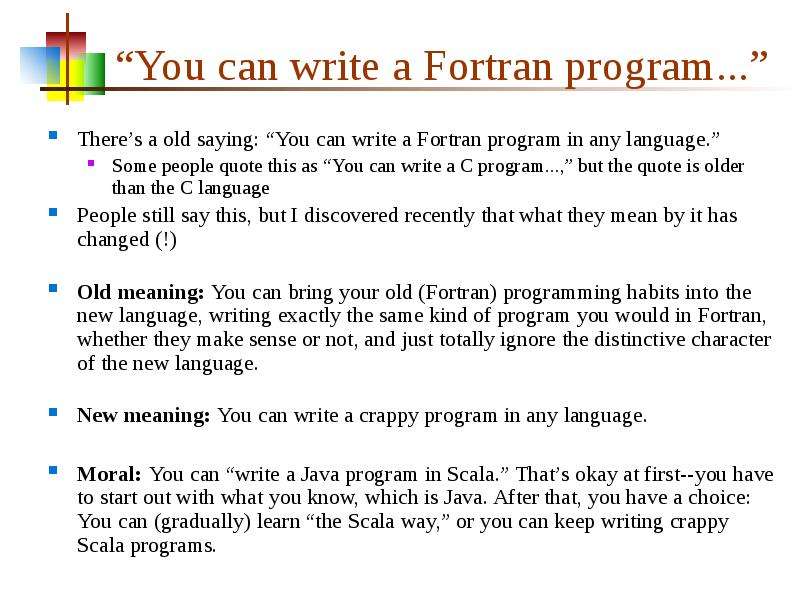
“You can write a Fortran program...” There’s a old saying: “You can write a Fortran program in any language.” Some people quote this as “You can...
Описание слайда:
“You can write a Fortran program...” There’s a old saying: “You can write a Fortran program in any language.” Some people quote this as “You can write a C program...,” but the quote is older than the C language People still say this, but I discovered recently that what they mean by it has changed (!) Old meaning: You can bring your old (Fortran) programming habits into the new language, writing exactly the same kind of program you would in Fortran, whether they make sense or not, and just totally ignore the distinctive character of the new language. New meaning: You can write a crappy program in any language. Moral: You can “write a Java program in Scala.” That’s okay at first--you have to start out with what you know, which is Java. After that, you have a choice: You can (gradually) learn “the Scala way,” or you can keep writing crappy Scala programs.

Слайд 33


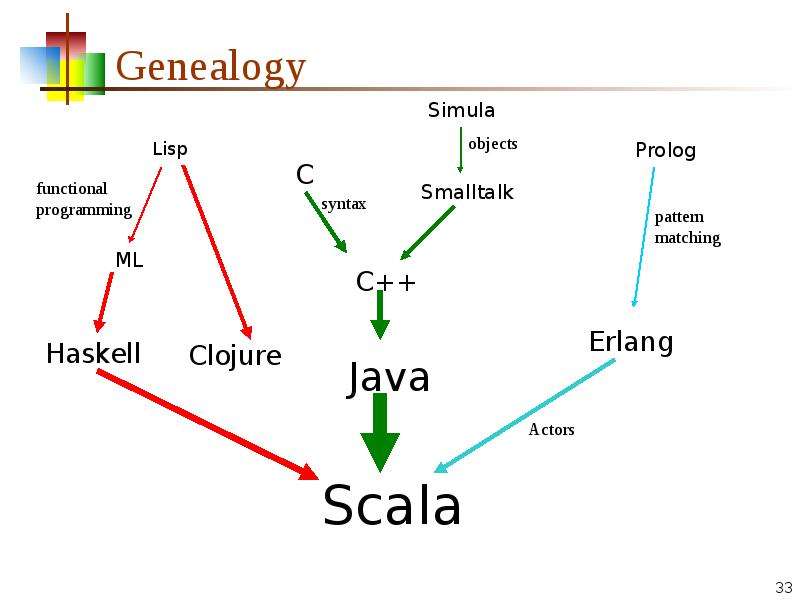
Genealogy
Описание слайда:
Genealogy

Слайд 34


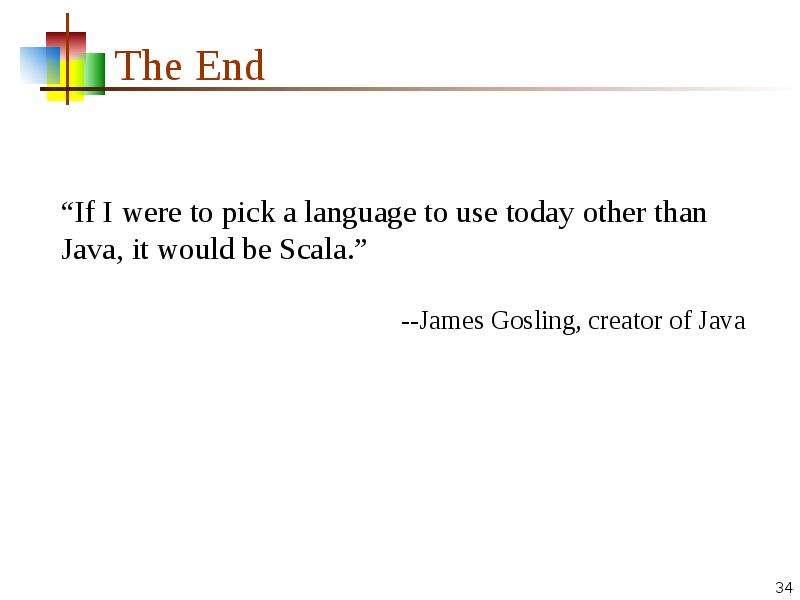
The End
Описание слайда:
The End


Теги Scala Java
Похожие презентации
Mypresentation.ru
Загрузить презентацию