🗊 Презентация The Civil War and after war years

Категория: Образование

Нажмите для полного просмотра!
The Civil War and after war years, слайд №1 The Civil War and after war years, слайд №2 The Civil War and after war years, слайд №3 The Civil War and after war years, слайд №4 The Civil War and after war years, слайд №5 The Civil War and after war years, слайд №6 The Civil War and after war years, слайд №7 The Civil War and after war years, слайд №8 The Civil War and after war years, слайд №9 The Civil War and after war years, слайд №10 The Civil War and after war years, слайд №11 The Civil War and after war years, слайд №12 The Civil War and after war years, слайд №13 The Civil War and after war years, слайд №14 The Civil War and after war years, слайд №15 The Civil War and after war years, слайд №16 The Civil War and after war years, слайд №17 The Civil War and after war years, слайд №18

Вы можете ознакомиться и скачать презентацию на тему The Civil War and after war years. Доклад-сообщение содержит 18 слайдов. Презентации для любого класса можно скачать бесплатно. Если материал и наш сайт презентаций Mypresentation Вам понравились – поделитесь им с друзьями с помощью социальных кнопок и добавьте в закладки в своем браузере.

Слайды и текст этой презентации


Слайд 1


The Civil War and After-War Years 1861 - 1900
Описание слайда:
The Civil War and After-War Years 1861 - 1900

Слайд 2


The Civil War and after war years, слайд №2
Описание слайда:
Слайд 3


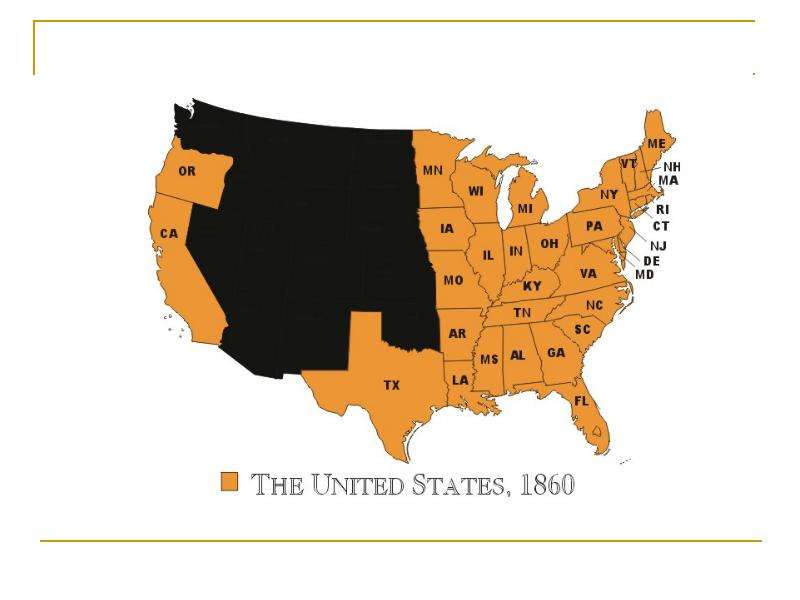
Secession In 1860, the South threatened to secede (break away) from the United States if the Republican Abraham Lincoln were elected president. By...
Описание слайда:
Secession In 1860, the South threatened to secede (break away) from the United States if the Republican Abraham Lincoln were elected president. By the end of January 1861, six other southern states imitated South Carolina and declared their independence from the United States. They were Mississippi, Florida, Alabama, Georgia, Louisiana and Texas. "We are divorced, North and South, because we have hated each other so."

Слайд 4


"Confiscation Acts" 1861 - authorized the Union to seize any property, including slaves, which were being used to aid the South in its...
Описание слайда:

"Confiscation Acts" 1861 - authorized the Union to seize any property, including slaves, which were being used to aid the South in its "insurrection" against the North The Second Confiscation Act was next passed in 1862, taking the additional step of ordering freedom for any slaves belonging to slave-owners engaged in "treason" against the United States.

Слайд 5


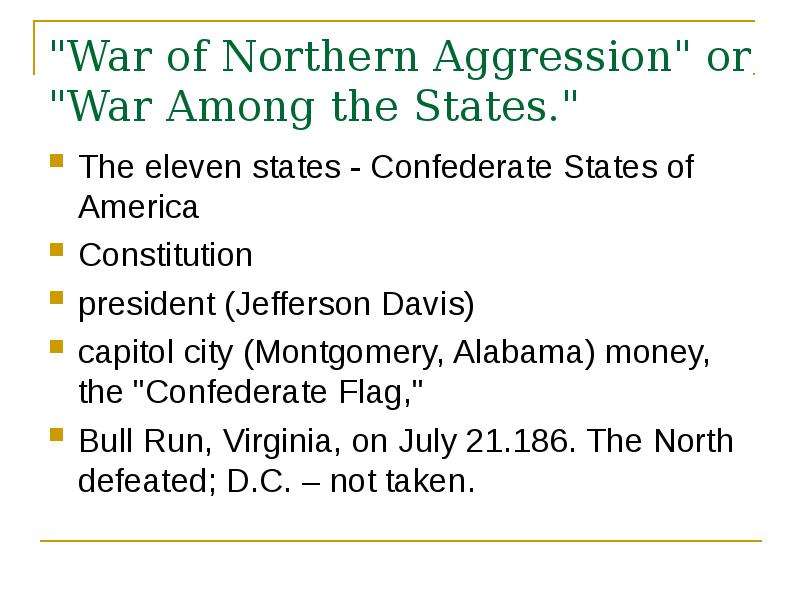
"War of Northern Aggression" or "War Among the States." The eleven states - Confederate States of America Constitution president...
Описание слайда:
"War of Northern Aggression" or "War Among the States." The eleven states - Confederate States of America Constitution president (Jefferson Davis) capitol city (Montgomery, Alabama) money, the "Confederate Flag," Bull Run, Virginia, on July 21.186. The North defeated; D.C. – not taken.

Слайд 6


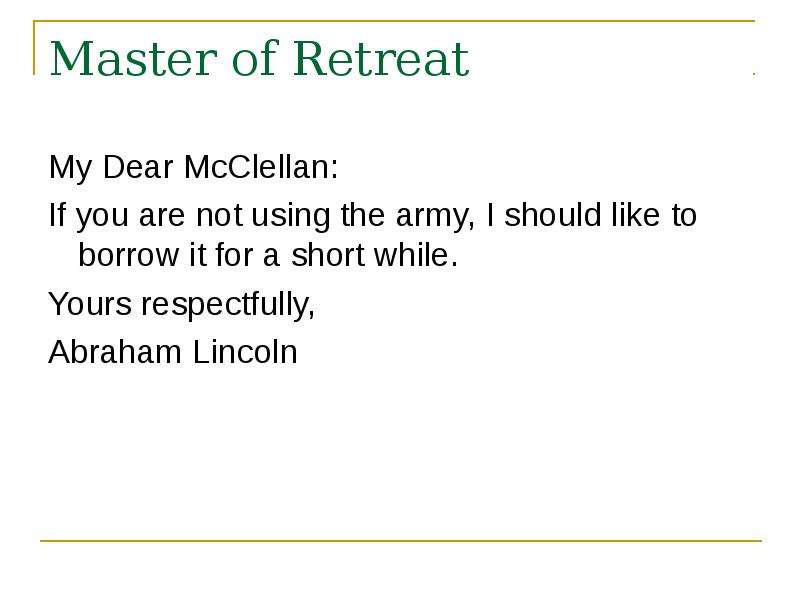
Master of Retreat My Dear McClellan: If you are not using the army, I should like to borrow it for a short while. Yours respectfully, Abraham Lincoln
Описание слайда:
Master of Retreat My Dear McClellan: If you are not using the army, I should like to borrow it for a short while. Yours respectfully, Abraham Lincoln

Слайд 7


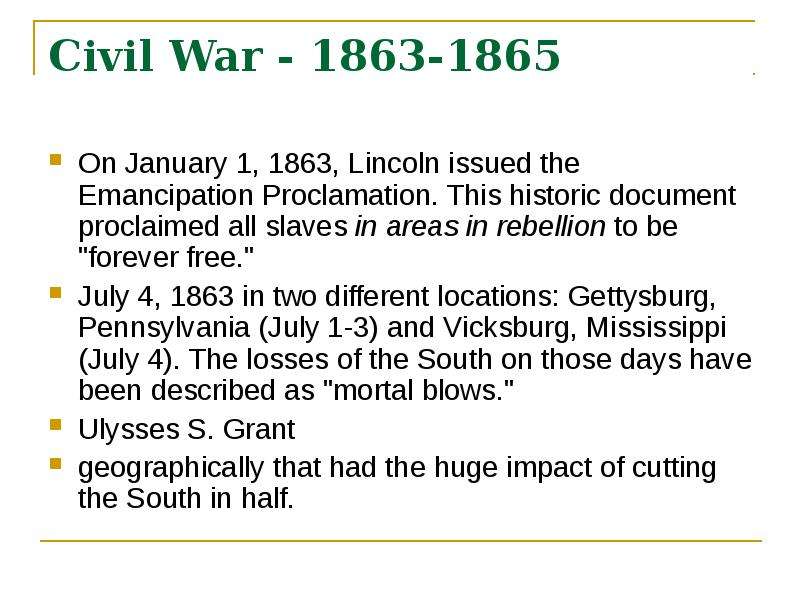
Civil War - 1863-1865 On January 1, 1863, Lincoln issued the Emancipation Proclamation. This historic document proclaimed all slaves in areas in...
Описание слайда:
Civil War - 1863-1865 On January 1, 1863, Lincoln issued the Emancipation Proclamation. This historic document proclaimed all slaves in areas in rebellion to be "forever free." July 4, 1863 in two different locations: Gettysburg, Pennsylvania (July 1-3) and Vicksburg, Mississippi (July 4). The losses of the South on those days have been described as "mortal blows." Ulysses S. Grant geographically that had the huge impact of cutting the South in half.

Слайд 8


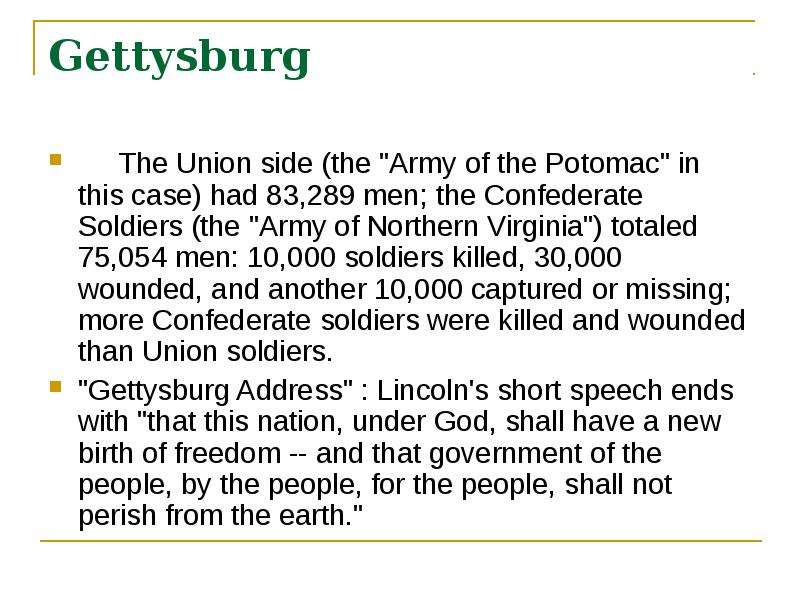
Gettysburg The Union side (the "Army of the Potomac" in this case) had 83,289 men; the Confederate Soldiers (the "Army of Northern...
Описание слайда:
Gettysburg The Union side (the "Army of the Potomac" in this case) had 83,289 men; the Confederate Soldiers (the "Army of Northern Virginia") totaled 75,054 men: 10,000 soldiers killed, 30,000 wounded, and another 10,000 captured or missing; more Confederate soldiers were killed and wounded than Union soldiers. "Gettysburg Address" : Lincoln's short speech ends with "that this nation, under God, shall have a new birth of freedom -- and that government of the people, by the people, for the people, shall not perish from the earth."

Слайд 9


1864-1865 "March to the Sea" in late 1864 "Southern Disunion“ The terms of surrender were generous to the South: Good Friday, April...
Описание слайда:
1864-1865 "March to the Sea" in late 1864 "Southern Disunion“ The terms of surrender were generous to the South: Good Friday, April 14th, Lincoln assassinated by John Wilkes Booth Congress controlled by the "Radical Republicans"

Слайд 10


Reconstruction the 12-year period from the end of the Civil War (1865) to 1877; Civil Rights Act of 1866 to establish the rights of blacks to testify...
Описание слайда:
Reconstruction the 12-year period from the end of the Civil War (1865) to 1877; Civil Rights Act of 1866 to establish the rights of blacks to testify in court, make contracts, and hold property "carpetbaggers" Reconstruction Amendments, all of which were added to the U.S. Constitution in the five years following the Civil War (1865-1870): 13th Amendments: abolish slavery 14th Amendment: give all races equal rights 15th Amendment: give all races the right to vote

Слайд 11


Embarrassing History Black Codes or "Jim Crow" laws 1868, the Ku Klux Klan (KKK) The Burlingame Treaty was signed between the United States...
Описание слайда:
Embarrassing History Black Codes or "Jim Crow" laws 1868, the Ku Klux Klan (KKK) The Burlingame Treaty was signed between the United States and China in 1868, and it permitted unrestricted immigration by Chinese to the U.S. The Chinese immigrants were the only ones who could complete the building of the railroad over the treacherous Sierra-Nevada mountain range, which finally enabled linking the West Coast to the East Coast by railroad. Afterward, factory owners as far away as Massachusetts would transport Chinese immigrants from California in order to break a strike by union workers (in other words, replace the local striking workers with the transported Chinese immigrants). 1876, "Custer's Last Stand." corruption in the government of New York City

Слайд 12


The "Gilded Age" a spectacularly creative and industrious period, with many of the greatest inventions (e.g., light bulb, telephone, motion...
Описание слайда:
The "Gilded Age" a spectacularly creative and industrious period, with many of the greatest inventions (e.g., light bulb, telephone, motion pictures, and phonograph) developed In 1869, the "Fisk-Gould Scandal," the Credit Mobilier scandal, the Whiskey Ring 70% inflation "robber barons" Big Business and Big Oil (Pennsylvania, just east of Pittsburgh; Colonel Edwin L. Drake struck "Oil Creek." Oil production began there in 1859.

Слайд 13


Rockefeller 1870 Rockefeller founded Standard Oil Company, and then began pursuing highly aggressive business tactics to drive out competitors and...
Описание слайда:
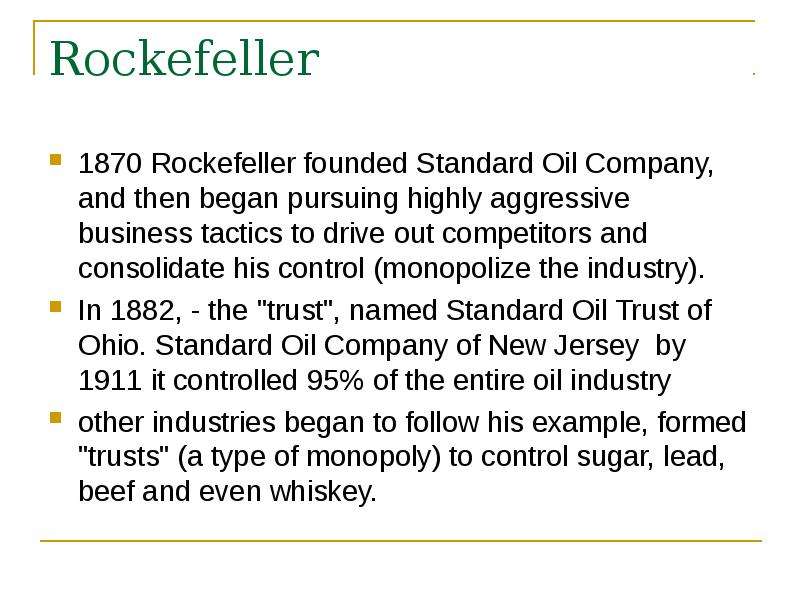
Rockefeller 1870 Rockefeller founded Standard Oil Company, and then began pursuing highly aggressive business tactics to drive out competitors and consolidate his control (monopolize the industry). In 1882, - the "trust", named Standard Oil Trust of Ohio. Standard Oil Company of New Jersey by 1911 it controlled 95% of the entire oil industry other industries began to follow his example, formed "trusts" (a type of monopoly) to control sugar, lead, beef and even whiskey.

Слайд 14


American Dream enacted Andrew Carnegie immigrated from Scotland without any money and ended up with massive wealth from founding the Carnegie Steel...
Описание слайда:
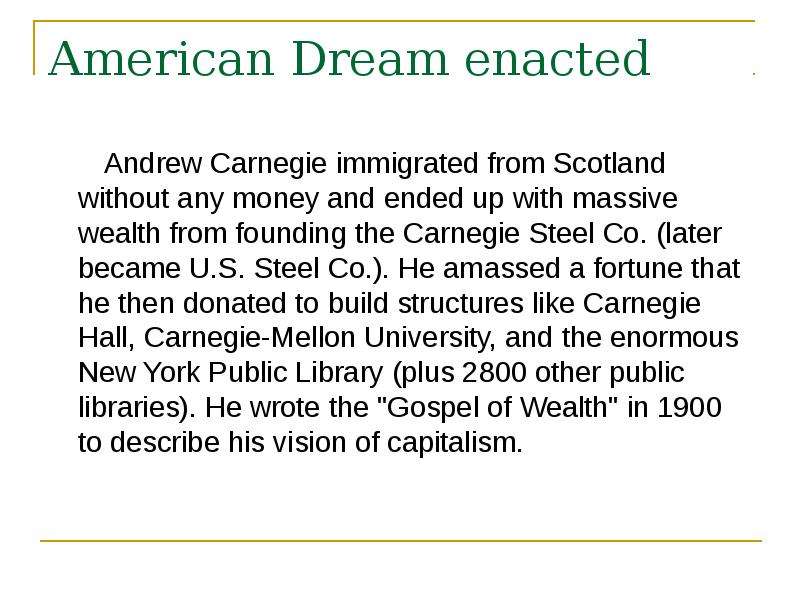
American Dream enacted Andrew Carnegie immigrated from Scotland without any money and ended up with massive wealth from founding the Carnegie Steel Co. (later became U.S. Steel Co.). He amassed a fortune that he then donated to build structures like Carnegie Hall, Carnegie-Mellon University, and the enormous New York Public Library (plus 2800 other public libraries). He wrote the "Gospel of Wealth" in 1900 to describe his vision of capitalism.

Слайд 15


Workers’ Rights From 1877 to 1880, the Workingmen's Party developed for ordinary workers In 1882, the Chinese Exclusion Act - banned the Chinese from...
Описание слайда:
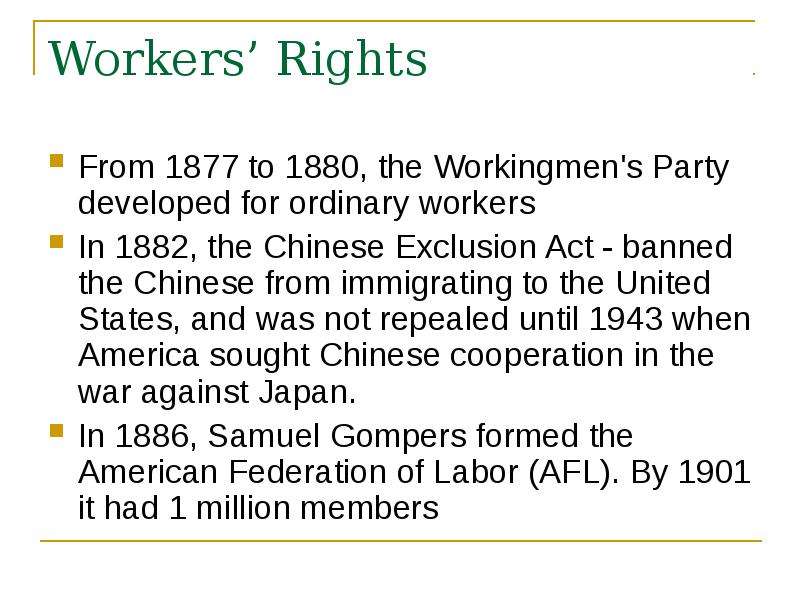
Workers’ Rights From 1877 to 1880, the Workingmen's Party developed for ordinary workers In 1882, the Chinese Exclusion Act - banned the Chinese from immigrating to the United States, and was not repealed until 1943 when America sought Chinese cooperation in the war against Japan. In 1886, Samuel Gompers formed the American Federation of Labor (AFL). By 1901 it had 1 million members

Слайд 16


Indian Matter In 1887 Congress enacted the Dawes Act to help Indians. This law granted landholdings (allotments, usually 160 acres or 65 hectares) to...
Описание слайда:
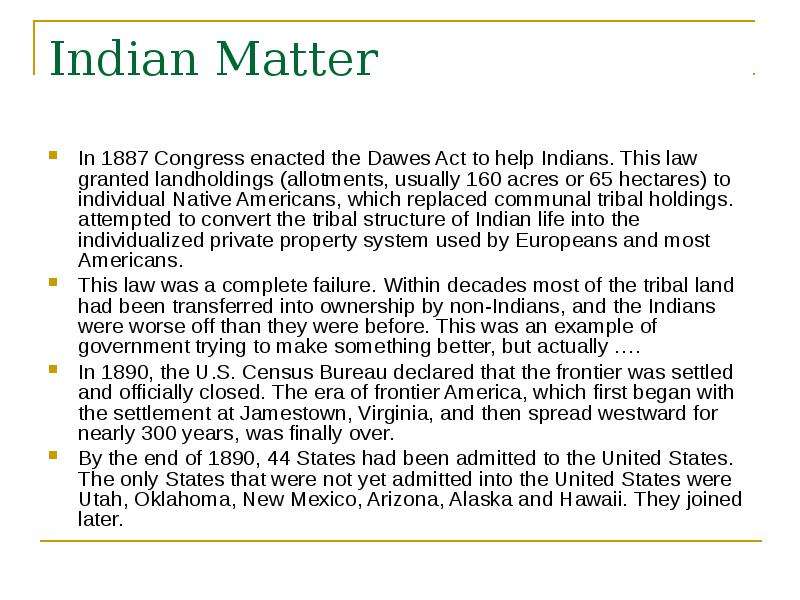
Indian Matter In 1887 Congress enacted the Dawes Act to help Indians. This law granted landholdings (allotments, usually 160 acres or 65 hectares) to individual Native Americans, which replaced communal tribal holdings. attempted to convert the tribal structure of Indian life into the individualized private property system used by Europeans and most Americans. This law was a complete failure. Within decades most of the tribal land had been transferred into ownership by non-Indians, and the Indians were worse off than they were before. This was an example of government trying to make something better, but actually …. In 1890, the U.S. Census Bureau declared that the frontier was settled and officially closed. The era of frontier America, which first began with the settlement at Jamestown, Virginia, and then spread westward for nearly 300 years, was finally over. By the end of 1890, 44 States had been admitted to the United States. The only States that were not yet admitted into the United States were Utah, Oklahoma, New Mexico, Arizona, Alaska and Hawaii. They joined later.

Слайд 17


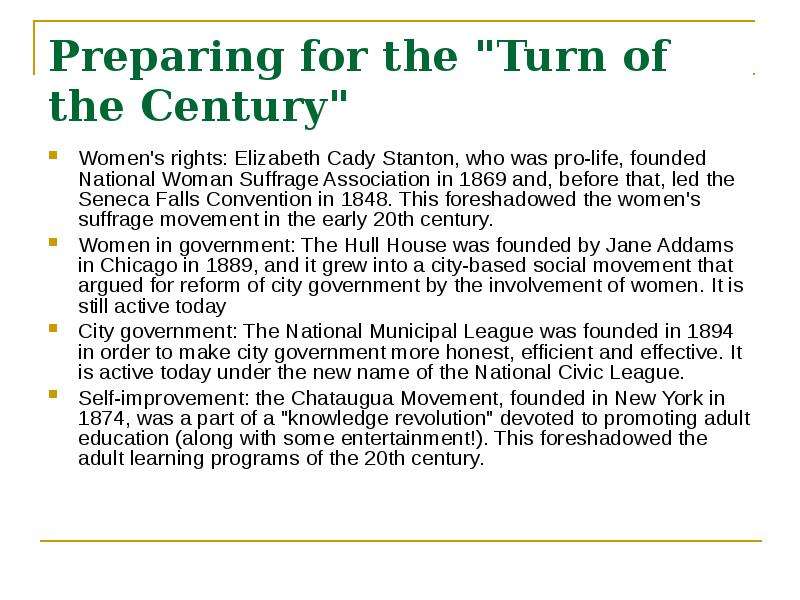
Preparing for the "Turn of the Century" Women's rights: Elizabeth Cady Stanton, who was pro-life, founded National Woman Suffrage...
Описание слайда:
Preparing for the "Turn of the Century" Women's rights: Elizabeth Cady Stanton, who was pro-life, founded National Woman Suffrage Association in 1869 and, before that, led the Seneca Falls Convention in 1848. This foreshadowed the women's suffrage movement in the early 20th century. Women in government: The Hull House was founded by Jane Addams in Chicago in 1889, and it grew into a city-based social movement that argued for reform of city government by the involvement of women. It is still active today City government: The National Municipal League was founded in 1894 in order to make city government more honest, efficient and effective. It is active today under the new name of the National Civic League. Self-improvement: the Chataugua Movement, founded in New York in 1874, was a part of a "knowledge revolution" devoted to promoting adult education (along with some entertainment!). This foreshadowed the adult learning programs of the 20th century.

Слайд 18


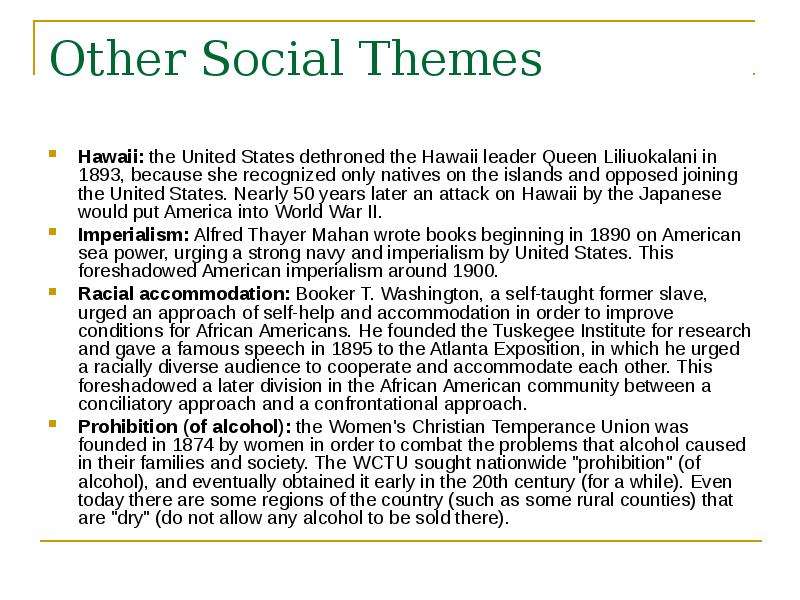
Other Social Themes Hawaii: the United States dethroned the Hawaii leader Queen Liliuokalani in 1893, because she recognized only natives on the...
Описание слайда:
Other Social Themes Hawaii: the United States dethroned the Hawaii leader Queen Liliuokalani in 1893, because she recognized only natives on the islands and opposed joining the United States. Nearly 50 years later an attack on Hawaii by the Japanese would put America into World War II. Imperialism: Alfred Thayer Mahan wrote books beginning in 1890 on American sea power, urging a strong navy and imperialism by United States. This foreshadowed American imperialism around 1900. Racial accommodation: Booker T. Washington, a self-taught former slave, urged an approach of self-help and accommodation in order to improve conditions for African Americans. He founded the Tuskegee Institute for research and gave a famous speech in 1895 to the Atlanta Exposition, in which he urged a racially diverse audience to cooperate and accommodate each other. This foreshadowed a later division in the African American community between a conciliatory approach and a confrontational approach. Prohibition (of alcohol): the Women's Christian Temperance Union was founded in 1874 by women in order to combat the problems that alcohol caused in their families and society. The WCTU sought nationwide "prohibition" (of alcohol), and eventually obtained it early in the 20th century (for a while). Even today there are some regions of the country (such as some rural counties) that are "dry" (do not allow any alcohol to be sold there).


Теги Civil after years
Похожие презентации
Mypresentation.ru
Загрузить презентацию