🗊 Презентация Time flies! Vocabulary: Best Practices in Acquisition

Категория: Образование
Нажмите для полного просмотра!
Time flies! Vocabulary: Best Practices in Acquisition, слайд №1 Time flies! Vocabulary: Best Practices in Acquisition, слайд №2 Time flies! Vocabulary: Best Practices in Acquisition, слайд №3 Time flies! Vocabulary: Best Practices in Acquisition, слайд №4 Time flies! Vocabulary: Best Practices in Acquisition, слайд №5 Time flies! Vocabulary: Best Practices in Acquisition, слайд №6 Time flies! Vocabulary: Best Practices in Acquisition, слайд №7 Time flies! Vocabulary: Best Practices in Acquisition, слайд №8 Time flies! Vocabulary: Best Practices in Acquisition, слайд №9 Time flies! Vocabulary: Best Practices in Acquisition, слайд №10 Time flies! Vocabulary: Best Practices in Acquisition, слайд №11 Time flies! Vocabulary: Best Practices in Acquisition, слайд №12 Time flies! Vocabulary: Best Practices in Acquisition, слайд №13 Time flies! Vocabulary: Best Practices in Acquisition, слайд №14 Time flies! Vocabulary: Best Practices in Acquisition, слайд №15 Time flies! Vocabulary: Best Practices in Acquisition, слайд №16 Time flies! Vocabulary: Best Practices in Acquisition, слайд №17 Time flies! Vocabulary: Best Practices in Acquisition, слайд №18 Time flies! Vocabulary: Best Practices in Acquisition, слайд №19 Time flies! Vocabulary: Best Practices in Acquisition, слайд №20 Time flies! Vocabulary: Best Practices in Acquisition, слайд №21 Time flies! Vocabulary: Best Practices in Acquisition, слайд №22 Time flies! Vocabulary: Best Practices in Acquisition, слайд №23 Time flies! Vocabulary: Best Practices in Acquisition, слайд №24 Time flies! Vocabulary: Best Practices in Acquisition, слайд №25 Time flies! Vocabulary: Best Practices in Acquisition, слайд №26 Time flies! Vocabulary: Best Practices in Acquisition, слайд №27 Time flies! Vocabulary: Best Practices in Acquisition, слайд №28 Time flies! Vocabulary: Best Practices in Acquisition, слайд №29 Time flies! Vocabulary: Best Practices in Acquisition, слайд №30 Time flies! Vocabulary: Best Practices in Acquisition, слайд №31 Time flies! Vocabulary: Best Practices in Acquisition, слайд №32 Time flies! Vocabulary: Best Practices in Acquisition, слайд №33 Time flies! Vocabulary: Best Practices in Acquisition, слайд №34 Time flies! Vocabulary: Best Practices in Acquisition, слайд №35

Содержание
Вы можете ознакомиться и скачать презентацию на тему Time flies! Vocabulary: Best Practices in Acquisition. Доклад-сообщение содержит 35 слайдов. Презентации для любого класса можно скачать бесплатно. Если материал и наш сайт презентаций Mypresentation Вам понравились – поделитесь им с друзьями с помощью социальных кнопок и добавьте в закладки в своем браузере.

Слайды и текст этой презентации


Слайд 1


DAY 3: TIME FLIES!
Описание слайда:
DAY 3: TIME FLIES!

Слайд 2


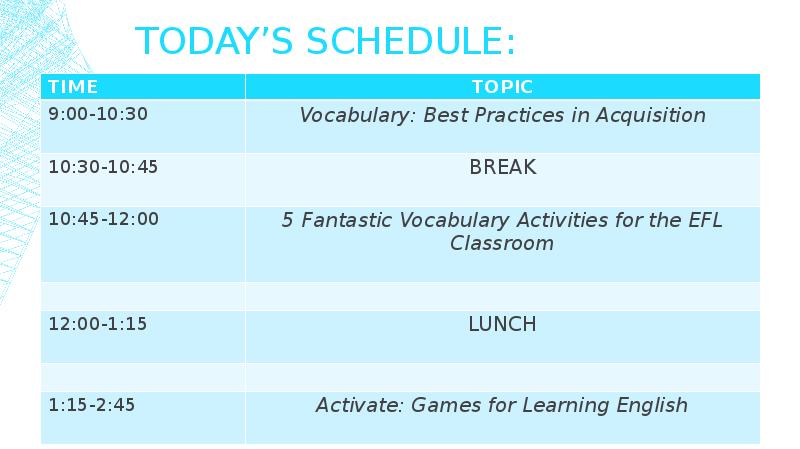
TODAY’S SCHEDULE:
Описание слайда:

TODAY’S SCHEDULE:

Слайд 3


Vocabulary: best practices & acquisition Seneca Ryan English Language Fellow 2015-2017 senecafellow@gmail.com
Описание слайда:
Vocabulary: best practices & acquisition Seneca Ryan English Language Fellow 2015-2017 senecafellow@gmail.com

Слайд 4


We think with words, therefore to improve thinking, teach vocabulary. -- A. Draper and G. Moeller
Описание слайда:
We think with words, therefore to improve thinking, teach vocabulary. -- A. Draper and G. Moeller

Слайд 5


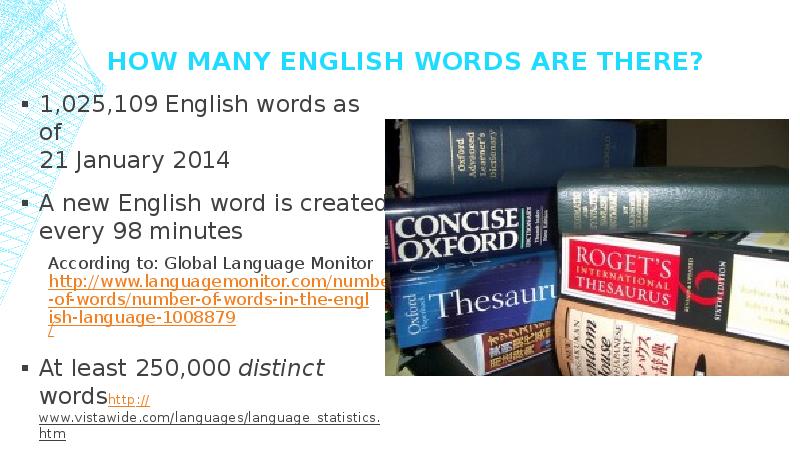
How Many English Words are There? 1,025,109 English words as of 21 January 2014 A new English word is created every 98 minutes According to: Global...
Описание слайда:
How Many English Words are There? 1,025,109 English words as of 21 January 2014 A new English word is created every 98 minutes According to: Global Language Monitor At least 250,000 distinct words

Слайд 6


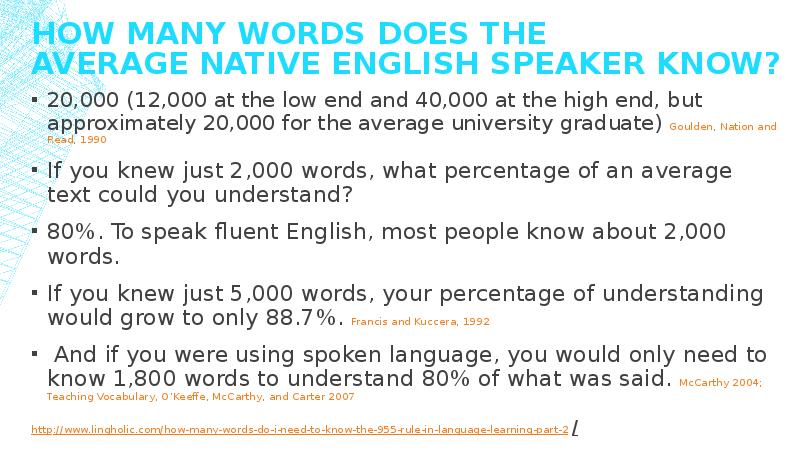
How Many Words Does the Average Native English Speaker Know? 20,000 (12,000 at the low end and 40,000 at the high end, but approximately 20,000 for...
Описание слайда:
How Many Words Does the Average Native English Speaker Know? 20,000 (12,000 at the low end and 40,000 at the high end, but approximately 20,000 for the average university graduate) Goulden, Nation and Read, 1990 If you knew just 2,000 words, what percentage of an average text could you understand? 80%. To speak fluent English, most people know about 2,000 words. If you knew just 5,000 words, your percentage of understanding would grow to only 88.7%. Francis and Kuccera, 1992 And if you were using spoken language, you would only need to know 1,800 words to understand 80% of what was said. McCarthy 2004; Teaching Vocabulary, O’Keeffe, McCarthy, and Carter 2007

Слайд 7


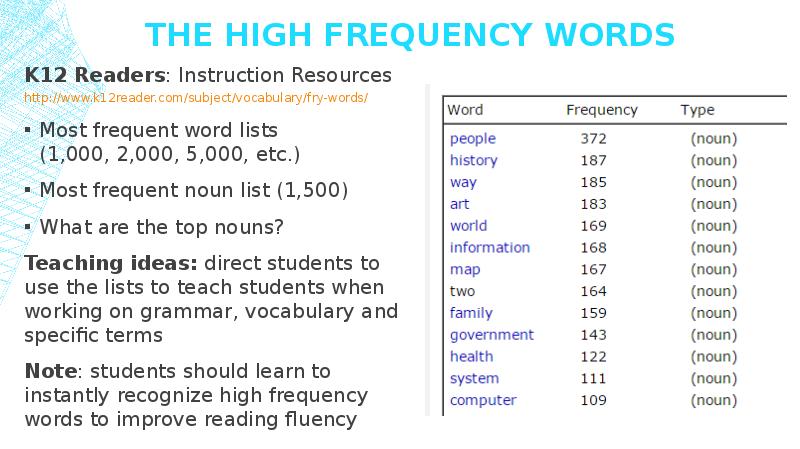
the high frequency Words K12 Readers: Instruction Resources Most frequent word lists (1,000, 2,000, 5,000, etc.) Most frequent noun list (1,500) What...
Описание слайда:
the high frequency Words K12 Readers: Instruction Resources Most frequent word lists (1,000, 2,000, 5,000, etc.) Most frequent noun list (1,500) What are the top nouns? Teaching ideas: direct students to use the lists to teach students when working on grammar, vocabulary and specific terms Note: students should learn to instantly recognize high frequency words to improve reading fluency

Слайд 8


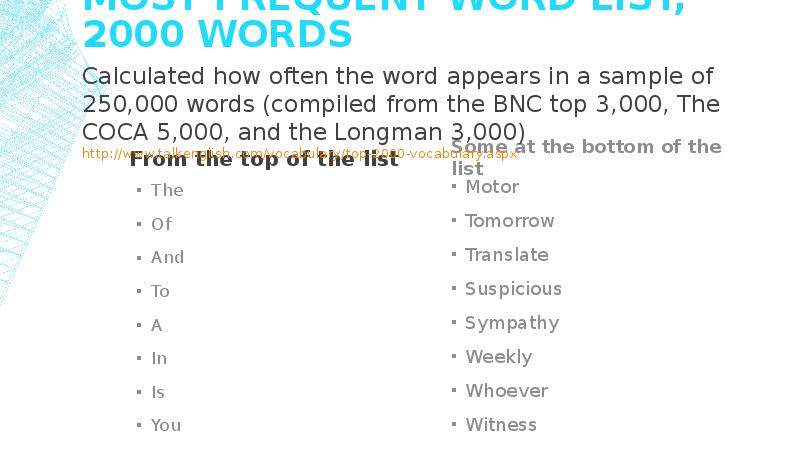
Most Frequent Word List, 2000 Words From the top of the list
Описание слайда:
Most Frequent Word List, 2000 Words From the top of the list

Слайд 9


Seven Steps to Learn Vocabulary STEP 1 Define the word They write the word in a sentence Give an example of the word Translate it
Описание слайда:
Seven Steps to Learn Vocabulary STEP 1 Define the word They write the word in a sentence Give an example of the word Translate it

Слайд 10


Step 2 Student defines the term in their own words, creating their own definition that makes sense to them They use the word in their speaking/writing
Описание слайда:
Step 2 Student defines the term in their own words, creating their own definition that makes sense to them They use the word in their speaking/writing

Слайд 11


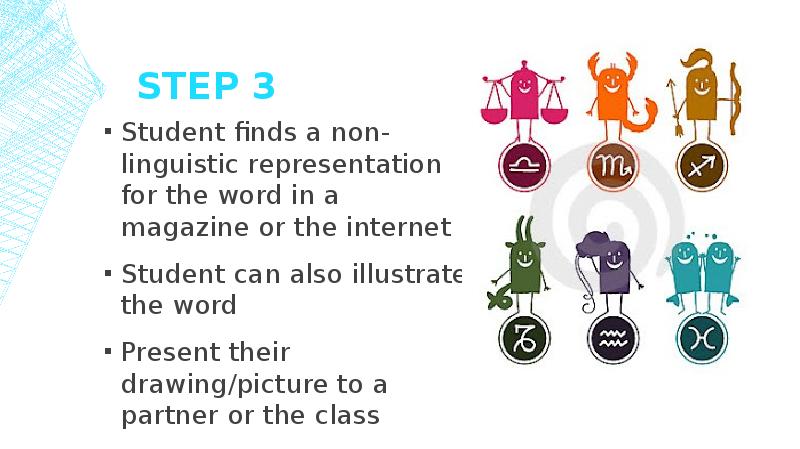
Step 3 Student finds a non-linguistic representation for the word in a magazine or the internet Student can also illustrate the word Present their...
Описание слайда:
Step 3 Student finds a non-linguistic representation for the word in a magazine or the internet Student can also illustrate the word Present their drawing/picture to a partner or the class

Слайд 12


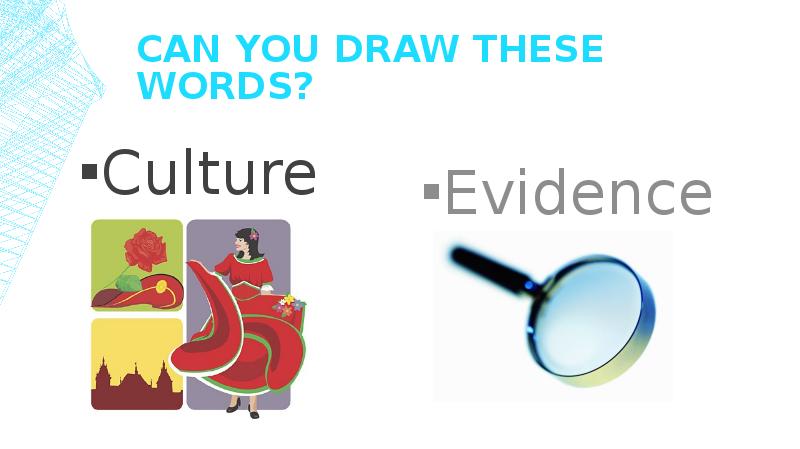
Can You Draw These Words? Culture
Описание слайда:
Can You Draw These Words? Culture

Слайд 13


Step 4 Students may increase their knowledge of terms by finding similarities, making comparisons, analyzing, etc.
Описание слайда:
Step 4 Students may increase their knowledge of terms by finding similarities, making comparisons, analyzing, etc.

Слайд 14


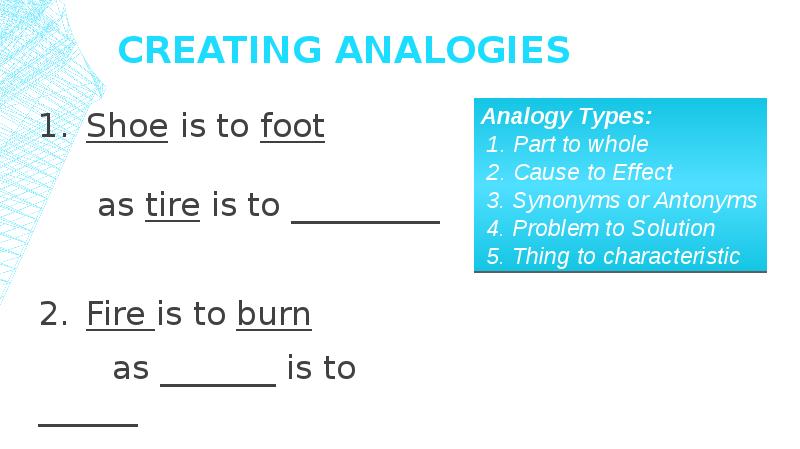
Creating Analogies Shoe is to foot as tire is to _________ Fire is to burn as _______ is to ______
Описание слайда:
Creating Analogies Shoe is to foot as tire is to _________ Fire is to burn as _______ is to ______

Слайд 15


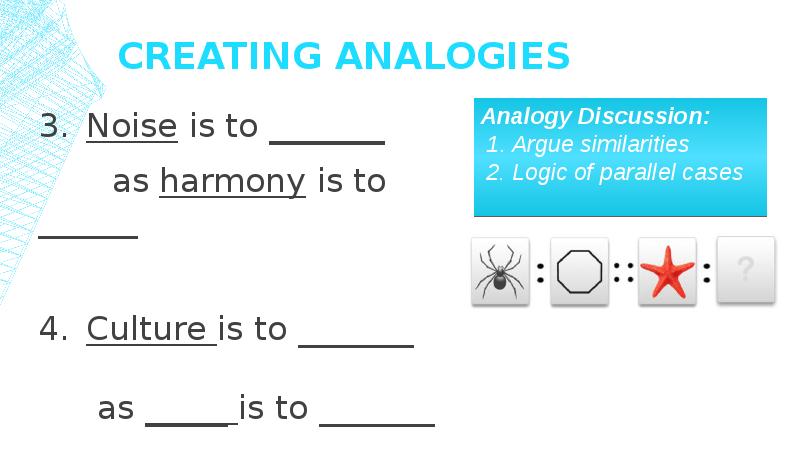
Creating Analogies Noise is to _______ as harmony is to ______ Culture is to _______ as _____ is to _______
Описание слайда:
Creating Analogies Noise is to _______ as harmony is to ______ Culture is to _______ as _____ is to _______

Слайд 16


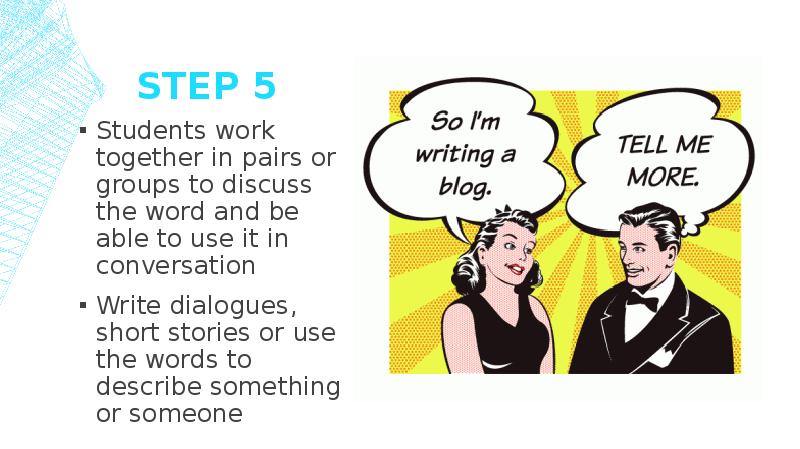
Step 5 Students work together in pairs or groups to discuss the word and be able to use it in conversation Write dialogues, short stories or use the...
Описание слайда:
Step 5 Students work together in pairs or groups to discuss the word and be able to use it in conversation Write dialogues, short stories or use the words to describe something or someone

Слайд 17


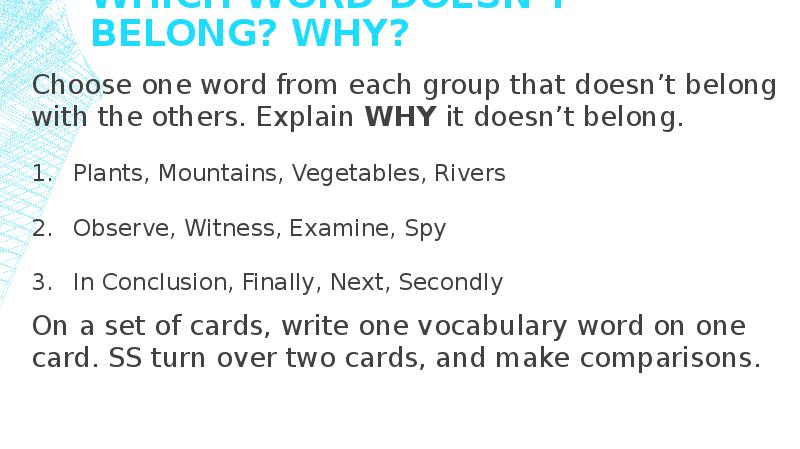
Which Word Doesn’t Belong? Why? Choose one word from each group that doesn’t belong with the others. Explain WHY it doesn’t belong. Plants,...
Описание слайда:
Which Word Doesn’t Belong? Why? Choose one word from each group that doesn’t belong with the others. Explain WHY it doesn’t belong. Plants, Mountains, Vegetables, Rivers Observe, Witness, Examine, Spy In Conclusion, Finally, Next, Secondly On a set of cards, write one vocabulary word on one card. SS turn over two cards, and make comparisons.

Слайд 18


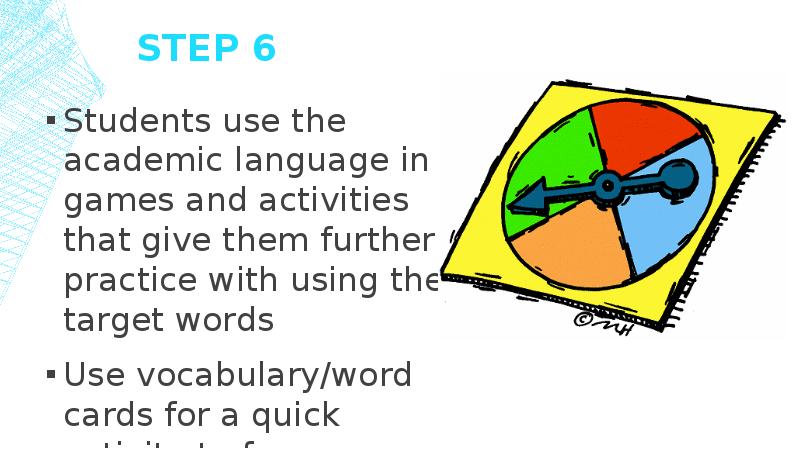
Step 6 Students use the academic language in games and activities that give them further practice with using the target words Use vocabulary/word...
Описание слайда:
Step 6 Students use the academic language in games and activities that give them further practice with using the target words Use vocabulary/word cards for a quick activity to focus on developing skills

Слайд 19


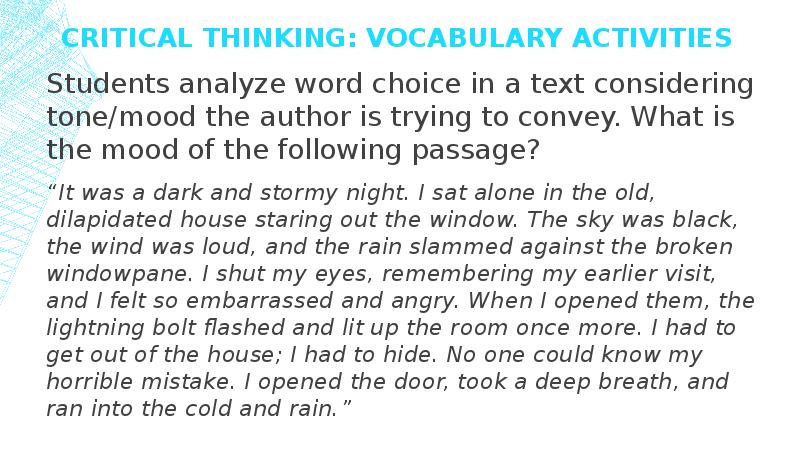
Critical Thinking: Vocabulary activities Students analyze word choice in a text considering tone/mood the author is trying to convey. What is the...
Описание слайда:
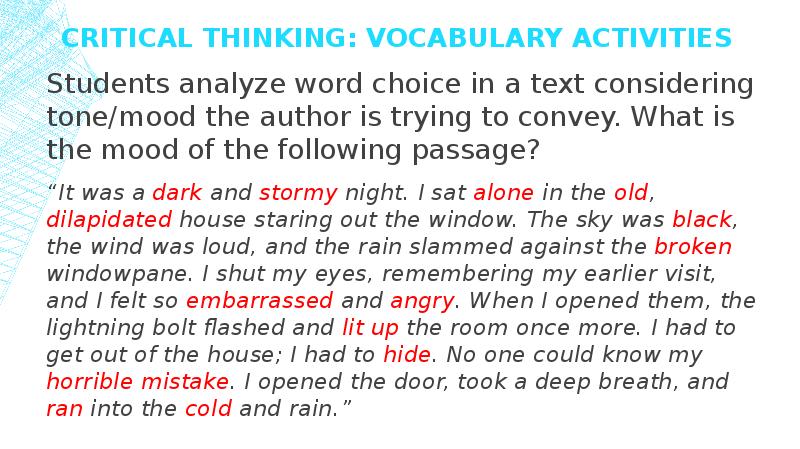
Critical Thinking: Vocabulary activities Students analyze word choice in a text considering tone/mood the author is trying to convey. What is the mood of the following passage? “It was a dark and stormy night. I sat alone in the old, dilapidated house staring out the window. The sky was black, the wind was loud, and the rain slammed against the broken windowpane. I shut my eyes, remembering my earlier visit, and I felt so embarrassed and angry. When I opened them, the lightning bolt flashed and lit up the room once more. I had to get out of the house; I had to hide. No one could know my horrible mistake. I opened the door, took a deep breath, and ran into the cold and rain.”

Слайд 20


Critical Thinking: Vocabulary activities Students analyze word choice in a text considering tone/mood the author is trying to convey. What is the...
Описание слайда:
Critical Thinking: Vocabulary activities Students analyze word choice in a text considering tone/mood the author is trying to convey. What is the mood of the following passage? “It was a dark and stormy night. I sat alone in the old, dilapidated house staring out the window. The sky was black, the wind was loud, and the rain slammed against the broken windowpane. I shut my eyes, remembering my earlier visit, and I felt so embarrassed and angry. When I opened them, the lightning bolt flashed and lit up the room once more. I had to get out of the house; I had to hide. No one could know my horrible mistake. I opened the door, took a deep breath, and ran into the cold and rain.”

Слайд 21


Critical Thinking: Vocabulary activities Students analyze connotations of words. Anthony appeared confident when speaking with his colleagues....
Описание слайда:
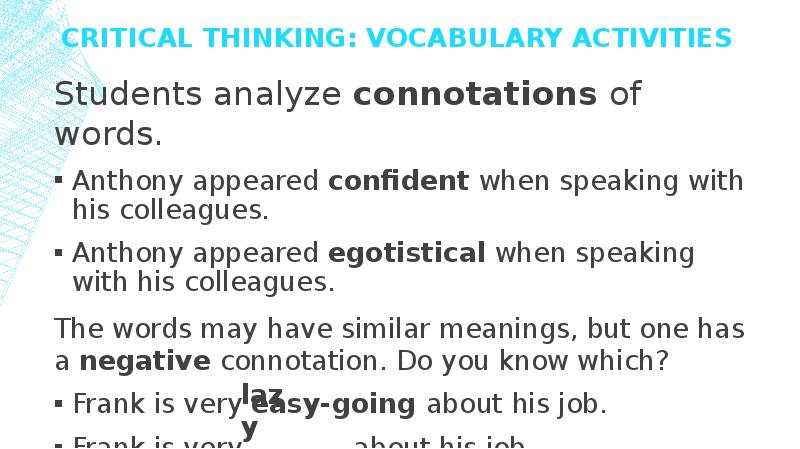
Critical Thinking: Vocabulary activities Students analyze connotations of words. Anthony appeared confident when speaking with his colleagues. Anthony appeared egotistical when speaking with his colleagues. The words may have similar meanings, but one has a negative connotation. Do you know which? Frank is very easy-going about his job. Frank is very _______ about his job.

Слайд 22


Step 7 Students recall words for quizzes, tests and exams This act of recalling words or knowledge is an important part of learning...
Описание слайда:
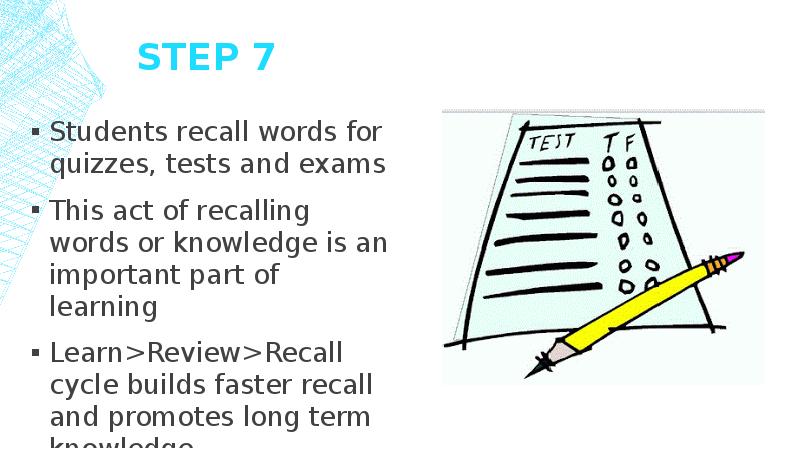
Step 7 Students recall words for quizzes, tests and exams This act of recalling words or knowledge is an important part of learning Learn>Review>Recall cycle builds faster recall and promotes long term knowledge

Слайд 23


In Tests consider Asking For… Definitions Use the word or phrase in a sentence Answer questions about the word in a speaking test Synonyms/Antonyms...
Описание слайда:
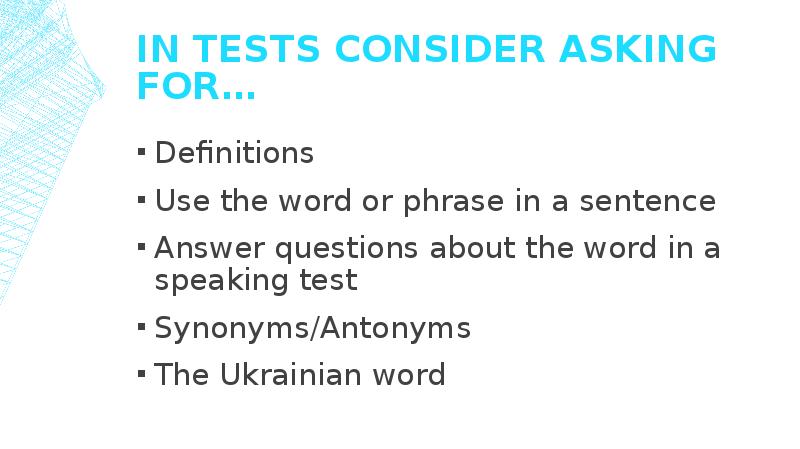
In Tests consider Asking For… Definitions Use the word or phrase in a sentence Answer questions about the word in a speaking test Synonyms/Antonyms The Ukrainian word

Слайд 24


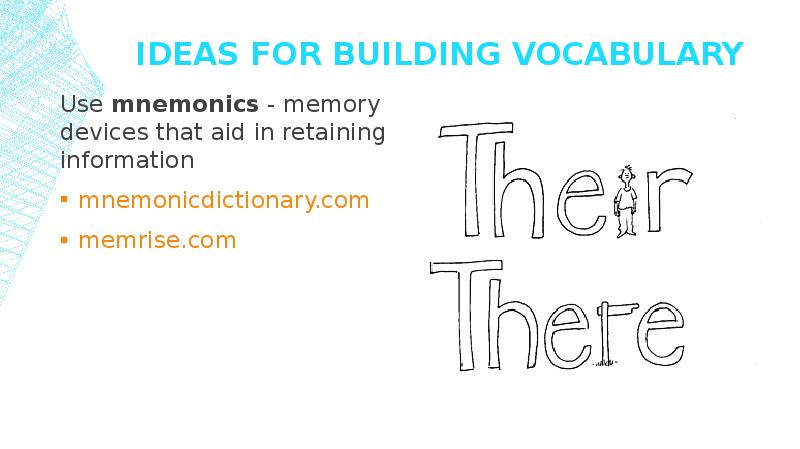
Ideas for Building vocabulary Use mnemonics - memory devices that aid in retaining information mnemonicdictionary.com memrise.com
Описание слайда:
Ideas for Building vocabulary Use mnemonics - memory devices that aid in retaining information mnemonicdictionary.com memrise.com

Слайд 25


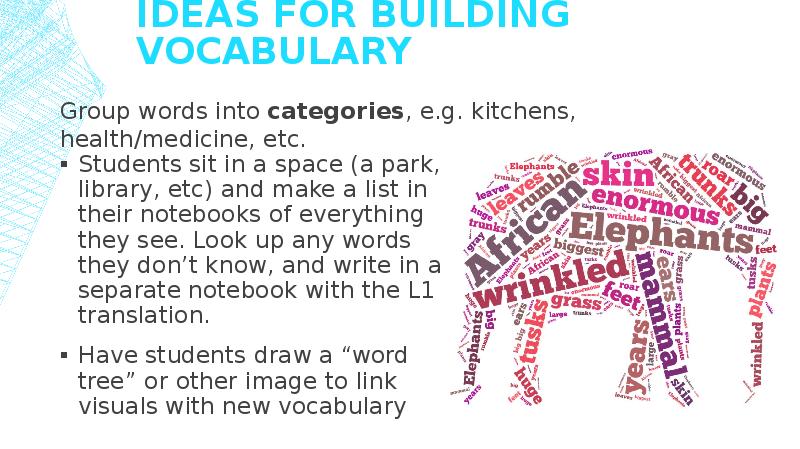
Ideas for Building vocabulary Students sit in a space (a park, library, etc) and make a list in their notebooks of everything they see. Look up any...
Описание слайда:
Ideas for Building vocabulary Students sit in a space (a park, library, etc) and make a list in their notebooks of everything they see. Look up any words they don’t know, and write in a separate notebook with the L1 translation. Have students draw a “word tree” or other image to link visuals with new vocabulary

Слайд 26


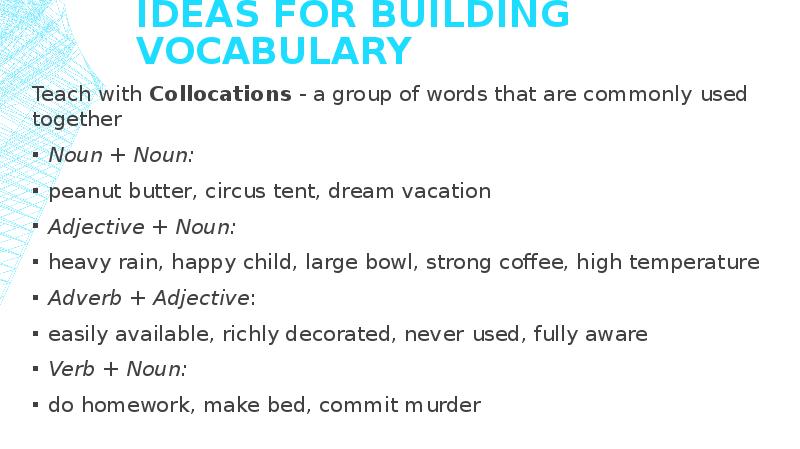
Ideas for Building vocabulary Teach with Collocations - a group of words that are commonly used together Noun + Noun: peanut butter, circus tent,...
Описание слайда:
Ideas for Building vocabulary Teach with Collocations - a group of words that are commonly used together Noun + Noun: peanut butter, circus tent, dream vacation Adjective + Noun: heavy rain, happy child, large bowl, strong coffee, high temperature Adverb + Adjective: easily available, richly decorated, never used, fully aware Verb + Noun: do homework, make bed, commit murder

Слайд 27


Students should think of words in groups/chunks and not just individuals words: Students should think of words in groups/chunks and not just...
Описание слайда:
Students should think of words in groups/chunks and not just individuals words: Students should think of words in groups/chunks and not just individuals words: Use collocation dictionaries with students Teaching collocations…to eat with, eat by, eat over, eat near, eat on… Activities for teaching collocations

Слайд 28


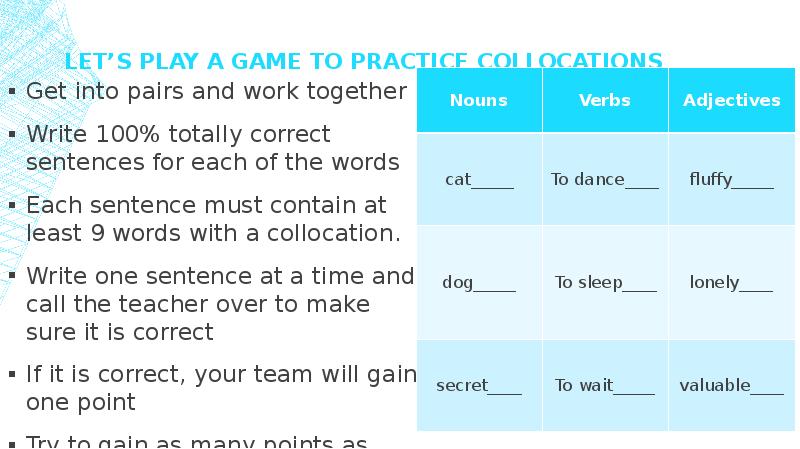
Let’s Play a Game to practice Collocations Get into pairs and work together Write 100% totally correct sentences for each of the words Each sentence...
Описание слайда:
Let’s Play a Game to practice Collocations Get into pairs and work together Write 100% totally correct sentences for each of the words Each sentence must contain at least 9 words with a collocation. Write one sentence at a time and call the teacher over to make sure it is correct If it is correct, your team will gain one point Try to gain as many points as possible from creating correct sentences

Слайд 29


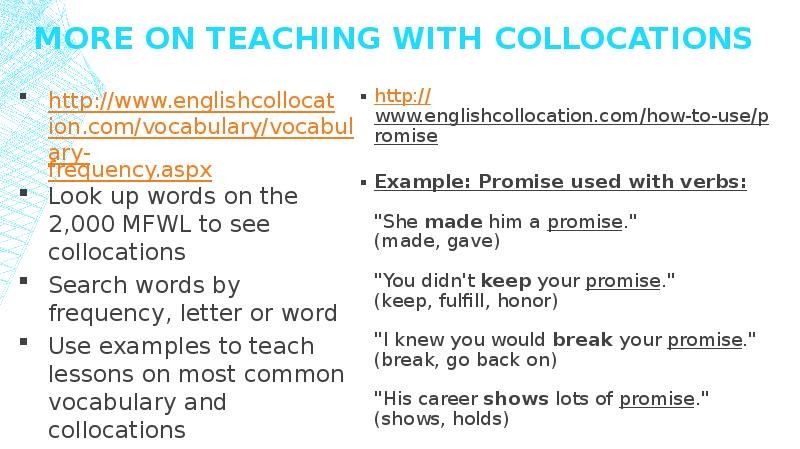
More on Teaching With Collocations Example: Promise used with verbs: "She made him a promise." (made, gave) "You didn't keep your...
Описание слайда:
More on Teaching With Collocations Example: Promise used with verbs: "She made him a promise." (made, gave) "You didn't keep your promise." (keep, fulfill, honor) "I knew you would break your promise." (break, go back on) "His career shows lots of promise." (shows, holds)

Слайд 30


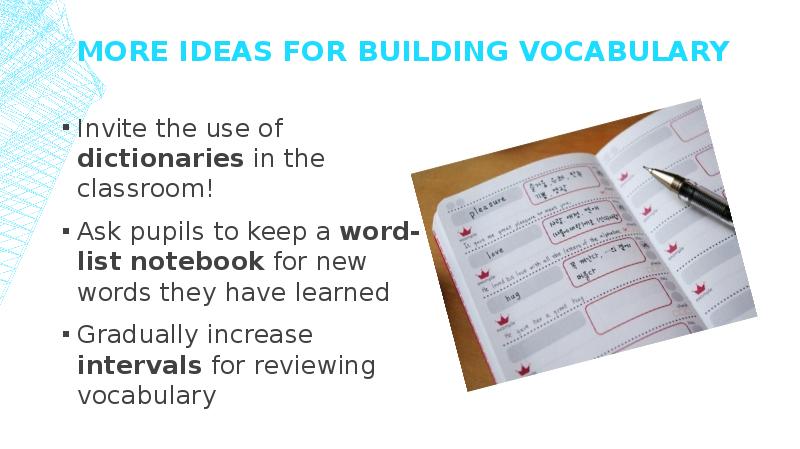
More Ideas for Building vocabulary Invite the use of dictionaries in the classroom! Ask pupils to keep a word-list notebook for new words they have...
Описание слайда:
More Ideas for Building vocabulary Invite the use of dictionaries in the classroom! Ask pupils to keep a word-list notebook for new words they have learned Gradually increase intervals for reviewing vocabulary

Слайд 31


Resource pages for Teachers & Students Resource website for teaching English around the world offering books, articles, music, lesson plans for all...
Описание слайда:
Resource pages for Teachers & Students Resource website for teaching English around the world offering books, articles, music, lesson plans for all levels including; Vocabulary building ideas “Trace Word Soup” and other video games for learning English Games and more!

Слайд 32


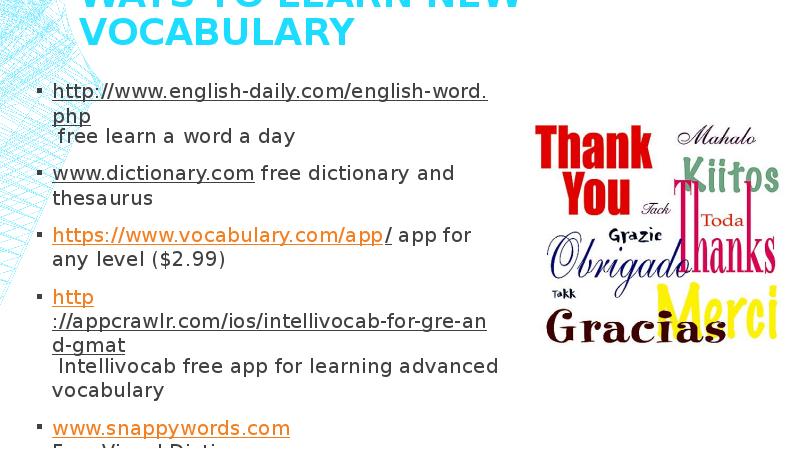
Ways to Learn New Vocabulary free learn a word a day free dictionary and thesaurus app for any level ($2.99) Intellivocab free app for learning...
Описание слайда:
Ways to Learn New Vocabulary free learn a word a day free dictionary and thesaurus app for any level ($2.99) Intellivocab free app for learning advanced vocabulary Free Visual Dictionary

Слайд 33


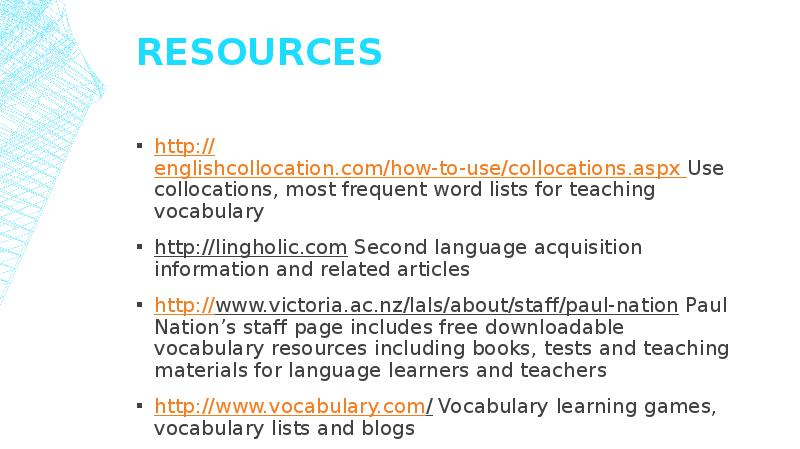
Resources Use collocations, most frequent word lists for teaching vocabulary Second language acquisition information and related articles Paul...
Описание слайда:
Resources Use collocations, most frequent word lists for teaching vocabulary Second language acquisition information and related articles Paul Nation’s staff page includes free downloadable vocabulary resources including books, tests and teaching materials for language learners and teachers Vocabulary learning games, vocabulary lists and blogs

Слайд 34


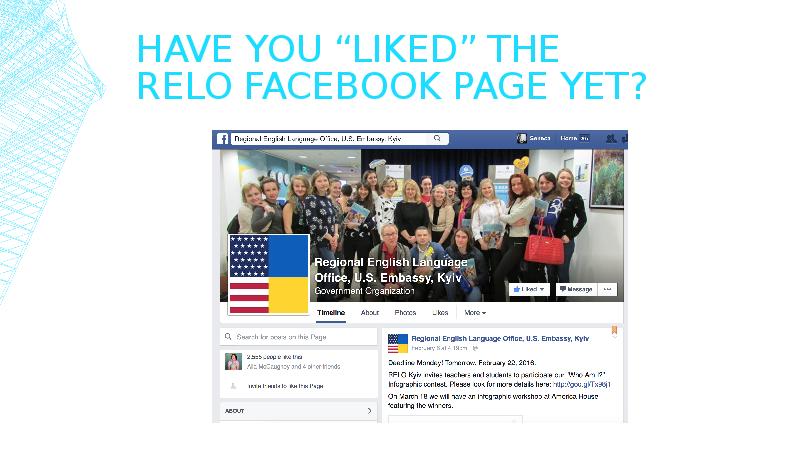
Have you “Liked” the RELo facebook page yet?
Описание слайда:
Have you “Liked” the RELo facebook page yet?

Слайд 35


If you don’t use it, you’ll lose it! comments or Questions? senecafellow@gmail.com
Описание слайда:
If you don’t use it, you’ll lose it! comments or Questions? senecafellow@gmail.com


Похожие презентации
Mypresentation.ru
Загрузить презентацию