🗊 Презентация Environmental Modeling in Industrial Application Models for Supporting Incident Evolution: Release of Dense-than-air Pollutants

Категория: Окружающий мир
Нажмите для полного просмотра!
Environmental Modeling in Industrial Application Models for Supporting Incident Evolution: Release of Dense-than-air Pollutants, слайд №1 Environmental Modeling in Industrial Application Models for Supporting Incident Evolution: Release of Dense-than-air Pollutants, слайд №2 Environmental Modeling in Industrial Application Models for Supporting Incident Evolution: Release of Dense-than-air Pollutants, слайд №3 Environmental Modeling in Industrial Application Models for Supporting Incident Evolution: Release of Dense-than-air Pollutants, слайд №4 Environmental Modeling in Industrial Application Models for Supporting Incident Evolution: Release of Dense-than-air Pollutants, слайд №5 Environmental Modeling in Industrial Application Models for Supporting Incident Evolution: Release of Dense-than-air Pollutants, слайд №6 Environmental Modeling in Industrial Application Models for Supporting Incident Evolution: Release of Dense-than-air Pollutants, слайд №7 Environmental Modeling in Industrial Application Models for Supporting Incident Evolution: Release of Dense-than-air Pollutants, слайд №8 Environmental Modeling in Industrial Application Models for Supporting Incident Evolution: Release of Dense-than-air Pollutants, слайд №9 Environmental Modeling in Industrial Application Models for Supporting Incident Evolution: Release of Dense-than-air Pollutants, слайд №10 Environmental Modeling in Industrial Application Models for Supporting Incident Evolution: Release of Dense-than-air Pollutants, слайд №11 Environmental Modeling in Industrial Application Models for Supporting Incident Evolution: Release of Dense-than-air Pollutants, слайд №12 Environmental Modeling in Industrial Application Models for Supporting Incident Evolution: Release of Dense-than-air Pollutants, слайд №13 Environmental Modeling in Industrial Application Models for Supporting Incident Evolution: Release of Dense-than-air Pollutants, слайд №14 Environmental Modeling in Industrial Application Models for Supporting Incident Evolution: Release of Dense-than-air Pollutants, слайд №15 Environmental Modeling in Industrial Application Models for Supporting Incident Evolution: Release of Dense-than-air Pollutants, слайд №16 Environmental Modeling in Industrial Application Models for Supporting Incident Evolution: Release of Dense-than-air Pollutants, слайд №17 Environmental Modeling in Industrial Application Models for Supporting Incident Evolution: Release of Dense-than-air Pollutants, слайд №18 Environmental Modeling in Industrial Application Models for Supporting Incident Evolution: Release of Dense-than-air Pollutants, слайд №19 Environmental Modeling in Industrial Application Models for Supporting Incident Evolution: Release of Dense-than-air Pollutants, слайд №20 Environmental Modeling in Industrial Application Models for Supporting Incident Evolution: Release of Dense-than-air Pollutants, слайд №21 Environmental Modeling in Industrial Application Models for Supporting Incident Evolution: Release of Dense-than-air Pollutants, слайд №22 Environmental Modeling in Industrial Application Models for Supporting Incident Evolution: Release of Dense-than-air Pollutants, слайд №23 Environmental Modeling in Industrial Application Models for Supporting Incident Evolution: Release of Dense-than-air Pollutants, слайд №24 Environmental Modeling in Industrial Application Models for Supporting Incident Evolution: Release of Dense-than-air Pollutants, слайд №25 Environmental Modeling in Industrial Application Models for Supporting Incident Evolution: Release of Dense-than-air Pollutants, слайд №26 Environmental Modeling in Industrial Application Models for Supporting Incident Evolution: Release of Dense-than-air Pollutants, слайд №27 Environmental Modeling in Industrial Application Models for Supporting Incident Evolution: Release of Dense-than-air Pollutants, слайд №28 Environmental Modeling in Industrial Application Models for Supporting Incident Evolution: Release of Dense-than-air Pollutants, слайд №29 Environmental Modeling in Industrial Application Models for Supporting Incident Evolution: Release of Dense-than-air Pollutants, слайд №30 Environmental Modeling in Industrial Application Models for Supporting Incident Evolution: Release of Dense-than-air Pollutants, слайд №31 Environmental Modeling in Industrial Application Models for Supporting Incident Evolution: Release of Dense-than-air Pollutants, слайд №32 Environmental Modeling in Industrial Application Models for Supporting Incident Evolution: Release of Dense-than-air Pollutants, слайд №33 Environmental Modeling in Industrial Application Models for Supporting Incident Evolution: Release of Dense-than-air Pollutants, слайд №34 Environmental Modeling in Industrial Application Models for Supporting Incident Evolution: Release of Dense-than-air Pollutants, слайд №35 Environmental Modeling in Industrial Application Models for Supporting Incident Evolution: Release of Dense-than-air Pollutants, слайд №36 Environmental Modeling in Industrial Application Models for Supporting Incident Evolution: Release of Dense-than-air Pollutants, слайд №37 Environmental Modeling in Industrial Application Models for Supporting Incident Evolution: Release of Dense-than-air Pollutants, слайд №38 Environmental Modeling in Industrial Application Models for Supporting Incident Evolution: Release of Dense-than-air Pollutants, слайд №39 Environmental Modeling in Industrial Application Models for Supporting Incident Evolution: Release of Dense-than-air Pollutants, слайд №40 Environmental Modeling in Industrial Application Models for Supporting Incident Evolution: Release of Dense-than-air Pollutants, слайд №41 Environmental Modeling in Industrial Application Models for Supporting Incident Evolution: Release of Dense-than-air Pollutants, слайд №42 Environmental Modeling in Industrial Application Models for Supporting Incident Evolution: Release of Dense-than-air Pollutants, слайд №43 Environmental Modeling in Industrial Application Models for Supporting Incident Evolution: Release of Dense-than-air Pollutants, слайд №44 Environmental Modeling in Industrial Application Models for Supporting Incident Evolution: Release of Dense-than-air Pollutants, слайд №45 Environmental Modeling in Industrial Application Models for Supporting Incident Evolution: Release of Dense-than-air Pollutants, слайд №46 Environmental Modeling in Industrial Application Models for Supporting Incident Evolution: Release of Dense-than-air Pollutants, слайд №47 Environmental Modeling in Industrial Application Models for Supporting Incident Evolution: Release of Dense-than-air Pollutants, слайд №48 Environmental Modeling in Industrial Application Models for Supporting Incident Evolution: Release of Dense-than-air Pollutants, слайд №49 Environmental Modeling in Industrial Application Models for Supporting Incident Evolution: Release of Dense-than-air Pollutants, слайд №50 Environmental Modeling in Industrial Application Models for Supporting Incident Evolution: Release of Dense-than-air Pollutants, слайд №51 Environmental Modeling in Industrial Application Models for Supporting Incident Evolution: Release of Dense-than-air Pollutants, слайд №52 Environmental Modeling in Industrial Application Models for Supporting Incident Evolution: Release of Dense-than-air Pollutants, слайд №53 Environmental Modeling in Industrial Application Models for Supporting Incident Evolution: Release of Dense-than-air Pollutants, слайд №54 Environmental Modeling in Industrial Application Models for Supporting Incident Evolution: Release of Dense-than-air Pollutants, слайд №55 Environmental Modeling in Industrial Application Models for Supporting Incident Evolution: Release of Dense-than-air Pollutants, слайд №56 Environmental Modeling in Industrial Application Models for Supporting Incident Evolution: Release of Dense-than-air Pollutants, слайд №57 Environmental Modeling in Industrial Application Models for Supporting Incident Evolution: Release of Dense-than-air Pollutants, слайд №58 Environmental Modeling in Industrial Application Models for Supporting Incident Evolution: Release of Dense-than-air Pollutants, слайд №59 Environmental Modeling in Industrial Application Models for Supporting Incident Evolution: Release of Dense-than-air Pollutants, слайд №60 Environmental Modeling in Industrial Application Models for Supporting Incident Evolution: Release of Dense-than-air Pollutants, слайд №61 Environmental Modeling in Industrial Application Models for Supporting Incident Evolution: Release of Dense-than-air Pollutants, слайд №62 Environmental Modeling in Industrial Application Models for Supporting Incident Evolution: Release of Dense-than-air Pollutants, слайд №63 Environmental Modeling in Industrial Application Models for Supporting Incident Evolution: Release of Dense-than-air Pollutants, слайд №64 Environmental Modeling in Industrial Application Models for Supporting Incident Evolution: Release of Dense-than-air Pollutants, слайд №65 Environmental Modeling in Industrial Application Models for Supporting Incident Evolution: Release of Dense-than-air Pollutants, слайд №66 Environmental Modeling in Industrial Application Models for Supporting Incident Evolution: Release of Dense-than-air Pollutants, слайд №67 Environmental Modeling in Industrial Application Models for Supporting Incident Evolution: Release of Dense-than-air Pollutants, слайд №68 Environmental Modeling in Industrial Application Models for Supporting Incident Evolution: Release of Dense-than-air Pollutants, слайд №69 Environmental Modeling in Industrial Application Models for Supporting Incident Evolution: Release of Dense-than-air Pollutants, слайд №70 Environmental Modeling in Industrial Application Models for Supporting Incident Evolution: Release of Dense-than-air Pollutants, слайд №71 Environmental Modeling in Industrial Application Models for Supporting Incident Evolution: Release of Dense-than-air Pollutants, слайд №72 Environmental Modeling in Industrial Application Models for Supporting Incident Evolution: Release of Dense-than-air Pollutants, слайд №73 Environmental Modeling in Industrial Application Models for Supporting Incident Evolution: Release of Dense-than-air Pollutants, слайд №74 Environmental Modeling in Industrial Application Models for Supporting Incident Evolution: Release of Dense-than-air Pollutants, слайд №75 Environmental Modeling in Industrial Application Models for Supporting Incident Evolution: Release of Dense-than-air Pollutants, слайд №76 Environmental Modeling in Industrial Application Models for Supporting Incident Evolution: Release of Dense-than-air Pollutants, слайд №77 Environmental Modeling in Industrial Application Models for Supporting Incident Evolution: Release of Dense-than-air Pollutants, слайд №78 Environmental Modeling in Industrial Application Models for Supporting Incident Evolution: Release of Dense-than-air Pollutants, слайд №79 Environmental Modeling in Industrial Application Models for Supporting Incident Evolution: Release of Dense-than-air Pollutants, слайд №80 Environmental Modeling in Industrial Application Models for Supporting Incident Evolution: Release of Dense-than-air Pollutants, слайд №81 Environmental Modeling in Industrial Application Models for Supporting Incident Evolution: Release of Dense-than-air Pollutants, слайд №82 Environmental Modeling in Industrial Application Models for Supporting Incident Evolution: Release of Dense-than-air Pollutants, слайд №83 Environmental Modeling in Industrial Application Models for Supporting Incident Evolution: Release of Dense-than-air Pollutants, слайд №84 Environmental Modeling in Industrial Application Models for Supporting Incident Evolution: Release of Dense-than-air Pollutants, слайд №85 Environmental Modeling in Industrial Application Models for Supporting Incident Evolution: Release of Dense-than-air Pollutants, слайд №86 Environmental Modeling in Industrial Application Models for Supporting Incident Evolution: Release of Dense-than-air Pollutants, слайд №87 Environmental Modeling in Industrial Application Models for Supporting Incident Evolution: Release of Dense-than-air Pollutants, слайд №88 Environmental Modeling in Industrial Application Models for Supporting Incident Evolution: Release of Dense-than-air Pollutants, слайд №89 Environmental Modeling in Industrial Application Models for Supporting Incident Evolution: Release of Dense-than-air Pollutants, слайд №90 Environmental Modeling in Industrial Application Models for Supporting Incident Evolution: Release of Dense-than-air Pollutants, слайд №91 Environmental Modeling in Industrial Application Models for Supporting Incident Evolution: Release of Dense-than-air Pollutants, слайд №92 Environmental Modeling in Industrial Application Models for Supporting Incident Evolution: Release of Dense-than-air Pollutants, слайд №93 Environmental Modeling in Industrial Application Models for Supporting Incident Evolution: Release of Dense-than-air Pollutants, слайд №94 Environmental Modeling in Industrial Application Models for Supporting Incident Evolution: Release of Dense-than-air Pollutants, слайд №95 Environmental Modeling in Industrial Application Models for Supporting Incident Evolution: Release of Dense-than-air Pollutants, слайд №96 Environmental Modeling in Industrial Application Models for Supporting Incident Evolution: Release of Dense-than-air Pollutants, слайд №97 Environmental Modeling in Industrial Application Models for Supporting Incident Evolution: Release of Dense-than-air Pollutants, слайд №98 Environmental Modeling in Industrial Application Models for Supporting Incident Evolution: Release of Dense-than-air Pollutants, слайд №99 Environmental Modeling in Industrial Application Models for Supporting Incident Evolution: Release of Dense-than-air Pollutants, слайд №100 Environmental Modeling in Industrial Application Models for Supporting Incident Evolution: Release of Dense-than-air Pollutants, слайд №101 Environmental Modeling in Industrial Application Models for Supporting Incident Evolution: Release of Dense-than-air Pollutants, слайд №102 Environmental Modeling in Industrial Application Models for Supporting Incident Evolution: Release of Dense-than-air Pollutants, слайд №103 Environmental Modeling in Industrial Application Models for Supporting Incident Evolution: Release of Dense-than-air Pollutants, слайд №104 Environmental Modeling in Industrial Application Models for Supporting Incident Evolution: Release of Dense-than-air Pollutants, слайд №105 Environmental Modeling in Industrial Application Models for Supporting Incident Evolution: Release of Dense-than-air Pollutants, слайд №106 Environmental Modeling in Industrial Application Models for Supporting Incident Evolution: Release of Dense-than-air Pollutants, слайд №107 Environmental Modeling in Industrial Application Models for Supporting Incident Evolution: Release of Dense-than-air Pollutants, слайд №108 Environmental Modeling in Industrial Application Models for Supporting Incident Evolution: Release of Dense-than-air Pollutants, слайд №109 Environmental Modeling in Industrial Application Models for Supporting Incident Evolution: Release of Dense-than-air Pollutants, слайд №110 Environmental Modeling in Industrial Application Models for Supporting Incident Evolution: Release of Dense-than-air Pollutants, слайд №111 Environmental Modeling in Industrial Application Models for Supporting Incident Evolution: Release of Dense-than-air Pollutants, слайд №112 Environmental Modeling in Industrial Application Models for Supporting Incident Evolution: Release of Dense-than-air Pollutants, слайд №113 Environmental Modeling in Industrial Application Models for Supporting Incident Evolution: Release of Dense-than-air Pollutants, слайд №114 Environmental Modeling in Industrial Application Models for Supporting Incident Evolution: Release of Dense-than-air Pollutants, слайд №115 Environmental Modeling in Industrial Application Models for Supporting Incident Evolution: Release of Dense-than-air Pollutants, слайд №116 Environmental Modeling in Industrial Application Models for Supporting Incident Evolution: Release of Dense-than-air Pollutants, слайд №117 Environmental Modeling in Industrial Application Models for Supporting Incident Evolution: Release of Dense-than-air Pollutants, слайд №118 Environmental Modeling in Industrial Application Models for Supporting Incident Evolution: Release of Dense-than-air Pollutants, слайд №119 Environmental Modeling in Industrial Application Models for Supporting Incident Evolution: Release of Dense-than-air Pollutants, слайд №120 Environmental Modeling in Industrial Application Models for Supporting Incident Evolution: Release of Dense-than-air Pollutants, слайд №121 Environmental Modeling in Industrial Application Models for Supporting Incident Evolution: Release of Dense-than-air Pollutants, слайд №122 Environmental Modeling in Industrial Application Models for Supporting Incident Evolution: Release of Dense-than-air Pollutants, слайд №123 Environmental Modeling in Industrial Application Models for Supporting Incident Evolution: Release of Dense-than-air Pollutants, слайд №124 Environmental Modeling in Industrial Application Models for Supporting Incident Evolution: Release of Dense-than-air Pollutants, слайд №125 Environmental Modeling in Industrial Application Models for Supporting Incident Evolution: Release of Dense-than-air Pollutants, слайд №126 Environmental Modeling in Industrial Application Models for Supporting Incident Evolution: Release of Dense-than-air Pollutants, слайд №127 Environmental Modeling in Industrial Application Models for Supporting Incident Evolution: Release of Dense-than-air Pollutants, слайд №128 Environmental Modeling in Industrial Application Models for Supporting Incident Evolution: Release of Dense-than-air Pollutants, слайд №129 Environmental Modeling in Industrial Application Models for Supporting Incident Evolution: Release of Dense-than-air Pollutants, слайд №130 Environmental Modeling in Industrial Application Models for Supporting Incident Evolution: Release of Dense-than-air Pollutants, слайд №131 Environmental Modeling in Industrial Application Models for Supporting Incident Evolution: Release of Dense-than-air Pollutants, слайд №132 Environmental Modeling in Industrial Application Models for Supporting Incident Evolution: Release of Dense-than-air Pollutants, слайд №133 Environmental Modeling in Industrial Application Models for Supporting Incident Evolution: Release of Dense-than-air Pollutants, слайд №134 Environmental Modeling in Industrial Application Models for Supporting Incident Evolution: Release of Dense-than-air Pollutants, слайд №135 Environmental Modeling in Industrial Application Models for Supporting Incident Evolution: Release of Dense-than-air Pollutants, слайд №136 Environmental Modeling in Industrial Application Models for Supporting Incident Evolution: Release of Dense-than-air Pollutants, слайд №137 Environmental Modeling in Industrial Application Models for Supporting Incident Evolution: Release of Dense-than-air Pollutants, слайд №138 Environmental Modeling in Industrial Application Models for Supporting Incident Evolution: Release of Dense-than-air Pollutants, слайд №139 Environmental Modeling in Industrial Application Models for Supporting Incident Evolution: Release of Dense-than-air Pollutants, слайд №140 Environmental Modeling in Industrial Application Models for Supporting Incident Evolution: Release of Dense-than-air Pollutants, слайд №141 Environmental Modeling in Industrial Application Models for Supporting Incident Evolution: Release of Dense-than-air Pollutants, слайд №142 Environmental Modeling in Industrial Application Models for Supporting Incident Evolution: Release of Dense-than-air Pollutants, слайд №143 Environmental Modeling in Industrial Application Models for Supporting Incident Evolution: Release of Dense-than-air Pollutants, слайд №144 Environmental Modeling in Industrial Application Models for Supporting Incident Evolution: Release of Dense-than-air Pollutants, слайд №145

Содержание
Вы можете ознакомиться и скачать презентацию на тему Environmental Modeling in Industrial Application Models for Supporting Incident Evolution: Release of Dense-than-air Pollutants. Доклад-сообщение содержит 145 слайдов. Презентации для любого класса можно скачать бесплатно. Если материал и наш сайт презентаций Mypresentation Вам понравились – поделитесь им с друзьями с помощью социальных кнопок и добавьте в закладки в своем браузере.
Слайды и текст этой презентации


Слайд 1


Environmental Modeling in Industrial Application Models for Supporting Incident Evolution: Release of Dense-than-air Pollutants a.y. 2016-2017 Prof....
Описание слайда:
Environmental Modeling in Industrial Application Models for Supporting Incident Evolution: Release of Dense-than-air Pollutants a.y. 2016-2017 Prof. Eng. Roberto Revetria PhD Dr. Lorenzo Damiani PhD

Слайд 2


CONTENTS INTRODUCTION PREVISION MODELS SLAB THEORETICAL DESCRIPTION MODEL ORGANIZATION GOVERNING EQUATIONS TIME AVERAGED CONCENTRATIONS SLAB USER...
Описание слайда:
CONTENTS INTRODUCTION PREVISION MODELS SLAB THEORETICAL DESCRIPTION MODEL ORGANIZATION GOVERNING EQUATIONS TIME AVERAGED CONCENTRATIONS SLAB USER GUIDE

Слайд 3


INTRODUCTION Emission of polluting substances can come from: Vehicular traffic Industrial plants Thermo-electric plants Natural sources Accidents The...
Описание слайда:
INTRODUCTION Emission of polluting substances can come from: Vehicular traffic Industrial plants Thermo-electric plants Natural sources Accidents The transport of the polluting substances in atmosphere and their falling on the ground is a primary issue. We need means to predict the path of the polluting cloud in order to fulfill the required assistance and reclamation operations.

Слайд 4


INTRODUCTION The spatial and temporal distribution of the concentration of the polluting substance can help to quantify: The effects on human health...
Описание слайда:
INTRODUCTION The spatial and temporal distribution of the concentration of the polluting substance can help to quantify: The effects on human health (immediate or long-term exposure) The effects on the environment

Слайд 5


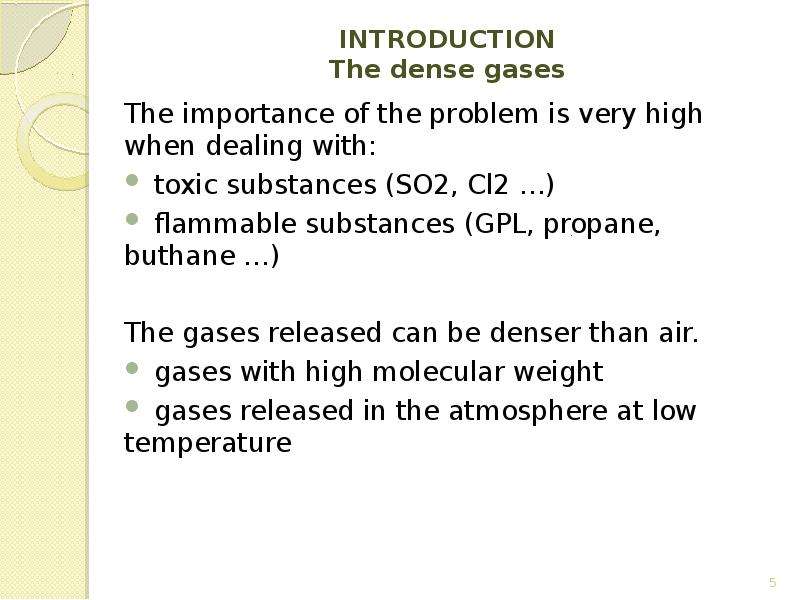
INTRODUCTION The dense gases The importance of the problem is very high when dealing with: toxic substances (SO2, Cl2 …) flammable substances (GPL,...
Описание слайда:
INTRODUCTION The dense gases The importance of the problem is very high when dealing with: toxic substances (SO2, Cl2 …) flammable substances (GPL, propane, buthane …) The gases released can be denser than air. gases with high molecular weight gases released in the atmosphere at low temperature

Слайд 6


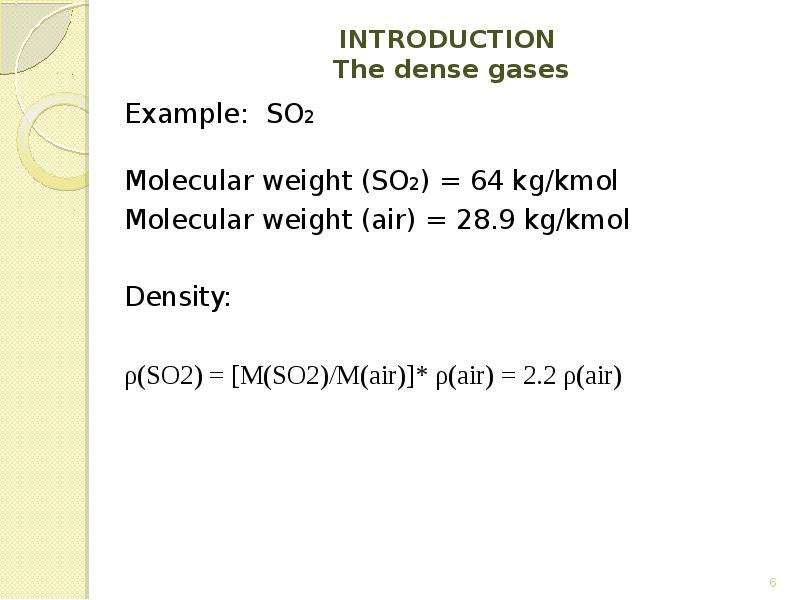
INTRODUCTION The dense gases Example: SO2 Molecular weight (SO2) = 64 kg/kmol Molecular weight (air) = 28.9 kg/kmol Density: ρ(SO2) =...
Описание слайда:
INTRODUCTION The dense gases Example: SO2 Molecular weight (SO2) = 64 kg/kmol Molecular weight (air) = 28.9 kg/kmol Density: ρ(SO2) = [M(SO2)/M(air)]* ρ(air) = 2.2 ρ(air)

Слайд 7


Airborne chemical pollution Attention must be paid to: accurately determine the types of pollutants taking into account the modalities of the...
Описание слайда:
Airborne chemical pollution Attention must be paid to: accurately determine the types of pollutants taking into account the modalities of the production process compare the reference concentrations with exposure limit values ​​allowed perform the technical control of concentrations, which must be made ​​exclusively by the source of pollution

Слайд 8


Airborne chemical pollution Pollutants are gaseous mixtures or aerosols, i.e. suspensions of solid or liquid particles in the air, large enough to...
Описание слайда:
Airborne chemical pollution Pollutants are gaseous mixtures or aerosols, i.e. suspensions of solid or liquid particles in the air, large enough to remain in suspension for an observable time. The following substance types can be individuated: Gases, i.e. substances that in reference conditions (temperature 25°C nd atmospheric pressure) are at gaseous state Vapors, substances at the gaseous state, which are liquid in reference conditions Dust or particulate matter i.e. solid particles with a diameter between 1 and 25 m Smokes and fogs, i.e. solid or liquid particles which generate aerosols by condensation of substances already present in air in the form of gases such particles are in the order of 0.1m

Слайд 9


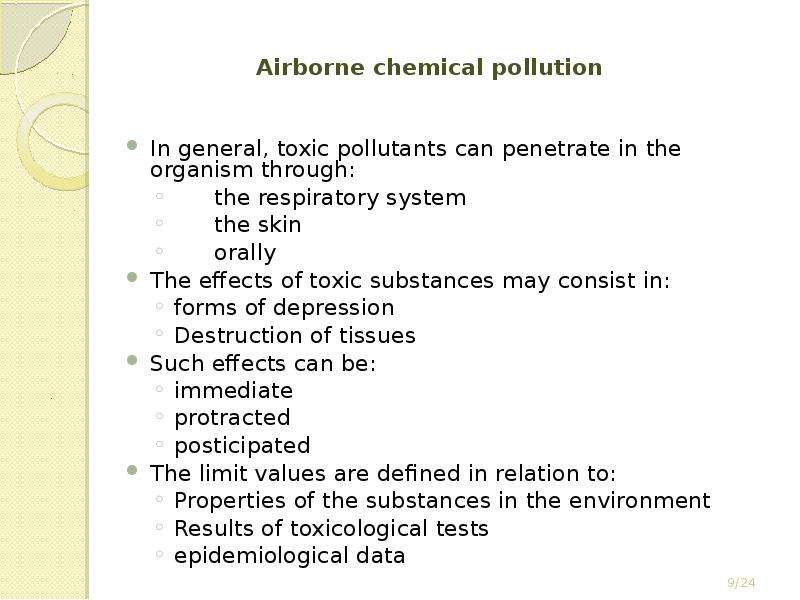
Airborne chemical pollution In general, toxic pollutants can penetrate in the organism through: the respiratory system the skin orally The effects of...
Описание слайда:
Airborne chemical pollution In general, toxic pollutants can penetrate in the organism through: the respiratory system the skin orally The effects of toxic substances may consist in: forms of depression Destruction of tissues Such effects can be: immediate protracted posticipated The limit values ​​are defined in relation to: Properties of the substances in the environment Results of toxicological tests epidemiological data

Слайд 10


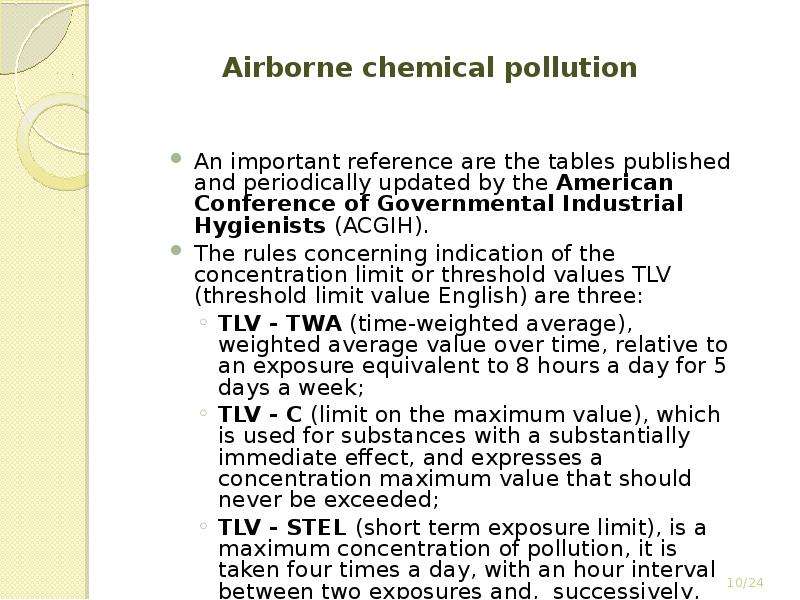
Airborne chemical pollution An important reference are the tables published and periodically updated by the American Conference of Governmental...
Описание слайда:
Airborne chemical pollution An important reference are the tables published and periodically updated by the American Conference of Governmental Industrial Hygienists (ACGIH). The rules concerning indication of the concentration limit or threshold values ​​TLV (threshold limit value English) are three: TLV - TWA (time-weighted average), weighted average value over time, relative to an exposure equivalent to 8 hours a day for 5 days a week; TLV - C (limit on the maximum value), which is used for substances with a substantially immediate effect, and expresses a concentration maximum value that should never be exceeded; TLV - STEL (short term exposure limit), is a maximum concentration of pollution, it is taken four times a day, with an hour interval between two exposures and, successively, for continuative exposures never longer than 15 minutes

Слайд 11


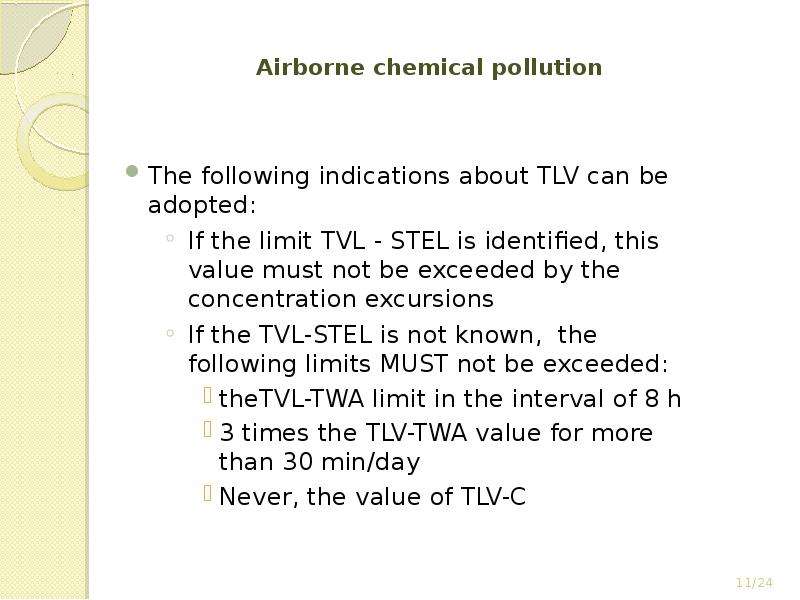
Airborne chemical pollution The following indications about TLV can be adopted: If the limit TVL - STEL is identified, this value must not be...
Описание слайда:
Airborne chemical pollution The following indications about TLV can be adopted: If the limit TVL - STEL is identified, this value must not be exceeded by the concentration excursions If the TVL-STEL is not known, the following limits MUST not be exceeded: theTVL-TWA limit in the interval of 8 h 3 times the TLV-TWA value for more than 30 min/day Never, the value of TLV-C

Слайд 12


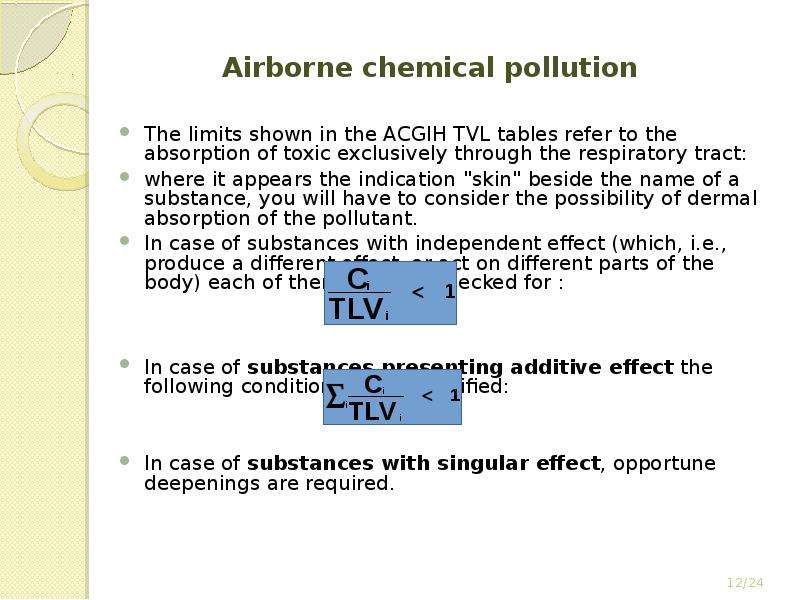
Airborne chemical pollution The limits shown in the ACGIH TVL tables refer to the absorption of toxic exclusively through the respiratory tract:...
Описание слайда:
Airborne chemical pollution The limits shown in the ACGIH TVL tables refer to the absorption of toxic exclusively through the respiratory tract: where it appears the indication "skin" beside the name of a substance, you will have to consider the possibility of dermal absorption of the pollutant. In case of substances with independent effect (which, i.e., produce a different effect, or act on different parts of the body) each of them must be checked for : In case of substances presenting additive effect the following condition must be verified: In case of substances with singular effect, opportune deepenings are required.

Слайд 13


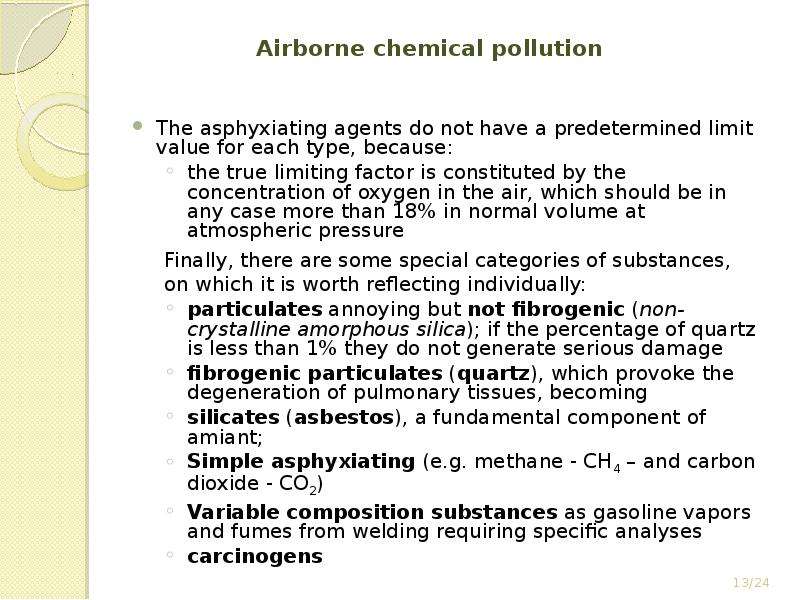
Airborne chemical pollution The asphyxiating agents do not have a predetermined limit value for each type, because: the true limiting factor is...
Описание слайда:
Airborne chemical pollution The asphyxiating agents do not have a predetermined limit value for each type, because: the true limiting factor is constituted by the concentration of oxygen in the air, which should be in any case more than 18% in normal volume at atmospheric pressure Finally, there are some special categories of substances, on which it is worth reflecting individually: particulates annoying but not fibrogenic (non-crystalline amorphous silica); if the percentage of quartz is less than 1% they do not generate serious damage fibrogenic particulates (quartz), which provoke the degeneration of pulmonary tissues, becoming silicates (asbestos), a fundamental component of amiant; Simple asphyxiating (e.g. methane - CH4 – and carbon dioxide - CO2) Variable composition substances as gasoline vapors and fumes from welding requiring specific analyses carcinogens

Слайд 14


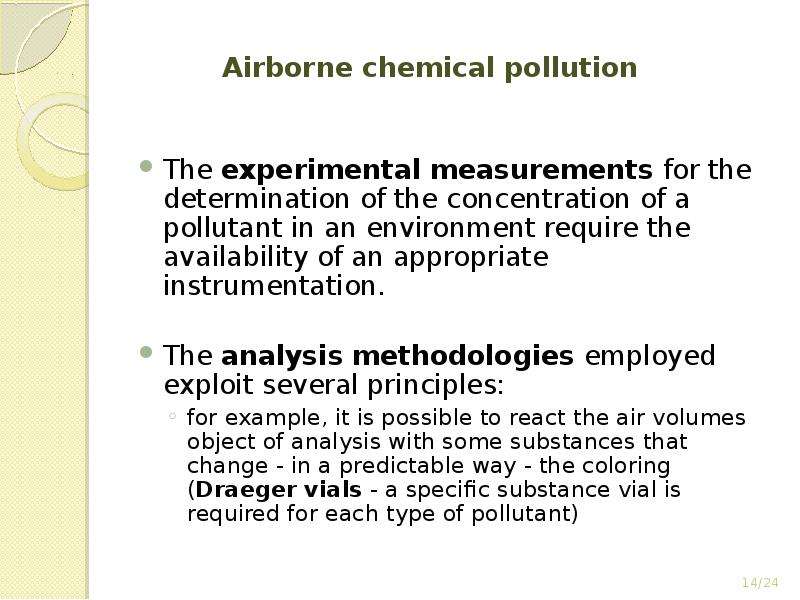
Airborne chemical pollution The experimental measurements for the determination of the concentration of a pollutant in an environment require the...
Описание слайда:
Airborne chemical pollution The experimental measurements for the determination of the concentration of a pollutant in an environment require the availability of an appropriate instrumentation. The analysis methodologies employed exploit several principles: for example, it is possible to react the air volumes object of analysis with some substances that change - in a predictable way - the coloring (Draeger vials - a specific substance vial is required for each type of pollutant)

Слайд 15


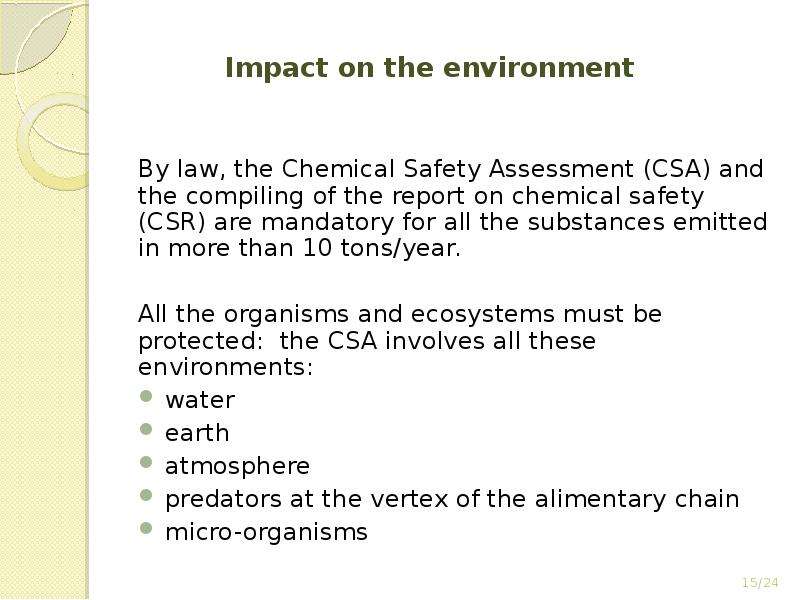
Impact on the environment By law, the Chemical Safety Assessment (CSA) and the compiling of the report on chemical safety (CSR) are mandatory for all...
Описание слайда:
Impact on the environment By law, the Chemical Safety Assessment (CSA) and the compiling of the report on chemical safety (CSR) are mandatory for all the substances emitted in more than 10 tons/year. All the organisms and ecosystems must be protected: the CSA involves all these environments: water earth atmosphere predators at the vertex of the alimentary chain micro-organisms

Слайд 16


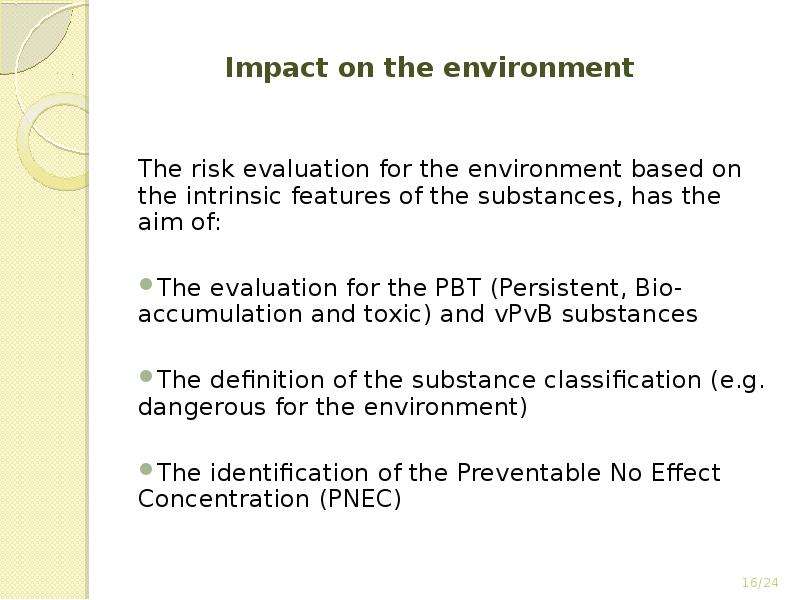
Impact on the environment The risk evaluation for the environment based on the intrinsic features of the substances, has the aim of: The evaluation...
Описание слайда:
Impact on the environment The risk evaluation for the environment based on the intrinsic features of the substances, has the aim of: The evaluation for the PBT (Persistent, Bio-accumulation and toxic) and vPvB substances The definition of the substance classification (e.g. dangerous for the environment) The identification of the Preventable No Effect Concentration (PNEC)

Слайд 17


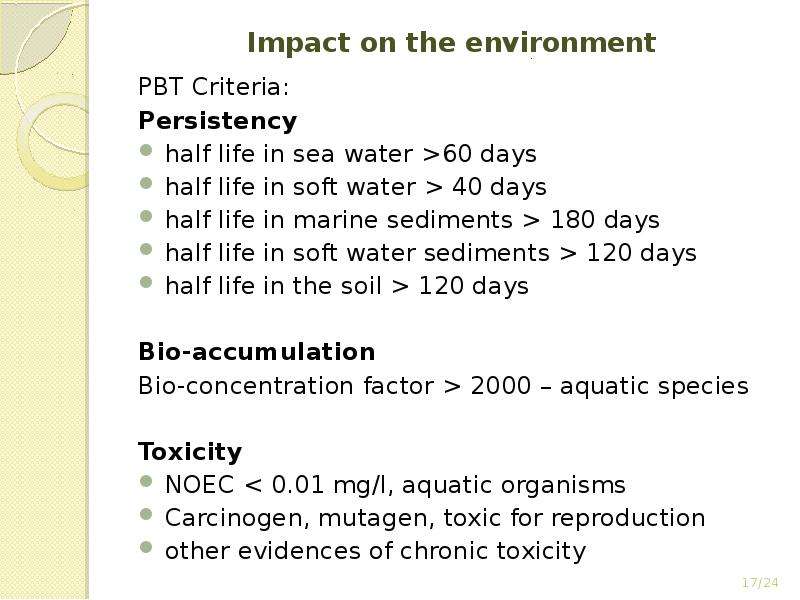
Impact on the environment PBT Criteria: Persistency half life in sea water >60 days half life in soft water > 40 days half life in marine sediments >...
Описание слайда:
Impact on the environment PBT Criteria: Persistency half life in sea water >60 days half life in soft water > 40 days half life in marine sediments > 180 days half life in soft water sediments > 120 days half life in the soil > 120 days Bio-accumulation Bio-concentration factor > 2000 – aquatic species Toxicity NOEC < 0.01 mg/l, aquatic organisms Carcinogen, mutagen, toxic for reproduction other evidences of chronic toxicity

Слайд 18


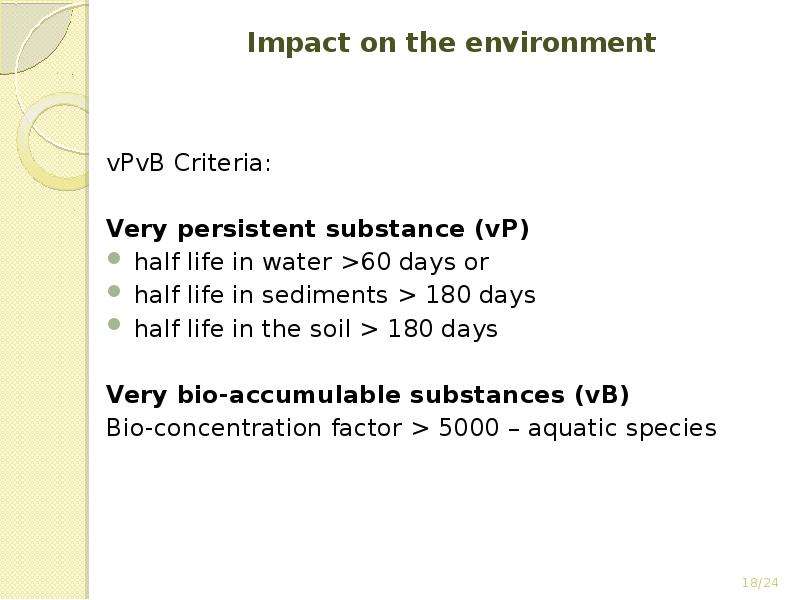
Impact on the environment vPvB Criteria: Very persistent substance (vP) half life in water >60 days or half life in sediments > 180 days half life in...
Описание слайда:
Impact on the environment vPvB Criteria: Very persistent substance (vP) half life in water >60 days or half life in sediments > 180 days half life in the soil > 180 days Very bio-accumulable substances (vB) Bio-concentration factor > 5000 – aquatic species

Слайд 19


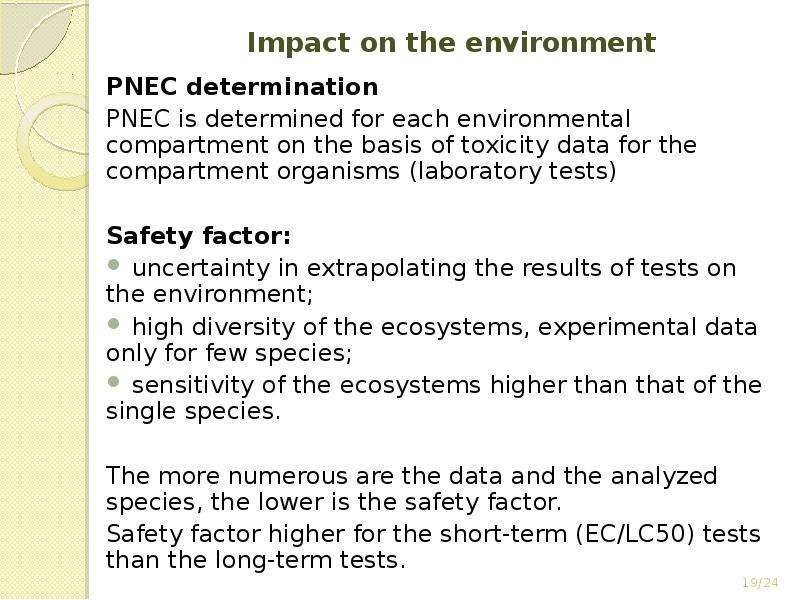
Impact on the environment PNEC determination PNEC is determined for each environmental compartment on the basis of toxicity data for the compartment...
Описание слайда:
Impact on the environment PNEC determination PNEC is determined for each environmental compartment on the basis of toxicity data for the compartment organisms (laboratory tests) Safety factor: uncertainty in extrapolating the results of tests on the environment; high diversity of the ecosystems, experimental data only for few species; sensitivity of the ecosystems higher than that of the single species. The more numerous are the data and the analyzed species, the lower is the safety factor. Safety factor higher for the short-term (EC/LC50) tests than the long-term tests.

Слайд 20


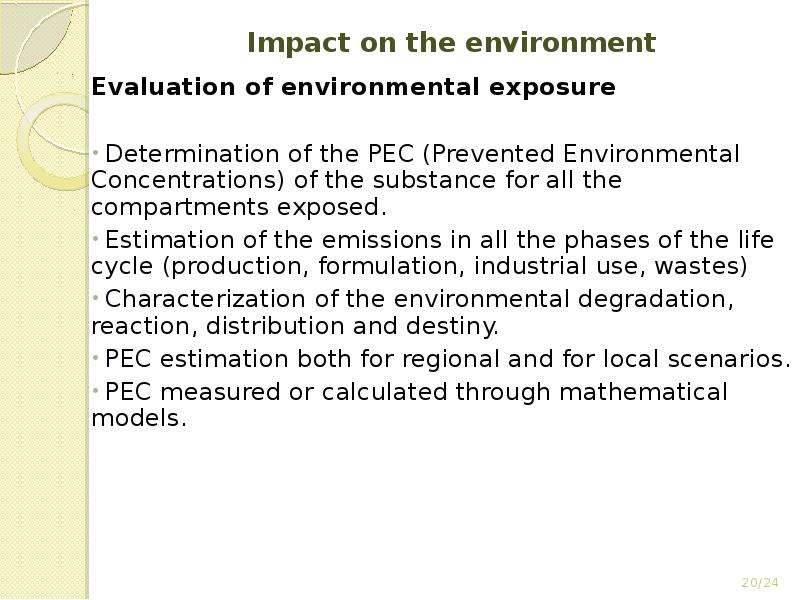
Impact on the environment Evaluation of environmental exposure Determination of the PEC (Prevented Environmental Concentrations) of the substance for...
Описание слайда:
Impact on the environment Evaluation of environmental exposure Determination of the PEC (Prevented Environmental Concentrations) of the substance for all the compartments exposed. Estimation of the emissions in all the phases of the life cycle (production, formulation, industrial use, wastes) Characterization of the environmental degradation, reaction, distribution and destiny. PEC estimation both for regional and for local scenarios. PEC measured or calculated through mathematical models.

Слайд 21


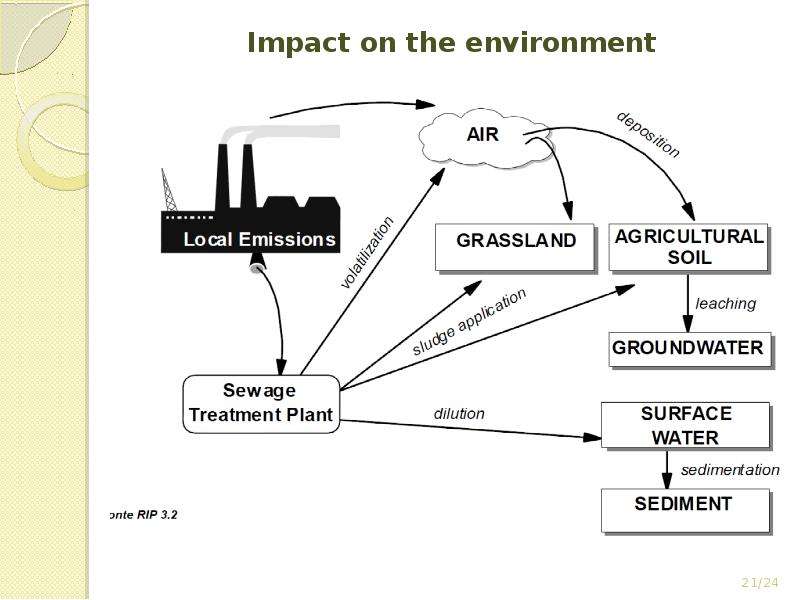
Impact on the environment
Описание слайда:
Impact on the environment

Слайд 22


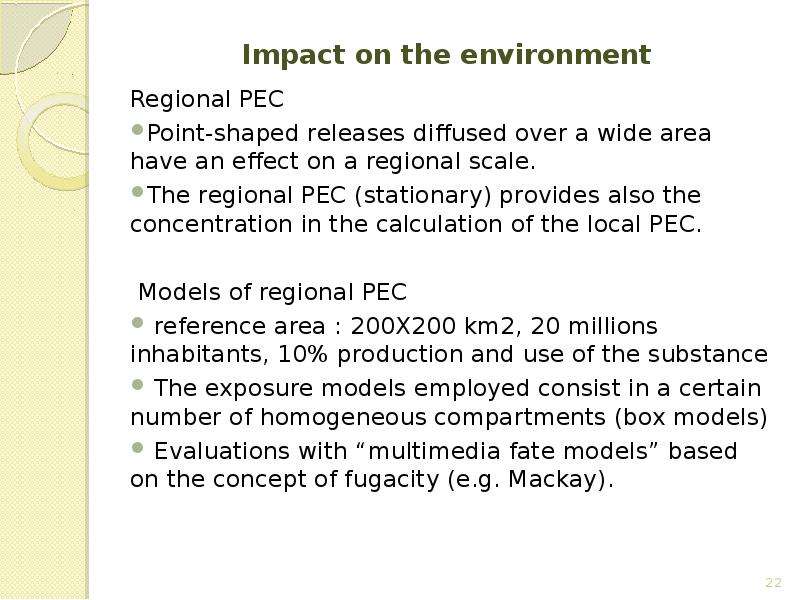
Impact on the environment Regional PEC Point-shaped releases diffused over a wide area have an effect on a regional scale. The regional PEC...
Описание слайда:
Impact on the environment Regional PEC Point-shaped releases diffused over a wide area have an effect on a regional scale. The regional PEC (stationary) provides also the concentration in the calculation of the local PEC. Models of regional PEC reference area : 200X200 km2, 20 millions inhabitants, 10% production and use of the substance The exposure models employed consist in a certain number of homogeneous compartments (box models) Evaluations with “multimedia fate models” based on the concept of fugacity (e.g. Mackay).

Слайд 23


Impact on the environment Characterization of the hazard Comparison between prevented environmental concentrations (PEC) and prevented no effect...
Описание слайда:
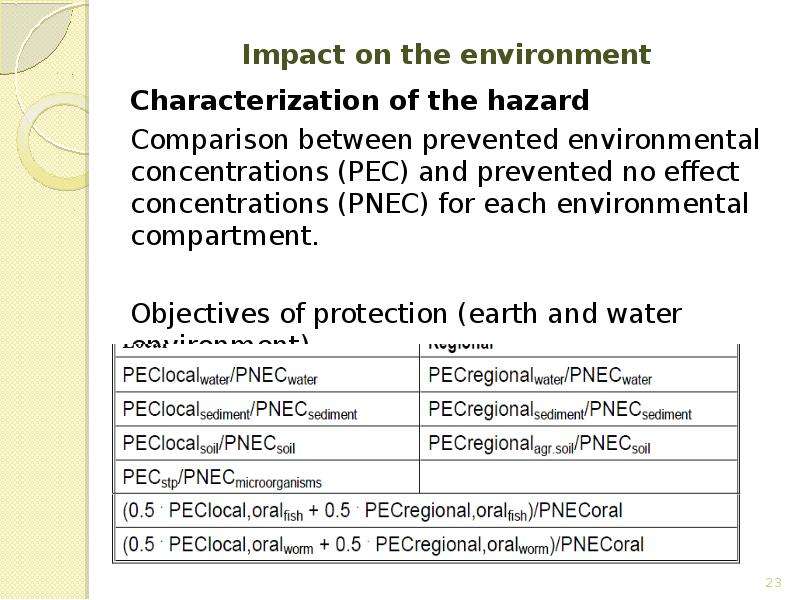
Impact on the environment Characterization of the hazard Comparison between prevented environmental concentrations (PEC) and prevented no effect concentrations (PNEC) for each environmental compartment. Objectives of protection (earth and water environment)

Слайд 24


Impact on the environment Characterization of the hazard Hazards adequately controlled if PEC < PNEC. If the condition is not satisfied, the...
Описание слайда:
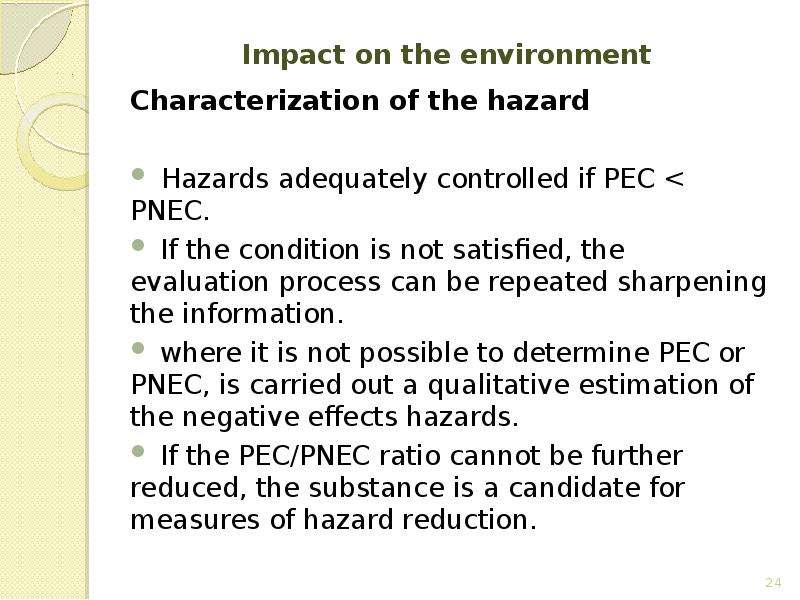
Impact on the environment Characterization of the hazard Hazards adequately controlled if PEC < PNEC. If the condition is not satisfied, the evaluation process can be repeated sharpening the information. where it is not possible to determine PEC or PNEC, is carried out a qualitative estimation of the negative effects hazards. If the PEC/PNEC ratio cannot be further reduced, the substance is a candidate for measures of hazard reduction.

Слайд 25


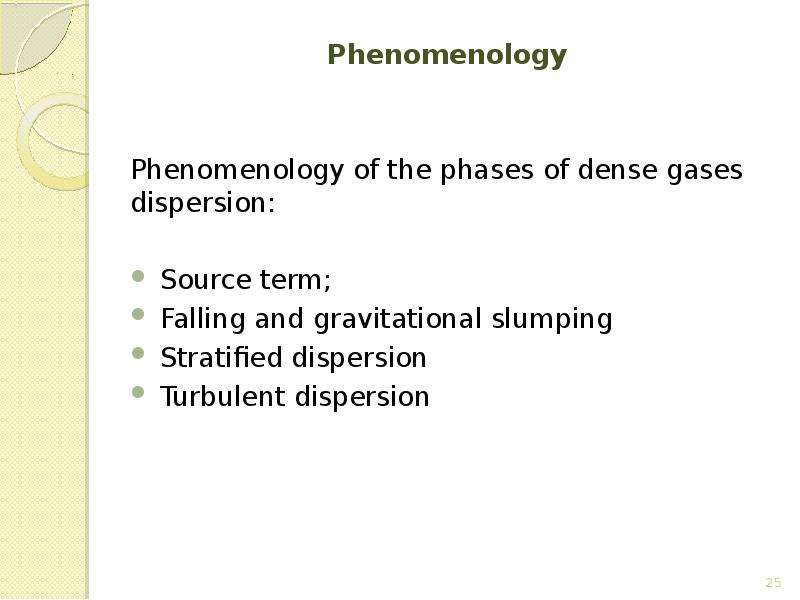
Phenomenology Phenomenology of the phases of dense gases dispersion: Source term; Falling and gravitational slumping Stratified dispersion Turbulent...
Описание слайда:
Phenomenology Phenomenology of the phases of dense gases dispersion: Source term; Falling and gravitational slumping Stratified dispersion Turbulent dispersion

Слайд 26


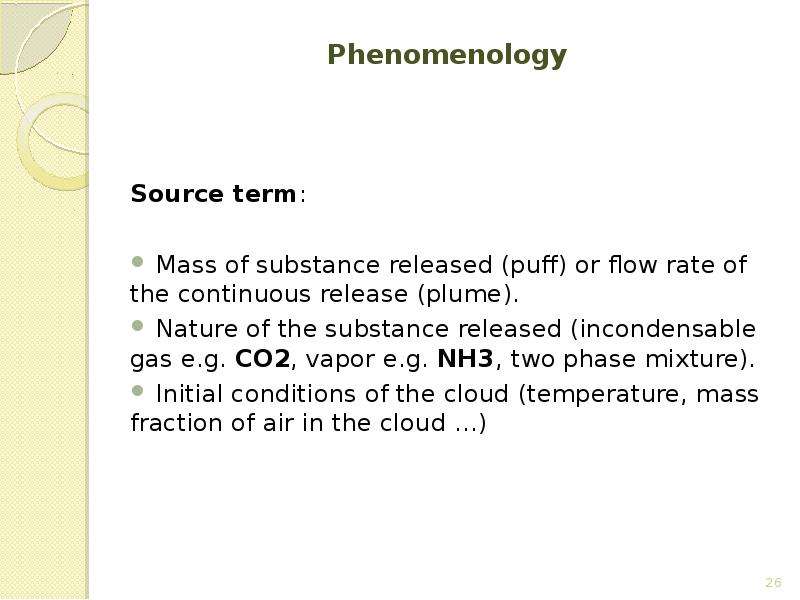
Phenomenology Source term: Mass of substance released (puff) or flow rate of the continuous release (plume). Nature of the substance released...
Описание слайда:
Phenomenology Source term: Mass of substance released (puff) or flow rate of the continuous release (plume). Nature of the substance released (incondensable gas e.g. CO2, vapor e.g. NH3, two phase mixture). Initial conditions of the cloud (temperature, mass fraction of air in the cloud …)

Слайд 27


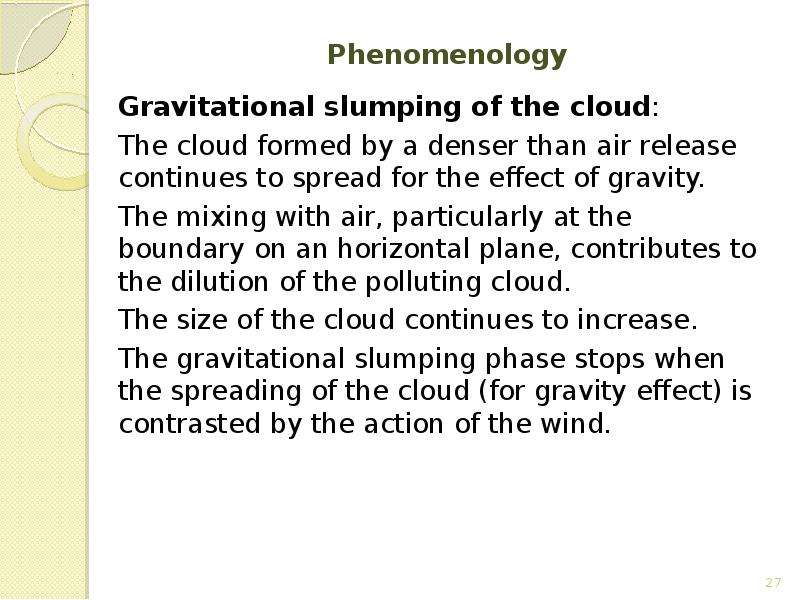
Phenomenology Gravitational slumping of the cloud: The cloud formed by a denser than air release continues to spread for the effect of gravity. The...
Описание слайда:
Phenomenology Gravitational slumping of the cloud: The cloud formed by a denser than air release continues to spread for the effect of gravity. The mixing with air, particularly at the boundary on an horizontal plane, contributes to the dilution of the polluting cloud. The size of the cloud continues to increase. The gravitational slumping phase stops when the spreading of the cloud (for gravity effect) is contrasted by the action of the wind.

Слайд 28


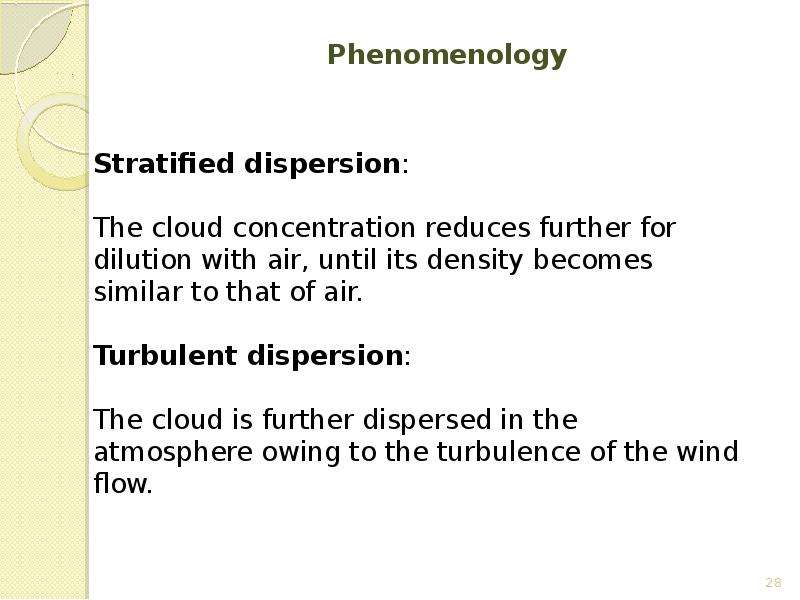
Phenomenology
Описание слайда:
Phenomenology

Слайд 29


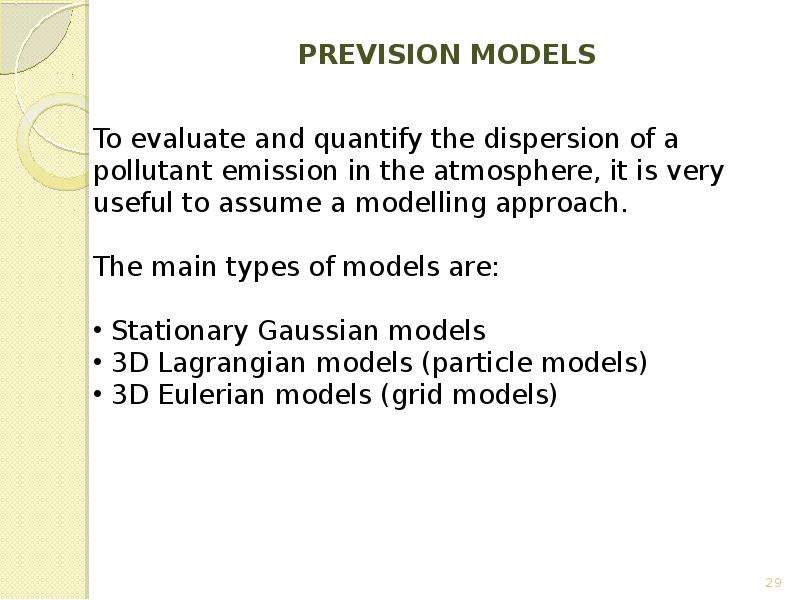
PREVISION MODELS
Описание слайда:
PREVISION MODELS

Слайд 30


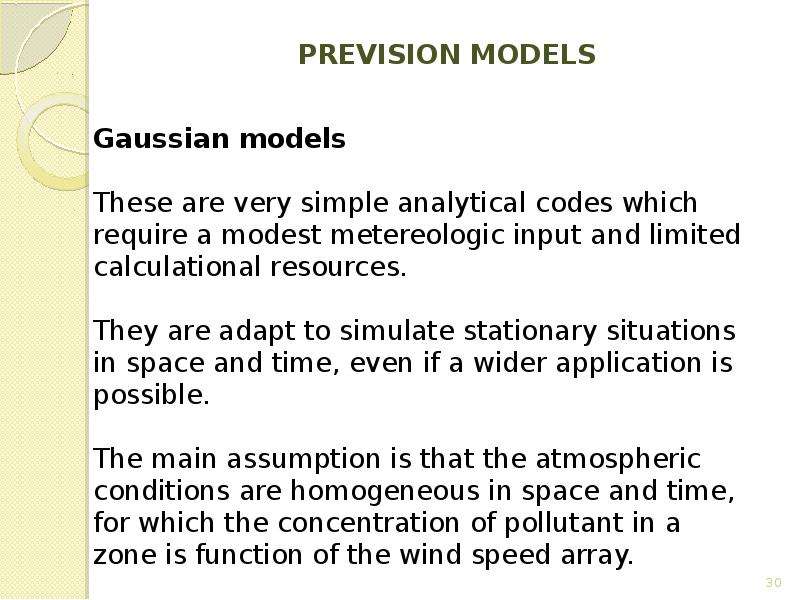
PREVISION MODELS
Описание слайда:
PREVISION MODELS

Слайд 31


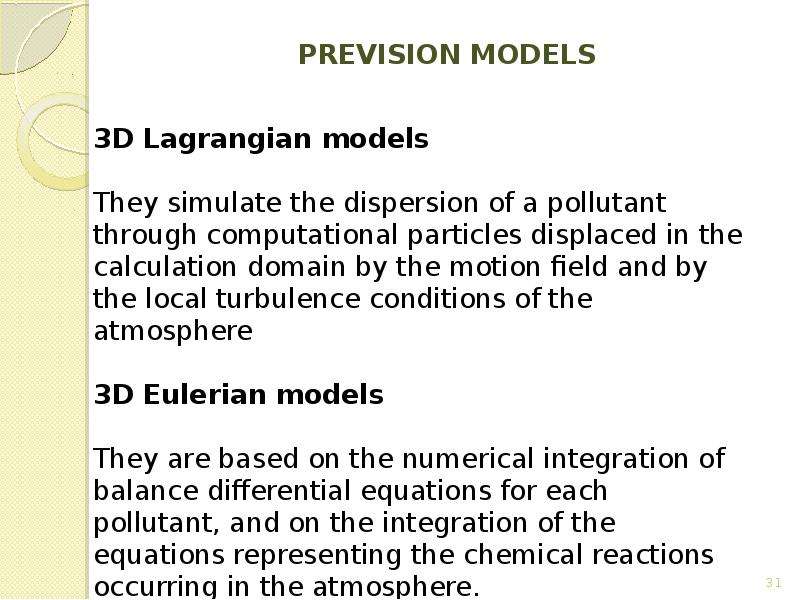
PREVISION MODELS
Описание слайда:
PREVISION MODELS

Слайд 32


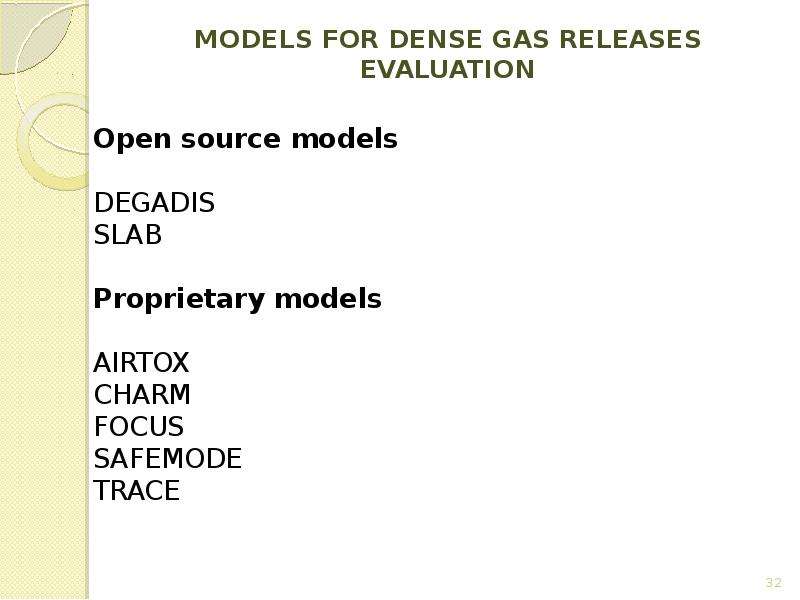
MODELS FOR DENSE GAS RELEASES EVALUATION
Описание слайда:
MODELS FOR DENSE GAS RELEASES EVALUATION

Слайд 33


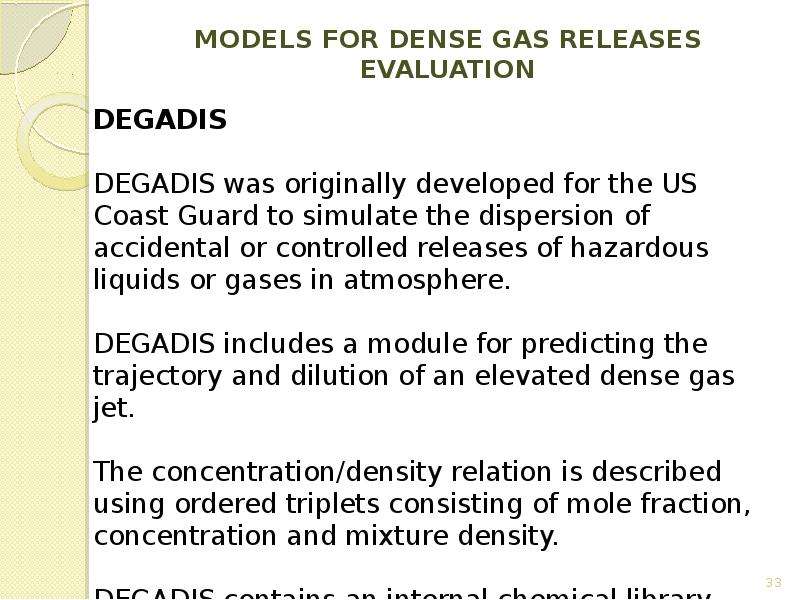
MODELS FOR DENSE GAS RELEASES EVALUATION
Описание слайда:
MODELS FOR DENSE GAS RELEASES EVALUATION

Слайд 34


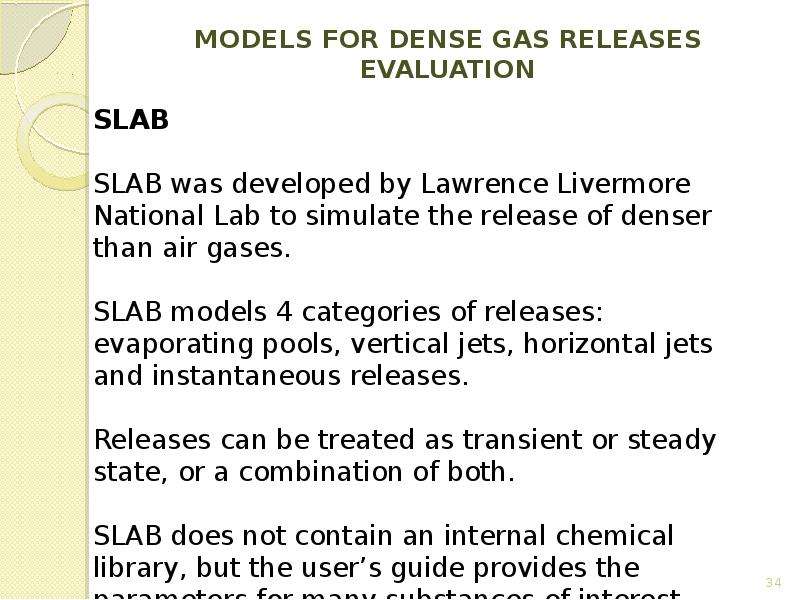
MODELS FOR DENSE GAS RELEASES EVALUATION
Описание слайда:
MODELS FOR DENSE GAS RELEASES EVALUATION

Слайд 35


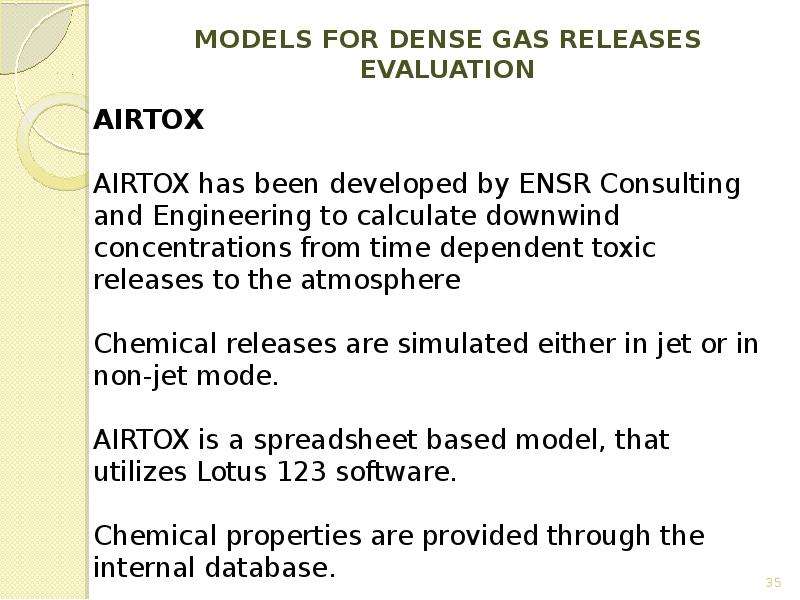
MODELS FOR DENSE GAS RELEASES EVALUATION
Описание слайда:
MODELS FOR DENSE GAS RELEASES EVALUATION

Слайд 36


MODELS FOR DENSE GAS RELEASES EVALUATION
Описание слайда:
MODELS FOR DENSE GAS RELEASES EVALUATION

Слайд 37


MODELS FOR DENSE GAS RELEASES EVALUATION
Описание слайда:
MODELS FOR DENSE GAS RELEASES EVALUATION

Слайд 38


MODELS FOR DENSE GAS RELEASES EVALUATION
Описание слайда:
MODELS FOR DENSE GAS RELEASES EVALUATION

Слайд 39


MODELS FOR DENSE GAS RELEASES EVALUATION
Описание слайда:
MODELS FOR DENSE GAS RELEASES EVALUATION

Слайд 40


SLAB
Описание слайда:
SLAB

Слайд 41


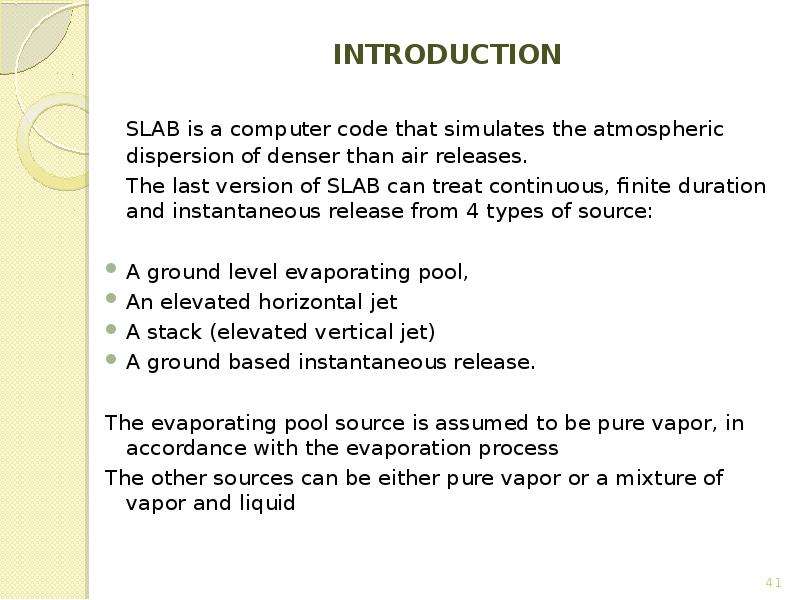
INTRODUCTION SLAB is a computer code that simulates the atmospheric dispersion of denser than air releases. The last version of SLAB can treat...
Описание слайда:
INTRODUCTION SLAB is a computer code that simulates the atmospheric dispersion of denser than air releases. The last version of SLAB can treat continuous, finite duration and instantaneous release from 4 types of source: A ground level evaporating pool, An elevated horizontal jet A stack (elevated vertical jet) A ground based instantaneous release. The evaporating pool source is assumed to be pure vapor, in accordance with the evaporation process The other sources can be either pure vapor or a mixture of vapor and liquid

Слайд 42


INTRODUCTION Atmospheric dispersion of the release is calculated by solving the conservation equations of Mass Momentum Energy Species To simplify...
Описание слайда:
INTRODUCTION Atmospheric dispersion of the release is calculated by solving the conservation equations of Mass Momentum Energy Species To simplify the solution of the conservation equations, the equations are spatially averaged with the cloud.

Слайд 43


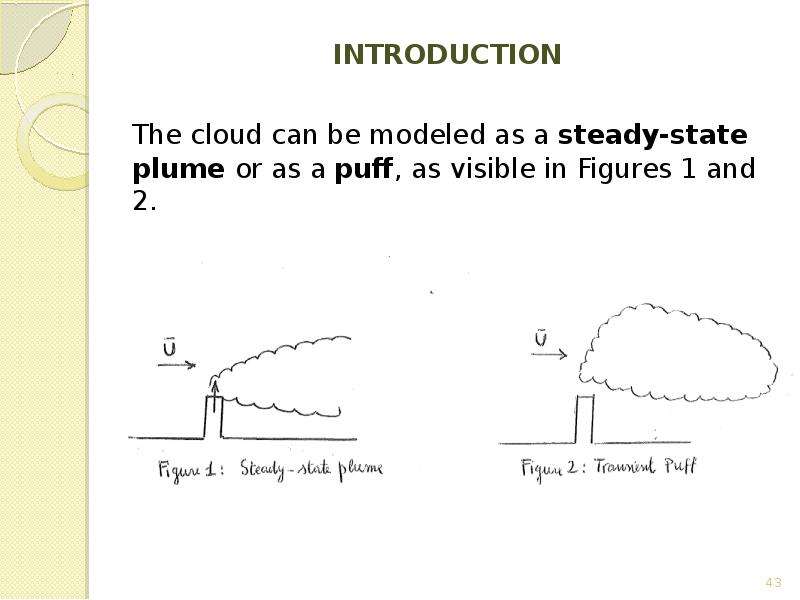
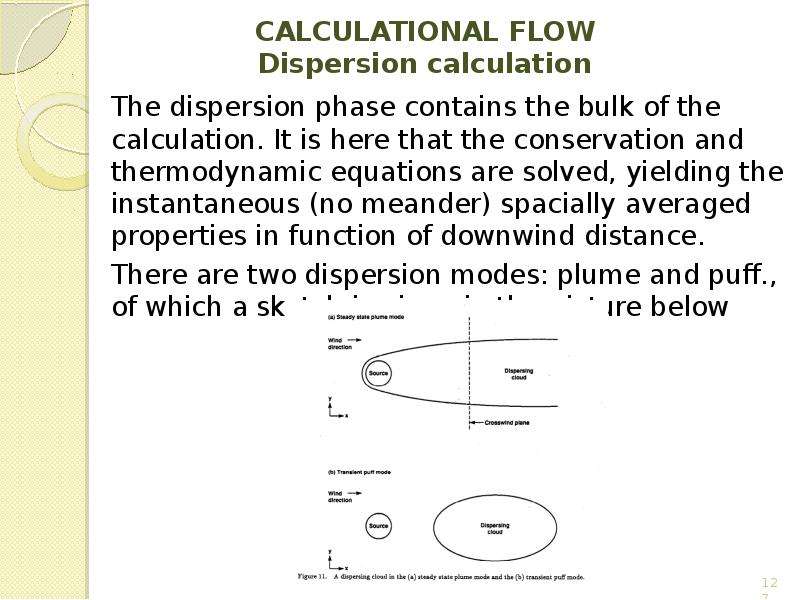
INTRODUCTION The cloud can be modeled as a steady-state plume or as a puff, as visible in Figures 1 and 2.
Описание слайда:
INTRODUCTION The cloud can be modeled as a steady-state plume or as a puff, as visible in Figures 1 and 2.

Слайд 44


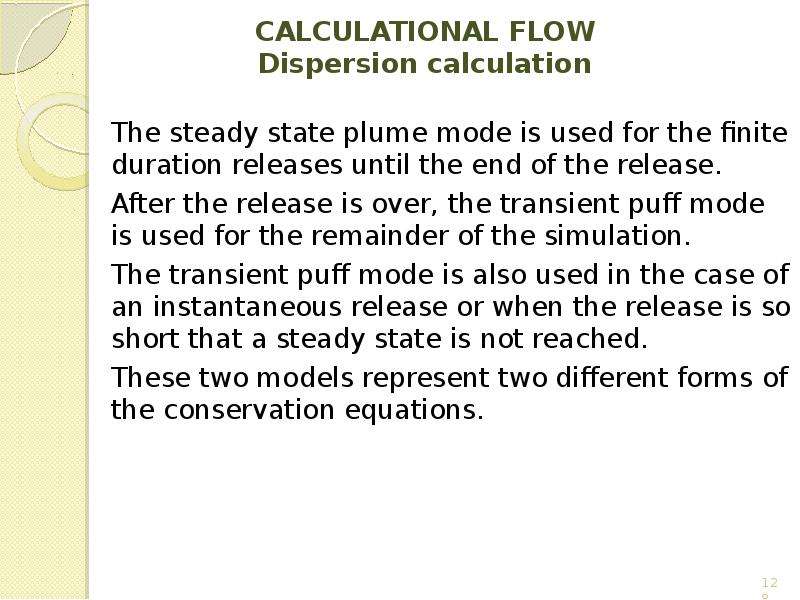
INTRODUCTION A continuous release (very long emission duration) is treated as a plume. In the case of a finite duration release, cloud dispersion is...
Описание слайда:
INTRODUCTION A continuous release (very long emission duration) is treated as a plume. In the case of a finite duration release, cloud dispersion is initially described using the steady state plume mode, and remains in this mode as long as the source is active. Once the source is shut off, the cloud is treated as a transient puff and the subsequent dispersion is calculated using the puff mode. For an instantaneous release (explosion), the transient puff dispersion mode is used for the entire calculation.

Слайд 45


INTRODUCTION Solution of the spatially-averaged conservation equations in either dispersion mode yields the spatially-averaged cloud properties. To...
Описание слайда:
INTRODUCTION Solution of the spatially-averaged conservation equations in either dispersion mode yields the spatially-averaged cloud properties. To regain the 3D variation of the concentration distribution, are applied particular profile functions of an assumed form and dependence on the calculated cloud dimensions.

Слайд 46


INTRODUCTION The time averaged concentration is obtained in a two step process: The effect of the cloud meander on the effective width of the cloud...
Описание слайда:
INTRODUCTION The time averaged concentration is obtained in a two step process: The effect of the cloud meander on the effective width of the cloud is calculated; The concentration is averaged over time using the effective (meander included) width in the concentration profile function. This calculation yields the final results of the SLAB model, namely, the time averaged concentration in time and space.

Слайд 47


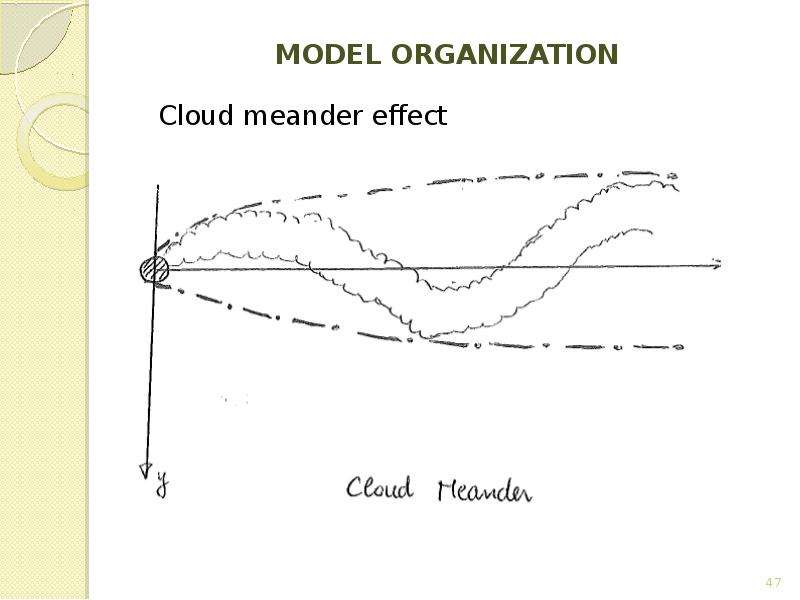
MODEL ORGANIZATION Cloud meander effect
Описание слайда:
MODEL ORGANIZATION Cloud meander effect

Слайд 48


THEORETICAL DESCRIPTION The atmospheric dispersion of a large denser than air release is affected by phenomena that do not occur in neutrally or...
Описание слайда:
THEORETICAL DESCRIPTION The atmospheric dispersion of a large denser than air release is affected by phenomena that do not occur in neutrally or positively buoyant trace gas releases: Turbulence damping due to stable density stratification of the heavy gas cloud; Alteration of the ambient velocity field due to gravity flow and initial source momentum; Thermodynamic effects on cloud temperature, buoyancy and turbulence due to liquid droplet formation and evaporation, and ground heating in the case of the release of a superheated or cryogenic liquid

Слайд 49


THEORETICAL DESCRIPTION In combustible gas releases one can be concerned with the instantaneous concentration. In toxic gas releases, the concern can...
Описание слайда:
THEORETICAL DESCRIPTION In combustible gas releases one can be concerned with the instantaneous concentration. In toxic gas releases, the concern can be about doses over minutes or hours as well as the long term dose. In order to make meaningful predictions of the size and duration of the hazardous concentration from a dense gas release, all of the significant phenomena need to be included, and the appropriate concentration averaging time needs to be used.

Слайд 50


THEORETICAL DESCRIPTION To meet these requirements, the SLAB model is built upon a theoretical framework that starts with averaged forms of the...
Описание слайда:
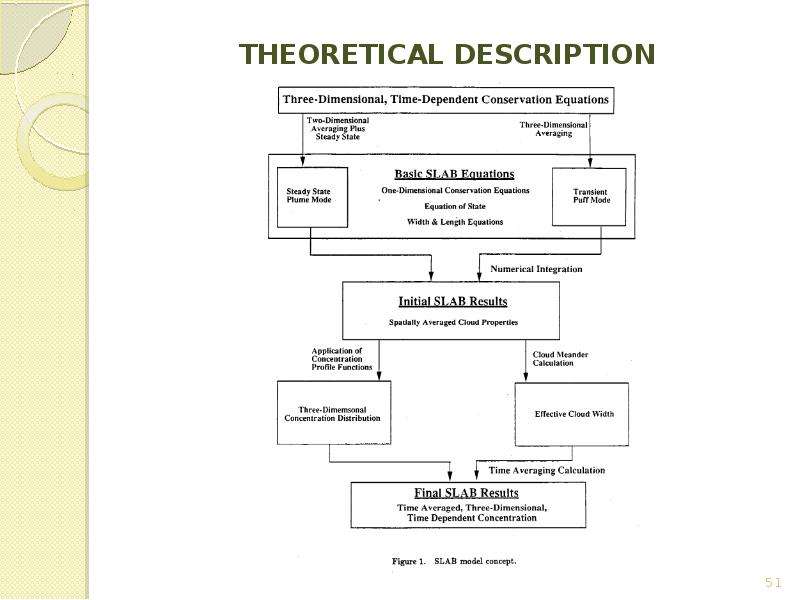
THEORETICAL DESCRIPTION To meet these requirements, the SLAB model is built upon a theoretical framework that starts with averaged forms of the conservation equations of mass, momentum, energy and species (see figure in the next page). These equations are used to calculate the spatially-averaged properties of the dispersing cloud and are expressed in two forms, representing two different dispersion modes: Steady state plume Transient puff.

Слайд 51


THEORETICAL DESCRIPTION
Описание слайда:
THEORETICAL DESCRIPTION

Слайд 52


THEORETICAL DESCRIPTION The conservation equations are different for the two modes, plume and puff. The steady state plume form of the equations is...
Описание слайда:
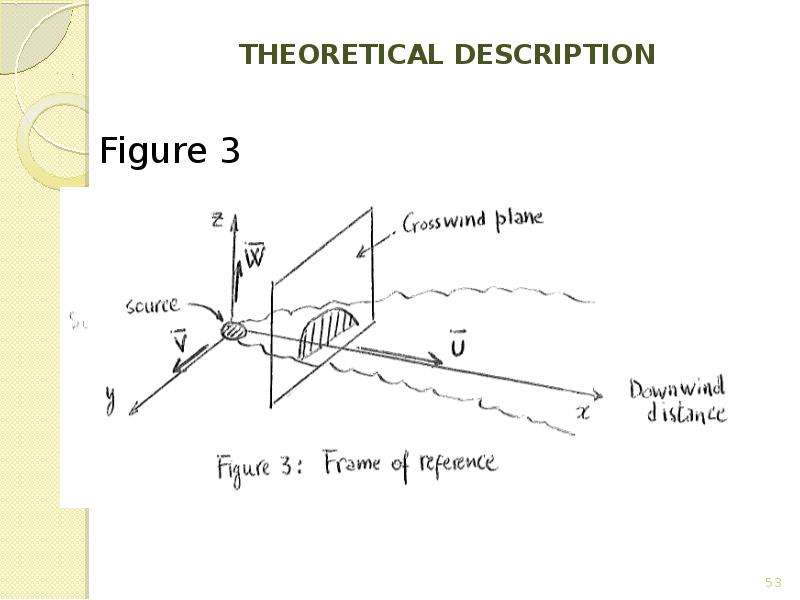
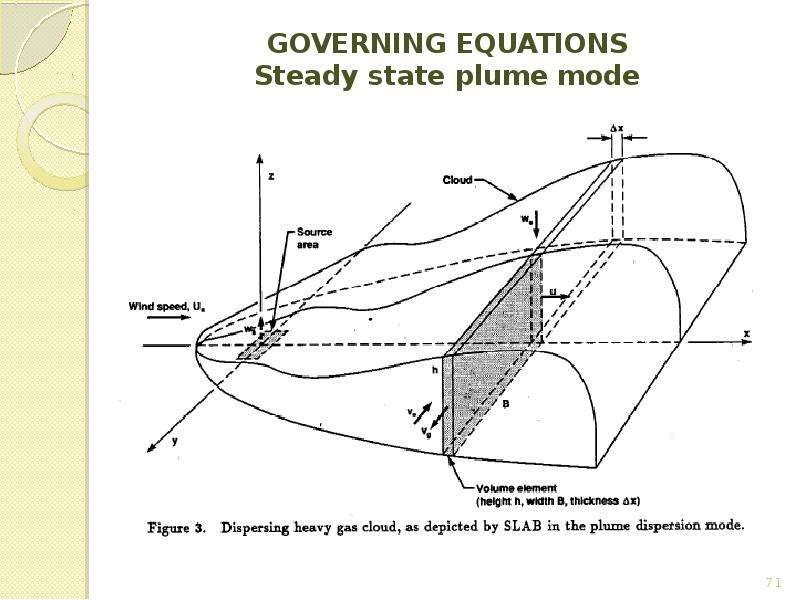
THEORETICAL DESCRIPTION The conservation equations are different for the two modes, plume and puff. The steady state plume form of the equations is obtained by making the steady state assumption (d/dt =0) and by averaging the equations over the cross wind direction (y and z, see figure 3 next page). The transient puff form of the equations is obtained by averaging the equations over all the three directions (x, y, z).

Слайд 53


THEORETICAL DESCRIPTION Figure 3
Описание слайда:
THEORETICAL DESCRIPTION Figure 3

Слайд 54


THEORETICAL DESCRIPTION The theoretical framework of the SLAB model is completed by the inclusion of the equation of state (ideal gas law) and...
Описание слайда:
THEORETICAL DESCRIPTION The theoretical framework of the SLAB model is completed by the inclusion of the equation of state (ideal gas law) and equations of the growth of cloud dimensions (plume width in the steady state mode and puff length and width in the transient puff mode)

Слайд 55


THEORETICAL DESCRIPTION To solve the basic set of equations, additional submodels are required. These submodels describe the dilution of the cloud...
Описание слайда:
THEORETICAL DESCRIPTION To solve the basic set of equations, additional submodels are required. These submodels describe the dilution of the cloud due to The turbulent mixing with surrounding air, the formation and evaporation of liquid droplets within the cloud and the heating of cold clouds at the ground surface.

Слайд 56


THEORETICAL DESCRIPTION The turbulent mixing with surrounding air, is treated by using the entrainment concept which specifies the rate of air flow...
Описание слайда:
THEORETICAL DESCRIPTION The turbulent mixing with surrounding air, is treated by using the entrainment concept which specifies the rate of air flow into the cloud. The thermodynamics of liquid droplets within the cloud is modeled by using the local thermodynamic equilibrium approximation. The size of the liquid droplets is assumed to be sufficiently small so that the transport of the vapor-droplet mixture can be treated as a single fluid. Ground heating of the cloud is treated by using the radiation boundary condition and a coefficient of surface and heat transfer.

Слайд 57


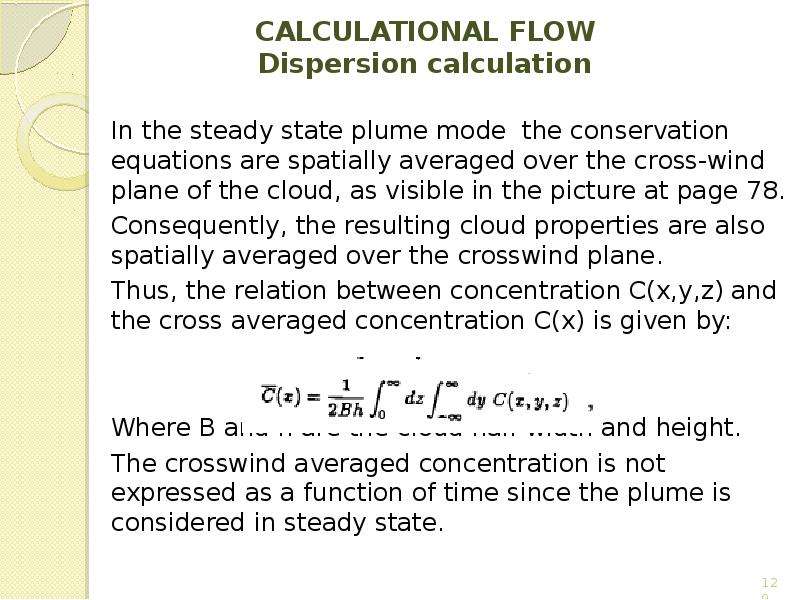
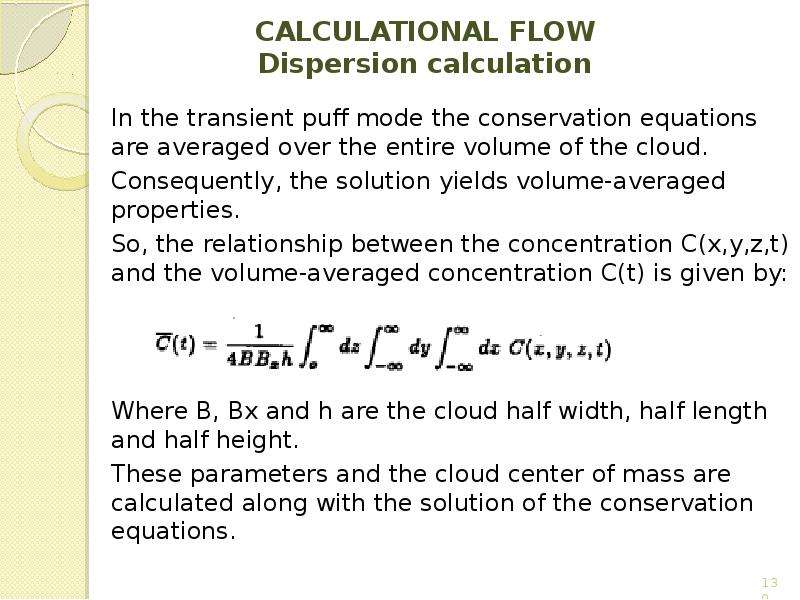
THEORETICAL DESCRIPTION In the steady state plume mode the conservation equations are averaged over the cross wind plan of the plume, leaving the...
Описание слайда:
THEORETICAL DESCRIPTION In the steady state plume mode the conservation equations are averaged over the cross wind plan of the plume, leaving the downwind distance (x) as the single independent variable. In the transient puff mode the conservation equations are averaged over all three dimensions of the cloud, leaving the downwind travel time (t) of the puff as a single independent variable. Notice that travel time (t) and downwind distance (x) are related by the downwind cloud velocity (U)

Слайд 58


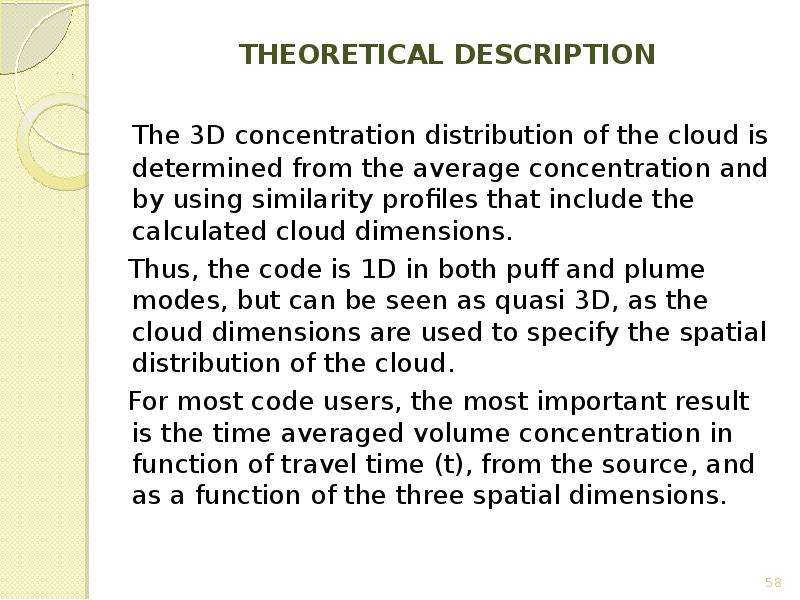
THEORETICAL DESCRIPTION The 3D concentration distribution of the cloud is determined from the average concentration and by using similarity profiles...
Описание слайда:
THEORETICAL DESCRIPTION The 3D concentration distribution of the cloud is determined from the average concentration and by using similarity profiles that include the calculated cloud dimensions. Thus, the code is 1D in both puff and plume modes, but can be seen as quasi 3D, as the cloud dimensions are used to specify the spatial distribution of the cloud. For most code users, the most important result is the time averaged volume concentration in function of travel time (t), from the source, and as a function of the three spatial dimensions.

Слайд 59


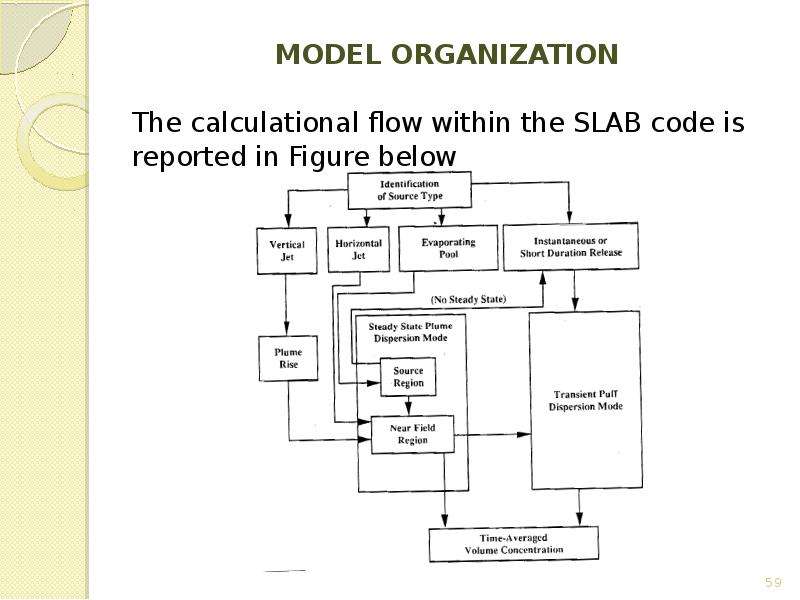
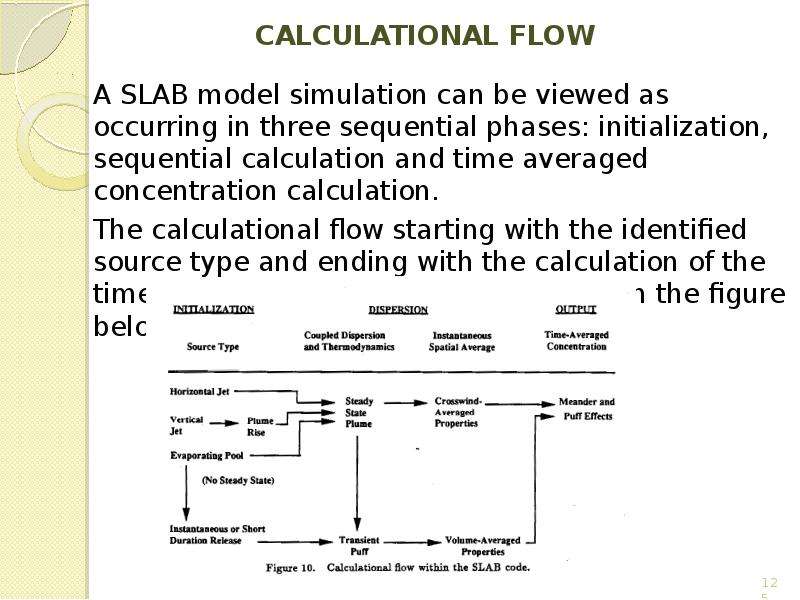
MODEL ORGANIZATION The calculational flow within the SLAB code is reported in Figure below
Описание слайда:
MODEL ORGANIZATION The calculational flow within the SLAB code is reported in Figure below

Слайд 60


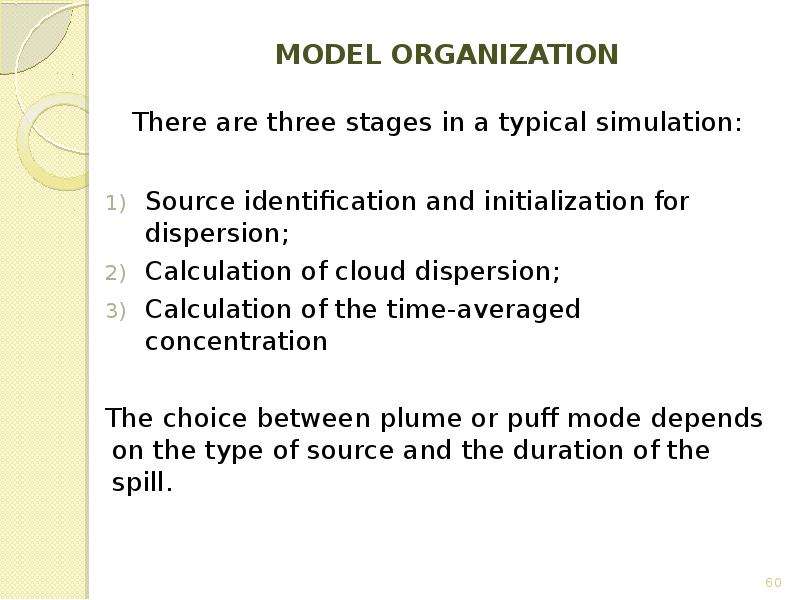
MODEL ORGANIZATION There are three stages in a typical simulation: Source identification and initialization for dispersion; Calculation of cloud...
Описание слайда:
MODEL ORGANIZATION There are three stages in a typical simulation: Source identification and initialization for dispersion; Calculation of cloud dispersion; Calculation of the time-averaged concentration The choice between plume or puff mode depends on the type of source and the duration of the spill.

Слайд 61


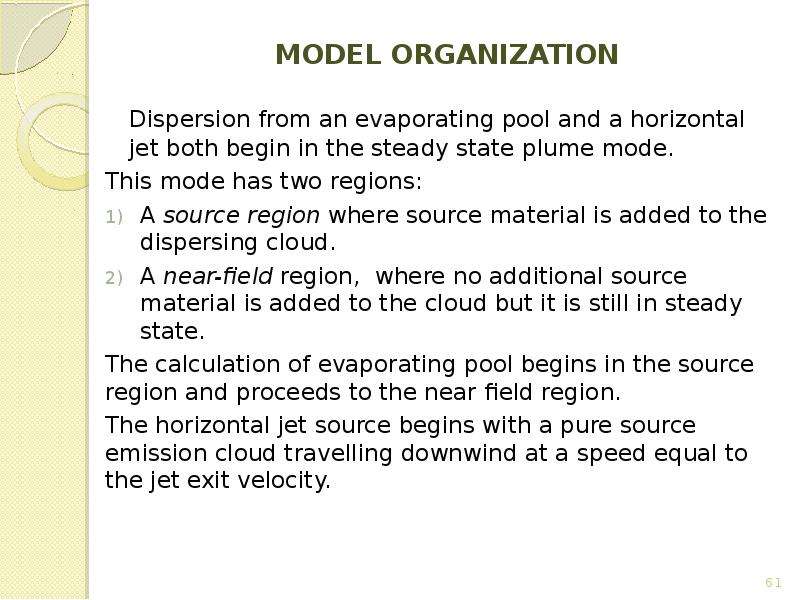
MODEL ORGANIZATION Dispersion from an evaporating pool and a horizontal jet both begin in the steady state plume mode. This mode has two regions: A...
Описание слайда:
MODEL ORGANIZATION Dispersion from an evaporating pool and a horizontal jet both begin in the steady state plume mode. This mode has two regions: A source region where source material is added to the dispersing cloud. A near-field region, where no additional source material is added to the cloud but it is still in steady state. The calculation of evaporating pool begins in the source region and proceeds to the near field region. The horizontal jet source begins with a pure source emission cloud travelling downwind at a speed equal to the jet exit velocity.

Слайд 62


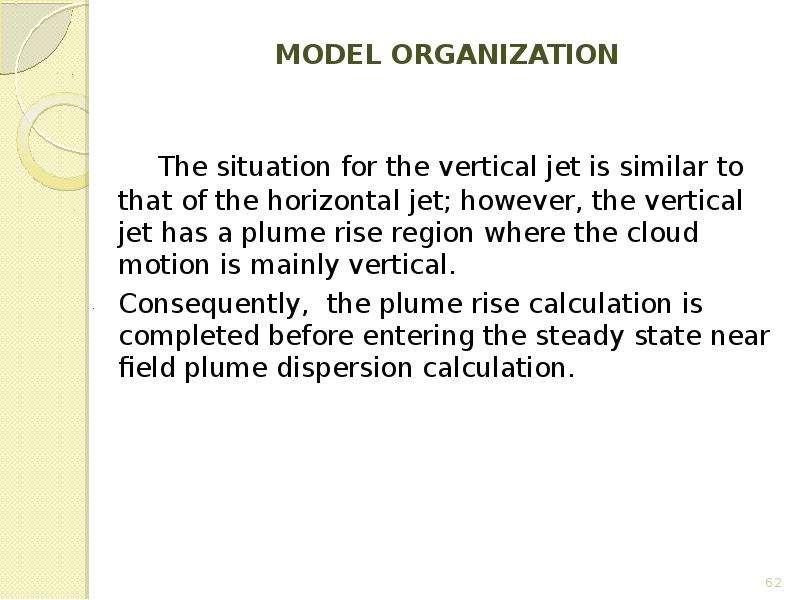
MODEL ORGANIZATION The situation for the vertical jet is similar to that of the horizontal jet; however, the vertical jet has a plume rise region...
Описание слайда:
MODEL ORGANIZATION The situation for the vertical jet is similar to that of the horizontal jet; however, the vertical jet has a plume rise region where the cloud motion is mainly vertical. Consequently, the plume rise calculation is completed before entering the steady state near field plume dispersion calculation.

Слайд 63


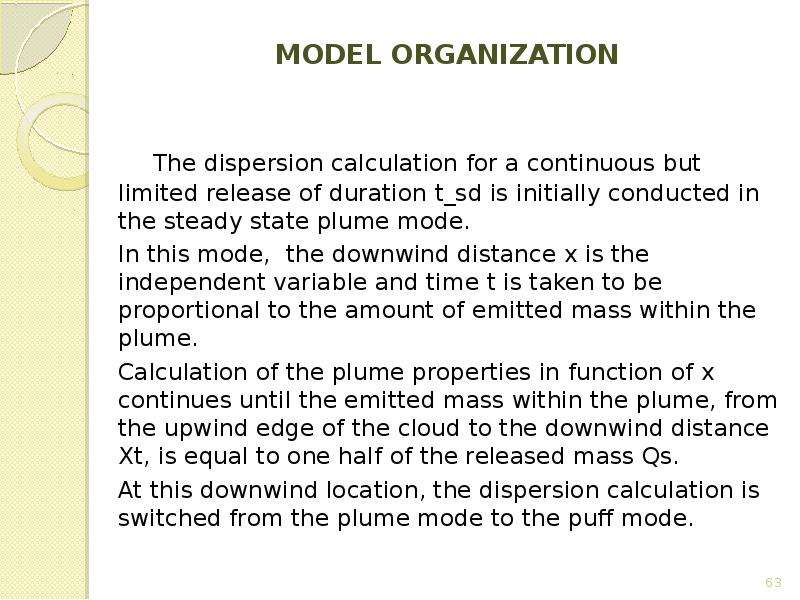
MODEL ORGANIZATION The dispersion calculation for a continuous but limited release of duration t_sd is initially conducted in the steady state plume...
Описание слайда:
MODEL ORGANIZATION The dispersion calculation for a continuous but limited release of duration t_sd is initially conducted in the steady state plume mode. In this mode, the downwind distance x is the independent variable and time t is taken to be proportional to the amount of emitted mass within the plume. Calculation of the plume properties in function of x continues until the emitted mass within the plume, from the upwind edge of the cloud to the downwind distance Xt, is equal to one half of the released mass Qs. At this downwind location, the dispersion calculation is switched from the plume mode to the puff mode.

Слайд 64


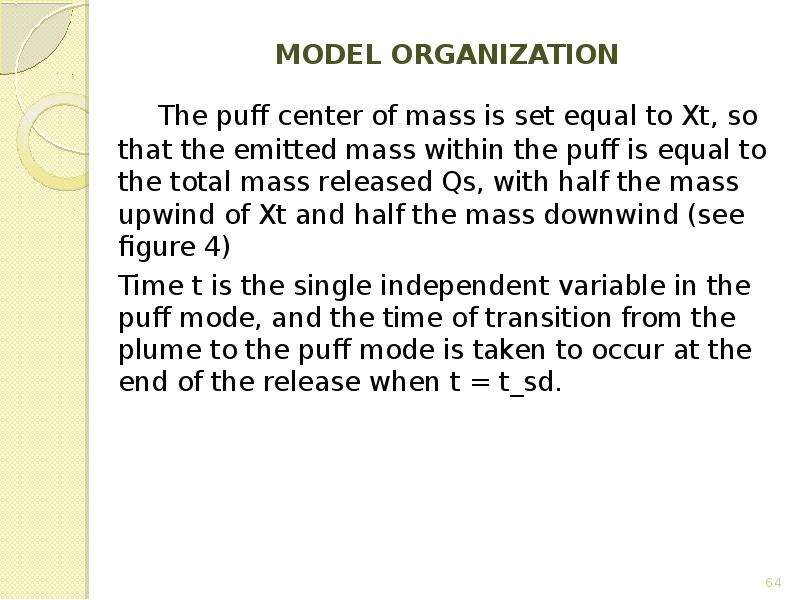
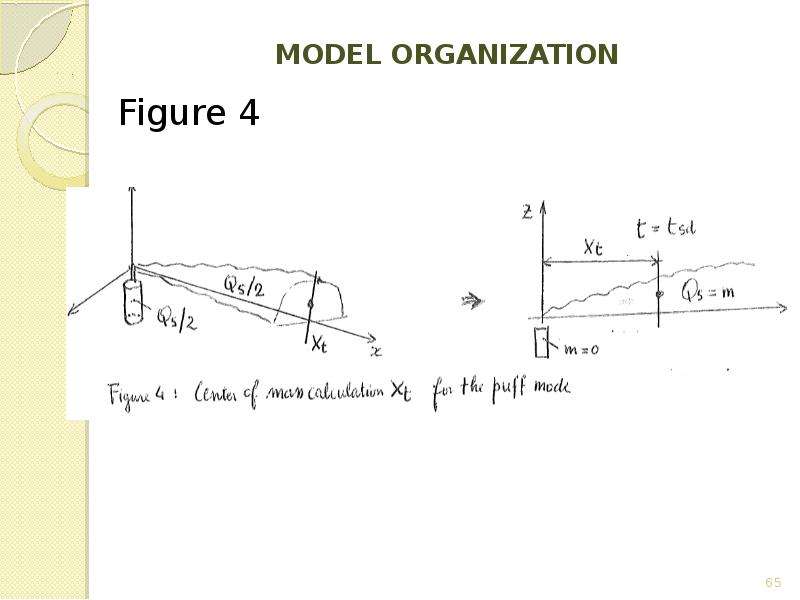
MODEL ORGANIZATION The puff center of mass is set equal to Xt, so that the emitted mass within the puff is equal to the total mass released Qs, with...
Описание слайда:
MODEL ORGANIZATION The puff center of mass is set equal to Xt, so that the emitted mass within the puff is equal to the total mass released Qs, with half the mass upwind of Xt and half the mass downwind (see figure 4) Time t is the single independent variable in the puff mode, and the time of transition from the plume to the puff mode is taken to occur at the end of the release when t = t_sd.

Слайд 65


MODEL ORGANIZATION Figure 4
Описание слайда:
MODEL ORGANIZATION Figure 4

Слайд 66


MODEL ORGANIZATION An exception to this procedure is taken when an evaporating pool release fails to reach steady state within the source region....
Описание слайда:
MODEL ORGANIZATION An exception to this procedure is taken when an evaporating pool release fails to reach steady state within the source region. (short duration evaporating pool) This occurs whenever the emitted mass within the source region of the steady state plume is greater than the total released mass Qs. When this occurs, the steady state calculation is discarded and the entire calculation is restarted in the transient puff mode. In case of instantaneous source there is also no steady state cloud.

Слайд 67


MODEL ORGANIZATION Completion of the dispersion calculations in either mode, yields the instantaneous spatially averaged cloud properties: mass and...
Описание слайда:
MODEL ORGANIZATION Completion of the dispersion calculations in either mode, yields the instantaneous spatially averaged cloud properties: mass and volume concentration, density, temperature, downwind velocity, cloud dimensions etc. The 3D variation of the concentration distribution is accounted for by applying profile functions that are based on the calculated cloud dimensions.

Слайд 68


MODEL ORGANIZATION The calculation of the time-averaged concentration is conducted in 2 steps: The effective cloud width, which includes the increase...
Описание слайда:
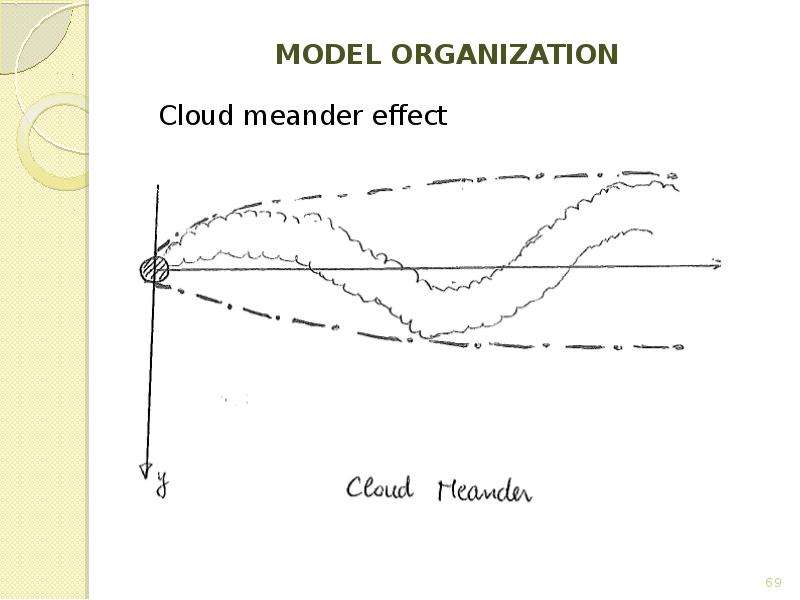
MODEL ORGANIZATION The calculation of the time-averaged concentration is conducted in 2 steps: The effective cloud width, which includes the increase due to cloud meander, is determined. (N.B.: instantaneous cloud width does not include the effect of cloud meander, which is the non-stationary displacement in the cross-wind direction). The amount of increase in width depends on the duration of averaging time, the duration of release and the instantaneous cloud width The time averaged concentration is calculated from the “new” concentration distribution, which includes the effect of cloud meander in the effective cloud width.

Слайд 69


MODEL ORGANIZATION Cloud meander effect
Описание слайда:
MODEL ORGANIZATION Cloud meander effect

Слайд 70


GOVERNING EQUATIONS Steady state plume mode The steady state plume mode of SLAB is based on the steady state crosswind-averaged conservation...
Описание слайда:
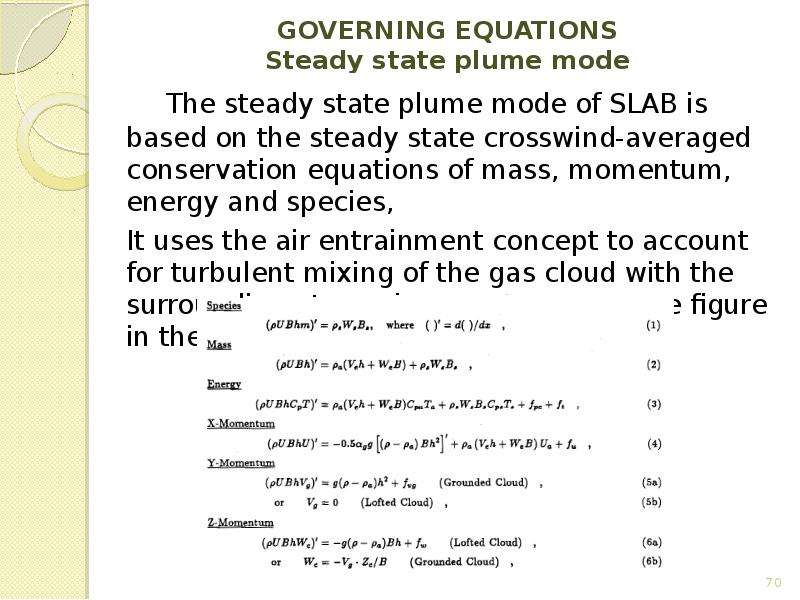
GOVERNING EQUATIONS Steady state plume mode The steady state plume mode of SLAB is based on the steady state crosswind-averaged conservation equations of mass, momentum, energy and species, It uses the air entrainment concept to account for turbulent mixing of the gas cloud with the surrounding atmosphere, as shown in the figure in the following page.

Слайд 71


GOVERNING EQUATIONS Steady state plume mode
Описание слайда:
GOVERNING EQUATIONS Steady state plume mode

Слайд 72


GOVERNING EQUATIONS Steady state plume mode Conservation of species (only one species of pollutant is considered)
Описание слайда:
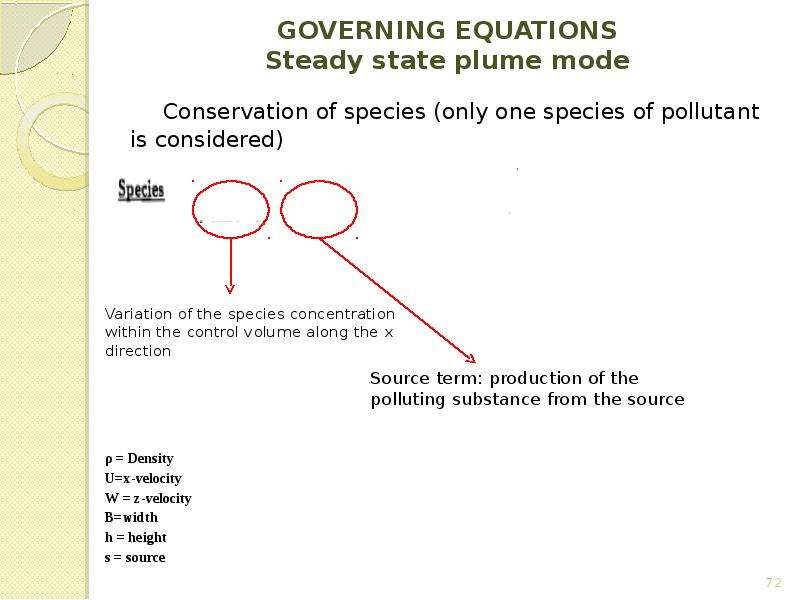
GOVERNING EQUATIONS Steady state plume mode Conservation of species (only one species of pollutant is considered)

Слайд 73


GOVERNING EQUATIONS Steady state plume mode Conservation of mass
Описание слайда:
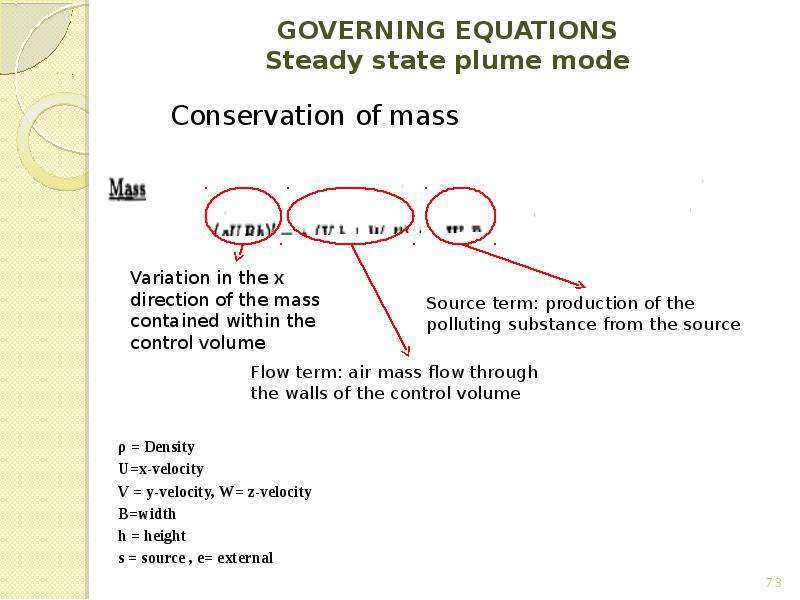
GOVERNING EQUATIONS Steady state plume mode Conservation of mass

Слайд 74


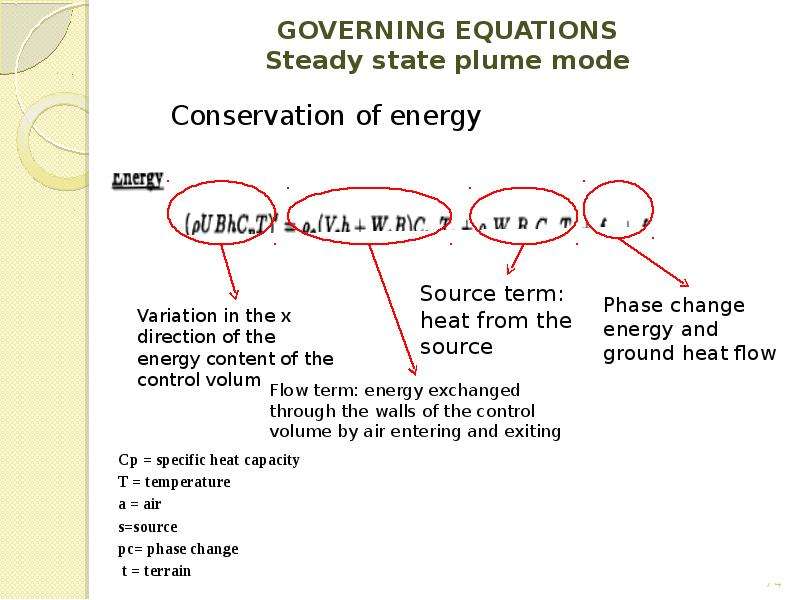
GOVERNING EQUATIONS Steady state plume mode Conservation of energy
Описание слайда:
GOVERNING EQUATIONS Steady state plume mode Conservation of energy

Слайд 75


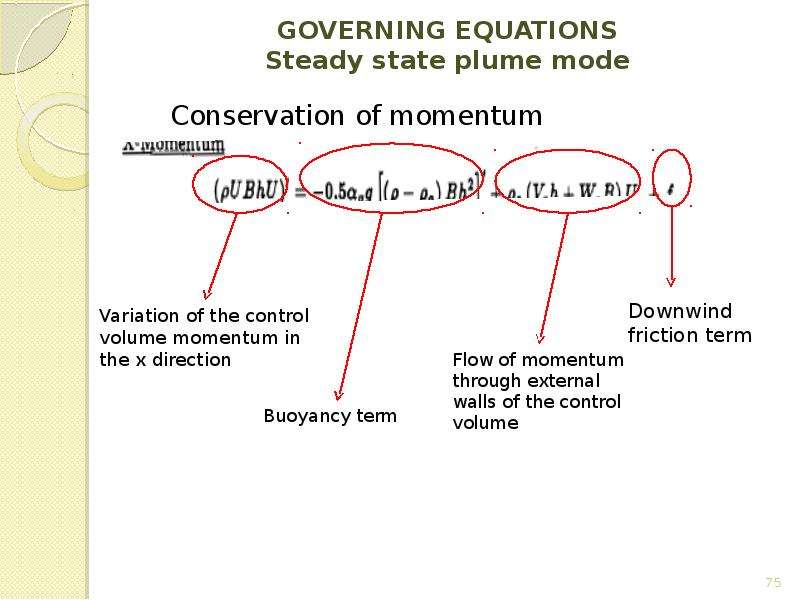
GOVERNING EQUATIONS Steady state plume mode Conservation of momentum
Описание слайда:
GOVERNING EQUATIONS Steady state plume mode Conservation of momentum

Слайд 76


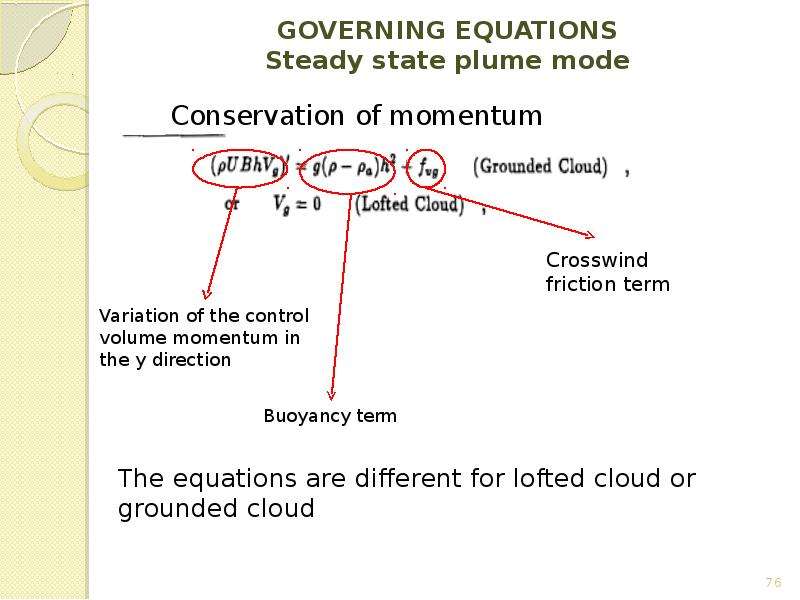
GOVERNING EQUATIONS Steady state plume mode Conservation of momentum
Описание слайда:
GOVERNING EQUATIONS Steady state plume mode Conservation of momentum

Слайд 77


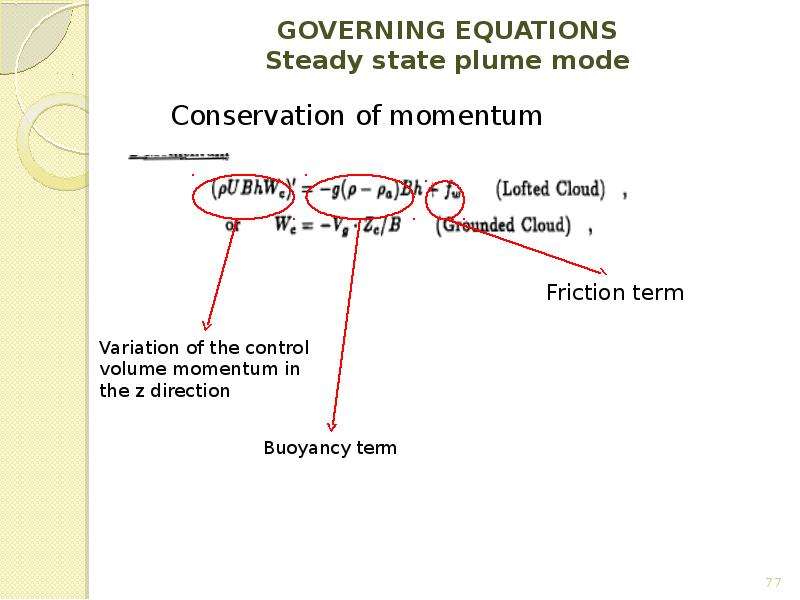
GOVERNING EQUATIONS Steady state plume mode Conservation of momentum
Описание слайда:
GOVERNING EQUATIONS Steady state plume mode Conservation of momentum

Слайд 78


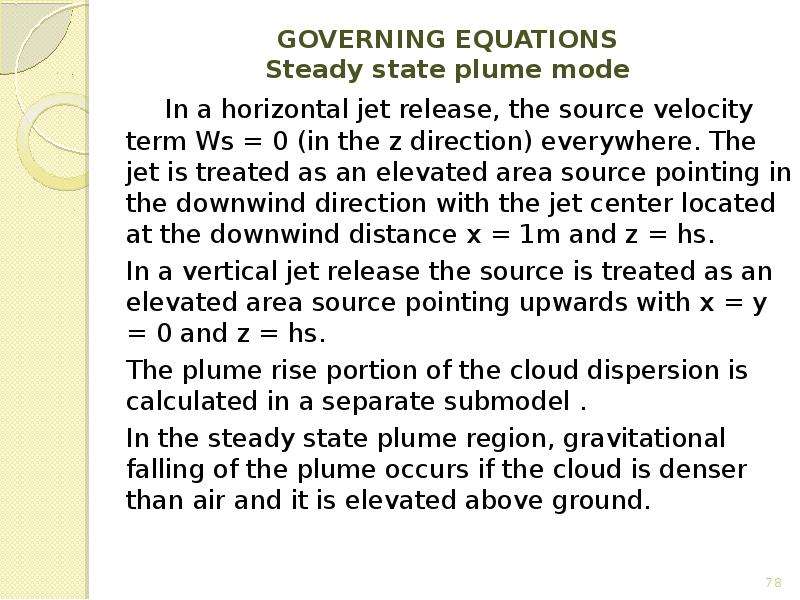
GOVERNING EQUATIONS Steady state plume mode In a horizontal jet release, the source velocity term Ws = 0 (in the z direction) everywhere. The jet is...
Описание слайда:
GOVERNING EQUATIONS Steady state plume mode In a horizontal jet release, the source velocity term Ws = 0 (in the z direction) everywhere. The jet is treated as an elevated area source pointing in the downwind direction with the jet center located at the downwind distance x = 1m and z = hs. In a vertical jet release the source is treated as an elevated area source pointing upwards with x = y = 0 and z = hs. The plume rise portion of the cloud dispersion is calculated in a separate submodel . In the steady state plume region, gravitational falling of the plume occurs if the cloud is denser than air and it is elevated above ground.

Слайд 79


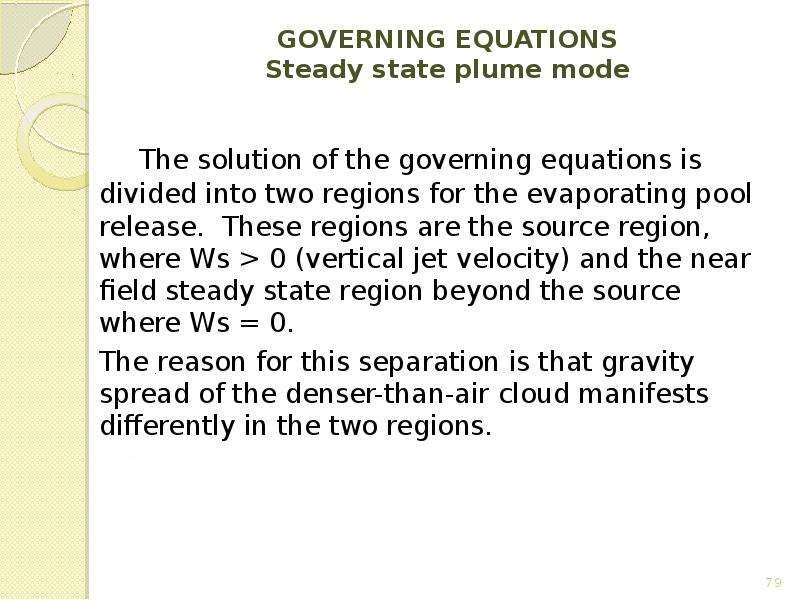
GOVERNING EQUATIONS Steady state plume mode The solution of the governing equations is divided into two regions for the evaporating pool release....
Описание слайда:
GOVERNING EQUATIONS Steady state plume mode The solution of the governing equations is divided into two regions for the evaporating pool release. These regions are the source region, where Ws > 0 (vertical jet velocity) and the near field steady state region beyond the source where Ws = 0. The reason for this separation is that gravity spread of the denser-than-air cloud manifests differently in the two regions.

Слайд 80


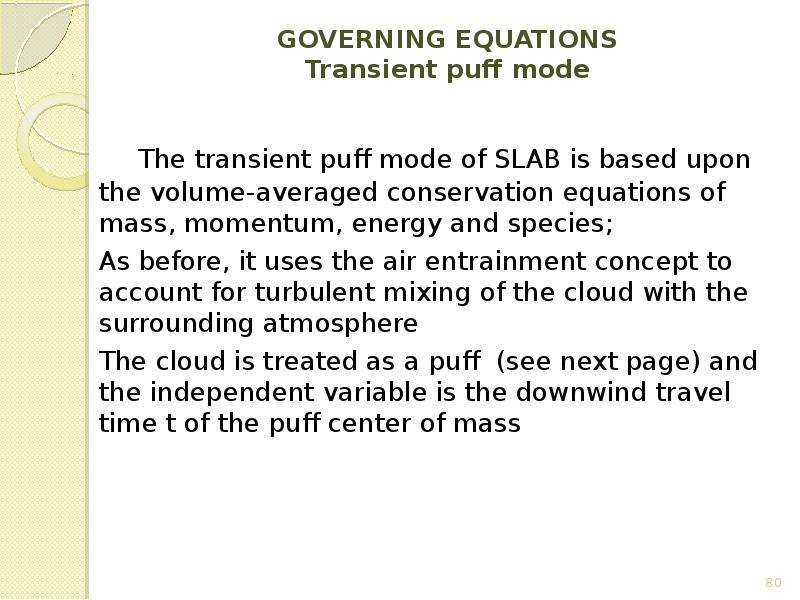
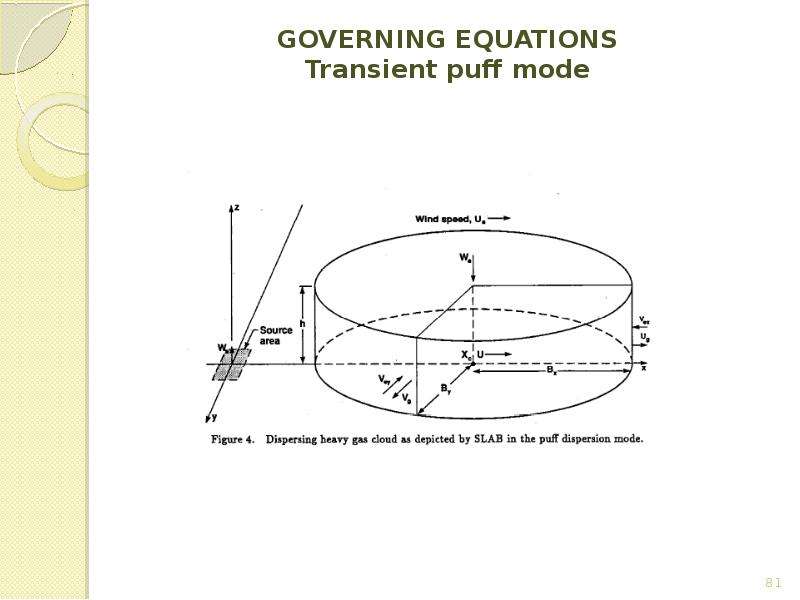
GOVERNING EQUATIONS Transient puff mode The transient puff mode of SLAB is based upon the volume-averaged conservation equations of mass, momentum,...
Описание слайда:
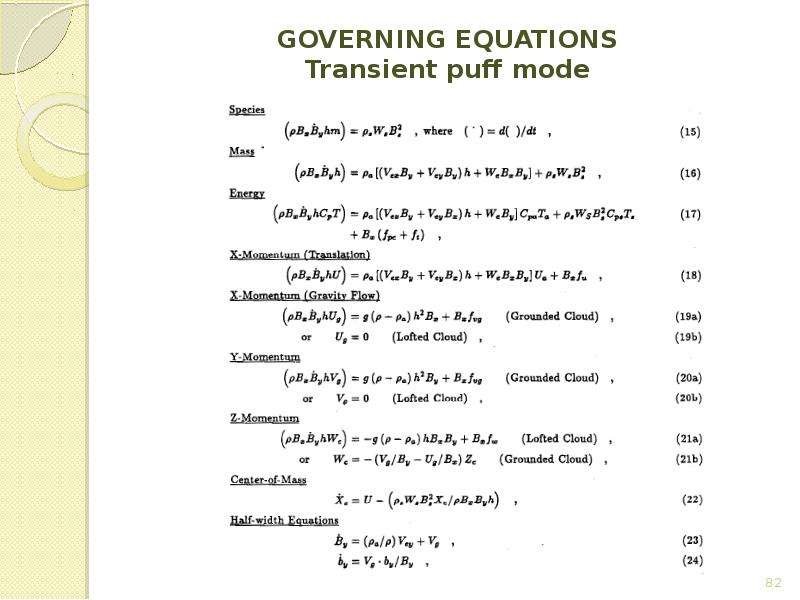
GOVERNING EQUATIONS Transient puff mode The transient puff mode of SLAB is based upon the volume-averaged conservation equations of mass, momentum, energy and species; As before, it uses the air entrainment concept to account for turbulent mixing of the cloud with the surrounding atmosphere The cloud is treated as a puff (see next page) and the independent variable is the downwind travel time t of the puff center of mass

Слайд 81


GOVERNING EQUATIONS Transient puff mode
Описание слайда:
GOVERNING EQUATIONS Transient puff mode

Слайд 82


GOVERNING EQUATIONS Transient puff mode
Описание слайда:
GOVERNING EQUATIONS Transient puff mode

Слайд 83


GOVERNING EQUATIONS Transient puff mode
Описание слайда:
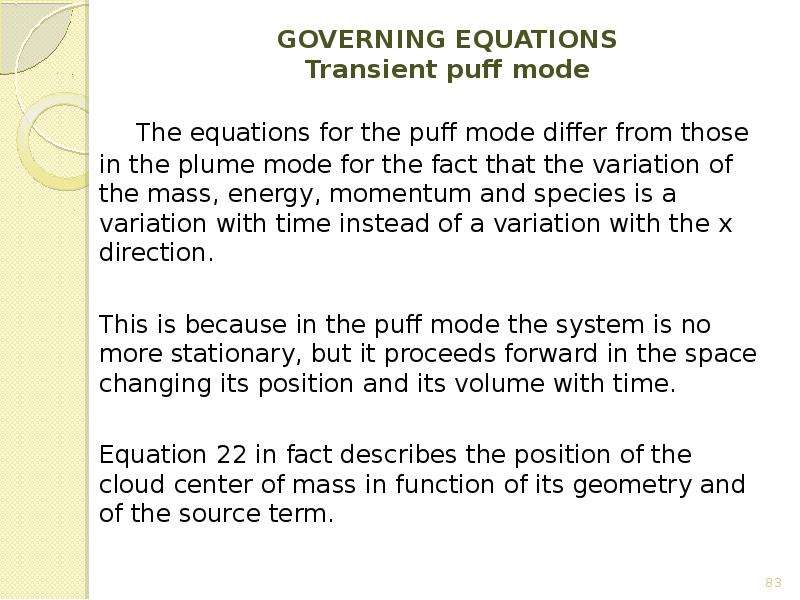
GOVERNING EQUATIONS Transient puff mode

Слайд 84


GOVERNING EQUATIONS Transition from plume to puff mode The puff dispersion mode can be entered: at the beginning of a simulation by specifying an...
Описание слайда:
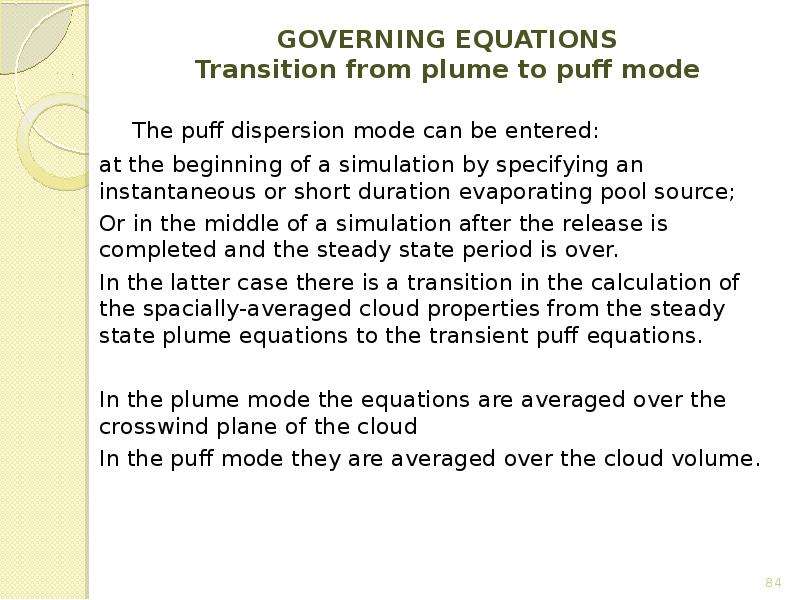
GOVERNING EQUATIONS Transition from plume to puff mode The puff dispersion mode can be entered: at the beginning of a simulation by specifying an instantaneous or short duration evaporating pool source; Or in the middle of a simulation after the release is completed and the steady state period is over. In the latter case there is a transition in the calculation of the spacially-averaged cloud properties from the steady state plume equations to the transient puff equations. In the plume mode the equations are averaged over the crosswind plane of the cloud In the puff mode they are averaged over the cloud volume.

Слайд 85


GOVERNING EQUATIONS Transition from plume to puff mode To begin the puff mode calculation it is necessary to define the time of this transition and...
Описание слайда:
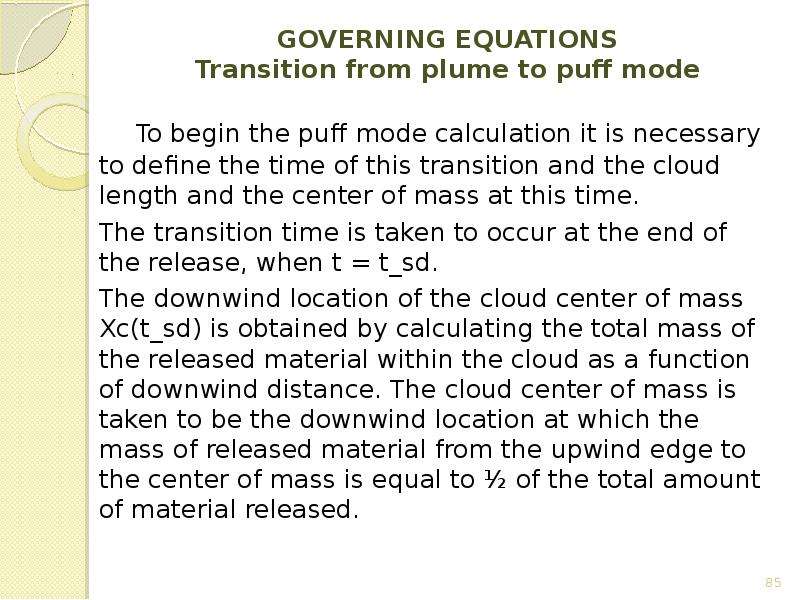
GOVERNING EQUATIONS Transition from plume to puff mode To begin the puff mode calculation it is necessary to define the time of this transition and the cloud length and the center of mass at this time. The transition time is taken to occur at the end of the release, when t = t_sd. The downwind location of the cloud center of mass Xc(t_sd) is obtained by calculating the total mass of the released material within the cloud as a function of downwind distance. The cloud center of mass is taken to be the downwind location at which the mass of released material from the upwind edge to the center of mass is equal to ½ of the total amount of material released.

Слайд 86


GOVERNING EQUATIONS Cloud length and time dependence in the plume mode The approach taken in the previous section for the calculation of the cloud...
Описание слайда:
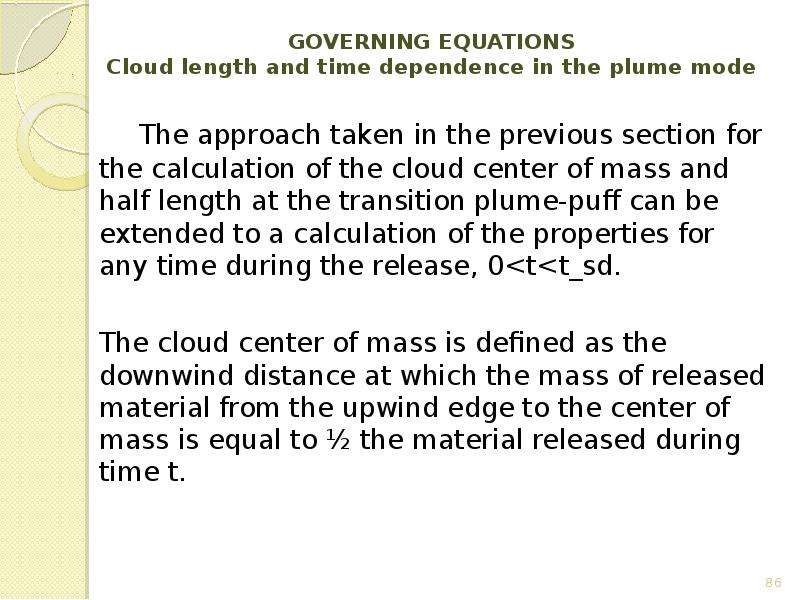
GOVERNING EQUATIONS Cloud length and time dependence in the plume mode The approach taken in the previous section for the calculation of the cloud center of mass and half length at the transition plume-puff can be extended to a calculation of the properties for any time during the release, 0

Слайд 87


GOVERNING EQUATIONS Solution of the dispersion equations The basic model equations can be solved by direct numerical integration of the equations as...
Описание слайда:
GOVERNING EQUATIONS Solution of the dispersion equations The basic model equations can be solved by direct numerical integration of the equations as given in the previous subsections. However, analytic solutions to some of these equations can be obtained by rearranging the equations and defining new variables. This approach is used in SLAB since it presumably will provide more accurate results.

Слайд 88


GOVERNING EQUATIONS Ambient velocity profile The ambient wind velocity profile is derived from the following assumed gradient: Where Ua is the...
Описание слайда:
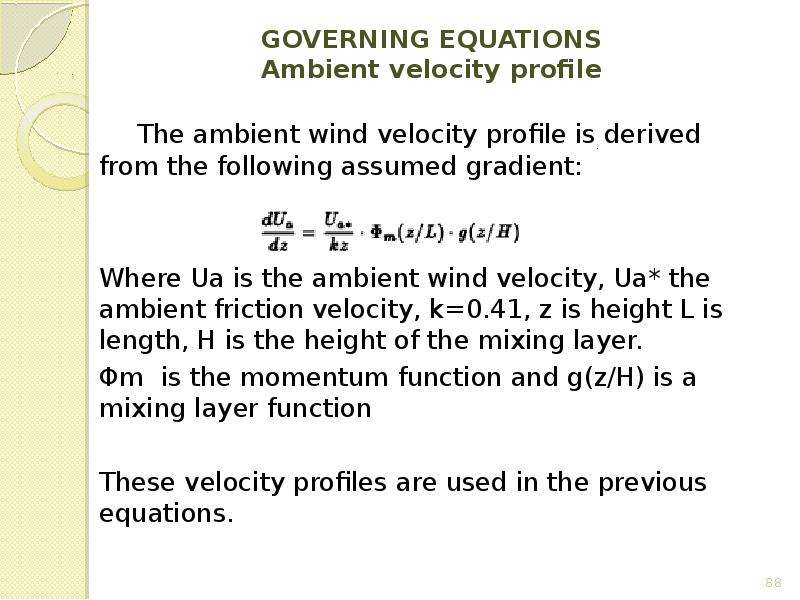
GOVERNING EQUATIONS Ambient velocity profile The ambient wind velocity profile is derived from the following assumed gradient: Where Ua is the ambient wind velocity, Ua* the ambient friction velocity, k=0.41, z is height L is length, H is the height of the mixing layer. Φm is the momentum function and g(z/H) is a mixing layer function These velocity profiles are used in the previous equations.

Слайд 89


GOVERNING EQUATIONS Entrainment rates The vertical entrainment rate includes the effects of surface friction, differential motion between air and...
Описание слайда:
GOVERNING EQUATIONS Entrainment rates The vertical entrainment rate includes the effects of surface friction, differential motion between air and cloud, thermal convection due to ground heating, damping of air-cloud mixing due to stable density stratification within the cloud. The formula used in SLAB is based on experimental data from several sources.

Слайд 90


GOVERNING EQUATIONS Heat and momentum flux terms The flux terms are adapted from Zeman (1982). The thermal flux at ground is given by The downwind...
Описание слайда:
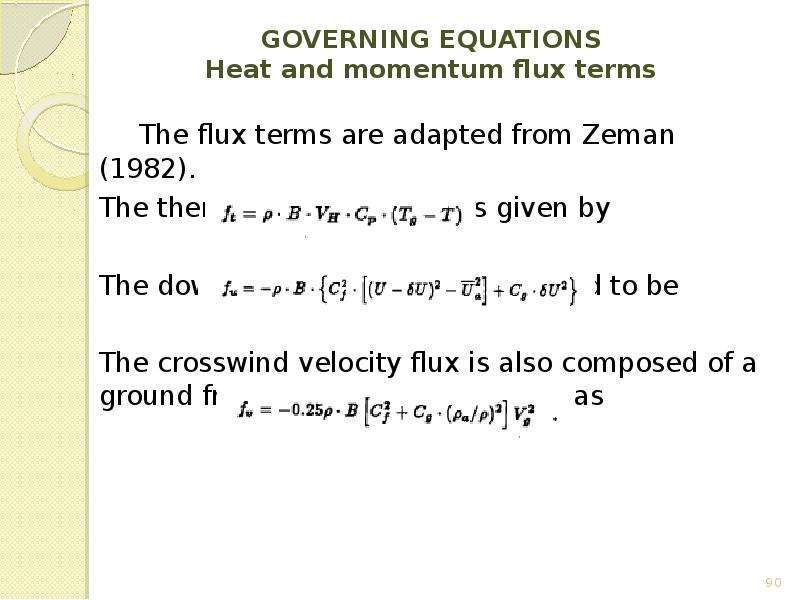
GOVERNING EQUATIONS Heat and momentum flux terms The flux terms are adapted from Zeman (1982). The thermal flux at ground is given by The downwind velocity flux is defined to be The crosswind velocity flux is also composed of a ground friction term and is defined as

Слайд 91


GOVERNING EQUATIONS Thermodynamic model Liquid droplets formation and evaporation is governed by an equilibrium thermodynamic model in SLAB. Two...
Описание слайда:
GOVERNING EQUATIONS Thermodynamic model Liquid droplets formation and evaporation is governed by an equilibrium thermodynamic model in SLAB. Two species are allowed to form droplets: the ambient water vapor that enters the cloud and the released emission within the cloud. The governing equations are: the mass conservation equation for the released material additional mass conservation equations for the dry air, total water and the liquid-vapor fractions of water and emission the energy conservation the equation of state for a liquid droplet-vapor mixture the equilibrium condition that controls the liquid-vapor ratio for each species.

Слайд 92


GOVERNING EQUATIONS Plume rise The plume from a vertical jet or stack release initially rises until a maximum plume height is attained. In SLAB the...
Описание слайда:
GOVERNING EQUATIONS Plume rise The plume from a vertical jet or stack release initially rises until a maximum plume height is attained. In SLAB the plume rise region is obtained from the results of wind tunnel and field experiments. Three types of jet are considered: denser than air jets (ρs>ρa) momentum jets (ρs=ρa) buoyant jets (ρs

Слайд 93


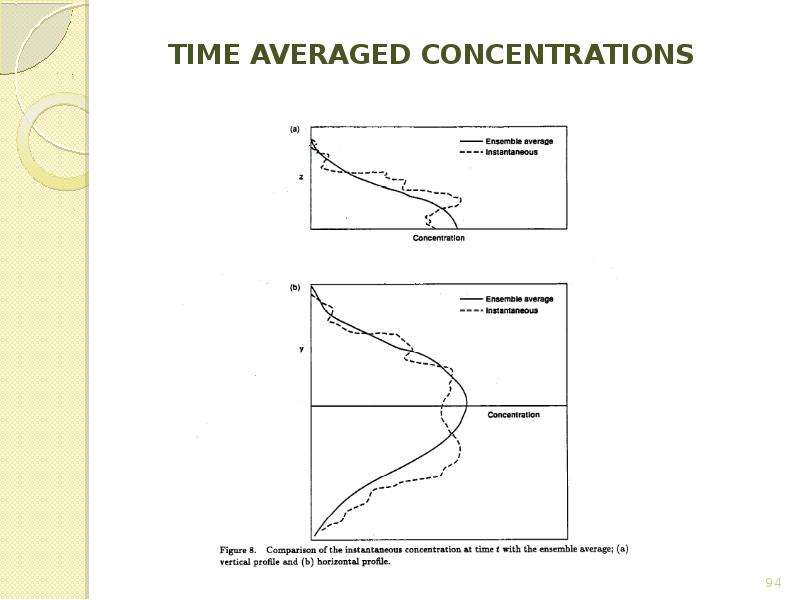
TIME AVERAGED CONCENTRATIONS All of the SLAB results (concentration, cloud width …) represent ensemble averages. An ensemble average is an average...
Описание слайда:
TIME AVERAGED CONCENTRATIONS All of the SLAB results (concentration, cloud width …) represent ensemble averages. An ensemble average is an average over numerous experiments under the same conditions. In a dispersion experiment these conditions are the spill terrain, and meteorological conditions. Since the model predicted concentration is an ensemble average, it may be greater than or less than the measured concentration. The situation is depicted in the next page, where the instantaneous concentration at time t and downwind distance x is compared with the ensemble average.

Слайд 94


TIME AVERAGED CONCENTRATIONS
Описание слайда:
TIME AVERAGED CONCENTRATIONS

Слайд 95


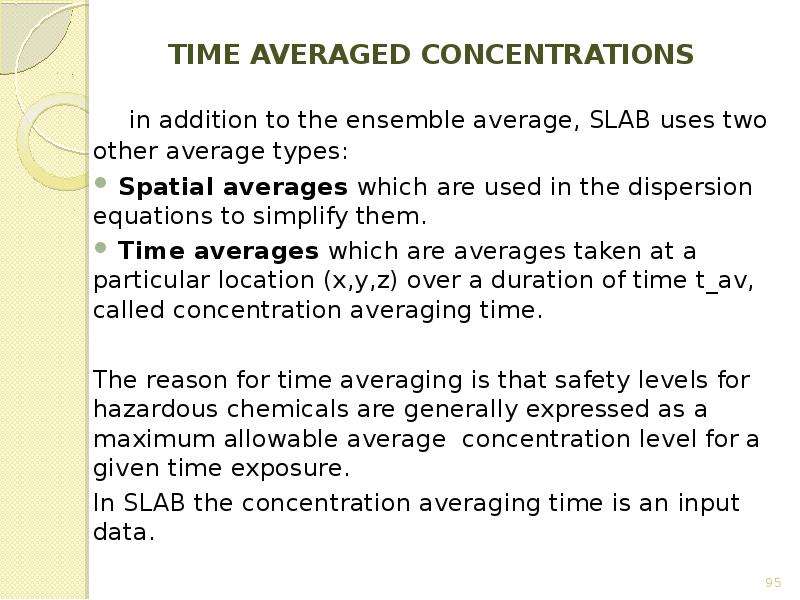
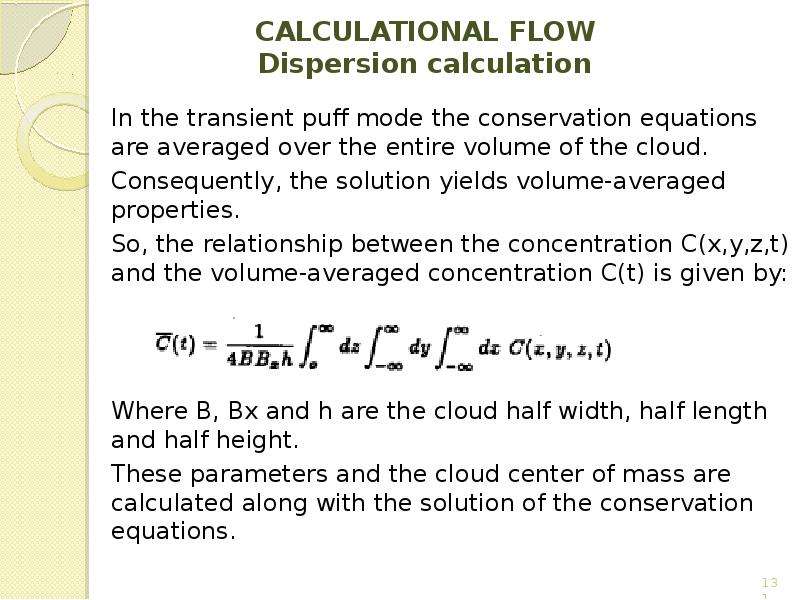
TIME AVERAGED CONCENTRATIONS in addition to the ensemble average, SLAB uses two other average types: Spatial averages which are used in the...
Описание слайда:
TIME AVERAGED CONCENTRATIONS in addition to the ensemble average, SLAB uses two other average types: Spatial averages which are used in the dispersion equations to simplify them. Time averages which are averages taken at a particular location (x,y,z) over a duration of time t_av, called concentration averaging time. The reason for time averaging is that safety levels for hazardous chemicals are generally expressed as a maximum allowable average concentration level for a given time exposure. In SLAB the concentration averaging time is an input data.

Слайд 96


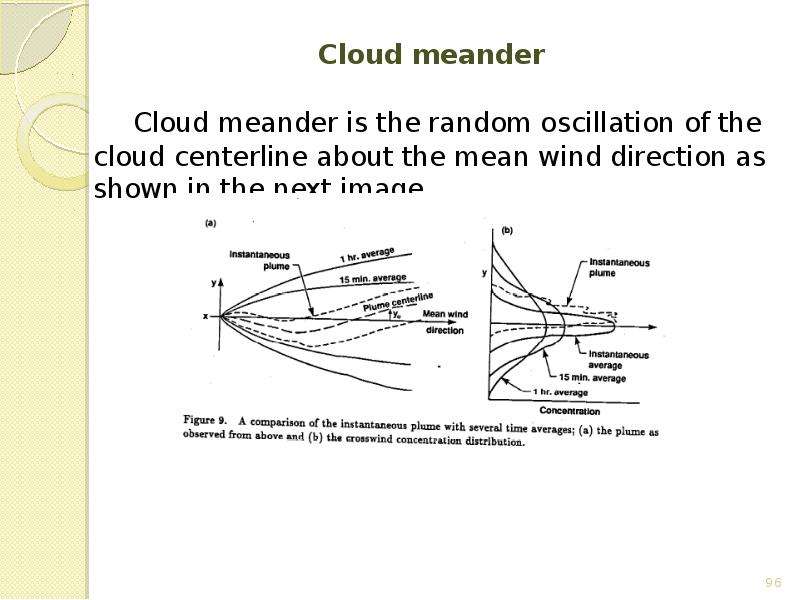
Cloud meander Cloud meander is the random oscillation of the cloud centerline about the mean wind direction as shown in the next image.
Описание слайда:
Cloud meander Cloud meander is the random oscillation of the cloud centerline about the mean wind direction as shown in the next image.

Слайд 97


Cloud meander When the cloud concentration os averaged over time, the effective width of the cloud appears to be wider due to the wandering of the...
Описание слайда:
Cloud meander When the cloud concentration os averaged over time, the effective width of the cloud appears to be wider due to the wandering of the cloud centerline. In addition, the mean cloud concentration decreases in the region about the mean centerline. Empirically, it has been found that the effective width of the cloud increases as the concentration averaging time is increased (see figure in previous page)

Слайд 98


Cloud meander In SLAB code solution to the dispersion equations, the cloud meander is ignored and the cloud is assumed to travel in a straight line....
Описание слайда:
Cloud meander In SLAB code solution to the dispersion equations, the cloud meander is ignored and the cloud is assumed to travel in a straight line. Consequently, in terms of time averaging, these results are the “instantaneous” average obtained in absence of cloud meander. To include the effects of cloud meander the “instantaneous” average cloud needs to be modified to include the cloud width due to the displacement y0 (see figure) of the meandering cloud centerline about the mean wind direction.

Слайд 99


Time averaged volume concentration With the determination of the effective cloud half width for the concentration averaging time t_av, the...
Описание слайда:
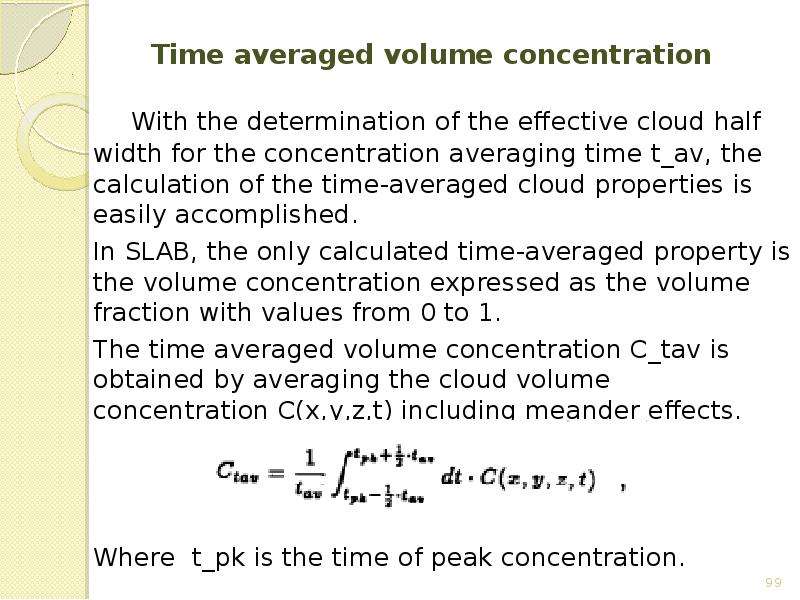
Time averaged volume concentration With the determination of the effective cloud half width for the concentration averaging time t_av, the calculation of the time-averaged cloud properties is easily accomplished. In SLAB, the only calculated time-averaged property is the volume concentration expressed as the volume fraction with values from 0 to 1. The time averaged volume concentration C_tav is obtained by averaging the cloud volume concentration C(x,y,z,t) including meander effects. Where t_pk is the time of peak concentration.

Слайд 100


SLAB User’s guide
Описание слайда:
SLAB User’s guide

Слайд 101


General information SLAB is implemented in the Fortran 77 language. SLAB operates by acquiring an input data file named INPUT containing the input...
Описание слайда:
General information SLAB is implemented in the Fortran 77 language. SLAB operates by acquiring an input data file named INPUT containing the input parameters. A SLAB problem may consist of a single run or several runs where metereologic conditions can vary while the remainder of the spill scenario is the same. SLAB produces as output a file named PREDICT containing the output from a single problem which may include one or more SLAB runs.

Слайд 102


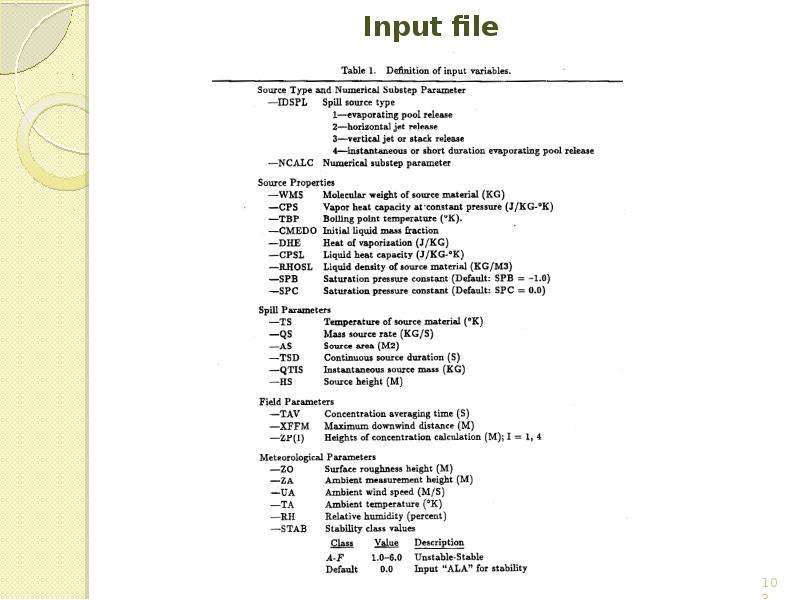
Input file There are 30 possible input parameters required to run in SLAB. Such parameters include the source type, source properties, spill...
Описание слайда:
Input file There are 30 possible input parameters required to run in SLAB. Such parameters include the source type, source properties, spill properties, field properties, meteorological parameters and a numerical substep parameter. These input parameters define uniquely the problem. The table in the next page lists the input parameters.

Слайд 103


Input file
Описание слайда:
Input file

Слайд 104


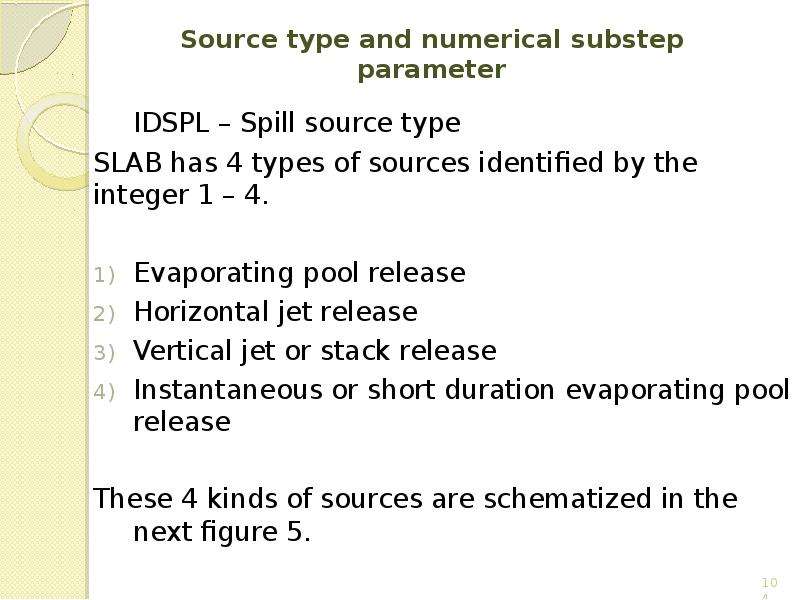
Source type and numerical substep parameter IDSPL – Spill source type SLAB has 4 types of sources identified by the integer 1 – 4. Evaporating pool...
Описание слайда:
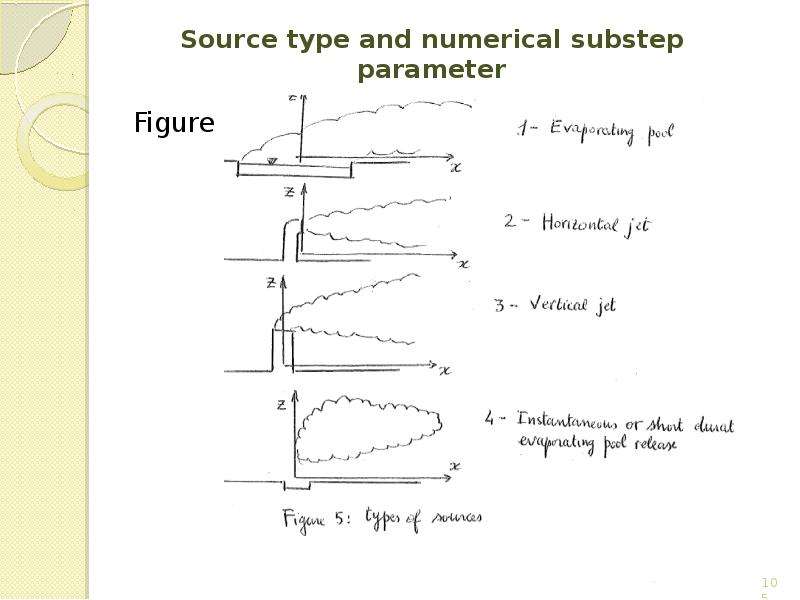
Source type and numerical substep parameter IDSPL – Spill source type SLAB has 4 types of sources identified by the integer 1 – 4. Evaporating pool release Horizontal jet release Vertical jet or stack release Instantaneous or short duration evaporating pool release These 4 kinds of sources are schematized in the next figure 5.

Слайд 105


Source type and numerical substep parameter Figure 5
Описание слайда:
Source type and numerical substep parameter Figure 5

Слайд 106


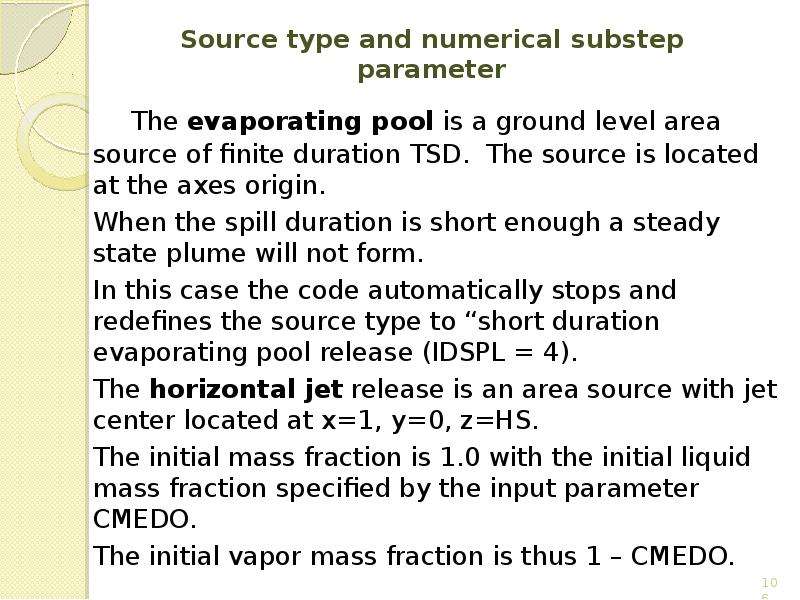
Source type and numerical substep parameter The evaporating pool is a ground level area source of finite duration TSD. The source is located at the...
Описание слайда:
Source type and numerical substep parameter The evaporating pool is a ground level area source of finite duration TSD. The source is located at the axes origin. When the spill duration is short enough a steady state plume will not form. In this case the code automatically stops and redefines the source type to “short duration evaporating pool release (IDSPL = 4). The horizontal jet release is an area source with jet center located at x=1, y=0, z=HS. The initial mass fraction is 1.0 with the initial liquid mass fraction specified by the input parameter CMEDO. The initial vapor mass fraction is thus 1 – CMEDO.

Слайд 107


Source type and numerical substep parameter The vertical jet release is an area source with source plane parallel to the ground and source velocity...
Описание слайда:
Source type and numerical substep parameter The vertical jet release is an area source with source plane parallel to the ground and source velocity pointing upward. The same considerations as the horizontal jet can be done for the mass fraction. The instantaneous or short duration evaporating pool release is a combination of two sources: an instantaneous volume source with a total mass given by the parameter QTIS and a short duration, ground level area source with a source rate and a spill duration given by the input parameters QS and TSD respectively. When an instantaneous volume release is simulated, QTIS is specified and QS and TSD are set to zero.

Слайд 108


Source type and numerical substep parameter In SLAB the pressure within the cloud is always 101325 Pa. If an explosion is to be simulated the SLAB...
Описание слайда:
Source type and numerical substep parameter In SLAB the pressure within the cloud is always 101325 Pa. If an explosion is to be simulated the SLAB calculation begins after the source is fully expanded to atmospheric pressure. It is recommended that an evaporating pool release of any finite duration be run in the source type parameter with IDSPL = 1. If the steady state cloud is not achieved, the code will turn automatically into IDSPL = 4.

Слайд 109


Source type and numerical substep parameter The parameter NCALC is an integer substep multiplier that specifies the number of calculation sub-steps...
Описание слайда:
Source type and numerical substep parameter The parameter NCALC is an integer substep multiplier that specifies the number of calculation sub-steps performed during the integration of the conservation equations. A value of NCALC=1 is generally recommended to provide computational stability and sufficient numerical accuracy However, if stability problems rise, the value of NCALC can be increased.

Слайд 110


Source properties WMS = molecular weight of the source material [kg] CPS = vapor heat capacity at constant pressure [J/kgK] TBP = boiling point...
Описание слайда:
Source properties WMS = molecular weight of the source material [kg] CPS = vapor heat capacity at constant pressure [J/kgK] TBP = boiling point temperature of source material [K] CMEDO = Initial liquid mass fraction The emission is assumed to be the pure substance with a fraction CMEDO in liquid phase in the form of liquid droplets; the remainder (1 – CMEDO) is in the vapor phase.

Слайд 111


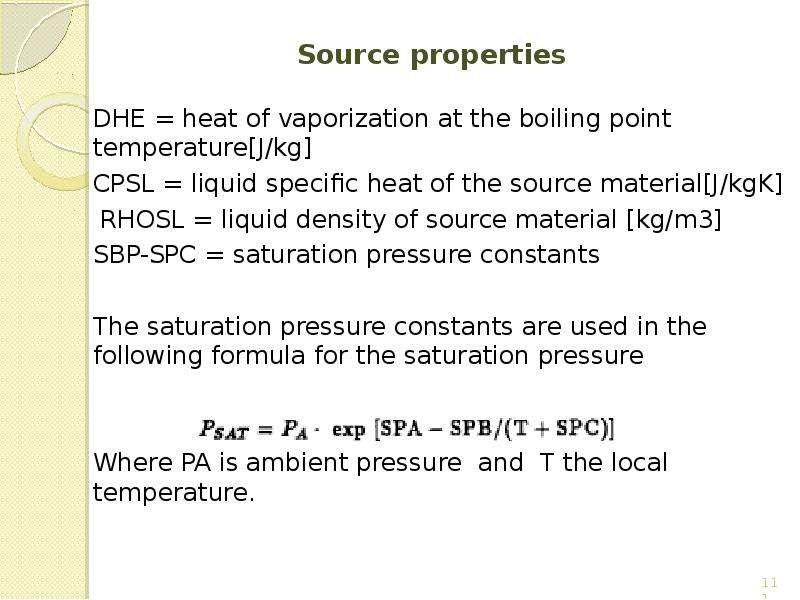
Source properties DHE = heat of vaporization at the boiling point temperature[J/kg] CPSL = liquid specific heat of the source material[J/kgK] RHOSL =...
Описание слайда:
Source properties DHE = heat of vaporization at the boiling point temperature[J/kg] CPSL = liquid specific heat of the source material[J/kgK] RHOSL = liquid density of source material [kg/m3] SBP-SPC = saturation pressure constants The saturation pressure constants are used in the following formula for the saturation pressure Where PA is ambient pressure and T the local temperature.

Слайд 112


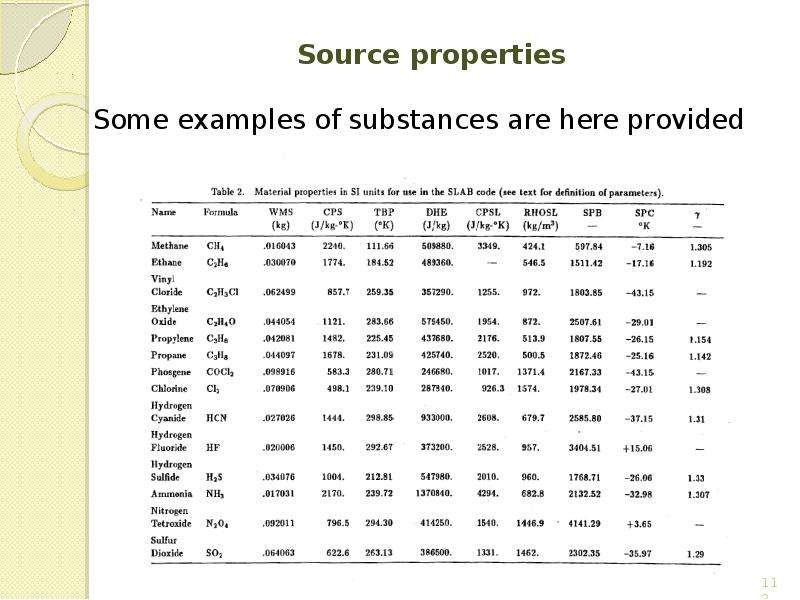
Source properties Some examples of substances are here provided
Описание слайда:
Source properties Some examples of substances are here provided

Слайд 113


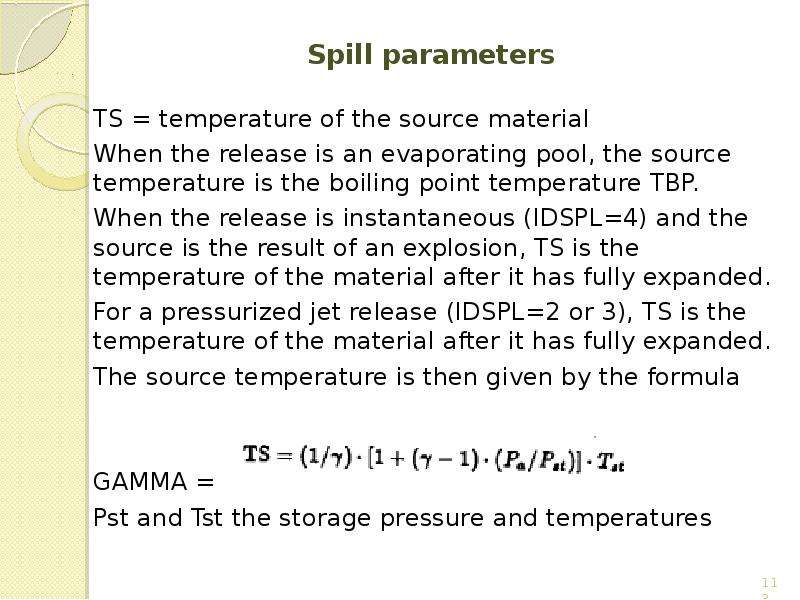
Spill parameters TS = temperature of the source material When the release is an evaporating pool, the source temperature is the boiling point...
Описание слайда:
Spill parameters TS = temperature of the source material When the release is an evaporating pool, the source temperature is the boiling point temperature TBP. When the release is instantaneous (IDSPL=4) and the source is the result of an explosion, TS is the temperature of the material after it has fully expanded. For a pressurized jet release (IDSPL=2 or 3), TS is the temperature of the material after it has fully expanded. The source temperature is then given by the formula GAMMA = Cp/Cv Pst and Tst the storage pressure and temperatures

Слайд 114


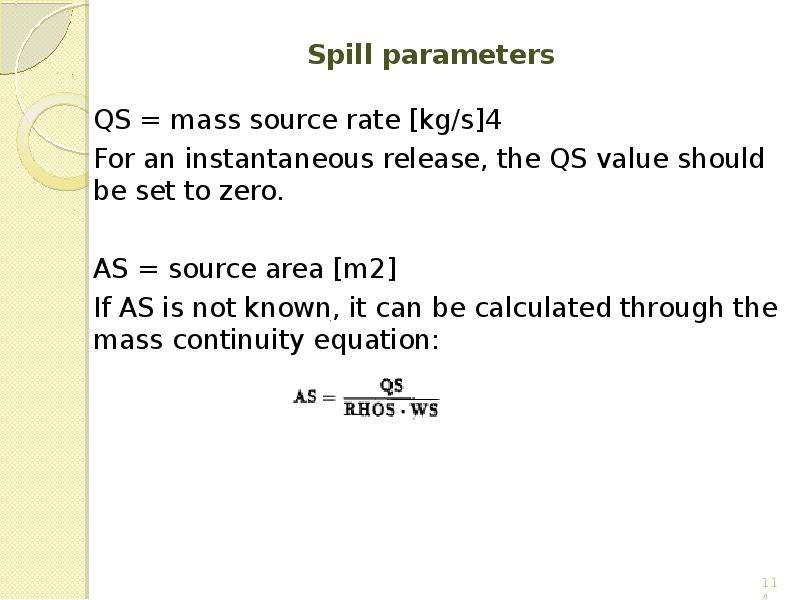
Spill parameters QS = mass source rate [kg/s]4 For an instantaneous release, the QS value should be set to zero. AS = source area [m2] If AS is not...
Описание слайда:
Spill parameters QS = mass source rate [kg/s]4 For an instantaneous release, the QS value should be set to zero. AS = source area [m2] If AS is not known, it can be calculated through the mass continuity equation:

Слайд 115


Spill parameters TSD = continuous source duration [s] This parameter specifies the duration of the release from an evaporating pool, (IDSPL=1 or 4)...
Описание слайда:
Spill parameters TSD = continuous source duration [s] This parameter specifies the duration of the release from an evaporating pool, (IDSPL=1 or 4) or jet (IDSPL = 2 or 3) source. When an instantaneous release is to be simulated, TSD =0. QTIS = instantaneous source mass [kg] This is the total mass of the instantaneous release. For an evaporating pool or jet should be equal to zero. HS = source height [m] For a pool, HS=0 For horizontal jet is the height at jet center For an instantaneous release, the source area AS multiplied by the height HS is equal to the total volume released.

Слайд 116


Field parameters TAV = concentration averaging time [s] The concentration averaging time is the appropriate averaging time for the safety standard of...
Описание слайда:
Field parameters TAV = concentration averaging time [s] The concentration averaging time is the appropriate averaging time for the safety standard of interest. E.G. if the safety standard of interest for a particular material is a maximum average concentration of 100 ppm for a 1h exposure, then TAV=3600 s. Care should be taken when TAV is greater than the cloud duration TCD. In this case the average concentration will be reduced since the puff is relatively short and the observer is exposed to the material for only a fraction of the concentration averaging time. In this case, a more meaningful TAV value to use might be one that is less or equal to the cloud duration.

Слайд 117


Field parameters XFFM=maximum downwind distance [m] This is the maximum downwind (x) distance for which the user is interested in knowing the cloud...
Описание слайда:
Field parameters XFFM=maximum downwind distance [m] This is the maximum downwind (x) distance for which the user is interested in knowing the cloud concentration. In steady state plume mode, the simulation is conducted to a downwind distance equal to XFFM. However, in the transient puff dispersion mode, time is the independent variable rather than distance. Then, in puff mode the simulation is conducted to a downwind distance a bit larger than XFFM. ZP(I), I=1,4 = heights of concentration calculation There are a maximum of 4 heights at which the concentration is calculated as a function of downwind distance.

Слайд 118


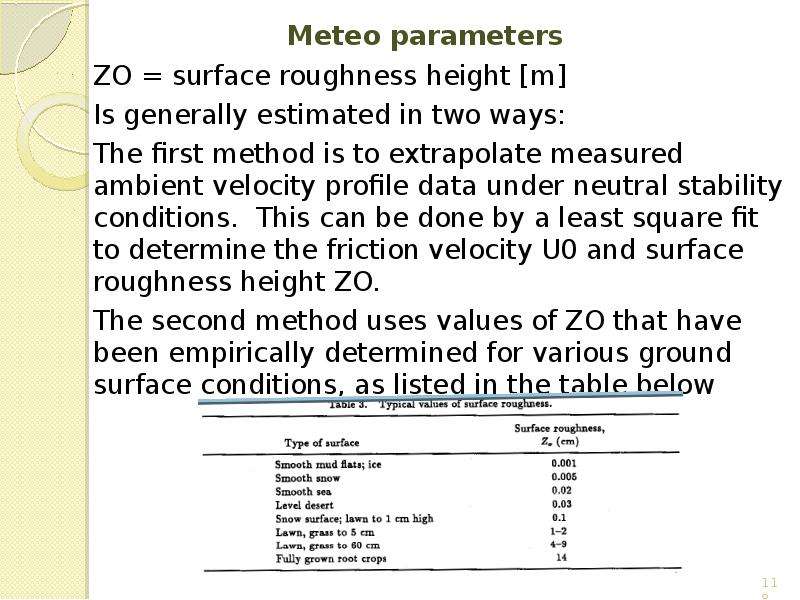
Meteo parameters ZO = surface roughness height [m] Is generally estimated in two ways: The first method is to extrapolate measured ambient velocity...
Описание слайда:
Meteo parameters ZO = surface roughness height [m] Is generally estimated in two ways: The first method is to extrapolate measured ambient velocity profile data under neutral stability conditions. This can be done by a least square fit to determine the friction velocity U0 and surface roughness height ZO. The second method uses values of ZO that have been empirically determined for various ground surface conditions, as listed in the table below

Слайд 119


Meteo parameters ZA = ambient measurement height [m] This is the height at which ambient windspeed is measured. This height should be much larger...
Описание слайда:
Meteo parameters ZA = ambient measurement height [m] This is the height at which ambient windspeed is measured. This height should be much larger than ZO. UA = ambient wind speed [m/s] TA = ambient temperature [K] RH = relative humidity [%]

Слайд 120


Meteo parameters STAB = stability class values The whole numbers from 1 to 6 are used in the code to describe the ambient atmospheric stability using...
Описание слайда:
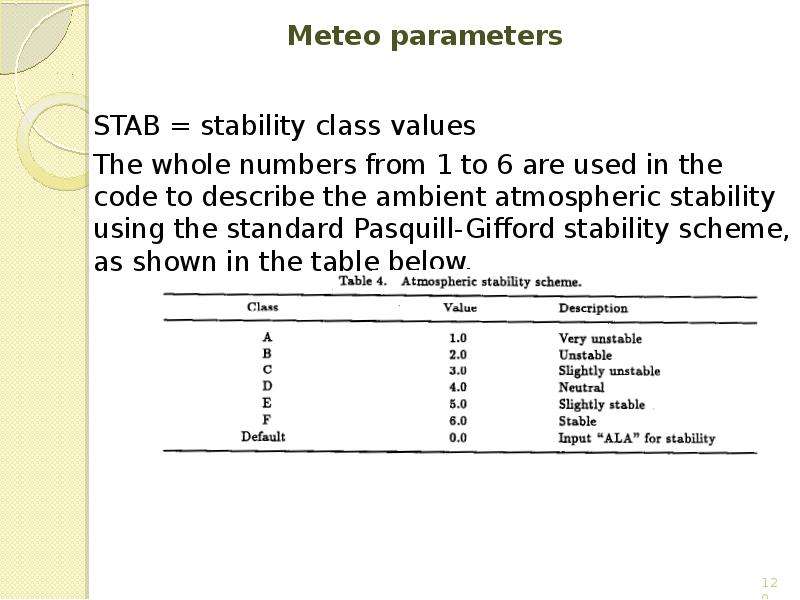
Meteo parameters STAB = stability class values The whole numbers from 1 to 6 are used in the code to describe the ambient atmospheric stability using the standard Pasquill-Gifford stability scheme, as shown in the table below.

Слайд 121


Meteo parameters The classes of atmospheric stability are an method of classification of the atmospheric stability, i.e. they are a method for...
Описание слайда:
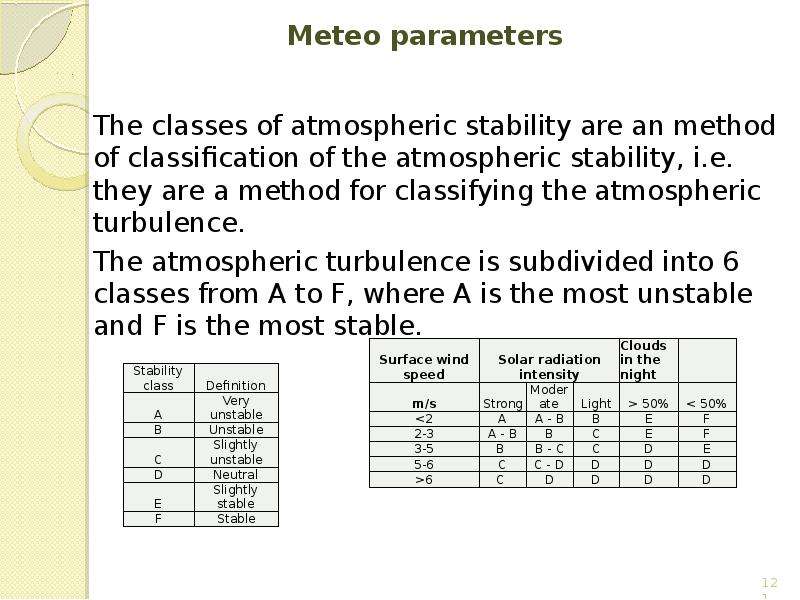
Meteo parameters The classes of atmospheric stability are an method of classification of the atmospheric stability, i.e. they are a method for classifying the atmospheric turbulence. The atmospheric turbulence is subdivided into 6 classes from A to F, where A is the most unstable and F is the most stable.

Слайд 122


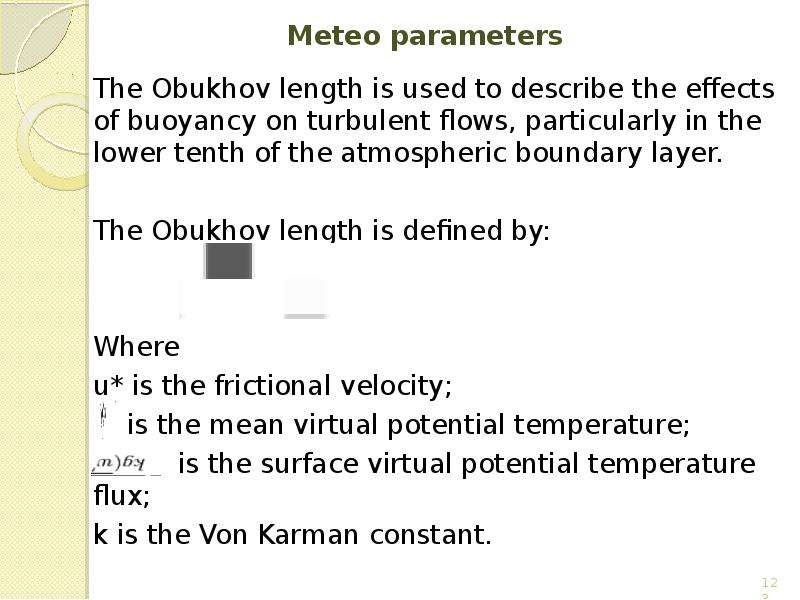
Meteo parameters ALA = inverse Monin-Obukhov length [1/m] This is a stability parameter used to describe the vertical profile of ambient wind speed...
Описание слайда:
Meteo parameters ALA = inverse Monin-Obukhov length [1/m] This is a stability parameter used to describe the vertical profile of ambient wind speed and the vertical turbulent diffusivity. This option for describing atmospheric stability is activated by setting STAB=0.0. ALA is an input parameter only when STAB=0.0. Inclusion of ALA when STAB is not zero results in an error.

Слайд 123


Meteo parameters The Obukhov length is used to describe the effects of buoyancy on turbulent flows, particularly in the lower tenth of the...
Описание слайда:
Meteo parameters The Obukhov length is used to describe the effects of buoyancy on turbulent flows, particularly in the lower tenth of the atmospheric boundary layer. The Obukhov length is defined by: Where u* is the frictional velocity; is the mean virtual potential temperature; is the surface virtual potential temperature flux; k is the Von Karman constant.

Слайд 124


Input file closure After the code has read the input and executed a run, it returns to the start of the code looking for an additional value of ZO...
Описание слайда:
Input file closure After the code has read the input and executed a run, it returns to the start of the code looking for an additional value of ZO (surface roughness height) . If an additional value of ZO is specified, the code will look for the remaining meteo input parameters (ZA, UA, TA, RH, STAB, ALA) and executes an additional run with the new metrologicla inputs. In this way multiple runs can be made with the same source, but different meteo conditions. When the code looks for an additional value of ZO and finds a value minor than zero, it terminates the problem. Thus the problem is terminated by including an additional input parameter with the value -1.

Слайд 125


CALCULATIONAL FLOW A SLAB model simulation can be viewed as occurring in three sequential phases: initialization, sequential calculation and time...
Описание слайда:
CALCULATIONAL FLOW A SLAB model simulation can be viewed as occurring in three sequential phases: initialization, sequential calculation and time averaged concentration calculation. The calculational flow starting with the identified source type and ending with the calculation of the time averaged concentration as shown in the figure below.

Слайд 126


CALCULATIONAL FLOW Initialization The initialization begins with the specification of the source type. There is one case where the code overrides the...
Описание слайда:
CALCULATIONAL FLOW Initialization The initialization begins with the specification of the source type. There is one case where the code overrides the specified source type, that is when “evaporating pool” is specified and the release duration is so short that a steady state cloud is not reached. In this case, the source type is switched to “instantaneous or short duration release”.

Слайд 127


CALCULATIONAL FLOW Dispersion calculation The dispersion phase contains the bulk of the calculation. It is here that the conservation and...
Описание слайда:
CALCULATIONAL FLOW Dispersion calculation The dispersion phase contains the bulk of the calculation. It is here that the conservation and thermodynamic equations are solved, yielding the instantaneous (no meander) spacially averaged properties in function of downwind distance. There are two dispersion modes: plume and puff., of which a sketch is given in the picture below

Слайд 128


CALCULATIONAL FLOW Dispersion calculation The steady state plume mode is used for the finite duration releases until the end of the release. After...
Описание слайда:
CALCULATIONAL FLOW Dispersion calculation The steady state plume mode is used for the finite duration releases until the end of the release. After the release is over, the transient puff mode is used for the remainder of the simulation. The transient puff mode is also used in the case of an instantaneous release or when the release is so short that a steady state is not reached. These two models represent two different forms of the conservation equations.

Слайд 129


CALCULATIONAL FLOW Dispersion calculation In the steady state plume mode the conservation equations are spatially averaged over the cross-wind plane...
Описание слайда:
CALCULATIONAL FLOW Dispersion calculation In the steady state plume mode the conservation equations are spatially averaged over the cross-wind plane of the cloud, as visible in the picture at page 78. Consequently, the resulting cloud properties are also spatially averaged over the crosswind plane. Thus, the relation between concentration C(x,y,z) and the cross averaged concentration C(x) is given by: Where B and h are the cloud half width and height. The crosswind averaged concentration is not expressed as a function of time since the plume is considered in steady state.

Слайд 130


CALCULATIONAL FLOW Dispersion calculation In the transient puff mode the conservation equations are averaged over the entire volume of the cloud....
Описание слайда:
CALCULATIONAL FLOW Dispersion calculation In the transient puff mode the conservation equations are averaged over the entire volume of the cloud. Consequently, the solution yields volume-averaged properties. So, the relationship between the concentration C(x,y,z,t) and the volume-averaged concentration C(t) is given by: Where B, Bx and h are the cloud half width, half length and half height. These parameters and the cloud center of mass are calculated along with the solution of the conservation equations.

Слайд 131


CALCULATIONAL FLOW Dispersion calculation In the transient puff mode the conservation equations are averaged over the entire volume of the cloud....
Описание слайда:
CALCULATIONAL FLOW Dispersion calculation In the transient puff mode the conservation equations are averaged over the entire volume of the cloud. Consequently, the solution yields volume-averaged properties. So, the relationship between the concentration C(x,y,z,t) and the volume-averaged concentration C(t) is given by: Where B, Bx and h are the cloud half width, half length and half height. These parameters and the cloud center of mass are calculated along with the solution of the conservation equations.

Слайд 132


CALCULATIONAL FLOW Time averaged concentration calculation After the spatially-averaged cloud properties are calculated at all downwind distances,...
Описание слайда:
CALCULATIONAL FLOW Time averaged concentration calculation After the spatially-averaged cloud properties are calculated at all downwind distances, the code calculates the time averaged concentration. In SLAB, the concentration is expressed as the volume fraction, ranging from 0 to 1. The time-averaged volume fraction C_tav(x,y,z,t) is calculated by the spatially averaged volume fraction C(Xc,t) and the cloud height, width and length parameters. To do this, the concentration distribution about the center of mass Xc must be assumed since C(Xc,t) does not contain this information. SLAB uses profile distribution functions, which are functions of the calculated half width, half length and height of the cloud.

Слайд 133


CALCULATIONAL FLOW Time averaged concentration calculation The calculation of the time averaged volume fraction C_tav(x,y,z,t) from the volume...
Описание слайда:
CALCULATIONAL FLOW Time averaged concentration calculation The calculation of the time averaged volume fraction C_tav(x,y,z,t) from the volume fraction C(x-Xc,y,z,t), involves two steps: The calculation of the cloud half-width The calculation of the time averaged volume fraction The effects of the cloud meander is to increase the width of the cloud, reducing the average concentration observed in the cloud centerline region. The longer the averaging time, the more meander can occur and the greater the increase in the effective width.

Слайд 134


CALCULATIONAL FLOW Time averaged concentration calculation The time available for cloud meander at the downwind location x cannot be longer than the...
Описание слайда:
CALCULATIONAL FLOW Time averaged concentration calculation The time available for cloud meander at the downwind location x cannot be longer than the duration of the exposure to the cloud at the same location. Thus, the time available for cloud meander is assumed to be equal to the concentration averaging time t_av with a maximum value equal to the cloud duration t_cd. As a result, the cloud effective width increases monotonically with the concentration averaging time t_av until some maximum value is reached that is dependent on the length of the cloud. With the calculation of the cloud effective half width, the time averaged volume fraction can now be determined. The calculation of the time averaged volume fraction concludes the SLAB run.

Слайд 135


OUTPUT FILE The output file contains several types of information which can be grouped in 3 categories: Problem description Instantaneous spatially...
Описание слайда:
OUTPUT FILE The output file contains several types of information which can be grouped in 3 categories: Problem description Instantaneous spatially averaged cloud properties Time averaged volume fraction These categories correspond to the three sequential phases (initialization, dispersion calculation and time-averaged concentration calculation) of the SLAB code calculation.

Слайд 136


OUTPUT FILE Problem description The Problem description output lists the various input parameters used by the code and thereby defines the problem to...
Описание слайда:
OUTPUT FILE Problem description The Problem description output lists the various input parameters used by the code and thereby defines the problem to be solved. The first group is the problem input parameter values as specified by the user. Some input parameters (IDSPL, SPB, SPC, TS and STAB) may be changed by the code in order to be consistent with SLAB model assumptions.

Слайд 137


OUTPUT FILE Instantaneous spatially averaged cloud properties The instantaneous spatially averaged cloud properties output gives the results of the...
Описание слайда:
OUTPUT FILE Instantaneous spatially averaged cloud properties The instantaneous spatially averaged cloud properties output gives the results of the dispersion calculation phase of the simulation. These results are intermediate results in that they are the solution of the spatially averaged (plume or pluff) conservation equations, the equation of state and the length and width equations. However they do not include the effects of cloud meander time averaging.

Слайд 138


OUTPUT FILE Instantaneous spatially averaged cloud properties The table below lists the instantaneous spatially averaged parameters and identifies...
Описание слайда:
OUTPUT FILE Instantaneous spatially averaged cloud properties The table below lists the instantaneous spatially averaged parameters and identifies their units. These parameters are listed in the output in function of the x coordinate.

Слайд 139


OUTPUT FILE Instantaneous spatially averaged cloud properties The cloud properties listed before, are described as “instantaneous” and “spatially”...
Описание слайда:
OUTPUT FILE Instantaneous spatially averaged cloud properties The cloud properties listed before, are described as “instantaneous” and “spatially” averaged properties. All of the SLAB results are ensemble average values: they represent the average taken over numerous trials under the same conditions. In addition, these ensemble average values can be averaged over time and space. The term “instantaneous” refers to the time averaging and indicates that the duration of the time period over which the average is taken is essentially zero. Thus the effects of cloud meander are assumed to be absent in the “instantaneous” average.

Слайд 140


OUTPUT FILE Instantaneous spatially averaged cloud properties The “spatial” averaging in SLAB is of 2 types: cross-wind and volume average. The...
Описание слайда:
OUTPUT FILE Instantaneous spatially averaged cloud properties The “spatial” averaging in SLAB is of 2 types: cross-wind and volume average. The choice of the spatial average depends on the dispersion mode (plume or puff). When a finite duration release is simulated, a transition occurs in the dispersion calculation as the code switches from the plume to the puff mode, with the transition occurring at the end of the release, t = TSD. Since there is no discontinuity in the actual dispersion of the cloud at this time, the code predicted values should also maintain this continuity. This is done in SLAB by the definition of the cloud half length at the time of the transition in the dispersion mode calculation.

Слайд 141


OUTPUT FILE Time averaged volume fraction In SLAB the time averaged concentration is expressed as the time averaged volume fraction with values...
Описание слайда:
OUTPUT FILE Time averaged volume fraction In SLAB the time averaged concentration is expressed as the time averaged volume fraction with values ranging from 0 to 1. This is easily turned into ppm concentration multiplying by one million. The time average volume concentration output is is presented under 3 sub titles: Concentration contour parameters Concentration in the Z = ZP(I) plane (height of concentration calculation) Maximum centerline concentration All of these results are presented from the point of view of an observer located at the downwind distance x, crosswind distance y and height z above the ground.

Слайд 142


OUTPUT FILE Time averaged volume fraction The concentration contour parameters output lists a number of parameters from which the time-averaged...
Описание слайда:
OUTPUT FILE Time averaged volume fraction The concentration contour parameters output lists a number of parameters from which the time-averaged volume concentration at any downwind location and time within the problem domain can be calculated.

Слайд 143


OUTPUT FILE Time averaged volume fraction The concentration in the Z=ZP(I) plane gives the the time averaged volume concentration in the horizontal...
Описание слайда:
OUTPUT FILE Time averaged volume fraction The concentration in the Z=ZP(I) plane gives the the time averaged volume concentration in the horizontal plane at the height ZP(I) above ground. Up to four planes can be selected by the user, all of which are specified in the input. In the output, concentration is listed in function of downwind distance x. At each downwind distance, the time of maximum concentration, cloud duration and effective cloud half-width is given.

Слайд 144


OUTPUT FILE Time averaged volume fraction The final result is the maximum centerline concentration. Here the maximum time averaged volume...
Описание слайда:
OUTPUT FILE Time averaged volume fraction The final result is the maximum centerline concentration. Here the maximum time averaged volume concentration along the cloud centerline is given as a function of the downwind distance x and the height Z_pk at which the maximum occurs. Generally, Z_pk = 0 except when the source is elevated or the cloud becomes positively buoyant and begins to loft. In the output, at each specified downwind location, the code lists the height at which the maximum occurs, the maximum time averaged volume concentration expressed as a volume fraction from 0 to 1, the time of maximum concentration and the cloud duration.

Слайд 145


CONCLUDING REMARKS Two cautions are given regarding the use of SLAB predicted values of the time-averaged concentration. The comparison of the model...
Описание слайда:
CONCLUDING REMARKS Two cautions are given regarding the use of SLAB predicted values of the time-averaged concentration. The comparison of the model predictions with safety standards for a hazardous material The comparison of model prediction with actual experiments. Safety standards are given as a maximum average concentration for a specified exposure duration.


Похожие презентации
Mypresentation.ru
Загрузить презентацию