🗊 Презентация Indo-european family of languages

Категория: Образование

Нажмите для полного просмотра!
Indo-european family of languages, слайд №1 Indo-european family of languages, слайд №2 Indo-european family of languages, слайд №3 Indo-european family of languages, слайд №4 Indo-european family of languages, слайд №5 Indo-european family of languages, слайд №6 Indo-european family of languages, слайд №7 Indo-european family of languages, слайд №8 Indo-european family of languages, слайд №9 Indo-european family of languages, слайд №10 Indo-european family of languages, слайд №11 Indo-european family of languages, слайд №12 Indo-european family of languages, слайд №13 Indo-european family of languages, слайд №14

Вы можете ознакомиться и скачать презентацию на тему Indo-european family of languages. Доклад-сообщение содержит 14 слайдов. Презентации для любого класса можно скачать бесплатно. Если материал и наш сайт презентаций Mypresentation Вам понравились – поделитесь им с друзьями с помощью социальных кнопок и добавьте в закладки в своем браузере.

Слайды и текст этой презентации


Слайд 1


Indo-European Family of Languages
Описание слайда:
Indo-European Family of Languages

Слайд 2


Introduction
Описание слайда:
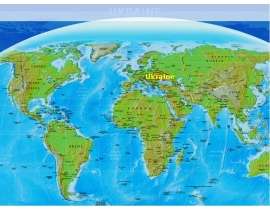
Introduction

Слайд 3


Branches of Indo-European Languages The Indo-European languages have a large number of branches: Anatolian, Indo-Iranian, Greek, Italic, Celtic,...
Описание слайда:
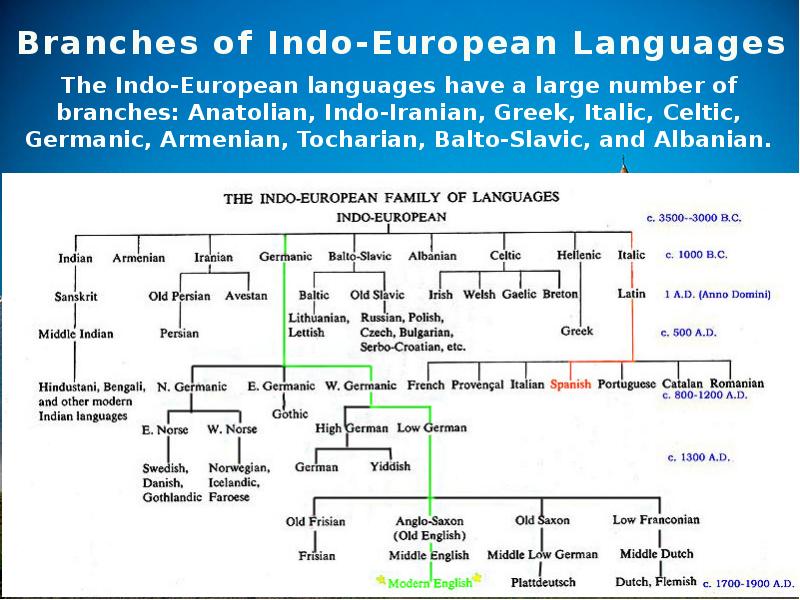
Branches of Indo-European Languages The Indo-European languages have a large number of branches: Anatolian, Indo-Iranian, Greek, Italic, Celtic, Germanic, Armenian, Tocharian, Balto-Slavic, and Albanian.

Слайд 4


Anatolian During the first and the second millennia BC, present Asian Turkey, and Northern Syria spoke now extinct Anatolian languages, the best...
Описание слайда:
Anatolian During the first and the second millennia BC, present Asian Turkey, and Northern Syria spoke now extinct Anatolian languages, the best known of which was Hittite, the official language of the Hittite empire, flourished in the second millennial. Before 1906, few Hittite texts were known. Moreover, they were not interpreted as Indo-European until 1915. The integration of Hittite into Indo-European comparative grammar was, therefore, one of the principal developments of Indo-European studies in the XX century. The most ancient Hittite texts date from the 17th century BC, whereas the latest ones - from approximately 13th century BC.

Слайд 5


Indo-Iranian The second branch is Indo-Iranian. It is subdivided into sub-branches: Indic and Iranian, predominant in India, Pakistan, Iran, and its...
Описание слайда:
Indo-Iranian The second branch is Indo-Iranian. It is subdivided into sub-branches: Indic and Iranian, predominant in India, Pakistan, Iran, and its vicinity, and also in areas from the Black Sea to Western China today.

Слайд 6


Greek Greek is more a group of dialects rather than a branch of languages. More than 3,000 years of written history have Greek dialects that never...
Описание слайда:
Greek Greek is more a group of dialects rather than a branch of languages. More than 3,000 years of written history have Greek dialects that never evolved into mutually incomprehensible languages. Greek was predominant in the Southern part of the Balkans, the Peloponnese Peninsula, as well as the Aegean Sea and its vicinity. Mycenaean is the earliest surviving written evidence of a Greek language. It belongs to the dialect of the Mycenaean civilization, mainly found on clay tablets and ceramic vessels on the Isle of Crete. Mycenaean did not have an alphabetic written system but a syllabic script known as the Linear B Script.

Слайд 7


Italic
Описание слайда:
Italic

Слайд 8


Celtic This branch splits into two sub-branches: Continental Celtic and Insular Celtic. By about 600 BC, Celtic-speaking tribes had spread from what...
Описание слайда:
Celtic This branch splits into two sub-branches: Continental Celtic and Insular Celtic. By about 600 BC, Celtic-speaking tribes had spread from what we know today as Southern Germany, Austria, and Western Czech Republic in almost all directions, to France, Belgium, Spain, and the British Isles. Then, by 400 BC, they also moved Southward into Northern Italy and Southeast into the Balkans and even beyond. During the early 1st century BC, Celtic-speaking tribes dominated a very significant portion of Europe. In 50 BC, Julius Caesar conquered Gaul (ancient France), but, about a century later, the emperor Claudius conquered Britain. Consequently, this sizeable Celtic-speaking area became Romanised, but Latin became the dominant language that caused the disappearance of the Continental Celtic languages, the main of which was Gaulish.

Слайд 9


Germanic The Germanic branch is divided into three sub-branches: 1) East Germanic that not extinct; 2) North Germanic that involves Old Norse, the...
Описание слайда:
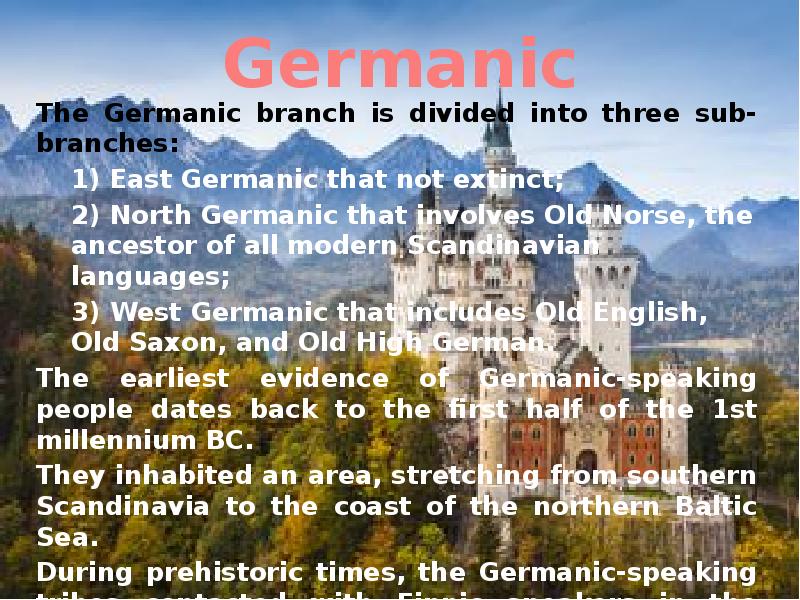
Germanic The Germanic branch is divided into three sub-branches: 1) East Germanic that not extinct; 2) North Germanic that involves Old Norse, the ancestor of all modern Scandinavian languages; 3) West Germanic that includes Old English, Old Saxon, and Old High German. The earliest evidence of Germanic-speaking people dates back to the first half of the 1st millennium BC. They inhabited an area, stretching from southern Scandinavia to the coast of the northern Baltic Sea. During prehistoric times, the Germanic-speaking tribes contacted with Finnic speakers in the North and with Balto-Slavic tribes in the East. Such an interaction caused borrowing several terms from Finnish and Balto-Slavic by the Germanic language.

Слайд 10


Armenian The origins of the Armenian-speaking people is a topic still unclear. The Armenians and the Phrygians are supposed to belong to the same...
Описание слайда:
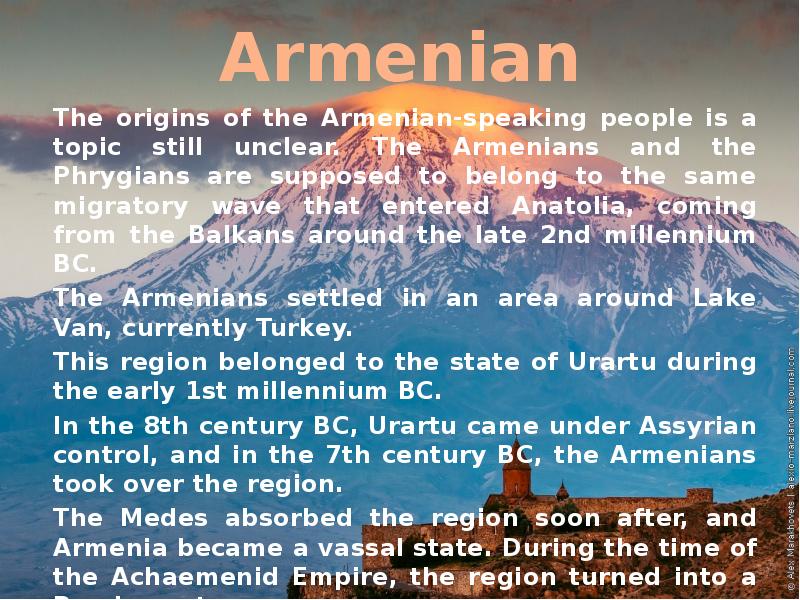
Armenian The origins of the Armenian-speaking people is a topic still unclear. The Armenians and the Phrygians are supposed to belong to the same migratory wave that entered Anatolia, coming from the Balkans around the late 2nd millennium BC. The Armenians settled in an area around Lake Van, currently Turkey. This region belonged to the state of Urartu during the early 1st millennium BC. In the 8th century BC, Urartu came under Assyrian control, and in the 7th century BC, the Armenians took over the region. The Medes absorbed the region soon after, and Armenia became a vassal state. During the time of the Achaemenid Empire, the region turned into a Persian satrapy. The Persian domination had a strong linguistic impact on Armenian, which misleads many scholars in the past to believe that Armenian belonged to the Iranian group.

Слайд 11


Tocharian
Описание слайда:
Tocharian

Слайд 12


Balto-Slavic This branch splits into two sub-branches: Baltic and Slavic. During the late Bronze Age, the Balts' territory may have stretched from...
Описание слайда:
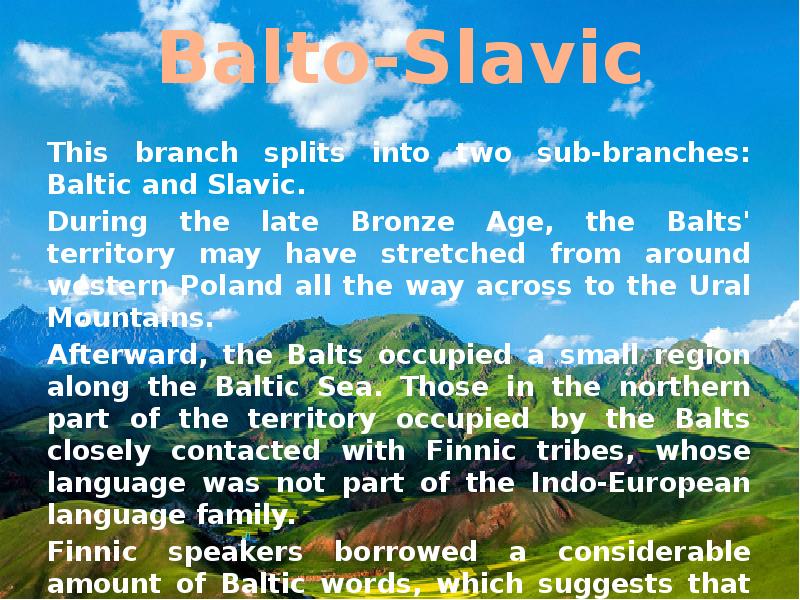
Balto-Slavic This branch splits into two sub-branches: Baltic and Slavic. During the late Bronze Age, the Balts' territory may have stretched from around western Poland all the way across to the Ural Mountains. Afterward, the Balts occupied a small region along the Baltic Sea. Those in the northern part of the territory occupied by the Balts closely contacted with Finnic tribes, whose language was not part of the Indo-European language family. Finnic speakers borrowed a considerable amount of Baltic words, which suggests that the Balts had an essential cultural prestige in that area.

Слайд 13


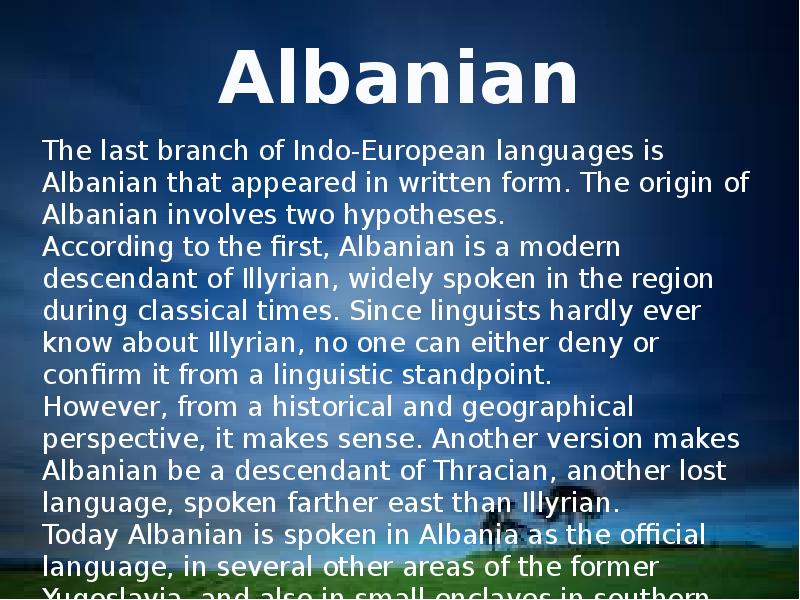
Albanian
Описание слайда:
Albanian

Слайд 14


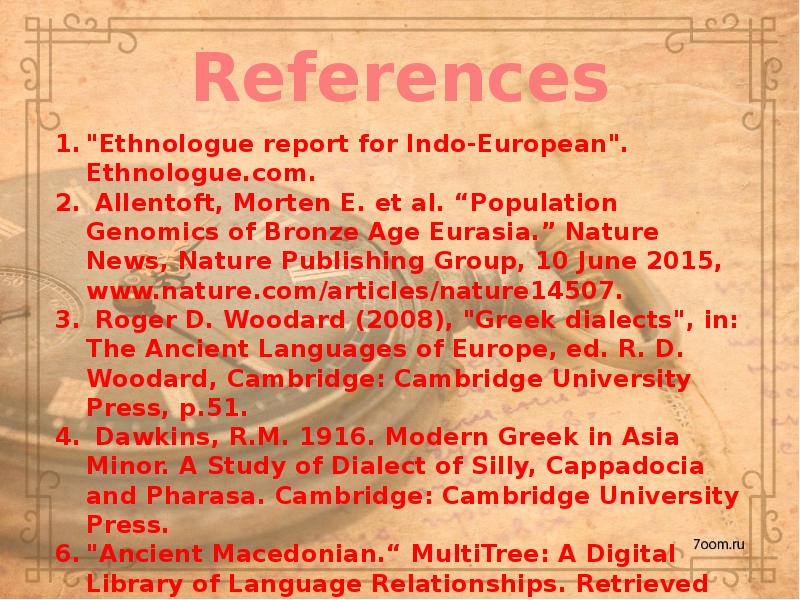
References
Описание слайда:
References


Похожие презентации
Mypresentation.ru
Загрузить презентацию