🗊 Презентация Manufacturing Statistics Current trends and challenges

Нажмите для полного просмотра!
Manufacturing Statistics Current trends and challenges, слайд №1 Manufacturing Statistics Current trends and challenges, слайд №2 Manufacturing Statistics Current trends and challenges, слайд №3 Manufacturing Statistics Current trends and challenges, слайд №4 Manufacturing Statistics Current trends and challenges, слайд №5 Manufacturing Statistics Current trends and challenges, слайд №6 Manufacturing Statistics Current trends and challenges, слайд №7 Manufacturing Statistics Current trends and challenges, слайд №8 Manufacturing Statistics Current trends and challenges, слайд №9 Manufacturing Statistics Current trends and challenges, слайд №10 Manufacturing Statistics Current trends and challenges, слайд №11 Manufacturing Statistics Current trends and challenges, слайд №12 Manufacturing Statistics Current trends and challenges, слайд №13 Manufacturing Statistics Current trends and challenges, слайд №14 Manufacturing Statistics Current trends and challenges, слайд №15 Manufacturing Statistics Current trends and challenges, слайд №16 Manufacturing Statistics Current trends and challenges, слайд №17 Manufacturing Statistics Current trends and challenges, слайд №18 Manufacturing Statistics Current trends and challenges, слайд №19 Manufacturing Statistics Current trends and challenges, слайд №20 Manufacturing Statistics Current trends and challenges, слайд №21 Manufacturing Statistics Current trends and challenges, слайд №22 Manufacturing Statistics Current trends and challenges, слайд №23 Manufacturing Statistics Current trends and challenges, слайд №24 Manufacturing Statistics Current trends and challenges, слайд №25 Manufacturing Statistics Current trends and challenges, слайд №26 Manufacturing Statistics Current trends and challenges, слайд №27 Manufacturing Statistics Current trends and challenges, слайд №28 Manufacturing Statistics Current trends and challenges, слайд №29 Manufacturing Statistics Current trends and challenges, слайд №30 Manufacturing Statistics Current trends and challenges, слайд №31 Manufacturing Statistics Current trends and challenges, слайд №32 Manufacturing Statistics Current trends and challenges, слайд №33 Manufacturing Statistics Current trends and challenges, слайд №34 Manufacturing Statistics Current trends and challenges, слайд №35 Manufacturing Statistics Current trends and challenges, слайд №36 Manufacturing Statistics Current trends and challenges, слайд №37 Manufacturing Statistics Current trends and challenges, слайд №38

Содержание
Вы можете ознакомиться и скачать презентацию на тему Manufacturing Statistics Current trends and challenges. Доклад-сообщение содержит 38 слайдов. Презентации для любого класса можно скачать бесплатно. Если материал и наш сайт презентаций Mypresentation Вам понравились – поделитесь им с друзьями с помощью социальных кнопок и добавьте в закладки в своем браузере.
Слайды и текст этой презентации


Слайд 1


Manufacturing Statistics Current trends and challenges United Nations Statistics Division
Описание слайда:
Manufacturing Statistics Current trends and challenges United Nations Statistics Division

Слайд 2


Are Manufacturing statistics still relevant? Often cited phrases: “Manufacturing activities are declining” “The share of manufacturing activities is...
Описание слайда:

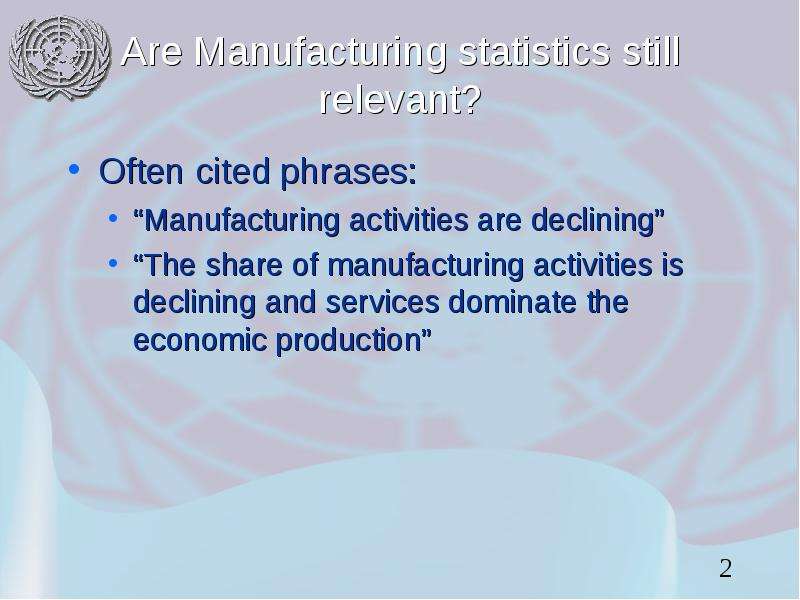
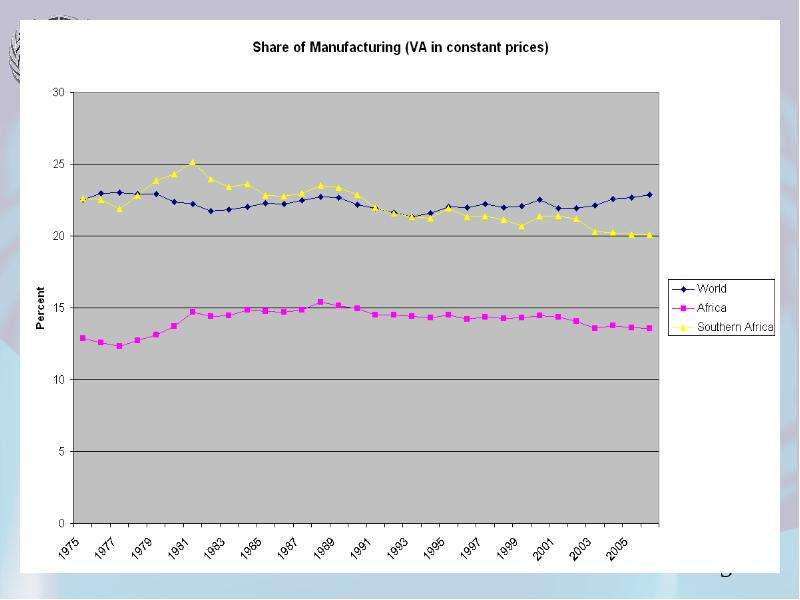
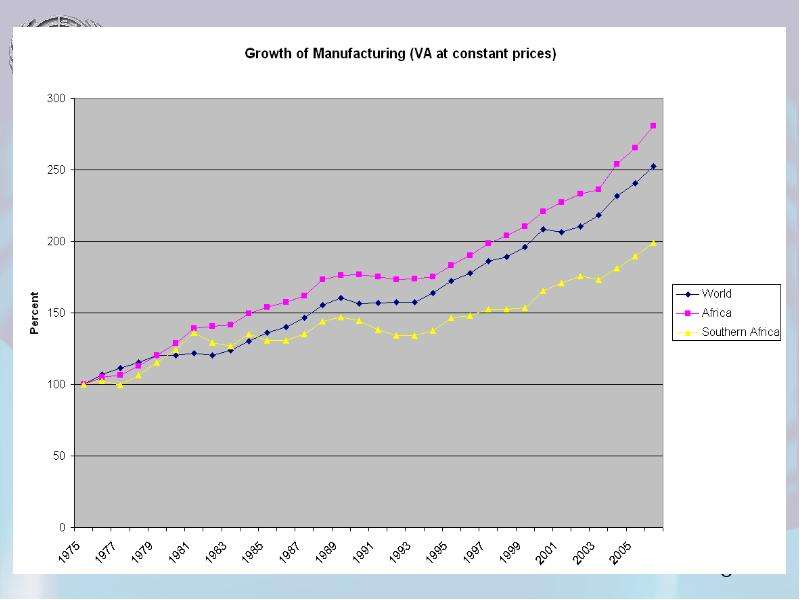
Are Manufacturing statistics still relevant? Often cited phrases: “Manufacturing activities are declining” “The share of manufacturing activities is declining and services dominate the economic production”

Слайд 3


Manufacturing Statistics Current trends and challenges, слайд №3
Описание слайда:

Слайд 4


Manufacturing Statistics Current trends and challenges, слайд №4
Описание слайда:

Слайд 5


Manufacturing Statistics Current trends and challenges, слайд №5
Описание слайда:

Слайд 6


Manufacturing Statistics Current trends and challenges, слайд №6
Описание слайда:

Слайд 7


Are Manufacturing statistics still relevant? Manufacturing activities are growing worldwide While services play an increasing role today,...
Описание слайда:
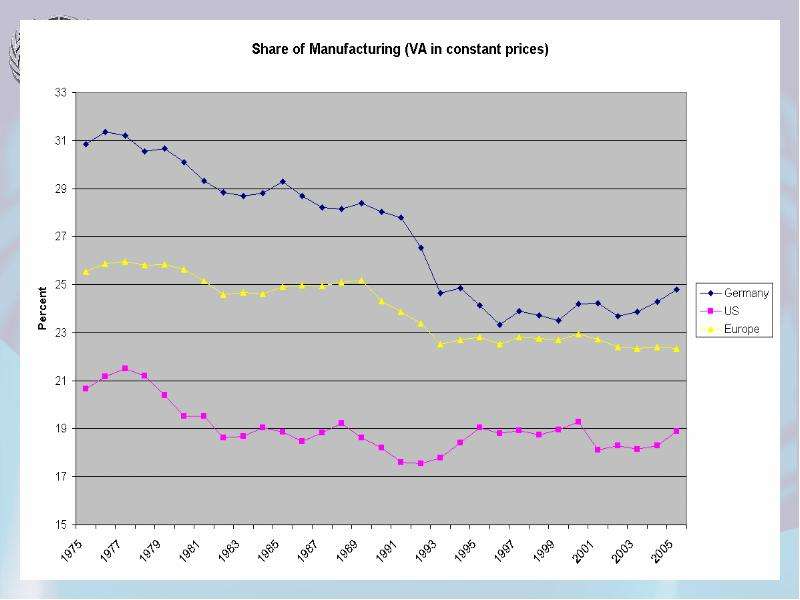
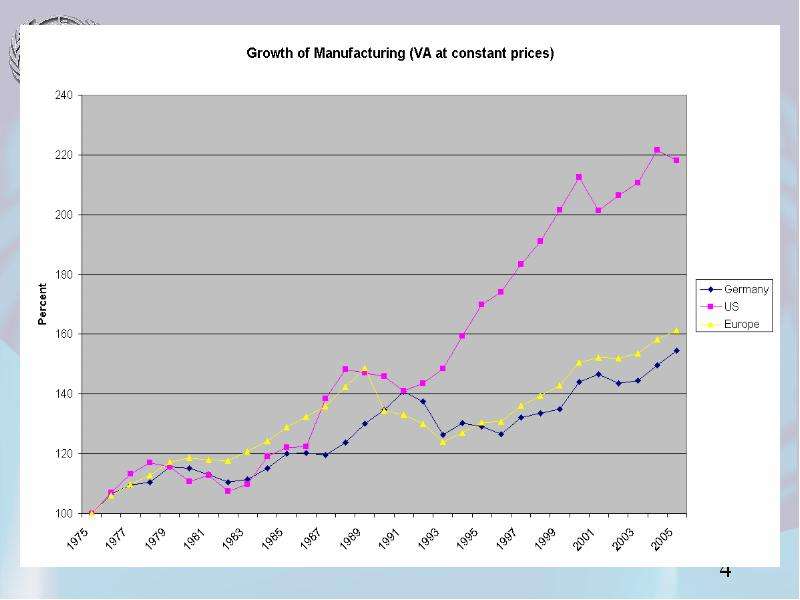
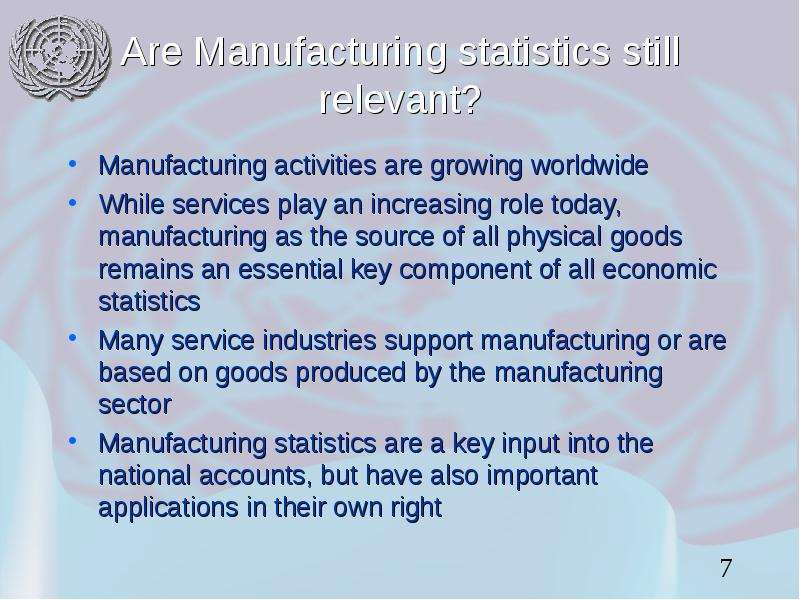
Are Manufacturing statistics still relevant? Manufacturing activities are growing worldwide While services play an increasing role today, manufacturing as the source of all physical goods remains an essential key component of all economic statistics Many service industries support manufacturing or are based on goods produced by the manufacturing sector Manufacturing statistics are a key input into the national accounts, but have also important applications in their own right

Слайд 8


Are Manufacturing statistics still relevant? Manufacturing sector plays leading role for growth in most developing countries, while the services...
Описание слайда:
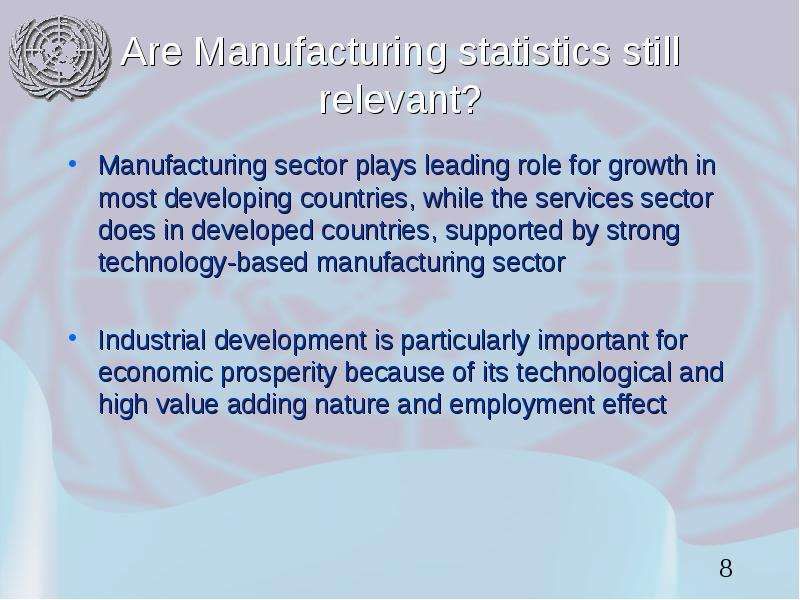
Are Manufacturing statistics still relevant? Manufacturing sector plays leading role for growth in most developing countries, while the services sector does in developed countries, supported by strong technology-based manufacturing sector Industrial development is particularly important for economic prosperity because of its technological and high value adding nature and employment effect

Слайд 9


Are Manufacturing statistics still relevant? Not all manufacturing industries have high growth potential, therefore research and policy makers seek...
Описание слайда:
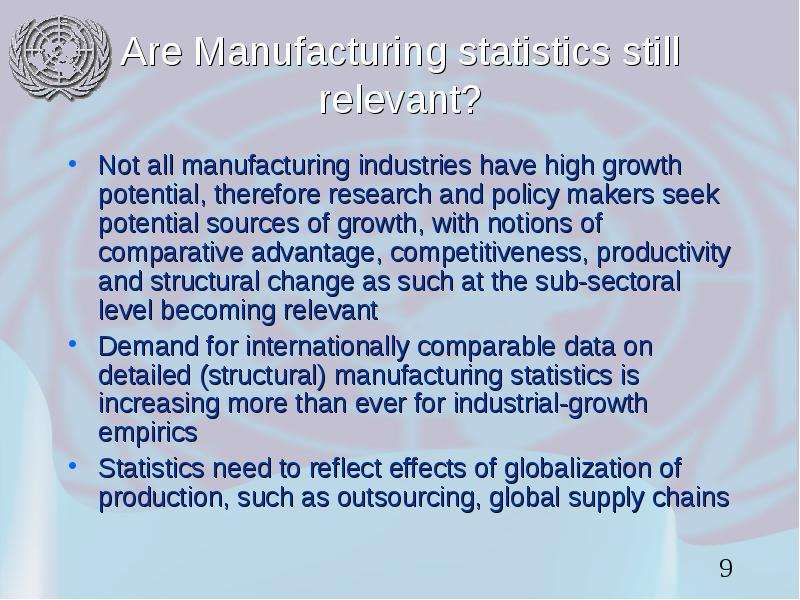
Are Manufacturing statistics still relevant? Not all manufacturing industries have high growth potential, therefore research and policy makers seek potential sources of growth, with notions of comparative advantage, competitiveness, productivity and structural change as such at the sub-sectoral level becoming relevant Demand for internationally comparable data on detailed (structural) manufacturing statistics is increasing more than ever for industrial-growth empirics Statistics need to reflect effects of globalization of production, such as outsourcing, global supply chains

Слайд 10


Available statistics for manufacturing Data collection at the international level: General industrial statistics (number of establishments,...
Описание слайда:
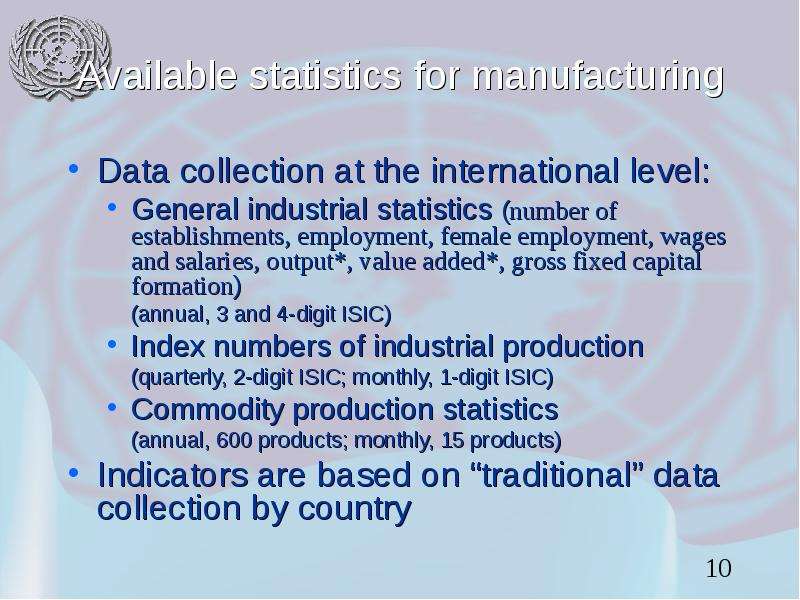
Available statistics for manufacturing Data collection at the international level: General industrial statistics (number of establishments, employment, female employment, wages and salaries, output*, value added*, gross fixed capital formation) (annual, 3 and 4-digit ISIC) Index numbers of industrial production (quarterly, 2-digit ISIC; monthly, 1-digit ISIC) Commodity production statistics (annual, 600 products; monthly, 15 products) Indicators are based on “traditional” data collection by country

Слайд 11


New Challenges Manufacturing technologies and methods of production have changed Manufacturing production has taken on a global character, with...
Описание слайда:
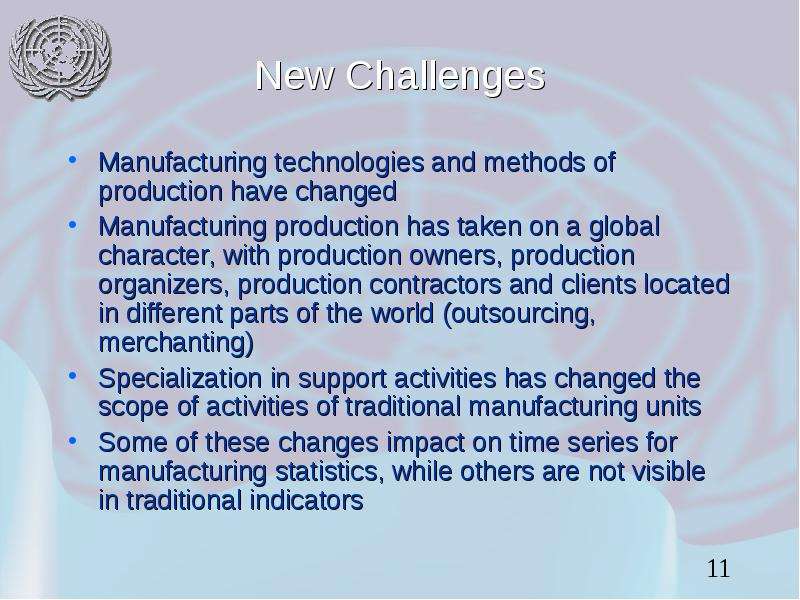
New Challenges Manufacturing technologies and methods of production have changed Manufacturing production has taken on a global character, with production owners, production organizers, production contractors and clients located in different parts of the world (outsourcing, merchanting) Specialization in support activities has changed the scope of activities of traditional manufacturing units Some of these changes impact on time series for manufacturing statistics, while others are not visible in traditional indicators

Слайд 12


New Challenges Coherence of business statistics is needed ‘internal coherence’ : between annual and short-term business statistics; between data...
Описание слайда:
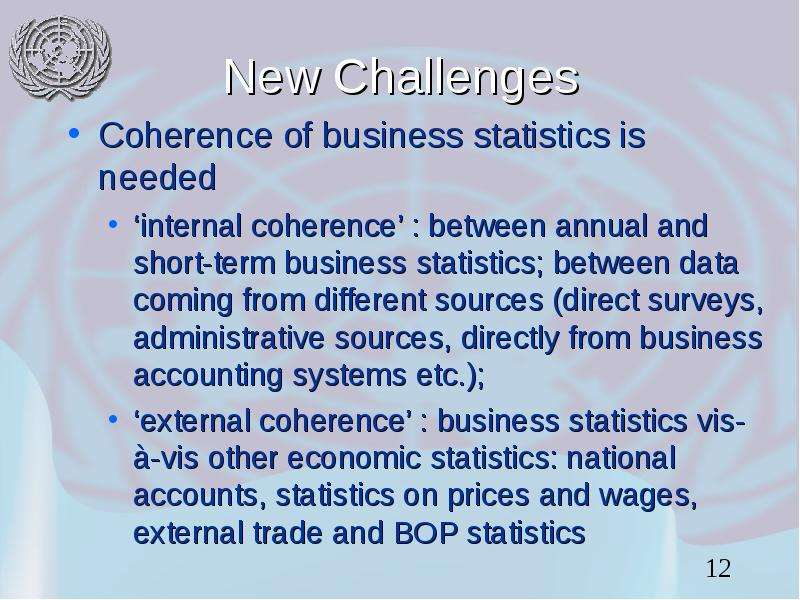
New Challenges Coherence of business statistics is needed ‘internal coherence’ : between annual and short-term business statistics; between data coming from different sources (direct surveys, administrative sources, directly from business accounting systems etc.); ‘external coherence’ : business statistics vis-à-vis other economic statistics: national accounts, statistics on prices and wages, external trade and BOP statistics

Слайд 13


We need a consistent approach to: Scope of manufacturing activities and products Detail of statistics required Selection of units problems for...
Описание слайда:
We need a consistent approach to: Scope of manufacturing activities and products Detail of statistics required Selection of units problems for continuity of historical time series Measurement issues industry vs. product based measurement measurement of volatile industries productivity measures valuation of output Different forms of outsourcing

Слайд 14


Consistent approach (cont.) Existing international guidelines: International Recommendations for Industrial Statistics (IRIS) Last revision: 2008...
Описание слайда:
Consistent approach (cont.) Existing international guidelines: International Recommendations for Industrial Statistics (IRIS) Last revision: 2008 International Standard Classification of All Economic Activities (ISIC) Last revision: 2008 Central product classification (CPC) Last revision: 2008 Manual on index numbers of industrial production Last revision: 1950 (currently under revision)

Слайд 15


Scope of manufacturing activities Manufacturing covers the production of physical goods Includes industrial services (repair, installation) Does not...
Описание слайда:
Scope of manufacturing activities Manufacturing covers the production of physical goods Includes industrial services (repair, installation) Does not include support services (accounting, computer services) Boundary issues e.g. between manufacturing and trade need to be consistently resolved

Слайд 16


Scope (cont.) Data collection should also cover SME (small and medium enterprises) for selected industries Some industries are dominated by large...
Описание слайда:
Scope (cont.) Data collection should also cover SME (small and medium enterprises) for selected industries Some industries are dominated by large companies, but there are exceptions based on country and industry (e.g. food manufacturing)

Слайд 17


Detail of statistics required New version of ISIC Rev.4 defines more accurately the scope of manufacturing and reflects new industries (electronic...
Описание слайда:
Detail of statistics required New version of ISIC Rev.4 defines more accurately the scope of manufacturing and reflects new industries (electronic products, pharmaceuticals, etc.) Compliance with the new international standard should be a priority For comprehensive study of manufacturing, all categories at 4-digit level of ISIC should be considered 2-digit level may be appropriate for some short term indicators, such as quarterly indices

Слайд 18


Selection of units In cases of production of multiple types of goods and in cases of outsourcing, the choice of unit strongly impacts comparability...
Описание слайда:
Selection of units In cases of production of multiple types of goods and in cases of outsourcing, the choice of unit strongly impacts comparability of statistics Choice of enterprise vs. establishment reflects balancing of data availability against homogeneity of outputs If output across establishments within an enterprise is not homogeneous, the establishment may be the better unit for manufacturing statistics, but less data may be available Using the establishment as unit, also produces more accurate regional data

Слайд 19


Selection of units (cont.) Changing concepts will disrupt historical time series Nonetheless, the new concepts provide a clearer description of...
Описание слайда:
Selection of units (cont.) Changing concepts will disrupt historical time series Nonetheless, the new concepts provide a clearer description of actual production SNA and IRIS provide guidance, but national interpretation and implementation differs Clearer guidelines at regional level are necessary to avoid ambiguity

Слайд 20


Measurement issues 1. Industry vs. product based measurement 2. Measurement of volatile industries 3. Productivity measures 4. Valuation of output
Описание слайда:
Measurement issues 1. Industry vs. product based measurement 2. Measurement of volatile industries 3. Productivity measures 4. Valuation of output

Слайд 21


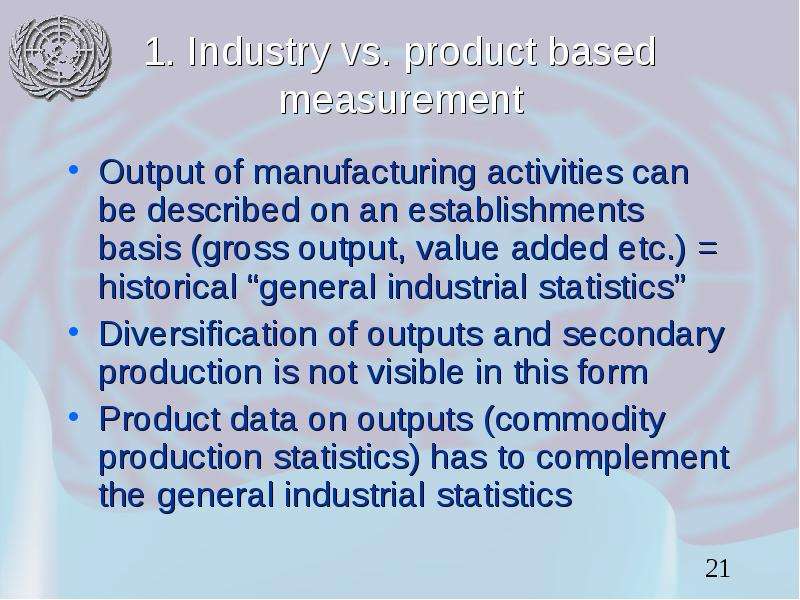
1. Industry vs. product based measurement Output of manufacturing activities can be described on an establishments basis (gross output, value added...
Описание слайда:
1. Industry vs. product based measurement Output of manufacturing activities can be described on an establishments basis (gross output, value added etc.) = historical “general industrial statistics” Diversification of outputs and secondary production is not visible in this form Product data on outputs (commodity production statistics) has to complement the general industrial statistics

Слайд 22


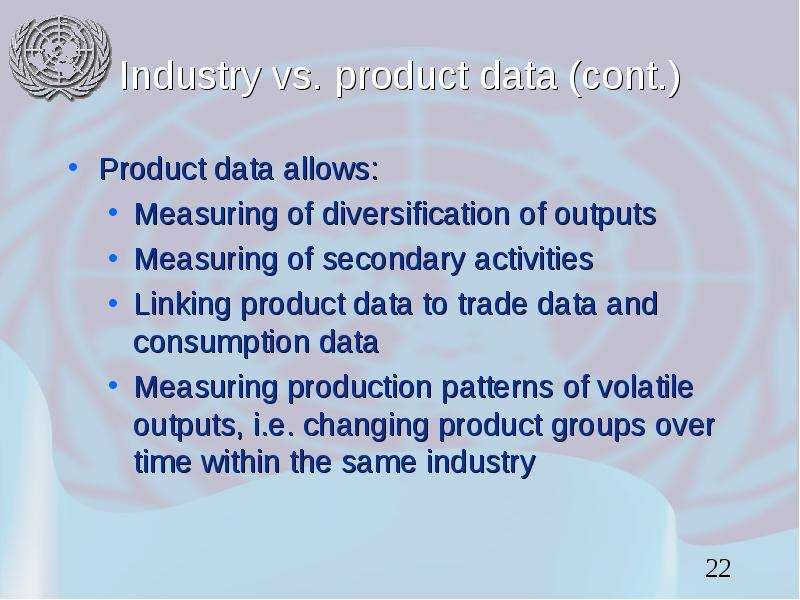
Industry vs. product data (cont.) Product data allows: Measuring of diversification of outputs Measuring of secondary activities Linking product data...
Описание слайда:
Industry vs. product data (cont.) Product data allows: Measuring of diversification of outputs Measuring of secondary activities Linking product data to trade data and consumption data Measuring production patterns of volatile outputs, i.e. changing product groups over time within the same industry

Слайд 23


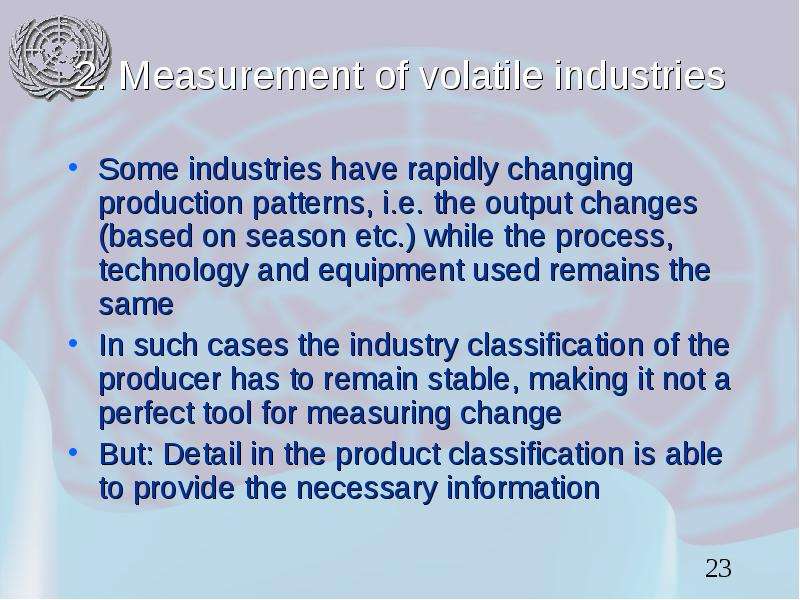
2. Measurement of volatile industries Some industries have rapidly changing production patterns, i.e. the output changes (based on season etc.) while...
Описание слайда:
2. Measurement of volatile industries Some industries have rapidly changing production patterns, i.e. the output changes (based on season etc.) while the process, technology and equipment used remains the same In such cases the industry classification of the producer has to remain stable, making it not a perfect tool for measuring change But: Detail in the product classification is able to provide the necessary information

Слайд 24


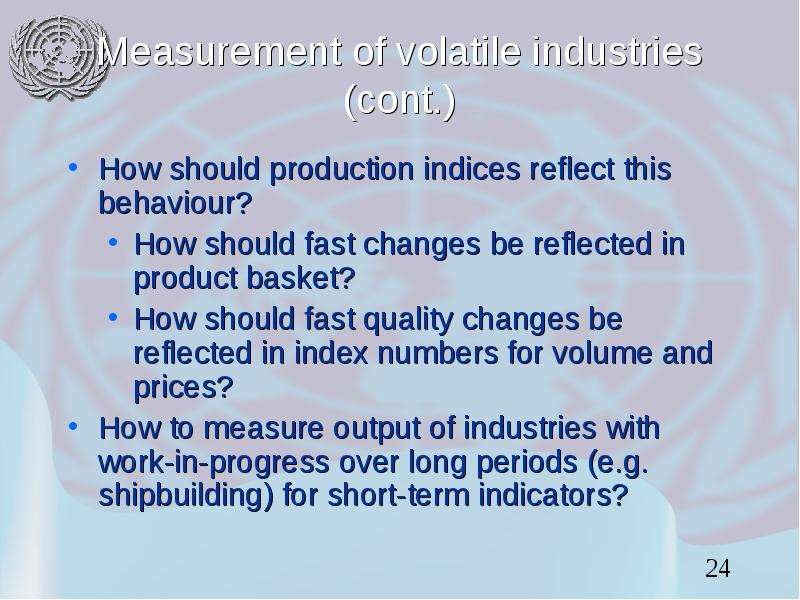
Measurement of volatile industries (cont.) How should production indices reflect this behaviour? How should fast changes be reflected in product...
Описание слайда:
Measurement of volatile industries (cont.) How should production indices reflect this behaviour? How should fast changes be reflected in product basket? How should fast quality changes be reflected in index numbers for volume and prices? How to measure output of industries with work-in-progress over long periods (e.g. shipbuilding) for short-term indicators?

Слайд 25


3. Productivity measures Outsourcing of labour force affects calculation of productivity indicators (e.g. output/worker or output/hours worked)...
Описание слайда:
3. Productivity measures Outsourcing of labour force affects calculation of productivity indicators (e.g. output/worker or output/hours worked) Trends in sector employment get distorted when labour force is outsourced Data collection needs to be supplemented with new information that allows linking the outsourced labour to the contracting manufacturing unit

Слайд 26


4. Valuation of output Output data in quantitative units are stable, but monetary terms are used for most analysis and aggregation, e.g. for National...
Описание слайда:
4. Valuation of output Output data in quantitative units are stable, but monetary terms are used for most analysis and aggregation, e.g. for National Accounts: Choice of national accounting concept or industrial census concept of value added Valuation of output: ‘Basic prices’ or ‘producer prices’ Difference between market prices and prices between related establishments; how does this affect the use of prices for deflation of outputs

Слайд 27


Valuation of output (cont.) Choice of national accounting concept vs. industrial census concept of value added The difference is significant for some...
Описание слайда:
Valuation of output (cont.) Choice of national accounting concept vs. industrial census concept of value added The difference is significant for some industries using relatively more non-industrial services due to: Industrial census excludes cost of and revenue from non-industrial services National accounts value added properly includes cost of and revenue from non-industrial services Valuation of output: ‘Basic prices’ vs. ‘producer prices’ Basic prices valuation does not include net taxes therefore reflects the actual cost of production. This avoids the effects of changes in taxes or subsidies on products on the value of output within a country or the effects of different tax regimes on output across countries. Producer prices include net taxes.

Слайд 28


Outsourcing Affects manufacturing to a large degree Can take place locally and on international level Can take three forms: outsourcing of support...
Описание слайда:
Outsourcing Affects manufacturing to a large degree Can take place locally and on international level Can take three forms: outsourcing of support functions (services), such as accounting, computer services outsourcing of parts of the manufacturing process outsourcing of labour force

Слайд 29


(1) Outsourcing of support functions (services) Problem: Affects time series, since over time units move out of manufacturing; showing apparent...
Описание слайда:
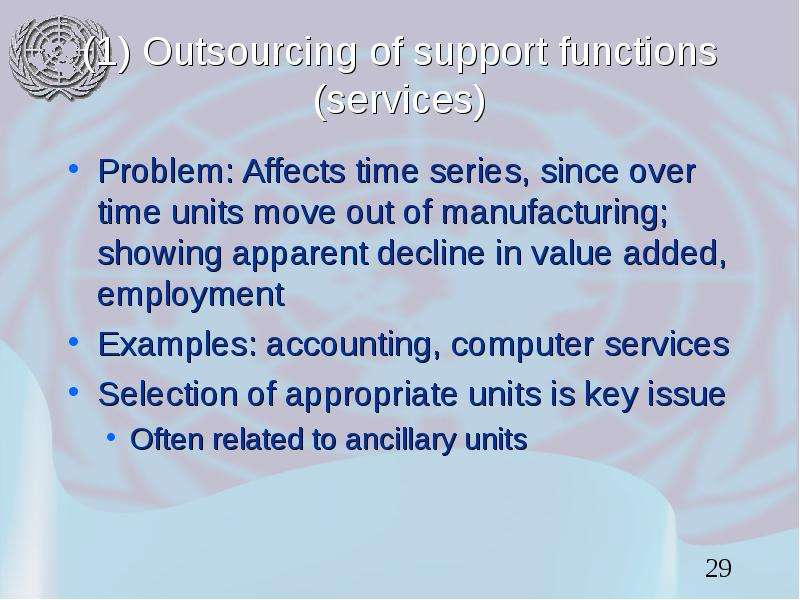
(1) Outsourcing of support functions (services) Problem: Affects time series, since over time units move out of manufacturing; showing apparent decline in value added, employment Examples: accounting, computer services Selection of appropriate units is key issue Often related to ancillary units

Слайд 30


(1) Outsourcing (cont.) Concept and use of “ancillary units” is inconsistent across countries and is changed in new SNA context Separate accounting...
Описание слайда:
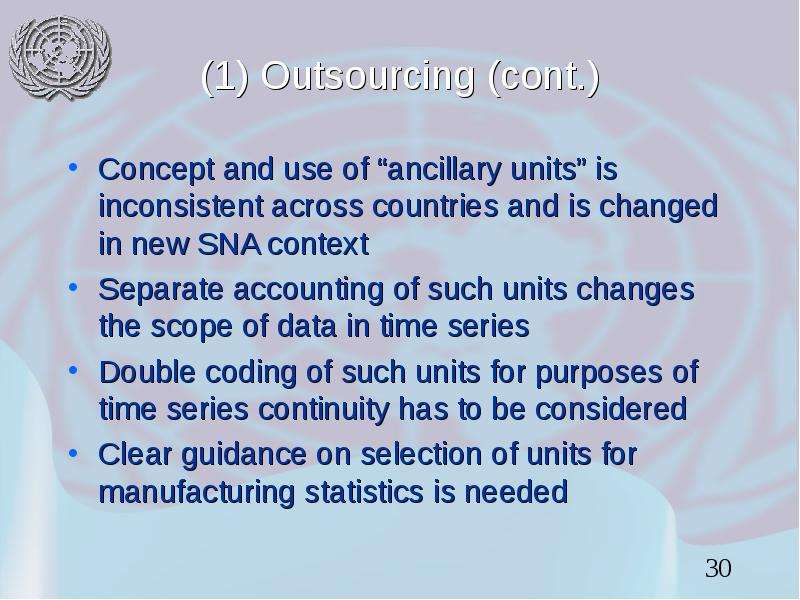
(1) Outsourcing (cont.) Concept and use of “ancillary units” is inconsistent across countries and is changed in new SNA context Separate accounting of such units changes the scope of data in time series Double coding of such units for purposes of time series continuity has to be considered Clear guidance on selection of units for manufacturing statistics is needed

Слайд 31


(2) Outsourcing of parts of the manufacturing process Problem: Where is production recorded? How are involved units linked in the statistics? Common...
Описание слайда:
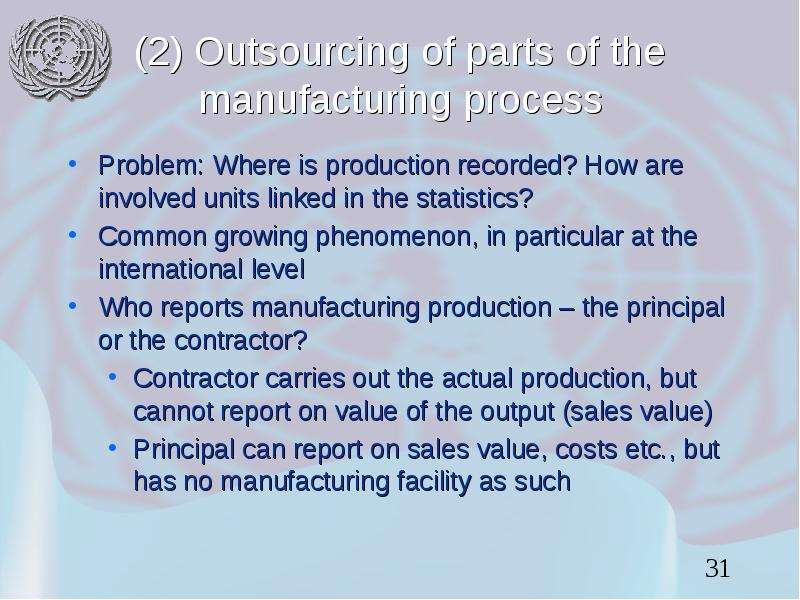
(2) Outsourcing of parts of the manufacturing process Problem: Where is production recorded? How are involved units linked in the statistics? Common growing phenomenon, in particular at the international level Who reports manufacturing production – the principal or the contractor? Contractor carries out the actual production, but cannot report on value of the output (sales value) Principal can report on sales value, costs etc., but has no manufacturing facility as such

Слайд 32


(2) Outsourcing (cont.) Countries treat this in different ways, harmonization is strongly needed SNA guidelines exist, but are not followed by all...
Описание слайда:
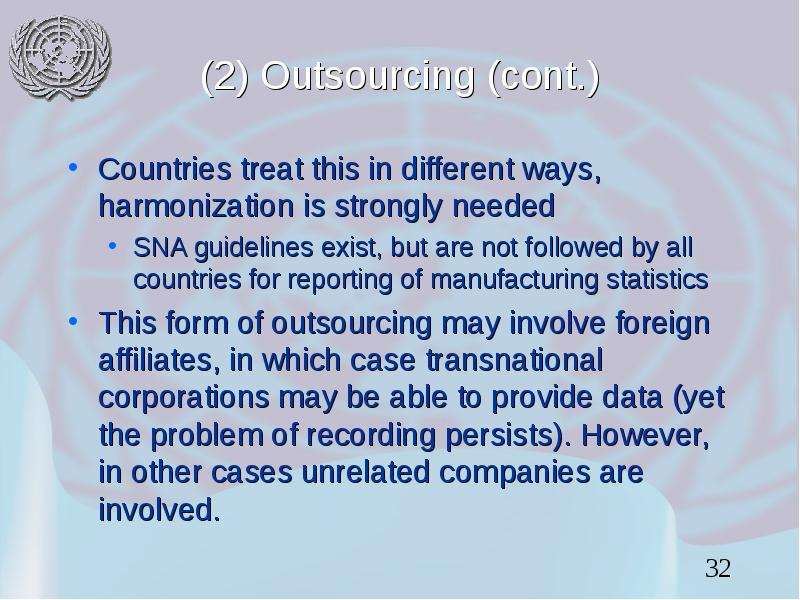
(2) Outsourcing (cont.) Countries treat this in different ways, harmonization is strongly needed SNA guidelines exist, but are not followed by all countries for reporting of manufacturing statistics This form of outsourcing may involve foreign affiliates, in which case transnational corporations may be able to provide data (yet the problem of recording persists). However, in other cases unrelated companies are involved.

Слайд 33


(3) Outsourcing of labour force Problem: Affects productivity statistics; employment in manufacturing declines Emergence of companies providing...
Описание слайда:
(3) Outsourcing of labour force Problem: Affects productivity statistics; employment in manufacturing declines Emergence of companies providing labour force to others – “Human resource provision” (e.g. PEOs) Manufacturing companies have no (or few) employees and therefore no compensation of employees

Слайд 34


(3) Outsourcing (cont.) Labour force is provided by independent company that charges a service fee for this provision Productivity statistics are...
Описание слайда:
(3) Outsourcing (cont.) Labour force is provided by independent company that charges a service fee for this provision Productivity statistics are affected by this Industry employment trends are difficult to observe Requires consistent approach to linking employees of human resources provision companies to production

Слайд 35


Summary Production patterns in manufacturing have changed Historical scope of manufacturing production may now be spread over other industries as...
Описание слайда:
Summary Production patterns in manufacturing have changed Historical scope of manufacturing production may now be spread over other industries as well Production takes no longer place in single locations but involves units across the globe Typical manufacturing indicators (output , value added, employment) do not paint the full picture of today’s complex economy and its global character, even with consistent use guidelines

Слайд 36


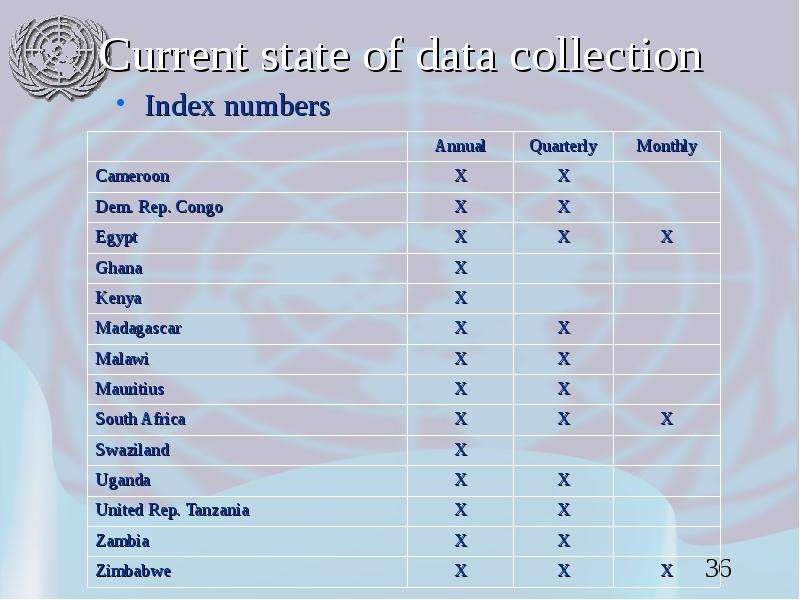
Current state of data collection Index numbers
Описание слайда:
Current state of data collection Index numbers

Слайд 37


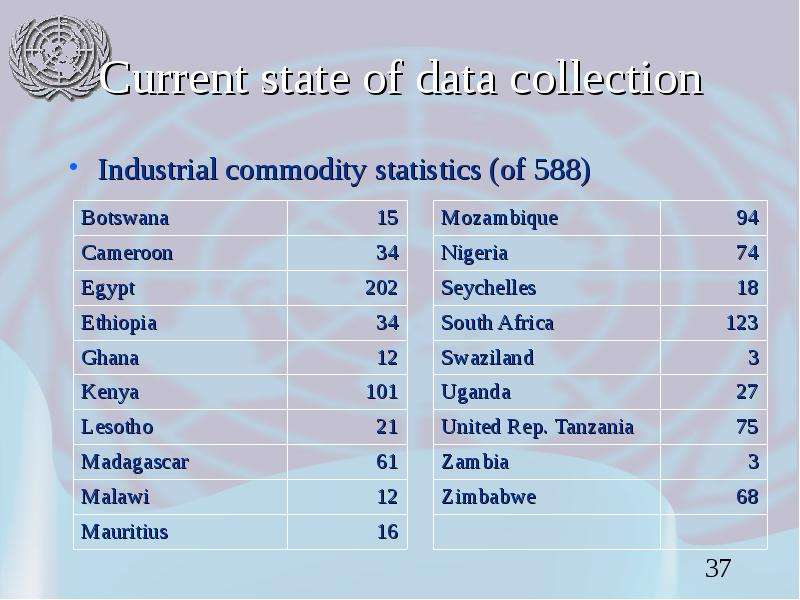
Current state of data collection Industrial commodity statistics (of 588)
Описание слайда:
Current state of data collection Industrial commodity statistics (of 588)

Слайд 38


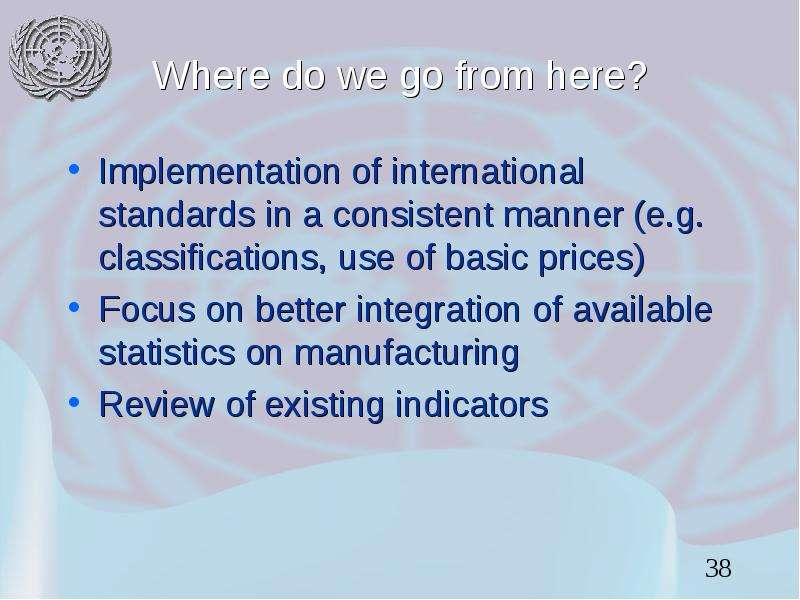
Where do we go from here? Implementation of international standards in a consistent manner (e.g. classifications, use of basic prices) Focus on...
Описание слайда:
Where do we go from here? Implementation of international standards in a consistent manner (e.g. classifications, use of basic prices) Focus on better integration of available statistics on manufacturing Review of existing indicators


Похожие презентации
Mypresentation.ru
Загрузить презентацию