🗊 Презентация Production and growth

Нажмите для полного просмотра!
Production and growth, слайд №1 Production and growth, слайд №2 Production and growth, слайд №3 Production and growth, слайд №4 Production and growth, слайд №5 Production and growth, слайд №6 Production and growth, слайд №7 Production and growth, слайд №8 Production and growth, слайд №9 Production and growth, слайд №10 Production and growth, слайд №11 Production and growth, слайд №12 Production and growth, слайд №13 Production and growth, слайд №14 Production and growth, слайд №15 Production and growth, слайд №16 Production and growth, слайд №17 Production and growth, слайд №18 Production and growth, слайд №19 Production and growth, слайд №20 Production and growth, слайд №21 Production and growth, слайд №22 Production and growth, слайд №23 Production and growth, слайд №24 Production and growth, слайд №25 Production and growth, слайд №26 Production and growth, слайд №27 Production and growth, слайд №28 Production and growth, слайд №29 Production and growth, слайд №30 Production and growth, слайд №31 Production and growth, слайд №32 Production and growth, слайд №33 Production and growth, слайд №34 Production and growth, слайд №35 Production and growth, слайд №36 Production and growth, слайд №37 Production and growth, слайд №38 Production and growth, слайд №39 Production and growth, слайд №40 Production and growth, слайд №41 Production and growth, слайд №42 Production and growth, слайд №43 Production and growth, слайд №44 Production and growth, слайд №45 Production and growth, слайд №46 Production and growth, слайд №47 Production and growth, слайд №48 Production and growth, слайд №49 Production and growth, слайд №50 Production and growth, слайд №51 Production and growth, слайд №52 Production and growth, слайд №53 Production and growth, слайд №54 Production and growth, слайд №55 Production and growth, слайд №56 Production and growth, слайд №57 Production and growth, слайд №58 Production and growth, слайд №59 Production and growth, слайд №60 Production and growth, слайд №61 Production and growth, слайд №62 Production and growth, слайд №63 Production and growth, слайд №64 Production and growth, слайд №65 Production and growth, слайд №66 Production and growth, слайд №67 Production and growth, слайд №68 Production and growth, слайд №69 Production and growth, слайд №70 Production and growth, слайд №71 Production and growth, слайд №72 Production and growth, слайд №73 Production and growth, слайд №74 Production and growth, слайд №75 Production and growth, слайд №76 Production and growth, слайд №77 Production and growth, слайд №78 Production and growth, слайд №79 Production and growth, слайд №80 Production and growth, слайд №81 Production and growth, слайд №82 Production and growth, слайд №83 Production and growth, слайд №84 Production and growth, слайд №85 Production and growth, слайд №86 Production and growth, слайд №87 Production and growth, слайд №88

Содержание
Вы можете ознакомиться и скачать презентацию на тему Production and growth. Доклад-сообщение содержит 88 слайдов. Презентации для любого класса можно скачать бесплатно. Если материал и наш сайт презентаций Mypresentation Вам понравились – поделитесь им с друзьями с помощью социальных кнопок и добавьте в закладки в своем браузере.
Слайды и текст этой презентации


Слайд 1


Chapter 25: Production and Growth Why are there countries so rich and others so poor? Why do growth rates vary across countries and over time? What...
Описание слайда:
Chapter 25: Production and Growth Why are there countries so rich and others so poor? Why do growth rates vary across countries and over time? What are the policies that can change growth in the short and long run? Why do some countries ``take off'' while others fall behind?

Слайд 2


Economic Growth Economic growth is a long-term expansion of the productive potential of the economy. Growth is not the same as development! Growth...
Описание слайда:
Economic Growth Economic growth is a long-term expansion of the productive potential of the economy. Growth is not the same as development! Growth can support development but the two are distinct. M. Todaro defines economic development as an increase in living standards, improvement in self-esteem needs and freedom from oppression as well as a greater choice. Economic development is Concerned with structural changes in the economy, but economic growth is concerned only with increase in the economy’s output. Economic growth is a necessary but not sufficient condition of economic development. Economic growth brings quantitative changes in the economy; where as economic development deals with quantitative and qualitative changes in the economy.

Слайд 3


Rostow’s Five-Stage Model of Development Rostow's Stages of Growth model is one of the most influential development theories of the twentieth...
Описание слайда:

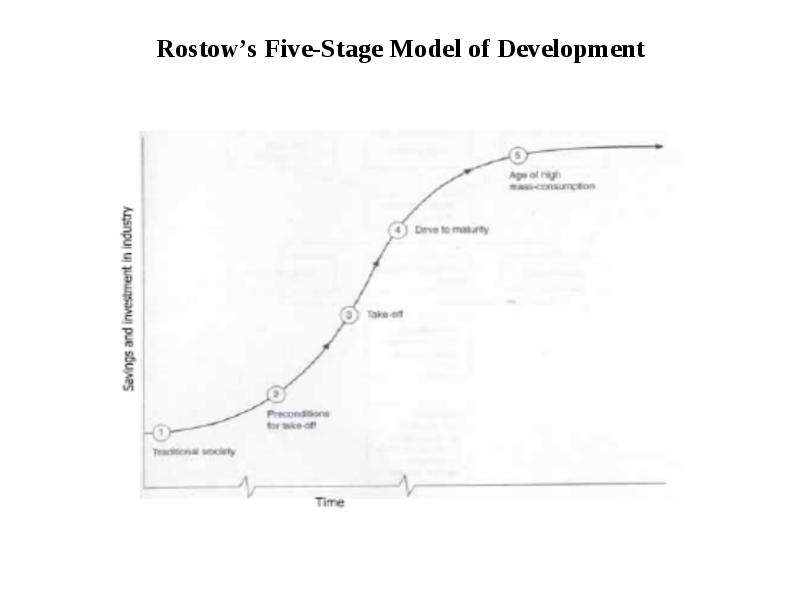
Rostow’s Five-Stage Model of Development Rostow's Stages of Growth model is one of the most influential development theories of the twentieth century. In 1960, Rostow presented five steps through which all countries must pass to become developed. Traditional Society: This stage is characterized by a subsistent, agricultural based economy, with intensive labor and low levels of trading, and a population that does not have a scientific perspective on the world and technology. Preconditions to Take-off: In this stage, the rates of investment are getting higher and a society begins to develop manufacturing. Take-off: Rostow describes this stage as a short period of intensive growth, in which industrialization begins to occur, and workers and institutions become concentrated around a new industry. Drive to Maturity: This stage takes place over a long period of time, as standards of living rise, use of technology increases, and the national economy grows and diversifies. Age of High Mass Consumption: Here, a country's economy flourishes in a capitalist system, characterized by mass production and consumerism.

Слайд 4


Rostow’s Five-Stage Model of Development
Описание слайда:

Rostow’s Five-Stage Model of Development

Слайд 5


Modernization Theory Linear stages of development
Описание слайда:

Modernization Theory Linear stages of development

Слайд 6


Economic Growth Growth rate How rapidly real GDP per person grew in the typical year. Growth in GDP per capita (or per worker) Y/L Real GDP per...
Описание слайда:

Economic Growth Growth rate How rapidly real GDP per person grew in the typical year. Growth in GDP per capita (or per worker) Y/L Real GDP per person Living standard Vary widely from country to country Because of differences in growth rates Ranking of countries by income changes substantially over time

Слайд 7


The Variety of Growth Experiences
Описание слайда:
The Variety of Growth Experiences

Слайд 8


Productivity Productivity Quantity of goods and services Produced from each unit of labor input Why productivity is so important Key determinant of...
Описание слайда:
Productivity Productivity Quantity of goods and services Produced from each unit of labor input Why productivity is so important Key determinant of living standards Growth in productivity is the key determinant of growth in living standards An economy’s income is the economy’s output

Слайд 9


Productivity Determinants of productivity Physical capital Stock of equipment and structures Used to produce goods and services Human capital...
Описание слайда:
Productivity Determinants of productivity Physical capital Stock of equipment and structures Used to produce goods and services Human capital Knowledge and skills that workers acquire through education, training, and experience

Слайд 10


Productivity Determinants of productivity Natural resources Inputs into the production of goods and services Provided by nature, such as land,...
Описание слайда:
Productivity Determinants of productivity Natural resources Inputs into the production of goods and services Provided by nature, such as land, rivers, and mineral deposits Technological knowledge Society’s understanding of the best ways to produce goods and services

Слайд 11


Additionally, other explanations have highlighted the significant role of non-economic factors. Additionally, other explanations have highlighted the...
Описание слайда:
Additionally, other explanations have highlighted the significant role of non-economic factors. Additionally, other explanations have highlighted the significant role of non-economic factors. These include institutional economics which underlines the substantial role of institutions, policy, legal and political systems (Matthews, 1986; North, 1990; Jutting, 2003) Economic sociology stressed the importance of socio-cultural factors such as Confucianism in East Asia (Granovetter, 1985; Knack and Keefer, 1997).

Слайд 12


Solow's Neoclassical Model or Exogenous Growth Model The Sources of Economic Growth Production function Y= AF(K, L) (1) The Cobb-Douglas Production...
Описание слайда:
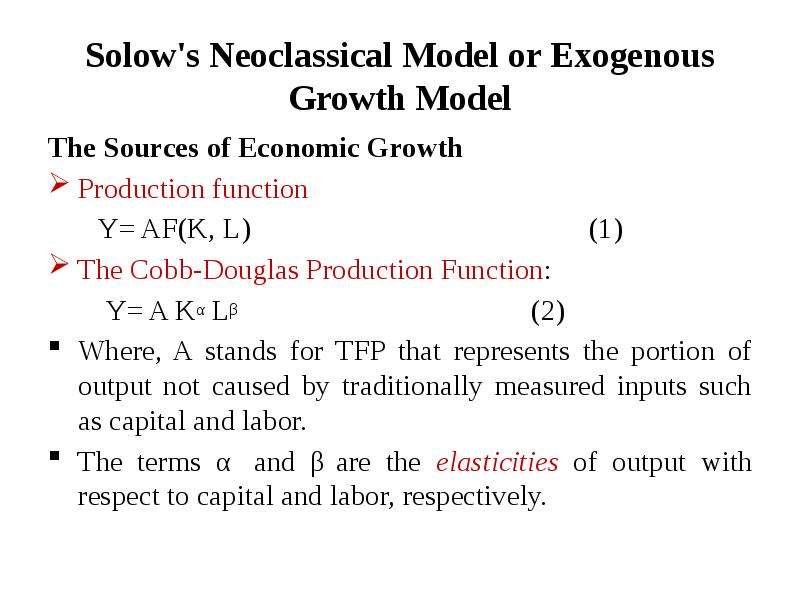
Solow's Neoclassical Model or Exogenous Growth Model The Sources of Economic Growth Production function Y= AF(K, L) (1) The Cobb-Douglas Production Function: Y= A Kα Lβ (2) Where, A stands for TFP that represents the portion of output not caused by traditionally measured inputs such as capital and labor. The terms α and β are the elasticities of output with respect to capital and labor, respectively.

Слайд 13


This can be transformed into a linear model by taking natural logs of both sides: This can be transformed into a linear model by taking natural logs...
Описание слайда:
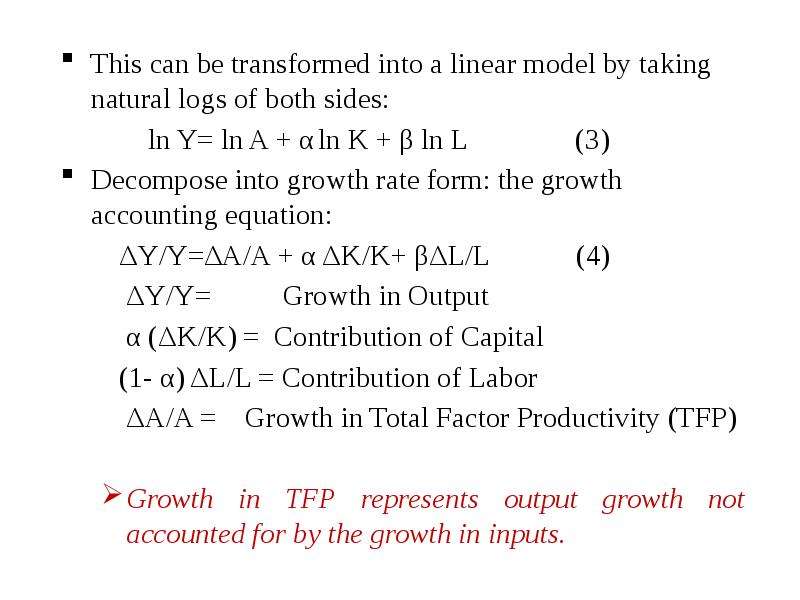
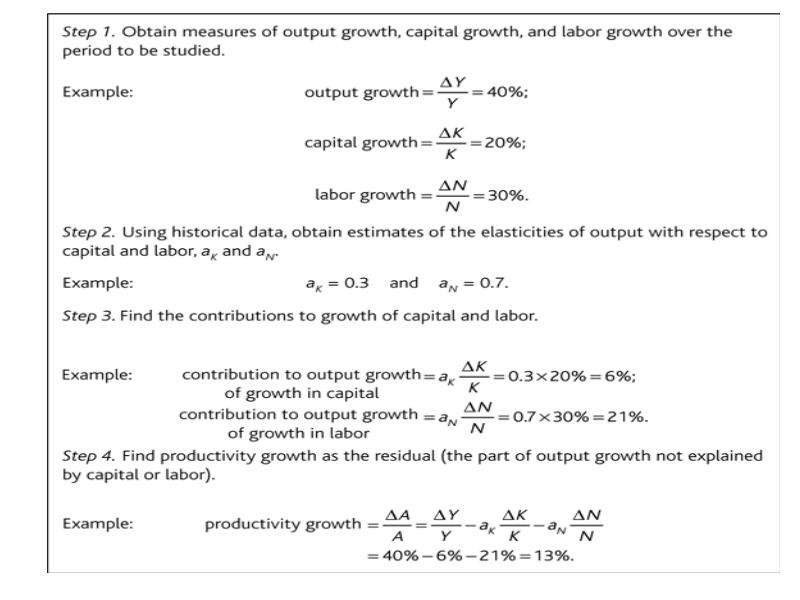
This can be transformed into a linear model by taking natural logs of both sides: This can be transformed into a linear model by taking natural logs of both sides: ln Y= ln A + α ln K + β ln L (3) Decompose into growth rate form: the growth accounting equation: ΔY/Y=ΔA/A + α ΔK/K+ βΔL/L (4) ΔY/Y= Growth in Output α (ΔK/K) = Contribution of Capital (1- α) ΔL/L = Contribution of Labor ΔA/A = Growth in Total Factor Productivity (TFP) Growth in TFP represents output growth not accounted for by the growth in inputs.

Слайд 14


The slope coefficients can be interpreted as elasticities. The slope coefficients can be interpreted as elasticities. If (α + β) = 1, we have...
Описание слайда:
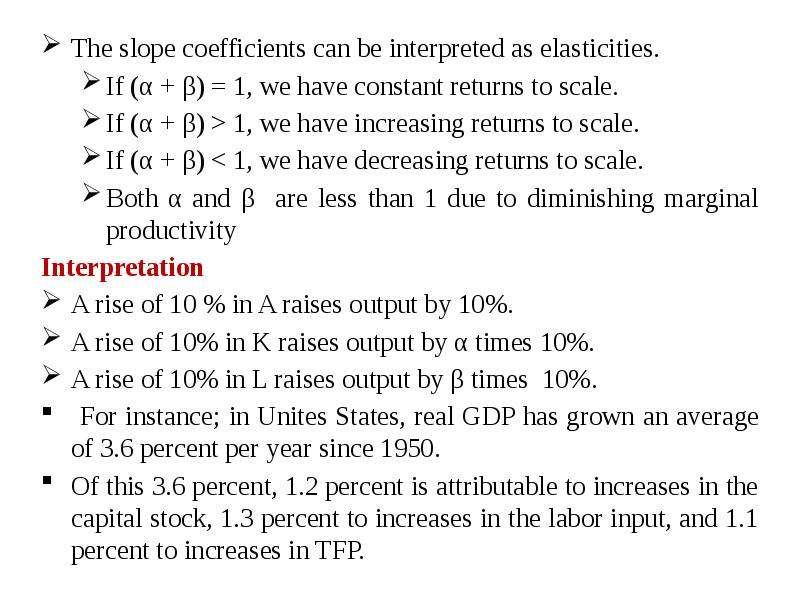
The slope coefficients can be interpreted as elasticities. The slope coefficients can be interpreted as elasticities. If (α + β) = 1, we have constant returns to scale. If (α + β) > 1, we have increasing returns to scale. If (α + β) < 1, we have decreasing returns to scale. Both α and β are less than 1 due to diminishing marginal productivity Interpretation A rise of 10 % in A raises output by 10%. A rise of 10% in K raises output by α times 10%. A rise of 10% in L raises output by β times 10%. For instance; in Unites States, real GDP has grown an average of 3.6 percent per year since 1950. Of this 3.6 percent, 1.2 percent is attributable to increases in the capital stock, 1.3 percent to increases in the labor input, and 1.1 percent to increases in TFP.

Слайд 15


Production and growth, слайд №15
Описание слайда:

Слайд 16


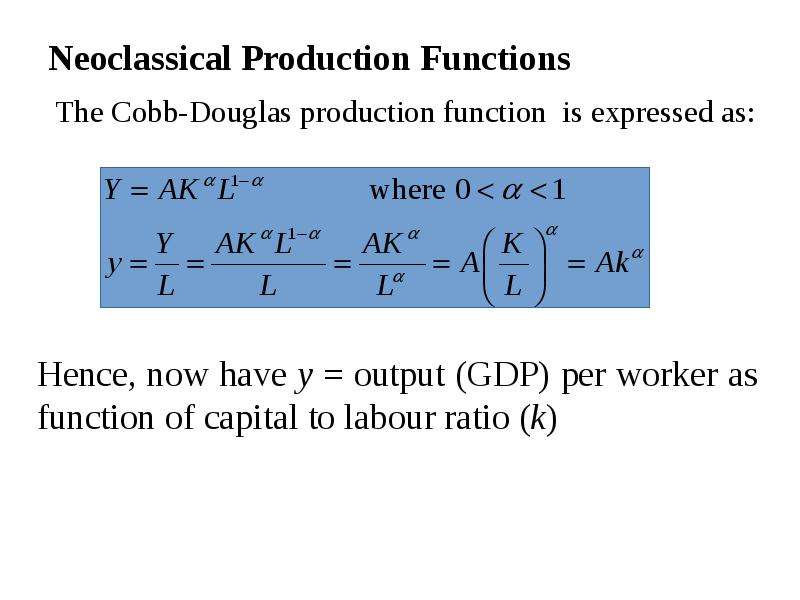
Neoclassical Production Functions The Cobb-Douglas production function is expressed as:
Описание слайда:
Neoclassical Production Functions The Cobb-Douglas production function is expressed as:

Слайд 17


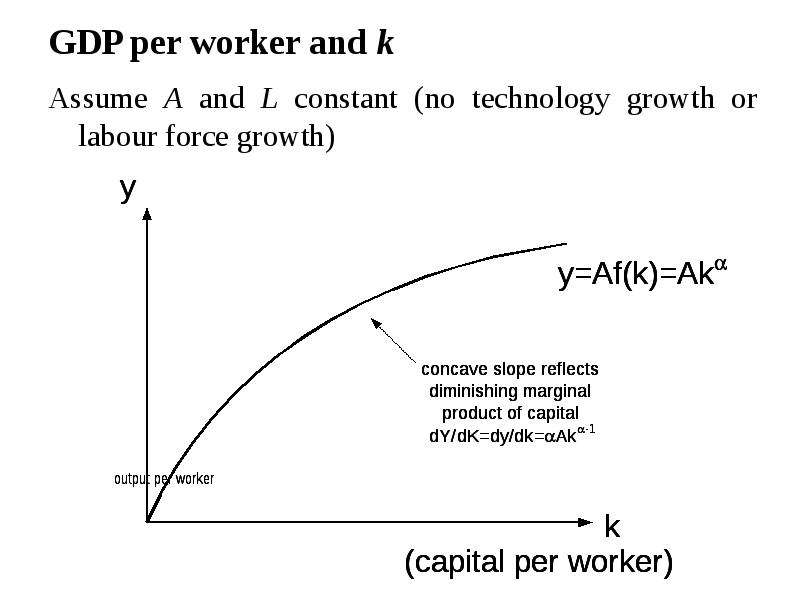
GDP per worker and k Assume A and L constant (no technology growth or labour force growth)
Описание слайда:
GDP per worker and k Assume A and L constant (no technology growth or labour force growth)

Слайд 18


Diminishing Returns The neo-classical growth theory of Solow (1956) and Swan (1956) postulates that capital accumulations are subject to diminishing...
Описание слайда:
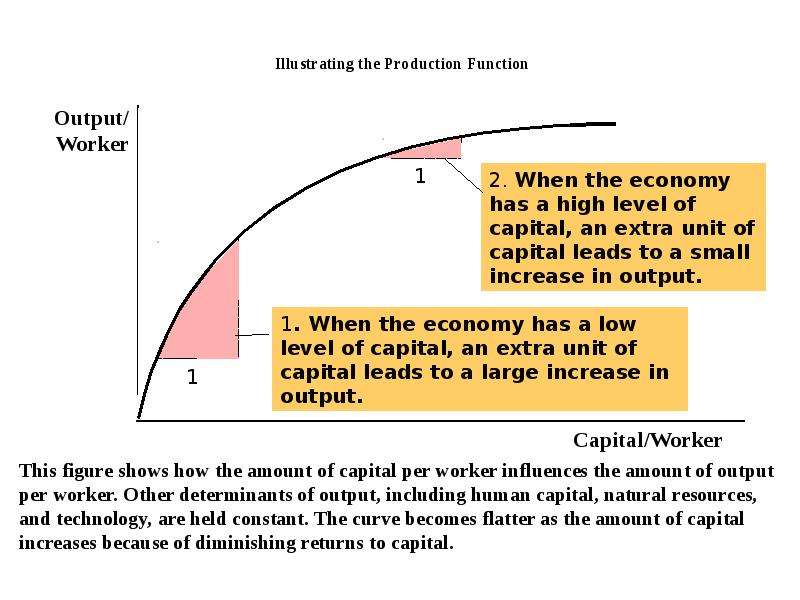
Diminishing Returns The neo-classical growth theory of Solow (1956) and Swan (1956) postulates that capital accumulations are subject to diminishing marginal returns to capital. Diminishing returns implies that the amount of extra output from each additional unit of input goes down as the quantity of input increases. Saving and investment are beneficial in the short-run, but diminishing returns to capital do not sustain long-run growth. In other words, after we reach the steady state, there is no long-run growth in Yt (unless Lt or A increases).

Слайд 19


Illustrating the Production Function
Описание слайда:
Illustrating the Production Function

Слайд 20


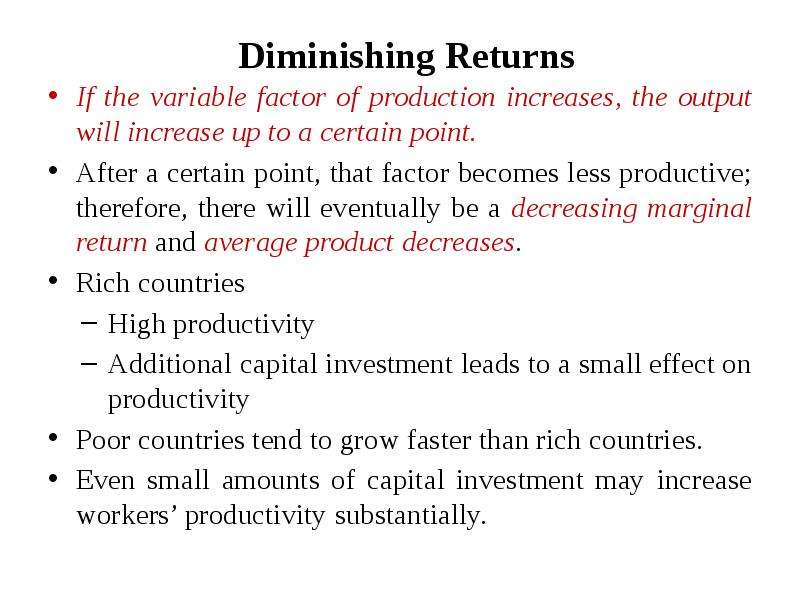
Diminishing Returns If the variable factor of production increases, the output will increase up to a certain point. After a certain point, that...
Описание слайда:
Diminishing Returns If the variable factor of production increases, the output will increase up to a certain point. After a certain point, that factor becomes less productive; therefore, there will eventually be a decreasing marginal return and average product decreases. Rich countries High productivity Additional capital investment leads to a small effect on productivity Poor countries tend to grow faster than rich countries. Even small amounts of capital investment may increase workers’ productivity substantially.

Слайд 21


Catch-up effect (Convergence) Countries that start off poor tend to grow more rapidly than countries that start off rich. Poor countries have the...
Описание слайда:
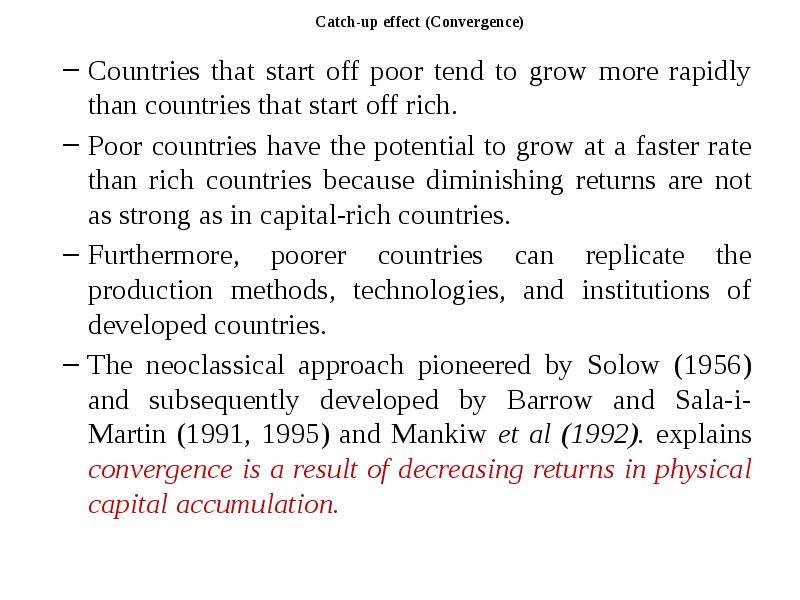
Catch-up effect (Convergence) Countries that start off poor tend to grow more rapidly than countries that start off rich. Poor countries have the potential to grow at a faster rate than rich countries because diminishing returns are not as strong as in capital-rich countries. Furthermore, poorer countries can replicate the production methods, technologies, and institutions of developed countries. The neoclassical approach pioneered by Solow (1956) and subsequently developed by Barrow and Sala-i-Martin (1991, 1995) and Mankiw et al (1992). explains convergence is a result of decreasing returns in physical capital accumulation.

Слайд 22


A second approach explains convergence as resulting primarily from cross- country knowledge spillovers. A second approach explains convergence as...
Описание слайда:
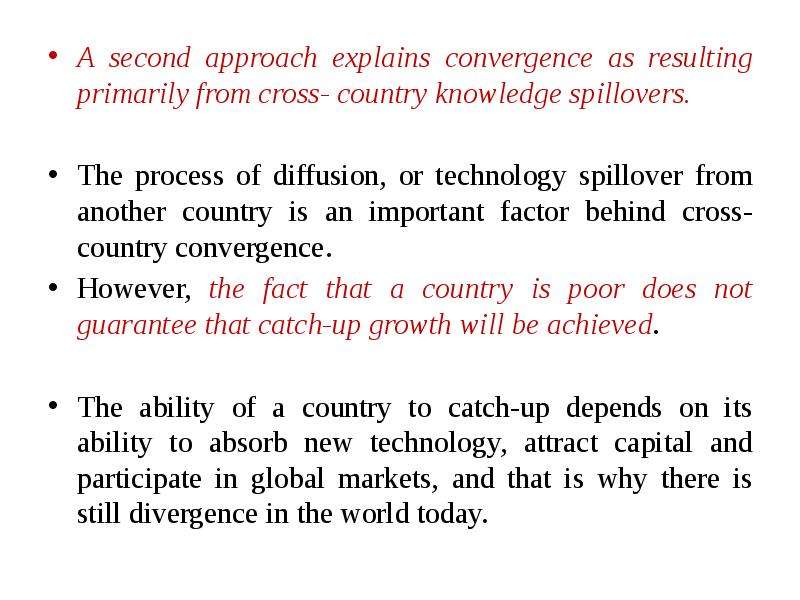
A second approach explains convergence as resulting primarily from cross- country knowledge spillovers. A second approach explains convergence as resulting primarily from cross- country knowledge spillovers. The process of diffusion, or technology spillover from another country is an important factor behind cross-country convergence. However, the fact that a country is poor does not guarantee that catch-up growth will be achieved. The ability of a country to catch-up depends on its ability to absorb new technology, attract capital and participate in global markets, and that is why there is still divergence in the world today.

Слайд 23


World’s ten fastest-growing economies
Описание слайда:
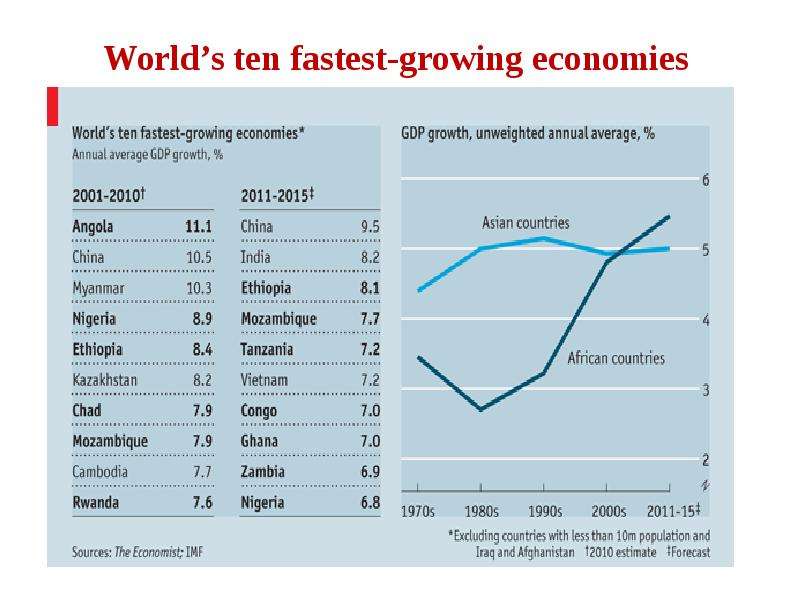
World’s ten fastest-growing economies

Слайд 24


What causes the differences in income over time and across countries? The Solow growth model shows how saving, population growth, and technological...
Описание слайда:
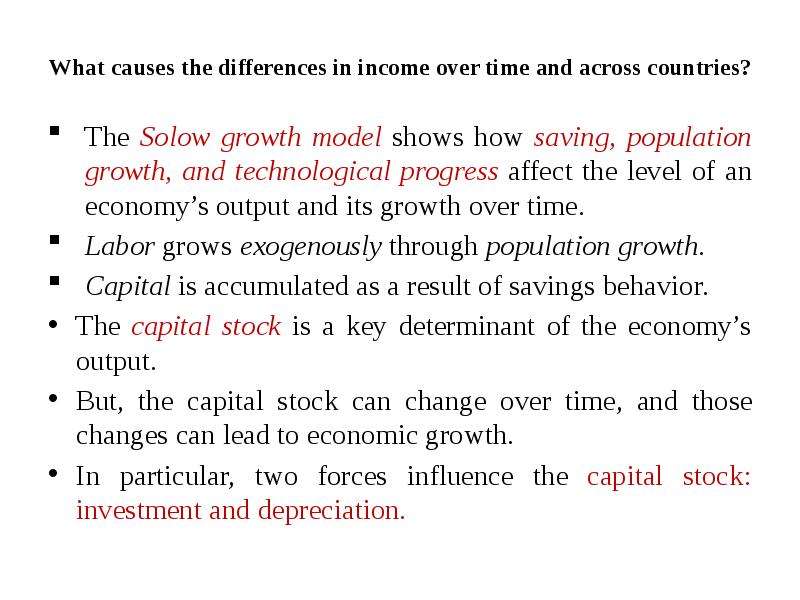
What causes the differences in income over time and across countries? The Solow growth model shows how saving, population growth, and technological progress affect the level of an economy’s output and its growth over time. Labor grows exogenously through population growth. Capital is accumulated as a result of savings behavior. The capital stock is a key determinant of the economy’s output. But, the capital stock can change over time, and those changes can lead to economic growth. In particular, two forces influence the capital stock: investment and depreciation.

Слайд 25


Investment refers to the expenditure on new plant and equipment, and it causes the capital stock to rise. Investment refers to the expenditure on new...
Описание слайда:
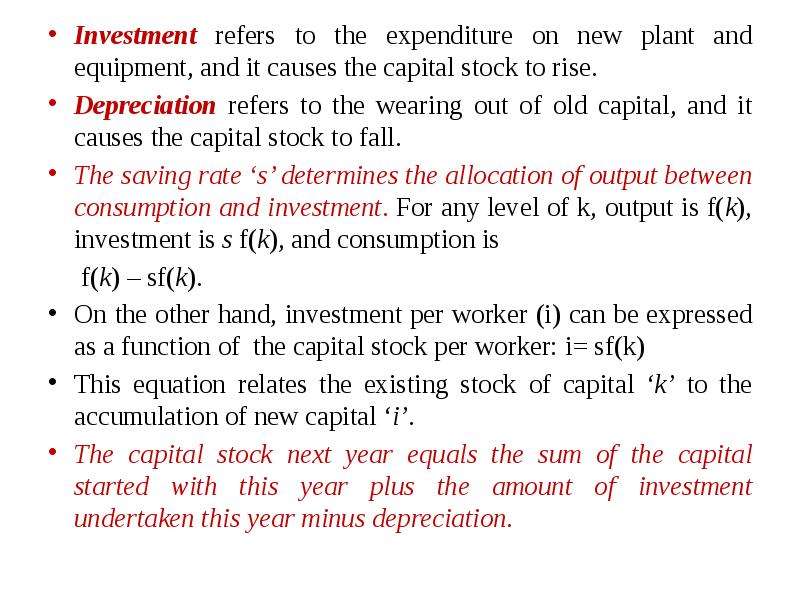
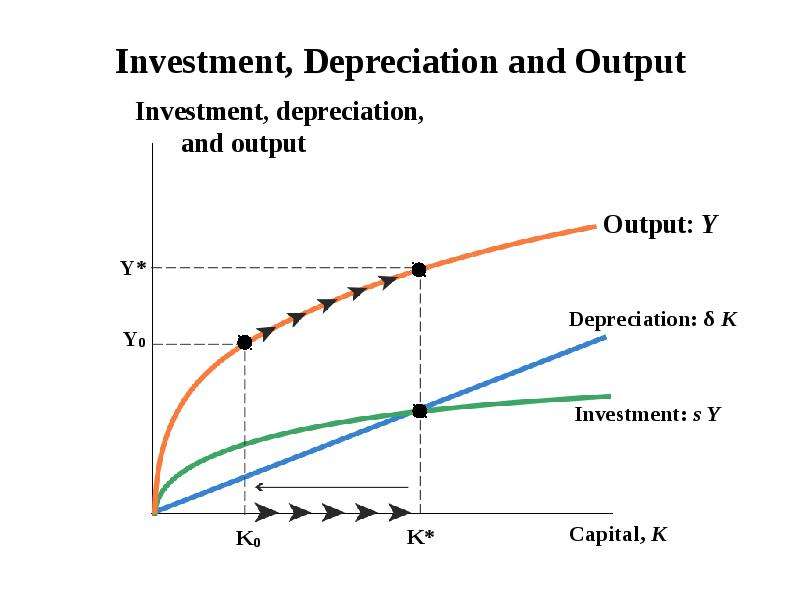
Investment refers to the expenditure on new plant and equipment, and it causes the capital stock to rise. Investment refers to the expenditure on new plant and equipment, and it causes the capital stock to rise. Depreciation refers to the wearing out of old capital, and it causes the capital stock to fall. The saving rate ‘s’ determines the allocation of output between consumption and investment. For any level of k, output is f(k), investment is s f(k), and consumption is f(k) – sf(k). On the other hand, investment per worker (i) can be expressed as a function of the capital stock per worker: i= sf(k) This equation relates the existing stock of capital ‘k’ to the accumulation of new capital ‘i’. The capital stock next year equals the sum of the capital started with this year plus the amount of investment undertaken this year minus depreciation.

Слайд 26


Depreciation is the amount of capital that wears out each period ~ 10 percent/year. Depreciation is the amount of capital that wears out each period...
Описание слайда:
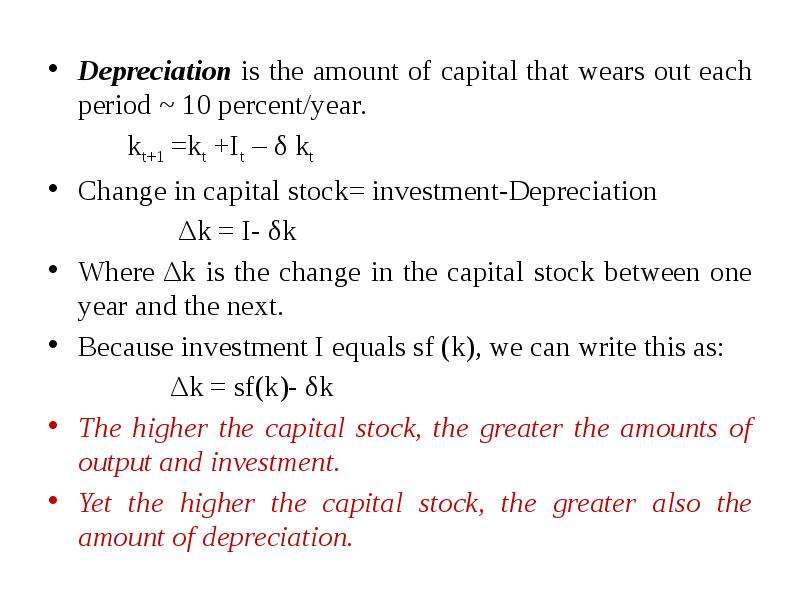
Depreciation is the amount of capital that wears out each period ~ 10 percent/year. Depreciation is the amount of capital that wears out each period ~ 10 percent/year. kt+1 =kt +It – δ kt Change in capital stock= investment-Depreciation Δk = I- δk Where Δk is the change in the capital stock between one year and the next. Because investment I equals sf (k), we can write this as: Δk = sf(k)- δk The higher the capital stock, the greater the amounts of output and investment. Yet the higher the capital stock, the greater also the amount of depreciation.

Слайд 27


Investment, Depreciation, and the Steady state
Описание слайда:
Investment, Depreciation, and the Steady state

Слайд 28


The steady-state level of capital K* is the level at which investment equals depreciation, indicating that the amount of capital will not change over...
Описание слайда:
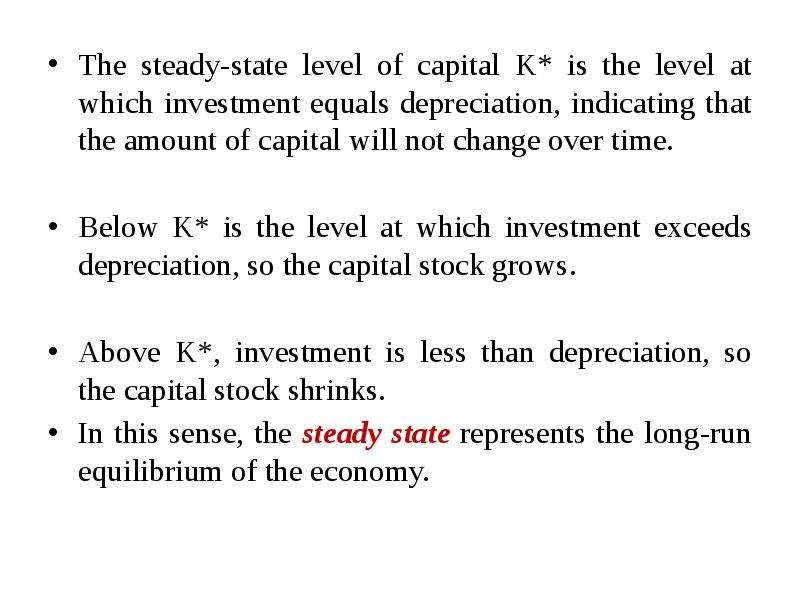
The steady-state level of capital K* is the level at which investment equals depreciation, indicating that the amount of capital will not change over time. The steady-state level of capital K* is the level at which investment equals depreciation, indicating that the amount of capital will not change over time. Below K* is the level at which investment exceeds depreciation, so the capital stock grows. Above K*, investment is less than depreciation, so the capital stock shrinks. In this sense, the steady state represents the long-run equilibrium of the economy.

Слайд 29


The major accomplishment of the Solow model is the principle of transition dynamics, which states that the farther below its steady state an economy...
Описание слайда:
The major accomplishment of the Solow model is the principle of transition dynamics, which states that the farther below its steady state an economy is, the faster it will grow. The major accomplishment of the Solow model is the principle of transition dynamics, which states that the farther below its steady state an economy is, the faster it will grow. Increases in the investment rate or TFP can increase a country’s steady-state position and therefore increase growth, at least for a number of years. However, it does not explain why different countries have different investment and productivity rates. In general, most poor countries have low TFP levels and low investment rates, the two key determinants of steady-state incomes.

Слайд 30


Investment, Depreciation and Output
Описание слайда:
Investment, Depreciation and Output

Слайд 31


Solving Mathematically for the Steady State In the steady state, investment equals depreciation and we can solve mathematically for it. In the steady...
Описание слайда:
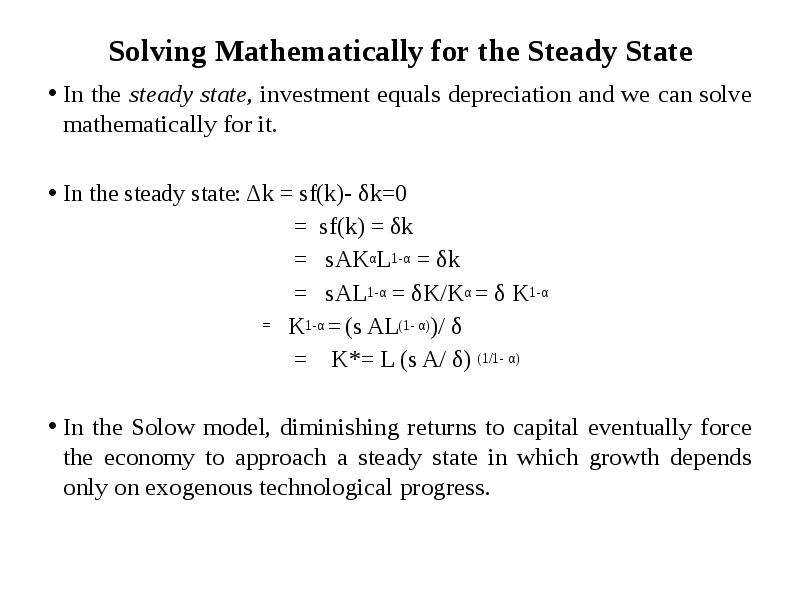
Solving Mathematically for the Steady State In the steady state, investment equals depreciation and we can solve mathematically for it. In the steady state: Δk = sf(k)- δk=0 = sf(k) = δk = sAKαL1-α = δk = sAL1-α = δK/Kα = δ K1-α = K1-α = (s AL(1- α))/ δ = K*= L (s A/ δ) (1/1- α) In the Solow model, diminishing returns to capital eventually force the economy to approach a steady state in which growth depends only on exogenous technological progress.

Слайд 32


Understanding Differences in Growth Rates OECD countries that were relatively poor in 1960 grew quickly while countries that were relatively rich...
Описание слайда:
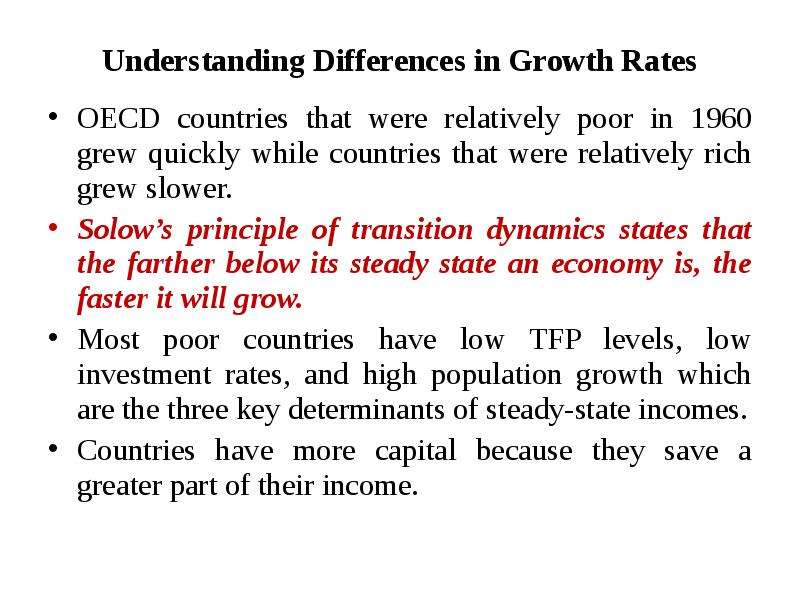
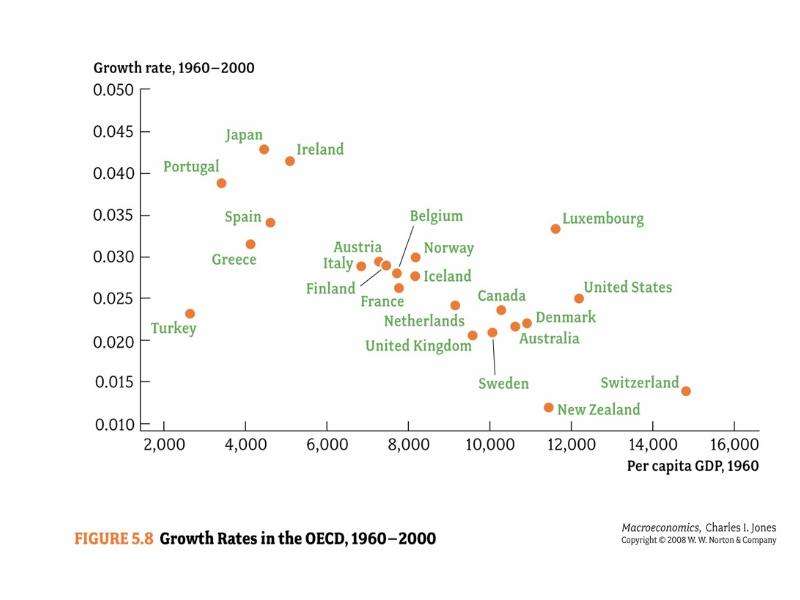
Understanding Differences in Growth Rates OECD countries that were relatively poor in 1960 grew quickly while countries that were relatively rich grew slower. Solow’s principle of transition dynamics states that the farther below its steady state an economy is, the faster it will grow. Most poor countries have low TFP levels, low investment rates, and high population growth which are the three key determinants of steady-state incomes. Countries have more capital because they save a greater part of their income.

Слайд 33


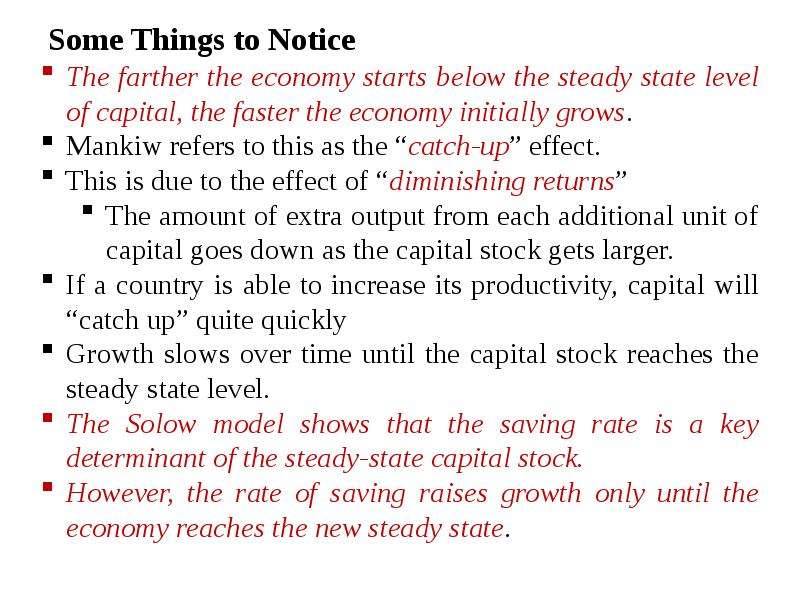
Some Things to Notice
Описание слайда:
Some Things to Notice

Слайд 34


Production and growth, слайд №34
Описание слайда:

Слайд 35


Production and growth, слайд №35
Описание слайда:

Слайд 36


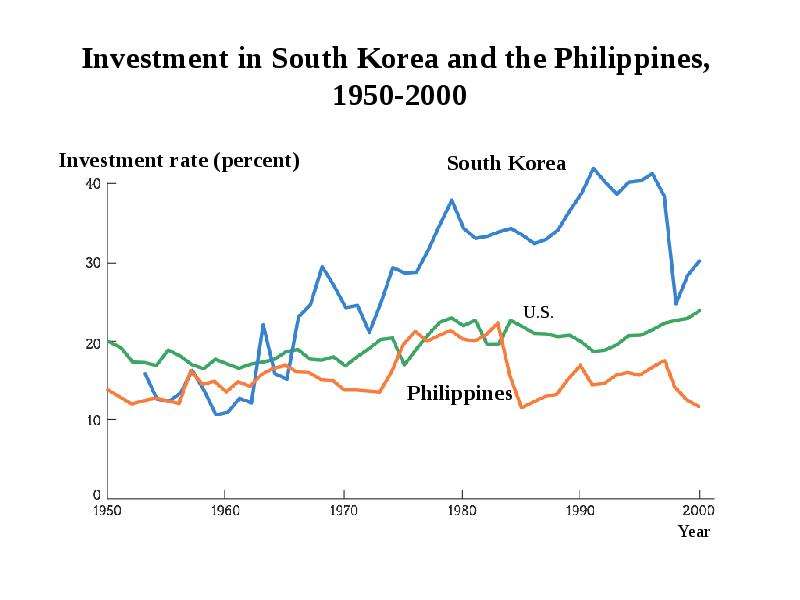
Investment in South Korea and the Philippines, 1950-2000
Описание слайда:
Investment in South Korea and the Philippines, 1950-2000

Слайд 37


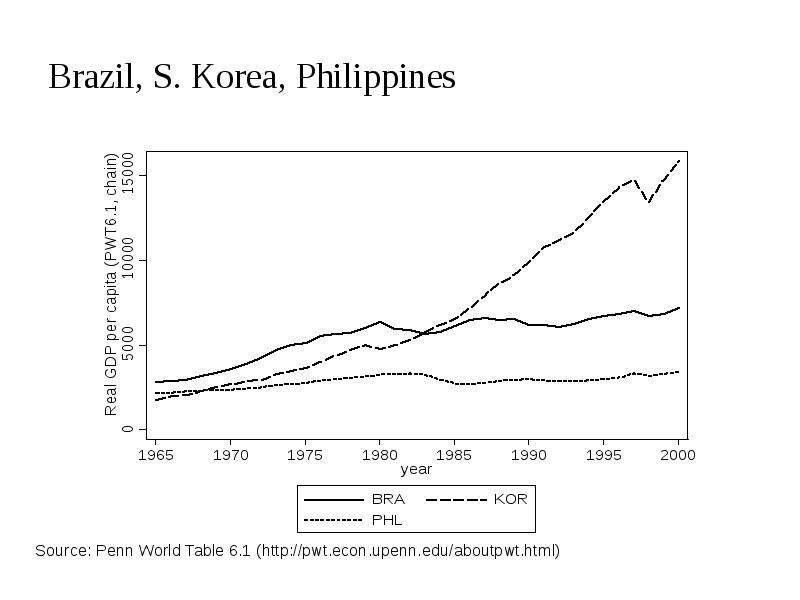
Brazil, S. Korea, Philippines
Описание слайда:
Brazil, S. Korea, Philippines

Слайд 38


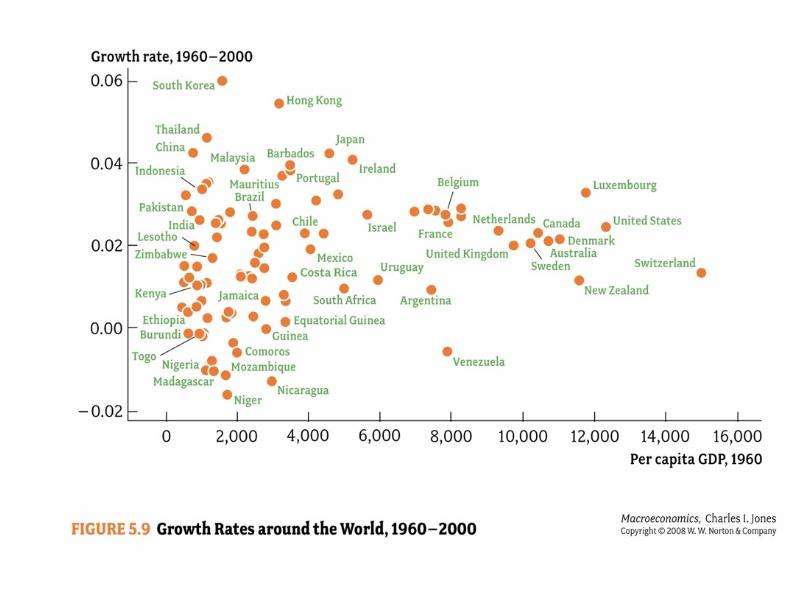
Application: Do Economies Converge? Unconditional (Absolute) convergence (α-Convergence) occurs when poor countries will eventually catch up with the...
Описание слайда:
Application: Do Economies Converge? Unconditional (Absolute) convergence (α-Convergence) occurs when poor countries will eventually catch up with the rich countries resulting in similar living standards. Conditional convergence (β-Convergence):-It will occur, conditional on a number of factors. In other words, it occurs when countries with similar characteristics will converge (savings rate, investment rate, population growth). No convergence occurs when poor countries do not catch up over time and living standards may diverge.

Слайд 39


Imagine that at the end of their first year, some students have A averages, whereas others have C averages. Would you expect the A and C students to...
Описание слайда:
Imagine that at the end of their first year, some students have A averages, whereas others have C averages. Would you expect the A and C students to converge over the remaining three years of college? Imagine that at the end of their first year, some students have A averages, whereas others have C averages. Would you expect the A and C students to converge over the remaining three years of college? The answer depends on why their first-year grades differed. If the differences arose because some students came from better high schools than others, then you might expect those who were initially disadvantaged to start catching up to their better-prepared peers. But if the differences arose because some students study more than others, you might expect the differences in grades to persist. Similarly, if two economies have different steady states, perhaps because the economies have different rates of saving, then we should not expect convergence.

Слайд 40


According to the traditional neoclassical growth theory: According to the traditional neoclassical growth theory: Output growth results either from...
Описание слайда:
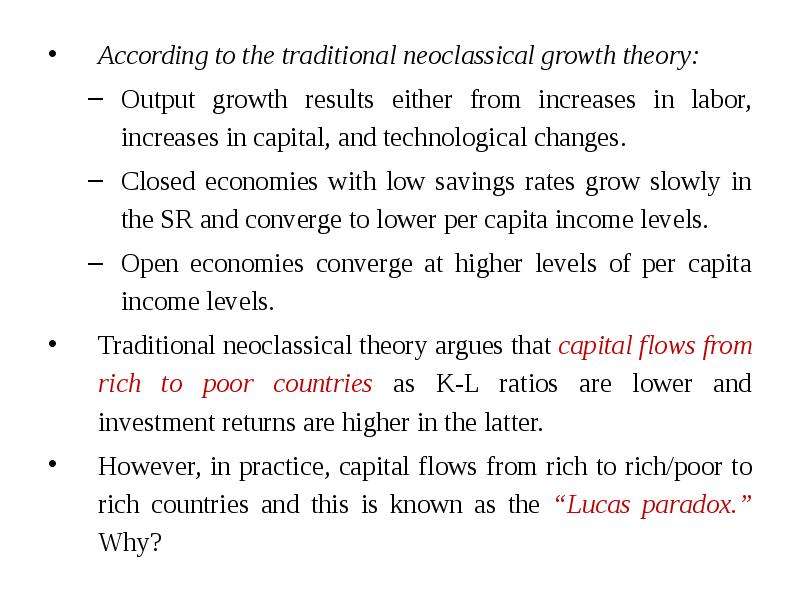
According to the traditional neoclassical growth theory: According to the traditional neoclassical growth theory: Output growth results either from increases in labor, increases in capital, and technological changes. Closed economies with low savings rates grow slowly in the SR and converge to lower per capita income levels. Open economies converge at higher levels of per capita income levels. Traditional neoclassical theory argues that capital flows from rich to poor countries as K-L ratios are lower and investment returns are higher in the latter. However, in practice, capital flows from rich to rich/poor to rich countries and this is known as the “Lucas paradox.” Why?

Слайд 41


Endogenous Growth Theory The neo-classical growth theory of Solow (1956) and Swan (1956) postulates that capital accumulations are subject to...
Описание слайда:
Endogenous Growth Theory The neo-classical growth theory of Solow (1956) and Swan (1956) postulates that capital accumulations are subject to diminishing marginal returns to capital. Endogenous growth theory (Romer, Lucas) emphasizes different growth opportunities in physical capital and knowledge. Endogenous growth theory predicts diminishing marginal returns to physical capital, but perhaps not knowledge The long run growth in GDP per capita in Solow model will depend on TFP growth, which reflects technological progress (which is exogenous in the Solow model). Technology is exogenous implies that it is not determined within the model (it is exogenous)

Слайд 42


Endogenous growth states that long-run economic growth is determined by forces that are internal to the economic system, particularly those forces...
Описание слайда:
Endogenous growth states that long-run economic growth is determined by forces that are internal to the economic system, particularly those forces governing the opportunities and incentives to create technological knowledge. Endogenous growth states that long-run economic growth is determined by forces that are internal to the economic system, particularly those forces governing the opportunities and incentives to create technological knowledge. Endogenous growth theory states technological change arises in large part because of intentional actions taken by people Endogenous growth theory endogenizes technical change, including human capital, and other forms of knowledge-rich capital in capital stocks. One drawback of the Solow model is that long-run growth in per capita income is entirely exogenous. In the absence of exogenous technological growth, income per capita would be static in the long run. This is an implication of diminishing marginal returns to capital.

Слайд 43


To introduce endogenous growth, it is necessary to have increasing (or at least non-decreasing) returns to capital. To introduce endogenous growth,...
Описание слайда:
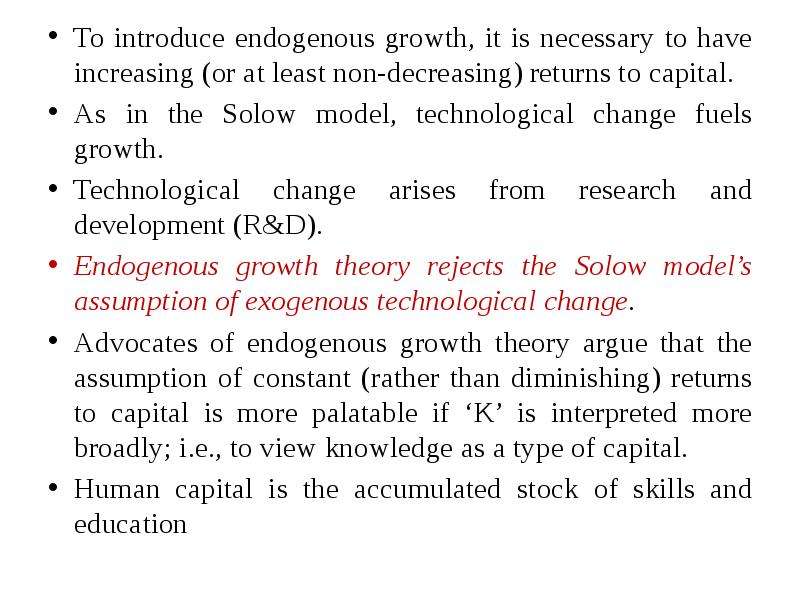
To introduce endogenous growth, it is necessary to have increasing (or at least non-decreasing) returns to capital. To introduce endogenous growth, it is necessary to have increasing (or at least non-decreasing) returns to capital. As in the Solow model, technological change fuels growth. Technological change arises from research and development (R&D). Endogenous growth theory rejects the Solow model’s assumption of exogenous technological change. Advocates of endogenous growth theory argue that the assumption of constant (rather than diminishing) returns to capital is more palatable if ‘K’ is interpreted more broadly; i.e., to view knowledge as a type of capital. Human capital is the accumulated stock of skills and education

Слайд 44


The largest difference between these two economic growth models is that the endogenous growth theory argues that economies do not reach stability, as...
Описание слайда:
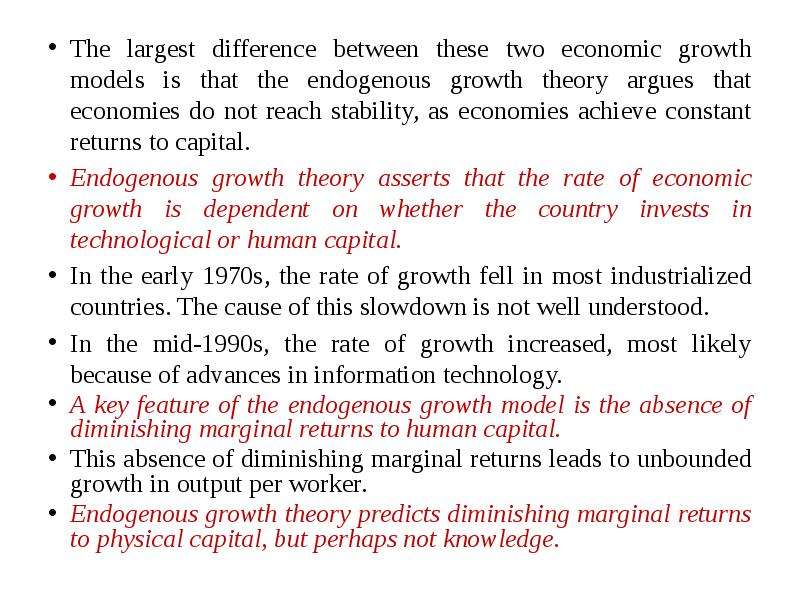
The largest difference between these two economic growth models is that the endogenous growth theory argues that economies do not reach stability, as economies achieve constant returns to capital. The largest difference between these two economic growth models is that the endogenous growth theory argues that economies do not reach stability, as economies achieve constant returns to capital. Endogenous growth theory asserts that the rate of economic growth is dependent on whether the country invests in technological or human capital. In the early 1970s, the rate of growth fell in most industrialized countries. The cause of this slowdown is not well understood. In the mid-1990s, the rate of growth increased, most likely because of advances in information technology. A key feature of the endogenous growth model is the absence of diminishing marginal returns to human capital. This absence of diminishing marginal returns leads to unbounded growth in output per worker. Endogenous growth theory predicts diminishing marginal returns to physical capital, but perhaps not knowledge.

Слайд 45


Correlation between Educational Attainment and Growth Rate in Real GDP per Worker
Описание слайда:
Correlation between Educational Attainment and Growth Rate in Real GDP per Worker

Слайд 46


The AK model The ‘AK model’ is sometimes termed an ‘endogenous growth model’ The model has Y = AK where K can be thought of as some composite...
Описание слайда:
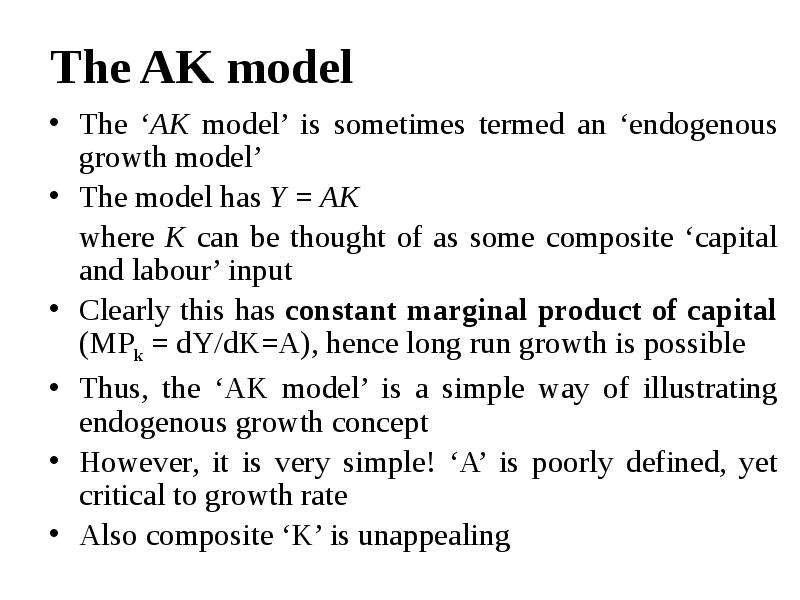
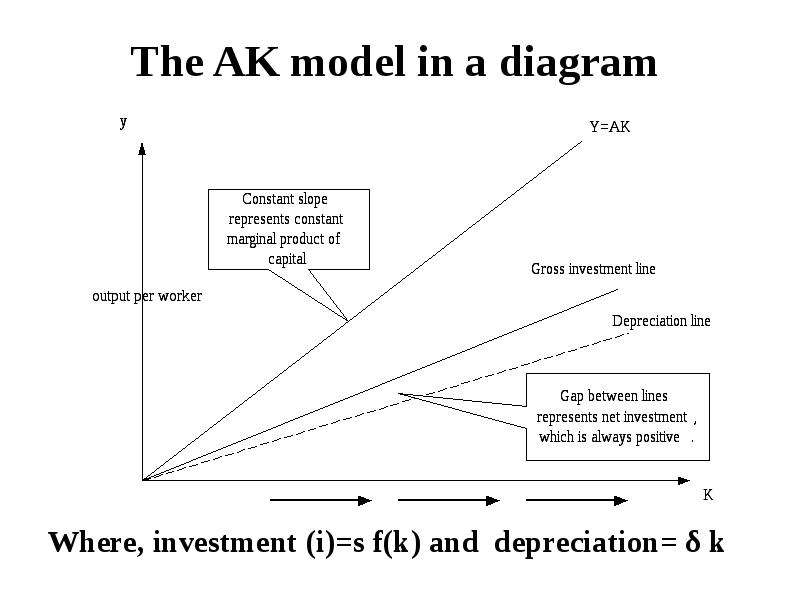
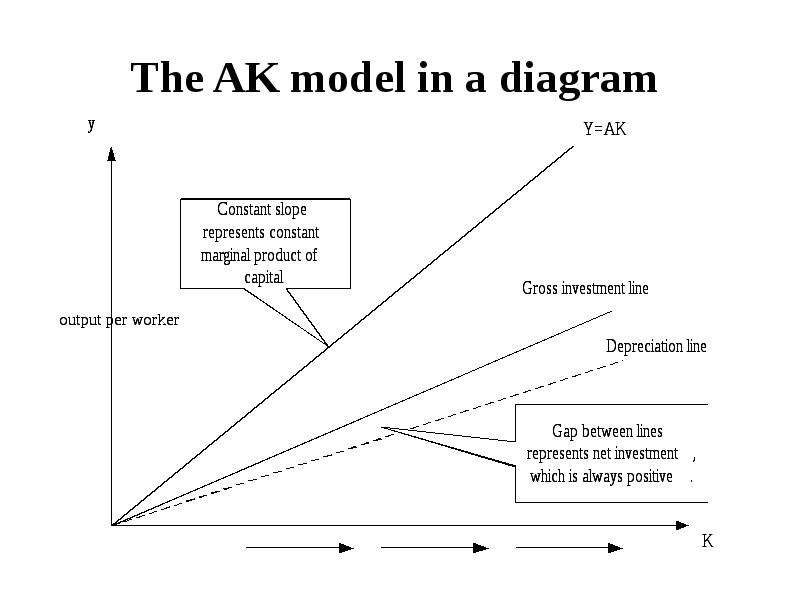
The AK model The ‘AK model’ is sometimes termed an ‘endogenous growth model’ The model has Y = AK where K can be thought of as some composite ‘capital and labour’ input Clearly this has constant marginal product of capital (MPk = dY/dK=A), hence long run growth is possible Thus, the ‘AK model’ is a simple way of illustrating endogenous growth concept However, it is very simple! ‘A’ is poorly defined, yet critical to growth rate Also composite ‘K’ is unappealing

Слайд 47


The AK model in a diagram
Описание слайда:
The AK model in a diagram

Слайд 48


Endogenous Technology Growth (by Ken Arrow (1962) Suppose that technology depends on past investment (i.e. the process of investment generates new...
Описание слайда:
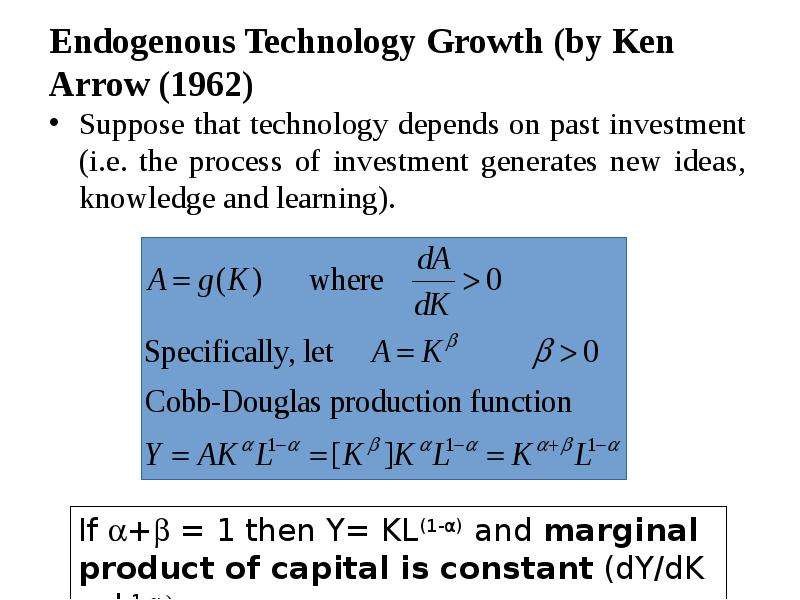
Endogenous Technology Growth (by Ken Arrow (1962) Suppose that technology depends on past investment (i.e. the process of investment generates new ideas, knowledge and learning).

Слайд 49


Assuming A=g(K) is Ken Arrow’s (1962) learning-by-doing paper Assuming A=g(K) is Ken Arrow’s (1962) learning-by-doing paper The intuition is that...
Описание слайда:
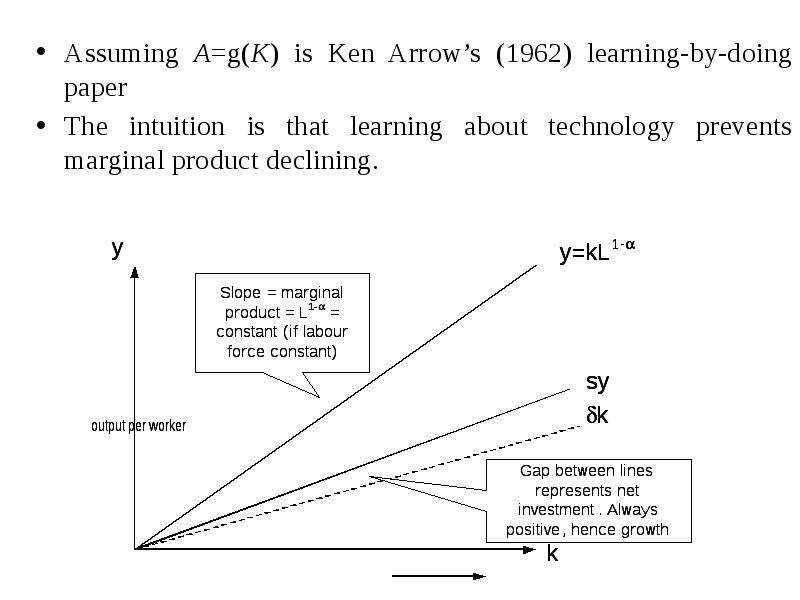
Assuming A=g(K) is Ken Arrow’s (1962) learning-by-doing paper Assuming A=g(K) is Ken Arrow’s (1962) learning-by-doing paper The intuition is that learning about technology prevents marginal product declining.

Слайд 50


No Convergence Neoclassical growth theory predicts: Conditional convergence for economies with equal rates of saving and population growth and with...
Описание слайда:
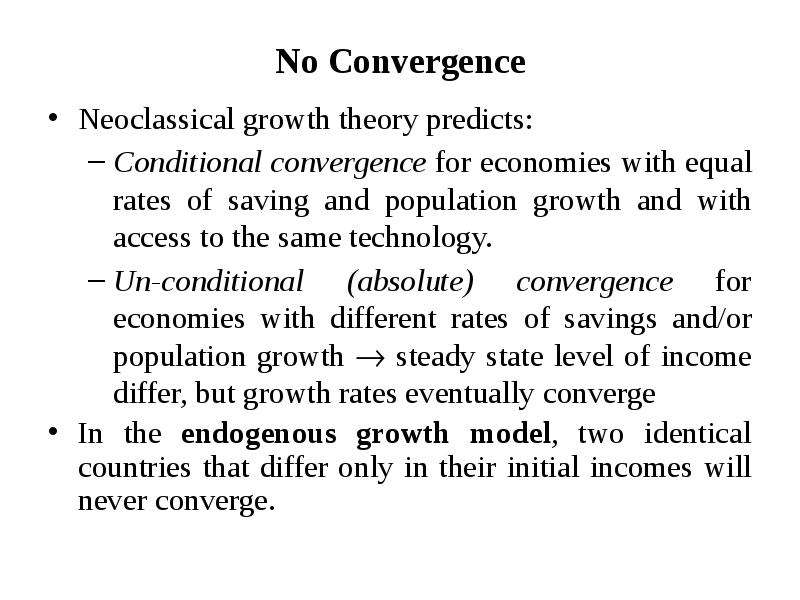
No Convergence Neoclassical growth theory predicts: Conditional convergence for economies with equal rates of saving and population growth and with access to the same technology. Un-conditional (absolute) convergence for economies with different rates of savings and/or population growth  steady state level of income differ, but growth rates eventually converge In the endogenous growth model, two identical countries that differ only in their initial incomes will never converge.

Слайд 51


Consumption and Output Paths of the Rich and Poor Countries
Описание слайда:
Consumption and Output Paths of the Rich and Poor Countries

Слайд 52


Convergence Robert Barro tested these competing theories, and found that: Countries with higher levels of investment tend to grow faster. The impact...
Описание слайда:
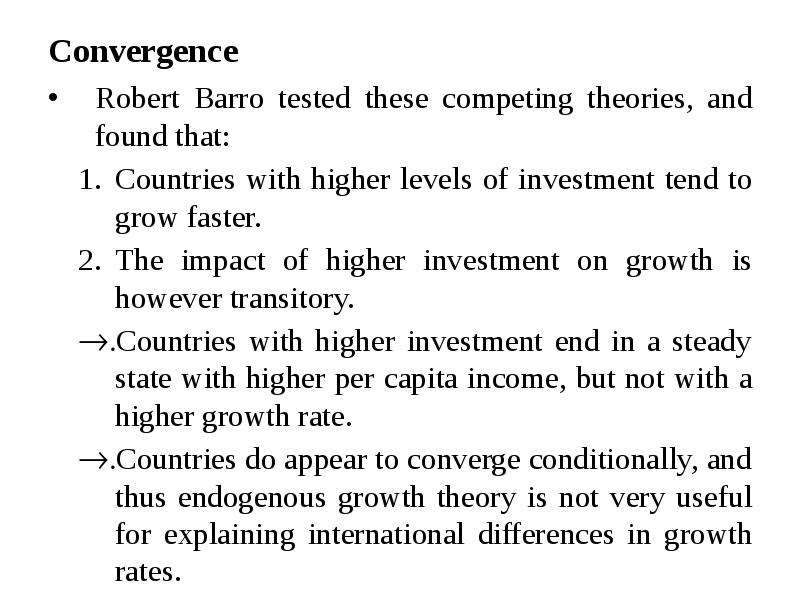
Convergence Robert Barro tested these competing theories, and found that: Countries with higher levels of investment tend to grow faster. The impact of higher investment on growth is however transitory. Countries with higher investment end in a steady state with higher per capita income, but not with a higher growth rate. Countries do appear to converge conditionally, and thus endogenous growth theory is not very useful for explaining international differences in growth rates.

Слайд 53


Transformation of the Korean Economy (1945-2005)
Описание слайда:
Transformation of the Korean Economy (1945-2005)

Слайд 54


Policy Choice and Quality of Institutions Matter: The Korean Experiment
Описание слайда:
Policy Choice and Quality of Institutions Matter: The Korean Experiment

Слайд 55


Flying geese’ pattern of economic development in East Asia The phrase “flying geese pattern of development” was coined originally by Kaname Akamatsu...
Описание слайда:
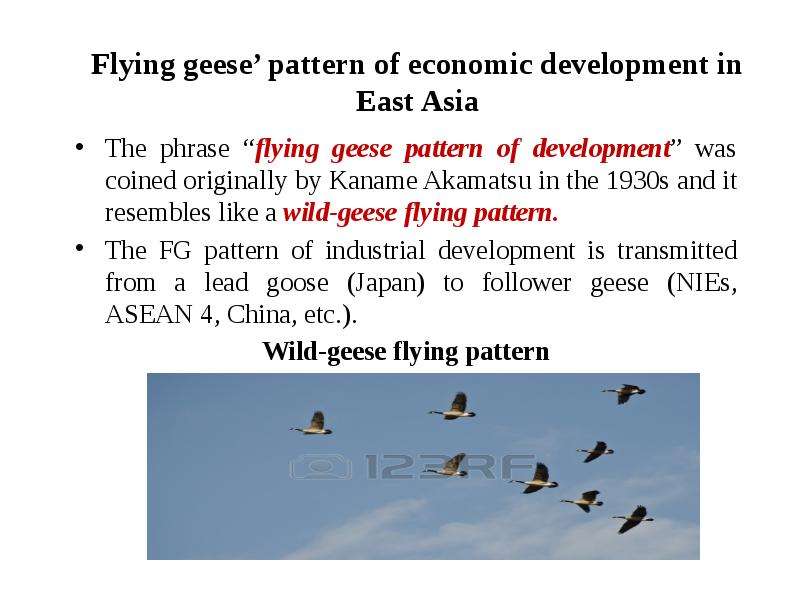
Flying geese’ pattern of economic development in East Asia The phrase “flying geese pattern of development” was coined originally by Kaname Akamatsu in the 1930s and it resembles like a wild-geese flying pattern. The FG pattern of industrial development is transmitted from a lead goose (Japan) to follower geese (NIEs, ASEAN 4, China, etc.). Wild-geese flying pattern

Слайд 56


Japan succeeded first in modernizing its economy during the latter half of the 19th century. Despite the interruption of World War II, it became...
Описание слайда:
Japan succeeded first in modernizing its economy during the latter half of the 19th century. Despite the interruption of World War II, it became virtually the sole developed country in Asia in the 1960s. Japan succeeded first in modernizing its economy during the latter half of the 19th century. Despite the interruption of World War II, it became virtually the sole developed country in Asia in the 1960s. The second wave of industrialization in East Asia took place in the Asian NIEs known as the four ‘dragons’ or ‘tigers’ (Taiwan, Korea, Hong Kong and Singapore) from the 1950s to the 1970s. The third wave of industrialization occurred in the leading ASEAN countries (Malaysia, Thailand, the Philippines and Indonesia) in the 1980s. The fourth wave of industrialization in the 1990s was led by China, which had industrialized itself by the 1980s, when its opening up to the world economy by Deng Xiaoping. Vietnam, one of the newcomer ASEAN countries, followed suit and successfully reformed its economy through ‘Doi Moi’ (renovation) Currently, the wave of industrialization in East Asia has reached Lao PDR and Cambodia.

Слайд 57


Structural Transformation in East Asia
Описание слайда:
Structural Transformation in East Asia

Слайд 58


Are natural resources a limit to growth? Argument Natural resources - will eventually limit how much the world’s economies can grow Fixed supply of...
Описание слайда:
Are natural resources a limit to growth? Argument Natural resources - will eventually limit how much the world’s economies can grow Fixed supply of nonrenewable natural resources – will run out. Stop economic growth Force living standards to fall

Слайд 59


Are natural resources a limit to growth? Technological progress Often yields ways to avoid these limits Improved use of natural resources over time...
Описание слайда:
Are natural resources a limit to growth? Technological progress Often yields ways to avoid these limits Improved use of natural resources over time Recycling New materials Are these efforts enough to permit continued economic growth?

Слайд 60


Are natural resources a limit to growth? Prices of natural resources Scarcity - reflected in market prices Natural resource prices Substantial...
Описание слайда:
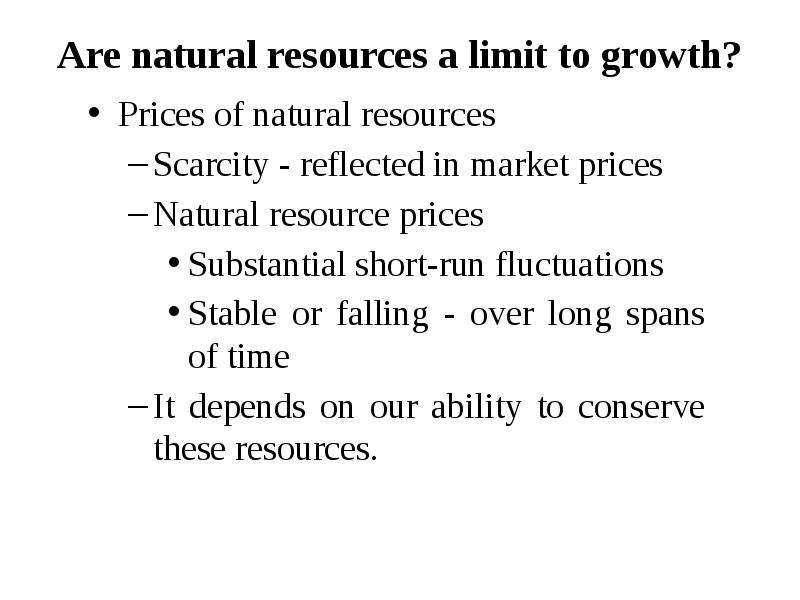
Are natural resources a limit to growth? Prices of natural resources Scarcity - reflected in market prices Natural resource prices Substantial short-run fluctuations Stable or falling - over long spans of time It depends on our ability to conserve these resources.

Слайд 61


Saving and Investment Raise future productivity Invest more current resources in the production of capital. Trade-off Devote fewer resources to...
Описание слайда:
Saving and Investment Raise future productivity Invest more current resources in the production of capital. Trade-off Devote fewer resources to produce goods and services for current consumption.

Слайд 62


Higher savings rate Higher savings rate Fewer resources – used to make consumption goods More resources – to make capital goods Capital stock...
Описание слайда:
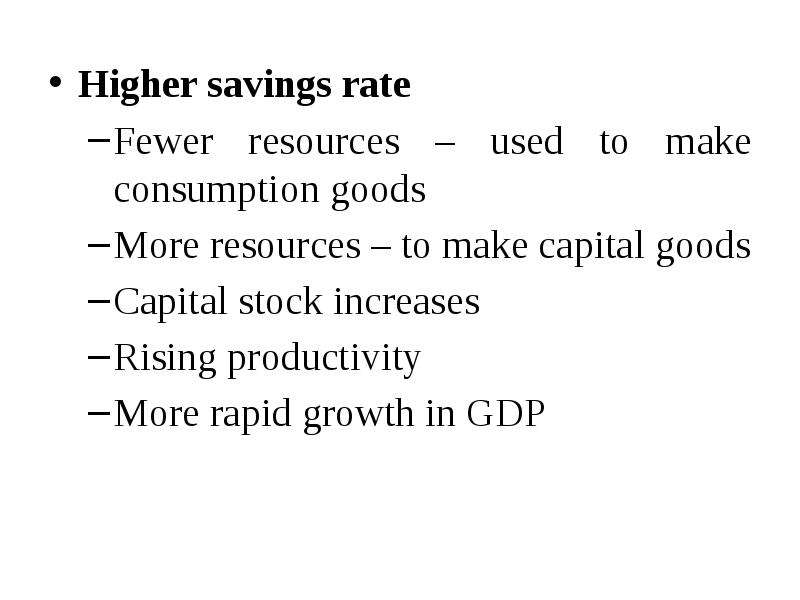
Higher savings rate Higher savings rate Fewer resources – used to make consumption goods More resources – to make capital goods Capital stock increases Rising productivity More rapid growth in GDP

Слайд 63


Investment from Abroad Investment from abroad Another way for a country to invest in new capital Foreign direct investment Capital investment that is...
Описание слайда:
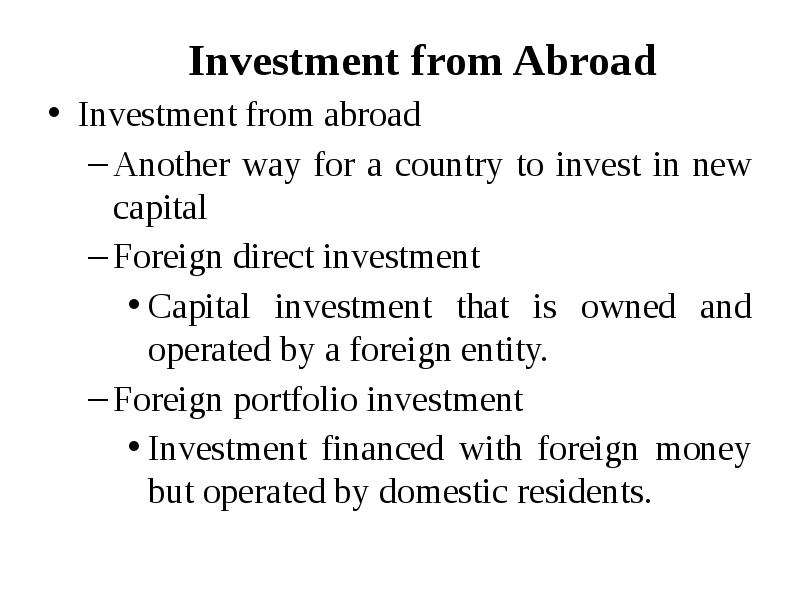
Investment from Abroad Investment from abroad Another way for a country to invest in new capital Foreign direct investment Capital investment that is owned and operated by a foreign entity. Foreign portfolio investment Investment financed with foreign money but operated by domestic residents.

Слайд 64


Investment from Abroad Benefits from investment Some flow back to the foreign capital owners. Increase the economy’s stock of capital Higher...
Описание слайда:
Investment from Abroad Benefits from investment Some flow back to the foreign capital owners. Increase the economy’s stock of capital Higher productivity Higher wages State-of-the-art technologies

Слайд 65


Investment from Abroad World Bank Encourages flow of capital to poor countries Funds from world’s advanced countries Makes loans to less developed...
Описание слайда:
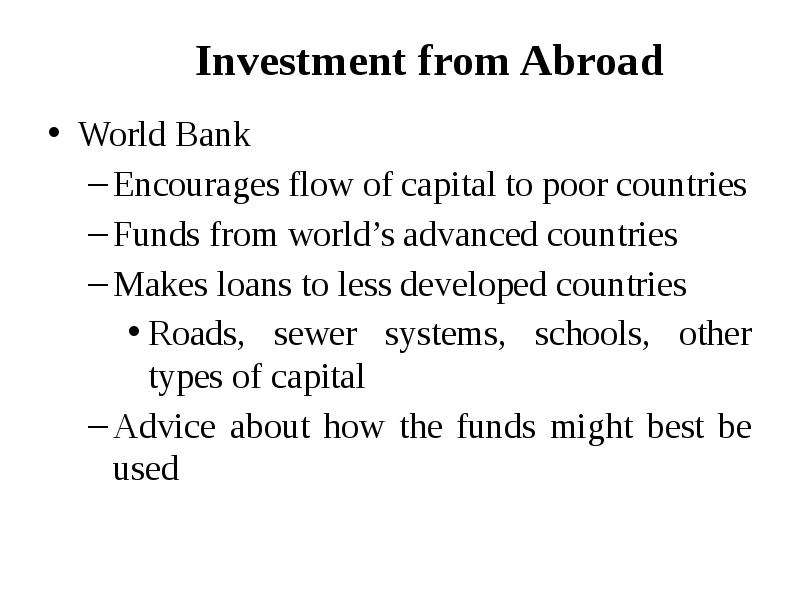
Investment from Abroad World Bank Encourages flow of capital to poor countries Funds from world’s advanced countries Makes loans to less developed countries Roads, sewer systems, schools, other types of capital Advice about how the funds might best be used

Слайд 66


Investment from Abroad World Bank and the International Monetary Fund Set up after World War II Economic distress leads to: Political turmoil,...
Описание слайда:
Investment from Abroad World Bank and the International Monetary Fund Set up after World War II Economic distress leads to: Political turmoil, international tensions, and military conflict Every country has an interest in promoting economic prosperity around the world.

Слайд 67


Education Education Investment in human capital Gap between wages of educated and uneducated workers Opportunity cost: wages forgone Conveys positive...
Описание слайда:
Education Education Investment in human capital Gap between wages of educated and uneducated workers Opportunity cost: wages forgone Conveys positive externalities Public education - large subsidies to human-capital investment Problem for poor countries: Brain drain

Слайд 68


Health and Nutrition Human capital Education Expenditures that lead to a healthier population Healthier workers More productive Wages Reflect a...
Описание слайда:
Health and Nutrition Human capital Education Expenditures that lead to a healthier population Healthier workers More productive Wages Reflect a worker’s productivity

Слайд 69


Health and Nutrition Right investments in the health of the population Increase productivity Raise living standards Historical trends: long-run...
Описание слайда:
Health and Nutrition Right investments in the health of the population Increase productivity Raise living standards Historical trends: long-run economic growth Improved health – from better nutrition Taller workers – higher wages – better productivity

Слайд 70


Health and Nutrition Vicious circle in poor countries Poor countries are poor Because their populations are not healthy Populations are not healthy...
Описание слайда:
Health and Nutrition Vicious circle in poor countries Poor countries are poor Because their populations are not healthy Populations are not healthy Because they are poor and cannot afford better healthcare and nutrition

Слайд 71


Health and Nutrition Virtuous circle Policies that lead to more rapid economic growth Would naturally improve health outcomes Which in turn would...
Описание слайда:
Health and Nutrition Virtuous circle Policies that lead to more rapid economic growth Would naturally improve health outcomes Which in turn would further promote economic growth

Слайд 72


Property Rights & Political Stability To foster economic growth Protect property rights Ability of people to exercise authority over the resources...
Описание слайда:
Property Rights & Political Stability To foster economic growth Protect property rights Ability of people to exercise authority over the resources they own. Courts – enforce property rights Promote political stability Property rights Prerequisite for the price system to work

Слайд 73


Property Rights & Political Stability Lack of property rights Major problem Contracts are hard to enforce Fraud goes unpunished Corruption Impedes...
Описание слайда:
Property Rights & Political Stability Lack of property rights Major problem Contracts are hard to enforce Fraud goes unpunished Corruption Impedes the coordinating power of markets Discourages domestic saving Discourages investment from abroad

Слайд 74


Property Rights & Political Stability Political instability A threat to property rights Revolutions and coups Revolutionary government might...
Описание слайда:
Property Rights & Political Stability Political instability A threat to property rights Revolutions and coups Revolutionary government might confiscate the capital of some businesses. Domestic residents - less incentive to save, invest, and start new businesses. Foreigners - less incentive to invest

Слайд 75


Free Trade Inward-oriented policies Avoid interaction with the rest of the world Infant-industry argument Tariffs Other trade restrictions Adverse...
Описание слайда:
Free Trade Inward-oriented policies Avoid interaction with the rest of the world Infant-industry argument Tariffs Other trade restrictions Adverse effect on economic growth

Слайд 76


Free Trade Outward-oriented policies Integrate into the world economy International trade in goods and services Economic growth Amount of trade –...
Описание слайда:
Free Trade Outward-oriented policies Integrate into the world economy International trade in goods and services Economic growth Amount of trade – determined by Government policy Geography Easier to trade for countries with natural seaports

Слайд 77


Research and Development Knowledge – public good Government–encourages research and development Farming methods Aerospace research (Air Force; NASA)...
Описание слайда:
Research and Development Knowledge – public good Government–encourages research and development Farming methods Aerospace research (Air Force; NASA) Research grants National Science Foundation National Institutes of Health Tax breaks Patent system

Слайд 78


Population Growth Large population More workers to produce goods and services Larger total output of goods and services More consumers Stretching...
Описание слайда:
Population Growth Large population More workers to produce goods and services Larger total output of goods and services More consumers Stretching natural resources Malthus: an ever-increasing population Strain society’s ability to provide for itself Mankind - doomed to forever live in poverty

Слайд 79


Population Growth Diluting the capital stock High population growth Spread the capital stock more thinly Lower productivity per worker Lower GDP per...
Описание слайда:
Population Growth Diluting the capital stock High population growth Spread the capital stock more thinly Lower productivity per worker Lower GDP per worker Reducing the rate of population growth Government regulation Increased awareness of birth control Equal opportunities for women

Слайд 80


Population Growth Promoting technological progress World population growth Engine for technological progress and economic prosperity More people =...
Описание слайда:
Population Growth Promoting technological progress World population growth Engine for technological progress and economic prosperity More people = More scientists, more inventors, more engineers

Слайд 81


Summary International differences in income per person can be attributed to either: differences in the factors of production, such as the quantities...
Описание слайда:
Summary International differences in income per person can be attributed to either: differences in the factors of production, such as the quantities of physical and human capital, or Differences in the efficiency with which economies use their factors of production. A final hypothesis is that both factor accumulation and production efficiency are driven by a common third variable: quality of the nation’s institutions , including the government’s policymaking process. Bad policies such as high inflation, excessive budget deficits, widespread market interference, and rampant corruption, often go hand in hand.

Слайд 82


Summary The Solow growth model has emphasized the importance of savings or investment ratio as the main determinant of short-run economic growth. The...
Описание слайда:
Summary The Solow growth model has emphasized the importance of savings or investment ratio as the main determinant of short-run economic growth. The neo-classical growth theory of Solow (1956) and Swann (1956) postulates that capital accumulations are subject to diminishing returns. The long run growth in GDP per capita, will depend on TFP growth, which reflects technological progress. In the absence of exogenous technological growth, income per capita would be static in the long run.

Слайд 83


Technological progress, though important in the long-run, is regarded as exogenous to the economic system. Technological progress, though important...
Описание слайда:
Technological progress, though important in the long-run, is regarded as exogenous to the economic system. Technological progress, though important in the long-run, is regarded as exogenous to the economic system. The Solow Model predicts catch-up growth (convergence in growth rate) on the basis that poor economies will grow faster compared to rich ones. One drawback of the Solow model is that long-run growth in per capita income is entirely exogenous.

Слайд 84


Investment, Depreciation and Output
Описание слайда:
Investment, Depreciation and Output

Слайд 85


The Endogenous growth theory believe that human capital and innovation capacity are the main sources of long-term economic growth. The Endogenous...
Описание слайда:
The Endogenous growth theory believe that human capital and innovation capacity are the main sources of long-term economic growth. The Endogenous growth theory believe that human capital and innovation capacity are the main sources of long-term economic growth. Human capital is the accumulated stock of skills and education Unlike Solow model, Endogenous growth theory endogenizes technical change. Technological change arises from research and development (R&D). A key feature of the endogenous growth model is the absence of diminishing marginal returns to human capital. The endogenous growth models suggest that convergence would not occur at all (mainly due to the fact that there are increasing returns to scale).

Слайд 86


The AK model in a diagram
Описание слайда:
The AK model in a diagram

Слайд 87


Generally, the following are growth drivers: Generally, the following are growth drivers: Growth in physical capital stock (capital deepening) Growth...
Описание слайда:
Generally, the following are growth drivers: Generally, the following are growth drivers: Growth in physical capital stock (capital deepening) Growth in the size of active labor force available for production Growth in the quality of labor (human capital) Technological progress and innovation Institutions-including maintaining the rule of law, stable macroeconomic and political stability Rising demand for goods and services-either led by domestic demand or from external trade.

Слайд 88


Solow's Neoclassical Model or Exogenous Growth Model = Yt = At Ktα Ltβ (1) = ln (Yt) = ln (At) + α ln (Kt) + (β) ln Lt (2) = = + α + (β) (3) = { }* {...
Описание слайда:
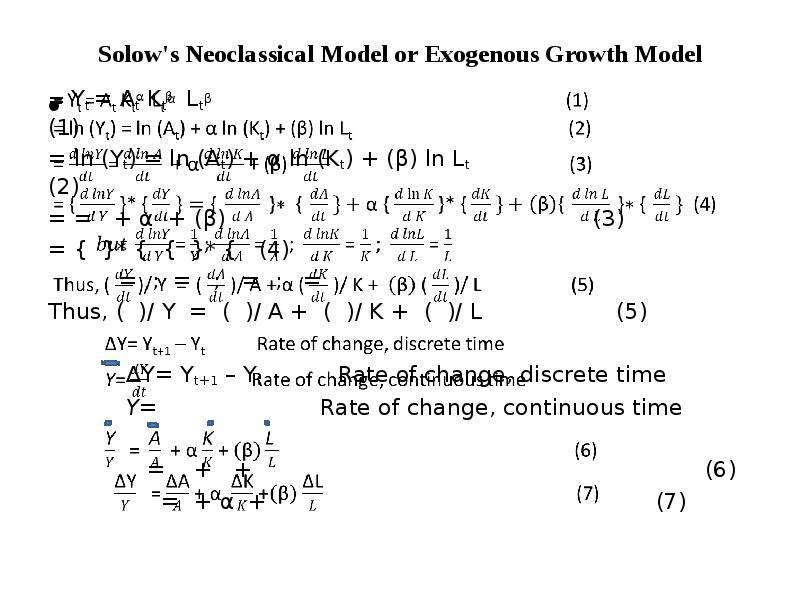
Solow's Neoclassical Model or Exogenous Growth Model = Yt = At Ktα Ltβ (1) = ln (Yt) = ln (At) + α ln (Kt) + (β) ln Lt (2) = = + α + (β) (3) = { }* { { }* { (4) = ; = ; = ; = Thus, ( )/ Y = ( )/ A + ( )/ K + ( )/ L (5) ∆Y= Yt+1 – Yt Rate of change, discrete time Y= Rate of change, continuous time = + + (6) = + α + (7)


Теги Production growth
Похожие презентации
Mypresentation.ru
Загрузить презентацию