🗊 Презентация Style and stylistics. Expressive means and stylistic devices

Категория: Образование
Нажмите для полного просмотра!
Style and stylistics. Expressive means and stylistic devices, слайд №1 Style and stylistics. Expressive means and stylistic devices, слайд №2 Style and stylistics. Expressive means and stylistic devices, слайд №3 Style and stylistics. Expressive means and stylistic devices, слайд №4 Style and stylistics. Expressive means and stylistic devices, слайд №5 Style and stylistics. Expressive means and stylistic devices, слайд №6 Style and stylistics. Expressive means and stylistic devices, слайд №7 Style and stylistics. Expressive means and stylistic devices, слайд №8 Style and stylistics. Expressive means and stylistic devices, слайд №9 Style and stylistics. Expressive means and stylistic devices, слайд №10 Style and stylistics. Expressive means and stylistic devices, слайд №11 Style and stylistics. Expressive means and stylistic devices, слайд №12 Style and stylistics. Expressive means and stylistic devices, слайд №13 Style and stylistics. Expressive means and stylistic devices, слайд №14 Style and stylistics. Expressive means and stylistic devices, слайд №15 Style and stylistics. Expressive means and stylistic devices, слайд №16 Style and stylistics. Expressive means and stylistic devices, слайд №17 Style and stylistics. Expressive means and stylistic devices, слайд №18 Style and stylistics. Expressive means and stylistic devices, слайд №19

Вы можете ознакомиться и скачать презентацию на тему Style and stylistics. Expressive means and stylistic devices. Доклад-сообщение содержит 19 слайдов. Презентации для любого класса можно скачать бесплатно. Если материал и наш сайт презентаций Mypresentation Вам понравились – поделитесь им с друзьями с помощью социальных кнопок и добавьте в закладки в своем браузере.

Слайды и текст этой презентации


Слайд 1


STYLE AND STYLISTICS
Описание слайда:

STYLE AND STYLISTICS

Слайд 2


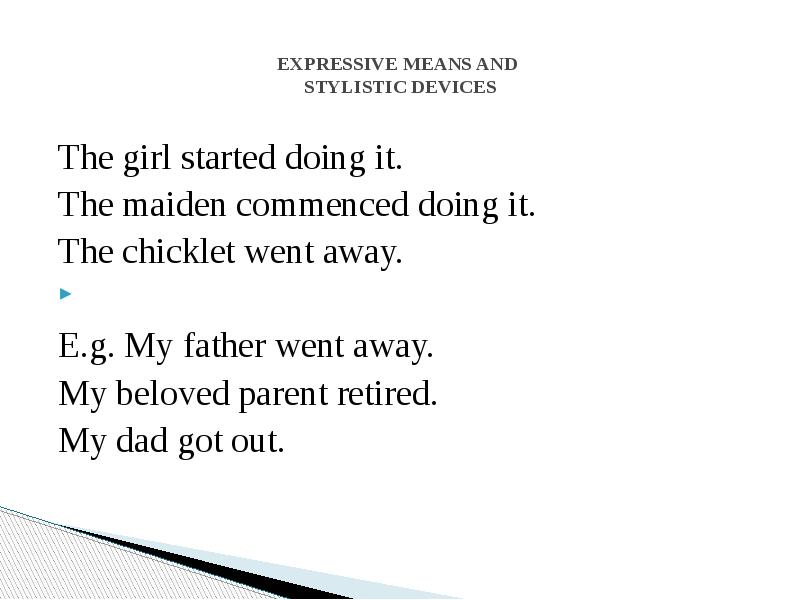
EXPRESSIVE MEANS AND STYLISTIC DEVICES The girl started doing it. The maiden commenced doing it. The chicklet went away. E.g. My father went away. My...
Описание слайда:

EXPRESSIVE MEANS AND STYLISTIC DEVICES The girl started doing it. The maiden commenced doing it. The chicklet went away. E.g. My father went away. My beloved parent retired. My dad got out.

Слайд 3


Style and stylistics. Expressive means and stylistic devices, слайд №3
Описание слайда:

Слайд 4


Expressive means of the language are those phonetic, graphical, lexical, syntactical forms which exist in the language for the purpose of logical and...
Описание слайда:

Expressive means of the language are those phonetic, graphical, lexical, syntactical forms which exist in the language for the purpose of logical and emotional intensification of the utterance (Galperin 1981). Expressive means of the language are those phonetic, graphical, lexical, syntactical forms which exist in the language for the purpose of logical and emotional intensification of the utterance (Galperin 1981). To phonetic expressive means refer pitch of the voice, stress, melody, intonation, manner of speech (sing-song speech, whisper­ing, laughing, crying, etc.). These means are the most powerful because the human voice can a lot of nuances of meaning which no other means can attain.

Слайд 5


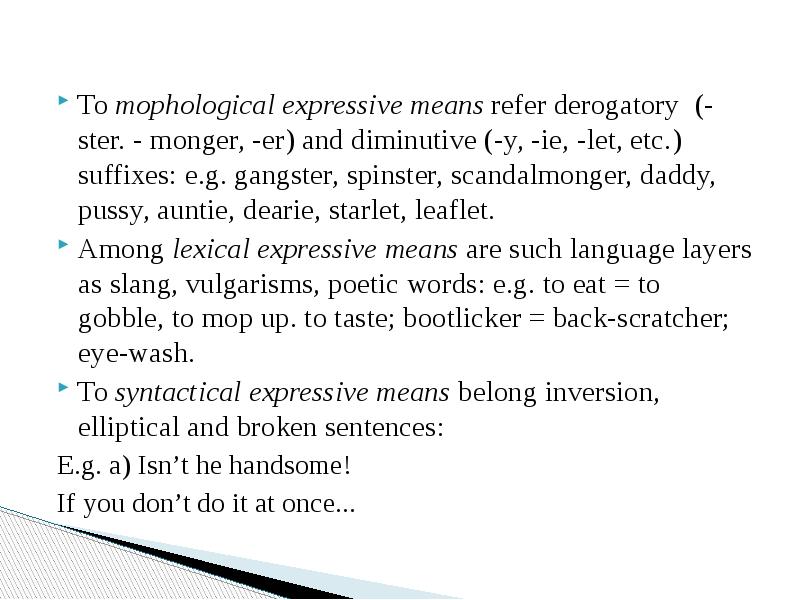
To mophological expressive means refer derogatory (-ster. - monger, -er) and diminutive (-y, -ie, -let, etc.) suffixes: e.g. gangster, spinster,...
Описание слайда:
To mophological expressive means refer derogatory (-ster. - monger, -er) and diminutive (-y, -ie, -let, etc.) suffixes: e.g. gangster, spinster, scandalmonger, daddy, pussy, auntie, dearie, starlet, leaflet. Among lexical expressive means are such language layers as slang, vulgarisms, poetic words: e.g. to eat = to gobble, to mop up. to taste; bootlicker = back-scratcher; eye-wash. To syntactical expressive means belong inversion, elliptical and broken sentences: E.g. a) Isn’t he handsome! If you don’t do it at once...

Слайд 6


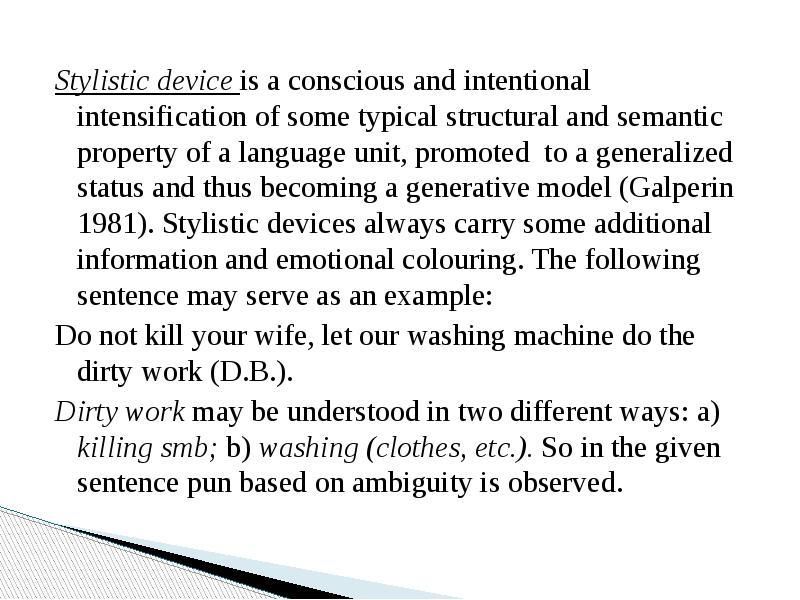
Stylistic device is a conscious and intentional intensification of some typical structural and semantic property of a language unit, promoted to a...
Описание слайда:
Stylistic device is a conscious and intentional intensification of some typical structural and semantic property of a language unit, promoted to a generalized status and thus becoming a generative model (Galperin 1981). Stylistic devices always carry some additional information and emotional colouring. The following sentence may serve as an example: Stylistic device is a conscious and intentional intensification of some typical structural and semantic property of a language unit, promoted to a generalized status and thus becoming a generative model (Galperin 1981). Stylistic devices always carry some additional information and emotional colouring. The following sentence may serve as an example: Do not kill your wife, let our washing machine do the dirty work (D.B.). Dirty work may be understood in two different ways: a) killing smb; b) washing (clothes, etc.). So in the given sentence pun based on ambiguity is observed.

Слайд 7


PHONO-GRAPHICAL EXPRESSIVE MEANS AND STYLISTIC DEVICES GRAPHICAL EXPRESSIVE MEANS Such marks of punctuation as hyphen, dash, comma, period, colon,...
Описание слайда:
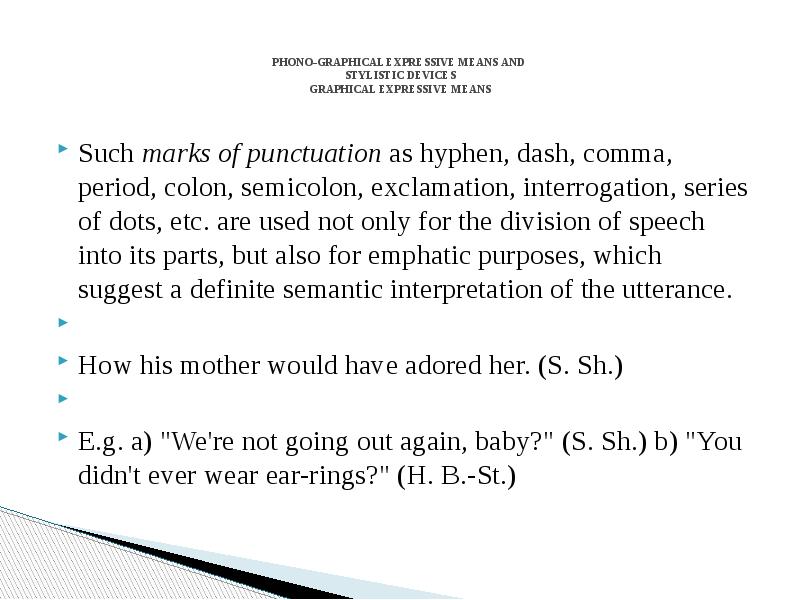
PHONO-GRAPHICAL EXPRESSIVE MEANS AND STYLISTIC DEVICES GRAPHICAL EXPRESSIVE MEANS Such marks of punctuation as hyphen, dash, comma, period, colon, semicolon, exclamation, interrogation, series of dots, etc. are used not only for the division of speech into its parts, but also for emphatic purposes, which suggest a definite semantic interpretation of the utterance. How his mother would have adored her. (S. Sh.) E.g. a) "We're not going out again, baby?" (S. Sh.) b) "You didn't ever wear ear-rings?" (H. B.-St.)

Слайд 8


E.g. “Why did you get divorced?" E.g. “Why did you get divorced?" “Christ. Why does anybody get divorced” (М. C.). E.g. You come here after...
Описание слайда:
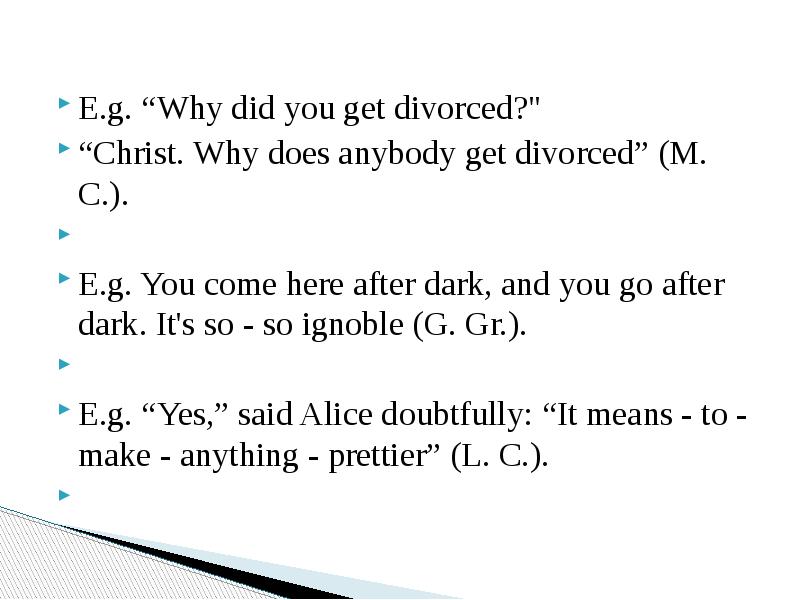
E.g. “Why did you get divorced?" E.g. “Why did you get divorced?" “Christ. Why does anybody get divorced” (М. C.). E.g. You come here after dark, and you go after dark. It's so - so ignoble (G. Gr.). E.g. “Yes,” said Alice doubtfully: “It means - to - make - any­thing - prettier” (L. C.).

Слайд 9


E.g. I am Beloved and she is mine. I see her take flowers away from leaves she puts them in a round basket the leaves are not for her she fills the...
Описание слайда:
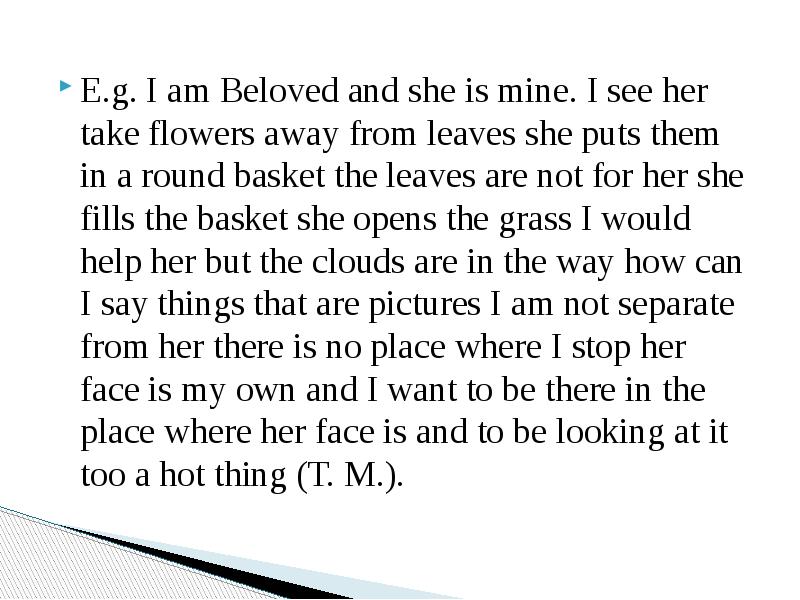
E.g. I am Beloved and she is mine. I see her take flowers away from leaves she puts them in a round basket the leaves are not for her she fills the basket she opens the grass I would help her but the clouds are in the way how can I say things that are pictures I am not separate from her there is no place where I stop her face is my own and I want to be there in the place where her face is and to be looking at it too a hot thing (Т. М.). E.g. I am Beloved and she is mine. I see her take flowers away from leaves she puts them in a round basket the leaves are not for her she fills the basket she opens the grass I would help her but the clouds are in the way how can I say things that are pictures I am not separate from her there is no place where I stop her face is my own and I want to be there in the place where her face is and to be looking at it too a hot thing (Т. М.).

Слайд 10


Graphical arrangement of phrases deals with peculiarities of their organization and division деление into paragraphs, chapters, etc. Graphical...
Описание слайда:
Graphical arrangement of phrases deals with peculiarities of their organization and division деление into paragraphs, chapters, etc. Graphical arrangement of phrases deals with peculiarities of their organization and division деление into paragraphs, chapters, etc. E.g. I will never leave you again Don't ever leave me again You will never leave me again You went in the water I drank your blood I brought your milk You forgot to smile I loved you You hurt me You came back to me You left me (T.M.).

Слайд 11


the violation of type – italics, bold type, capitalization the violation of type – italics, bold type, capitalization E.g. “GOD DAMN YOU!” Mr. Geddes...
Описание слайда:
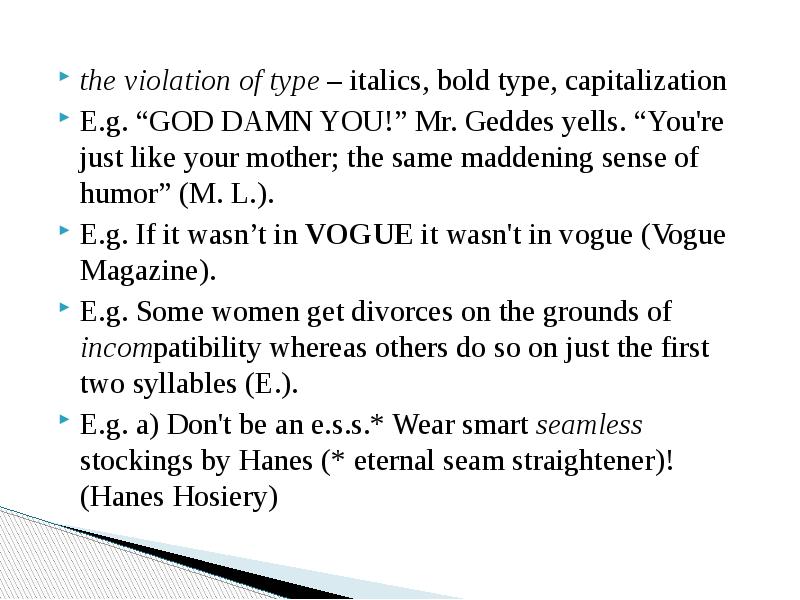
the violation of type – italics, bold type, capitalization the violation of type – italics, bold type, capitalization E.g. “GOD DAMN YOU!” Mr. Geddes yells. “You're just like your mother; the same maddening sense of humor” (M. L.). E.g. If it wasn’t in VOGUE it wasn't in vogue (Vogue Magazine). E.g. Some women get divorces on the grounds of incompatibility whereas others do so on just the first two syllables (E.). E.g. a) Don't be an e.s.s.* Wear smart seamless stockings by Hanes (* eternal seam straightener)! (Hanes Hosiery)

Слайд 12


"If we stay here, we will both die,” Victor says (M. L.). "If we stay here, we will both die,” Victor says (M. L.). E.g. It would have...
Описание слайда:
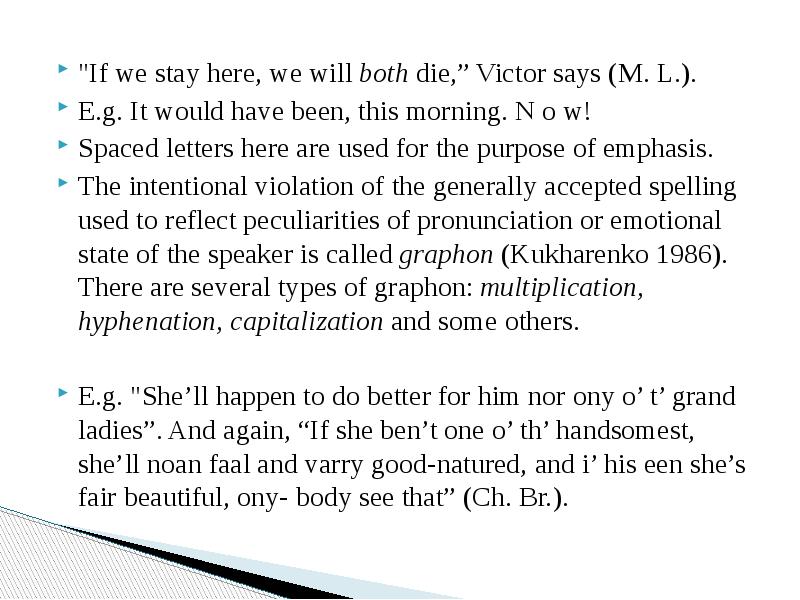
"If we stay here, we will both die,” Victor says (M. L.). "If we stay here, we will both die,” Victor says (M. L.). E.g. It would have been, this morning. N o w! Spaced letters here are used for the purpose of emphasis. The intentional violation of the generally accepted spelling used to reflect peculiarities of pronunciation or emotional state of the speaker is called graphon (Kukharenko 1986). There are several types of graphon: multiplication, hyphenation, capitalization and some others. E.g. "She’ll happen to do better for him nor ony o’ t’ grand ladies”. And again, “If she ben’t one o’ th’ handsomest, she’ll noan faal and varry good-natured, and i’ his een she’s fair beautiful, ony- body see that” (Ch. Br.).

Слайд 13


E.g. “How do you spell relief? R-O-L-A-l-D-S” (Rolaids Anta­cid Tablets). E.g. “How do you spell relief? R-O-L-A-l-D-S” (Rolaids Anta­cid Tablets)....
Описание слайда:
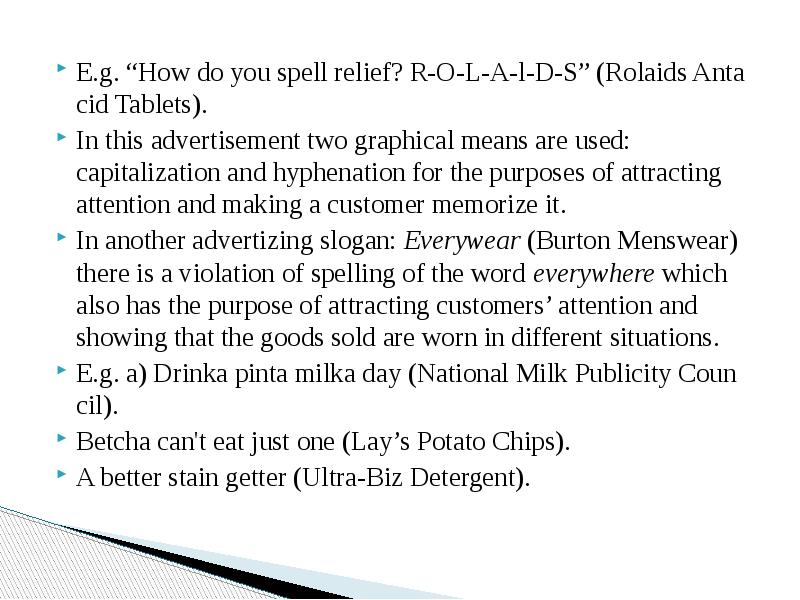
E.g. “How do you spell relief? R-O-L-A-l-D-S” (Rolaids Anta­cid Tablets). E.g. “How do you spell relief? R-O-L-A-l-D-S” (Rolaids Anta­cid Tablets). In this advertisement two graphical means are used: capitalization and hyphenation for the purposes of attracting attention and making a customer memorize it. In another advertizing slogan: Everywear (Burton Menswear) there is a violation of spelling of the word everywhere which also has the purpose of attracting customers’ attention and showing that the goods sold are worn in different situations. E.g. a) Drinka pinta milka day (National Milk Publicity Coun­cil). Betcha can't eat just one (Lay’s Potato Chips). A better stain getter (Ultra-Biz Detergent).

Слайд 14


Onomatopoeia (sound imitation)* is a combination of speech sounds which imitate sounds produced in nature (by wind, sea, thunder|, etc.: roar,...
Описание слайда:
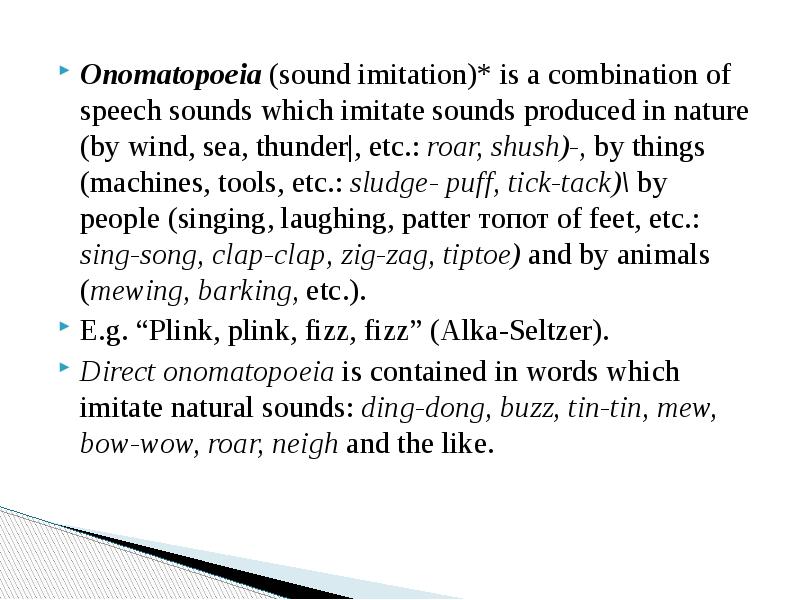
Onomatopoeia (sound imitation)* is a combination of speech sounds which imitate sounds produced in nature (by wind, sea, thunder|, etc.: roar, shush)-, by things (machines, tools, etc.: sludge- puff, tick-tack)\ by people (singing, laughing, patter топот of feet, etc.: sing-song, clap-clap, zig-zag, tiptoe) and by animals (mewing, bark­ing, etc.). Onomatopoeia (sound imitation)* is a combination of speech sounds which imitate sounds produced in nature (by wind, sea, thunder|, etc.: roar, shush)-, by things (machines, tools, etc.: sludge- puff, tick-tack)\ by people (singing, laughing, patter топот of feet, etc.: sing-song, clap-clap, zig-zag, tiptoe) and by animals (mewing, bark­ing, etc.). E.g. “Plink, plink, fizz, fizz” (Alka-Seltzer). Direct onomatopoeia is contained in words which imitate natural sounds: ding-dong, buzz, tin-tin, mew, bow-wow, roar, neigh and the like.

Слайд 15


alliteration - is the repetition of similar consonant sounds in close succession, particularly at the beginning of successive words. alliteration -...
Описание слайда:
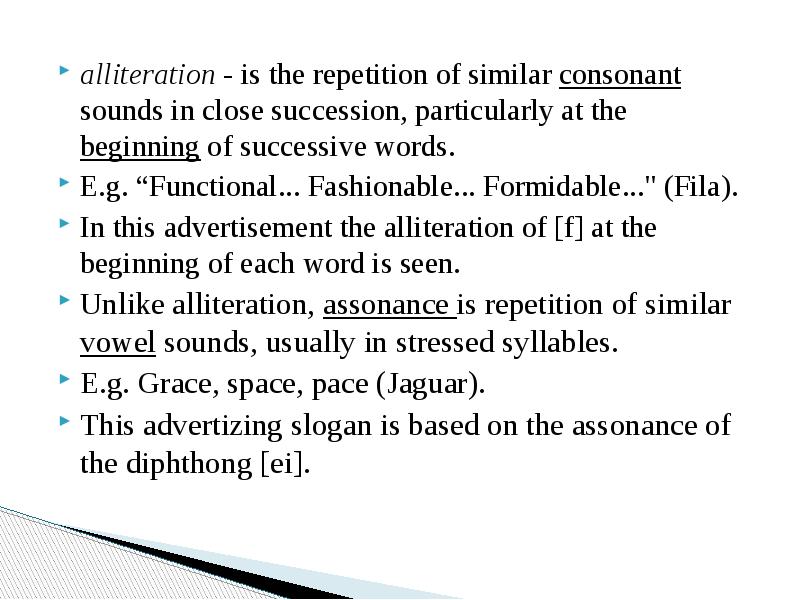
alliteration - is the repetition of similar consonant sounds in close succession, particularly at the beginning of successive words. alliteration - is the repetition of similar consonant sounds in close succession, particularly at the beginning of successive words. E.g. “Functional... Fashionable... Formidable..." (Fila). In this advertisement the alliteration of [f] at the beginning of each word is seen. Unlike alliteration, assonance is repetition of similar vowel sounds, usually in stressed syllables. E.g. Grace, space, pace (Jaguar). This advertizing slogan is based on the assonance of the diphthong [ei].

Слайд 16


Alliteration and assonance may produce the effect of euphony or cacophony. Alliteration and assonance may produce the effect of euphony or cacophony....
Описание слайда:
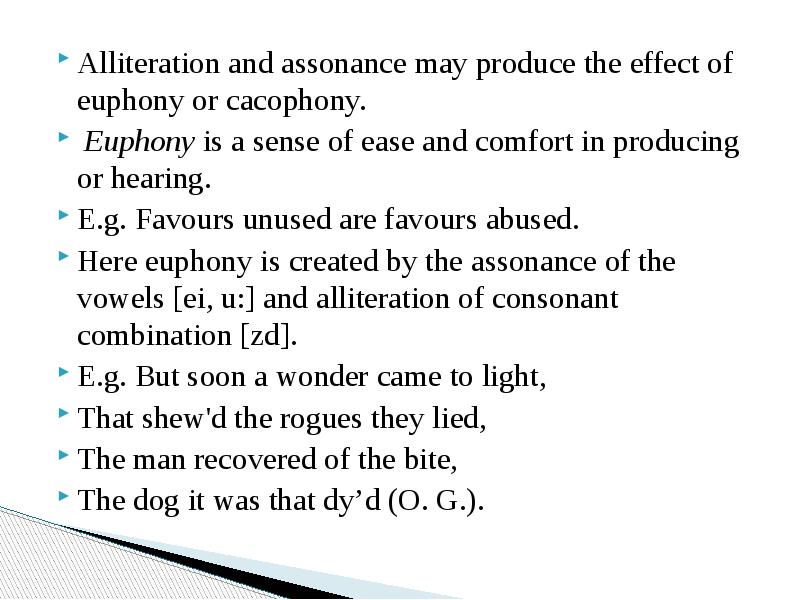
Alliteration and assonance may produce the effect of euphony or cacophony. Alliteration and assonance may produce the effect of euphony or cacophony. Euphony is a sense of ease and comfort in producing or hearing. E.g. Favours unused are favours abused. Here euphony is created by the assonance of the vowels [ei, u:] and alliteration of consonant combination [zd]. E.g. But soon a wonder came to light, That shew'd the rogues they lied, The man recovered of the bite, The dog it was that dy’d (O. G.).

Слайд 17


Cacophony is a sense of strain or discomfort in pronouncing or hearing: Cacophony is a sense of strain or discomfort in pronouncing or hearing: E.g....
Описание слайда:
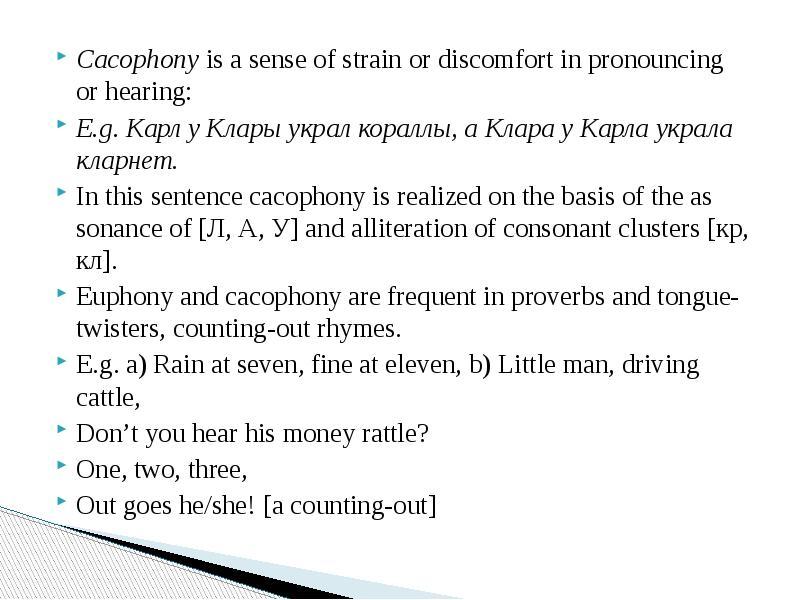
Cacophony is a sense of strain or discomfort in pronouncing or hearing: Cacophony is a sense of strain or discomfort in pronouncing or hearing: E.g. Карл у Клары украл кораллы, а Клара у Карла украла кларнет. In this sentence cacophony is realized on the basis of the as­sonance of [Л, А, У] and alliteration of consonant clusters [кр, кл]. Euphony and cacophony are frequent in proverbs and tongue-twisters, counting-out rhymes. E.g. a) Rain at seven, fine at eleven, b) Little man, driving cattle, Don’t you hear his money rattle? One, two, three, Out goes he/she! [a counting-out]

Слайд 18


Rhyme is the repetition of identical or similar terminal sounds or sound combinations in words. Rhyme is the repetition of identical or similar...
Описание слайда:
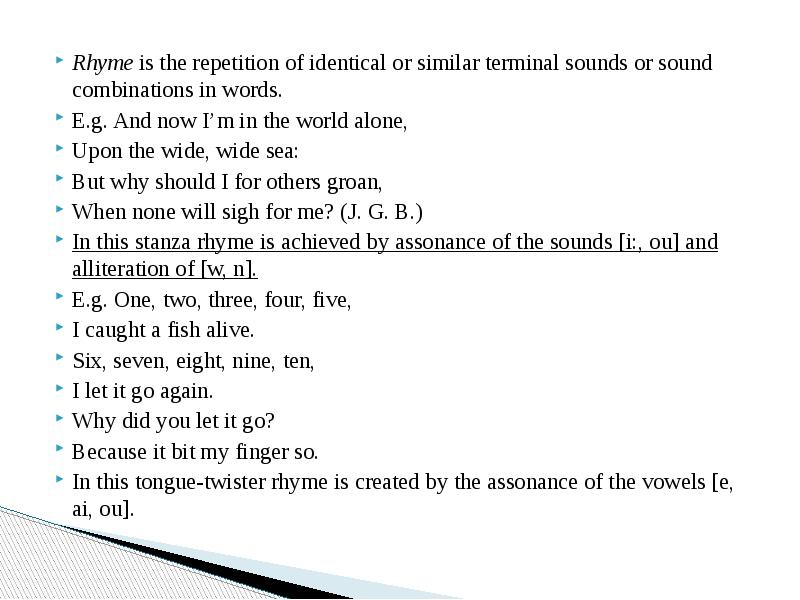
Rhyme is the repetition of identical or similar terminal sounds or sound combinations in words. Rhyme is the repetition of identical or similar terminal sounds or sound combinations in words. E.g. And now I’m in the world alone, Upon the wide, wide sea: But why should I for others groan, When none will sigh for me? (J. G. B.) In this stanza rhyme is achieved by assonance of the sounds [i:, ou] and alliteration of [w, n]. E.g. One, two, three, four, five, I caught a fish alive. Six, seven, eight, nine, ten, I let it go again. Why did you let it go? Because it bit my finger so. In this tongue-twister rhyme is created by the assonance of the vowels [e, ai, ou].

Слайд 19


Rhythm is a complex unit defined as a regular recurrence of stressed and unstressed syllables (strong and weak elements) which determine the metre in...
Описание слайда:
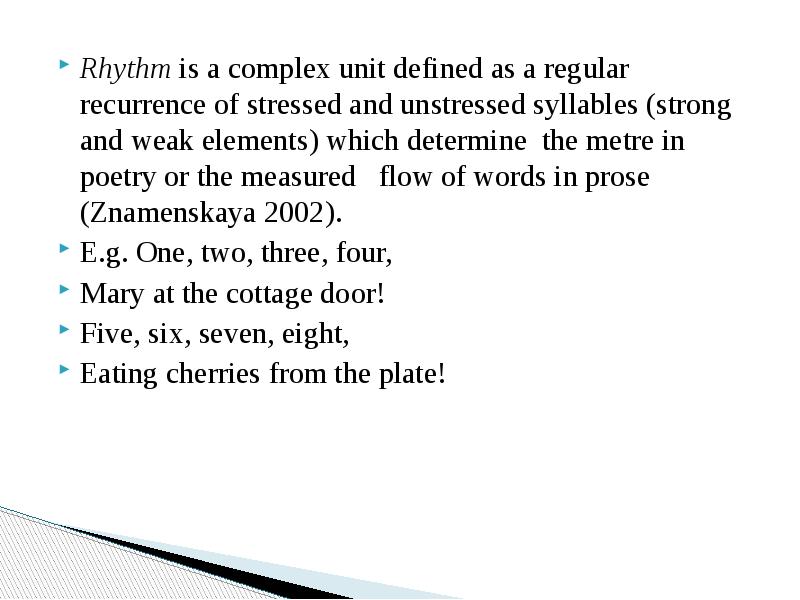
Rhythm is a complex unit defined as a regular recurrence of stressed and unstressed syllables (strong and weak elements) which determine the metre in poetry or the measured flow of words in prose (Znamenskaya 2002). Rhythm is a complex unit defined as a regular recurrence of stressed and unstressed syllables (strong and weak elements) which determine the metre in poetry or the measured flow of words in prose (Znamenskaya 2002). E.g. One, two, three, four, Mary at the cottage door! Five, six, seven, eight, Eating cherries from the plate!


Похожие презентации
Mypresentation.ru
Загрузить презентацию