🗊 Презентация War for Independence

Категория: Образование
Нажмите для полного просмотра!
War for Independence, слайд №1 War for Independence, слайд №2 War for Independence, слайд №3 War for Independence, слайд №4 War for Independence, слайд №5 War for Independence, слайд №6 War for Independence, слайд №7 War for Independence, слайд №8 War for Independence, слайд №9 War for Independence, слайд №10 War for Independence, слайд №11 War for Independence, слайд №12 War for Independence, слайд №13 War for Independence, слайд №14 War for Independence, слайд №15 War for Independence, слайд №16 War for Independence, слайд №17 War for Independence, слайд №18 War for Independence, слайд №19 War for Independence, слайд №20 War for Independence, слайд №21 War for Independence, слайд №22 War for Independence, слайд №23 War for Independence, слайд №24 War for Independence, слайд №25 War for Independence, слайд №26 War for Independence, слайд №27 War for Independence, слайд №28 War for Independence, слайд №29 War for Independence, слайд №30 War for Independence, слайд №31 War for Independence, слайд №32 War for Independence, слайд №33 War for Independence, слайд №34 War for Independence, слайд №35

Содержание
Вы можете ознакомиться и скачать презентацию на тему War for Independence. Доклад-сообщение содержит 35 слайдов. Презентации для любого класса можно скачать бесплатно. Если материал и наш сайт презентаций Mypresentation Вам понравились – поделитесь им с друзьями с помощью социальных кнопок и добавьте в закладки в своем браузере.

Слайды и текст этой презентации


Слайд 1


War for Independence and First Constitution 1800 - 1850s: Jacksonian Democracy; Social Movements, Manifest Destiny and Expansion
Описание слайда:

War for Independence and First Constitution 1800 - 1850s: Jacksonian Democracy; Social Movements, Manifest Destiny and Expansion

Слайд 2


King George III, and Debts assumed the throne in 1760 (he ruled until 1820). The ruling sentiment was that the colonies should be obliged to pay for...
Описание слайда:
King George III, and Debts assumed the throne in 1760 (he ruled until 1820). The ruling sentiment was that the colonies should be obliged to pay for their own expenses, rather than depending on the mother county (England). the Proclamation Act of 1763, forbidding colonists from settling west of Appalachians and forcing them to stop buying land from Indians. The logic behind the Proclamation Act - as long as the colonists stayed in the colonies and had nothing to do with Indians, there should be peace.

Слайд 3


Tension Grows Farmers needed land to grow valuable crops of tobacco, corn, rice, indigo, and wheat, but the Proclamation Act confined them to the...
Описание слайда:
Tension Grows Farmers needed land to grow valuable crops of tobacco, corn, rice, indigo, and wheat, but the Proclamation Act confined them to the land they already had in the colonies- was detrimental to their growth. The first true crisis began around 1763 when Parliament allocated money to maintain a standing army in the colonies. More than 1500 ships began to patrol American waters.

Слайд 4


9 major causes of the Revolutionary War, also called the "American Revolution": (1) Colonists were accustomed to much independence and...
Описание слайда:
9 major causes of the Revolutionary War, also called the "American Revolution": (1) Colonists were accustomed to much independence and self-determination, and British efforts (led by the Tory political party in England) to regulate and tax were bitterly opposed by the colonies (and by the Whig political party in England; the conservative Edmund Burke was a British politician who sided with the American colonists). (2) British burdens hurt nearly all the colonists in all walks of life. (3) Taxes hit at a bad time: postwar depression. (4) Legally, colonies disagreed with "virtual representation." (5) Religious reasons: many colonists disliked Anglicans (and Catholics), and feared England would install an Anglican bishop. (6) Colonists disliked English class distinctions. (7) 1/3 of colonists were not even English, and thus felt no attachment to the British. (8) Colonists accepted John Locke's philosophy of natural rights and a social contract, which conflicted with rule by a monarchy. (9) Colonists saw a bright prospect for their future.

Слайд 5


Violence Begins December 16, 1773 a group of colonists led by Samuel Adams disguised themselves as Indians; Result - the Coercive Acts or the...
Описание слайда:
Violence Begins December 16, 1773 a group of colonists led by Samuel Adams disguised themselves as Indians; Result - the Coercive Acts or the Intolerable Acts. These laws revoked Massachusetts' charter, closed Boston Harbor, installed a British general as governor, and repealed liberties like the right to hold town meetings. In Boston today, there is still no tax on tea as a tribute to the Boston Tea Party.

Слайд 6


The Revolutionary War First Continental Congress, in 1774. The colonies agreed to end all trade with Britain in a final effort to have her alter her...
Описание слайда:
The Revolutionary War First Continental Congress, in 1774. The colonies agreed to end all trade with Britain in a final effort to have her alter her policies. All of these plans were carried out. Parliament officially declared that Massachusetts was in rebellion. Patrick Henry “give me liberty or give me death!" On July 4, 1776, the Declaration of Independence was formally announced.

Слайд 7


The Turning Point At Saratoga in upstate New York in October 1777, 6,000 British soldiers surrendered; the French then ended its neutrality and...
Описание слайда:
The Turning Point At Saratoga in upstate New York in October 1777, 6,000 British soldiers surrendered; the French then ended its neutrality and entered on American side. Benjamin Franklin was instrumental in obtaining French backing for the American cause and forging the Franco-American Alliance in 1778 (+Franklin stove for heating, and starting the first library).

Слайд 8


The Outcome May 1781, Yorktown, Virginia. February 1783, the Treaty of Paris. In it the British gave up their claim to land east of the Mississippi,...
Описание слайда:
The Outcome May 1781, Yorktown, Virginia. February 1783, the Treaty of Paris. In it the British gave up their claim to land east of the Mississippi, from Canada to Florida. The Americans promised to treat fairly the Loyalists and English creditors.

Слайд 9


State Constitutions Soon after the end of the Revolution, all but two of the states adopted new constitutions. Rhode Island and Connecticut continued...
Описание слайда:
State Constitutions Soon after the end of the Revolution, all but two of the states adopted new constitutions. Rhode Island and Connecticut continued to use their charters, after removing all references to Britain. opposition to concentrating power in one person was reflected in the states' constitutions by concentrating power – where? Governers’ positions? state courts?

Слайд 10


The Articles of Confederation The Articles provided for a unicameral (one body) Congress to govern the states. There was no ___? Just to imagine! a...
Описание слайда:
The Articles of Confederation The Articles provided for a unicameral (one body) Congress to govern the states. There was no ___? Just to imagine! a very weak national government: why? The federal government under the Articles did not have enough power to operate effectively in its foreign policy . more than 35 million dollars in debt There were no national taxes, and requests for money from the states were ignored.

Слайд 11


The Land Ordinance and The Northwest Ordinance The Land Ordinance of 1785 provided for surveying and dividing territories west of the colonies into...
Описание слайда:
The Land Ordinance and The Northwest Ordinance The Land Ordinance of 1785 provided for surveying and dividing territories west of the colonies into towns 6 miles square, and selling 640 acre chunks at public auctions for a minimum of $1 per acre. The Northwest Ordinance established a way to create no less than three and no more than five new states. It established a three-stage process based on population for new states to be created and join the Confederation of colonies. It also specified what type of government the new territories and states must have, a requirement that would later become part of the U.S. Constitution.

Слайд 12


The Result The following new territories became new states due to the success of the Northwest Ordinance :Ohio (1803), Indiana (1816), Illinois...
Описание слайда:
The Result The following new territories became new states due to the success of the Northwest Ordinance :Ohio (1803), Indiana (1816), Illinois (1818), Michigan (1837), Wisconsin (1848), and Minnesota (1858).

Слайд 13


The Constitutional Convention summer of 1787 Key participants :James Madison, George Washington, Alexander Hamilton , Benjamin Franklin, George...
Описание слайда:
The Constitutional Convention summer of 1787 Key participants :James Madison, George Washington, Alexander Hamilton , Benjamin Franklin, George Washington the Connecticut Compromise: Congress would have one house with equal representation and one house with representation based on population. (part of the Constitution, and today Americans have both the House of Representatives and the Senate). The "Three-Fifths Compromise“ Sept. 17, 1787 – Constitution day

Слайд 14


George Washington's Presidency the Judiciary Act of 1789, which established federal court system. 1791 Hamilton was successful in persuading Congress...
Описание слайда:
George Washington's Presidency the Judiciary Act of 1789, which established federal court system. 1791 Hamilton was successful in persuading Congress to establish the First Bank of the United States "Washington's Neutrality Proclamation," "Executive Privilege" of President The Bill of Rights passed in 1791 to limit the federal government an unwritten tradition of a maximum of two terms for presidents +Eli Whitney invented the cotton gin = ‘King Cotton’

Слайд 15


The Presidency of John Adams served from 1797-1801 The Alien & Sedition Acts – blatantly unconstitutional "lame duck" action: case of...
Описание слайда:
The Presidency of John Adams served from 1797-1801 The Alien & Sedition Acts – blatantly unconstitutional "lame duck" action: case of Marbury v. Madison (1803), where the Supreme Court held in Jefferson's favor by declaring a federal law to be unconstitutional: the first time the new Supreme Court declared an Act of Congress to be unconstitutional and thus void.

Слайд 16


The formation of political parties Tariffs + North/South friction The Federalist Party - a strong national government, friendly dealings with...
Описание слайда:
The formation of political parties Tariffs + North/South friction The Federalist Party - a strong national government, friendly dealings with England, a liberal interpretation of the Constitution (known as "loose constructionism), Democratic-Republican Party - the opposite: a weak national government (keeping the power at a local level, which Virginia preferred), friendly dealings with France, and a strict interpretation of the Constitution ("strict constructionism"). "Revolution of 1800," victory by Jefferson and Burr against Adams was a victory for limited government and a "strict constructionist"

Слайд 17


Jefferson Administration Monroe : $11.25 million to France for all of the property (which translates to only a few pennies per acre), not merely West...
Описание слайда:
Jefferson Administration Monroe : $11.25 million to France for all of the property (which translates to only a few pennies per acre), not merely West Florida and New Orleans. This enormous tract of land was as large as the entire United States at the time. In 1812, Louisiana because the first state admitted to the United States from this new territory. Only one additional state joined the United States during Jefferson's presidency: Ohio, in 1803. Jefferson is credited with eliminating unnecessary taxes such as the whiskey tax and decreasing the size of the federal government.

Слайд 18


The War of 1812 England invaded D.C. itself and burned down the Capitol and the White House Francis Scott Key - the Star-Spangled Banner; In 1931,...
Описание слайда:
The War of 1812 England invaded D.C. itself and burned down the Capitol and the White House Francis Scott Key - the Star-Spangled Banner; In 1931, over 100 years later, it became the official National Anthem. Treaty of Ghent (negotiated by the Czar of Russia!) arranged for the long, open Canadian-U.S. border that remains to this day

Слайд 19


The Conservative President: James Monroe In 1820, the successful "Missouri Compromise" : 11 free states and 11 slave states So the Missouri...
Описание слайда:
The Conservative President: James Monroe In 1820, the successful "Missouri Compromise" : 11 free states and 11 slave states So the Missouri Compromise added Maine as a free state (which would side with the North), and Missouri as a slave state (which would side with the South until the Civil War, when it refused to join the southern Confederacy). The other new states to be added from the Louisiana Purchase (once they had enough population) would be free: slavery was banned by this Compromise above the latitude of 36 degrees, 30 minutes. The most lasting contribution of James Monroe - "Monroe Doctrine" in 1823 – Which? Works to this day.

Слайд 20


Jacksonian Democracy 1828 was a triumph of democracy the "spoils system," the "Indian Removal." the powerful tools of the modern...
Описание слайда:
Jacksonian Democracy 1828 was a triumph of democracy the "spoils system," the "Indian Removal." the powerful tools of the modern presidency: vetoing bills of Congress to prevent them from becoming law (Jackson vetoed more bills than all the presidents before him combined), removing people from office when the President disagreed with them, and using executive orders as President to give his views the power of law. “the president was not merely a member of the government's symphony: he was its conductor”

Слайд 21


Slavery 1800-1840 the South feared being outvoted by the North in the Senate if the States abolishing slavery outnumbered the States using it....
Описание слайда:
Slavery 1800-1840 the South feared being outvoted by the North in the Senate if the States abolishing slavery outnumbered the States using it. Slavery became caught up in politics In 1831, Nat Turner led slave revolt in Virginia, and 57 whites died; William Lloyd Garrison, a fiery Puritan abolitionist in Massachusetts, started the "Liberator" newspaper to demand an end to slavery. 1833 - the American Antislavery Society Congress instituted a "gag rule" from 1836 to 1844 to prohibit its members from circulating proposals concerning slavery, especially abolitionism

Слайд 22


Other Developments 1800-1850 Counting California, which joined the Union in 1850, five new states were added to the United States: Florida, Texas,...
Описание слайда:
Other Developments 1800-1850 Counting California, which joined the Union in 1850, five new states were added to the United States: Florida, Texas, Iowa, Wisconsin and California. This included the two largest states in area in the continental United States (California and Texas), and what are now three of the four largest in population (California, Texas and Florida). This was the greatest addition of new states since the 1810s. The nation as we know it today was taking shape.

Слайд 23


"Manifest Destiny" exploration and expansion was a mission from God on the Oregon Trail. 1843- the Oregon territory, and 1000 pioneers...
Описание слайда:
"Manifest Destiny" exploration and expansion was a mission from God on the Oregon Trail. 1843- the Oregon territory, and 1000 pioneers traveled all the way from Missouri to Willamette Valley (a trip that took 4 to 6 months then). From 1811 to 1818, the first national road was built In 1836, Texas fought and won its independence from Mexico the "gold rush" - in 1848 , hit a fever pitch in 1849, attracting many to California (the football team the "San Francisco 49ers" is named after those settlers)

Слайд 24


Social Change Utopian communities in the 1840s (and earlier) the Shakers, Brook Farm, the Rappites, the Oneida Community ; David Thoreau! the Church...
Описание слайда:
Social Change Utopian communities in the 1840s (and earlier) the Shakers, Brook Farm, the Rappites, the Oneida Community ; David Thoreau! the Church of Jesus Christ of Latter Day Saints (the Mormon Church), the only major church founded in America, was established in 1830 by Joseph Smith in western New York. The Seventh Day Adventist Church began 1844 -developed an approach to good health that included building hospitals

Слайд 25


Women's rights Began as a social movement in 1848 in Seneca Falls, New York: a Declaration of Sentiments that called for granting women the right to...
Описание слайда:
Women's rights Began as a social movement in 1848 in Seneca Falls, New York: a Declaration of Sentiments that called for granting women the right to vote In 1849, the English-born Elizabeth Blackwell became the first woman to receive a medical degree in America, which she obtained from Geneva College in New York.

Слайд 26


Other Milepost Events In 1842, the union workers' movement; it became legal for workers to organize a union and to strike. The unionization of...
Описание слайда:
Other Milepost Events In 1842, the union workers' movement; it became legal for workers to organize a union and to strike. The unionization of government workers recently became a national controversy ("prohibition", or the "temperance movement") began in 1826 and lasted until the 18th Amendment passed in 1919 to ban alcohol nationwide (it was later repealed by the 21st Amendment during the Great Depression); public school education. Horace Mann - the first state school board.

Слайд 27


James K. Polk and War with Mexico instigated, fought and won the Mexican War (also called the Mexican-American War) (ended in 1848 with the Treaty of...
Описание слайда:
James K. Polk and War with Mexico instigated, fought and won the Mexican War (also called the Mexican-American War) (ended in 1848 with the Treaty of Guadalupe-Hidalgo) annexed Texas (1845) settled a dispute with British (Canada) by establishing the northwest boundary in Oregon Treaty (1846) reduced tariffs reestablished an independent treasury (bank) admitted Iowa as a free state in 1846 (under the Missouri Compromise), with Iowa having the highest percentage of farmland of any State set off the gold rush by announcing there was gold in California (1849)

Слайд 28


Treaty of Guadalupe-Hidalgo the Texas-Mexico border would be set at the Rio Grande River Mexico would grant to the United States about 525,000 square...
Описание слайда:
Treaty of Guadalupe-Hidalgo the Texas-Mexico border would be set at the Rio Grande River Mexico would grant to the United States about 525,000 square miles (55% of its prewar territory) the United States would pay Mexico $15 million the United States government would pay off up to $3.25 million worth of debts owed by Mexico to U.S. citizens, relieving Mexico of those obligations

Слайд 29


Kansas-Nebraska Act Ill-advised law to be the greatest single step towards Civil War each new region could decide for itself whether to allow...
Описание слайда:
Kansas-Nebraska Act Ill-advised law to be the greatest single step towards Civil War each new region could decide for itself whether to allow slavery. anti-slavery activists founded the Republican Party in 1854 on the moral grounds of ending slavery : stop the expansion of slavery repeal the Kansas-Nebraska Act repeal the Fugitive Slave Law end slavery in D.C.

Слайд 30


"Bleeding Kansas" Civil war in Kansas; In early 1856, pro-slavery forces burned down the "Free State Hotel" and destroyed the...
Описание слайда:
"Bleeding Kansas" Civil war in Kansas; In early 1856, pro-slavery forces burned down the "Free State Hotel" and destroyed the offices and presses of antislavery newspapers. A man was killed. John Brown - the Pottawatomie Massacre.

Слайд 31


The Debate Over Slavery Stephen Douglas and Abraham Lincoln The Dred Scott ruling The South: tremendous economy, had strategic advantages: it...
Описание слайда:
The Debate Over Slavery Stephen Douglas and Abraham Lincoln The Dred Scott ruling The South: tremendous economy, had strategic advantages: it controlled the mouth of the Mississippi and had better generals. The North benefited from the railroad system, heavy immigration and a much more balanced economy. The population of the North was 22 million compared with only 9 million in the South, 3.5 million of whom were slaves; control of the United States Navy; was politically successful in keeping border slave states -- Delaware, Kentucky, Maryland, Missouri and the to-be-formed West Virginia -- from joining the Confederacy to fight against the North.

Слайд 32


War for Independence, слайд №32
Описание слайда:

Слайд 33


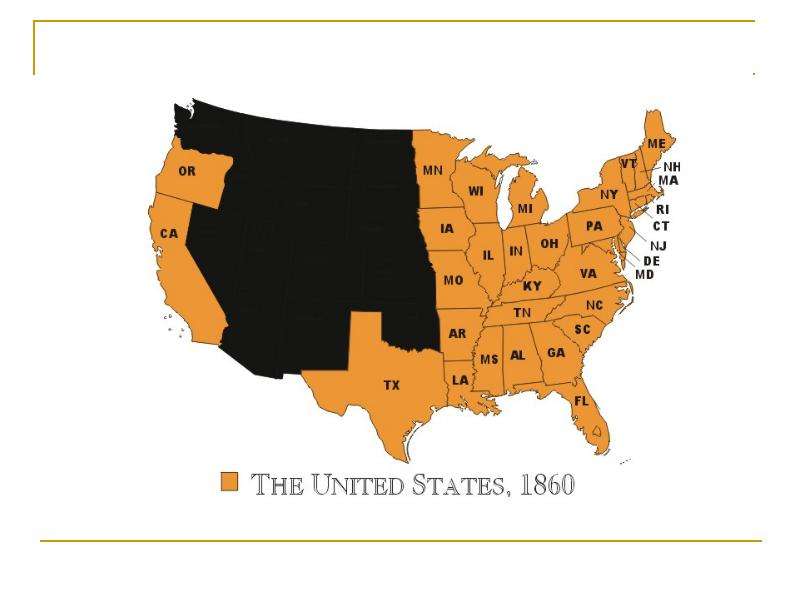
Secession In 1860, the South threatened to secede (break away) from the United States if the Republican Abraham Lincoln were elected president. By...
Описание слайда:
Secession In 1860, the South threatened to secede (break away) from the United States if the Republican Abraham Lincoln were elected president. By the end of January 1861, six other southern states imitated South Carolina and declared their independence from the United States. They were Mississippi, Florida, Alabama, Georgia, Louisiana and Texas. "We are divorced, North and South, because we have hated each other so."

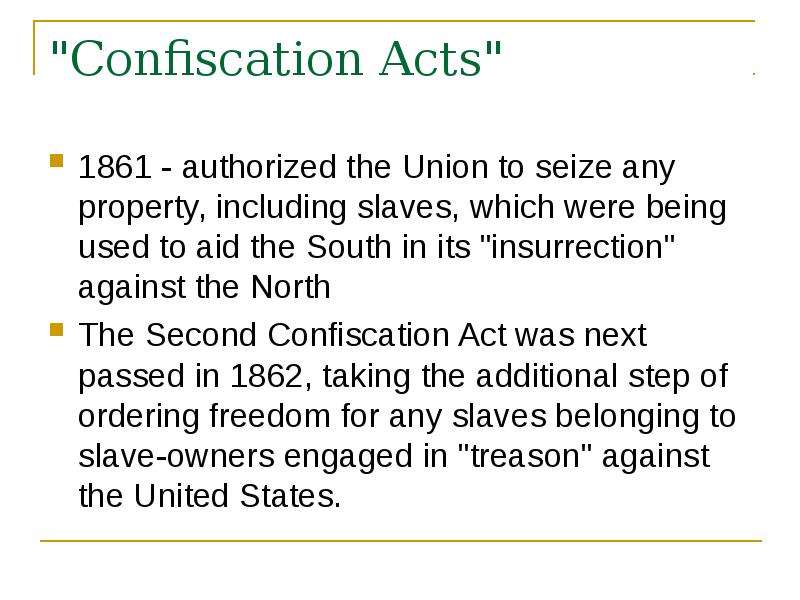
Слайд 34


"Confiscation Acts" 1861 - authorized the Union to seize any property, including slaves, which were being used to aid the South in its...
Описание слайда:
"Confiscation Acts" 1861 - authorized the Union to seize any property, including slaves, which were being used to aid the South in its "insurrection" against the North The Second Confiscation Act was next passed in 1862, taking the additional step of ordering freedom for any slaves belonging to slave-owners engaged in "treason" against the United States.

Слайд 35


Thank you for your Attention!
Описание слайда:
Thank you for your Attention!


Теги Independence
Похожие презентации
Mypresentation.ru
Загрузить презентацию