🗊 Презентация Создание и управление потоками


Нажмите для полного просмотра!
Создание и управление потоками, слайд №1 Создание и управление потоками, слайд №2 Создание и управление потоками, слайд №3 Создание и управление потоками, слайд №4 Создание и управление потоками, слайд №5 Создание и управление потоками, слайд №6 Создание и управление потоками, слайд №7 Создание и управление потоками, слайд №8 Создание и управление потоками, слайд №9 Создание и управление потоками, слайд №10 Создание и управление потоками, слайд №11 Создание и управление потоками, слайд №12 Создание и управление потоками, слайд №13 Создание и управление потоками, слайд №14 Создание и управление потоками, слайд №15 Создание и управление потоками, слайд №16

Вы можете ознакомиться и скачать презентацию на тему Создание и управление потоками. Доклад-сообщение содержит 16 слайдов. Презентации для любого класса можно скачать бесплатно. Если материал и наш сайт презентаций Mypresentation Вам понравились – поделитесь им с друзьями с помощью социальных кнопок и добавьте в закладки в своем браузере.

Слайды и текст этой презентации


Слайд 1


Создание и управление потоками java.lang.Thread
Описание слайда:
Создание и управление потоками java.lang.Thread

Слайд 2


Плюсы и минусы многопотокового программирования
Описание слайда:
Плюсы и минусы многопотокового программирования

Слайд 3


The Thread Class static Thread currentThread( ) Returns a reference to a Thread object that represents the invoking thread. long getID( ) Returns a...
Описание слайда:
The Thread Class static Thread currentThread( ) Returns a reference to a Thread object that represents the invoking thread. long getID( ) Returns a thread’s ID. final String getName( ) Obtains a thread’s name. final int getPriority( ) Obtains a thread’s priority. Thread.State getState( ) Returns the current state of the thread. static boolean holdsLock(Object о) Returns true if the invoking thread holds the lock on obj. void interrupt( ) Interrupts a thread. static boolean interrupted( ) Returns true if the invoking thread has been interrupted. final boolean isAlive( ) Determines whether a thread is still running. final boolean isDaemon( ) Returns true if the invoking thread is a daemon thread. boolean isInterrupted( ) Returns true if the thread on which it is called has been interrupted. final void join( ) Waits for a thread to terminate. void run( ) Entry point for the thread. final void setDaemon(boolean how) If how is true, the invoking thread is set to daemon status. final void setName(String thrdName) Sets a thread’s name to thrdName. final void setPriority(int level) Sets a thread’s priority to level. static void sleep(long milliseconds) Suspends a thread for a specified period of milliseconds. void start( ) Starts a thread by calling its run( ) method. static void yield( ) Yields the CPU to another thread.

Слайд 4


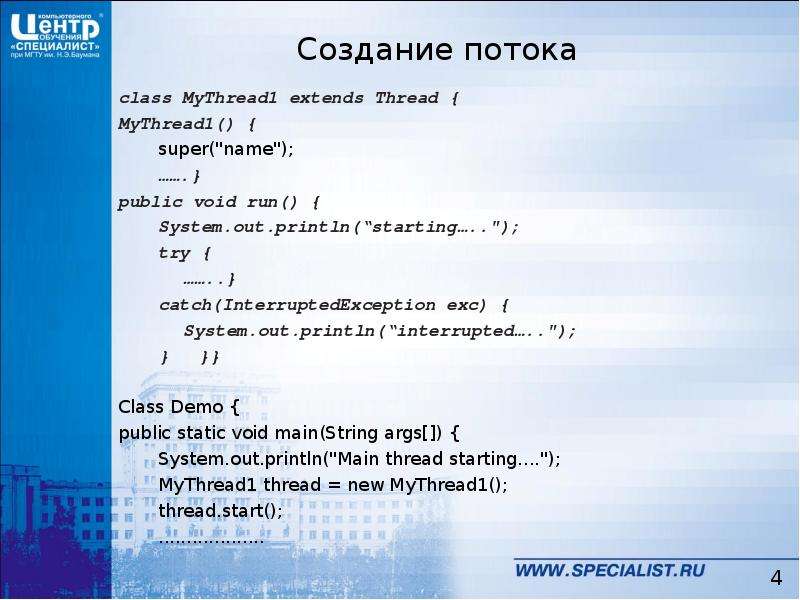
Создание потока class MyThread1 extends Thread { MyThread1() { super("name"); …….} public void run() {...
Описание слайда:
Создание потока class MyThread1 extends Thread { MyThread1() { super("name"); …….} public void run() { System.out.println(“starting….."); try { ……..} catch(InterruptedException exc) { System.out.println(“interrupted….."); } }} Class Demo { public static void main(String args[]) { System.out.println("Main thread starting...."); MyThread1 thread = new MyThread1(); thread.start(); ...................

Слайд 5


Создание потока (второй способ) class MyThread2 implements Runnable { MyThread2() { // new Thread(this, “name”) . start(); …….} public void run() {...
Описание слайда:
Создание потока (второй способ) class MyThread2 implements Runnable { MyThread2() { // new Thread(this, “name”) . start(); …….} public void run() { System.out.println(“starting….."); try { ……..} catch(InterruptedException exc) { System.out.println(“interrupted….."); } }} Class Demo { public static void main(String args[]) { System.out.println("Main thread starting....."); Thread thread= new Thread(new MyThread2()); thread.start(); ...........

Слайд 6


Анонимный класс new Thread() { public void run() { System.out.println(“starting….."); try { ……..} catch(InterruptedException exc) {...
Описание слайда:
Анонимный класс new Thread() { public void run() { System.out.println(“starting….."); try { ……..} catch(InterruptedException exc) { System.out.println(“interrupted….."); } } }.start(); // доступ только к полям “final”

Слайд 7


Ожидание завершения потока Class Demo { public static void main(String args[]) { System.out.println("Main thread starting....."); Thread...
Описание слайда:
Ожидание завершения потока Class Demo { public static void main(String args[]) { System.out.println("Main thread starting....."); Thread thread= new Thread(new MyThread2()); thread.start(); ........... try { thread.join(); // ждём – нет загрузки CPU // thread.join(1000); // while(thread.isAlive()) { ..... } // загружаем CPU работой } catch(InterruptedException ex) { System.out.println(“main interrupted....."); } смотреть Demo1

Слайд 8


Завершение потока return Daemon thread Thread thread= new Thread(new MyThread2()); thread.setDaemon(true); thread.start(); .....................
Описание слайда:
Завершение потока return Daemon thread Thread thread= new Thread(new MyThread2()); thread.setDaemon(true); thread.start(); .................. suspend( ), resume( ), stop() - deprecated interrupt( )

Слайд 9


Interrupt a Thread Пример 1. создать класс «MyThread» реализ. инт. Runnable переопределить метод - run() в этом методе : получить имя потока...
Описание слайда:
Interrupt a Thread Пример 1. создать класс «MyThread» реализ. инт. Runnable переопределить метод - run() в этом методе : получить имя потока реализовать цикл с продолжительной работой на каждой итерации проверять состояние потока если поток прерван, то завершить цикл создать класс “Demo” реализовать метод “main”

Слайд 10


Наблюдение за состоянием потока getState() BLOCKED - The thread is blocked, which means that it is waiting for access to a synchronized code. NEW -...
Описание слайда:
Наблюдение за состоянием потока getState() BLOCKED - The thread is blocked, which means that it is waiting for access to a synchronized code. NEW - The thread has been created, but its start( ) method has not yet been called. RUNNABLE - The thread is either currently executing or will execute as soon as it gets access to the CPU. TERMINATED - The thread has ended. A thread ends when its run( ) method returns, or when the thread is stopped via a call to stop( ). (Note that stop( ) is deprecated and should not be used.) TIMED_WAITING - The thread is suspended, waiting on another thread for a specific period of time. This can occur because of a call to the timeout versions of sleep( ), wait( ), or join( ), for example. WAITING - The thread is suspended, waiting on another thread. This can occur because of a call to the non-timeout versions of wait( ) or join( ), for example.

Слайд 11


Локальная память потока private static ThreadLocal threadLocal = new ThreadLocal() { protected Integer initialValue() { return new Integer(0); } };...
Описание слайда:
Локальная память потока private static ThreadLocal threadLocal = new ThreadLocal() { protected Integer initialValue() { return new Integer(0); } }; смотреть Demo2

Слайд 12


Синхронизация потоков synchronized type method(arg-list){ // synchronized method body } synchronized(objref) { // synchronized statements } - делать...
Описание слайда:
Синхронизация потоков synchronized type method(arg-list){ // synchronized method body } synchronized(objref) { // synchronized statements } - делать пример 2

Слайд 13


Взаимодействие потоков class Test { boolean ready = false; synchronized void waitFor() { try { while(!ready) wait(); } catch(InterruptedException...
Описание слайда:
Взаимодействие потоков class Test { boolean ready = false; synchronized void waitFor() { try { while(!ready) wait(); } catch(InterruptedException exc) { System.out.println("Interrupted….."); } } synchronized void goNow() { ready = true; notify(); } } смотреть Demo3

Слайд 14


Группы потоков MyThread a = new MyThread(); MyThread b= new MyThread(); ThreadGroup gr = new ThreadGroup(“name"); Thread t1= new Thread(gr, a,...
Описание слайда:
Группы потоков MyThread a = new MyThread(); MyThread b= new MyThread(); ThreadGroup gr = new ThreadGroup(“name"); Thread t1= new Thread(gr, a, “Thread #1"); Thread t2= new Thread(gr, b, “Thread #2"); t1.start(); t2.start(); Thread threads[] = new Thread[gr.activeCount()]; gr.enumerate(threads); for(Thread t : threads) System.out.println(t.getName()); gr.interrupt();

Слайд 15


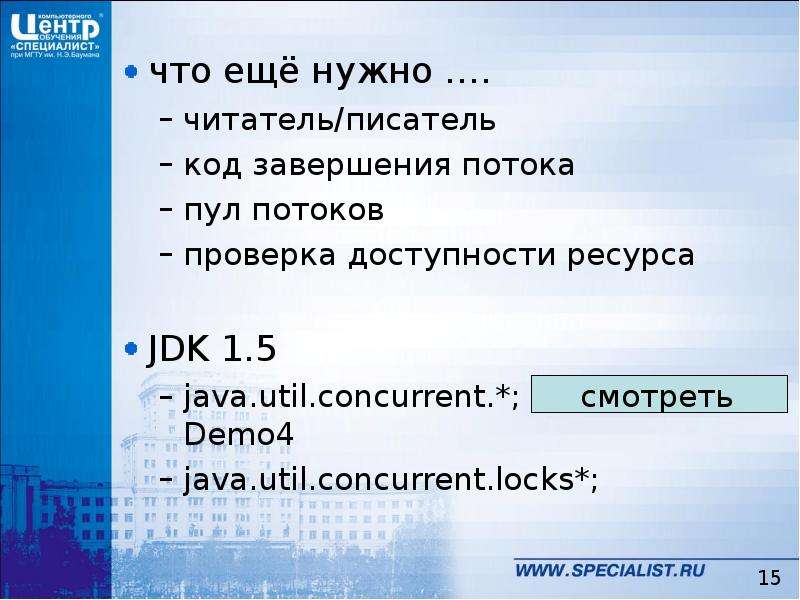
что ещё нужно …. что ещё нужно …. читатель/писатель код завершения потока пул потоков проверка доступности ресурса JDK 1.5 java.util.concurrent.*;...
Описание слайда:
что ещё нужно …. что ещё нужно …. читатель/писатель код завершения потока пул потоков проверка доступности ресурса JDK 1.5 java.util.concurrent.*; смотреть Demo4 java.util.concurrent.locks*;

Слайд 16


делать пример 3 делать пример 3 ReadWriteLock lock = new ReentrantReadWriteLock(); Lock rl = lock.readLock(); Lock wl = lock.writeLock(); rl.lock();...
Описание слайда:
делать пример 3 делать пример 3 ReadWriteLock lock = new ReentrantReadWriteLock(); Lock rl = lock.readLock(); Lock wl = lock.writeLock(); rl.lock(); ............. rl.unlock(); if (rl.tryLock()) { ............. rl.unlock(); } if (rl.tryLock(5, TimeUnit.SECONDS)) { ............. rl.unlock(); }


Похожие презентации
Mypresentation.ru
Загрузить презентацию