🗊 Презентация Alkali metals

Категория: Химия
Нажмите для полного просмотра!
Alkali metals, слайд №1 Alkali metals, слайд №2 Alkali metals, слайд №3 Alkali metals, слайд №4 Alkali metals, слайд №5 Alkali metals, слайд №6 Alkali metals, слайд №7 Alkali metals, слайд №8 Alkali metals, слайд №9 Alkali metals, слайд №10 Alkali metals, слайд №11 Alkali metals, слайд №12 Alkali metals, слайд №13

Вы можете ознакомиться и скачать презентацию на тему Alkali metals. Доклад-сообщение содержит 13 слайдов. Презентации для любого класса можно скачать бесплатно. Если материал и наш сайт презентаций Mypresentation Вам понравились – поделитесь им с друзьями с помощью социальных кнопок и добавьте в закладки в своем браузере.

Слайды и текст этой презентации


Слайд 1


Alkali metals, слайд №1
Описание слайда:
Слайд 2


Alkali metals, слайд №2
Описание слайда:
Слайд 3


Alkali metals, слайд №3
Описание слайда:
Слайд 4


Alkali metals, слайд №4
Описание слайда:

Слайд 5


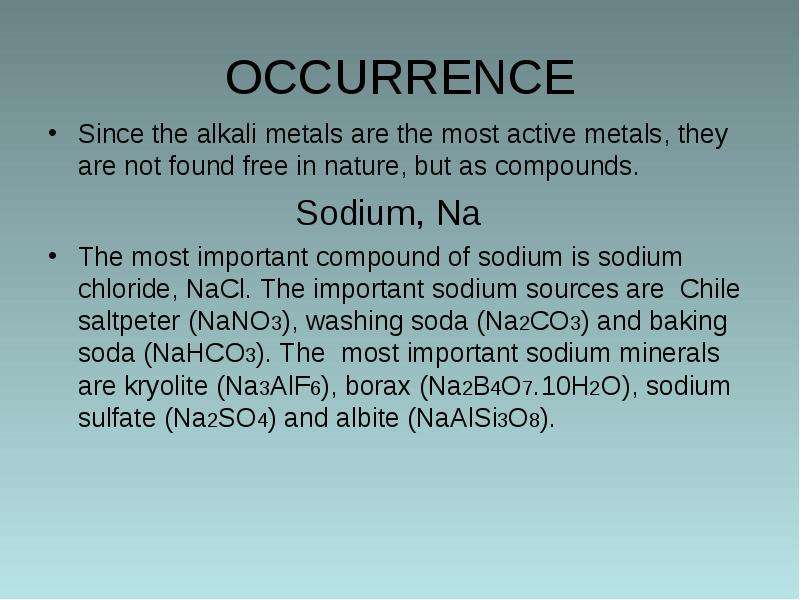
OCCURRENCE Since the alkali metals are the most active metals, they are not found free in nature, but as compounds. Sodium, Na The most important...
Описание слайда:
OCCURRENCE Since the alkali metals are the most active metals, they are not found free in nature, but as compounds. Sodium, Na The most important compound of sodium is sodium chloride, NaCl. The important sodium sources are Chile saltpeter (NaNO3), washing soda (Na2CO3) and baking soda (NaHCO3). The most important sodium minerals are kryolite (Na3AlF6), borax (Na2B4O7.10H2O), sodium sulfate (Na2SO4) and albite (NaAlSi3O8).

Слайд 6


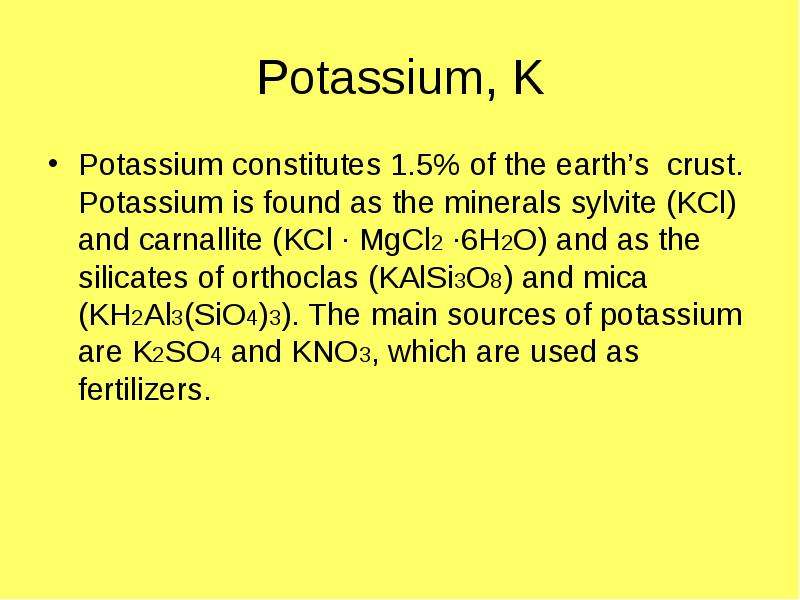
Potassium, K Potassium constitutes 1.5% of the earth’s crust. Potassium is found as the minerals sylvite (KCl) and carnallite (KCl · MgCl2 ·6H2O) and...
Описание слайда:
Potassium, K Potassium constitutes 1.5% of the earth’s crust. Potassium is found as the minerals sylvite (KCl) and carnallite (KCl · MgCl2 ·6H2O) and as the silicates of orthoclas (KAlSi3O8) and mica (KH2Al3(SiO4)3). The main sources of potassium are K2SO4 and KNO3, which are used as fertilizers.

Слайд 7


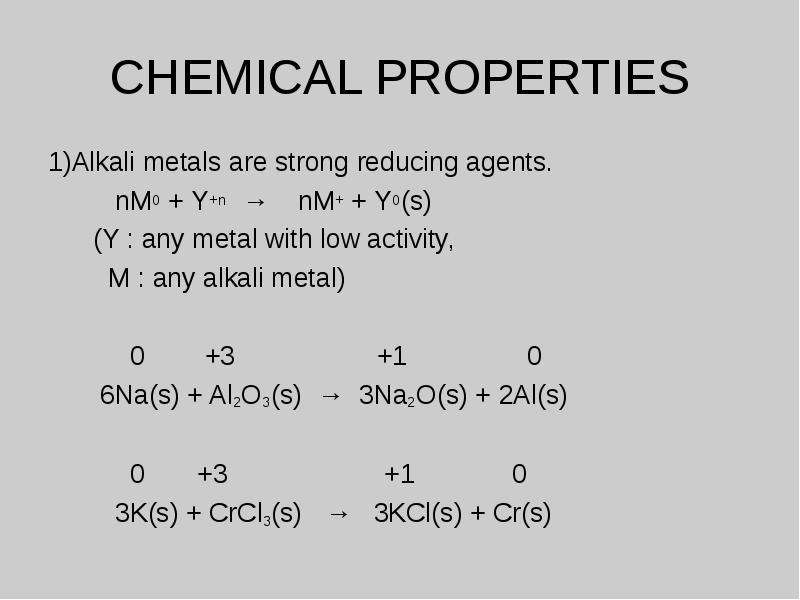
CHEMICAL PROPERTIES 1)Alkali metals are strong reducing agents. nM0 + Y+n → nM+ + Y0(s) (Y : any metal with low activity, M : any alkali metal) 0 +3...
Описание слайда:
CHEMICAL PROPERTIES 1)Alkali metals are strong reducing agents. nM0 + Y+n → nM+ + Y0(s) (Y : any metal with low activity, M : any alkali metal) 0 +3 +1 0 6Na(s) + Al2O3(s) → 3Na2O(s) + 2Al(s) 0 +3 +1 0 3K(s) + CrCl3(s) → 3KCl(s) + Cr(s)

Слайд 8


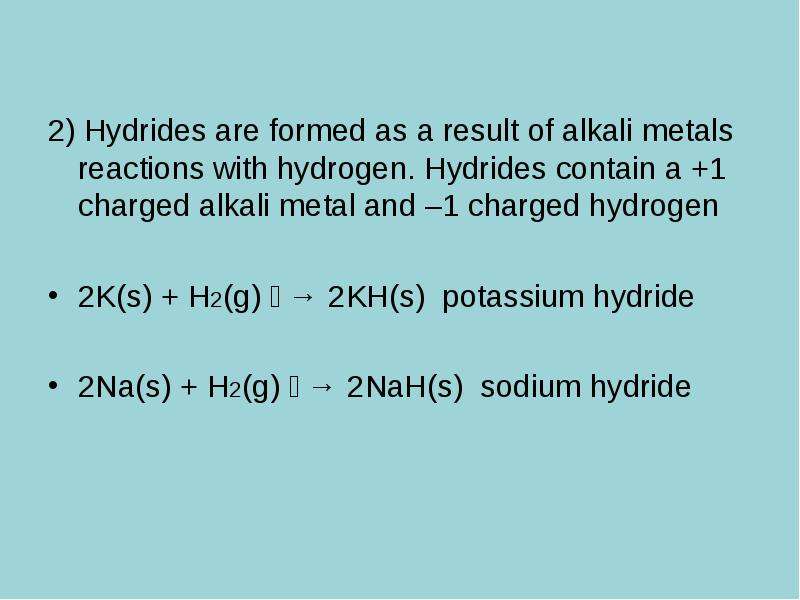
2) Hydrides are formed as a result of alkali metals reactions with hydrogen. Hydrides contain a +1 charged alkali metal and –1 charged hydrogen 2)...
Описание слайда:
2) Hydrides are formed as a result of alkali metals reactions with hydrogen. Hydrides contain a +1 charged alkali metal and –1 charged hydrogen 2) Hydrides are formed as a result of alkali metals reactions with hydrogen. Hydrides contain a +1 charged alkali metal and –1 charged hydrogen 2K(s) + H2(g) ⎯→ 2KH(s) potassium hydride 2Na(s) + H2(g) ⎯→ 2NaH(s) sodium hydride

Слайд 9


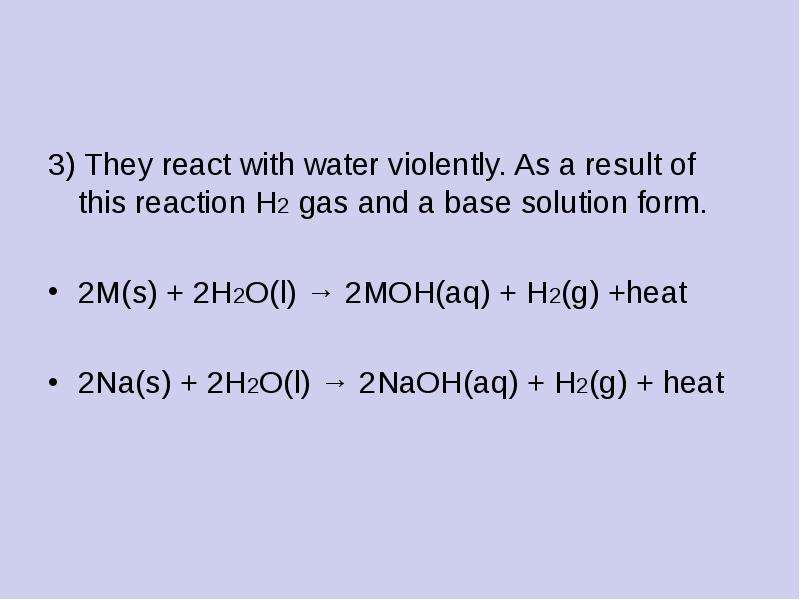
3) They react with water violently. As a result of this reaction H2 gas and a base solution form. 2M(s) + 2H2O(l) → 2MOH(aq) + H2(g) +heat 2Na(s) +...
Описание слайда:
3) They react with water violently. As a result of this reaction H2 gas and a base solution form. 2M(s) + 2H2O(l) → 2MOH(aq) + H2(g) +heat 2Na(s) + 2H2O(l) → 2NaOH(aq) + H2(g) + heat

Слайд 10


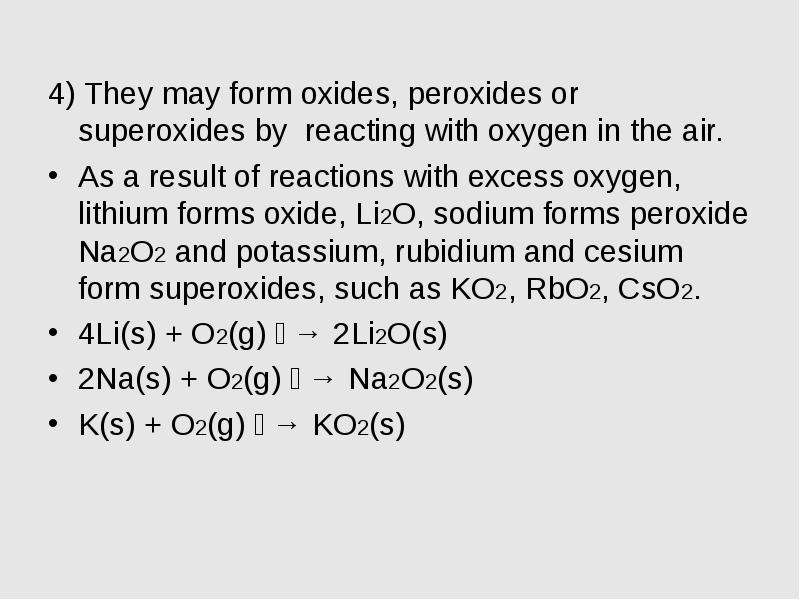
4) They may form oxides, peroxides or superoxides by reacting with oxygen in the air. 4) They may form oxides, peroxides or superoxides by reacting...
Описание слайда:
4) They may form oxides, peroxides or superoxides by reacting with oxygen in the air. 4) They may form oxides, peroxides or superoxides by reacting with oxygen in the air. As a result of reactions with excess oxygen, lithium forms oxide, Li2O, sodium forms peroxide Na2O2 and potassium, rubidium and cesium form superoxides, such as KO2, RbO2, CsO2. 4Li(s) + O2(g) ⎯→ 2Li2O(s) 2Na(s) + O2(g) ⎯→ Na2O2(s) K(s) + O2(g) ⎯→ KO2(s)

Слайд 11


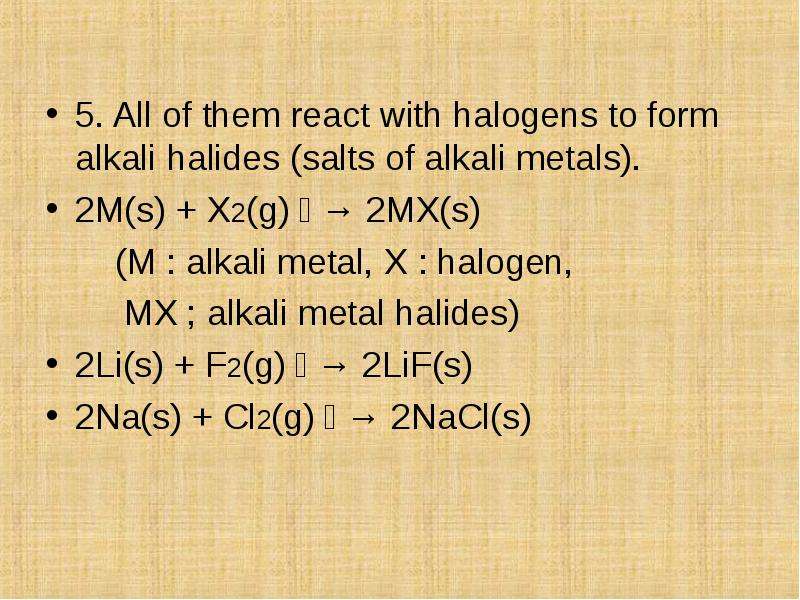
5. All of them react with halogens to form alkali halides (salts of alkali metals). 5. All of them react with halogens to form alkali halides (salts...
Описание слайда:
5. All of them react with halogens to form alkali halides (salts of alkali metals). 5. All of them react with halogens to form alkali halides (salts of alkali metals). 2M(s) + X2(g) ⎯→ 2MX(s) (M : alkali metal, X : halogen, MX ; alkali metal halides) 2Li(s) + F2(g) ⎯→ 2LiF(s) 2Na(s) + Cl2(g) ⎯→ 2NaCl(s)

Слайд 12


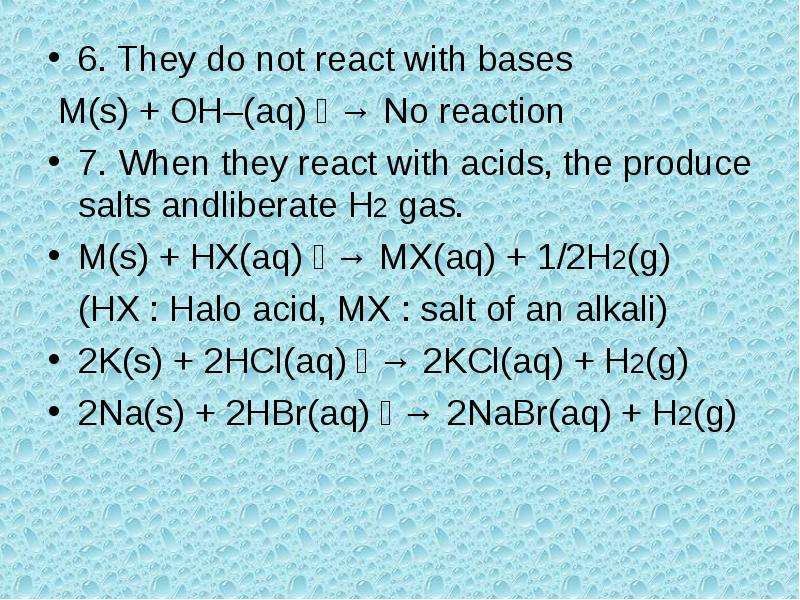
6. They do not react with bases 6. They do not react with bases M(s) + OH–(aq) ⎯→ No reaction 7. When they react with acids, the produce salts...
Описание слайда:
6. They do not react with bases 6. They do not react with bases M(s) + OH–(aq) ⎯→ No reaction 7. When they react with acids, the produce salts andliberate H2 gas. M(s) + HX(aq) ⎯→ MX(aq) + 1/2H2(g) (HX : Halo acid, MX : salt of an alkali) 2K(s) + 2HCl(aq) ⎯→ 2KCl(aq) + H2(g) 2Na(s) + 2HBr(aq) ⎯→ 2NaBr(aq) + H2(g)

Слайд 13


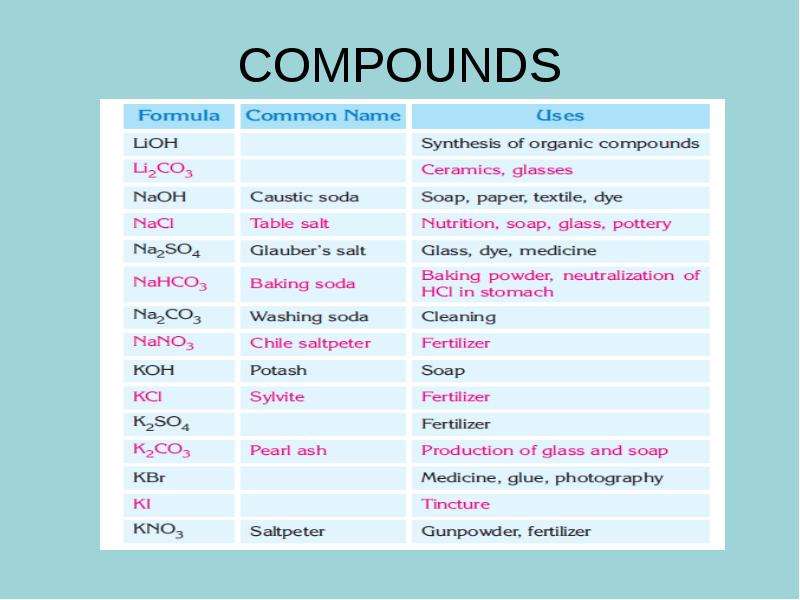
COMPOUNDS
Описание слайда:
COMPOUNDS


Теги Alkali metals
Похожие презентации
Mypresentation.ru
Загрузить презентацию