🗊 Презентация General properties Transition Metals

Категория: Химия
Нажмите для полного просмотра!
General properties Transition Metals, слайд №1 General properties Transition Metals, слайд №2 General properties Transition Metals, слайд №3 General properties Transition Metals, слайд №4 General properties Transition Metals, слайд №5 General properties Transition Metals, слайд №6 General properties Transition Metals, слайд №7 General properties Transition Metals, слайд №8 General properties Transition Metals, слайд №9 General properties Transition Metals, слайд №10 General properties Transition Metals, слайд №11 General properties Transition Metals, слайд №12 General properties Transition Metals, слайд №13 General properties Transition Metals, слайд №14 General properties Transition Metals, слайд №15 General properties Transition Metals, слайд №16 General properties Transition Metals, слайд №17

Вы можете ознакомиться и скачать презентацию на тему General properties Transition Metals. Доклад-сообщение содержит 17 слайдов. Презентации для любого класса можно скачать бесплатно. Если материал и наш сайт презентаций Mypresentation Вам понравились – поделитесь им с друзьями с помощью социальных кнопок и добавьте в закладки в своем браузере.

Слайды и текст этой презентации


Слайд 1


General properties Transition Metals The transition metals lie between groups 2A and 3A of the periodic table. They are malleable and ductile They...
Описание слайда:
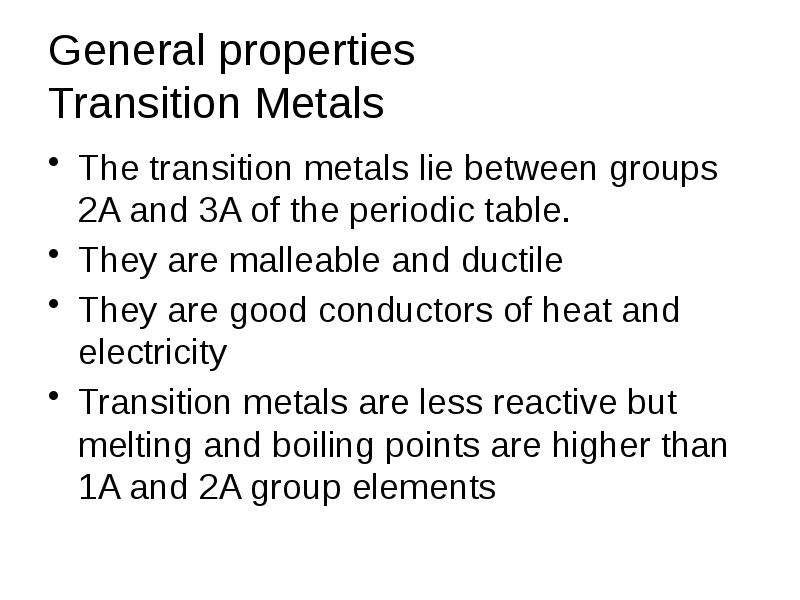
General properties Transition Metals The transition metals lie between groups 2A and 3A of the periodic table. They are malleable and ductile They are good conductors of heat and electricity Transition metals are less reactive but melting and boiling points are higher than 1A and 2A group elements

Слайд 2


I R O N Its density is 7.87 g/cm3 Melting point is 1538 oC Boiling point is 2861 oC Pure iron is a silvery white colored, lustrous, soft metal with...
Описание слайда:
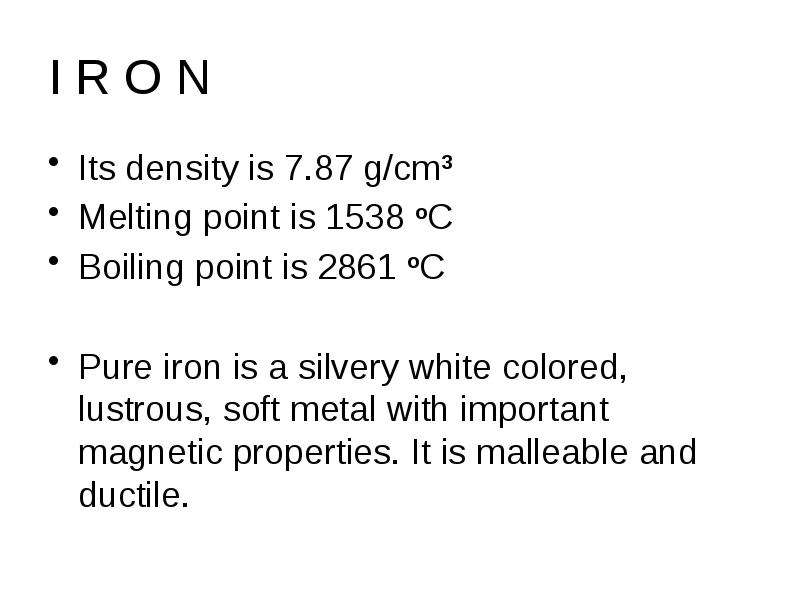
I R O N Its density is 7.87 g/cm3 Melting point is 1538 oC Boiling point is 2861 oC Pure iron is a silvery white colored, lustrous, soft metal with important magnetic properties. It is malleable and ductile.

Слайд 3


Occurrence of iron Iron is second most abundant metal (6%) in the earth’s crust. But it is not found in elemental form in nature. Iron is found in...
Описание слайда:
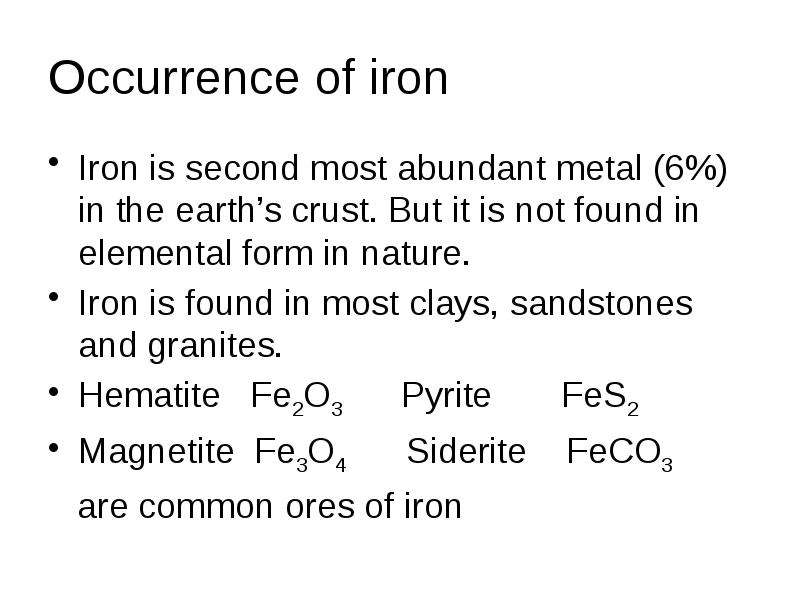
Occurrence of iron Iron is second most abundant metal (6%) in the earth’s crust. But it is not found in elemental form in nature. Iron is found in most clays, sandstones and granites. Hematite Fe2O3 Pyrite FeS2 Magnetite Fe3O4 Siderite FeCO3 are common ores of iron

Слайд 4


Preparation of Iron In the laboratory 1. H2 gas is added to iron oxide Fe2O3 + 3H2 2Fe + 3H2O 2. Iron oxides are reduced by more active metals 3FeO +...
Описание слайда:
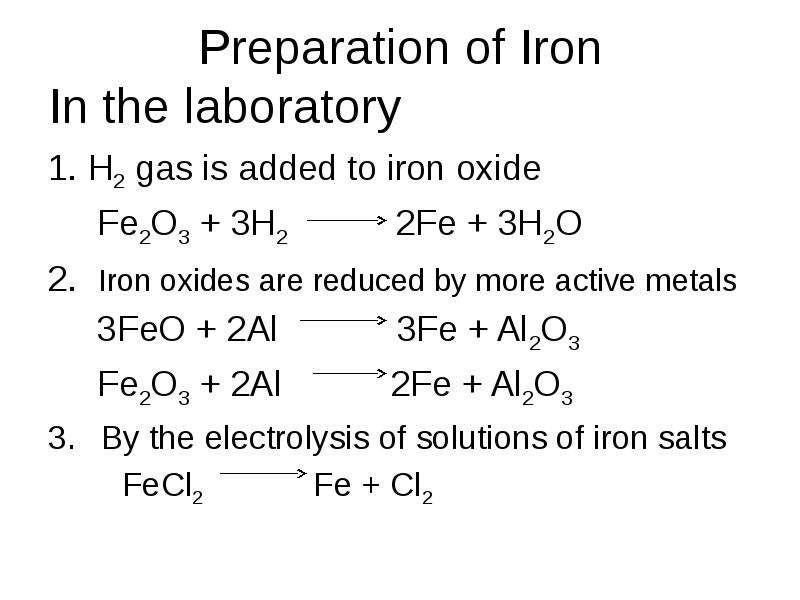
Preparation of Iron In the laboratory 1. H2 gas is added to iron oxide Fe2O3 + 3H2 2Fe + 3H2O 2. Iron oxides are reduced by more active metals 3FeO + 2Al 3Fe + Al2O3 Fe2O3 + 2Al 2Fe + Al2O3 By the electrolysis of solutions of iron salts FeCl2 Fe + Cl2

Слайд 5


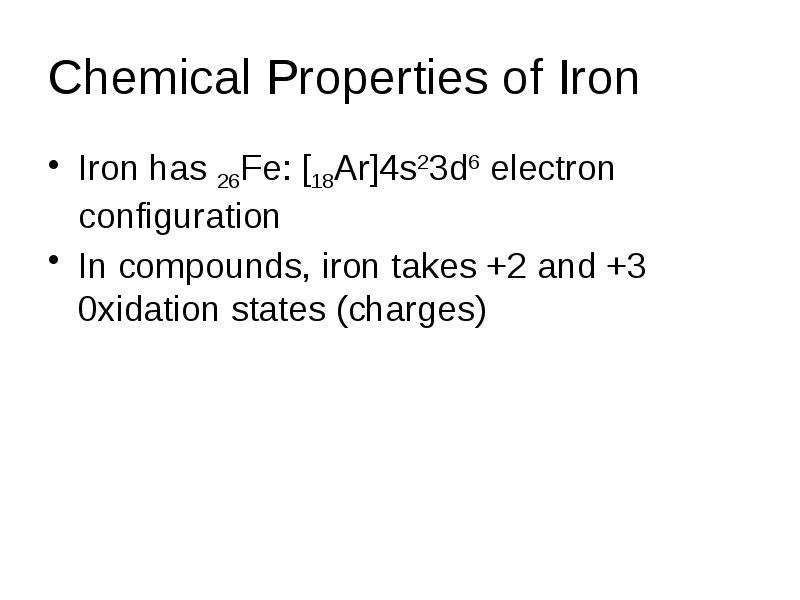
Chemical Properties of Iron Iron has 26Fe: [18Ar]4s23d6 electron configuration In compounds, iron takes +2 and +3 0xidation states (charges)
Описание слайда:
Chemical Properties of Iron Iron has 26Fe: [18Ar]4s23d6 electron configuration In compounds, iron takes +2 and +3 0xidation states (charges)

Слайд 6


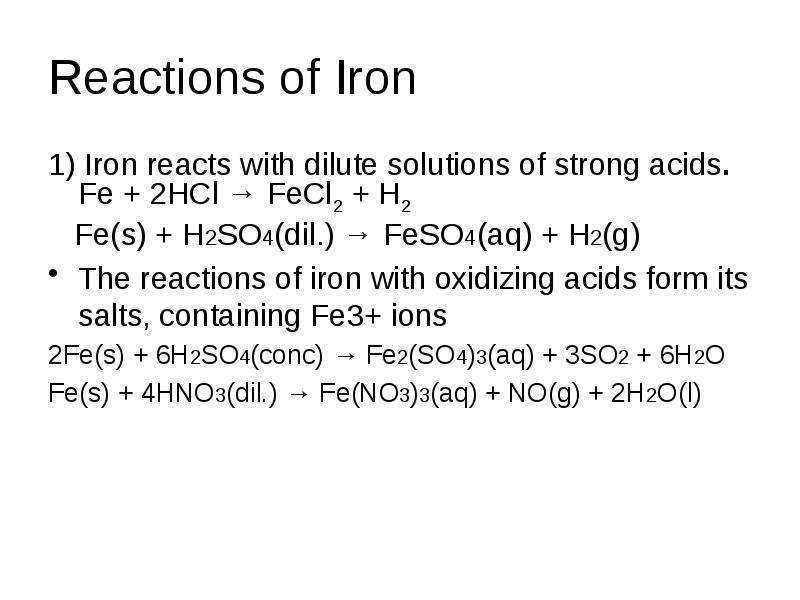
Reactions of Iron 1) Iron reacts with dilute solutions of strong acids. Fe + 2HCl → FeCl2 + H2 Fe(s) + H2SO4(dil.) → FeSO4(aq) + H2(g) The reactions...
Описание слайда:
Reactions of Iron 1) Iron reacts with dilute solutions of strong acids. Fe + 2HCl → FeCl2 + H2 Fe(s) + H2SO4(dil.) → FeSO4(aq) + H2(g) The reactions of iron with oxidizing acids form its salts, containing Fe3+ ions 2Fe(s) + 6H2SO4(conc) → Fe2(SO4)3(aq) + 3SO2 + 6H2O Fe(s) + 4HNO3(dil.) → Fe(NO3)3(aq) + NO(g) + 2H2O(l)

Слайд 7


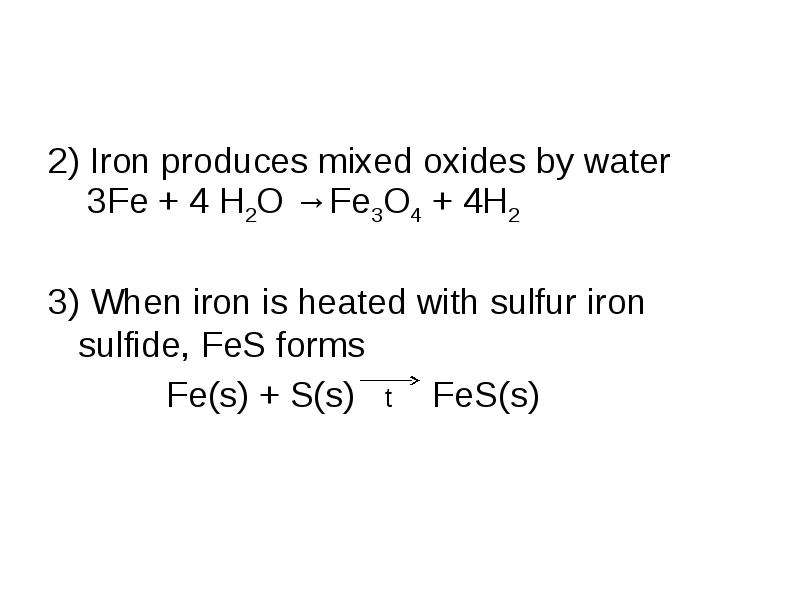
2) Iron produces mixed oxides by water 2) Iron produces mixed oxides by water 3Fe + 4 H2O →Fe3O4 + 4H2 3) When iron is heated with sulfur iron...
Описание слайда:
2) Iron produces mixed oxides by water 2) Iron produces mixed oxides by water 3Fe + 4 H2O →Fe3O4 + 4H2 3) When iron is heated with sulfur iron sulfide, FeS forms Fe(s) + S(s) t FeS(s)

Слайд 8


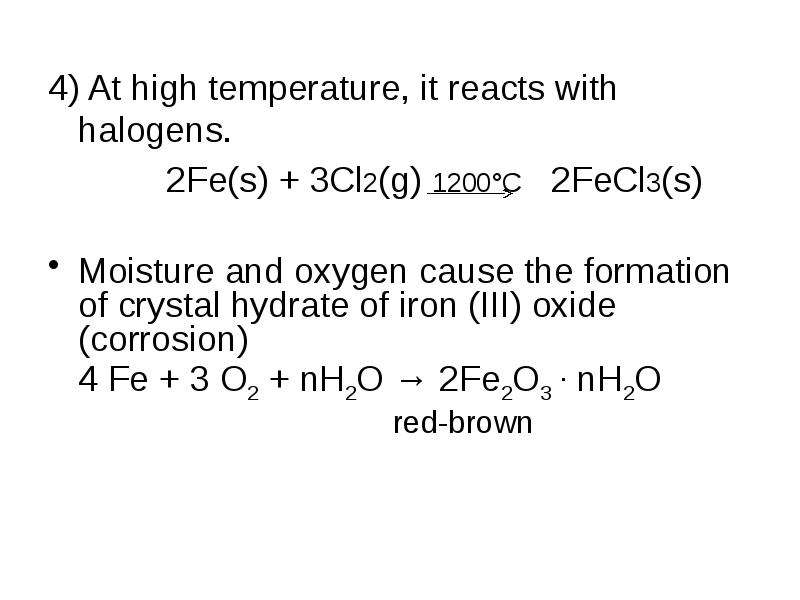
4) At high temperature, it reacts with halogens. 4) At high temperature, it reacts with halogens. 2Fe(s) + 3Cl2(g) 1200°C 2FeCl3(s) Moisture and...
Описание слайда:
4) At high temperature, it reacts with halogens. 4) At high temperature, it reacts with halogens. 2Fe(s) + 3Cl2(g) 1200°C 2FeCl3(s) Moisture and oxygen cause the formation of crystal hydrate of iron (III) oxide (corrosion) 4 Fe + 3 O2 + nH2O → 2Fe2O3 . nH2O red-brown

Слайд 9


Uses Iron is useful in our society today because iron is virtually used in everything : building ( bridge , highway , rail road ,etc.),...
Описание слайда:
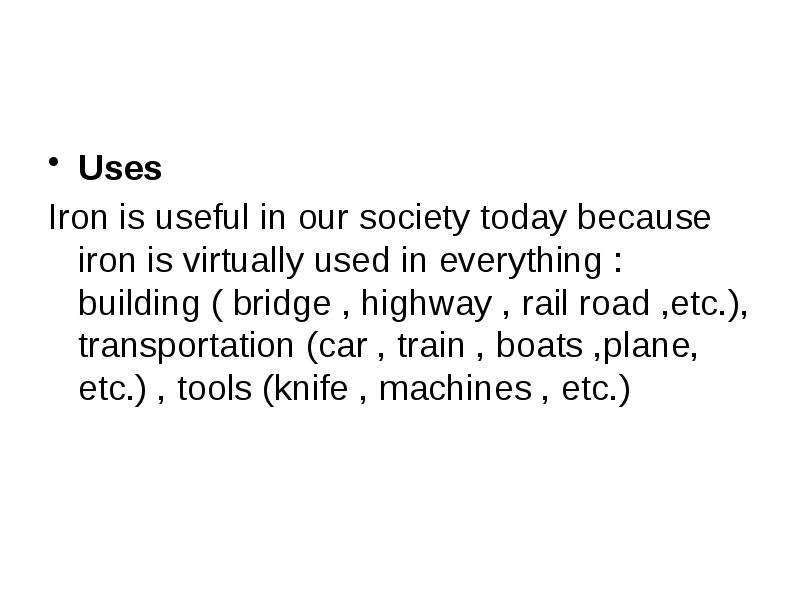
Uses Iron is useful in our society today because iron is virtually used in everything : building ( bridge , highway , rail road ,etc.), transportation (car , train , boats ,plane, etc.) , tools (knife , machines , etc.)

Слайд 10


IMPORTANT COMPOUNDS OF IRON Iron has +2 and +3 oxidation states in its compounds. Fe2+ ion is called ferrous and compounds that contain Fe2+ ion are...
Описание слайда:
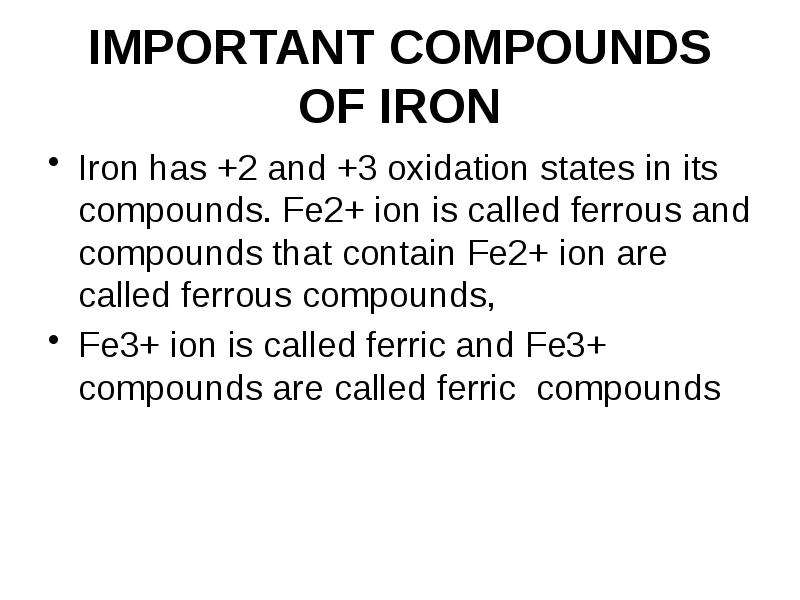
IMPORTANT COMPOUNDS OF IRON Iron has +2 and +3 oxidation states in its compounds. Fe2+ ion is called ferrous and compounds that contain Fe2+ ion are called ferrous compounds, Fe3+ ion is called ferric and Fe3+ compounds are called ferric compounds

Слайд 11


Iron (II) compounds (Ferro Compounds) 1. Iron (II) chloride, FeCl2 It is obtained by passing hydrogen chloride gas over heated iron. FeCl2 is a white...
Описание слайда:
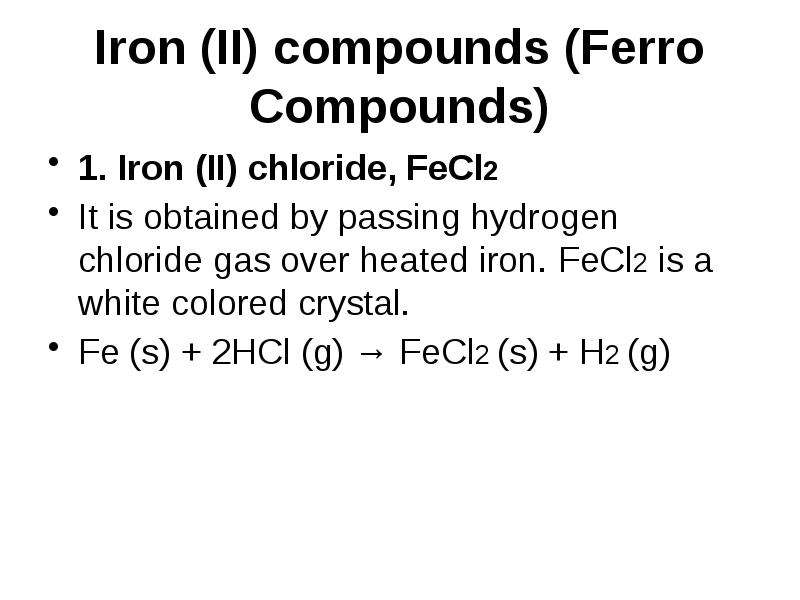
Iron (II) compounds (Ferro Compounds) 1. Iron (II) chloride, FeCl2 It is obtained by passing hydrogen chloride gas over heated iron. FeCl2 is a white colored crystal. Fe (s) + 2HCl (g) → FeCl2 (s) + H2 (g)

Слайд 12


2. Iron (II) oxide, FeO This compound is produced by decomposition of iron (II) oxalate. FeC2O4 (s) heat FeO (s) + CO (g) + CO2(g) FeO is also...
Описание слайда:
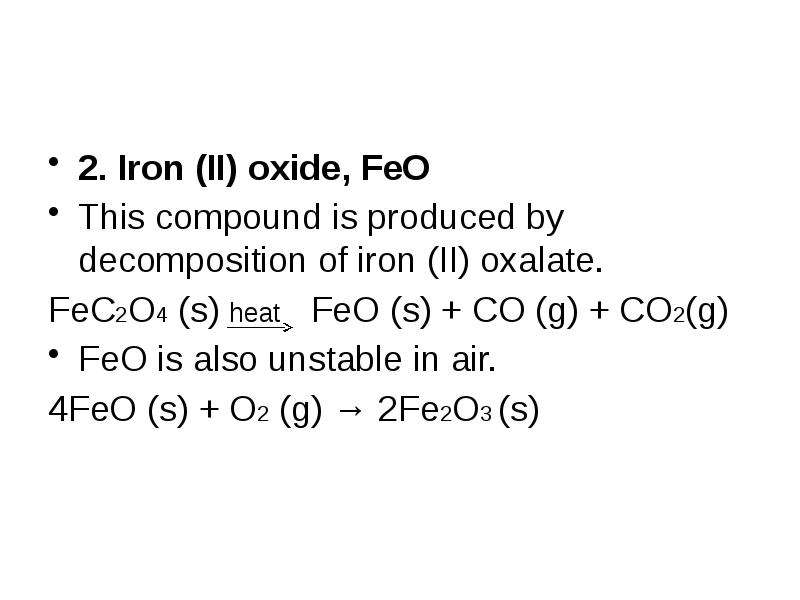
2. Iron (II) oxide, FeO This compound is produced by decomposition of iron (II) oxalate. FeC2O4 (s) heat FeO (s) + CO (g) + CO2(g) FeO is also unstable in air. 4FeO (s) + O2 (g) → 2Fe2O3 (s)

Слайд 13


Iron (III) Compounds (Ferric Compounds) 1. Iron(III) chloride, FeCl3 When iron is reacted with chlorine gas, it produces iron(III) chloride. 2Fe(s) +...
Описание слайда:
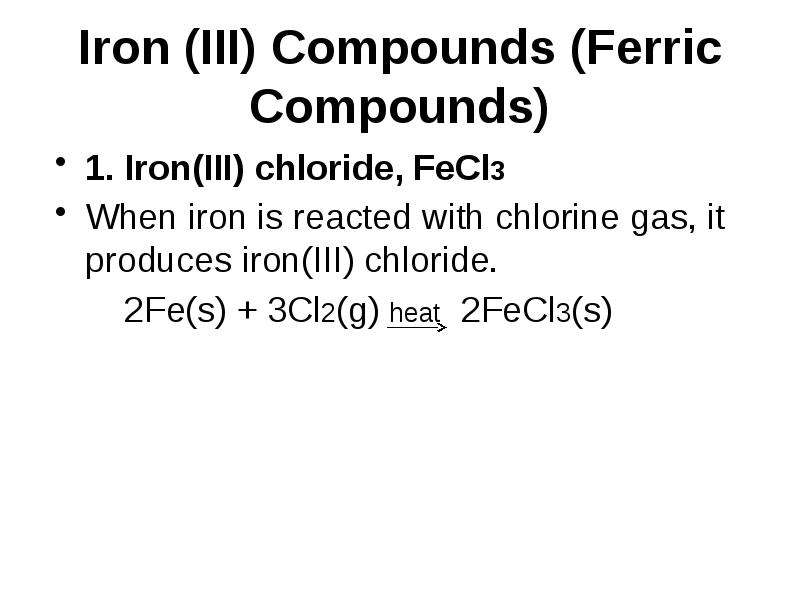
Iron (III) Compounds (Ferric Compounds) 1. Iron(III) chloride, FeCl3 When iron is reacted with chlorine gas, it produces iron(III) chloride. 2Fe(s) + 3Cl2(g) heat 2FeCl3(s)

Слайд 14


2. Iron (III) hydroxide, Fe(OH)3 It is obtained by the reaction of Fe3+ with a base or carbonates. It is similar to gelatin. Fe(OH)3 is a...
Описание слайда:
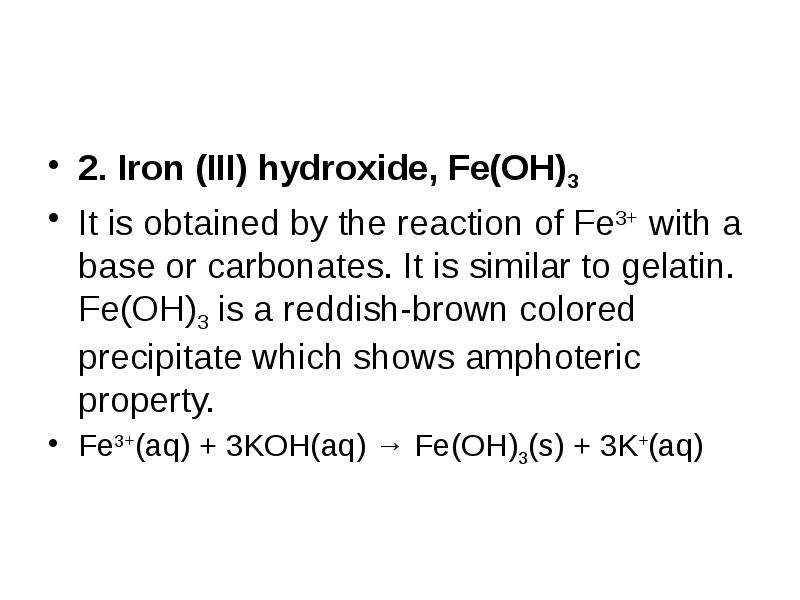
2. Iron (III) hydroxide, Fe(OH)3 It is obtained by the reaction of Fe3+ with a base or carbonates. It is similar to gelatin. Fe(OH)3 is a reddish-brown colored precipitate which shows amphoteric property. Fe3+(aq) + 3KOH(aq) → Fe(OH)3(s) + 3K+(aq)

Слайд 15


3. Iron (III) oxide, Fe2O3 3. Iron (III) oxide, Fe2O3 In nature Fe2O3 is found in hematite and limonite minerals. It can be obtained by several...
Описание слайда:
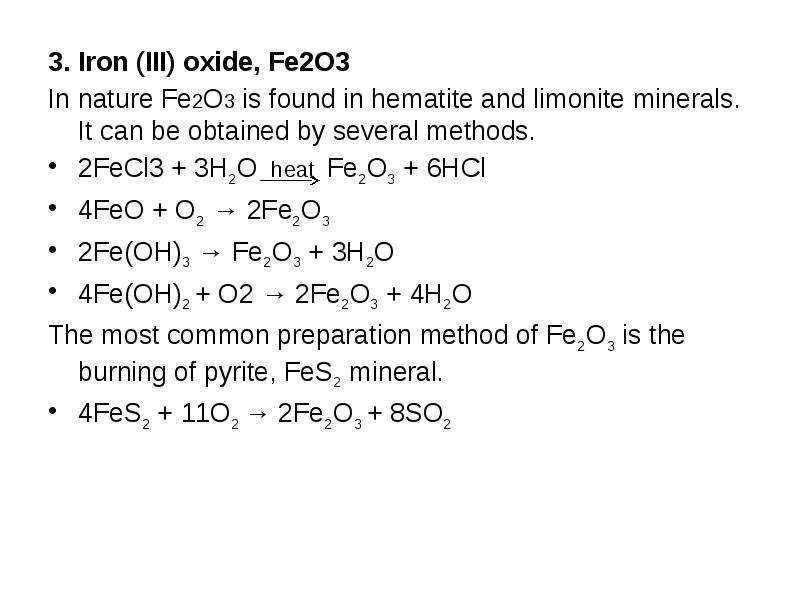
3. Iron (III) oxide, Fe2O3 3. Iron (III) oxide, Fe2O3 In nature Fe2O3 is found in hematite and limonite minerals. It can be obtained by several methods. 2FeCl3 + 3H2O heat Fe2O3 + 6HCl 4FeO + O2 → 2Fe2O3 2Fe(OH)3 → Fe2O3 + 3H2O 4Fe(OH)2 + O2 → 2Fe2O3 + 4H2O The most common preparation method of Fe2O3 is the burning of pyrite, FeS2 mineral. 4FeS2 + 11O2 → 2Fe2O3 + 8SO2

Слайд 16


Iron(II, III) oxide, Fe3O4 Iron(II, III) oxide, Fe3O4 Fe3O4, mixed oxide, is obtained by passing heated steam over iron metal or heating Fe2O3 3Fe +...
Описание слайда:
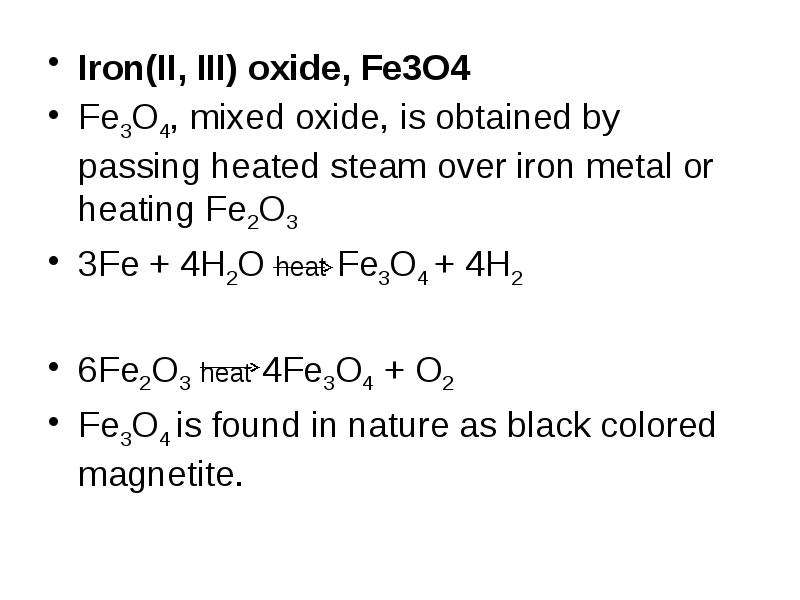
Iron(II, III) oxide, Fe3O4 Iron(II, III) oxide, Fe3O4 Fe3O4, mixed oxide, is obtained by passing heated steam over iron metal or heating Fe2O3 3Fe + 4H2O heat Fe3O4 + 4H2 6Fe2O3 heat 4Fe3O4 + O2 Fe3O4 is found in nature as black colored magnetite.

Слайд 17


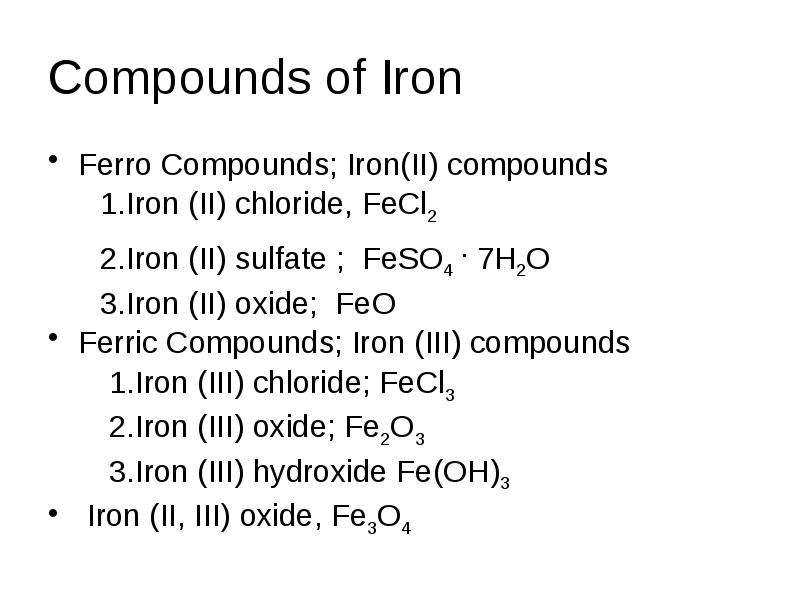
Compounds of Iron Ferro Compounds; Iron(II) compounds 1.Iron (II) chloride, FeCl2 2.Iron (II) sulfate ; FeSO4 . 7H2O 3.Iron (II) oxide; FeO Ferric...
Описание слайда:
Compounds of Iron Ferro Compounds; Iron(II) compounds 1.Iron (II) chloride, FeCl2 2.Iron (II) sulfate ; FeSO4 . 7H2O 3.Iron (II) oxide; FeO Ferric Compounds; Iron (III) compounds 1.Iron (III) chloride; FeCl3 2.Iron (III) oxide; Fe2O3 3.Iron (III) hydroxide Fe(OH)3 Iron (II, III) oxide, Fe3O4


Похожие презентации
Mypresentation.ru
Загрузить презентацию