🗊 Презентация American History discovery, conquest and settlement

Категория: Образование
Нажмите для полного просмотра!
American History discovery, conquest and settlement, слайд №1 American History discovery, conquest and settlement, слайд №2 American History discovery, conquest and settlement, слайд №3 American History discovery, conquest and settlement, слайд №4 American History discovery, conquest and settlement, слайд №5 American History discovery, conquest and settlement, слайд №6 American History discovery, conquest and settlement, слайд №7 American History discovery, conquest and settlement, слайд №8 American History discovery, conquest and settlement, слайд №9 American History discovery, conquest and settlement, слайд №10 American History discovery, conquest and settlement, слайд №11 American History discovery, conquest and settlement, слайд №12 American History discovery, conquest and settlement, слайд №13 American History discovery, conquest and settlement, слайд №14 American History discovery, conquest and settlement, слайд №15 American History discovery, conquest and settlement, слайд №16 American History discovery, conquest and settlement, слайд №17 American History discovery, conquest and settlement, слайд №18 American History discovery, conquest and settlement, слайд №19 American History discovery, conquest and settlement, слайд №20 American History discovery, conquest and settlement, слайд №21 American History discovery, conquest and settlement, слайд №22 American History discovery, conquest and settlement, слайд №23 American History discovery, conquest and settlement, слайд №24 American History discovery, conquest and settlement, слайд №25 American History discovery, conquest and settlement, слайд №26 American History discovery, conquest and settlement, слайд №27 American History discovery, conquest and settlement, слайд №28 American History discovery, conquest and settlement, слайд №29 American History discovery, conquest and settlement, слайд №30 American History discovery, conquest and settlement, слайд №31 American History discovery, conquest and settlement, слайд №32 American History discovery, conquest and settlement, слайд №33 American History discovery, conquest and settlement, слайд №34 American History discovery, conquest and settlement, слайд №35 American History discovery, conquest and settlement, слайд №36

Вы можете ознакомиться и скачать презентацию на тему American History discovery, conquest and settlement. Доклад-сообщение содержит 36 слайдов. Презентации для любого класса можно скачать бесплатно. Если материал и наш сайт презентаций Mypresentation Вам понравились – поделитесь им с друзьями с помощью социальных кнопок и добавьте в закладки в своем браузере.

Слайды и текст этой презентации


Слайд 1


American History Discovery, Conquest and Settlement
Описание слайда:

American History Discovery, Conquest and Settlement

Слайд 2


Pre-Columbian Period Native Americans: where did they migrate from? Why such diverse selection of cultures (from tribes to quasigovernmental...
Описание слайда:
Pre-Columbian Period Native Americans: where did they migrate from? Why such diverse selection of cultures (from tribes to quasigovernmental systems)? Cherokee and Iroquois Nations – business transactions; no writing, no monetary systems; to Europe – corn and tobacco; from Europe – horses and guns First ?European discovery ascribed to Leif Erickson, Newfoundland (“Vinland”)

Слайд 3


Indian Civilizations
Описание слайда:
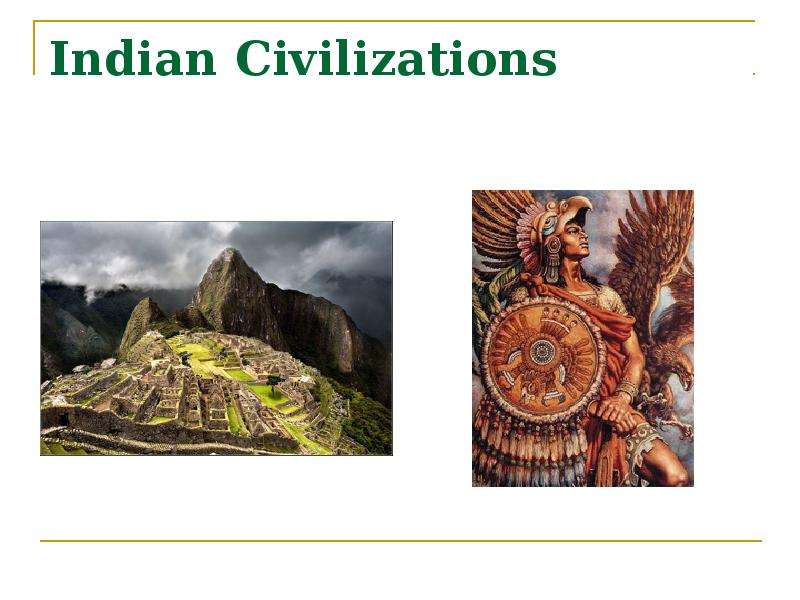
Indian Civilizations

Слайд 4


And Lost Chance…
Описание слайда:

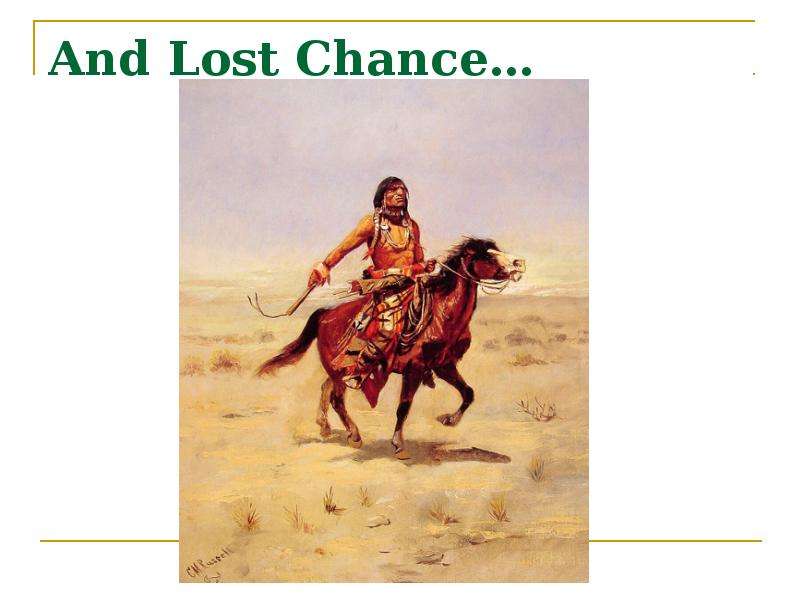
And Lost Chance…

Слайд 5


Exploration (Columbian Period) Spain December 24, 1492, Santa Maria, reached the island of Haiti 1493 Pope Alexander VI - the Bull of Demarkation....
Описание слайда:
Exploration (Columbian Period) Spain December 24, 1492, Santa Maria, reached the island of Haiti 1493 Pope Alexander VI - the Bull of Demarkation. North America and the western part of South America to Spain, Brazil - to Portugal. Spain acquired Haiti, Puerto Rico, Jamaica and Cuba by 1515. Florida (St. Augustine), and later Santa Fe (now in New Mexico). Spanish Hernando Cortes conquered the Aztecs in central Mexico (1521), and Francisco Pizarro conquered the Incas of Peru (1531) Spanish women? Separate governments? 1898 –Spanish-American war, loss of most Spanish territories

Слайд 6


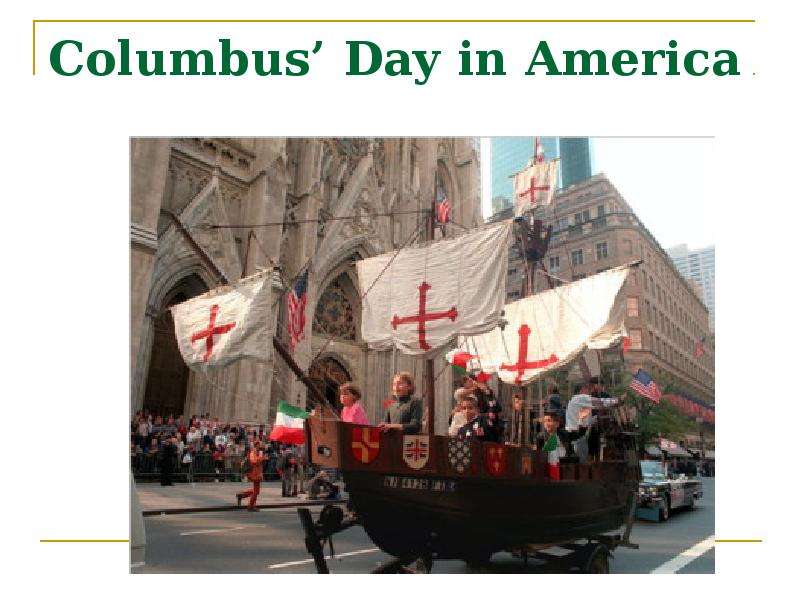
Columbus’ Day in America
Описание слайда:
Columbus’ Day in America

Слайд 7


France The French explored the St. Lawrence and settled Quebec, where French is still spoken; the Mississippi in 1672 (Le Salle), the towns of Saint...
Описание слайда:
France The French explored the St. Lawrence and settled Quebec, where French is still spoken; the Mississippi in 1672 (Le Salle), the towns of Saint Louis (named after a French king) and New Orleans. In 1534 Jacques Cartier explored the Gulf of st. Lawrence and the river upstream up to the modern Montreal. The whole territory was given the name of “New France”, later replaced by ‘Canada’, which in Indian means just ‘a village’, or ‘settlement’. building forts where the Great Lakes came together, Detroit in 1707. Growing French expansion was not to be born by the English : series of military conflicts from 1689 up to 1760. The English-French war came to an end with capturing Quebec by General Grant in 1759, Canada ceded to England. The defeat of France in America made the USA development possible.

Слайд 8


Holland, Sweden, Germany The Dutch - the Hudson River, calling the region New Netherlands ; buying and naming Manhattan New Amsterdam in 1613. In the...
Описание слайда:
Holland, Sweden, Germany The Dutch - the Hudson River, calling the region New Netherlands ; buying and naming Manhattan New Amsterdam in 1613. In the Dutch colony religion was separated from government, which attracted Quakers, Moravians, Jews and made New Amsterdam a cosmopolitan place (Theodor Roosevelt) In 1664 the Dutch surrended their colony to a special military expedition sent by Charles II. The Swedish settled in Delaware; Germans settled later in Pennsylvania.

Слайд 9


Manhattan
Описание слайда:
Manhattan

Слайд 10


Great Britain John Cabot discovered the North American coastline for England in 1497. No interest for 100 years. Why? In 1576, the British explorer...
Описание слайда:
Great Britain John Cabot discovered the North American coastline for England in 1497. No interest for 100 years. Why? In 1576, the British explorer Martin Frobisher hauled 200 tons of material back to England… first settlement of North America in 1585, on Roanoke Island in Virginia.

Слайд 11


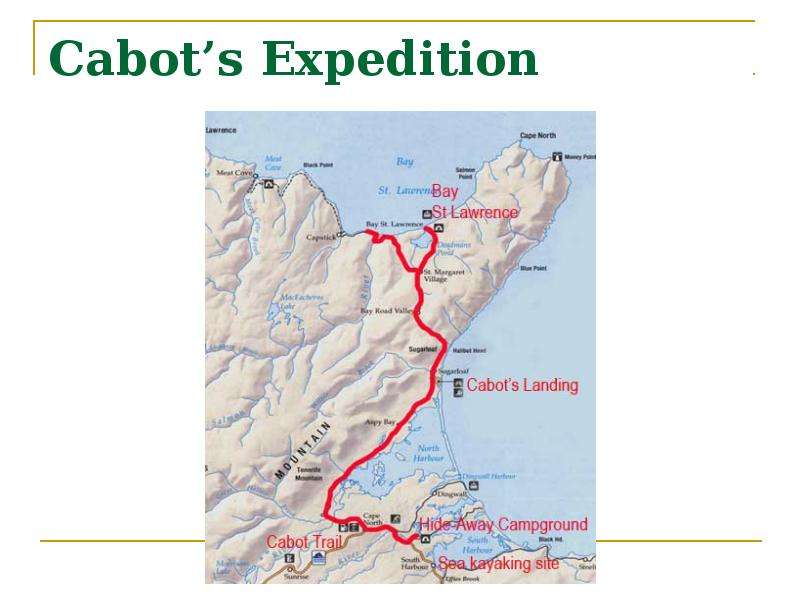
Cabot’s Expedition
Описание слайда:
Cabot’s Expedition

Слайд 12


Successful Settlements- Virginia "joint stock company," 1607! the Jamestown settlement lived under socialism 1613 – tobacco, John Rolfe....
Описание слайда:
Successful Settlements- Virginia "joint stock company," 1607! the Jamestown settlement lived under socialism 1613 – tobacco, John Rolfe. The King banned the growing of tobacco in England; importation of slaves to the New World – 1619 Virginia produced four of America’s first five presidents

Слайд 13


Massachusetts John Winthrop - trained at Oxford. Salem, Massachusetts in 1629 Within five years the Great Migration of religiously motivated settlers...
Описание слайда:
Massachusetts John Winthrop - trained at Oxford. Salem, Massachusetts in 1629 Within five years the Great Migration of religiously motivated settlers followed from England. By the 1640s, robust trade by sea with England, the West Indies, with West Africa. In all New England communities schools were established. The first college was Harward, founded in 1636, 16 years after landing of the Pilgrims. The College of William & Mary in 1693; and Yale in 1701.

Слайд 14


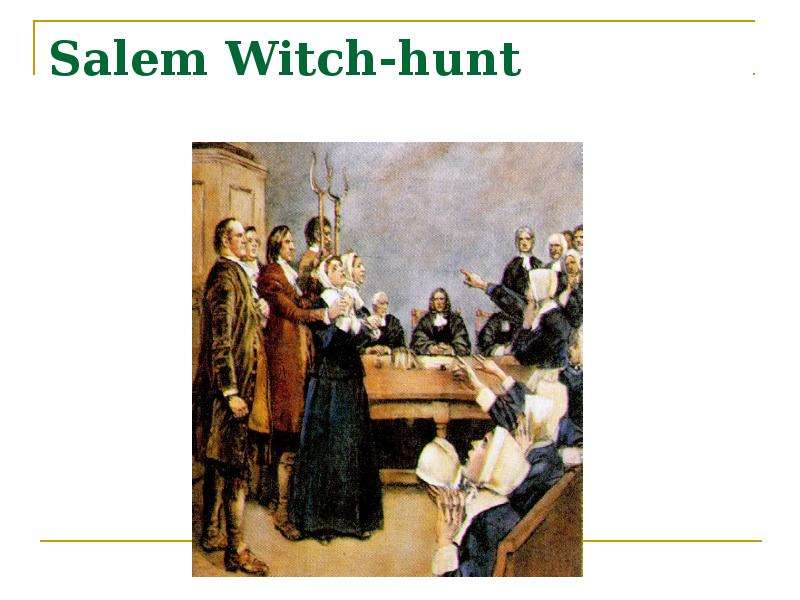
Salem Witch-hunt
Описание слайда:
Salem Witch-hunt

Слайд 15


Too different… Religion and motivation. Attitude to slavery. Attitude to Indians. Different crops; Ways to attract new settlers;"headright...
Описание слайда:
Too different… Religion and motivation. Attitude to slavery. Attitude to Indians. Different crops; Ways to attract new settlers;"headright system," - 50 acres to those who paid for the passage to the colony of an immigrant, an "indentured servant" contrast between Massachusetts and Virginia - 250 years later, the Civil War.

Слайд 16


Types of Colonies Joint-Stock Colony; Charter Colony; Proprietary Colony; Royal Colony.
Описание слайда:
Types of Colonies Joint-Stock Colony; Charter Colony; Proprietary Colony; Royal Colony.

Слайд 17


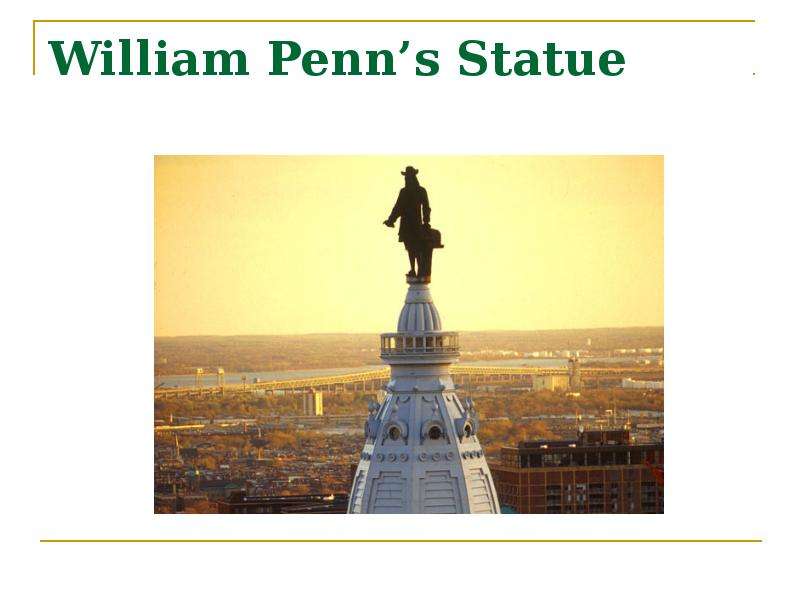
A third Approach Pennsylvania. William Penn - a Quaker . Quakers were a problem – why? colony based on one principle: which? Philadelphia, which...
Описание слайда:
A third Approach Pennsylvania. William Penn - a Quaker . Quakers were a problem – why? colony based on one principle: which? Philadelphia, which means "brotherly love" in Greek, became America's greatest city, surpassing Boston in population in the 1700s.

Слайд 18


William Penn’s Statue
Описание слайда:
William Penn’s Statue

Слайд 19


13 colonies to become first states Rhode Island Colony Roger Williams – a misfit – why? with the founding of Providence the Rhode Island colony...
Описание слайда:
13 colonies to become first states Rhode Island Colony Roger Williams – a misfit – why? with the founding of Providence the Rhode Island colony became independent from Massachusetts. The Connecticut Colony - founded in 1639 with establishment of a town at Hartford; also built on more liberal principles than Massachusetts; New Haven colony - a restrictive Puritan society with elaborate punishments for misconduct in the community; existed till 1662, then was united to the Connecticut Colony. Between the New England states and the Southern stated lies a group of states known as Middle States. They are New York, New Jersey, Pennsylvania, Delaware and Maryland. Delaware next to Rhode Island is the smallest state: began as early as 1638 with Swedish settlers, led by Peter Minuit. Soon enough - part of New York, in 1682 united to Pennsylvania; 20 years later became independent again. People who settled there - a curious mix of Swedes, Finns, the Dutch and the English.

Слайд 20


13 colonies to become first states Maryland - in 1634 with a settlement on Cheasepeake Bay.The founders - Lord Baltimore and his son, Roman...
Описание слайда:
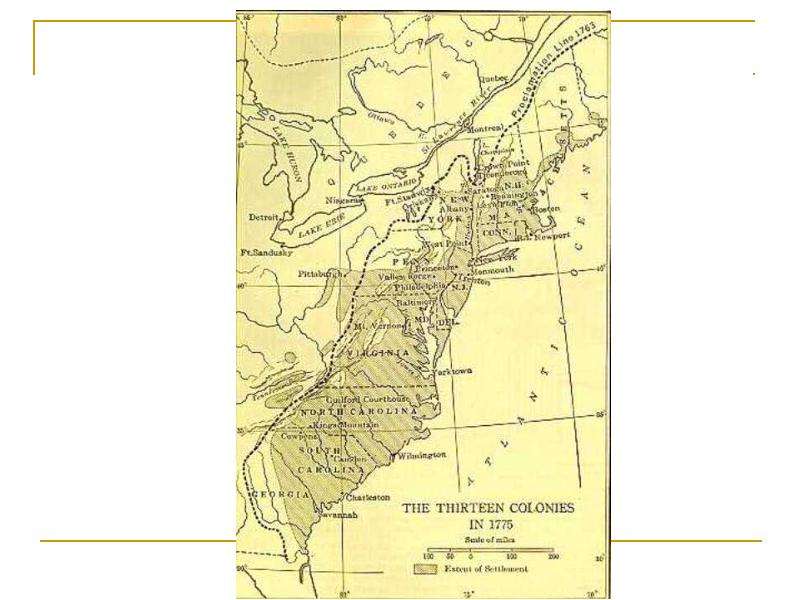
13 colonies to become first states Maryland - in 1634 with a settlement on Cheasepeake Bay.The founders - Lord Baltimore and his son, Roman Catholics. The settlers practiced religious tolerance. Georgia was founded in 1733 as a military front to protect the other colonies from the Spanish. The founder was James Oglthorpe, the English army officer and MP. He founded it with the help of a joint stock company to give a new chance to insolvent debtors; the chief town was Savannah. So the original 13 colonies were: Massachusetts, Rhode Island, Connecticut and New Hampshire in the North; New York, New Jersey, Pennsylvania, Delaware and Maryland in the Middle groud; Virginia, North and South Carolina and Georgia in the South

Слайд 21


Economic System mercantilism began to develop in the 1600s and 1700s, which would lay the foundation for capitalism in the 1800s. mercantilism was an...
Описание слайда:
Economic System mercantilism began to develop in the 1600s and 1700s, which would lay the foundation for capitalism in the 1800s. mercantilism was an economic system in which the colonies existed to give raw materials to mother country (England), and buy her finished products, so that England could export more than it imported and thereby increase its gold reserves from a surplus in the balance of trade.

Слайд 22


The encomienda system a modified form of feudalism- to force the Indians to do the hard work. The "encomienda" was a grant by the King or...
Описание слайда:
The encomienda system a modified form of feudalism- to force the Indians to do the hard work. The "encomienda" was a grant by the King or Queen of Spain of power over Indians within a geographic region, a grant that was given to an "encomendero", who was the Spaniard in that region who would put the Indians to work. The Indians themselves became known as the economiendas. The encomendero was supposed to educate the encomiendas, convert them to Christianity (Catholicism), and not exercise any political power over them (as in telling them how to live). In practice, however, there were no "checks and balances" preventing exploitation and abuse of power in working the Indians.

Слайд 23


American History discovery, conquest and settlement, слайд №23
Описание слайда:

Слайд 24


War for Independence The Great Awakening
Описание слайда:
War for Independence The Great Awakening

Слайд 25


Salutary Neglect from the late 1600s (just after all the colonies were established) until about 1760, when conflicts began and Britain changed its...
Описание слайда:
Salutary Neglect from the late 1600s (just after all the colonies were established) until about 1760, when conflicts began and Britain changed its "hands off" policy. During this period, colonies differed in many ways from each other, but businesses flourished and the wealth of the colonies grew.

Слайд 26


The Zenger Trial the colony of New York - "seditious libel.“1735. Andrew Hamilton of Philadelphia, agreed to defend Zenger for free; truth is a...
Описание слайда:
The Zenger Trial the colony of New York - "seditious libel.“1735. Andrew Hamilton of Philadelphia, agreed to defend Zenger for free; truth is a perfect defense against a charge of libel/ publishing the truth about someone can be a crime (the crime of "libel") "jury nullification," the power of the jury to ignore the law and hold in favor of a defendant even though the law says he is guilty; exists to this day. Juries may "nullify" the law to find a defendant "not guilty."

Слайд 27


1730-1740: The Great Awakening In the 1700s, the English colonies grew in size, reaching 2 million in population compared to only 100,000 in the...
Описание слайда:
1730-1740: The Great Awakening In the 1700s, the English colonies grew in size, reaching 2 million in population compared to only 100,000 in the French settlements. During this time South Carolina had grown heavily dependent on slavery to pick its crops and sustain its economy. By the late 1730s South Carolina had twice as many slaves as free Europeans. In 1739 tensions between the slaves and their masters reached a boiling point in the Stono Rebellion in Charleston. This insurgency by the slaves was brutally suppressed, and then South Carolina passed harsh laws (codes) to exert even more control over the slaves. More so than any other colony (and later, more than any other state), South Carolina was determined to keep and use slavery.

Слайд 28


Migration and Conflict As the population and confidence of the English settlers in the colonies grew in the mid-1700s, they began to migrate to Ohio....
Описание слайда:
Migration and Conflict As the population and confidence of the English settlers in the colonies grew in the mid-1700s, they began to migrate to Ohio. There they came into conflict with the French over the fur trade and control of the region. Conflict between the English colonists and the French traders increased after the end of King George's War in 1748. In 1754, 7 colonies met to address these problems at the Albany Congress. They considered, but did not adopt, Benjamin Franklin's Albany Plan of Union. The Albany Plan of Union attempted to unite the English colonies with the Iroquois League in a defensive stance against New France George Washington appears on stage

Слайд 29


French and Indian War "The" French and Indian War was the seven-year struggle that was the culmination of the conflicts between France and...
Описание слайда:
French and Indian War "The" French and Indian War was the seven-year struggle that was the culmination of the conflicts between France and England in America. It was the American portion of the Seven Years' War (1756-1763) between England and France in Europe. The name is confusing – why?

Слайд 30


Result of the war Under Pitt's leadership, the English captured Fort Duquesne (renaming it Fort Pitt) in 1758, Quebec in 1759, and then Montreal in...
Описание слайда:
Result of the war Under Pitt's leadership, the English captured Fort Duquesne (renaming it Fort Pitt) in 1758, Quebec in 1759, and then Montreal in 1760. In 1763, the war ended when Britain, France and Spain signed the Treaty of Paris. Terms of the treaty? In 1763, Native Americans, inspired by the anti-British message of a Lenni-Lenape (Delaware) prophet named Neolin, and led by the Ottawa chieftain Pontiac, destroyed every British post west of the Appalachians with the exceptions of Niagara, Pitt, and Detroit.

Слайд 31


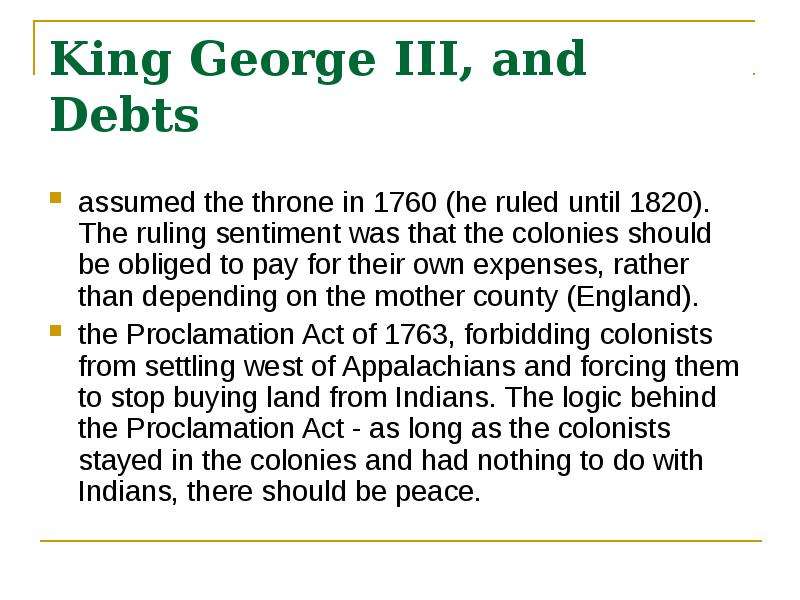
King George III, and Debts assumed the throne in 1760 (he ruled until 1820). The ruling sentiment was that the colonies should be obliged to pay for...
Описание слайда:
King George III, and Debts assumed the throne in 1760 (he ruled until 1820). The ruling sentiment was that the colonies should be obliged to pay for their own expenses, rather than depending on the mother county (England). the Proclamation Act of 1763, forbidding colonists from settling west of Appalachians and forcing them to stop buying land from Indians. The logic behind the Proclamation Act - as long as the colonists stayed in the colonies and had nothing to do with Indians, there should be peace.

Слайд 32


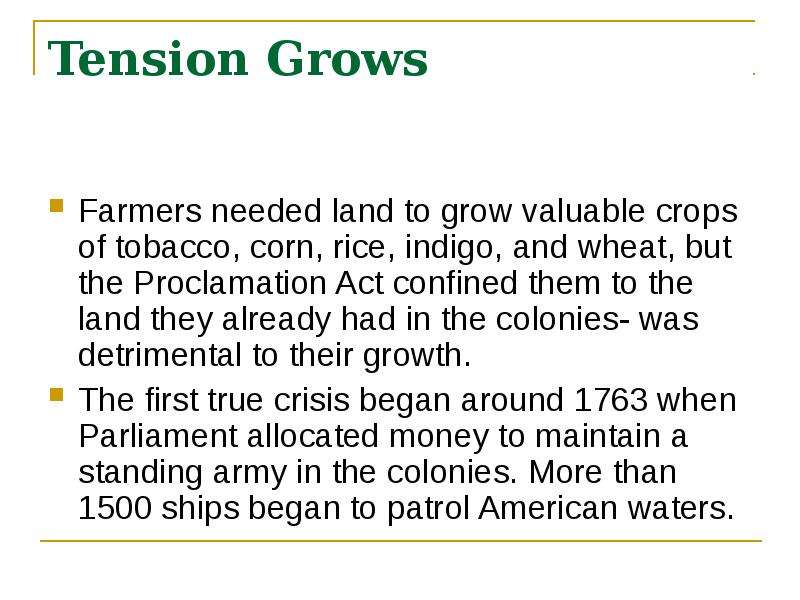
Tension Grows Farmers needed land to grow valuable crops of tobacco, corn, rice, indigo, and wheat, but the Proclamation Act confined them to the...
Описание слайда:
Tension Grows Farmers needed land to grow valuable crops of tobacco, corn, rice, indigo, and wheat, but the Proclamation Act confined them to the land they already had in the colonies- was detrimental to their growth. The first true crisis began around 1763 when Parliament allocated money to maintain a standing army in the colonies. More than 1500 ships began to patrol American waters.

Слайд 33


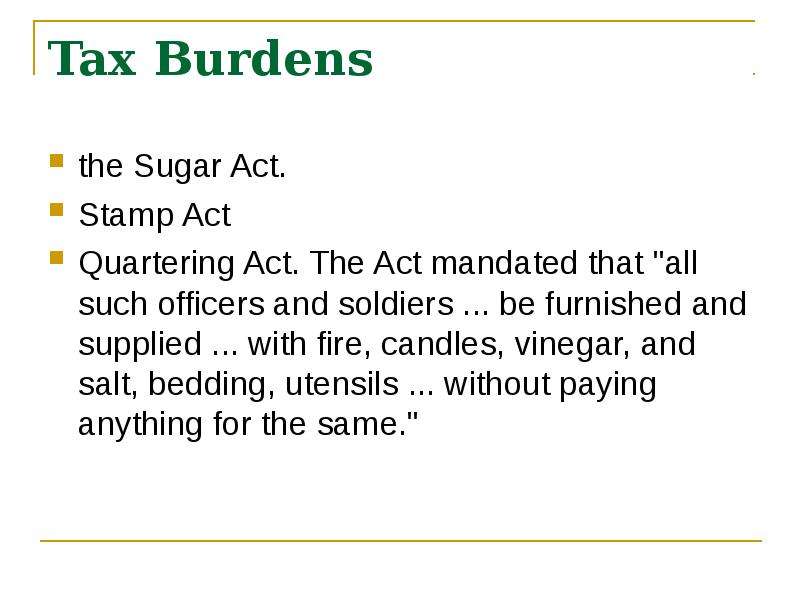
Tax Burdens the Sugar Act. Stamp Act Quartering Act. The Act mandated that "all such officers and soldiers ... be furnished and supplied ......
Описание слайда:
Tax Burdens the Sugar Act. Stamp Act Quartering Act. The Act mandated that "all such officers and soldiers ... be furnished and supplied ... with fire, candles, vinegar, and salt, bedding, utensils ... without paying anything for the same."

Слайд 34


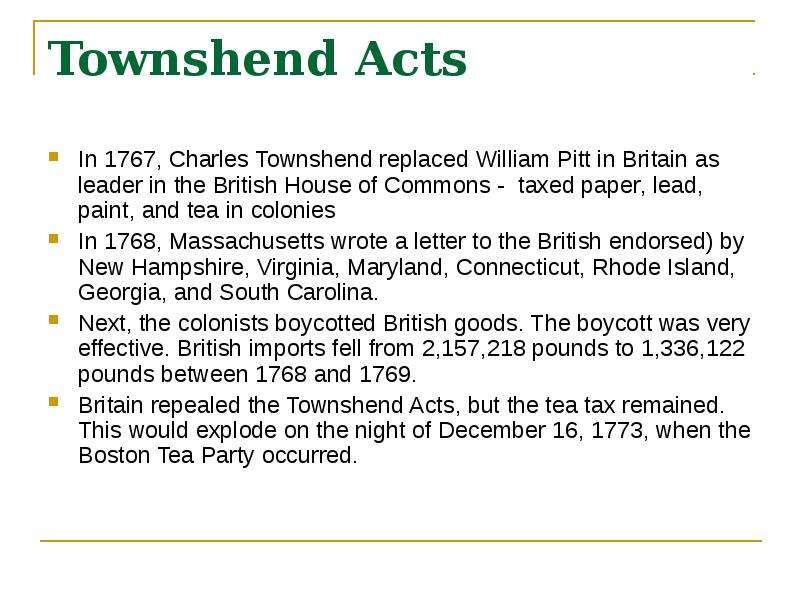
Townshend Acts In 1767, Charles Townshend replaced William Pitt in Britain as leader in the British House of Commons - taxed paper, lead, paint, and...
Описание слайда:
Townshend Acts In 1767, Charles Townshend replaced William Pitt in Britain as leader in the British House of Commons - taxed paper, lead, paint, and tea in colonies In 1768, Massachusetts wrote a letter to the British endorsed) by New Hampshire, Virginia, Maryland, Connecticut, Rhode Island, Georgia, and South Carolina. Next, the colonists boycotted British goods. The boycott was very effective. British imports fell from 2,157,218 pounds to 1,336,122 pounds between 1768 and 1769. Britain repealed the Townshend Acts, but the tea tax remained. This would explode on the night of December 16, 1773, when the Boston Tea Party occurred.

Слайд 35


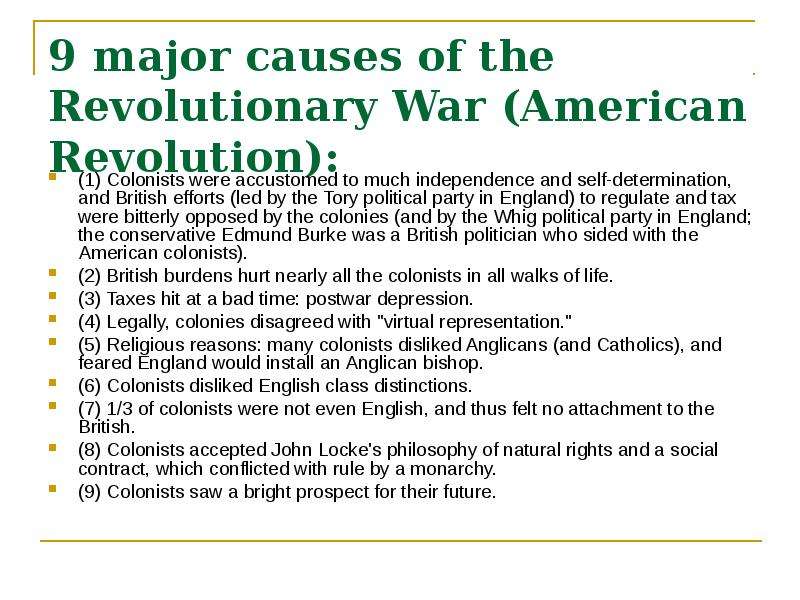
9 major causes of the Revolutionary War (American Revolution): (1) Colonists were accustomed to much independence and self-determination, and British...
Описание слайда:
9 major causes of the Revolutionary War (American Revolution): (1) Colonists were accustomed to much independence and self-determination, and British efforts (led by the Tory political party in England) to regulate and tax were bitterly opposed by the colonies (and by the Whig political party in England; the conservative Edmund Burke was a British politician who sided with the American colonists). (2) British burdens hurt nearly all the colonists in all walks of life. (3) Taxes hit at a bad time: postwar depression. (4) Legally, colonies disagreed with "virtual representation." (5) Religious reasons: many colonists disliked Anglicans (and Catholics), and feared England would install an Anglican bishop. (6) Colonists disliked English class distinctions. (7) 1/3 of colonists were not even English, and thus felt no attachment to the British. (8) Colonists accepted John Locke's philosophy of natural rights and a social contract, which conflicted with rule by a monarchy. (9) Colonists saw a bright prospect for their future.

Слайд 36


Thank you for attention!
Описание слайда:
Thank you for attention!


Похожие презентации
Mypresentation.ru
Загрузить презентацию