🗊 Презентация Fogs and Haze

Категория: Образование
Нажмите для полного просмотра!
Fogs and Haze, слайд №1 Fogs and Haze, слайд №2 Fogs and Haze, слайд №3 Fogs and Haze, слайд №4 Fogs and Haze, слайд №5 Fogs and Haze, слайд №6 Fogs and Haze, слайд №7 Fogs and Haze, слайд №8 Fogs and Haze, слайд №9 Fogs and Haze, слайд №10 Fogs and Haze, слайд №11 Fogs and Haze, слайд №12 Fogs and Haze, слайд №13 Fogs and Haze, слайд №14 Fogs and Haze, слайд №15 Fogs and Haze, слайд №16 Fogs and Haze, слайд №17 Fogs and Haze, слайд №18 Fogs and Haze, слайд №19 Fogs and Haze, слайд №20 Fogs and Haze, слайд №21 Fogs and Haze, слайд №22 Fogs and Haze, слайд №23 Fogs and Haze, слайд №24 Fogs and Haze, слайд №25 Fogs and Haze, слайд №26 Fogs and Haze, слайд №27 Fogs and Haze, слайд №28 Fogs and Haze, слайд №29 Fogs and Haze, слайд №30 Fogs and Haze, слайд №31 Fogs and Haze, слайд №32 Fogs and Haze, слайд №33 Fogs and Haze, слайд №34 Fogs and Haze, слайд №35

Вы можете ознакомиться и скачать презентацию на тему Fogs and Haze. Доклад-сообщение содержит 35 слайдов. Презентации для любого класса можно скачать бесплатно. Если материал и наш сайт презентаций Mypresentation Вам понравились – поделитесь им с друзьями с помощью социальных кнопок и добавьте в закладки в своем браузере.

Слайды и текст этой презентации


Слайд 1


Lecture 22 Fogs and Haze
Описание слайда:
Lecture 22 Fogs and Haze

Слайд 2


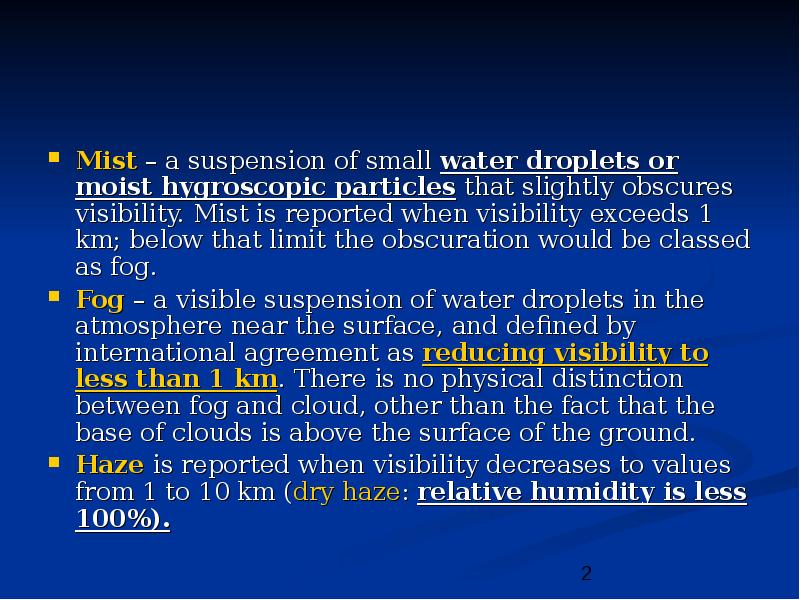
Mist – a suspension of small water droplets or moist hygroscopic particles that slightly obscures visibility. Mist is reported when visibility...
Описание слайда:

Mist – a suspension of small water droplets or moist hygroscopic particles that slightly obscures visibility. Mist is reported when visibility exceeds 1 km; below that limit the obscuration would be classed as fog. Fog – a visible suspension of water droplets in the atmosphere near the surface, and defined by international agreement as reducing visibility to less than 1 km. There is no physical distinction between fog and cloud, other than the fact that the base of clouds is above the surface of the ground. Haze is reported when visibility decreases to values from 1 to 10 km (dry haze: relative humidity is less 100%).

Слайд 3


Condensation and fog Properties of water Formation of dew, frost, rime Types of fog formation clearance Synoptic situations
Описание слайда:
Condensation and fog Properties of water Formation of dew, frost, rime Types of fog formation clearance Synoptic situations

Слайд 4


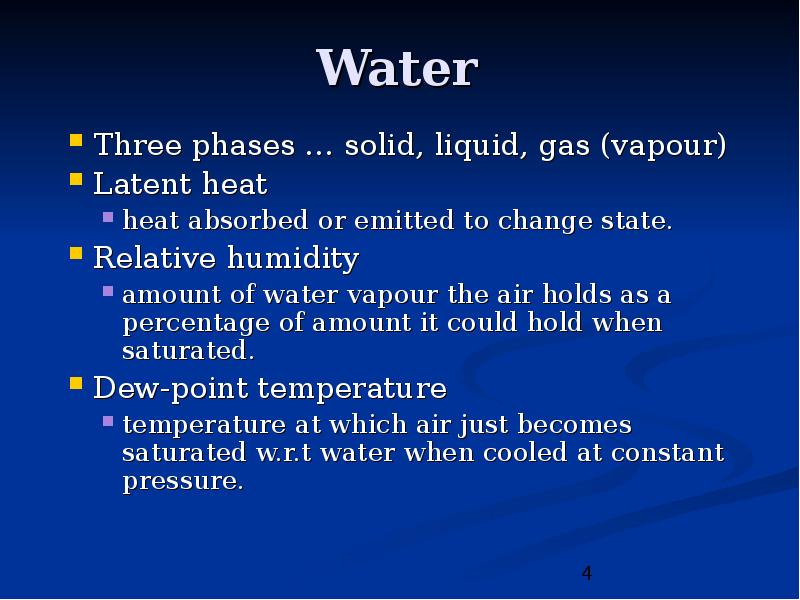
Water Three phases … solid, liquid, gas (vapour) Latent heat heat absorbed or emitted to change state. Relative humidity amount of water vapour the...
Описание слайда:

Water Three phases … solid, liquid, gas (vapour) Latent heat heat absorbed or emitted to change state. Relative humidity amount of water vapour the air holds as a percentage of amount it could hold when saturated. Dew-point temperature temperature at which air just becomes saturated w.r.t water when cooled at constant pressure.

Слайд 5


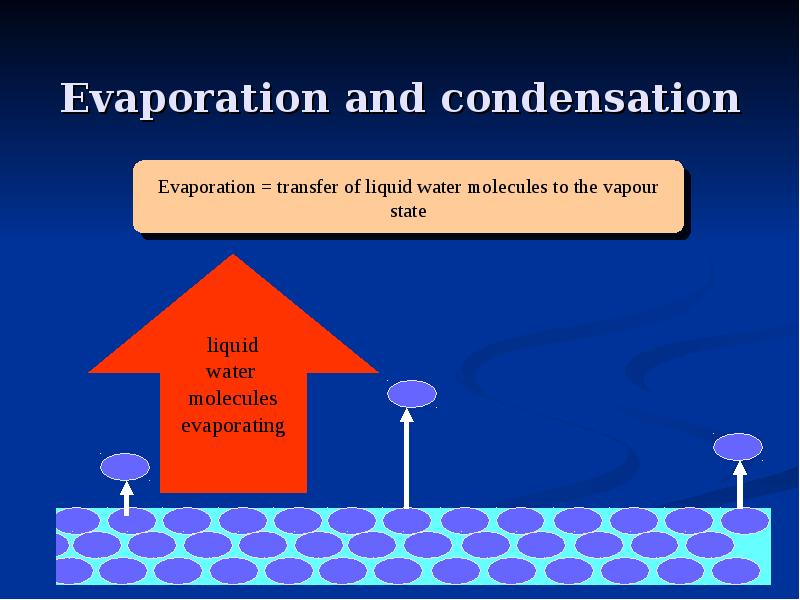
Evaporation and condensation
Описание слайда:
Evaporation and condensation

Слайд 6


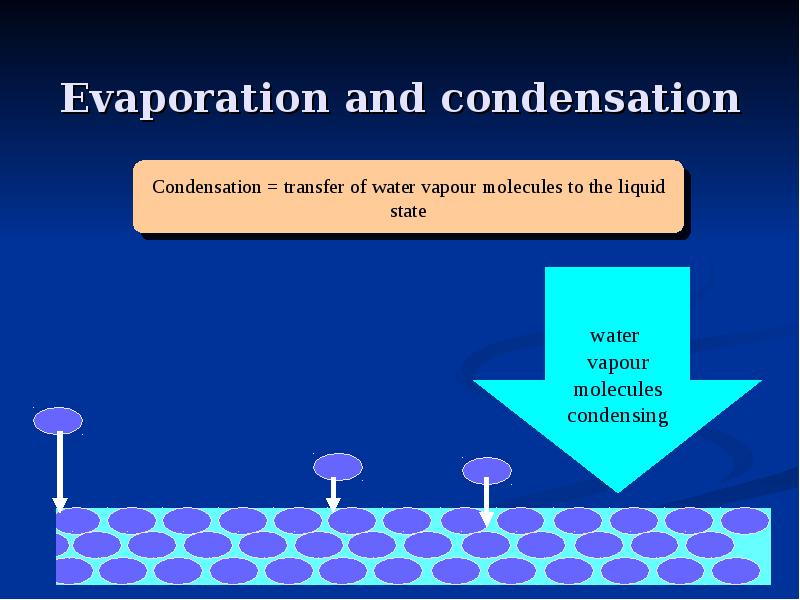
Evaporation and condensation
Описание слайда:
Evaporation and condensation

Слайд 7


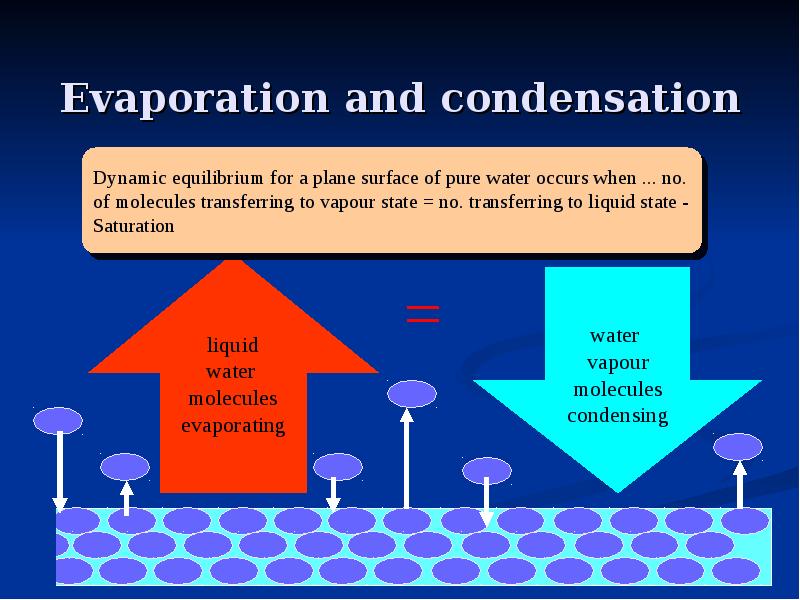
Evaporation and condensation
Описание слайда:
Evaporation and condensation

Слайд 8


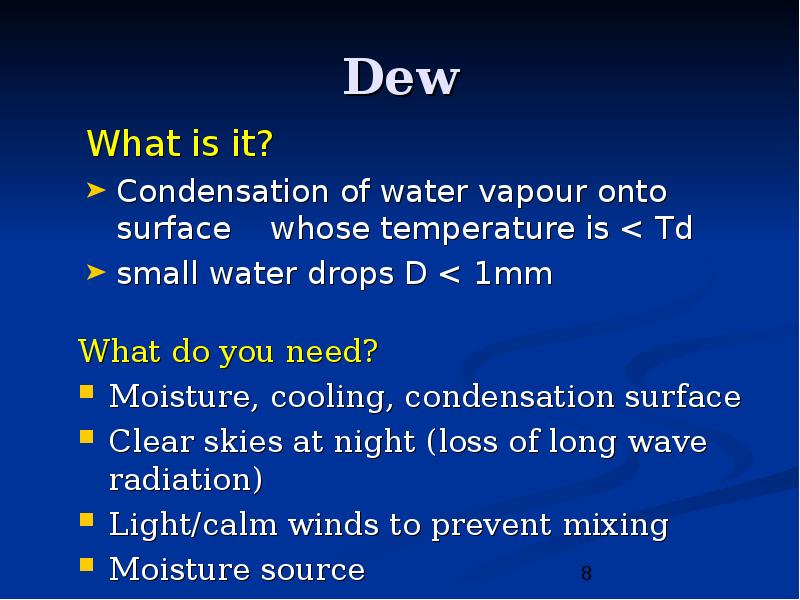
Dew What do you need? Moisture, cooling, condensation surface Clear skies at night (loss of long wave radiation) Light/calm winds to prevent mixing...
Описание слайда:
Dew What do you need? Moisture, cooling, condensation surface Clear skies at night (loss of long wave radiation) Light/calm winds to prevent mixing Moisture source

Слайд 9


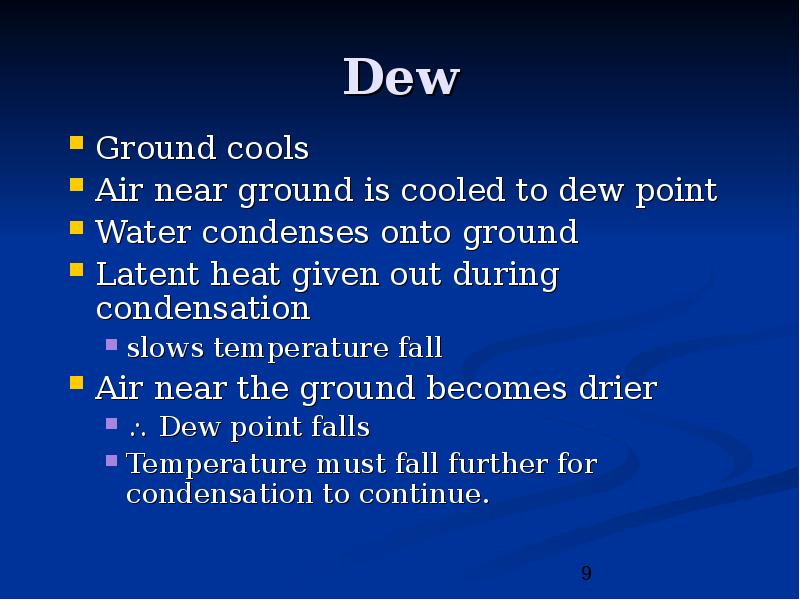
Dew Ground cools Air near ground is cooled to dew point Water condenses onto ground Latent heat given out during condensation slows temperature fall...
Описание слайда:
Dew Ground cools Air near ground is cooled to dew point Water condenses onto ground Latent heat given out during condensation slows temperature fall Air near the ground becomes drier  Dew point falls Temperature must fall further for condensation to continue.

Слайд 10


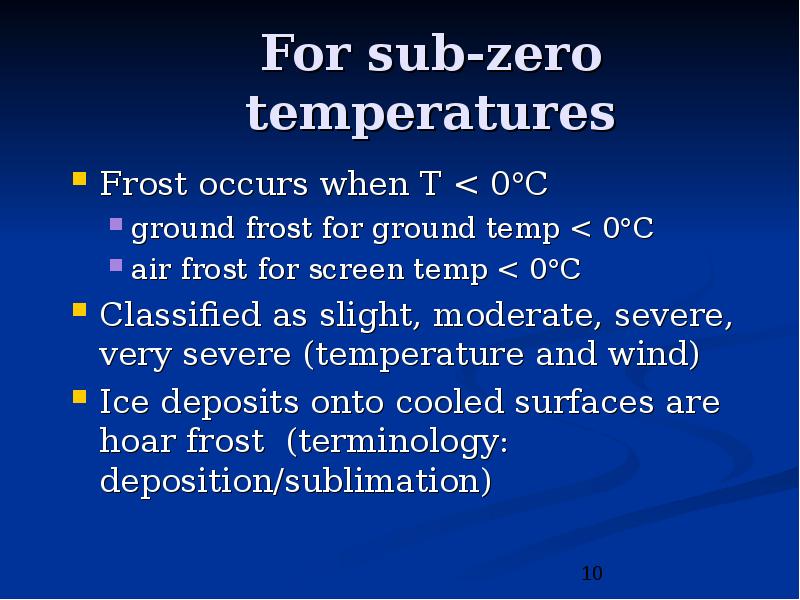
For sub-zero temperatures Frost occurs when T < 0C ground frost for ground temp < 0C air frost for screen temp < 0C Classified as slight,...
Описание слайда:
For sub-zero temperatures Frost occurs when T < 0C ground frost for ground temp < 0C air frost for screen temp < 0C Classified as slight, moderate, severe, very severe (temperature and wind) Ice deposits onto cooled surfaces are hoar frost (terminology: deposition/sublimation)

Слайд 11


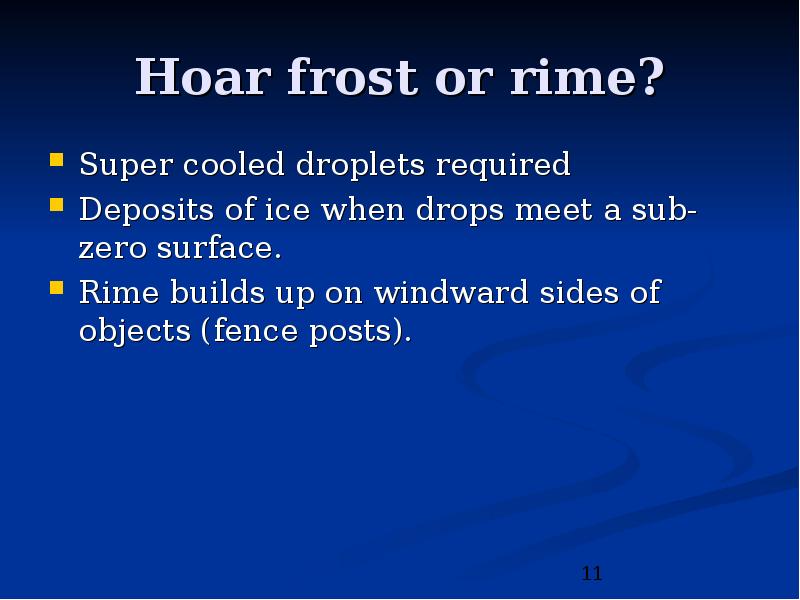
Hoar frost or rime? Super cooled droplets required Deposits of ice when drops meet a sub-zero surface. Rime builds up on windward sides of objects...
Описание слайда:
Hoar frost or rime? Super cooled droplets required Deposits of ice when drops meet a sub-zero surface. Rime builds up on windward sides of objects (fence posts).

Слайд 12


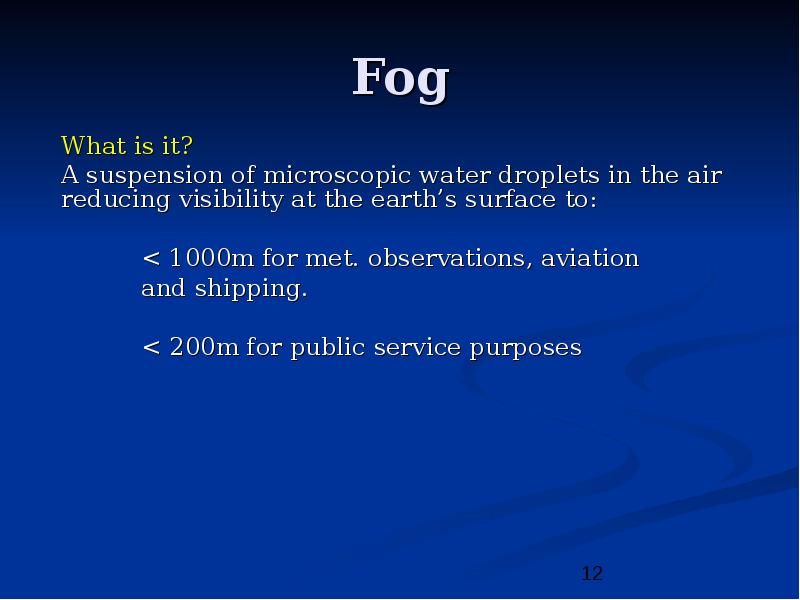
Fog What is it? A suspension of microscopic water droplets in the air reducing visibility at the earth’s surface to: < 1000m for met. observations,...
Описание слайда:
Fog What is it? A suspension of microscopic water droplets in the air reducing visibility at the earth’s surface to: < 1000m for met. observations, aviation and shipping. < 200m for public service purposes

Слайд 13


Fog Freezing fog Super-cooled fog drops which freeze on impact with a surface Ice fog Tiny suspended ice particles Usually requires T= -30C Very...
Описание слайда:
Fog Freezing fog Super-cooled fog drops which freeze on impact with a surface Ice fog Tiny suspended ice particles Usually requires T= -30C Very rare in the UK but often in Siberia!

Слайд 14


Why does fog form? Water vapour condenses onto atmospheric particles. For condensation we need saturation. How do we turn unsaturated air into...
Описание слайда:
Why does fog form? Water vapour condenses onto atmospheric particles. For condensation we need saturation. How do we turn unsaturated air into saturated air?

Слайд 15


There are 3 ways
Описание слайда:
There are 3 ways

Слайд 16


There are 3 ways (1) Cool air to dew-point
Описание слайда:
There are 3 ways (1) Cool air to dew-point

Слайд 17


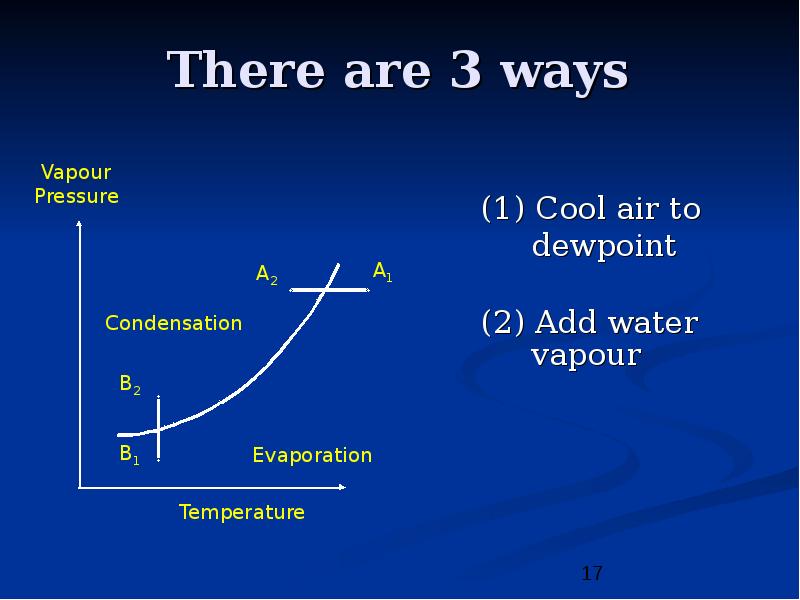
There are 3 ways (1) Cool air to dewpoint (2) Add water vapour
Описание слайда:
There are 3 ways (1) Cool air to dewpoint (2) Add water vapour

Слайд 18


There are 3 ways (1) Cool air to dewpoint (2) Add water vapour (3) Mix moist parcels at different temperatures
Описание слайда:
There are 3 ways (1) Cool air to dewpoint (2) Add water vapour (3) Mix moist parcels at different temperatures

Слайд 19


Fog Classification There are four main types: Radiation - cooling of ground by radiation Advection - (warm advection) cooling of air by conduction...
Описание слайда:
Fog Classification There are four main types: Radiation - cooling of ground by radiation Advection - (warm advection) cooling of air by conduction Upslope - cooling of air by adiabatic expansion Frontal - increasing moisture by evaporation Also: Steam - (cold advection) increasing moisture by evaporation

Слайд 20


1. Radiation fog Favourable conditions Clear sky or thin, high cloud Moist air in lowest 100m Moist ground Light surface wind Favourable local...
Описание слайда:
1. Radiation fog Favourable conditions Clear sky or thin, high cloud Moist air in lowest 100m Moist ground Light surface wind Favourable local topography When are these conditions likely?

Слайд 21


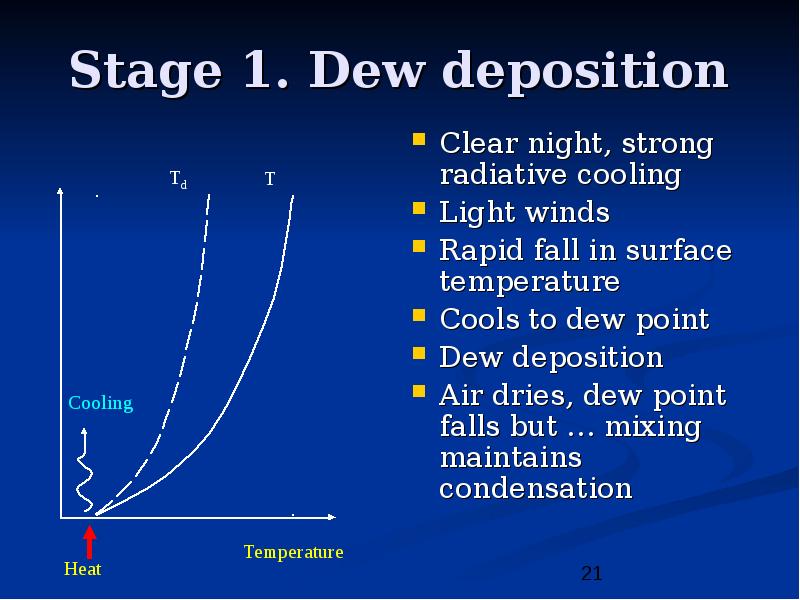
Stage 1. Dew deposition Clear night, strong radiative cooling Light winds Rapid fall in surface temperature Cools to dew point Dew deposition Air...
Описание слайда:
Stage 1. Dew deposition Clear night, strong radiative cooling Light winds Rapid fall in surface temperature Cools to dew point Dew deposition Air dries, dew point falls but … mixing maintains condensation

Слайд 22


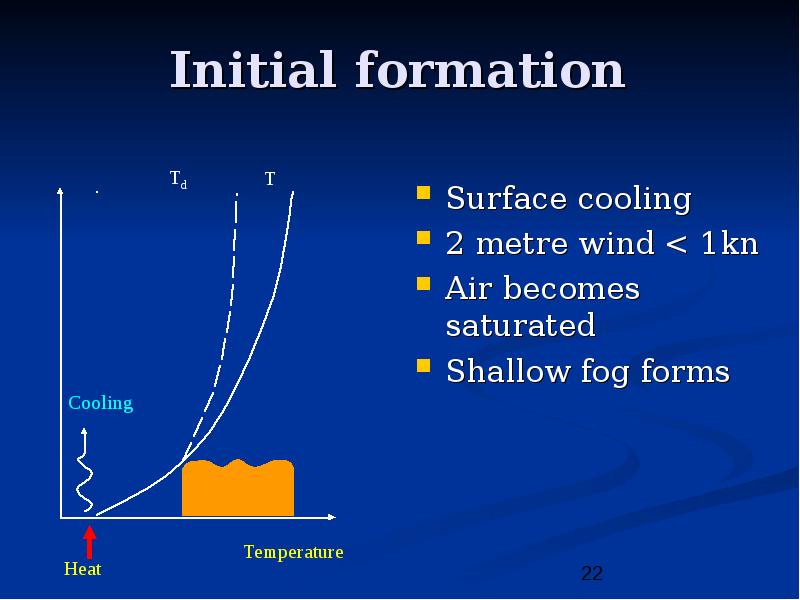
Initial formation Surface cooling 2 metre wind < 1kn Air becomes saturated Shallow fog forms
Описание слайда:
Initial formation Surface cooling 2 metre wind < 1kn Air becomes saturated Shallow fog forms

Слайд 23


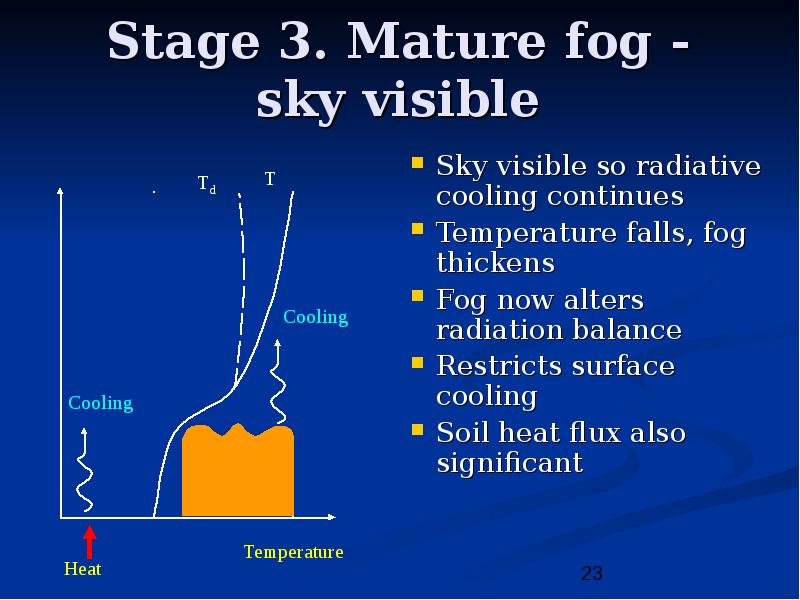
Stage 3. Mature fog - sky visible Sky visible so radiative cooling continues Temperature falls, fog thickens Fog now alters radiation balance...
Описание слайда:
Stage 3. Mature fog - sky visible Sky visible so radiative cooling continues Temperature falls, fog thickens Fog now alters radiation balance Restricts surface cooling Soil heat flux also significant

Слайд 24


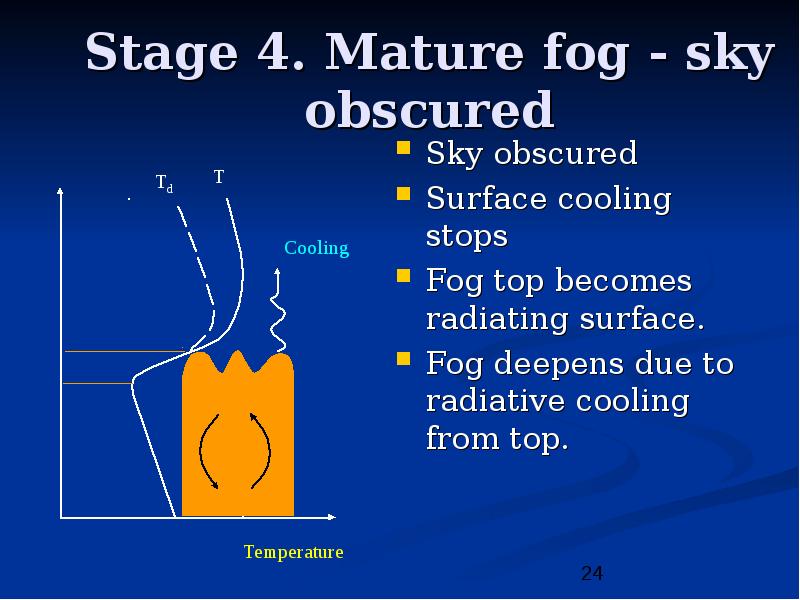
Stage 4. Mature fog - sky obscured Sky obscured Surface cooling stops Fog top becomes radiating surface. Fog deepens due to radiative cooling from...
Описание слайда:
Stage 4. Mature fog - sky obscured Sky obscured Surface cooling stops Fog top becomes radiating surface. Fog deepens due to radiative cooling from top.

Слайд 25


Additional processes... Lowering of stratus to the ground
Описание слайда:
Additional processes... Lowering of stratus to the ground

Слайд 26


Clearance mechanisms Solar radiation – raises air temperature above dew point. Increase in gradient wind – turbulence Advection of cloud over the fog...
Описание слайда:
Clearance mechanisms Solar radiation – raises air temperature above dew point. Increase in gradient wind – turbulence Advection of cloud over the fog – radiation warms the fog top (most efficient method) Advection of drier air – lowers surface dew point

Слайд 27


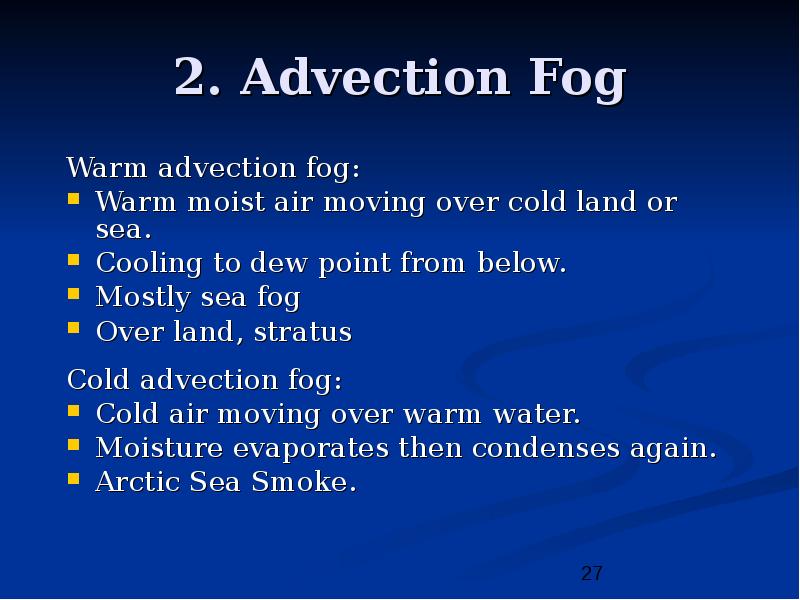
2. Advection Fog Warm advection fog: Warm moist air moving over cold land or sea. Cooling to dew point from below. Mostly sea fog Over land, stratus...
Описание слайда:
2. Advection Fog Warm advection fog: Warm moist air moving over cold land or sea. Cooling to dew point from below. Mostly sea fog Over land, stratus Cold advection fog: Cold air moving over warm water. Moisture evaporates then condenses again. Arctic Sea Smoke.

Слайд 28


3. Upslope fog Formed by Warm, moist air forced to rise over hills. Air cools adiabatically on ascent Very common in western and northern Britain...
Описание слайда:
3. Upslope fog Formed by Warm, moist air forced to rise over hills. Air cools adiabatically on ascent Very common in western and northern Britain Tropical maritime airmass

Слайд 29


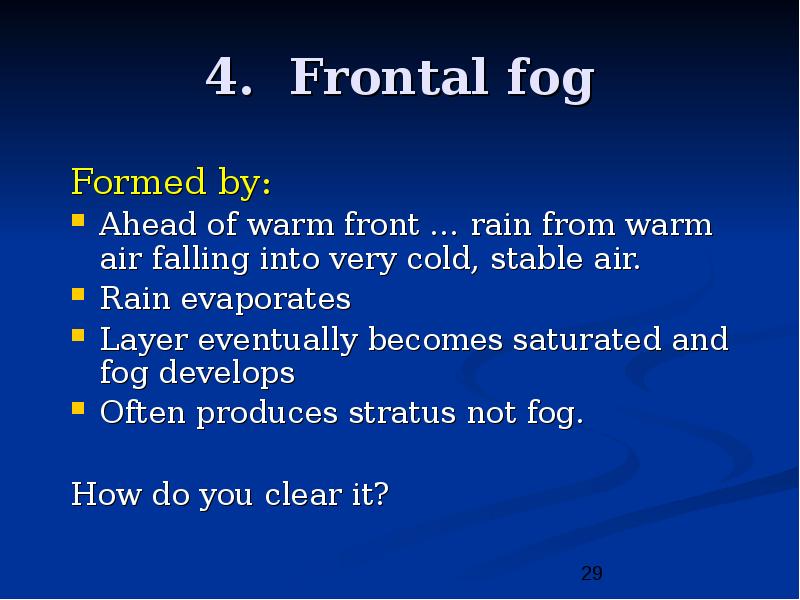
4. Frontal fog Formed by: Ahead of warm front … rain from warm air falling into very cold, stable air. Rain evaporates Layer eventually becomes...
Описание слайда:
4. Frontal fog Formed by: Ahead of warm front … rain from warm air falling into very cold, stable air. Rain evaporates Layer eventually becomes saturated and fog develops Often produces stratus not fog. How do you clear it?

Слайд 30


Examples
Описание слайда:
Examples

Слайд 31


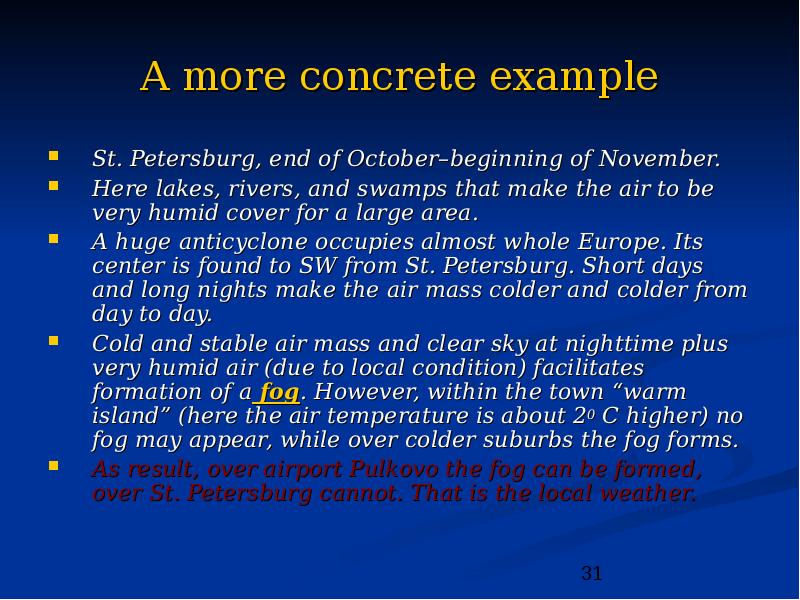
A more concrete example St. Petersburg, end of October–beginning of November. Here lakes, rivers, and swamps that make the air to be very humid cover...
Описание слайда:
A more concrete example St. Petersburg, end of October–beginning of November. Here lakes, rivers, and swamps that make the air to be very humid cover for a large area. A huge anticyclone occupies almost whole Europe. Its center is found to SW from St. Petersburg. Short days and long nights make the air mass colder and colder from day to day. Cold and stable air mass and clear sky at nighttime plus very humid air (due to local condition) facilitates formation of a fog. However, within the town “warm island” (here the air temperature is about 20 C higher) no fog may appear, while over colder suburbs the fog forms. As result, over airport Pulkovo the fog can be formed, over St. Petersburg cannot. That is the local weather.

Слайд 32


A more concrete example
Описание слайда:
A more concrete example

Слайд 33


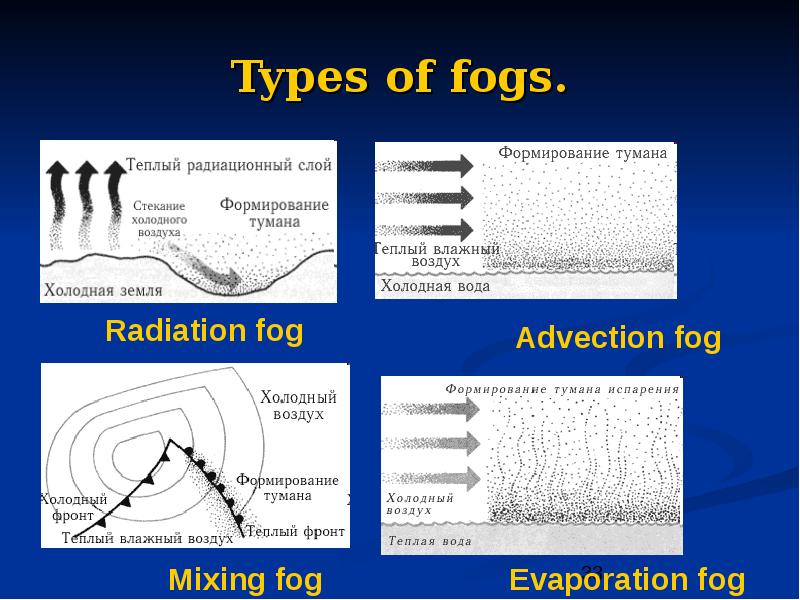
Types of fogs.
Описание слайда:
Types of fogs.

Слайд 34


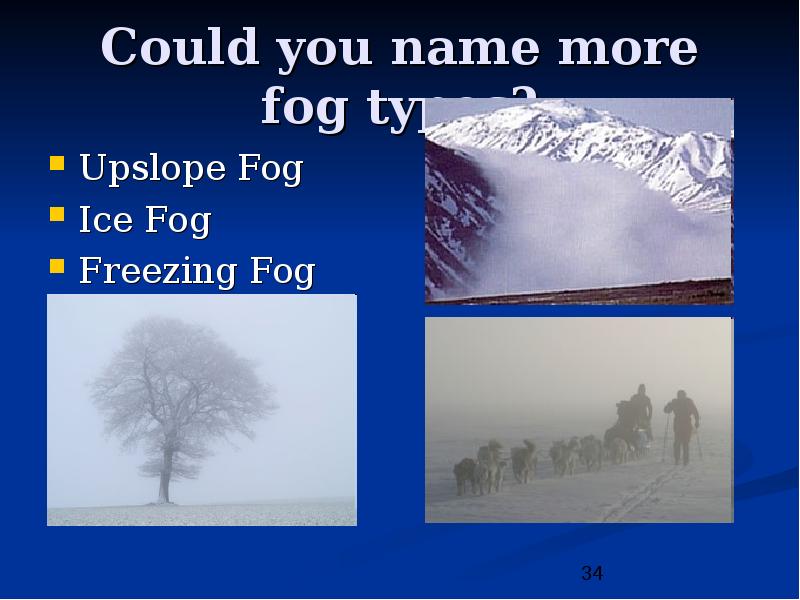
Could you name more fog types? Upslope Fog Ice Fog Freezing Fog
Описание слайда:
Could you name more fog types? Upslope Fog Ice Fog Freezing Fog

Слайд 35


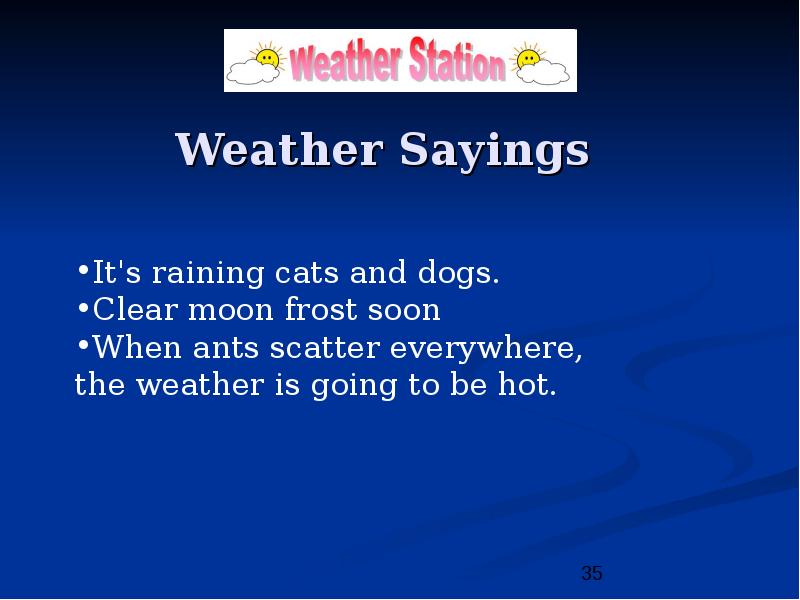
Weather Sayings
Описание слайда:
Weather Sayings


Теги Fogs Haze
Похожие презентации
Mypresentation.ru
Загрузить презентацию