🗊 Презентация History of radioactivity

Категория: Химия
Нажмите для полного просмотра!
History of radioactivity, слайд №1 History of radioactivity, слайд №2 History of radioactivity, слайд №3 History of radioactivity, слайд №4 History of radioactivity, слайд №5 History of radioactivity, слайд №6 History of radioactivity, слайд №7 History of radioactivity, слайд №8 History of radioactivity, слайд №9 History of radioactivity, слайд №10 History of radioactivity, слайд №11 History of radioactivity, слайд №12 History of radioactivity, слайд №13 History of radioactivity, слайд №14 History of radioactivity, слайд №15 History of radioactivity, слайд №16 History of radioactivity, слайд №17 History of radioactivity, слайд №18 History of radioactivity, слайд №19 History of radioactivity, слайд №20 History of radioactivity, слайд №21 History of radioactivity, слайд №22 History of radioactivity, слайд №23 History of radioactivity, слайд №24 History of radioactivity, слайд №25 History of radioactivity, слайд №26 History of radioactivity, слайд №27 History of radioactivity, слайд №28 History of radioactivity, слайд №29 History of radioactivity, слайд №30 History of radioactivity, слайд №31 History of radioactivity, слайд №32 History of radioactivity, слайд №33 History of radioactivity, слайд №34 History of radioactivity, слайд №35 History of radioactivity, слайд №36 History of radioactivity, слайд №37 History of radioactivity, слайд №38 History of radioactivity, слайд №39 History of radioactivity, слайд №40 History of radioactivity, слайд №41 History of radioactivity, слайд №42 History of radioactivity, слайд №43 History of radioactivity, слайд №44 History of radioactivity, слайд №45 History of radioactivity, слайд №46 History of radioactivity, слайд №47 History of radioactivity, слайд №48 History of radioactivity, слайд №49 History of radioactivity, слайд №50 History of radioactivity, слайд №51 History of radioactivity, слайд №52 History of radioactivity, слайд №53 History of radioactivity, слайд №54 History of radioactivity, слайд №55 History of radioactivity, слайд №56 History of radioactivity, слайд №57 History of radioactivity, слайд №58 History of radioactivity, слайд №59 History of radioactivity, слайд №60 History of radioactivity, слайд №61 History of radioactivity, слайд №62 History of radioactivity, слайд №63 History of radioactivity, слайд №64 History of radioactivity, слайд №65 History of radioactivity, слайд №66 History of radioactivity, слайд №67 History of radioactivity, слайд №68 History of radioactivity, слайд №69 History of radioactivity, слайд №70 History of radioactivity, слайд №71 History of radioactivity, слайд №72 History of radioactivity, слайд №73 History of radioactivity, слайд №74 History of radioactivity, слайд №75 History of radioactivity, слайд №76 History of radioactivity, слайд №77 History of radioactivity, слайд №78 History of radioactivity, слайд №79 History of radioactivity, слайд №80 History of radioactivity, слайд №81 History of radioactivity, слайд №82 History of radioactivity, слайд №83 History of radioactivity, слайд №84 History of radioactivity, слайд №85 History of radioactivity, слайд №86

Содержание
Вы можете ознакомиться и скачать презентацию на тему History of radioactivity. Доклад-сообщение содержит 86 слайдов. Презентации для любого класса можно скачать бесплатно. Если материал и наш сайт презентаций Mypresentation Вам понравились – поделитесь им с друзьями с помощью социальных кнопок и добавьте в закладки в своем браузере.
Слайды и текст этой презентации


Слайд 1


History of radioactivity
Описание слайда:
History of radioactivity

Слайд 2


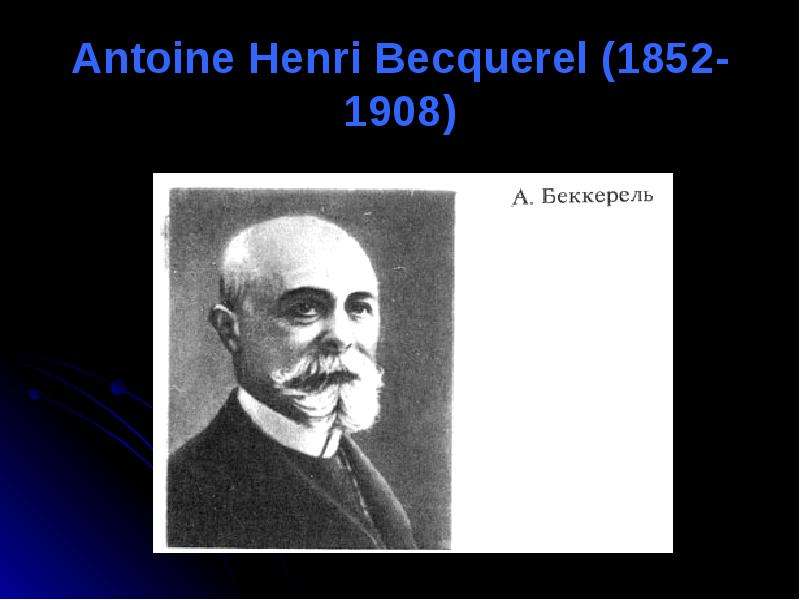
Antoine Henri Becquerel (1852-1908)
Описание слайда:
Antoine Henri Becquerel (1852-1908)

Слайд 3


Henri Becquerel was born into a family of scientists. His grandfather had made important contributions in the field of electrochemistry while his...
Описание слайда:

Henri Becquerel was born into a family of scientists. His grandfather had made important contributions in the field of electrochemistry while his father had investigated the phenomena of fluorescence and phosphorescence. Becquerel not only inherited their interest in science, he also inherited the minerals and compounds studied by his farther.

Слайд 4


And so, upon learning how Wilhelm Roentgen discovered x-rays from the fluorescence they produced, Becquerel had ready source of fluorescent materials...
Описание слайда:

And so, upon learning how Wilhelm Roentgen discovered x-rays from the fluorescence they produced, Becquerel had ready source of fluorescent materials with which to pursue his own investigations of these mysterious rays.

Слайд 5


The material Becquerel chose to work with was potassium uranyl sulphate, K2UO2 (SO4 )2, which he exposed to sunlight and placed on photographic...
Описание слайда:

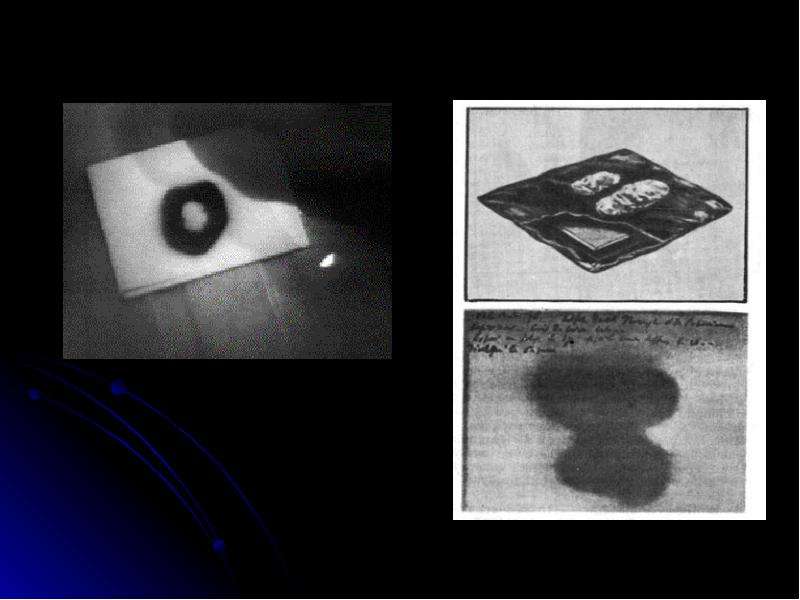
The material Becquerel chose to work with was potassium uranyl sulphate, K2UO2 (SO4 )2, which he exposed to sunlight and placed on photographic plates wrapped in black paper. When developed, the plates revealed an image of the uranium crystals.

Слайд 6


Becquerel concluded “that the phosphorescence substance in question emits radiation which penetrates paper opaque to light”. Initially he believed...
Описание слайда:

Becquerel concluded “that the phosphorescence substance in question emits radiation which penetrates paper opaque to light”. Initially he believed that the sun’s energy was being absorbed by the uranium which then emitted x rays.

Слайд 7


History of radioactivity, слайд №7
Описание слайда:

Слайд 8


Further investigation, on the 26th and 27th of February, was delayed because the skies over Paris were overcast and the uranium-covered plates...
Описание слайда:
Further investigation, on the 26th and 27th of February, was delayed because the skies over Paris were overcast and the uranium-covered plates Becquerel intended to expose to the sun were returned to a drawer.

Слайд 9


On the first of March, he developed the photographic plates expecting only faint images to appear. To his surprise, the images were clear and strong....
Описание слайда:
On the first of March, he developed the photographic plates expecting only faint images to appear. To his surprise, the images were clear and strong. On the first of March, he developed the photographic plates expecting only faint images to appear. To his surprise, the images were clear and strong.

Слайд 10


This meant that the uranium emitted radiation without an external source of energy such as the sun. Becquerel had discovered radioactivity, the...
Описание слайда:
This meant that the uranium emitted radiation without an external source of energy such as the sun. Becquerel had discovered radioactivity, the spontaneous emission of radiation by a material. This meant that the uranium emitted radiation without an external source of energy such as the sun. Becquerel had discovered radioactivity, the spontaneous emission of radiation by a material.

Слайд 11


Later, Becquerel demonstrated that the radiation emitted by uranium shared certain characteristic with x-rays but, unlike x-rays, could be deflected...
Описание слайда:
Later, Becquerel demonstrated that the radiation emitted by uranium shared certain characteristic with x-rays but, unlike x-rays, could be deflected by a magnetic field and therefore must consist of charged particles. For his discovery of radioactivity, Becquerel was awarded the 1903 Nobel Prize for physics.

Слайд 12


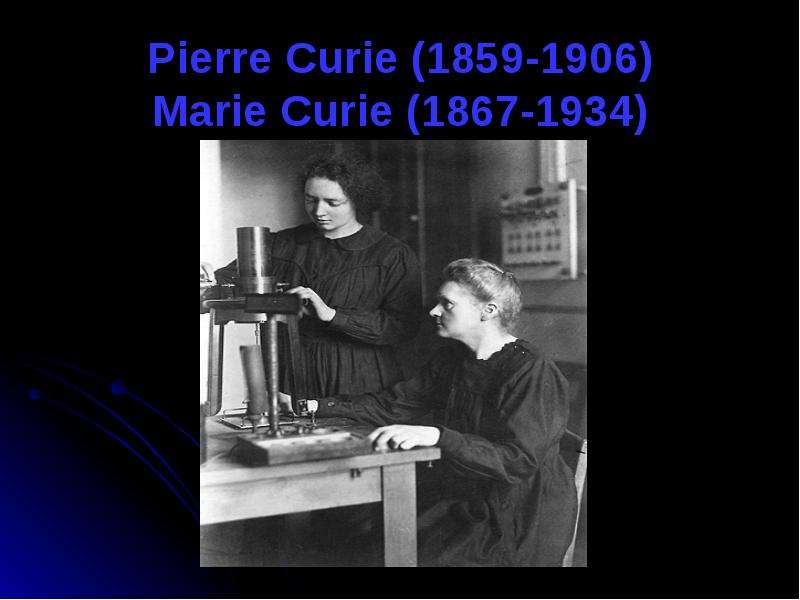
Pierre Curie (1859-1906) Marie Curie (1867-1934)
Описание слайда:
Pierre Curie (1859-1906) Marie Curie (1867-1934)

Слайд 13


Pierre Curie and Marie Curie began investigating the phenomenon of radioactivity recently discovered in uranium ore. After chemical extraction of...
Описание слайда:
Pierre Curie and Marie Curie began investigating the phenomenon of radioactivity recently discovered in uranium ore. After chemical extraction of uranium from the ore, Marie noted the residual material to be more “active” than the pure uranium.

Слайд 14


She concluded that the ore contained, in addition to uranium, new elements that were also radioactive. This led to their discoveries of the elements...
Описание слайда:
She concluded that the ore contained, in addition to uranium, new elements that were also radioactive. This led to their discoveries of the elements of polonium and radium, but it took four more years of processing tons of ore under oppressive conditions to isolate enough of each element to determine its chemical properties. She concluded that the ore contained, in addition to uranium, new elements that were also radioactive. This led to their discoveries of the elements of polonium and radium, but it took four more years of processing tons of ore under oppressive conditions to isolate enough of each element to determine its chemical properties.

Слайд 15


For their work on radioactivity, the Curies were awarded the 1903 Nobel Prize in physics. For their work on radioactivity, the Curies were awarded...
Описание слайда:
For their work on radioactivity, the Curies were awarded the 1903 Nobel Prize in physics. For their work on radioactivity, the Curies were awarded the 1903 Nobel Prize in physics. Tragically, Pierre was killed three years later in an accident while crossing a street in a rainstorm.

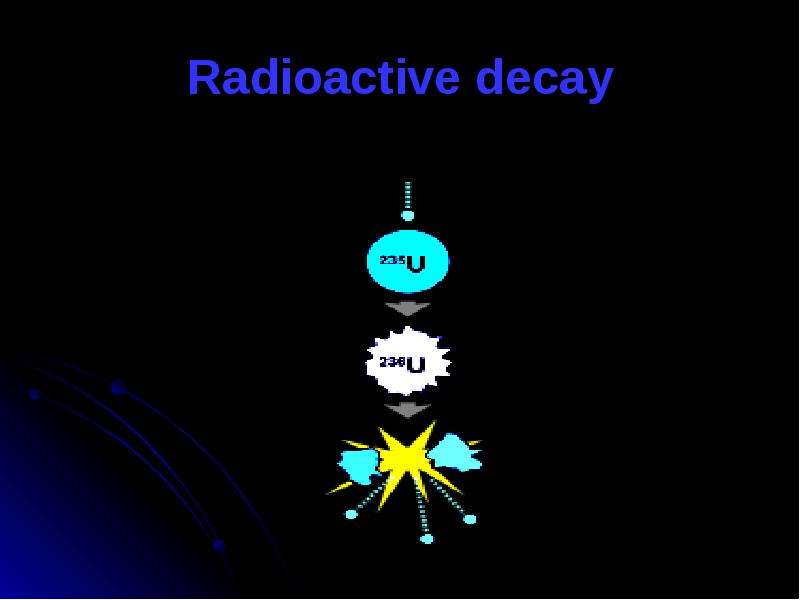
Слайд 16


Pierre’s teaching position at the Sorbonne was given to Marie. Never before had a woman taught there. A year later, Marie was awarded the Nobel Prize...
Описание слайда:
Pierre’s teaching position at the Sorbonne was given to Marie. Never before had a woman taught there. A year later, Marie was awarded the Nobel Prize in chemistry for her discoveries of radium and polonium, thus becoming the first person to receive two Nobel Prizes. For the remainder of her life she tirelessly investigated and promoted the use if radium as a treatment for cancer. Marie Curie died 1935, overtaken by pernicious anemia no doubt caused by years of overwork and radiation exposure. Pierre’s teaching position at the Sorbonne was given to Marie. Never before had a woman taught there. A year later, Marie was awarded the Nobel Prize in chemistry for her discoveries of radium and polonium, thus becoming the first person to receive two Nobel Prizes. For the remainder of her life she tirelessly investigated and promoted the use if radium as a treatment for cancer. Marie Curie died 1935, overtaken by pernicious anemia no doubt caused by years of overwork and radiation exposure.

Слайд 17


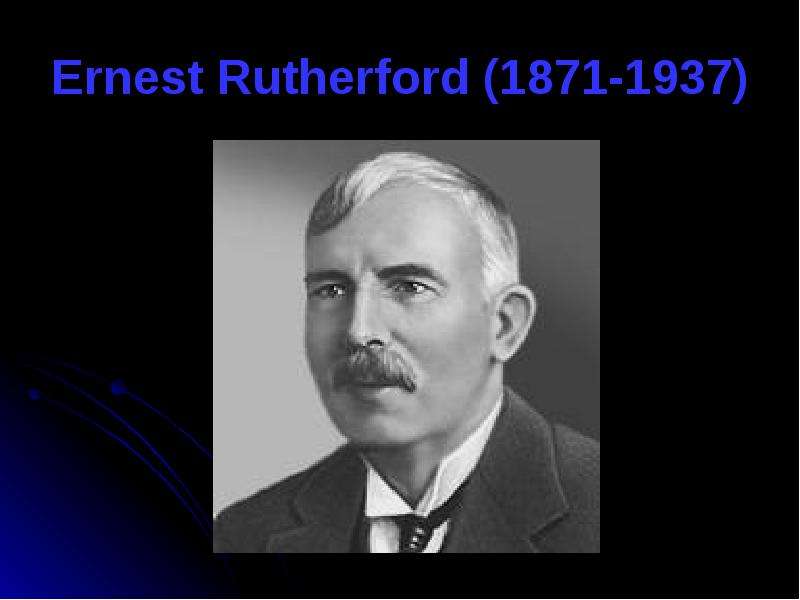
Ernest Rutherford (1871-1937)
Описание слайда:
Ernest Rutherford (1871-1937)

Слайд 18


Ernest Rutherford is considered the father of nuclear physics. Indeed, it could be said that Rutherford invented the very language to describe the...
Описание слайда:
Ernest Rutherford is considered the father of nuclear physics. Indeed, it could be said that Rutherford invented the very language to describe the theoretical concepts of the atom and the phenomenon of radioactivity. Particles named and characterized by him include the alpha particle, beta particle and proton.

Слайд 19


Even the neutron, discovered by James Chadwick, owes its name to Rutherford. Purpose by Rutherford and he was the first to elucidate the related...
Описание слайда:
Even the neutron, discovered by James Chadwick, owes its name to Rutherford. Purpose by Rutherford and he was the first to elucidate the related concepts of the half-life and decay constant. With Frederick Soddy at McGill University, Rutherford showed that elements such as uranium and thorium became different elements through the process of radioactive decay.

Слайд 20


For this work, Rutherford won the 1908 Nobel Prize in chemistry. In 1909, now at the University of Manchester, Rutherford was bombarding a thin gold...
Описание слайда:
For this work, Rutherford won the 1908 Nobel Prize in chemistry. In 1909, now at the University of Manchester, Rutherford was bombarding a thin gold foil with alpha particles when he noticed that although almost all of them went through the gold, one in eight thousand would “bounce” back. The amazed Rutherford commented that it was “as if you fired a 15-inch naval shell at a piece of tissue paper and the shell came right back and hit you”. For this work, Rutherford won the 1908 Nobel Prize in chemistry. In 1909, now at the University of Manchester, Rutherford was bombarding a thin gold foil with alpha particles when he noticed that although almost all of them went through the gold, one in eight thousand would “bounce” back. The amazed Rutherford commented that it was “as if you fired a 15-inch naval shell at a piece of tissue paper and the shell came right back and hit you”.

Слайд 21


From this simple observation, Rutherford concluded that the atom’s mass must be concentrated in a small positively-charged nucleus while the...
Описание слайда:
From this simple observation, Rutherford concluded that the atom’s mass must be concentrated in a small positively-charged nucleus while the electrons inhabit the farthest reaches of the atom. Although this planetary model of the atom has been greatly refined over the years, it remains as valid today as when it was originally formulated by Rutherford.

Слайд 22


In 1919, Rutherford returned to Cambridge to become director of the Cavendish laboratory where he had previously done his graduate work under...
Описание слайда:
In 1919, Rutherford returned to Cambridge to become director of the Cavendish laboratory where he had previously done his graduate work under J.J.Thomson. In 1919, Rutherford returned to Cambridge to become director of the Cavendish laboratory where he had previously done his graduate work under J.J.Thomson.

Слайд 23


It was here that he made his final major achievement, the artificial alteration of nuclear and atomic structure. By bombarding nitrogen with alpha...
Описание слайда:
It was here that he made his final major achievement, the artificial alteration of nuclear and atomic structure. By bombarding nitrogen with alpha particles, Rutherford demonstrated the production of a different element, oxygen. “Playing with marbles” is what he called; the newspapers reported that Rutherford had “split the atom”.

Слайд 24


What is ionizing radiation? Ionizing radiation is radiation that has sufficient energy to remove orbital electrons from atoms, leading to the...
Описание слайда:
What is ionizing radiation? Ionizing radiation is radiation that has sufficient energy to remove orbital electrons from atoms, leading to the formation of ions.

Слайд 25


One source of radiation is the nuclei of unstable atoms. For these radioactive atoms (also referred to as radionuclides or radioisotopes) to become...
Описание слайда:
One source of radiation is the nuclei of unstable atoms. For these radioactive atoms (also referred to as radionuclides or radioisotopes) to become more stable, the nuclei eject or emit subatomic particles and high-energy photons (gamma rays). This process is called radioactive decay.

Слайд 26


Unstable isotopes of radium, radon, uranium, and thorium, for example, exist naturally. Others are continually being made naturally or by human...
Описание слайда:
Unstable isotopes of radium, radon, uranium, and thorium, for example, exist naturally. Others are continually being made naturally or by human activities, such as the splitting of atoms in a nuclear reactor. Either way, they release ionizing radiation. Unstable isotopes of radium, radon, uranium, and thorium, for example, exist naturally. Others are continually being made naturally or by human activities, such as the splitting of atoms in a nuclear reactor. Either way, they release ionizing radiation.

Слайд 27


Types of ionizing radiation alpha particle radiation beta particle radiation gamma ray radiation x-ray Radiation
Описание слайда:
Types of ionizing radiation alpha particle radiation beta particle radiation gamma ray radiation x-ray Radiation

Слайд 28


Alpha Particle Radiation An alpha particle consists of two neutrons and two protons ejected from the nucleus of an atom. The alpha particle is...
Описание слайда:
Alpha Particle Radiation An alpha particle consists of two neutrons and two protons ejected from the nucleus of an atom. The alpha particle is identical to the nucleus of a helium atom. Examples of alpha emitters are radium, radon, thorium, and uranium.

Слайд 29


The a-rays are positively charged. Because alpha particles are charged and relatively heavy, they interact intensely with atoms in materials they...
Описание слайда:
The a-rays are positively charged. Because alpha particles are charged and relatively heavy, they interact intensely with atoms in materials they encounter, giving up their energy over a very short range. In air, their travel distances are limited to approximately an inch.

Слайд 30


Alpha particles are easily shielded against and can be stopped by a single sheet of paper. Since alpha particles cannot penetrate the dead layer of...
Описание слайда:
Alpha particles are easily shielded against and can be stopped by a single sheet of paper. Since alpha particles cannot penetrate the dead layer of the skin, they do not present a hazard from exposure external to the body.

Слайд 31


However, due to the very large number of ionizations they produce in a very short distance, alpha emitters can present a serious hazard when they are...
Описание слайда:
However, due to the very large number of ionizations they produce in a very short distance, alpha emitters can present a serious hazard when they are in close proximity to cells and tissues such as the lung. Special precautions are taken to ensure that alpha emitters are not inhaled, ingested or injected. However, due to the very large number of ionizations they produce in a very short distance, alpha emitters can present a serious hazard when they are in close proximity to cells and tissues such as the lung. Special precautions are taken to ensure that alpha emitters are not inhaled, ingested or injected.

Слайд 32


Beta Particle Radiation A beta particle is an electron emitted from the nucleus of a radioactive atom. Examples of beta emitters commonly used in...
Описание слайда:
Beta Particle Radiation A beta particle is an electron emitted from the nucleus of a radioactive atom. Examples of beta emitters commonly used in biological research are: hydrogen-3 (tritium), carbon-14, phosphorus-32, phosphorus-33, and sulfur-35.

Слайд 33


Beta particles are much less massive and less charged than alpha particles and interact less intensely with atoms in the materials they pass through,...
Описание слайда:
Beta particles are much less massive and less charged than alpha particles and interact less intensely with atoms in the materials they pass through, which give them a longer range than alpha particles.

Слайд 34


Some energetic beta particles, such as those from P-32 (phosphorus), will travel up to several feet in air or approximately one half of an inch into...
Описание слайда:
Some energetic beta particles, such as those from P-32 (phosphorus), will travel up to several feet in air or approximately one half of an inch into the skin, while low energy beta particles, such as those from H-3 (hydrogen), are not capable of penetrating the dead layer of the skin. Thin layers of metal or plastic stop beta particles

Слайд 35


All beta emitters, depending on the amount present, can pose a hazard if inhaled, ingested or absorbed into the body. In addition, energetic beta...
Описание слайда:
All beta emitters, depending on the amount present, can pose a hazard if inhaled, ingested or absorbed into the body. In addition, energetic beta emitters are capable of presenting an external radiation hazard, especially to the skin.

Слайд 36


Gamma Ray Radiation A gamma ray is a packet (or photon) of electromagnetic radiation emitted from the nucleus during radioactive decay and...
Описание слайда:
Gamma Ray Radiation A gamma ray is a packet (or photon) of electromagnetic radiation emitted from the nucleus during radioactive decay and occasionally accompanying the emission of an alpha or beta particle. Gamma rays are identical in nature to other electromagnetic radiations such as light or microwaves but are of much higher energy. Examples of gamma emitters are cobalt-60, zinc-65, cesium-137, and radium-226.

Слайд 37


Gamma rays are identical in nature to other electromagnetic radiations such as light or microwaves but are of much higher energy. Examples of gamma...
Описание слайда:
Gamma rays are identical in nature to other electromagnetic radiations such as light or microwaves but are of much higher energy. Examples of gamma emitters are cobalt-60, zinc-65, cesium-137, and radium-226 Gamma rays are identical in nature to other electromagnetic radiations such as light or microwaves but are of much higher energy. Examples of gamma emitters are cobalt-60, zinc-65, cesium-137, and radium-226

Слайд 38


Like all forms of electromagnetic radiation, gamma rays have no mass or charge and interact less intensively with matter than ionizing particles....
Описание слайда:
Like all forms of electromagnetic radiation, gamma rays have no mass or charge and interact less intensively with matter than ionizing particles. Because gamma radiation loses energy slowly, gamma rays are able to travel significant distances. Depending upon their initial energy, gamma rays can travel tens or hundreds of feet in air.

Слайд 39


Gamma radiation is typically shielded using very dense materials (the denser the material, the more chance that a gamma ray will interact with atoms...
Описание слайда:
Gamma radiation is typically shielded using very dense materials (the denser the material, the more chance that a gamma ray will interact with atoms in the material) such as lead or other dense metals. Gamma radiation is typically shielded using very dense materials (the denser the material, the more chance that a gamma ray will interact with atoms in the material) such as lead or other dense metals. Gamma radiation particularly can present a hazard from exposures external to the body.

Слайд 40


X-Ray Radiation Like a gamma ray, an x-ray is a packet (or photon) of electromagnetic radiation emitted from an atom, except that the x-ray is not...
Описание слайда:
X-Ray Radiation Like a gamma ray, an x-ray is a packet (or photon) of electromagnetic radiation emitted from an atom, except that the x-ray is not emitted from the nucleus.

Слайд 41


X-rays are produced as the result of changes in the positions of the electrons orbiting the nucleus, as the electrons shift to different energy...
Описание слайда:
X-rays are produced as the result of changes in the positions of the electrons orbiting the nucleus, as the electrons shift to different energy levels. Examples of x-ray emitting radioisotopes are iodine-125 and iodine-131. X-rays are produced as the result of changes in the positions of the electrons orbiting the nucleus, as the electrons shift to different energy levels. Examples of x-ray emitting radioisotopes are iodine-125 and iodine-131.

Слайд 42


X-rays can be produced during the process of radioactive decay or as bremsstrahlung radiation. Bremsstrahlung radiation is x-rays produced when...
Описание слайда:
X-rays can be produced during the process of radioactive decay or as bremsstrahlung radiation. Bremsstrahlung radiation is x-rays produced when high-energy electrons strike a target made of a heavy metal, such as tungsten or copper. X-rays can be produced during the process of radioactive decay or as bremsstrahlung radiation. Bremsstrahlung radiation is x-rays produced when high-energy electrons strike a target made of a heavy metal, such as tungsten or copper.

Слайд 43


As electrons collide with this material, some have their paths deflected by the nucleus of the metal atoms. This deflection results in the production...
Описание слайда:
As electrons collide with this material, some have their paths deflected by the nucleus of the metal atoms. This deflection results in the production of x-rays as the electrons lose energy. This is the process by which an x-ray machine produces x-rays. As electrons collide with this material, some have their paths deflected by the nucleus of the metal atoms. This deflection results in the production of x-rays as the electrons lose energy. This is the process by which an x-ray machine produces x-rays.

Слайд 44


Like gamma rays, x-rays are typically shielded using very dense materials such as lead or other dense metals. Like gamma rays, x-rays are typically...
Описание слайда:
Like gamma rays, x-rays are typically shielded using very dense materials such as lead or other dense metals. Like gamma rays, x-rays are typically shielded using very dense materials such as lead or other dense metals. X-rays particularly can present a hazard from exposures external to the body.

Слайд 45


Non-ionizing Radiation Nonionizing radiations are not energetic enough to ionize atoms and interact with materials in ways that create different...
Описание слайда:
Non-ionizing Radiation Nonionizing radiations are not energetic enough to ionize atoms and interact with materials in ways that create different hazards than ionizing radiation.

Слайд 46


Examples of nonionizing radiation include: Examples of nonionizing radiation include: Microwaves Visible Light Radio Waves TV Waves Ultraviolet Light
Описание слайда:
Examples of nonionizing radiation include: Examples of nonionizing radiation include: Microwaves Visible Light Radio Waves TV Waves Ultraviolet Light

Слайд 47


Natural radioactivity Definition: it is defined as the radioactivity displayed by natural isotopes of elements. For example: All the elements with...
Описание слайда:
Natural radioactivity Definition: it is defined as the radioactivity displayed by natural isotopes of elements. For example: All the elements with atomic number greater than 82 are radioactive. Radioactivity shown by radon and uranium. (f.e.a, b, y).

Слайд 48


Artificial radioactivity Definition: artificial radioactivity is defined as the process of changing common stable nuclei of atoms into unstable...
Описание слайда:
Artificial radioactivity Definition: artificial radioactivity is defined as the process of changing common stable nuclei of atoms into unstable radioactive nuclei which decay at their own rate. It is called induced radioactivity.

Слайд 49


Fredric and Irene Curie shared the 1935 Nobel Prize in chemistry for their investigations on the reaction of alpha particle with some of lighter...
Описание слайда:
Fredric and Irene Curie shared the 1935 Nobel Prize in chemistry for their investigations on the reaction of alpha particle with some of lighter elements such as boron, magnesium and aluminium. They found that when the aluminium is bombarded with alpha particle then neutron was produced.

Слайд 50


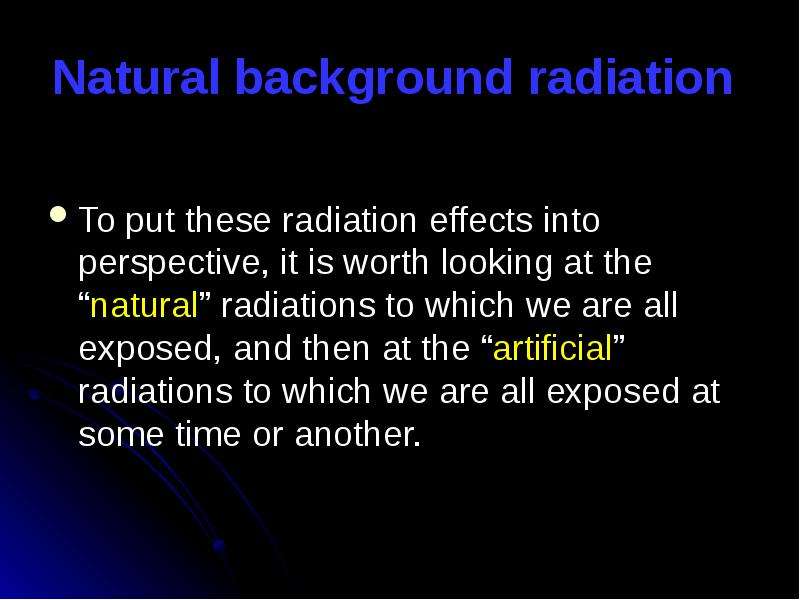
Natural background radiation To put these radiation effects into perspective, it is worth looking at the “natural” radiations to which we are all...
Описание слайда:
Natural background radiation To put these radiation effects into perspective, it is worth looking at the “natural” radiations to which we are all exposed, and then at the “artificial” radiations to which we are all exposed at some time or another.

Слайд 51


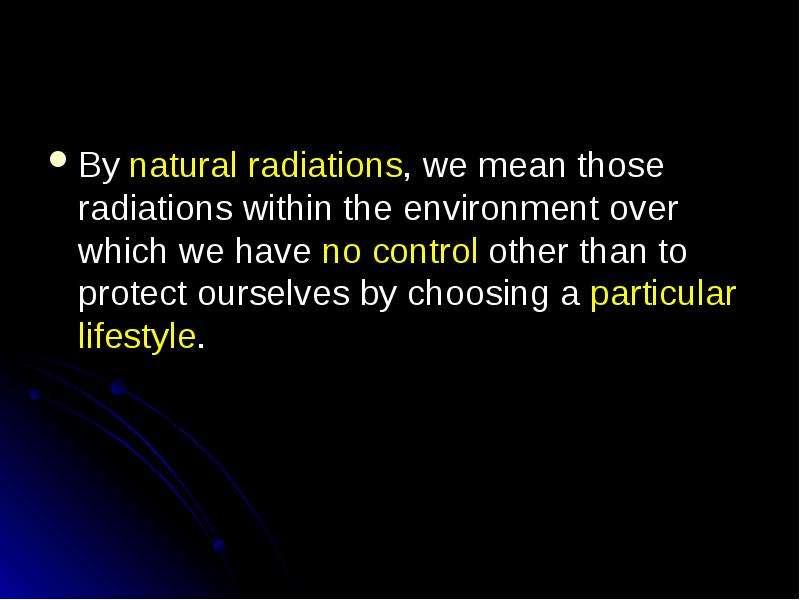
By natural radiations, we mean those radiations within the environment over which we have no control other than to protect ourselves by choosing a...
Описание слайда:
By natural radiations, we mean those radiations within the environment over which we have no control other than to protect ourselves by choosing a particular lifestyle.

Слайд 52


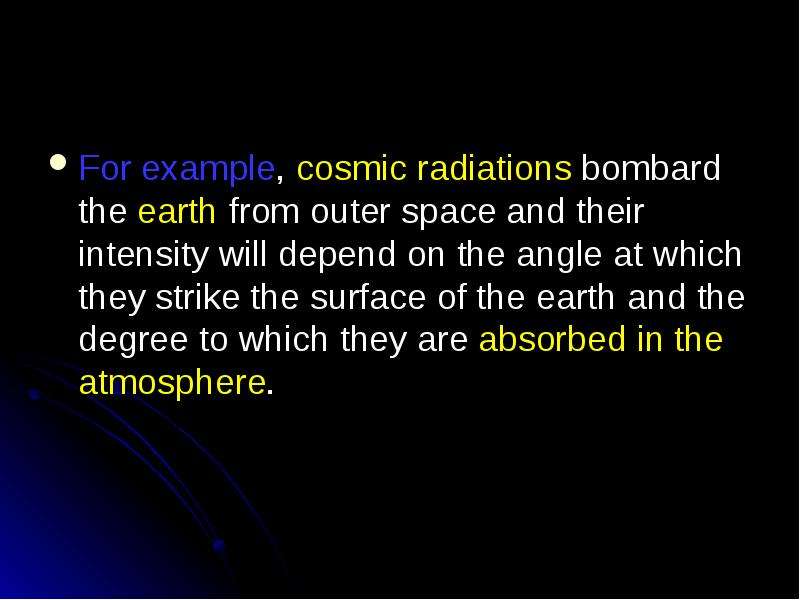
For example, cosmic radiations bombard the earth from outer space and their intensity will depend on the angle at which they strike the surface of...
Описание слайда:
For example, cosmic radiations bombard the earth from outer space and their intensity will depend on the angle at which they strike the surface of the earth and the degree to which they are absorbed in the atmosphere. For example, cosmic radiations bombard the earth from outer space and their intensity will depend on the angle at which they strike the surface of the earth and the degree to which they are absorbed in the atmosphere.

Слайд 53


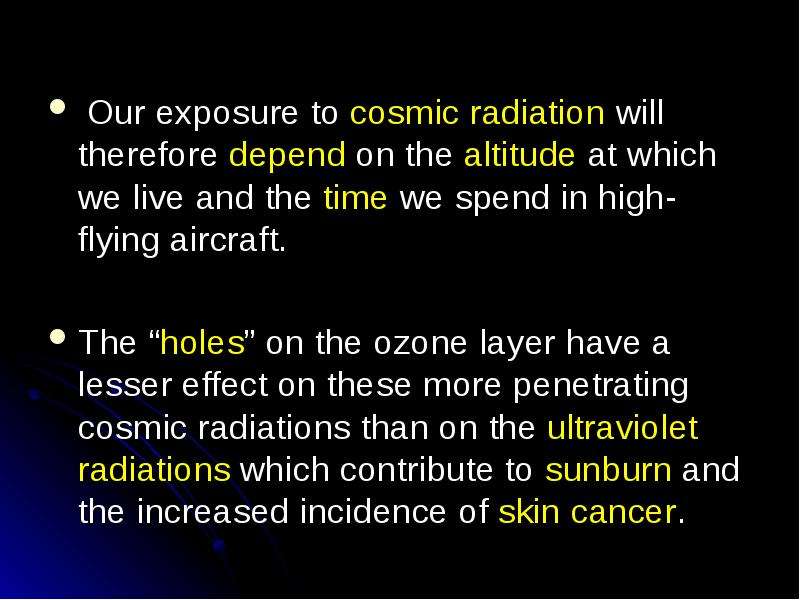
Our exposure to cosmic radiation will therefore depend on the altitude at which we live and the time we spend in high-flying aircraft. The “holes” on...
Описание слайда:
Our exposure to cosmic radiation will therefore depend on the altitude at which we live and the time we spend in high-flying aircraft. The “holes” on the ozone layer have a lesser effect on these more penetrating cosmic radiations than on the ultraviolet radiations which contribute to sunburn and the increased incidence of skin cancer.

Слайд 54


The major source of “natural” radiation is the gas radon. Radon permeates through the rocks into the atmosphere. In addition, there is the smaller...
Описание слайда:
The major source of “natural” radiation is the gas radon. Radon permeates through the rocks into the atmosphere. In addition, there is the smaller component from the “artificial” or “man-made" sources of radiation amounting, on average to about 0.3 mSv per annum. Most of this comes from the diagnostic uses of x-ray.

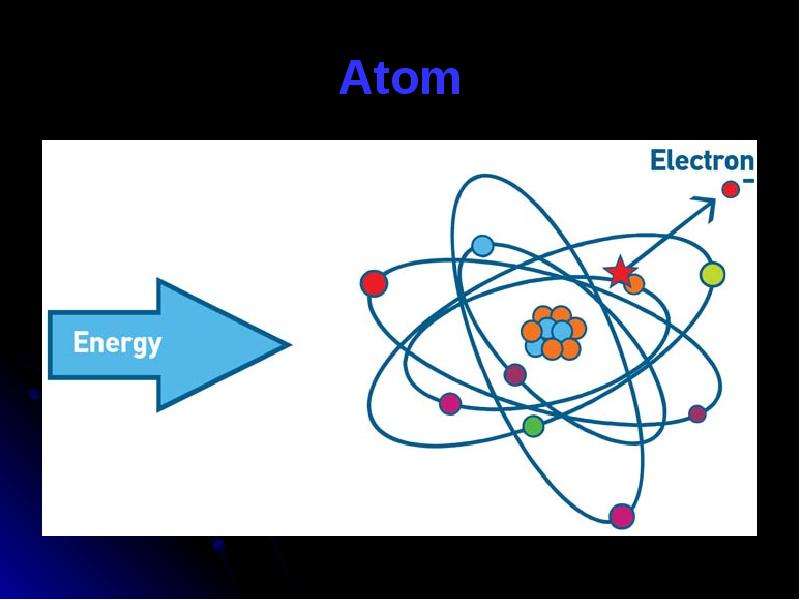
Слайд 55


Atom
Описание слайда:
Atom

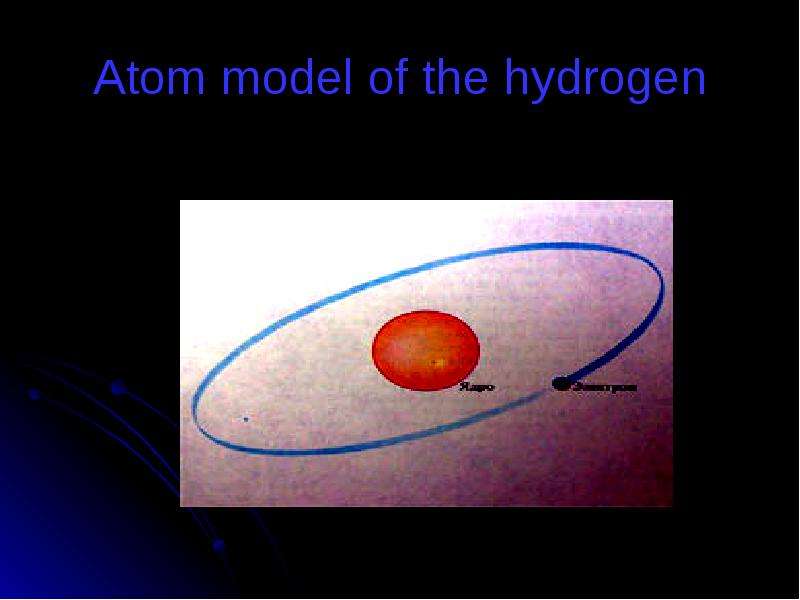
Слайд 56


Atom model of the hydrogen
Описание слайда:
Atom model of the hydrogen

Слайд 57


Atom model There are three parts of an atom: protons neutron electrons
Описание слайда:
Atom model There are three parts of an atom: protons neutron electrons

Слайд 58


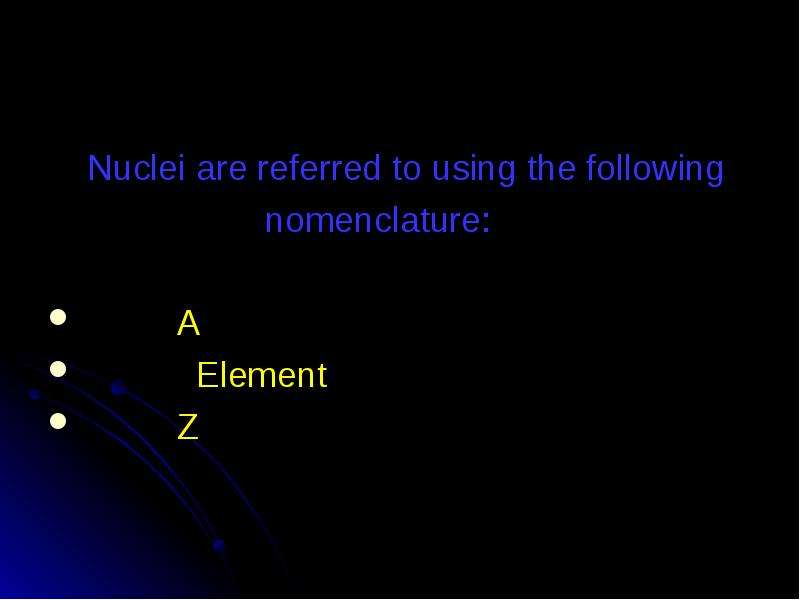
Nuclei are referred to using the following Nuclei are referred to using the following nomenclature: A Element Z
Описание слайда:
Nuclei are referred to using the following Nuclei are referred to using the following nomenclature: A Element Z

Слайд 59


Z is the atomic number. It characterizes the element. It also the number of protons. Since protons carry all the positive charge in a nucleus, Z also...
Описание слайда:
Z is the atomic number. It characterizes the element. It also the number of protons. Since protons carry all the positive charge in a nucleus, Z also is the number of electrons in a neutral atom.

Слайд 60


A is called the “mass number” and is equal to the sum of Z and neutrons. Collectively, neutrons and protons are called “nucleons”.
Описание слайда:
A is called the “mass number” and is equal to the sum of Z and neutrons. Collectively, neutrons and protons are called “nucleons”.

Слайд 61


A species of nucleus of given Z and A is called nuclide. Nuclides of an element (i.e. same Z) with different A are called isotopes. Nuclides having...
Описание слайда:
A species of nucleus of given Z and A is called nuclide. Nuclides of an element (i.e. same Z) with different A are called isotopes. Nuclides having the same neutrons are called isotones, and nuclides having the same A are called isobars. A species of nucleus of given Z and A is called nuclide. Nuclides of an element (i.e. same Z) with different A are called isotopes. Nuclides having the same neutrons are called isotones, and nuclides having the same A are called isobars.

Слайд 62


The proton is the part of an atom that helps to form the nucleus and has a positive charge. Protons must have an equal number of neutrons except...
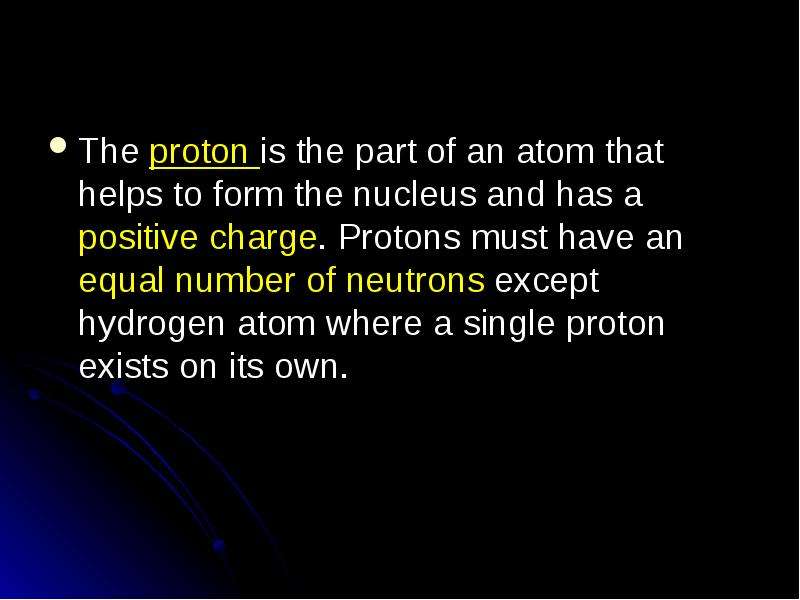
Описание слайда:
The proton is the part of an atom that helps to form the nucleus and has a positive charge. Protons must have an equal number of neutrons except hydrogen atom where a single proton exists on its own.

Слайд 63


A neutron is the part of an atom that holds no charge. Neutrons and protons occur in equal numbers in stable atoms except in hydrogen. Protons and...
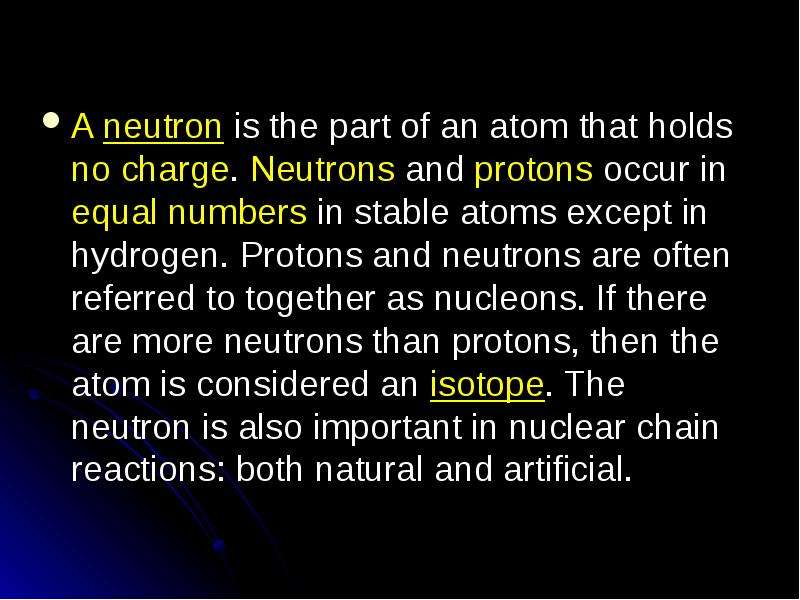
Описание слайда:
A neutron is the part of an atom that holds no charge. Neutrons and protons occur in equal numbers in stable atoms except in hydrogen. Protons and neutrons are often referred to together as nucleons. If there are more neutrons than protons, then the atom is considered an isotope. The neutron is also important in nuclear chain reactions: both natural and artificial.

Слайд 64


Electrons are the smallest parts of the atom and have a negative charge. They are the most numerous of the three. It has no known components or...
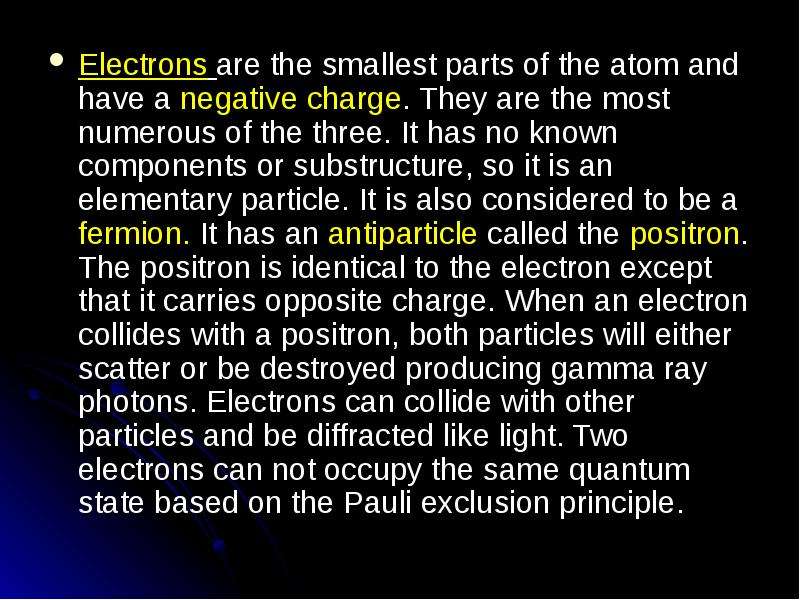
Описание слайда:
Electrons are the smallest parts of the atom and have a negative charge. They are the most numerous of the three. It has no known components or substructure, so it is an elementary particle. It is also considered to be a fermion. It has an antiparticle called the positron. The positron is identical to the electron except that it carries opposite charge. When an electron collides with a positron, both particles will either scatter or be destroyed producing gamma ray photons. Electrons can collide with other particles and be diffracted like light. Two electrons can not occupy the same quantum state based on the Pauli exclusion principle. Electrons are the smallest parts of the atom and have a negative charge. They are the most numerous of the three. It has no known components or substructure, so it is an elementary particle. It is also considered to be a fermion. It has an antiparticle called the positron. The positron is identical to the electron except that it carries opposite charge. When an electron collides with a positron, both particles will either scatter or be destroyed producing gamma ray photons. Electrons can collide with other particles and be diffracted like light. Two electrons can not occupy the same quantum state based on the Pauli exclusion principle.

Слайд 65


The positron is identical to the electron except that it carries opposite charge. When an electron collides with a positron, both particles will...
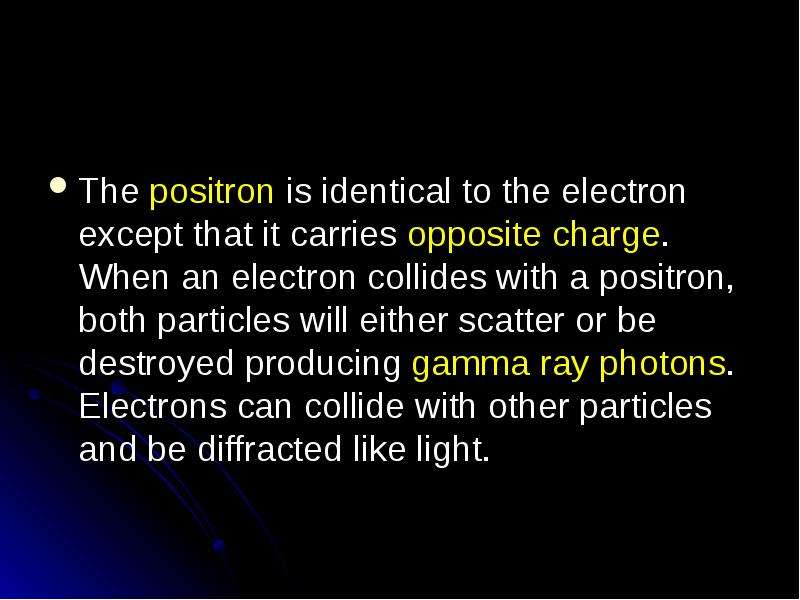
Описание слайда:
The positron is identical to the electron except that it carries opposite charge. When an electron collides with a positron, both particles will either scatter or be destroyed producing gamma ray photons. Electrons can collide with other particles and be diffracted like light.

Слайд 66


Radioactive decay
Описание слайда:
Radioactive decay

Слайд 67


Radioactive decay is the process in which an unstable atomic nucleus spontaneously loses energy by emitting ionizing particles and radiation. This...
Описание слайда:
Radioactive decay is the process in which an unstable atomic nucleus spontaneously loses energy by emitting ionizing particles and radiation. This decay, or loss of energy, results in an atom of one type, called the parent nuclide transforming to an atom of a different type, named the daughter nuclide.

Слайд 68


For example: a carbon-14 atom (the “parent”) emits radiation and transforms to a nitrogen-14 atom (the “daughter”). This is a stochastic process on...
Описание слайда:
For example: a carbon-14 atom (the “parent”) emits radiation and transforms to a nitrogen-14 atom (the “daughter”). This is a stochastic process on the atomic level, in that it is impossible to predict when a given atom will decay, but given a large number of similar atoms the decay rate, on average, is predictable. For example: a carbon-14 atom (the “parent”) emits radiation and transforms to a nitrogen-14 atom (the “daughter”). This is a stochastic process on the atomic level, in that it is impossible to predict when a given atom will decay, but given a large number of similar atoms the decay rate, on average, is predictable.

Слайд 69


The SI (international system) unit of activity is the bequerel (Bq). One Bq is defined as one transformation (or decay) per second.
Описание слайда:
The SI (international system) unit of activity is the bequerel (Bq). One Bq is defined as one transformation (or decay) per second.

Слайд 70


Half-life Half-life is the period of time it takes for a substance undergoing decay to decrease by half. The name originally was used to describe a...
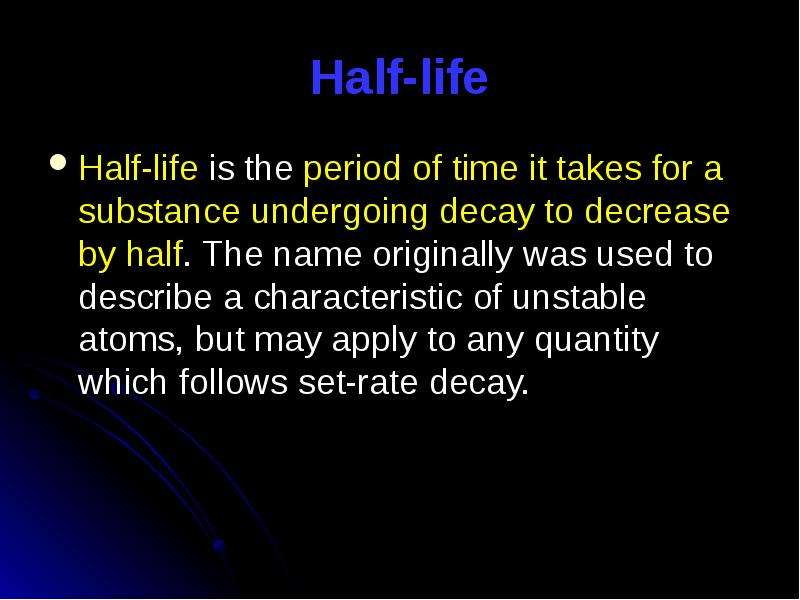
Описание слайда:
Half-life Half-life is the period of time it takes for a substance undergoing decay to decrease by half. The name originally was used to describe a characteristic of unstable atoms, but may apply to any quantity which follows set-rate decay.

Слайд 71


For example: consider 10 kg of radioelement with a half-life of 1 hour. In the first hour 5 kg will disintegrate. In this manner in each successive...
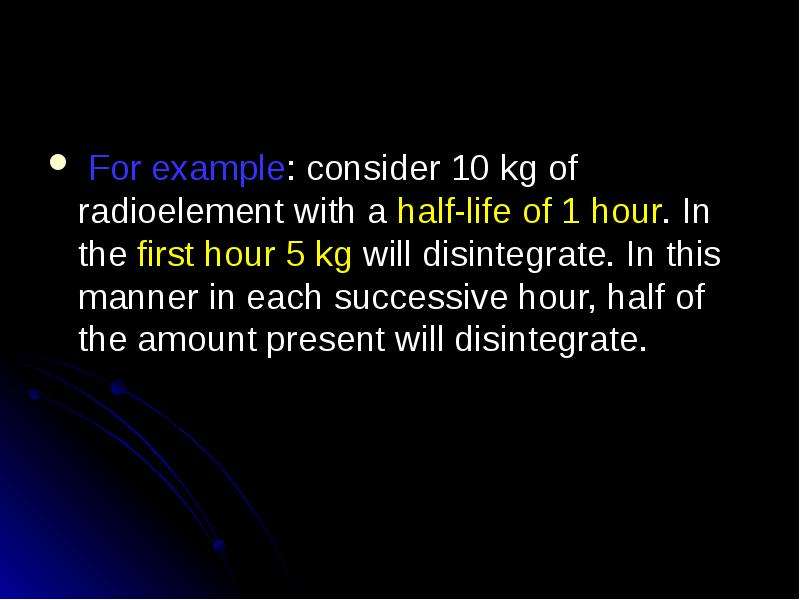
Описание слайда:
For example: consider 10 kg of radioelement with a half-life of 1 hour. In the first hour 5 kg will disintegrate. In this manner in each successive hour, half of the amount present will disintegrate. For example: consider 10 kg of radioelement with a half-life of 1 hour. In the first hour 5 kg will disintegrate. In this manner in each successive hour, half of the amount present will disintegrate.

Слайд 72


Initially, the rate of disintegration is rapid, but it becomes slower as time passes. The fraction can never be zero. All the atoms of any...
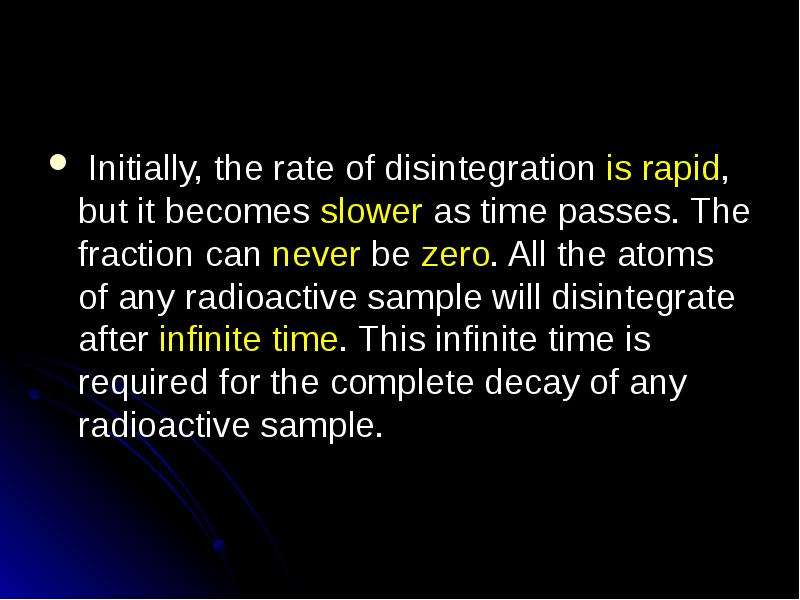
Описание слайда:
Initially, the rate of disintegration is rapid, but it becomes slower as time passes. The fraction can never be zero. All the atoms of any radioactive sample will disintegrate after infinite time. This infinite time is required for the complete decay of any radioactive sample. Initially, the rate of disintegration is rapid, but it becomes slower as time passes. The fraction can never be zero. All the atoms of any radioactive sample will disintegrate after infinite time. This infinite time is required for the complete decay of any radioactive sample.

Слайд 73


Therefore, for comparison between different radioactive substances we consider the quantity called the half-life of the half value period of...
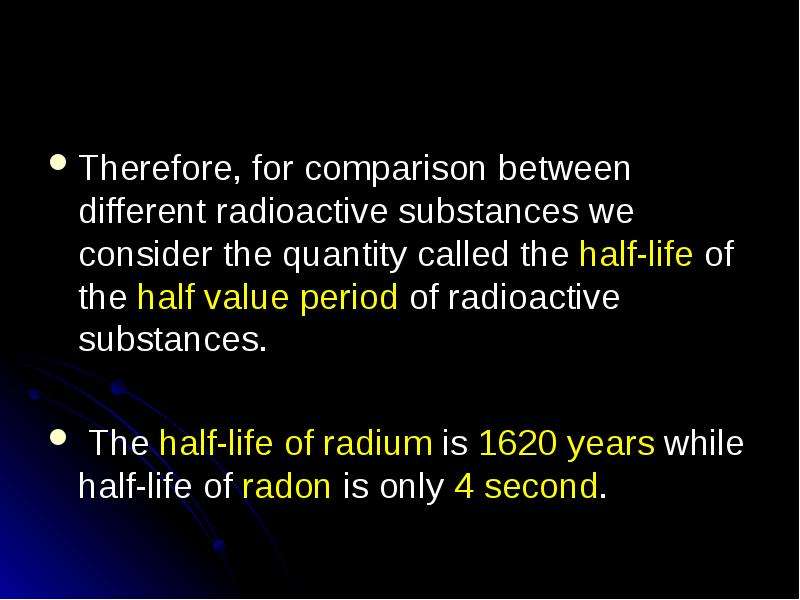
Описание слайда:
Therefore, for comparison between different radioactive substances we consider the quantity called the half-life of the half value period of radioactive substances. Therefore, for comparison between different radioactive substances we consider the quantity called the half-life of the half value period of radioactive substances. The half-life of radium is 1620 years while half-life of radon is only 4 second.

Слайд 74


Radiation protection principle There are four basic radiation protection principles that can be employed to reduce to ionizing radiation. These...
Описание слайда:
Radiation protection principle There are four basic radiation protection principles that can be employed to reduce to ionizing radiation. These principles are based on consideration of four radiation protection factors that alter radiation dose, time, distance, shielding and quantity.

Слайд 75


Time Time is an important factor in radiation protection. The principles states that the shorter the time spent in a radiation field, the less...
Описание слайда:
Time Time is an important factor in radiation protection. The principles states that the shorter the time spent in a radiation field, the less radiation will be accumulated. Depending on the activity present, radioactive material will emit a know amount of radiation per unit time.

Слайд 76


Many radiation monitoring devices measure exposure in milliroentgens (mR) per hour. An exposure rate of 60 mR/hr means that for each minute spent in...
Описание слайда:
Many radiation monitoring devices measure exposure in milliroentgens (mR) per hour. An exposure rate of 60 mR/hr means that for each minute spent in a radiation field, a person will receive a 1-mR exposure (60mR/hr-5-60min/hr =1mR/min). Obviously, the longer a person remains in radiation field, the more radiation that person will accumulate. Many radiation monitoring devices measure exposure in milliroentgens (mR) per hour. An exposure rate of 60 mR/hr means that for each minute spent in a radiation field, a person will receive a 1-mR exposure (60mR/hr-5-60min/hr =1mR/min). Obviously, the longer a person remains in radiation field, the more radiation that person will accumulate.

Слайд 77


Distance The second radiation protection factor is distance, and the principle is the farther a person is from a source of radiation, the lower the...
Описание слайда:
Distance The second radiation protection factor is distance, and the principle is the farther a person is from a source of radiation, the lower the radiation dose. This principle is known as the inverse square law. By measuring the radiation exposure rate at a given distance from a source of radiation and then doubling the distance from the source, the intensity of the radiation is decreased by factor of four.

Слайд 78


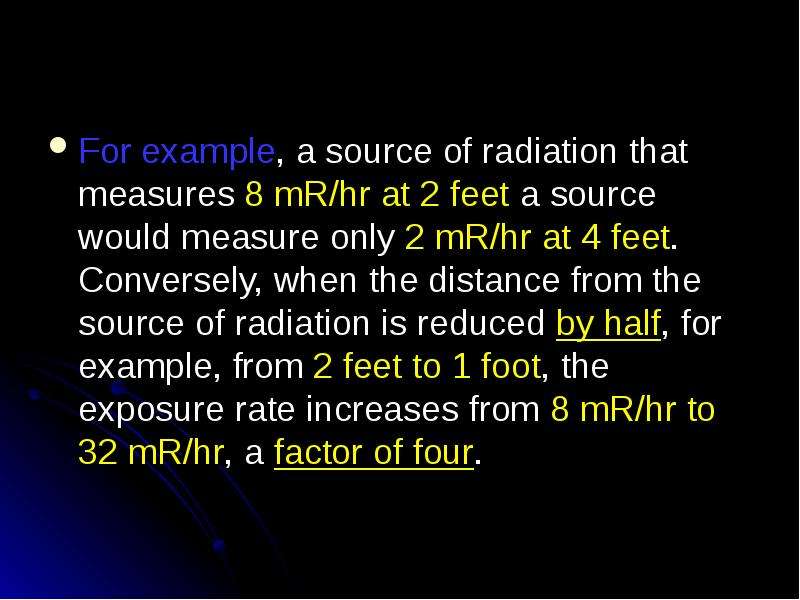
For example, a source of radiation that measures 8 mR/hr at 2 feet a source would measure only 2 mR/hr at 4 feet. Conversely, when the distance from...
Описание слайда:
For example, a source of radiation that measures 8 mR/hr at 2 feet a source would measure only 2 mR/hr at 4 feet. Conversely, when the distance from the source of radiation is reduced by half, for example, from 2 feet to 1 foot, the exposure rate increases from 8 mR/hr to 32 mR/hr, a factor of four.

Слайд 79


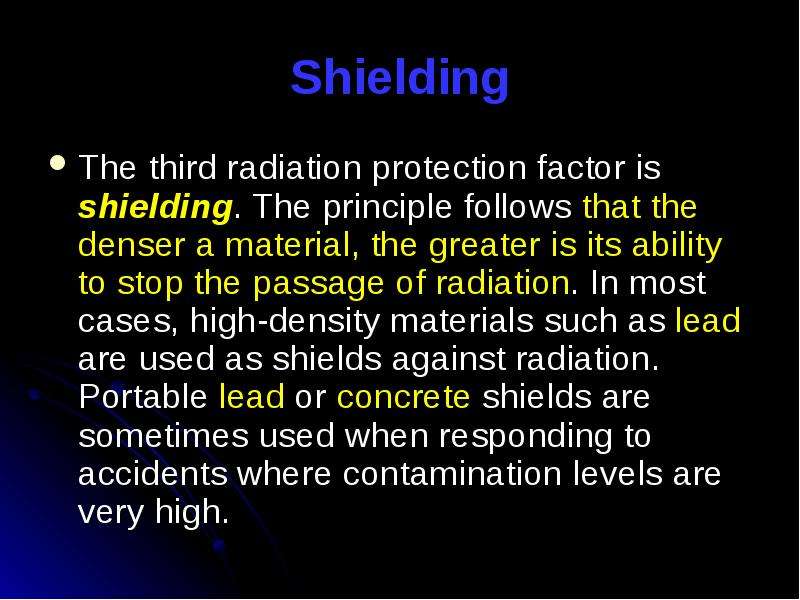
Shielding The third radiation protection factor is shielding. The principle follows that the denser a material, the greater is its ability to stop...
Описание слайда:
Shielding The third radiation protection factor is shielding. The principle follows that the denser a material, the greater is its ability to stop the passage of radiation. In most cases, high-density materials such as lead are used as shields against radiation. Portable lead or concrete shields are sometimes used when responding to accidents where contamination levels are very high.

Слайд 80


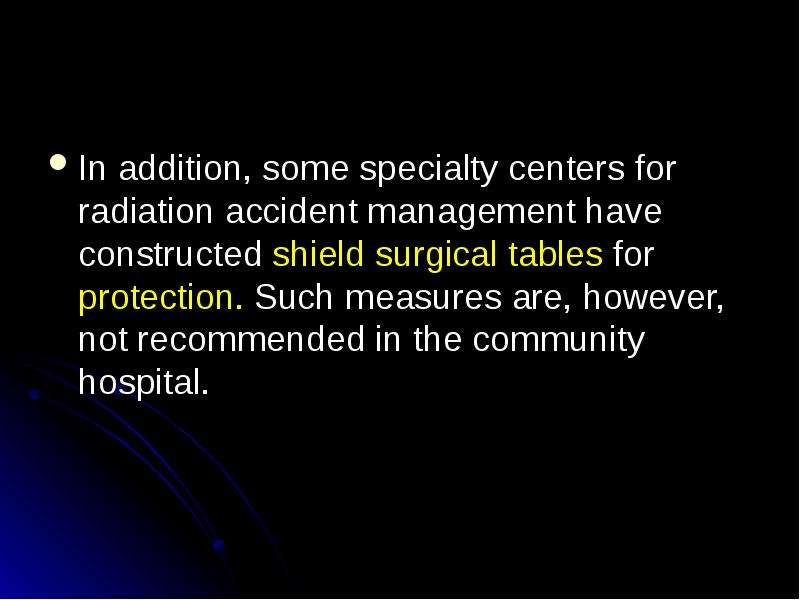
In addition, some specialty centers for radiation accident management have constructed shield surgical tables for protection. Such measures are,...
Описание слайда:
In addition, some specialty centers for radiation accident management have constructed shield surgical tables for protection. Such measures are, however, not recommended in the community hospital. In addition, some specialty centers for radiation accident management have constructed shield surgical tables for protection. Such measures are, however, not recommended in the community hospital.

Слайд 81


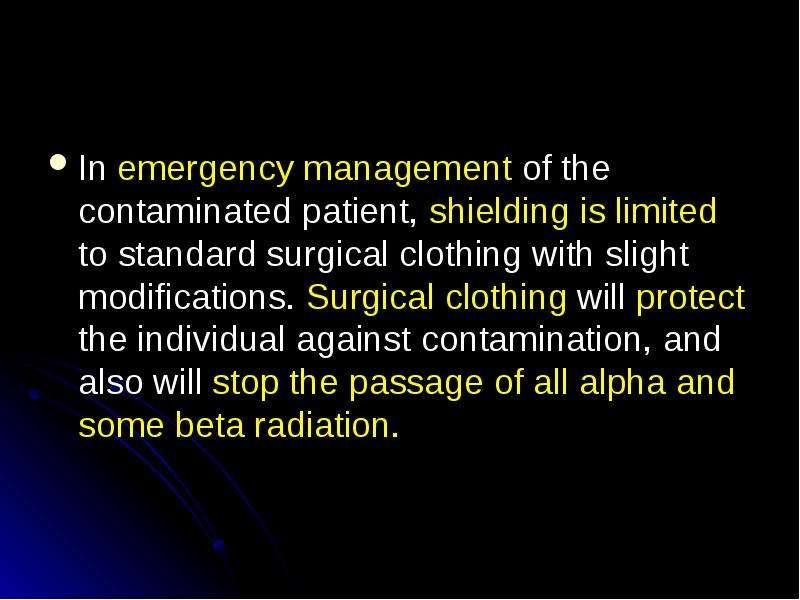
In emergency management of the contaminated patient, shielding is limited to standard surgical clothing with slight modifications. Surgical clothing...
Описание слайда:
In emergency management of the contaminated patient, shielding is limited to standard surgical clothing with slight modifications. Surgical clothing will protect the individual against contamination, and also will stop the passage of all alpha and some beta radiation. In emergency management of the contaminated patient, shielding is limited to standard surgical clothing with slight modifications. Surgical clothing will protect the individual against contamination, and also will stop the passage of all alpha and some beta radiation.

Слайд 82


However, it does not stop penetrating gamma radiation. In the hospital emergency department shielding is actually limited to anti-contamination...
Описание слайда:
However, it does not stop penetrating gamma radiation. In the hospital emergency department shielding is actually limited to anti-contamination measure and the principles of time and distance are used to reduce radiation exposure. However, it does not stop penetrating gamma radiation. In the hospital emergency department shielding is actually limited to anti-contamination measure and the principles of time and distance are used to reduce radiation exposure.

Слайд 83


Quantity The fourth radiation protection factor is quantity. Because the exposure rate from a given radioactive material is directly related to the...
Описание слайда:
Quantity The fourth radiation protection factor is quantity. Because the exposure rate from a given radioactive material is directly related to the amount or quantity of the material present, the principle involves limiting the quantity of radioactive material in the working area to decrease radiation exposure. Any technique that reduces the amount of radiation or radioactive material in the treatment area is very useful.

Слайд 84


At work with the closed sources of radiations there is a potential danger of radioactive pollution of integuments, overalls and working surface due...
Описание слайда:
At work with the closed sources of radiations there is a potential danger of radioactive pollution of integuments, overalls and working surface due to infringement of tightness of source. It is necessary for taking into account at carrying out of a sanitary – radiation control. At work with the closed sources of radiations there is a potential danger of radioactive pollution of integuments, overalls and working surface due to infringement of tightness of source. It is necessary for taking into account at carrying out of a sanitary – radiation control.

Слайд 85


Check of tightness of the closed sources is necessary for carrying out on a regular basis by the developed techniques. Also the regular control over...
Описание слайда:
Check of tightness of the closed sources is necessary for carrying out on a regular basis by the developed techniques. Also the regular control over radioactive impurity of hands, overalls, toolkit and working surfaces is necessary. Check of tightness of the closed sources is necessary for carrying out on a regular basis by the developed techniques. Also the regular control over radioactive impurity of hands, overalls, toolkit and working surfaces is necessary.

Слайд 86


At work with the closed sources of the mall sizes there is its danger loss. In such cases it is necessary to have a dosimeter – radiometer with which...
Описание слайда:
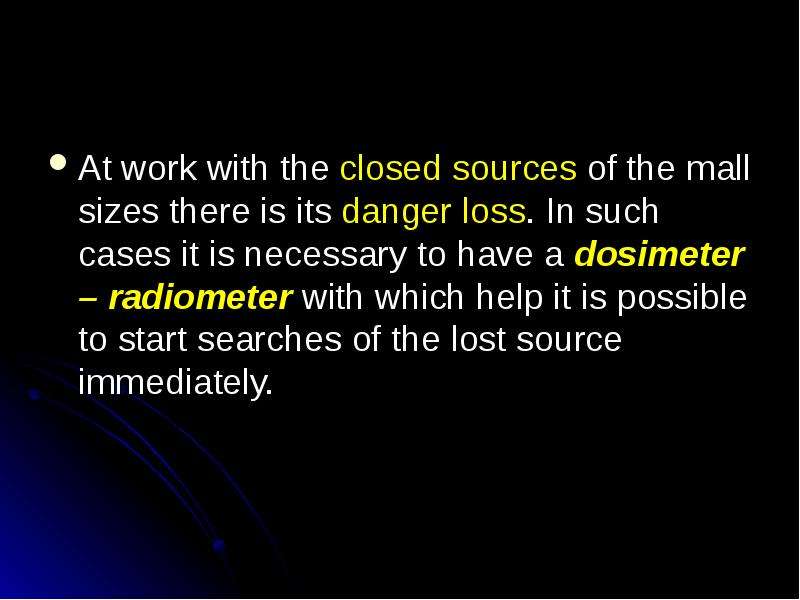
At work with the closed sources of the mall sizes there is its danger loss. In such cases it is necessary to have a dosimeter – radiometer with which help it is possible to start searches of the lost source immediately. At work with the closed sources of the mall sizes there is its danger loss. In such cases it is necessary to have a dosimeter – radiometer with which help it is possible to start searches of the lost source immediately.


Похожие презентации
Mypresentation.ru
Загрузить презентацию