🗊 Презентация Speech Recognition and Synthesis. Waveform Synthesis (in Concatenative TTS)

Категория: Физика
Нажмите для полного просмотра!
Speech Recognition and Synthesis. Waveform Synthesis (in Concatenative TTS), слайд №1 Speech Recognition and Synthesis. Waveform Synthesis (in Concatenative TTS), слайд №2 Speech Recognition and Synthesis. Waveform Synthesis (in Concatenative TTS), слайд №3 Speech Recognition and Synthesis. Waveform Synthesis (in Concatenative TTS), слайд №4 Speech Recognition and Synthesis. Waveform Synthesis (in Concatenative TTS), слайд №5 Speech Recognition and Synthesis. Waveform Synthesis (in Concatenative TTS), слайд №6 Speech Recognition and Synthesis. Waveform Synthesis (in Concatenative TTS), слайд №7 Speech Recognition and Synthesis. Waveform Synthesis (in Concatenative TTS), слайд №8 Speech Recognition and Synthesis. Waveform Synthesis (in Concatenative TTS), слайд №9 Speech Recognition and Synthesis. Waveform Synthesis (in Concatenative TTS), слайд №10 Speech Recognition and Synthesis. Waveform Synthesis (in Concatenative TTS), слайд №11 Speech Recognition and Synthesis. Waveform Synthesis (in Concatenative TTS), слайд №12 Speech Recognition and Synthesis. Waveform Synthesis (in Concatenative TTS), слайд №13 Speech Recognition and Synthesis. Waveform Synthesis (in Concatenative TTS), слайд №14 Speech Recognition and Synthesis. Waveform Synthesis (in Concatenative TTS), слайд №15 Speech Recognition and Synthesis. Waveform Synthesis (in Concatenative TTS), слайд №16 Speech Recognition and Synthesis. Waveform Synthesis (in Concatenative TTS), слайд №17 Speech Recognition and Synthesis. Waveform Synthesis (in Concatenative TTS), слайд №18 Speech Recognition and Synthesis. Waveform Synthesis (in Concatenative TTS), слайд №19 Speech Recognition and Synthesis. Waveform Synthesis (in Concatenative TTS), слайд №20 Speech Recognition and Synthesis. Waveform Synthesis (in Concatenative TTS), слайд №21 Speech Recognition and Synthesis. Waveform Synthesis (in Concatenative TTS), слайд №22 Speech Recognition and Synthesis. Waveform Synthesis (in Concatenative TTS), слайд №23 Speech Recognition and Synthesis. Waveform Synthesis (in Concatenative TTS), слайд №24 Speech Recognition and Synthesis. Waveform Synthesis (in Concatenative TTS), слайд №25 Speech Recognition and Synthesis. Waveform Synthesis (in Concatenative TTS), слайд №26 Speech Recognition and Synthesis. Waveform Synthesis (in Concatenative TTS), слайд №27 Speech Recognition and Synthesis. Waveform Synthesis (in Concatenative TTS), слайд №28 Speech Recognition and Synthesis. Waveform Synthesis (in Concatenative TTS), слайд №29 Speech Recognition and Synthesis. Waveform Synthesis (in Concatenative TTS), слайд №30 Speech Recognition and Synthesis. Waveform Synthesis (in Concatenative TTS), слайд №31 Speech Recognition and Synthesis. Waveform Synthesis (in Concatenative TTS), слайд №32 Speech Recognition and Synthesis. Waveform Synthesis (in Concatenative TTS), слайд №33 Speech Recognition and Synthesis. Waveform Synthesis (in Concatenative TTS), слайд №34 Speech Recognition and Synthesis. Waveform Synthesis (in Concatenative TTS), слайд №35 Speech Recognition and Synthesis. Waveform Synthesis (in Concatenative TTS), слайд №36 Speech Recognition and Synthesis. Waveform Synthesis (in Concatenative TTS), слайд №37 Speech Recognition and Synthesis. Waveform Synthesis (in Concatenative TTS), слайд №38 Speech Recognition and Synthesis. Waveform Synthesis (in Concatenative TTS), слайд №39 Speech Recognition and Synthesis. Waveform Synthesis (in Concatenative TTS), слайд №40 Speech Recognition and Synthesis. Waveform Synthesis (in Concatenative TTS), слайд №41 Speech Recognition and Synthesis. Waveform Synthesis (in Concatenative TTS), слайд №42 Speech Recognition and Synthesis. Waveform Synthesis (in Concatenative TTS), слайд №43 Speech Recognition and Synthesis. Waveform Synthesis (in Concatenative TTS), слайд №44 Speech Recognition and Synthesis. Waveform Synthesis (in Concatenative TTS), слайд №45 Speech Recognition and Synthesis. Waveform Synthesis (in Concatenative TTS), слайд №46 Speech Recognition and Synthesis. Waveform Synthesis (in Concatenative TTS), слайд №47 Speech Recognition and Synthesis. Waveform Synthesis (in Concatenative TTS), слайд №48 Speech Recognition and Synthesis. Waveform Synthesis (in Concatenative TTS), слайд №49 Speech Recognition and Synthesis. Waveform Synthesis (in Concatenative TTS), слайд №50 Speech Recognition and Synthesis. Waveform Synthesis (in Concatenative TTS), слайд №51 Speech Recognition and Synthesis. Waveform Synthesis (in Concatenative TTS), слайд №52 Speech Recognition and Synthesis. Waveform Synthesis (in Concatenative TTS), слайд №53 Speech Recognition and Synthesis. Waveform Synthesis (in Concatenative TTS), слайд №54 Speech Recognition and Synthesis. Waveform Synthesis (in Concatenative TTS), слайд №55 Speech Recognition and Synthesis. Waveform Synthesis (in Concatenative TTS), слайд №56 Speech Recognition and Synthesis. Waveform Synthesis (in Concatenative TTS), слайд №57 Speech Recognition and Synthesis. Waveform Synthesis (in Concatenative TTS), слайд №58 Speech Recognition and Synthesis. Waveform Synthesis (in Concatenative TTS), слайд №59 Speech Recognition and Synthesis. Waveform Synthesis (in Concatenative TTS), слайд №60 Speech Recognition and Synthesis. Waveform Synthesis (in Concatenative TTS), слайд №61 Speech Recognition and Synthesis. Waveform Synthesis (in Concatenative TTS), слайд №62 Speech Recognition and Synthesis. Waveform Synthesis (in Concatenative TTS), слайд №63 Speech Recognition and Synthesis. Waveform Synthesis (in Concatenative TTS), слайд №64 Speech Recognition and Synthesis. Waveform Synthesis (in Concatenative TTS), слайд №65 Speech Recognition and Synthesis. Waveform Synthesis (in Concatenative TTS), слайд №66

Содержание
Вы можете ознакомиться и скачать презентацию на тему Speech Recognition and Synthesis. Waveform Synthesis (in Concatenative TTS). Доклад-сообщение содержит 66 слайдов. Презентации для любого класса можно скачать бесплатно. Если материал и наш сайт презентаций Mypresentation Вам понравились – поделитесь им с друзьями с помощью социальных кнопок и добавьте в закладки в своем браузере.
Слайды и текст этой презентации


Слайд 1


LSA 352 Speech Recognition and Synthesis Dan Jurafsky
Описание слайда:
LSA 352 Speech Recognition and Synthesis Dan Jurafsky

Слайд 2


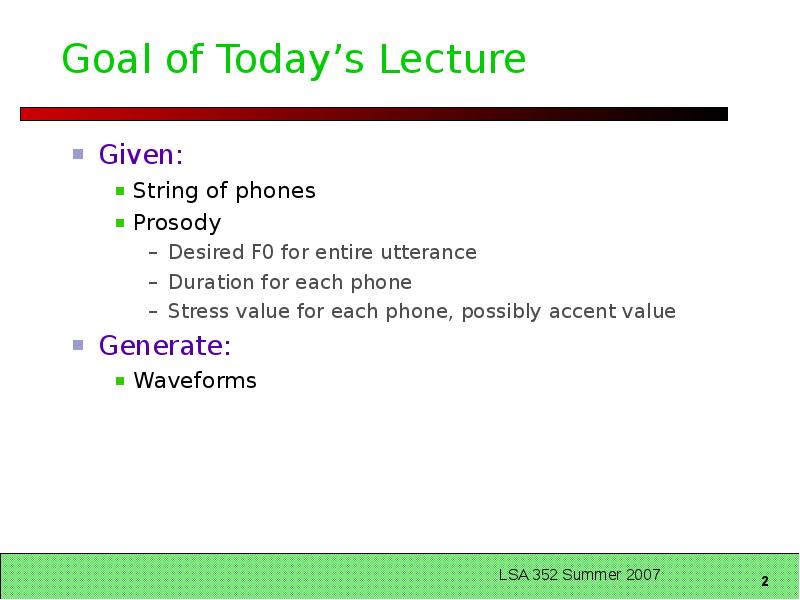
Goal of Today’s Lecture Given: String of phones Prosody Desired F0 for entire utterance Duration for each phone Stress value for each phone, possibly...
Описание слайда:
Goal of Today’s Lecture Given: String of phones Prosody Desired F0 for entire utterance Duration for each phone Stress value for each phone, possibly accent value Generate: Waveforms

Слайд 3


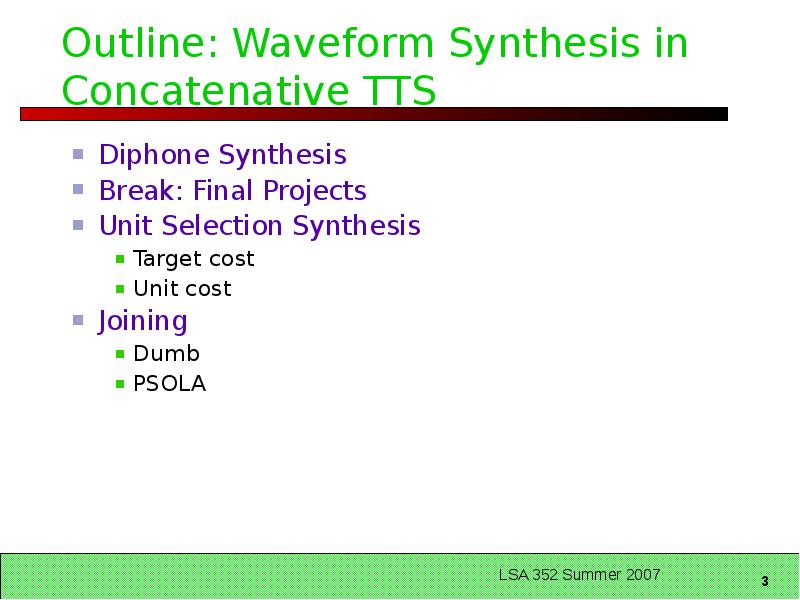
Outline: Waveform Synthesis in Concatenative TTS Diphone Synthesis Break: Final Projects Unit Selection Synthesis Target cost Unit cost Joining Dumb...
Описание слайда:

Outline: Waveform Synthesis in Concatenative TTS Diphone Synthesis Break: Final Projects Unit Selection Synthesis Target cost Unit cost Joining Dumb PSOLA

Слайд 4


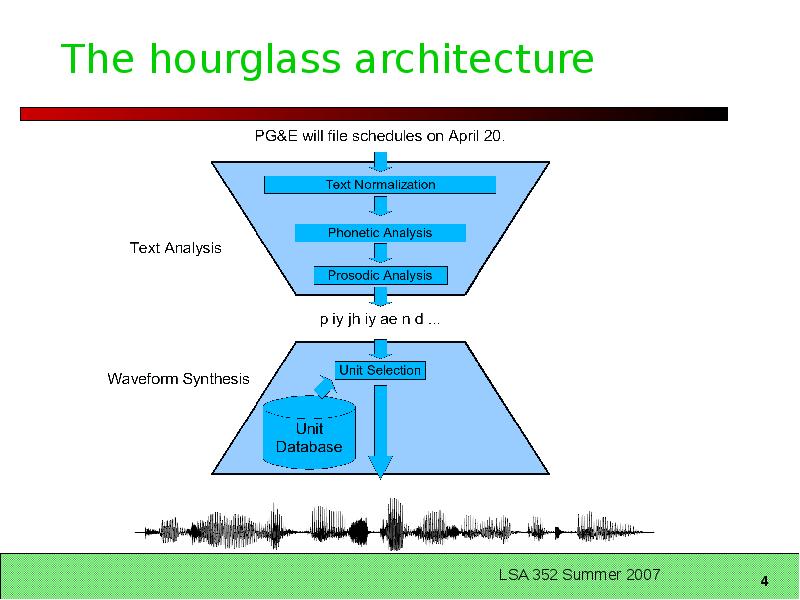
The hourglass architecture
Описание слайда:
The hourglass architecture

Слайд 5


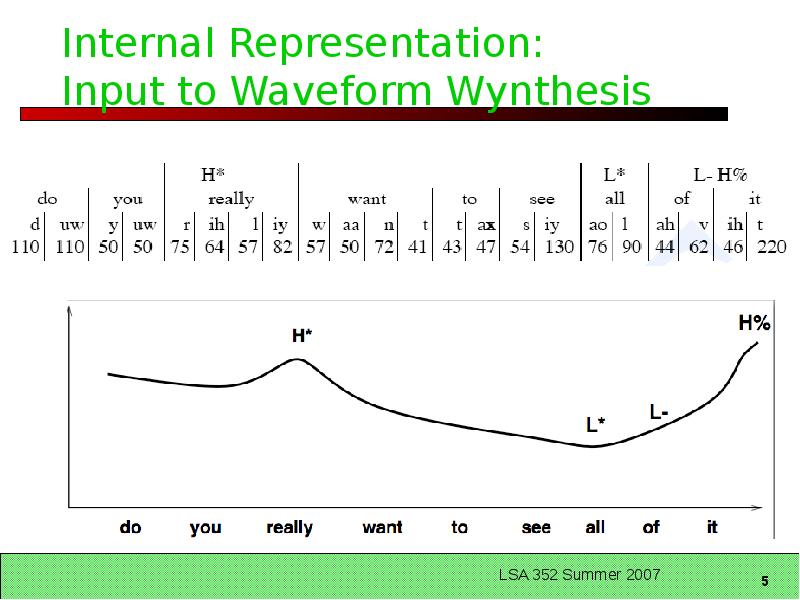
Internal Representation: Input to Waveform Wynthesis
Описание слайда:
Internal Representation: Input to Waveform Wynthesis

Слайд 6


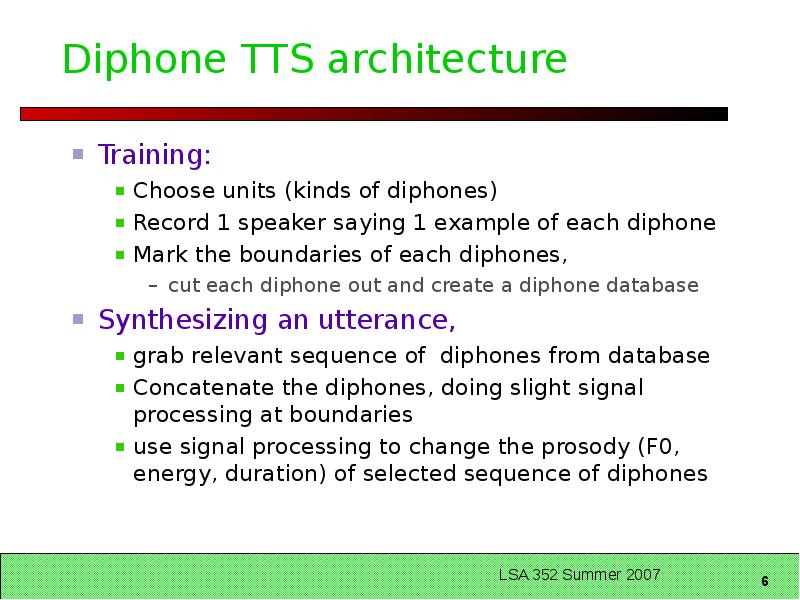
Diphone TTS architecture Training: Choose units (kinds of diphones) Record 1 speaker saying 1 example of each diphone Mark the boundaries of each...
Описание слайда:
Diphone TTS architecture Training: Choose units (kinds of diphones) Record 1 speaker saying 1 example of each diphone Mark the boundaries of each diphones, cut each diphone out and create a diphone database Synthesizing an utterance, grab relevant sequence of diphones from database Concatenate the diphones, doing slight signal processing at boundaries use signal processing to change the prosody (F0, energy, duration) of selected sequence of diphones

Слайд 7


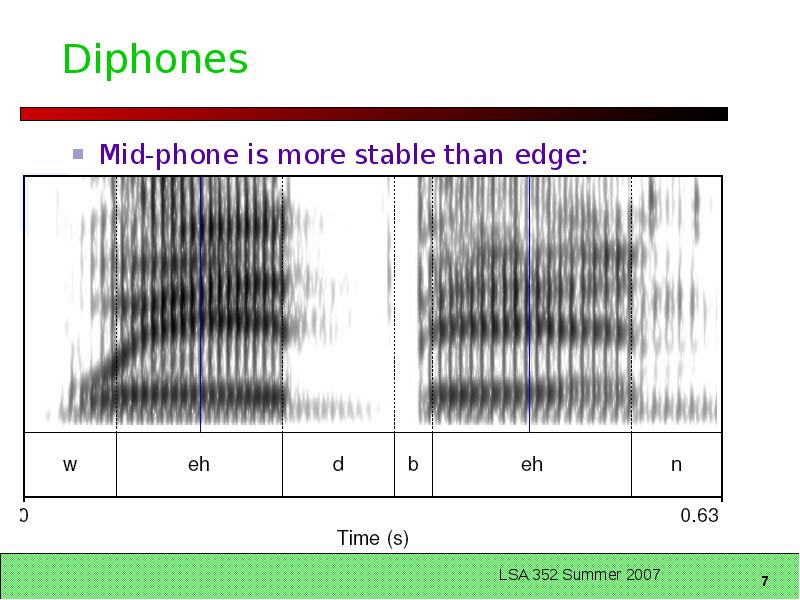
Diphones Mid-phone is more stable than edge:
Описание слайда:
Diphones Mid-phone is more stable than edge:

Слайд 8


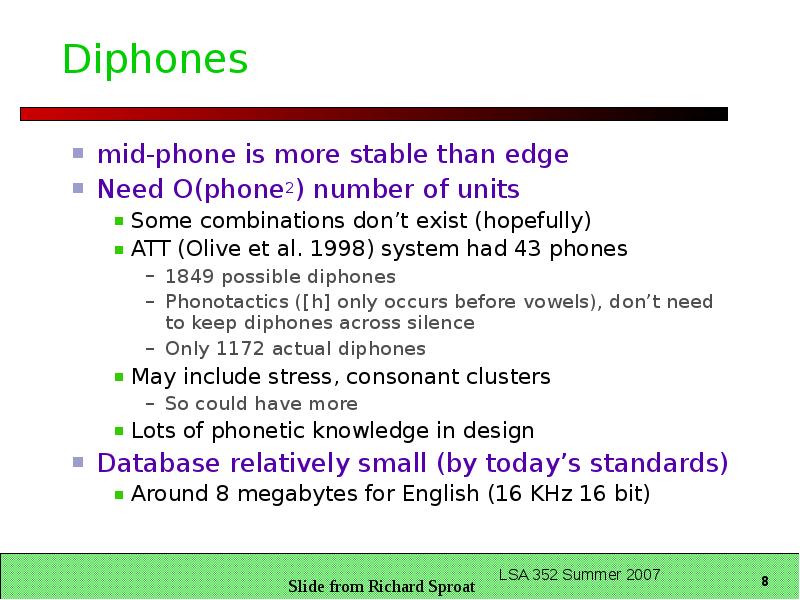
Diphones mid-phone is more stable than edge Need O(phone2) number of units Some combinations don’t exist (hopefully) ATT (Olive et al. 1998) system...
Описание слайда:
Diphones mid-phone is more stable than edge Need O(phone2) number of units Some combinations don’t exist (hopefully) ATT (Olive et al. 1998) system had 43 phones 1849 possible diphones Phonotactics ([h] only occurs before vowels), don’t need to keep diphones across silence Only 1172 actual diphones May include stress, consonant clusters So could have more Lots of phonetic knowledge in design Database relatively small (by today’s standards) Around 8 megabytes for English (16 KHz 16 bit)

Слайд 9


Voice Speaker Called a voice talent Diphone database Called a voice
Описание слайда:
Voice Speaker Called a voice talent Diphone database Called a voice

Слайд 10


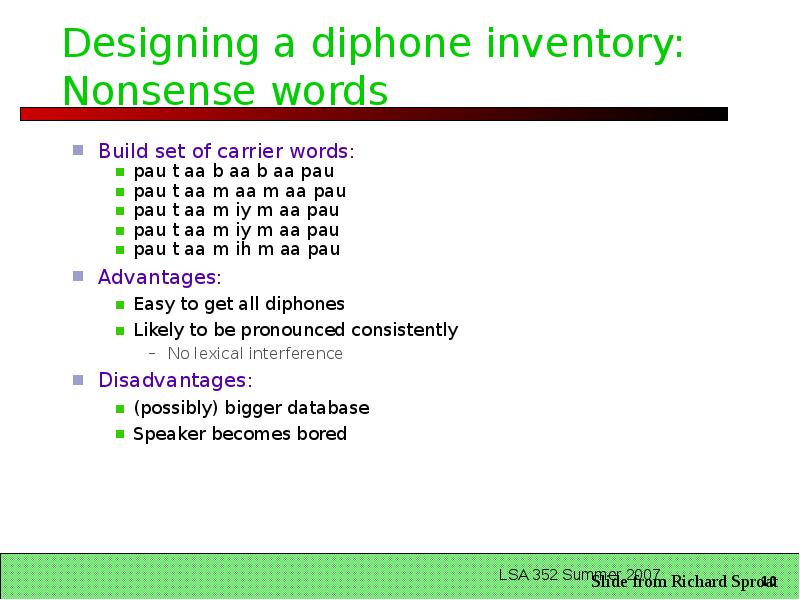
Designing a diphone inventory: Nonsense words Build set of carrier words: pau t aa b aa b aa pau pau t aa m aa m aa pau pau t aa m iy m aa pau pau t...
Описание слайда:
Designing a diphone inventory: Nonsense words Build set of carrier words: pau t aa b aa b aa pau pau t aa m aa m aa pau pau t aa m iy m aa pau pau t aa m iy m aa pau pau t aa m ih m aa pau Advantages: Easy to get all diphones Likely to be pronounced consistently No lexical interference Disadvantages: (possibly) bigger database Speaker becomes bored

Слайд 11


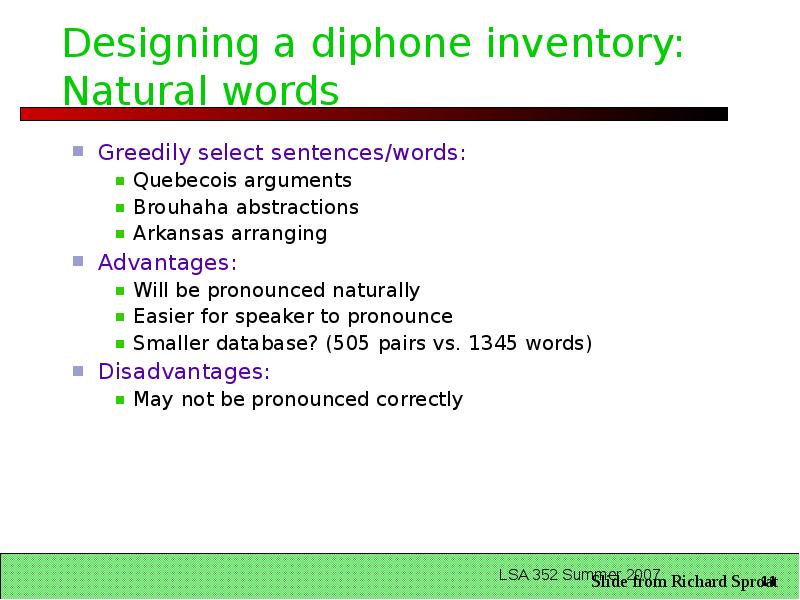
Designing a diphone inventory: Natural words Greedily select sentences/words: Quebecois arguments Brouhaha abstractions Arkansas arranging...
Описание слайда:
Designing a diphone inventory: Natural words Greedily select sentences/words: Quebecois arguments Brouhaha abstractions Arkansas arranging Advantages: Will be pronounced naturally Easier for speaker to pronounce Smaller database? (505 pairs vs. 1345 words) Disadvantages: May not be pronounced correctly

Слайд 12


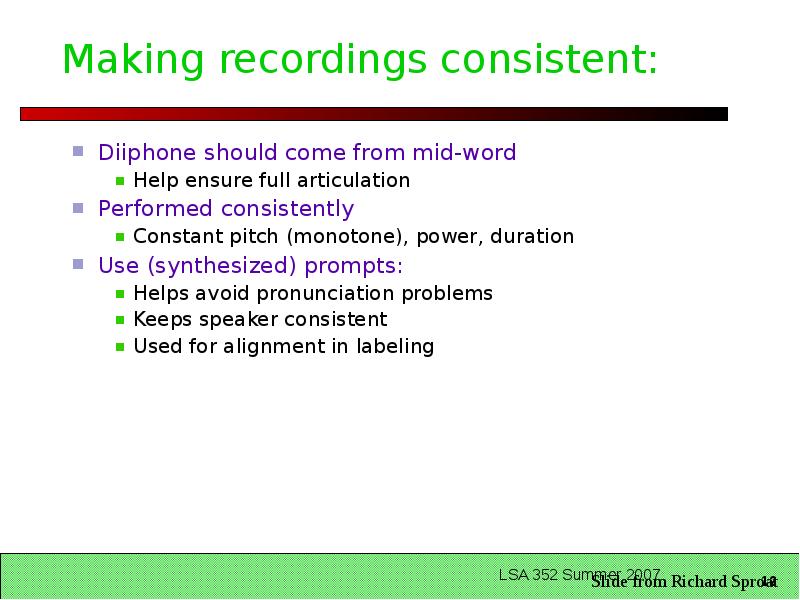
Making recordings consistent: Diiphone should come from mid-word Help ensure full articulation Performed consistently Constant pitch (monotone),...
Описание слайда:
Making recordings consistent: Diiphone should come from mid-word Help ensure full articulation Performed consistently Constant pitch (monotone), power, duration Use (synthesized) prompts: Helps avoid pronunciation problems Keeps speaker consistent Used for alignment in labeling

Слайд 13


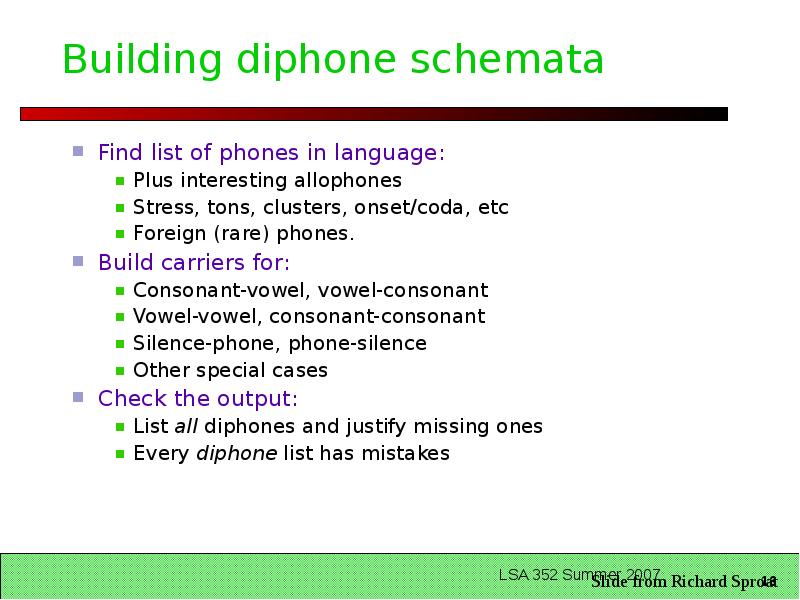
Building diphone schemata Find list of phones in language: Plus interesting allophones Stress, tons, clusters, onset/coda, etc Foreign (rare) phones....
Описание слайда:
Building diphone schemata Find list of phones in language: Plus interesting allophones Stress, tons, clusters, onset/coda, etc Foreign (rare) phones. Build carriers for: Consonant-vowel, vowel-consonant Vowel-vowel, consonant-consonant Silence-phone, phone-silence Other special cases Check the output: List all diphones and justify missing ones Every diphone list has mistakes

Слайд 14


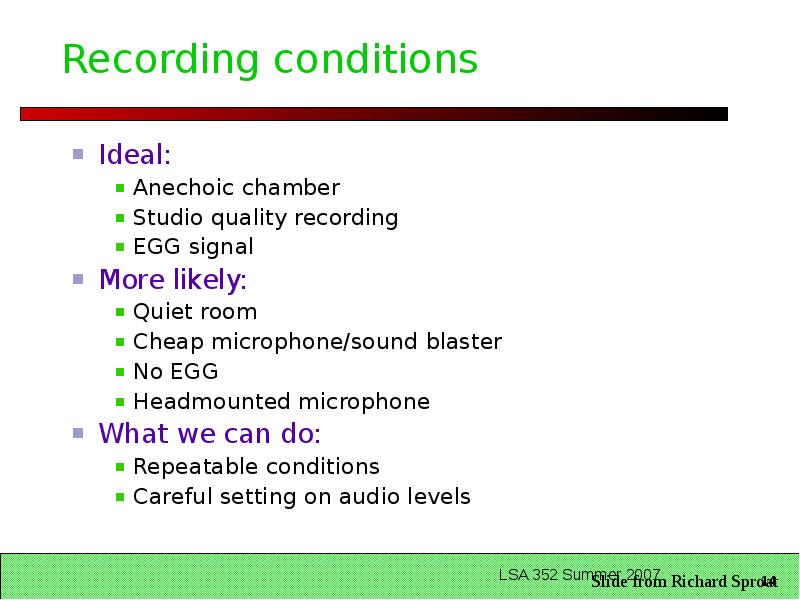
Recording conditions Ideal: Anechoic chamber Studio quality recording EGG signal More likely: Quiet room Cheap microphone/sound blaster No EGG...
Описание слайда:
Recording conditions Ideal: Anechoic chamber Studio quality recording EGG signal More likely: Quiet room Cheap microphone/sound blaster No EGG Headmounted microphone What we can do: Repeatable conditions Careful setting on audio levels

Слайд 15


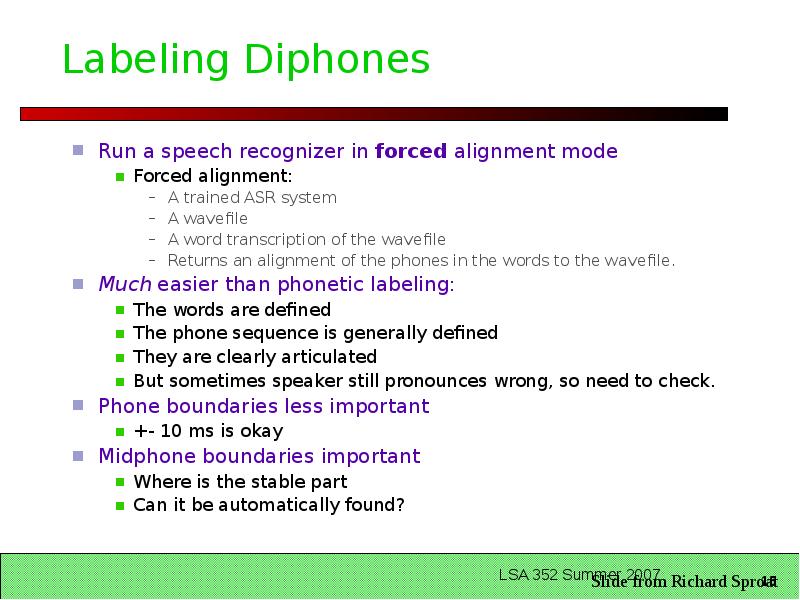
Labeling Diphones Run a speech recognizer in forced alignment mode Forced alignment: A trained ASR system A wavefile A word transcription of the...
Описание слайда:
Labeling Diphones Run a speech recognizer in forced alignment mode Forced alignment: A trained ASR system A wavefile A word transcription of the wavefile Returns an alignment of the phones in the words to the wavefile. Much easier than phonetic labeling: The words are defined The phone sequence is generally defined They are clearly articulated But sometimes speaker still pronounces wrong, so need to check. Phone boundaries less important +- 10 ms is okay Midphone boundaries important Where is the stable part Can it be automatically found?

Слайд 16


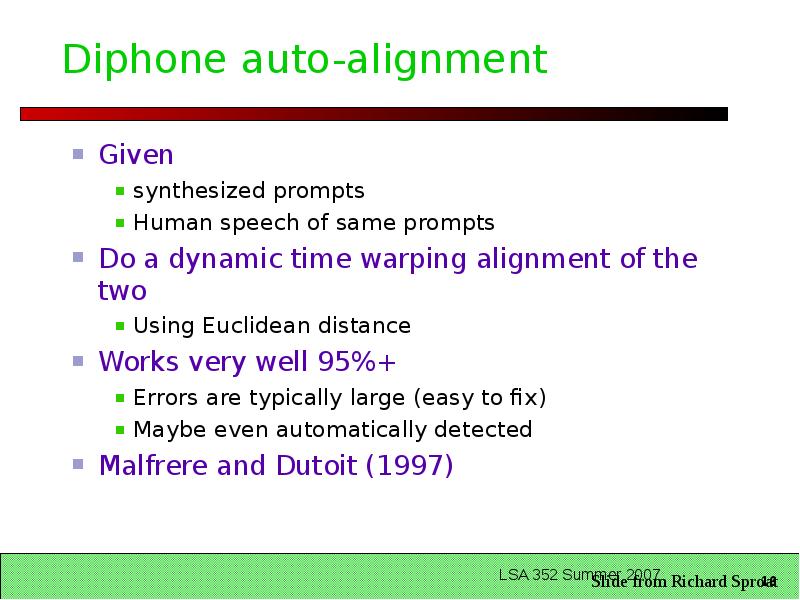
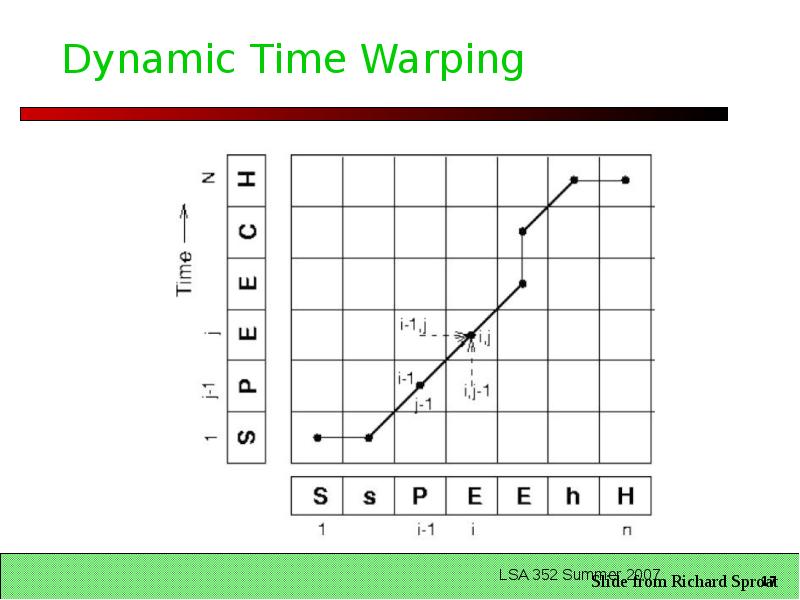
Diphone auto-alignment Given synthesized prompts Human speech of same prompts Do a dynamic time warping alignment of the two Using Euclidean distance...
Описание слайда:
Diphone auto-alignment Given synthesized prompts Human speech of same prompts Do a dynamic time warping alignment of the two Using Euclidean distance Works very well 95%+ Errors are typically large (easy to fix) Maybe even automatically detected Malfrere and Dutoit (1997)

Слайд 17


Dynamic Time Warping
Описание слайда:
Dynamic Time Warping

Слайд 18


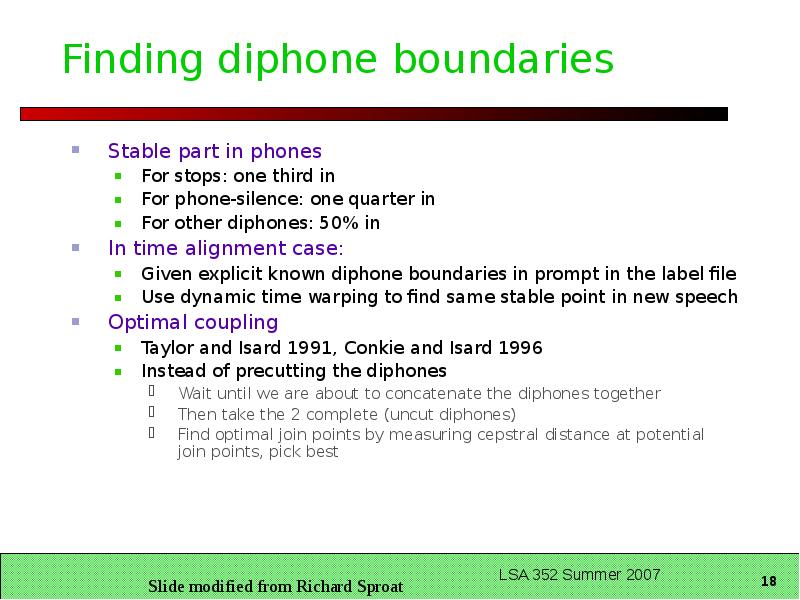
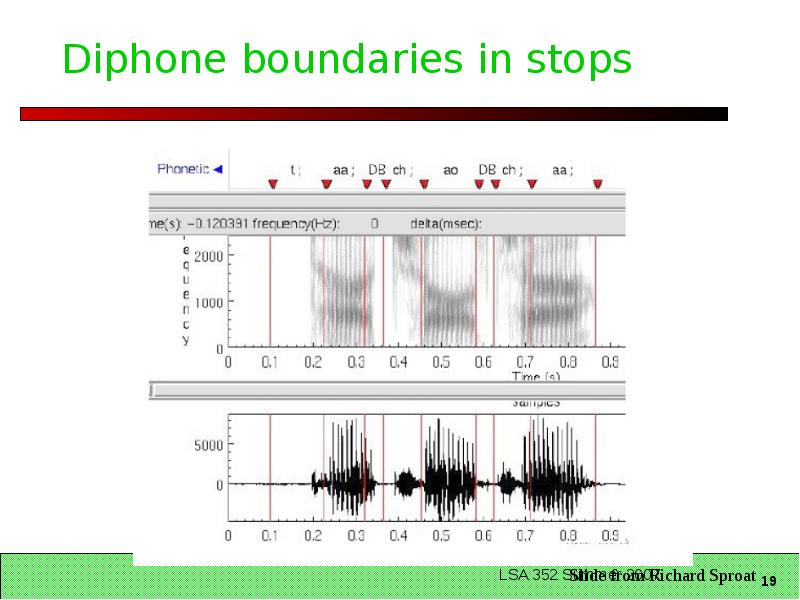
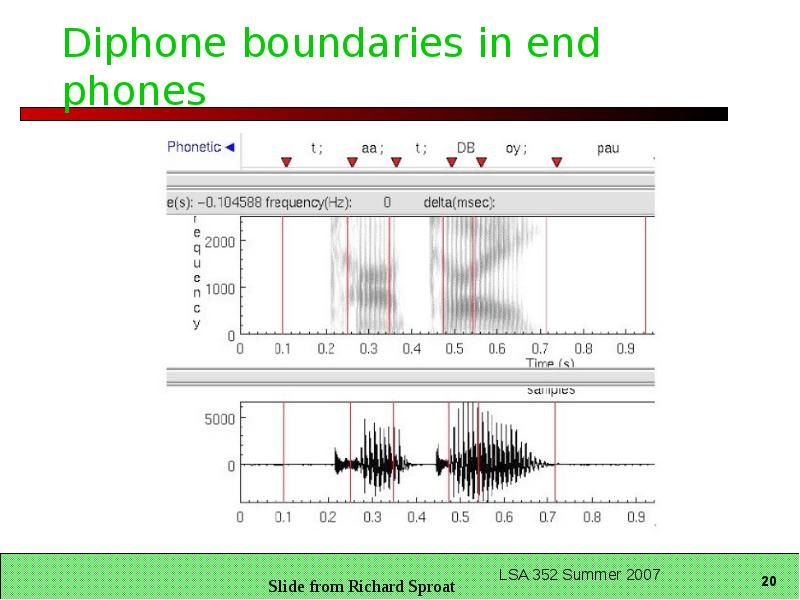
Finding diphone boundaries Stable part in phones For stops: one third in For phone-silence: one quarter in For other diphones: 50% in In time...
Описание слайда:
Finding diphone boundaries Stable part in phones For stops: one third in For phone-silence: one quarter in For other diphones: 50% in In time alignment case: Given explicit known diphone boundaries in prompt in the label file Use dynamic time warping to find same stable point in new speech Optimal coupling Taylor and Isard 1991, Conkie and Isard 1996 Instead of precutting the diphones Wait until we are about to concatenate the diphones together Then take the 2 complete (uncut diphones) Find optimal join points by measuring cepstral distance at potential join points, pick best

Слайд 19


Diphone boundaries in stops
Описание слайда:
Diphone boundaries in stops

Слайд 20


Diphone boundaries in end phones
Описание слайда:
Diphone boundaries in end phones

Слайд 21


Concatenating diphones: junctures If waveforms are very different, will perceive a click at the junctures So need to window them Also if both...
Описание слайда:
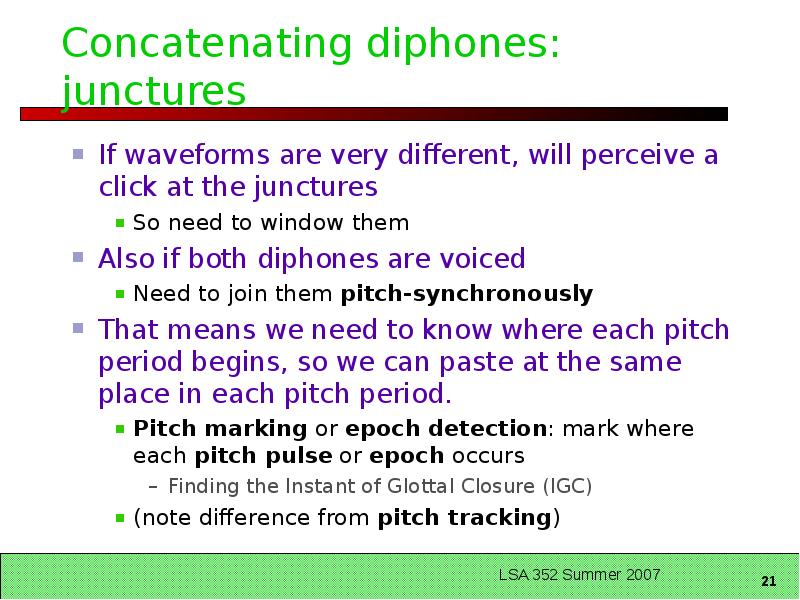
Concatenating diphones: junctures If waveforms are very different, will perceive a click at the junctures So need to window them Also if both diphones are voiced Need to join them pitch-synchronously That means we need to know where each pitch period begins, so we can paste at the same place in each pitch period. Pitch marking or epoch detection: mark where each pitch pulse or epoch occurs Finding the Instant of Glottal Closure (IGC) (note difference from pitch tracking)

Слайд 22


Epoch-labeling An example of epoch-labeling useing “SHOW PULSES” in Praat:
Описание слайда:
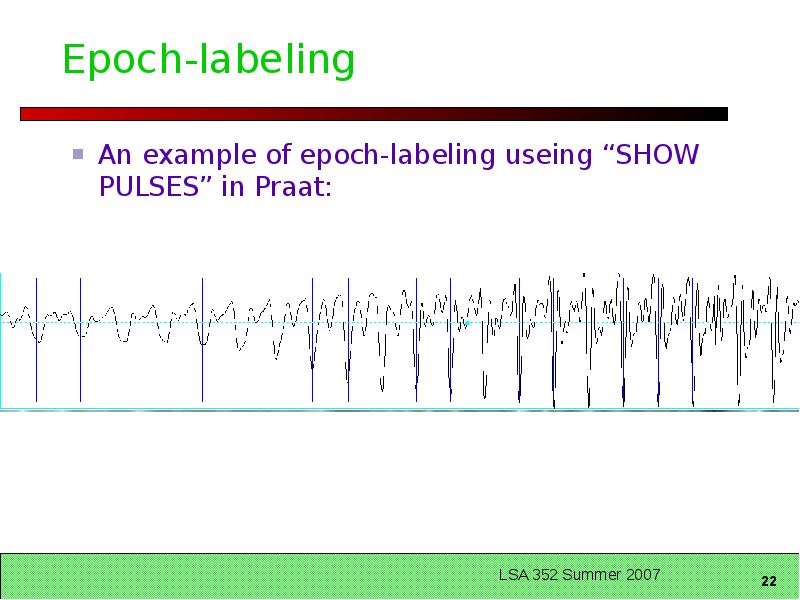
Epoch-labeling An example of epoch-labeling useing “SHOW PULSES” in Praat:

Слайд 23


Epoch-labeling: Electroglottograph (EGG) Also called laryngograph or Lx Device that straps on speaker’s neck near the larynx Sends small high...
Описание слайда:
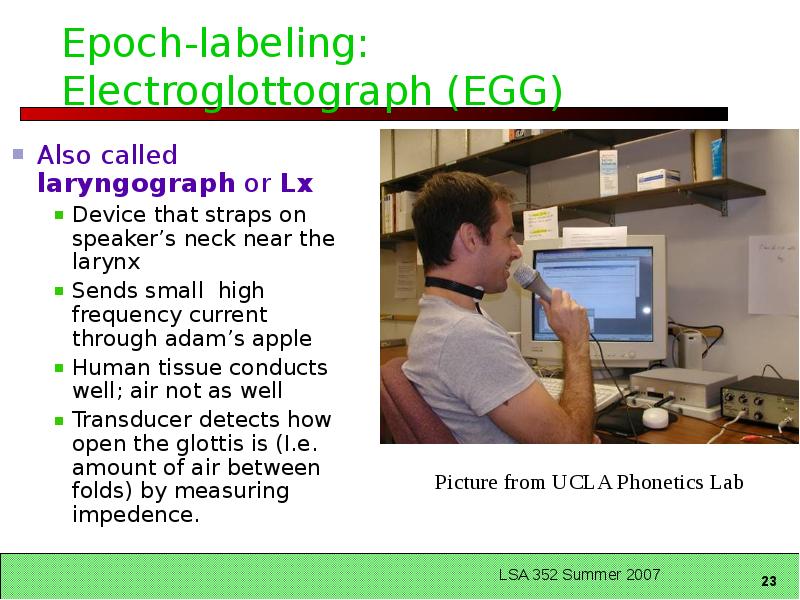
Epoch-labeling: Electroglottograph (EGG) Also called laryngograph or Lx Device that straps on speaker’s neck near the larynx Sends small high frequency current through adam’s apple Human tissue conducts well; air not as well Transducer detects how open the glottis is (I.e. amount of air between folds) by measuring impedence.

Слайд 24


Less invasive way to do epoch-labeling Signal processing E.g.: BROOKES, D. M., AND LOKE, H. P. 1999. Modelling energy flow in the vocal tract with...
Описание слайда:
Less invasive way to do epoch-labeling Signal processing E.g.: BROOKES, D. M., AND LOKE, H. P. 1999. Modelling energy flow in the vocal tract with applications to glottal closure and opening detection. In ICASSP 1999.

Слайд 25


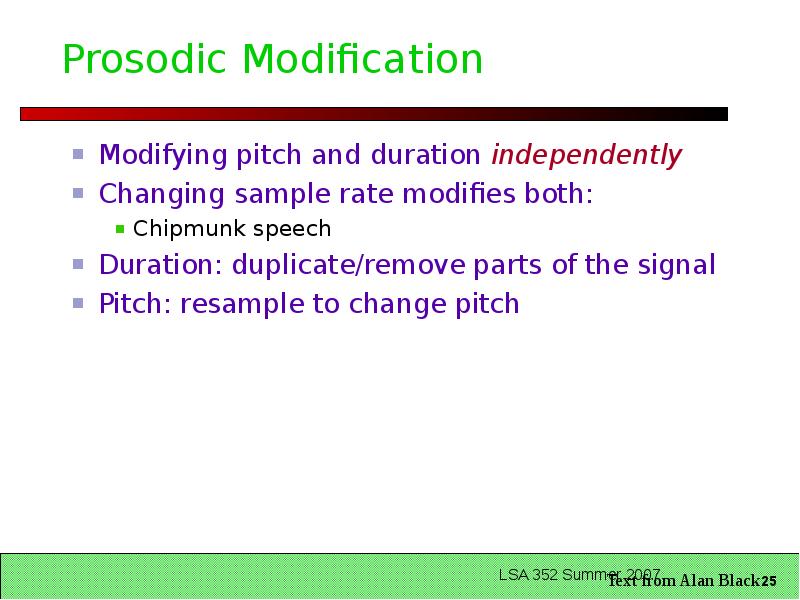
Prosodic Modification Modifying pitch and duration independently Changing sample rate modifies both: Chipmunk speech Duration: duplicate/remove parts...
Описание слайда:
Prosodic Modification Modifying pitch and duration independently Changing sample rate modifies both: Chipmunk speech Duration: duplicate/remove parts of the signal Pitch: resample to change pitch

Слайд 26


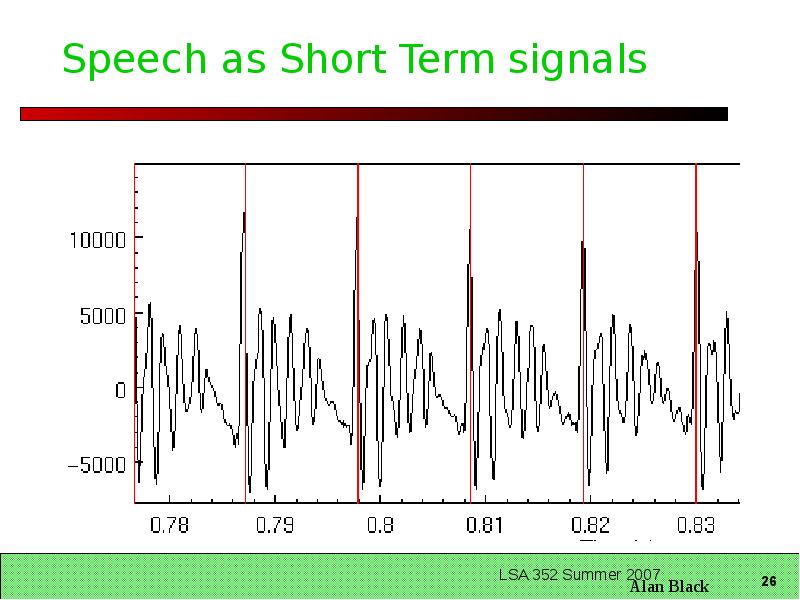
Speech as Short Term signals
Описание слайда:
Speech as Short Term signals

Слайд 27


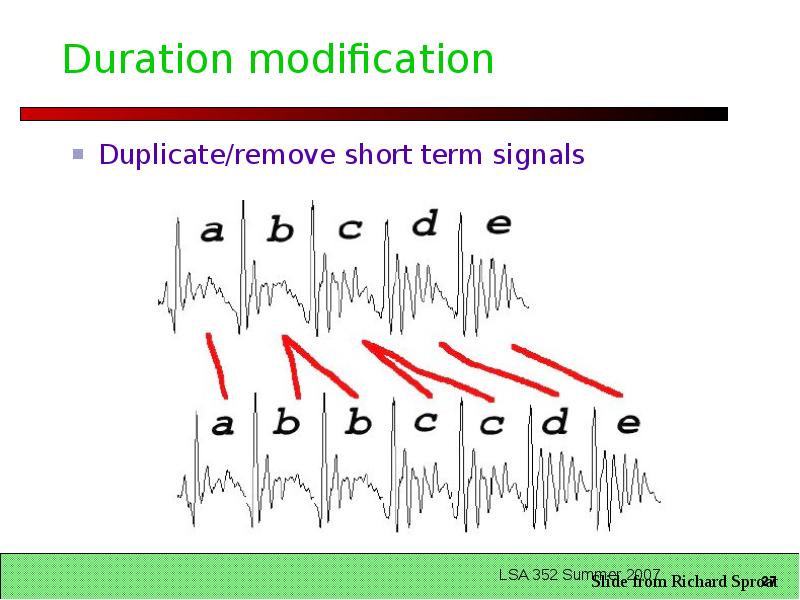
Duration modification Duplicate/remove short term signals
Описание слайда:
Duration modification Duplicate/remove short term signals

Слайд 28


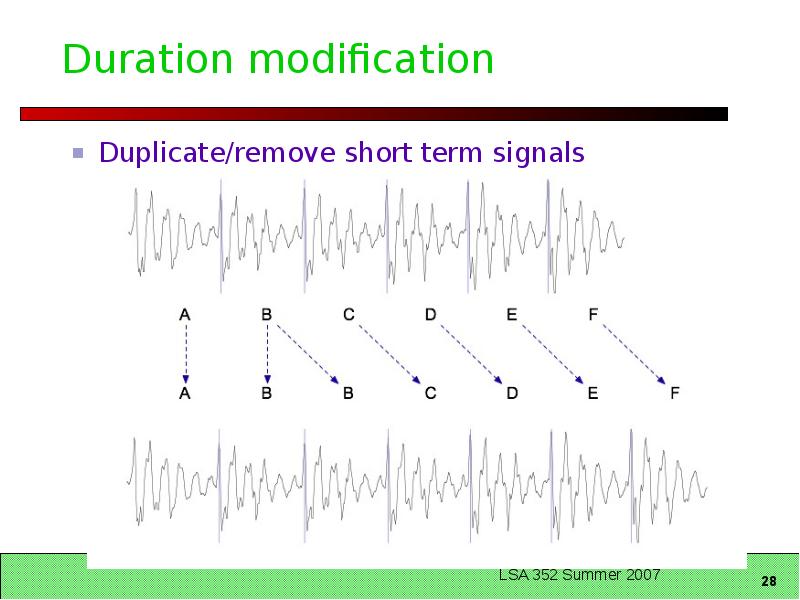
Duration modification Duplicate/remove short term signals
Описание слайда:
Duration modification Duplicate/remove short term signals

Слайд 29


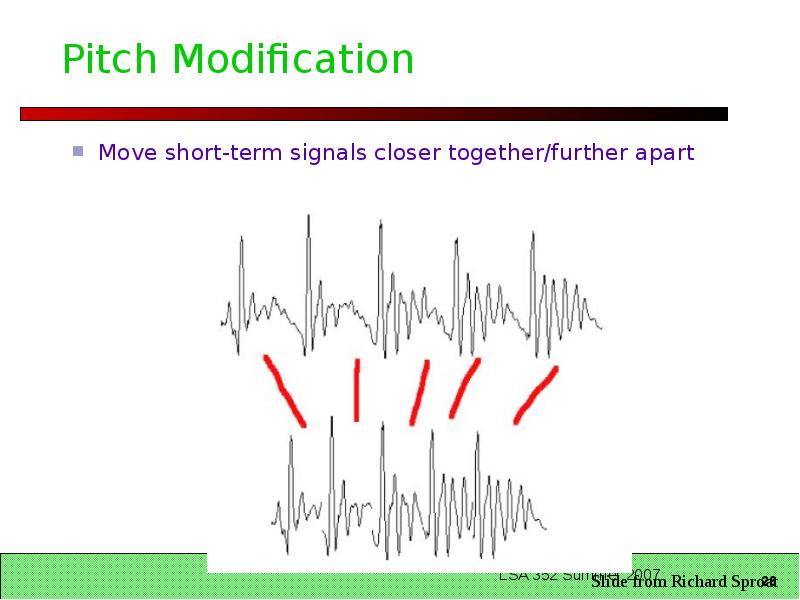
Pitch Modification Move short-term signals closer together/further apart
Описание слайда:
Pitch Modification Move short-term signals closer together/further apart

Слайд 30


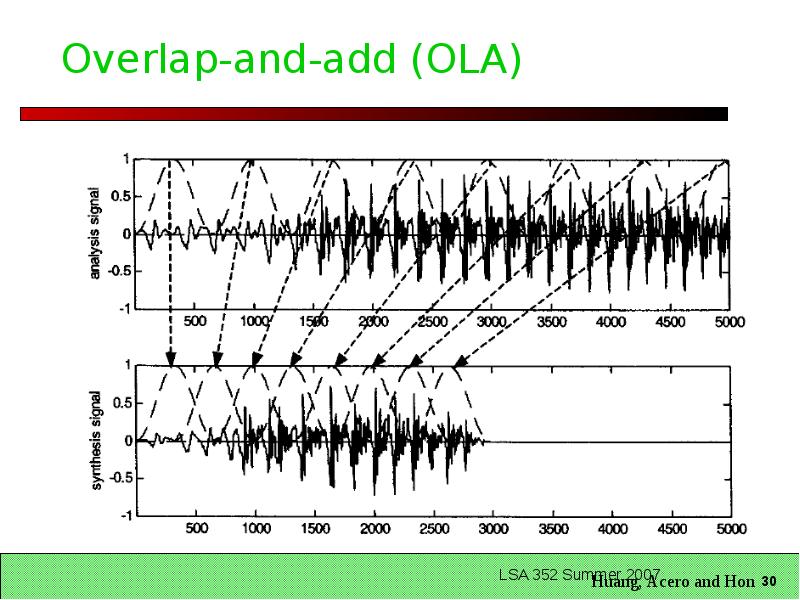
Overlap-and-add (OLA)
Описание слайда:
Overlap-and-add (OLA)

Слайд 31


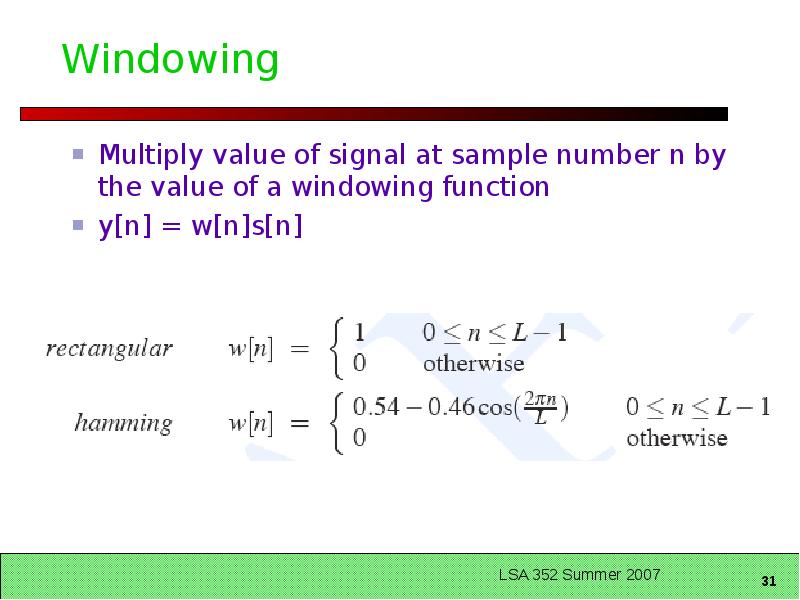
Windowing Multiply value of signal at sample number n by the value of a windowing function y[n] = w[n]s[n]
Описание слайда:
Windowing Multiply value of signal at sample number n by the value of a windowing function y[n] = w[n]s[n]

Слайд 32


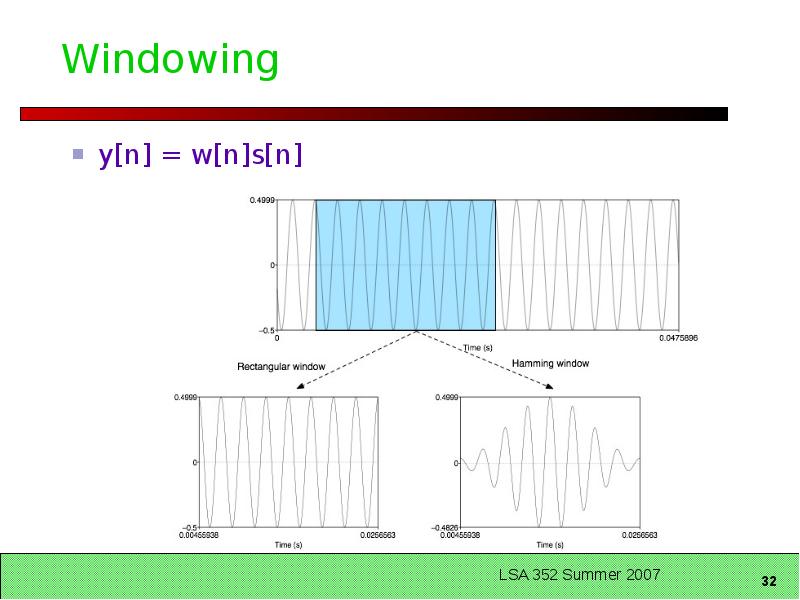
Windowing y[n] = w[n]s[n]
Описание слайда:
Windowing y[n] = w[n]s[n]

Слайд 33


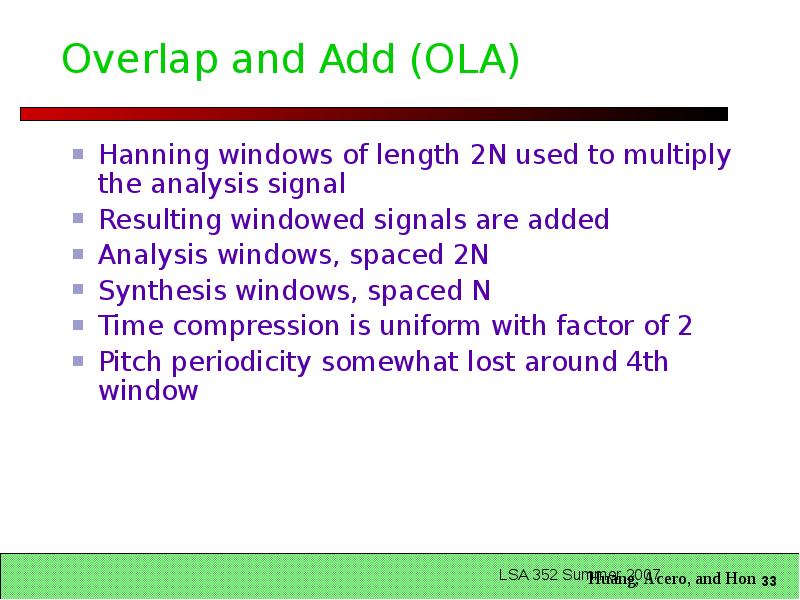
Overlap and Add (OLA) Hanning windows of length 2N used to multiply the analysis signal Resulting windowed signals are added Analysis windows, spaced...
Описание слайда:
Overlap and Add (OLA) Hanning windows of length 2N used to multiply the analysis signal Resulting windowed signals are added Analysis windows, spaced 2N Synthesis windows, spaced N Time compression is uniform with factor of 2 Pitch periodicity somewhat lost around 4th window

Слайд 34


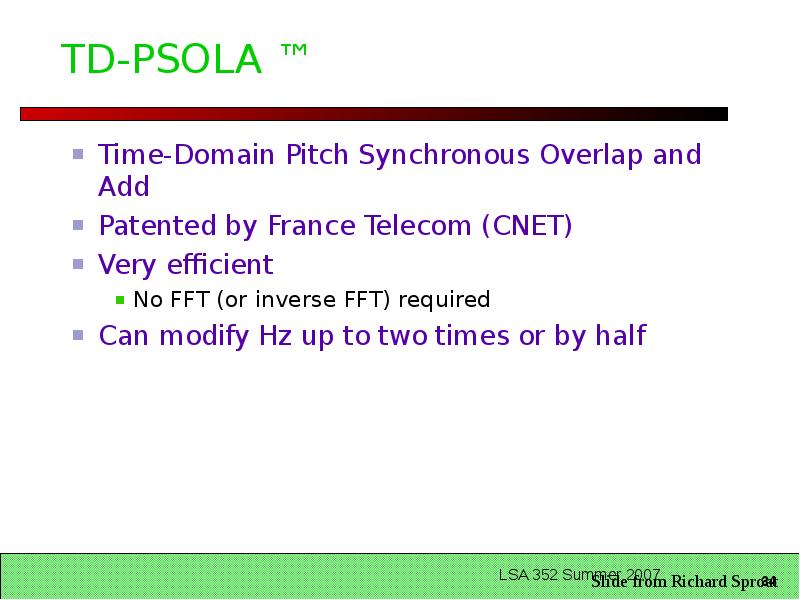
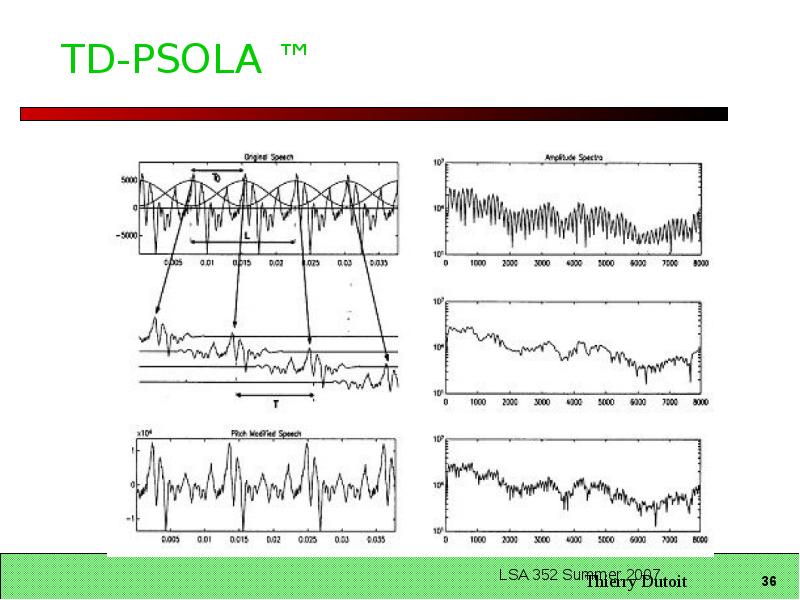
TD-PSOLA ™ Time-Domain Pitch Synchronous Overlap and Add Patented by France Telecom (CNET) Very efficient No FFT (or inverse FFT) required Can modify...
Описание слайда:
TD-PSOLA ™ Time-Domain Pitch Synchronous Overlap and Add Patented by France Telecom (CNET) Very efficient No FFT (or inverse FFT) required Can modify Hz up to two times or by half

Слайд 35


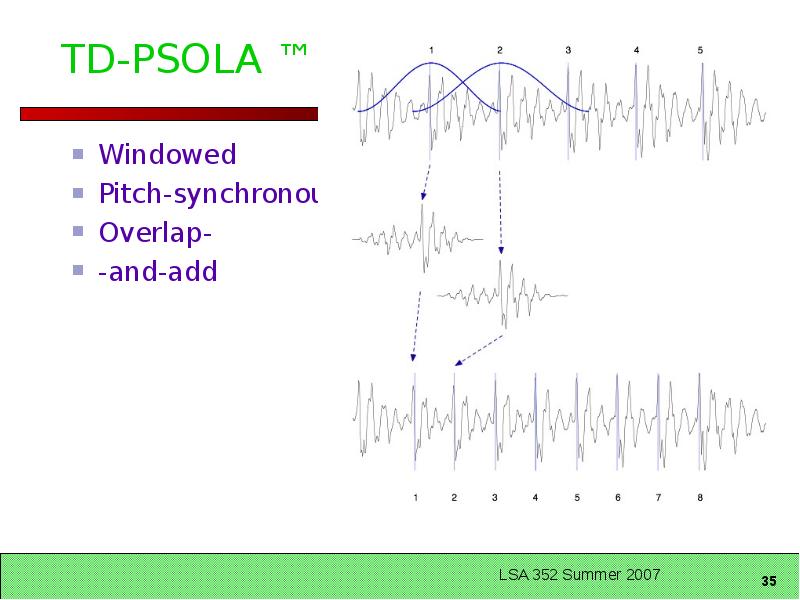
TD-PSOLA ™ Windowed Pitch-synchronous Overlap- -and-add
Описание слайда:
TD-PSOLA ™ Windowed Pitch-synchronous Overlap- -and-add

Слайд 36


TD-PSOLA ™
Описание слайда:
TD-PSOLA ™

Слайд 37


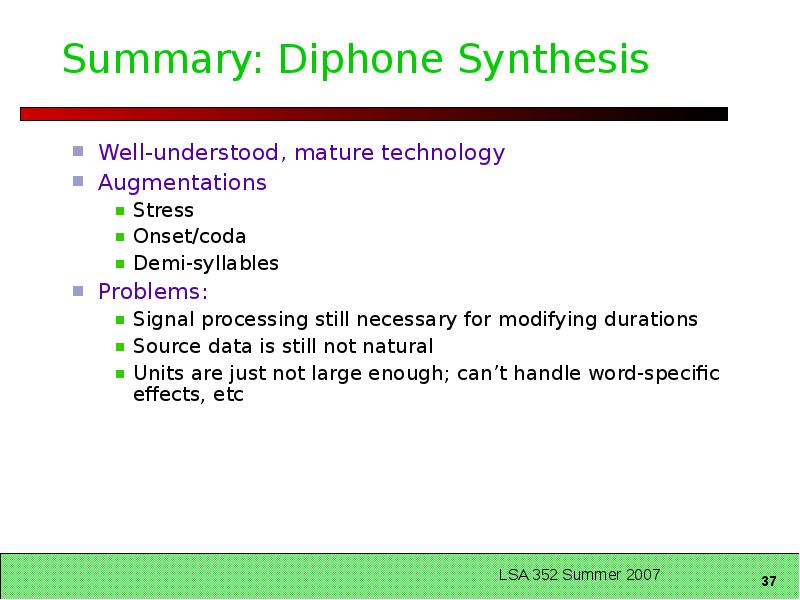
Summary: Diphone Synthesis Well-understood, mature technology Augmentations Stress Onset/coda Demi-syllables Problems: Signal processing still...
Описание слайда:
Summary: Diphone Synthesis Well-understood, mature technology Augmentations Stress Onset/coda Demi-syllables Problems: Signal processing still necessary for modifying durations Source data is still not natural Units are just not large enough; can’t handle word-specific effects, etc

Слайд 38


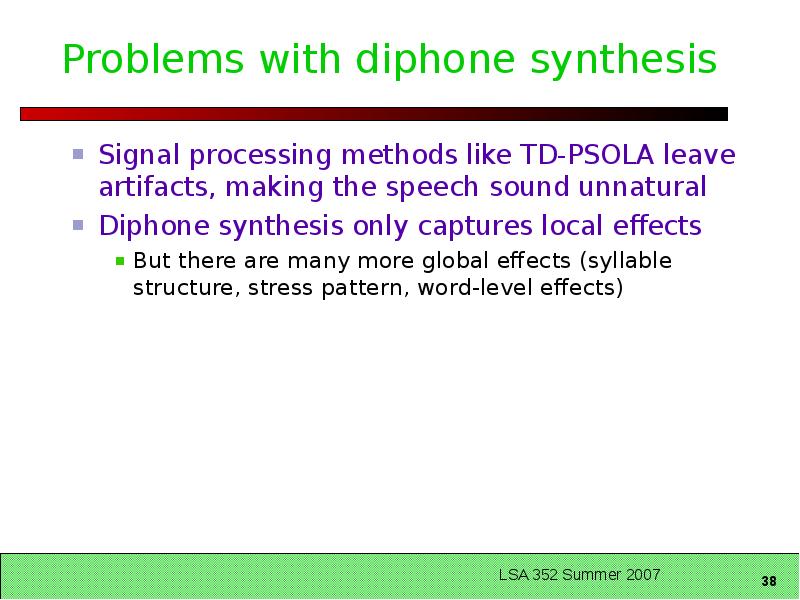
Problems with diphone synthesis Signal processing methods like TD-PSOLA leave artifacts, making the speech sound unnatural Diphone synthesis only...
Описание слайда:
Problems with diphone synthesis Signal processing methods like TD-PSOLA leave artifacts, making the speech sound unnatural Diphone synthesis only captures local effects But there are many more global effects (syllable structure, stress pattern, word-level effects)

Слайд 39


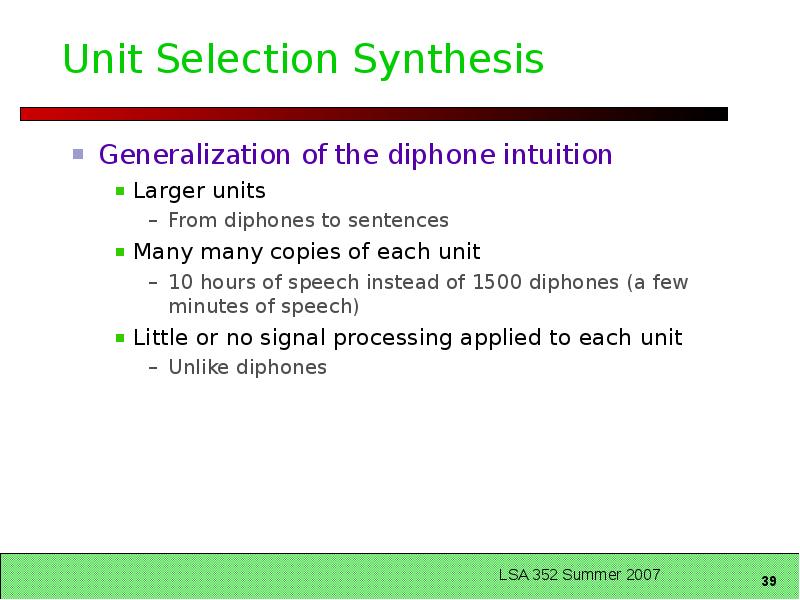
Unit Selection Synthesis Generalization of the diphone intuition Larger units From diphones to sentences Many many copies of each unit 10 hours of...
Описание слайда:
Unit Selection Synthesis Generalization of the diphone intuition Larger units From diphones to sentences Many many copies of each unit 10 hours of speech instead of 1500 diphones (a few minutes of speech) Little or no signal processing applied to each unit Unlike diphones

Слайд 40


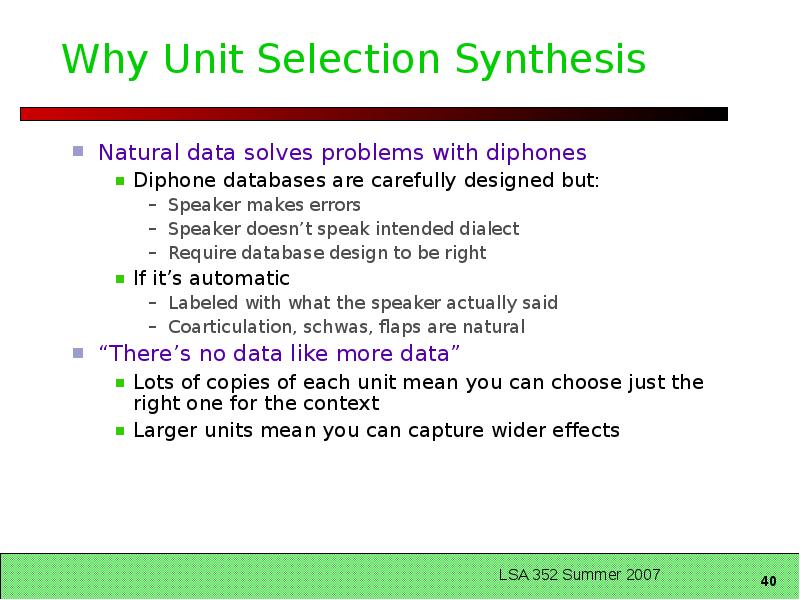
Why Unit Selection Synthesis Natural data solves problems with diphones Diphone databases are carefully designed but: Speaker makes errors Speaker...
Описание слайда:
Why Unit Selection Synthesis Natural data solves problems with diphones Diphone databases are carefully designed but: Speaker makes errors Speaker doesn’t speak intended dialect Require database design to be right If it’s automatic Labeled with what the speaker actually said Coarticulation, schwas, flaps are natural “There’s no data like more data” Lots of copies of each unit mean you can choose just the right one for the context Larger units mean you can capture wider effects

Слайд 41


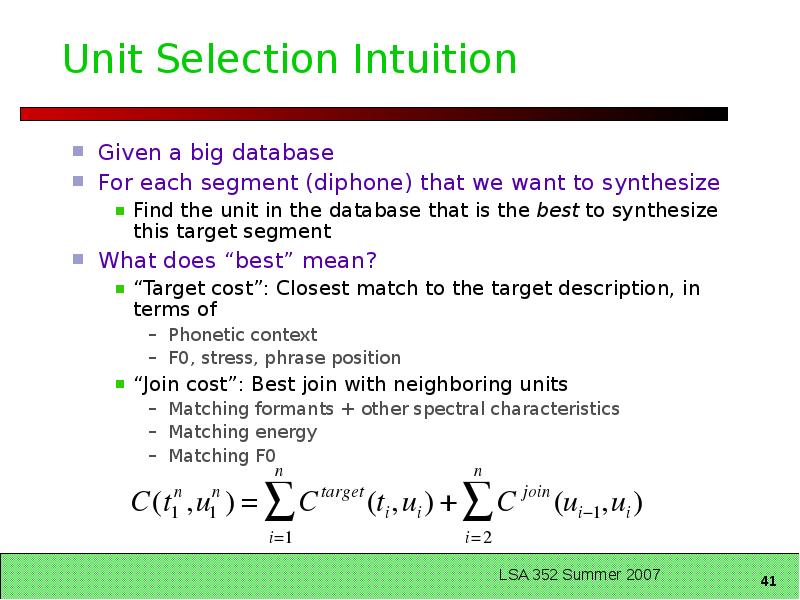
Unit Selection Intuition Given a big database For each segment (diphone) that we want to synthesize Find the unit in the database that is the best to...
Описание слайда:
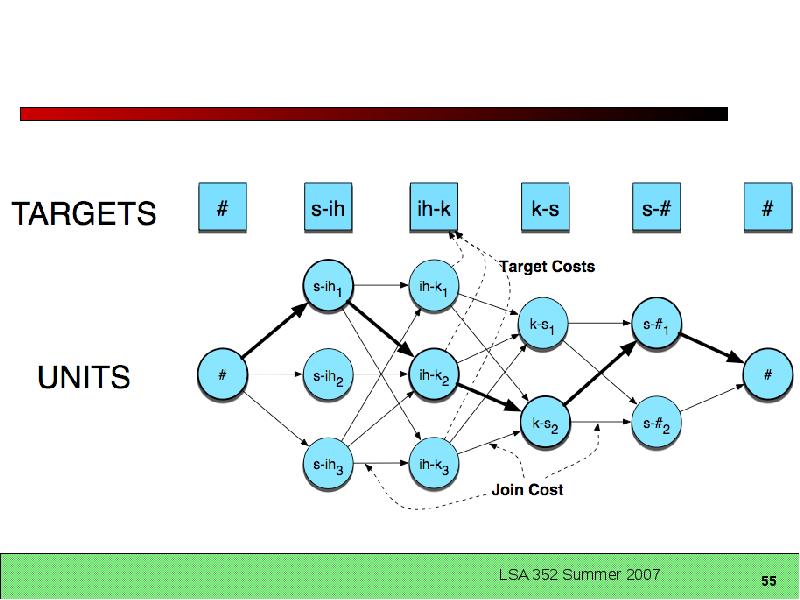
Unit Selection Intuition Given a big database For each segment (diphone) that we want to synthesize Find the unit in the database that is the best to synthesize this target segment What does “best” mean? “Target cost”: Closest match to the target description, in terms of Phonetic context F0, stress, phrase position “Join cost”: Best join with neighboring units Matching formants + other spectral characteristics Matching energy Matching F0

Слайд 42


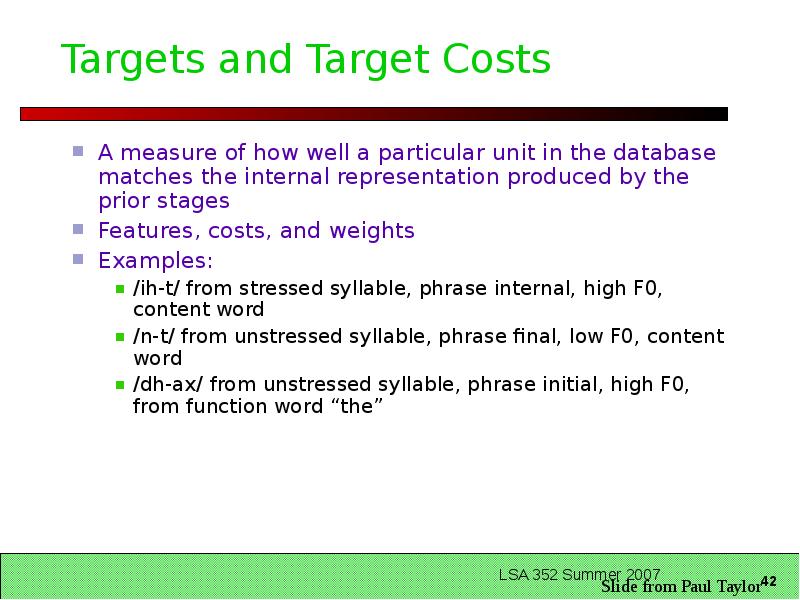
Targets and Target Costs A measure of how well a particular unit in the database matches the internal representation produced by the prior stages...
Описание слайда:
Targets and Target Costs A measure of how well a particular unit in the database matches the internal representation produced by the prior stages Features, costs, and weights Examples: /ih-t/ from stressed syllable, phrase internal, high F0, content word /n-t/ from unstressed syllable, phrase final, low F0, content word /dh-ax/ from unstressed syllable, phrase initial, high F0, from function word “the”

Слайд 43


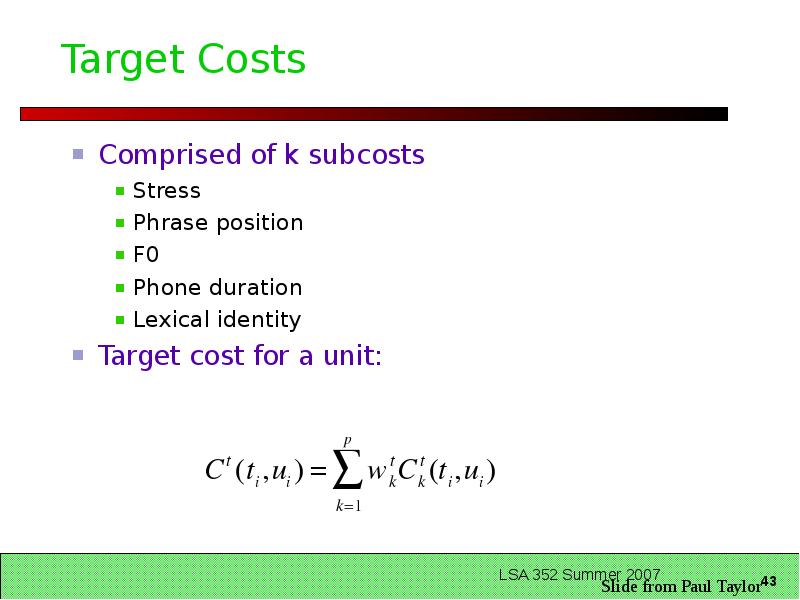
Target Costs Comprised of k subcosts Stress Phrase position F0 Phone duration Lexical identity Target cost for a unit:
Описание слайда:
Target Costs Comprised of k subcosts Stress Phrase position F0 Phone duration Lexical identity Target cost for a unit:

Слайд 44


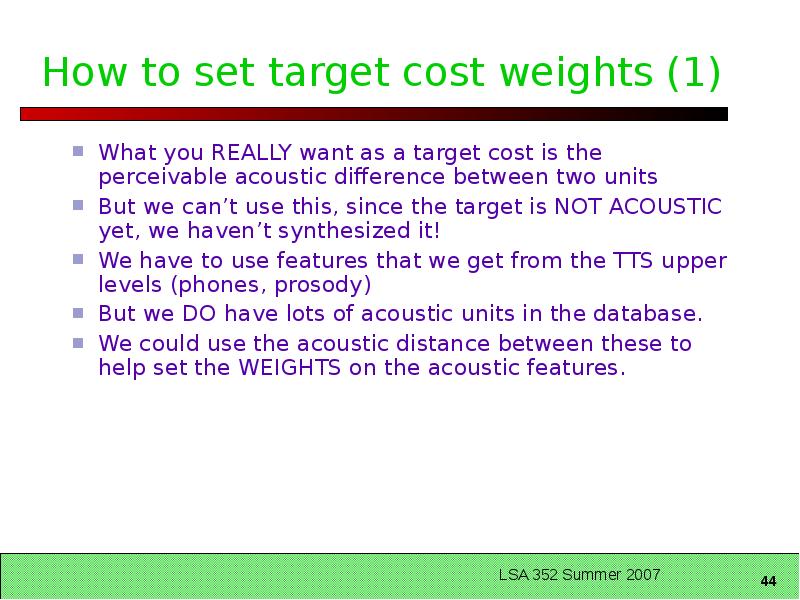
How to set target cost weights (1) What you REALLY want as a target cost is the perceivable acoustic difference between two units But we can’t use...
Описание слайда:
How to set target cost weights (1) What you REALLY want as a target cost is the perceivable acoustic difference between two units But we can’t use this, since the target is NOT ACOUSTIC yet, we haven’t synthesized it! We have to use features that we get from the TTS upper levels (phones, prosody) But we DO have lots of acoustic units in the database. We could use the acoustic distance between these to help set the WEIGHTS on the acoustic features.

Слайд 45


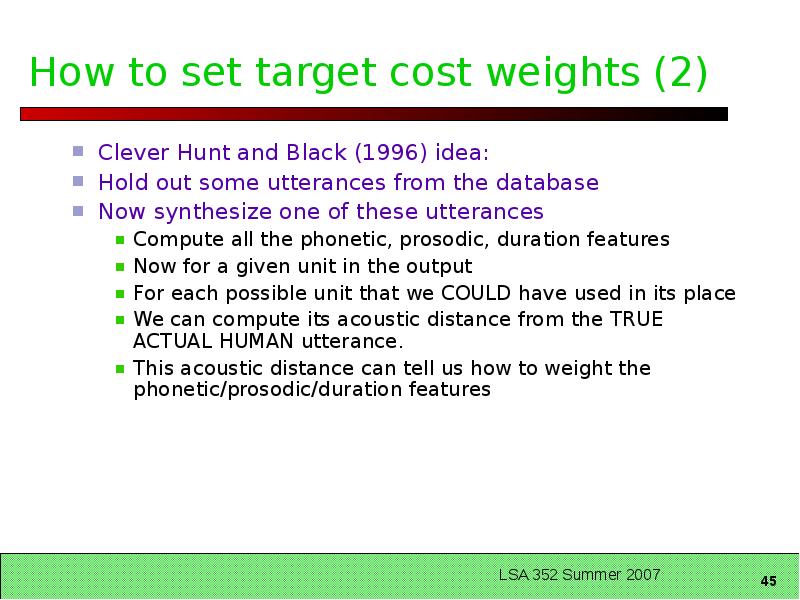
How to set target cost weights (2) Clever Hunt and Black (1996) idea: Hold out some utterances from the database Now synthesize one of these...
Описание слайда:
How to set target cost weights (2) Clever Hunt and Black (1996) idea: Hold out some utterances from the database Now synthesize one of these utterances Compute all the phonetic, prosodic, duration features Now for a given unit in the output For each possible unit that we COULD have used in its place We can compute its acoustic distance from the TRUE ACTUAL HUMAN utterance. This acoustic distance can tell us how to weight the phonetic/prosodic/duration features

Слайд 46


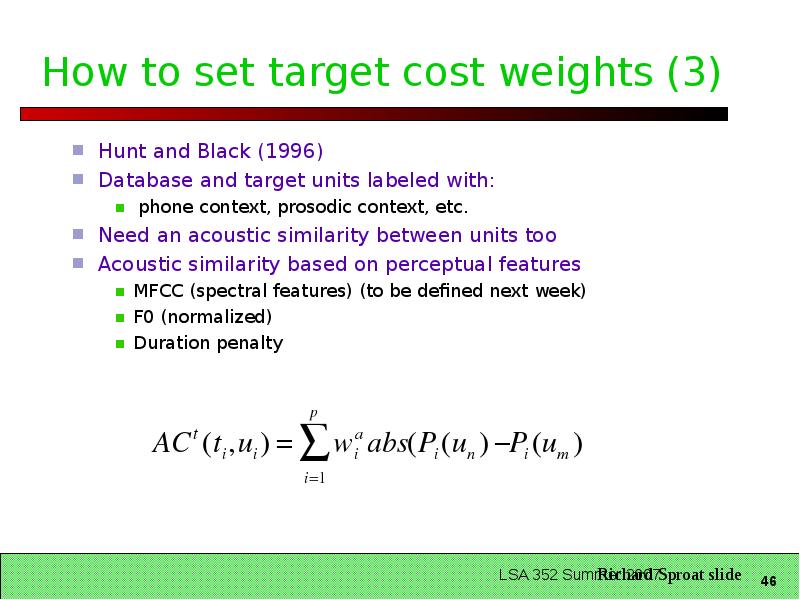
How to set target cost weights (3) Hunt and Black (1996) Database and target units labeled with: phone context, prosodic context, etc. Need an...
Описание слайда:
How to set target cost weights (3) Hunt and Black (1996) Database and target units labeled with: phone context, prosodic context, etc. Need an acoustic similarity between units too Acoustic similarity based on perceptual features MFCC (spectral features) (to be defined next week) F0 (normalized) Duration penalty

Слайд 47


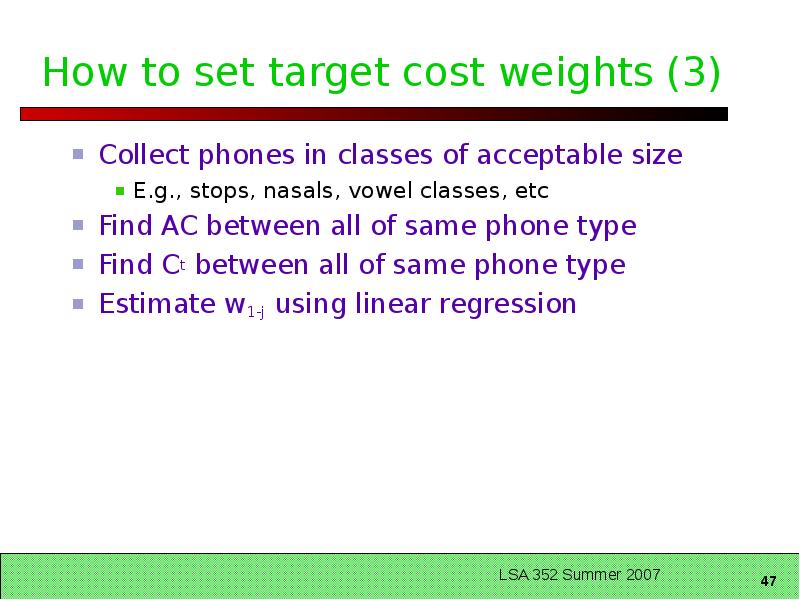
How to set target cost weights (3) Collect phones in classes of acceptable size E.g., stops, nasals, vowel classes, etc Find AC between all of same...
Описание слайда:
How to set target cost weights (3) Collect phones in classes of acceptable size E.g., stops, nasals, vowel classes, etc Find AC between all of same phone type Find Ct between all of same phone type Estimate w1-j using linear regression

Слайд 48


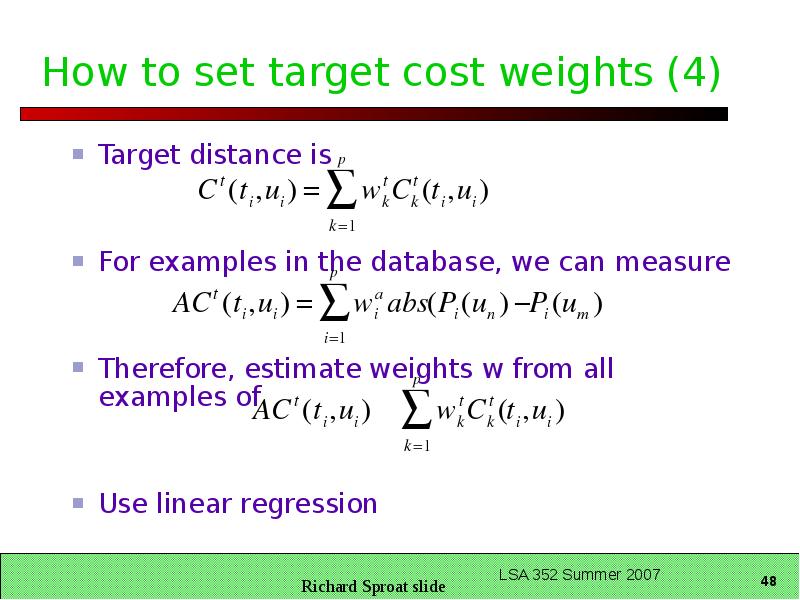
How to set target cost weights (4) Target distance is For examples in the database, we can measure Therefore, estimate weights w from all examples of...
Описание слайда:
How to set target cost weights (4) Target distance is For examples in the database, we can measure Therefore, estimate weights w from all examples of Use linear regression

Слайд 49


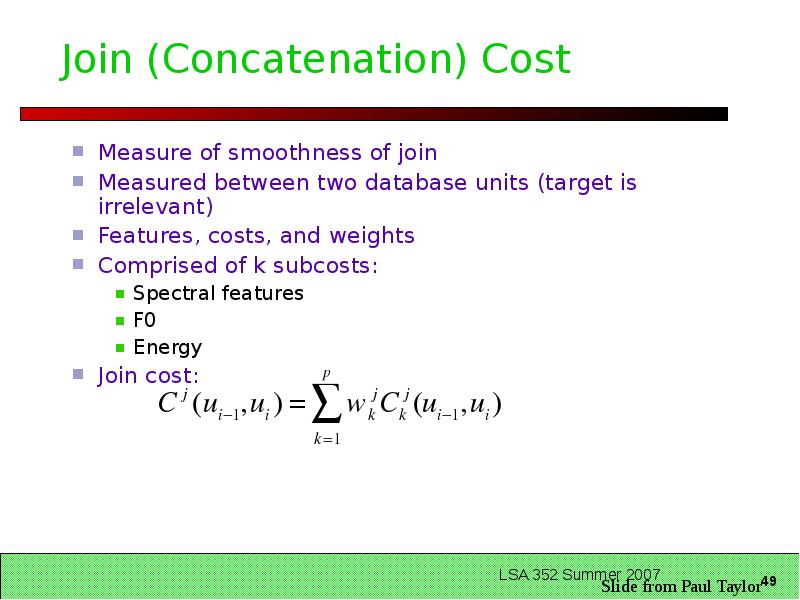
Join (Concatenation) Cost Measure of smoothness of join Measured between two database units (target is irrelevant) Features, costs, and weights...
Описание слайда:
Join (Concatenation) Cost Measure of smoothness of join Measured between two database units (target is irrelevant) Features, costs, and weights Comprised of k subcosts: Spectral features F0 Energy Join cost:

Слайд 50


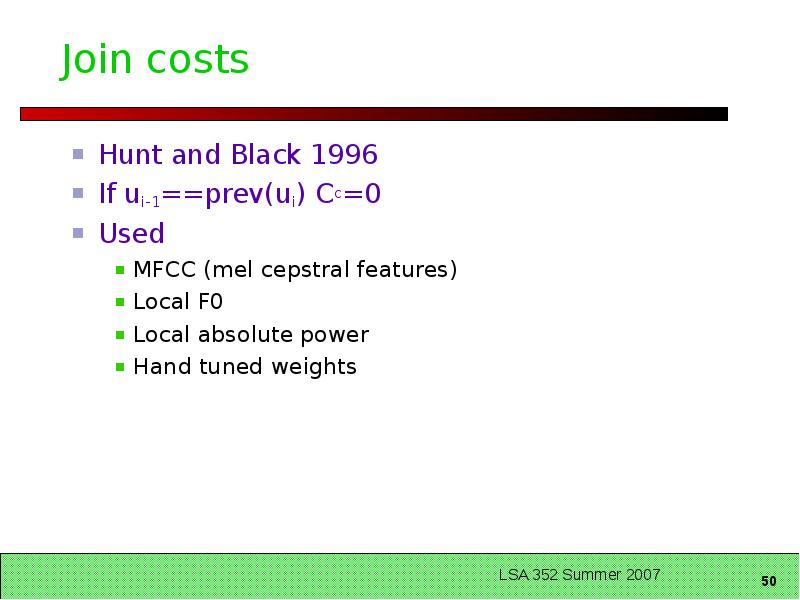
Join costs Hunt and Black 1996 If ui-1==prev(ui) Cc=0 Used MFCC (mel cepstral features) Local F0 Local absolute power Hand tuned weights
Описание слайда:
Join costs Hunt and Black 1996 If ui-1==prev(ui) Cc=0 Used MFCC (mel cepstral features) Local F0 Local absolute power Hand tuned weights

Слайд 51


Join costs The join cost can be used for more than just part of search Can use the join cost for optimal coupling (Isard and Taylor 1991, Conkie...
Описание слайда:
Join costs The join cost can be used for more than just part of search Can use the join cost for optimal coupling (Isard and Taylor 1991, Conkie 1996), i.e., finding the best place to join the two units. Vary edges within a small amount to find best place for join This allows different joins with different units Thus labeling of database (or diphones) need not be so accurate

Слайд 52


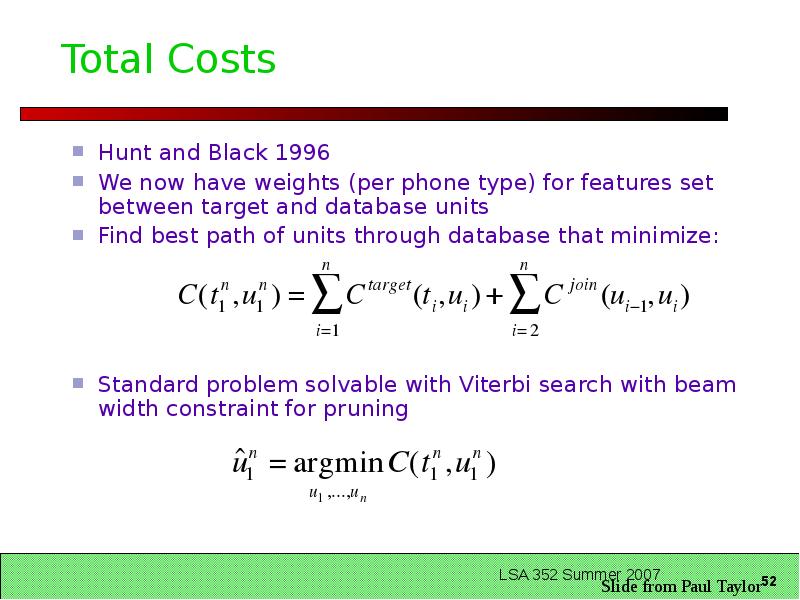
Total Costs Hunt and Black 1996 We now have weights (per phone type) for features set between target and database units Find best path of units...
Описание слайда:
Total Costs Hunt and Black 1996 We now have weights (per phone type) for features set between target and database units Find best path of units through database that minimize: Standard problem solvable with Viterbi search with beam width constraint for pruning

Слайд 53


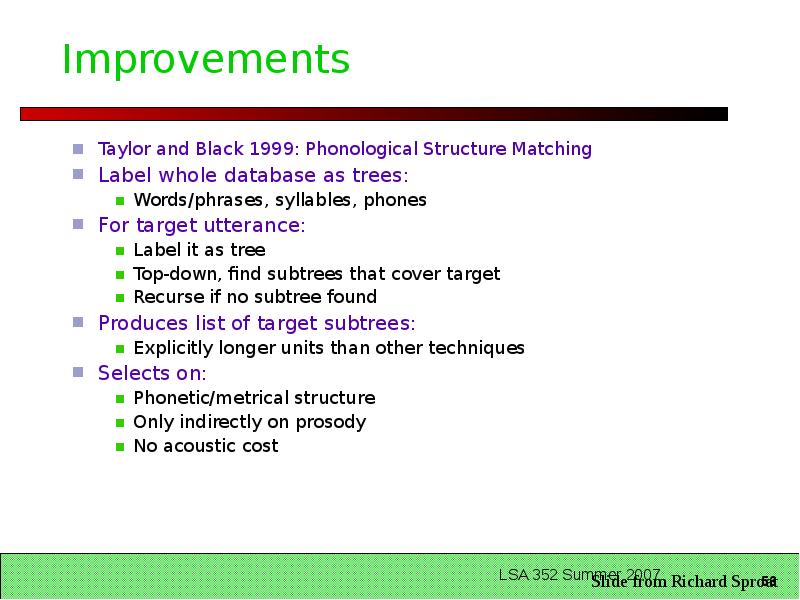
Improvements Taylor and Black 1999: Phonological Structure Matching Label whole database as trees: Words/phrases, syllables, phones For target...
Описание слайда:
Improvements Taylor and Black 1999: Phonological Structure Matching Label whole database as trees: Words/phrases, syllables, phones For target utterance: Label it as tree Top-down, find subtrees that cover target Recurse if no subtree found Produces list of target subtrees: Explicitly longer units than other techniques Selects on: Phonetic/metrical structure Only indirectly on prosody No acoustic cost

Слайд 54


Unit Selection Search
Описание слайда:
Unit Selection Search

Слайд 55


Speech Recognition and Synthesis. Waveform Synthesis (in Concatenative TTS), слайд №55
Описание слайда:

Слайд 56


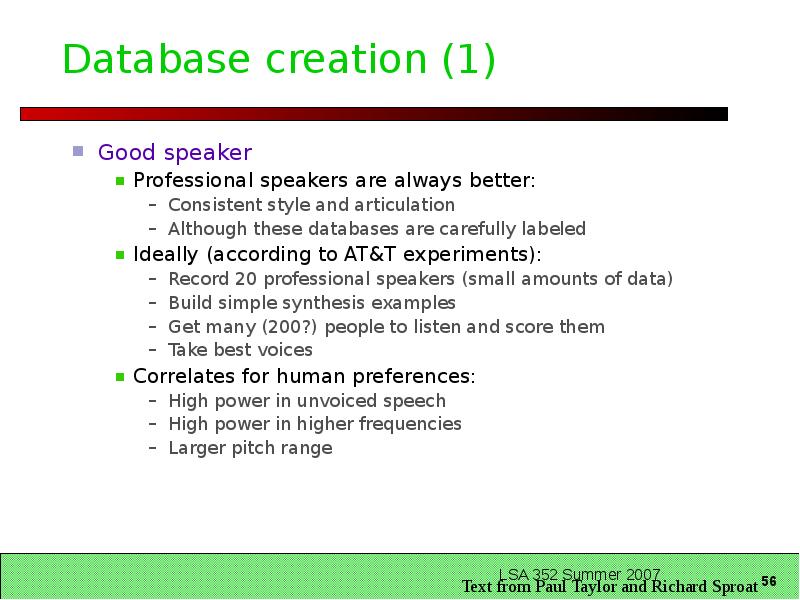
Database creation (1) Good speaker Professional speakers are always better: Consistent style and articulation Although these databases are carefully...
Описание слайда:
Database creation (1) Good speaker Professional speakers are always better: Consistent style and articulation Although these databases are carefully labeled Ideally (according to AT&T experiments): Record 20 professional speakers (small amounts of data) Build simple synthesis examples Get many (200?) people to listen and score them Take best voices Correlates for human preferences: High power in unvoiced speech High power in higher frequencies Larger pitch range

Слайд 57


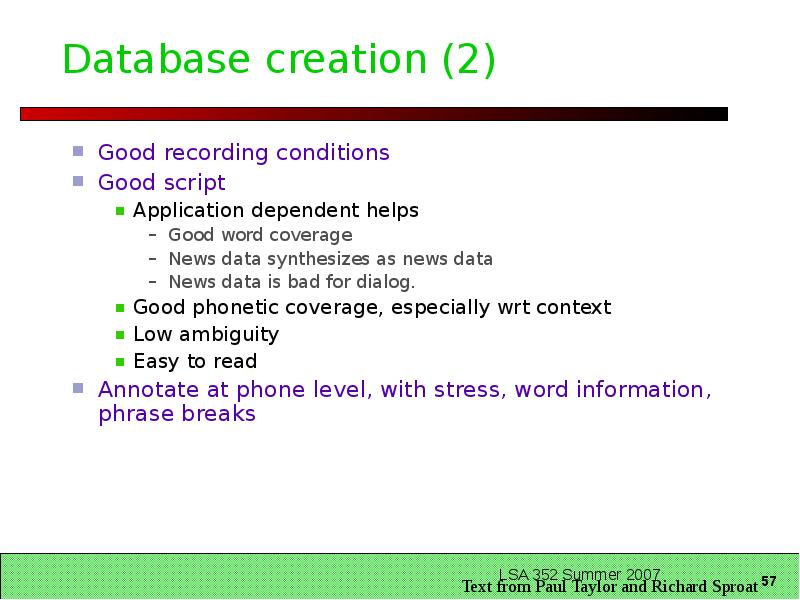
Database creation (2) Good recording conditions Good script Application dependent helps Good word coverage News data synthesizes as news data News...
Описание слайда:
Database creation (2) Good recording conditions Good script Application dependent helps Good word coverage News data synthesizes as news data News data is bad for dialog. Good phonetic coverage, especially wrt context Low ambiguity Easy to read Annotate at phone level, with stress, word information, phrase breaks

Слайд 58


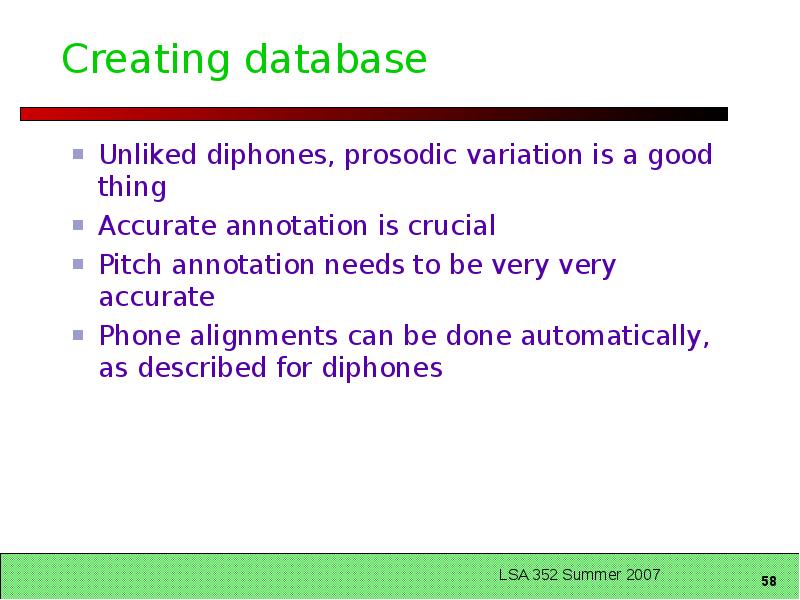
Creating database Unliked diphones, prosodic variation is a good thing Accurate annotation is crucial Pitch annotation needs to be very very accurate...
Описание слайда:
Creating database Unliked diphones, prosodic variation is a good thing Accurate annotation is crucial Pitch annotation needs to be very very accurate Phone alignments can be done automatically, as described for diphones

Слайд 59


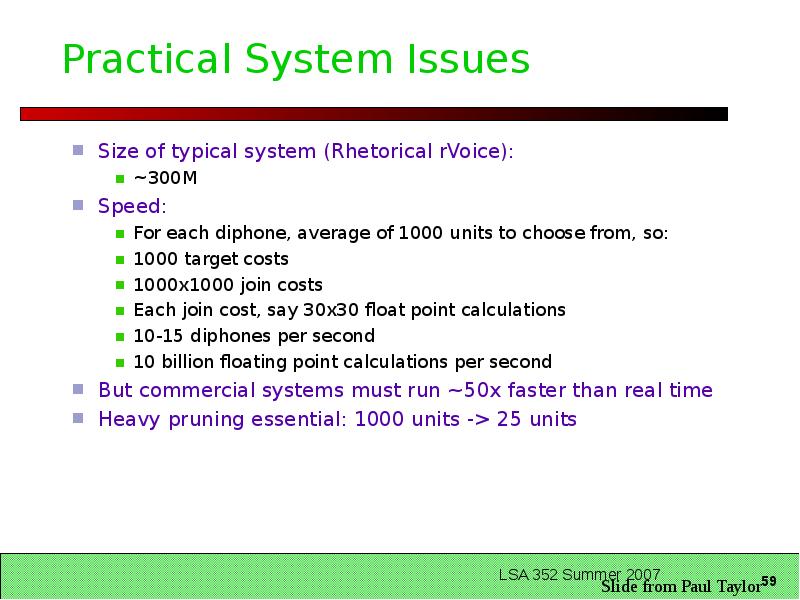
Practical System Issues Size of typical system (Rhetorical rVoice): ~300M Speed: For each diphone, average of 1000 units to choose from, so: 1000...
Описание слайда:
Practical System Issues Size of typical system (Rhetorical rVoice): ~300M Speed: For each diphone, average of 1000 units to choose from, so: 1000 target costs 1000x1000 join costs Each join cost, say 30x30 float point calculations 10-15 diphones per second 10 billion floating point calculations per second But commercial systems must run ~50x faster than real time Heavy pruning essential: 1000 units -> 25 units

Слайд 60


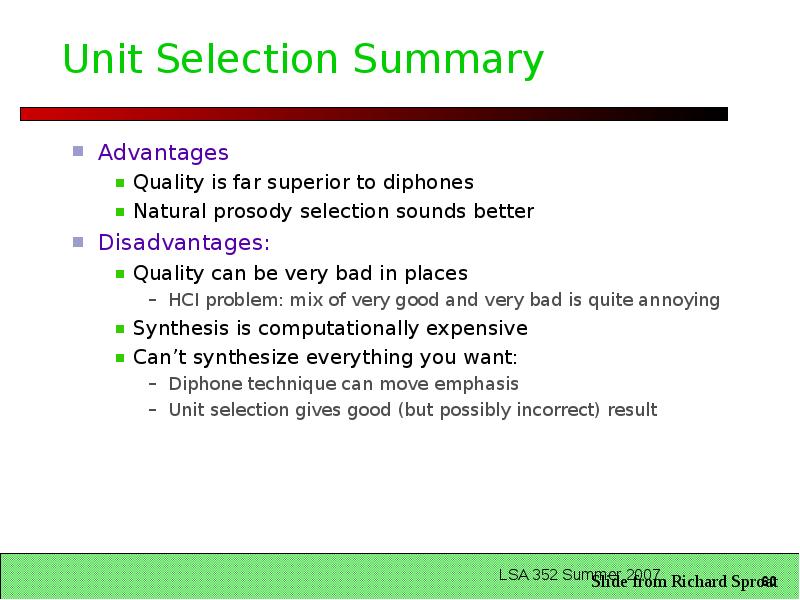
Unit Selection Summary Advantages Quality is far superior to diphones Natural prosody selection sounds better Disadvantages: Quality can be very bad...
Описание слайда:
Unit Selection Summary Advantages Quality is far superior to diphones Natural prosody selection sounds better Disadvantages: Quality can be very bad in places HCI problem: mix of very good and very bad is quite annoying Synthesis is computationally expensive Can’t synthesize everything you want: Diphone technique can move emphasis Unit selection gives good (but possibly incorrect) result

Слайд 61


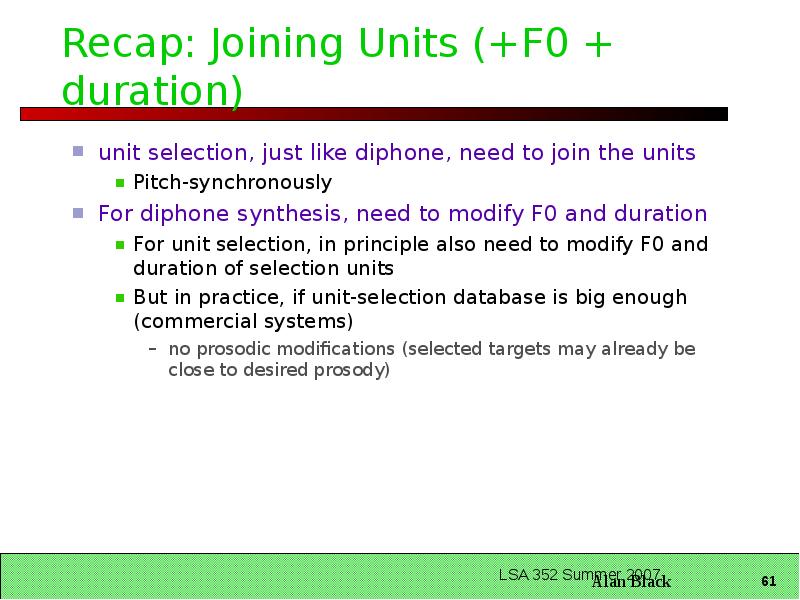
Recap: Joining Units (+F0 + duration) unit selection, just like diphone, need to join the units Pitch-synchronously For diphone synthesis, need to...
Описание слайда:
Recap: Joining Units (+F0 + duration) unit selection, just like diphone, need to join the units Pitch-synchronously For diphone synthesis, need to modify F0 and duration For unit selection, in principle also need to modify F0 and duration of selection units But in practice, if unit-selection database is big enough (commercial systems) no prosodic modifications (selected targets may already be close to desired prosody)

Слайд 62


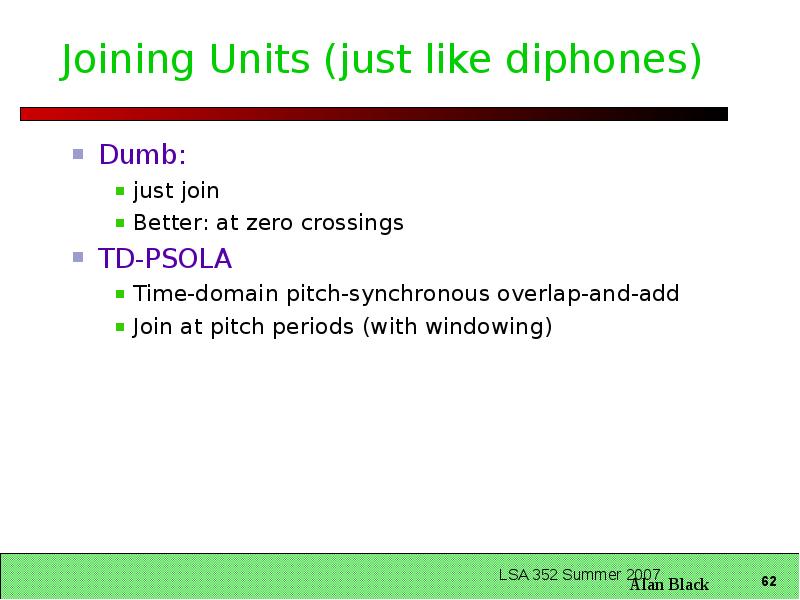
Joining Units (just like diphones) Dumb: just join Better: at zero crossings TD-PSOLA Time-domain pitch-synchronous overlap-and-add Join at pitch...
Описание слайда:
Joining Units (just like diphones) Dumb: just join Better: at zero crossings TD-PSOLA Time-domain pitch-synchronous overlap-and-add Join at pitch periods (with windowing)

Слайд 63


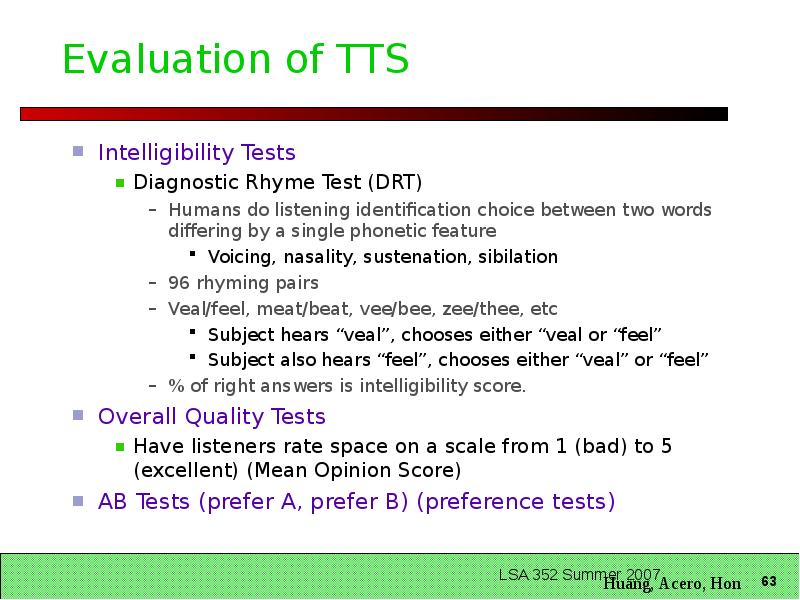
Evaluation of TTS Intelligibility Tests Diagnostic Rhyme Test (DRT) Humans do listening identification choice between two words differing by a single...
Описание слайда:
Evaluation of TTS Intelligibility Tests Diagnostic Rhyme Test (DRT) Humans do listening identification choice between two words differing by a single phonetic feature Voicing, nasality, sustenation, sibilation 96 rhyming pairs Veal/feel, meat/beat, vee/bee, zee/thee, etc Subject hears “veal”, chooses either “veal or “feel” Subject also hears “feel”, chooses either “veal” or “feel” % of right answers is intelligibility score. Overall Quality Tests Have listeners rate space on a scale from 1 (bad) to 5 (excellent) (Mean Opinion Score) AB Tests (prefer A, prefer B) (preference tests)

Слайд 64


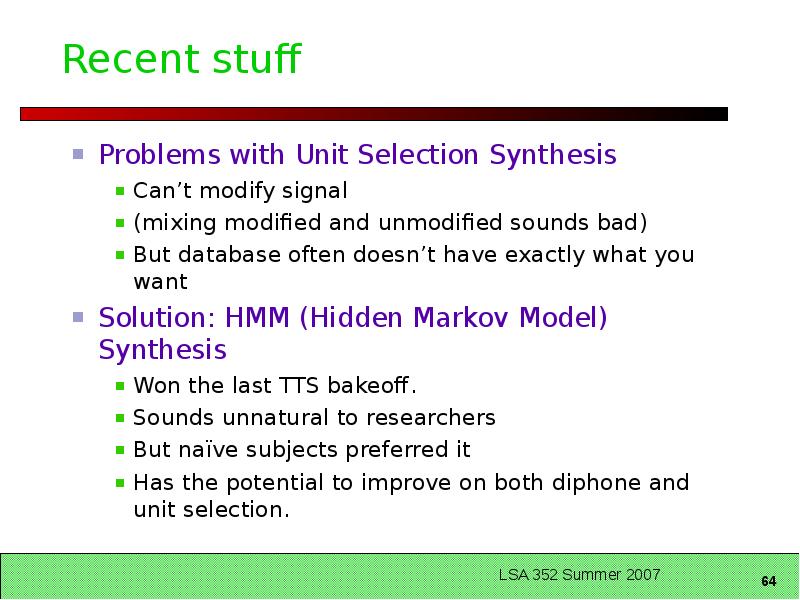
Recent stuff Problems with Unit Selection Synthesis Can’t modify signal (mixing modified and unmodified sounds bad) But database often doesn’t have...
Описание слайда:
Recent stuff Problems with Unit Selection Synthesis Can’t modify signal (mixing modified and unmodified sounds bad) But database often doesn’t have exactly what you want Solution: HMM (Hidden Markov Model) Synthesis Won the last TTS bakeoff. Sounds unnatural to researchers But naïve subjects preferred it Has the potential to improve on both diphone and unit selection.

Слайд 65


HMM Synthesis Unit selection (Roger) HMM (Roger) Unit selection (Nina) HMM (Nina)
Описание слайда:
HMM Synthesis Unit selection (Roger) HMM (Roger) Unit selection (Nina) HMM (Nina)

Слайд 66


Summary Diphone Synthesis Unit Selection Synthesis Target cost Unit cost
Описание слайда:
Summary Diphone Synthesis Unit Selection Synthesis Target cost Unit cost


Похожие презентации
Mypresentation.ru
Загрузить презентацию