🗊 Презентация Colloid chemistry

Категория: Химия
Нажмите для полного просмотра!
Colloid chemistry, слайд №1 Colloid chemistry, слайд №2 Colloid chemistry, слайд №3 Colloid chemistry, слайд №4 Colloid chemistry, слайд №5 Colloid chemistry, слайд №6 Colloid chemistry, слайд №7 Colloid chemistry, слайд №8 Colloid chemistry, слайд №9 Colloid chemistry, слайд №10 Colloid chemistry, слайд №11 Colloid chemistry, слайд №12 Colloid chemistry, слайд №13 Colloid chemistry, слайд №14 Colloid chemistry, слайд №15 Colloid chemistry, слайд №16 Colloid chemistry, слайд №17 Colloid chemistry, слайд №18 Colloid chemistry, слайд №19 Colloid chemistry, слайд №20 Colloid chemistry, слайд №21 Colloid chemistry, слайд №22 Colloid chemistry, слайд №23 Colloid chemistry, слайд №24 Colloid chemistry, слайд №25 Colloid chemistry, слайд №26 Colloid chemistry, слайд №27 Colloid chemistry, слайд №28 Colloid chemistry, слайд №29 Colloid chemistry, слайд №30 Colloid chemistry, слайд №31 Colloid chemistry, слайд №32 Colloid chemistry, слайд №33 Colloid chemistry, слайд №34 Colloid chemistry, слайд №35 Colloid chemistry, слайд №36 Colloid chemistry, слайд №37 Colloid chemistry, слайд №38 Colloid chemistry, слайд №39 Colloid chemistry, слайд №40 Colloid chemistry, слайд №41 Colloid chemistry, слайд №42 Colloid chemistry, слайд №43 Colloid chemistry, слайд №44 Colloid chemistry, слайд №45 Colloid chemistry, слайд №46 Colloid chemistry, слайд №47 Colloid chemistry, слайд №48 Colloid chemistry, слайд №49 Colloid chemistry, слайд №50 Colloid chemistry, слайд №51 Colloid chemistry, слайд №52 Colloid chemistry, слайд №53 Colloid chemistry, слайд №54 Colloid chemistry, слайд №55

Содержание
Вы можете ознакомиться и скачать презентацию на тему Colloid chemistry. Доклад-сообщение содержит 55 слайдов. Презентации для любого класса можно скачать бесплатно. Если материал и наш сайт презентаций Mypresentation Вам понравились – поделитесь им с друзьями с помощью социальных кнопок и добавьте в закладки в своем браузере.
Слайды и текст этой презентации


Слайд 1


Colloid chemistry, слайд №1
Описание слайда:
Слайд 2


Colloid chemistry, слайд №2
Описание слайда:
Слайд 3


Colloid chemistry, слайд №3
Описание слайда:

Слайд 4


Colloid chemistry, слайд №4
Описание слайда:

Слайд 5


Colloid chemistry, слайд №5
Описание слайда:

Слайд 6


Colloid chemistry, слайд №6
Описание слайда:

Слайд 7


Colloid chemistry, слайд №7
Описание слайда:

Слайд 8


Colloid chemistry, слайд №8
Описание слайда:

Слайд 9


Colloid chemistry, слайд №9
Описание слайда:

Слайд 10


Colloid chemistry, слайд №10
Описание слайда:

Слайд 11


Colloid chemistry, слайд №11
Описание слайда:

Слайд 12


Colloid chemistry, слайд №12
Описание слайда:

Слайд 13


Colloid chemistry, слайд №13
Описание слайда:

Слайд 14


Colloid chemistry, слайд №14
Описание слайда:

Слайд 15


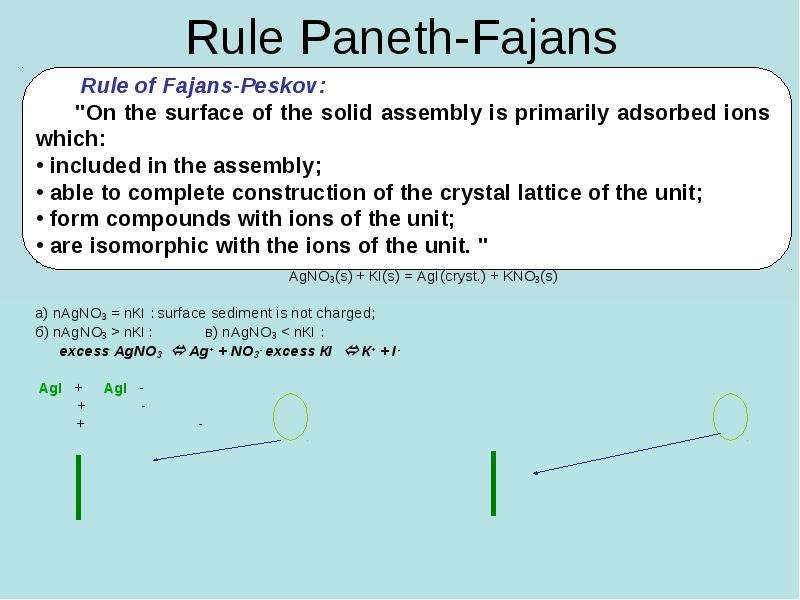
Rule Paneth-Fajans Determine the sign of the surface charge of AgI (cryst.) obtained by the reaction: АgNО3(s) + КI(s) = АgI(cryst.) + KNO3(s) а)...
Описание слайда:
Rule Paneth-Fajans Determine the sign of the surface charge of AgI (cryst.) obtained by the reaction: АgNО3(s) + КI(s) = АgI(cryst.) + KNO3(s) а) nАgNО3 = nКI : surface sediment is not charged; б) nАgNO3 > nКI : в) nАgNО3 < nКI : excess АgNO3  Аg+ + NО3- excess КI  К+ + I- АgI + АgI - + - + -

Слайд 16


Colloid chemistry, слайд №16
Описание слайда:

Слайд 17


Colloid chemistry, слайд №17
Описание слайда:

Слайд 18


Colloid chemistry, слайд №18
Описание слайда:

Слайд 19


Colloid chemistry, слайд №19
Описание слайда:

Слайд 20


Colloid chemistry, слайд №20
Описание слайда:

Слайд 21


Colloid chemistry, слайд №21
Описание слайда:

Слайд 22


Colloid chemistry, слайд №22
Описание слайда:

Слайд 23


Colloid chemistry, слайд №23
Описание слайда:

Слайд 24


Colloid chemistry, слайд №24
Описание слайда:

Слайд 25


Molecular-kinetic properties of dispersion systems
Описание слайда:
Molecular-kinetic properties of dispersion systems

Слайд 26


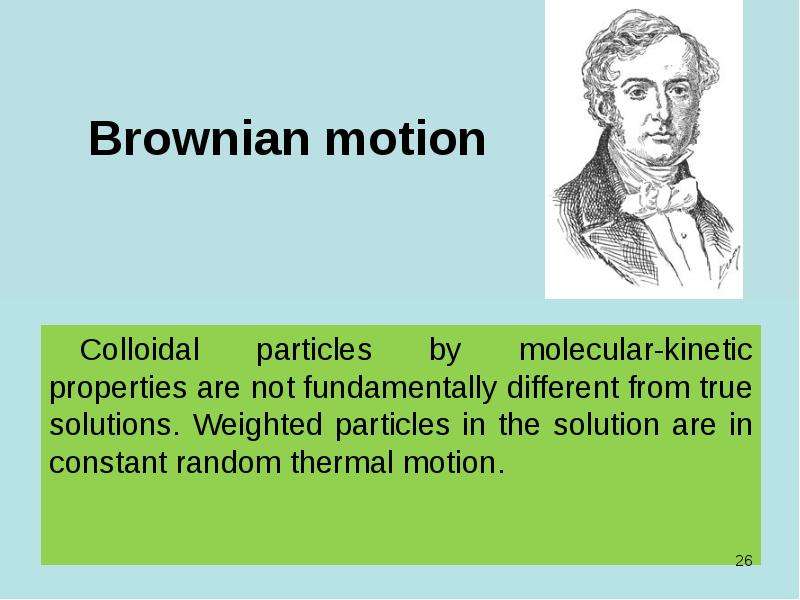
Brownian motion Colloidal particles by molecular-kinetic properties are not fundamentally different from true solutions. Weighted particles in the...
Описание слайда:
Brownian motion Colloidal particles by molecular-kinetic properties are not fundamentally different from true solutions. Weighted particles in the solution are in constant random thermal motion.

Слайд 27


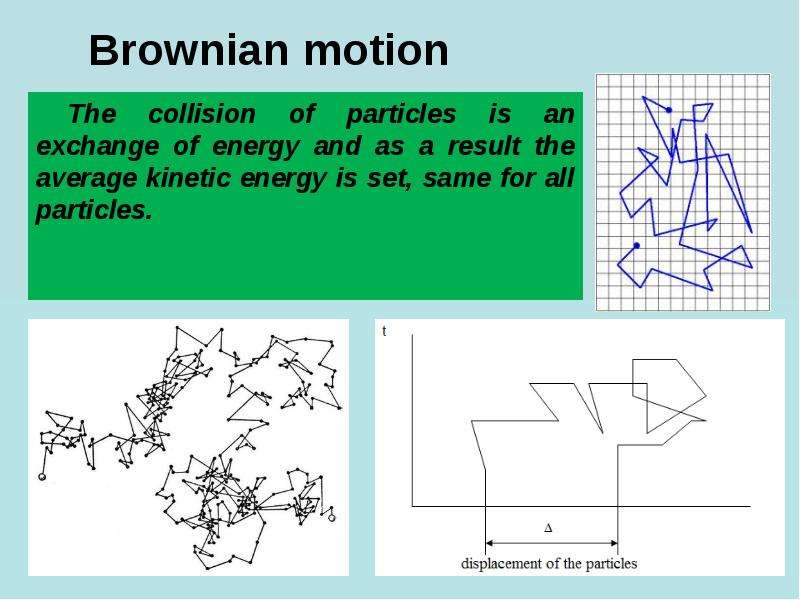
Brownian motion The collision of particles is an exchange of energy and as a result the average kinetic energy is set, same for all particles.
Описание слайда:
Brownian motion The collision of particles is an exchange of energy and as a result the average kinetic energy is set, same for all particles.

Слайд 28


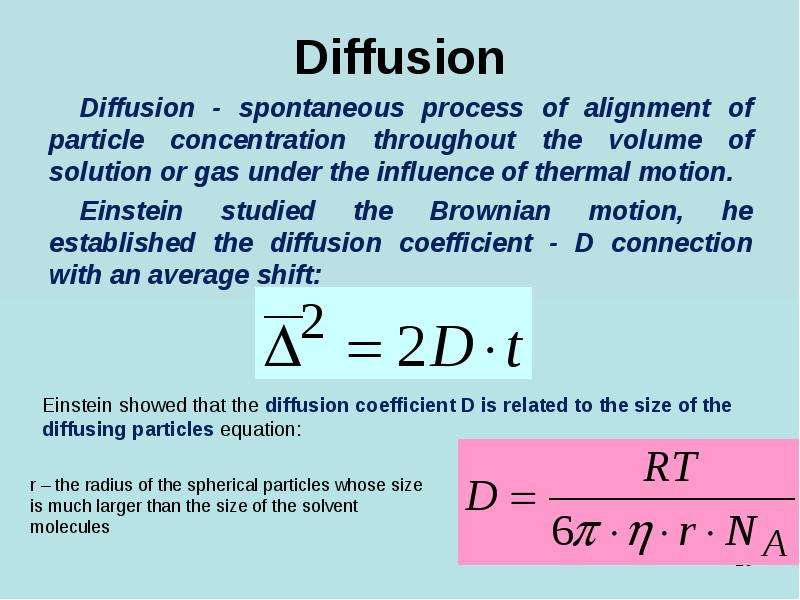
Diffusion Diffusion - spontaneous process of alignment of particle concentration throughout the volume of solution or gas under the influence of...
Описание слайда:
Diffusion Diffusion - spontaneous process of alignment of particle concentration throughout the volume of solution or gas under the influence of thermal motion. Einstein studied the Brownian motion, he established the diffusion coefficient - D connection with an average shift:

Слайд 29


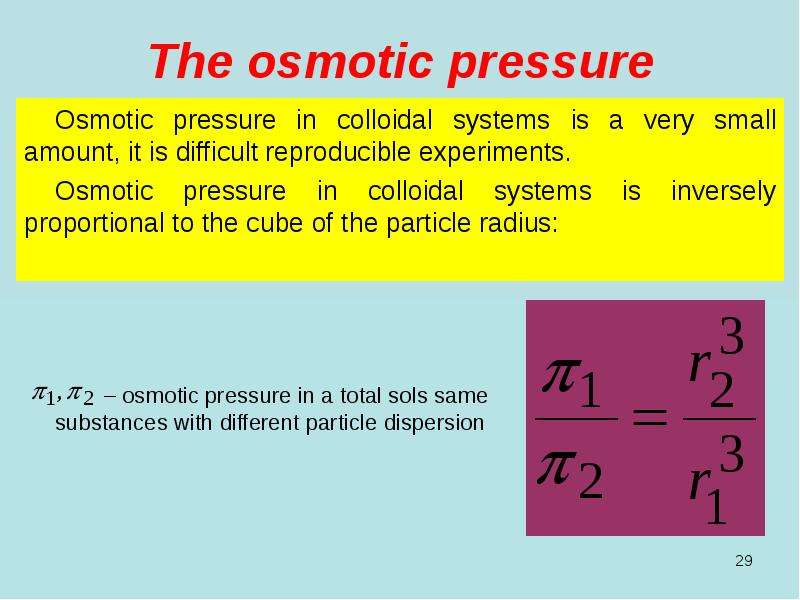
The osmotic pressure Osmotic pressure in colloidal systems is a very small amount, it is difficult reproducible experiments. Osmotic pressure in...
Описание слайда:
The osmotic pressure Osmotic pressure in colloidal systems is a very small amount, it is difficult reproducible experiments. Osmotic pressure in colloidal systems is inversely proportional to the cube of the particle radius:

Слайд 30


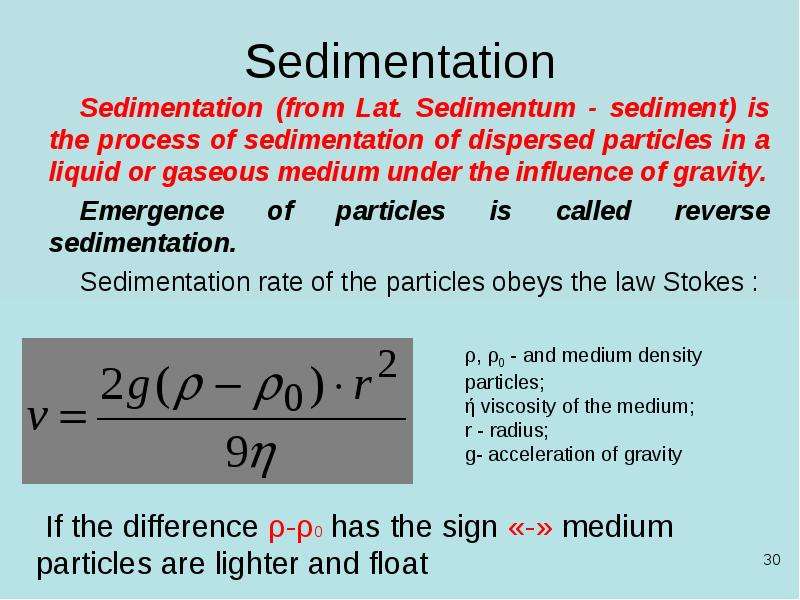
Sedimentation Sedimentation (from Lat. Sedimentum - sediment) is the process of sedimentation of dispersed particles in a liquid or gaseous medium...
Описание слайда:
Sedimentation Sedimentation (from Lat. Sedimentum - sediment) is the process of sedimentation of dispersed particles in a liquid or gaseous medium under the influence of gravity. Emergence of particles is called reverse sedimentation. Sedimentation rate of the particles obeys the law Stokes :

Слайд 31


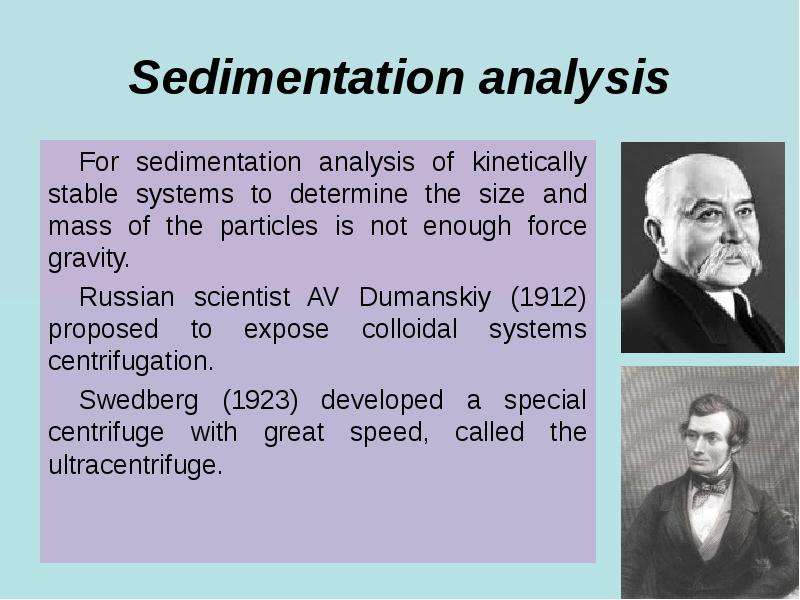
Sedimentation analysis For sedimentation analysis of kinetically stable systems to determine the size and mass of the particles is not enough force...
Описание слайда:
Sedimentation analysis For sedimentation analysis of kinetically stable systems to determine the size and mass of the particles is not enough force gravity. Russian scientist AV Dumanskiy (1912) proposed to expose colloidal systems centrifugation. Swedberg (1923) developed a special centrifuge with great speed, called the ultracentrifuge.

Слайд 32


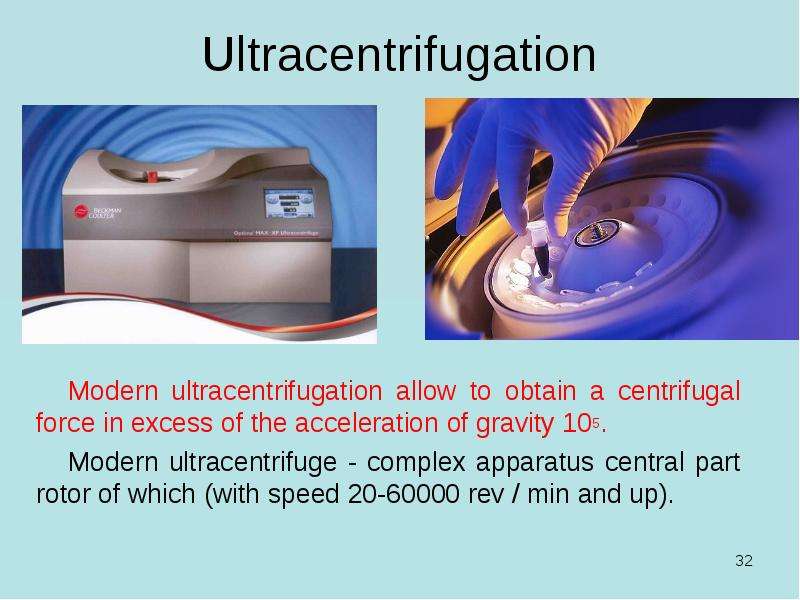
Ultracentrifugation Modern ultracentrifugation allow to obtain a centrifugal force in excess of the acceleration of gravity 105. Modern...
Описание слайда:
Ultracentrifugation Modern ultracentrifugation allow to obtain a centrifugal force in excess of the acceleration of gravity 105. Modern ultracentrifuge - complex apparatus central part rotor of which (with speed 20-60000 rev / min and up).

Слайд 33


Optical properties of disperse systems
Описание слайда:
Optical properties of disperse systems

Слайд 34


The scattering of light This is the most characteristic optical property of colloidal systems. The light is scattered in all directions. This...
Описание слайда:
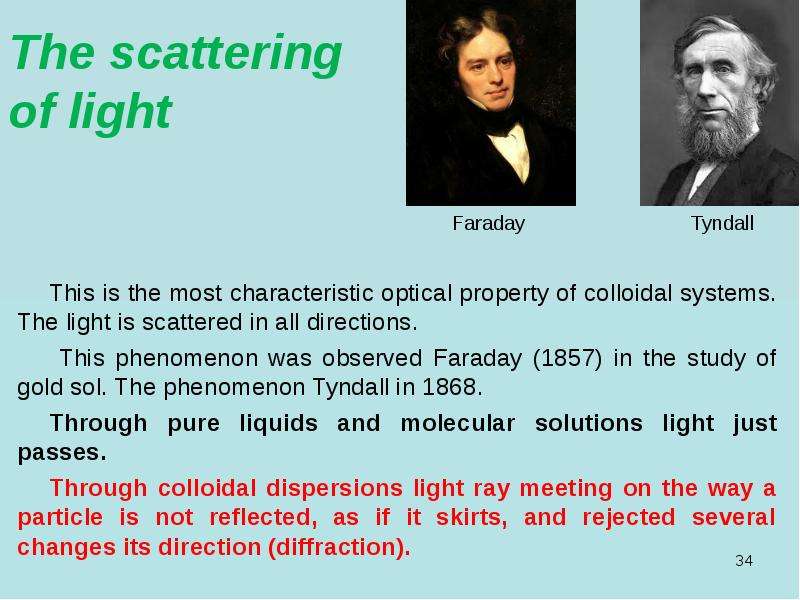
The scattering of light This is the most characteristic optical property of colloidal systems. The light is scattered in all directions. This phenomenon was observed Faraday (1857) in the study of gold sol. The phenomenon Tyndall in 1868. Through pure liquids and molecular solutions light just passes. Through colloidal dispersions light ray meeting on the way a particle is not reflected, as if it skirts, and rejected several changes its direction (diffraction).

Слайд 35


The scattering of light Tyndall found that when illuminated colloidal solution bright light ray path it is visible when viewed side as a luminous...
Описание слайда:
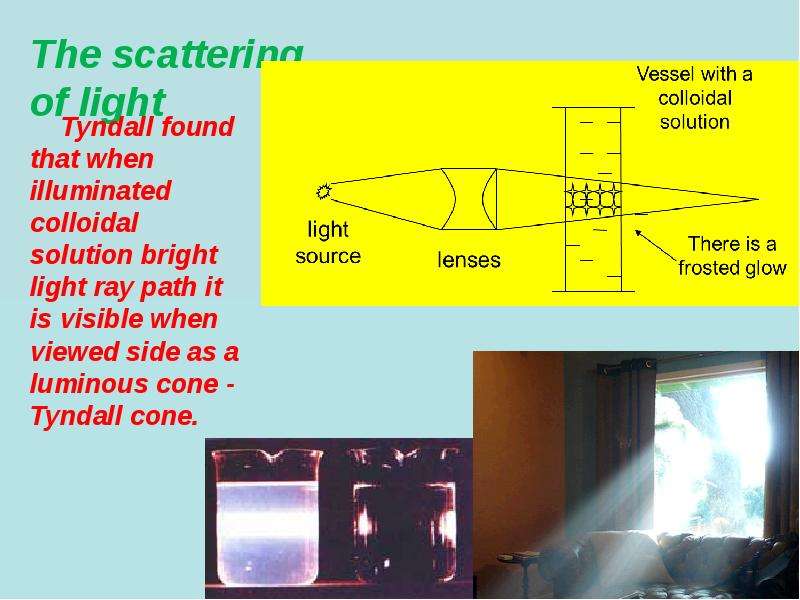
The scattering of light Tyndall found that when illuminated colloidal solution bright light ray path it is visible when viewed side as a luminous cone - Tyndall cone.

Слайд 36


Electrical properties of disperse systems
Описание слайда:
Electrical properties of disperse systems

Слайд 37


DEL. Formation of a double electric layer DEL existence of ions and the potential jump at the interface of the two phases plays an important role in...
Описание слайда:
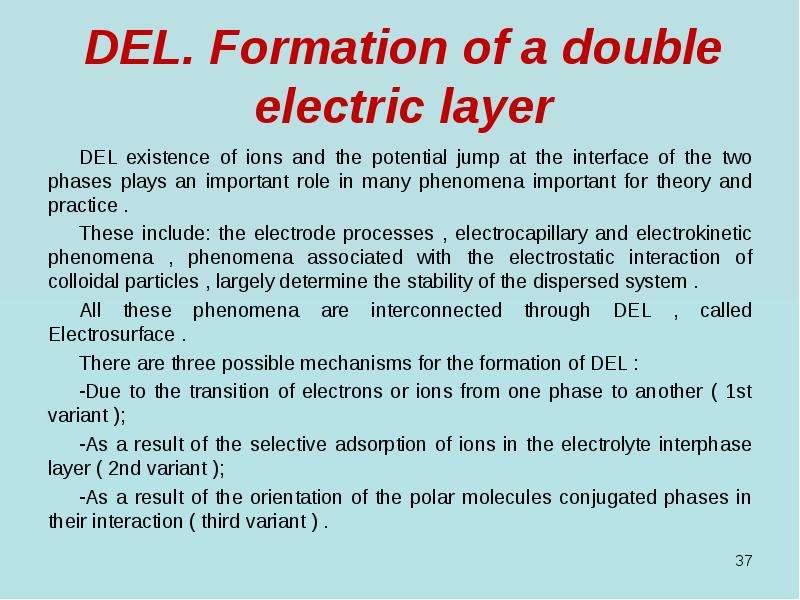
DEL. Formation of a double electric layer DEL existence of ions and the potential jump at the interface of the two phases plays an important role in many phenomena important for theory and practice . These include: the electrode processes , electrocapillary and electrokinetic phenomena , phenomena associated with the electrostatic interaction of colloidal particles , largely determine the stability of the dispersed system . All these phenomena are interconnected through DEL , called Electrosurface . There are three possible mechanisms for the formation of DEL : Due to the transition of electrons or ions from one phase to another ( 1st variant ); As a result of the selective adsorption of ions in the electrolyte interphase layer ( 2nd variant ); As a result of the orientation of the polar molecules conjugated phases in their interaction ( third variant ) .

Слайд 38


When immersed in water, the metal plate portion of the positive ions, which are located in the crystal lattice as a result of interaction with the...
Описание слайда:
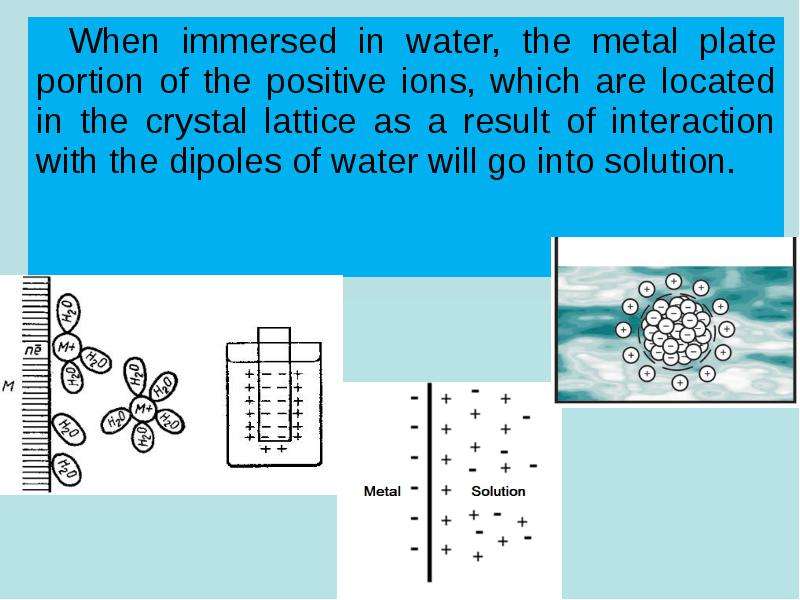
When immersed in water, the metal plate portion of the positive ions, which are located in the crystal lattice as a result of interaction with the dipoles of water will go into solution. When immersed in water, the metal plate portion of the positive ions, which are located in the crystal lattice as a result of interaction with the dipoles of water will go into solution.

Слайд 39


Electric double layer 2nd version. In the formation of AgI sol by reaction between AgNO3 and KI at AgI microcrystals adsorbed ions (Ag +, I-). If an...
Описание слайда:
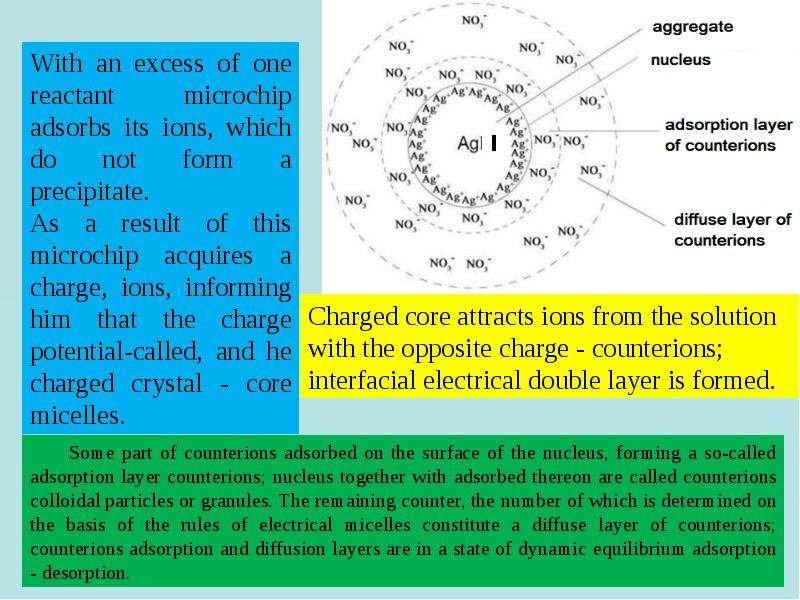
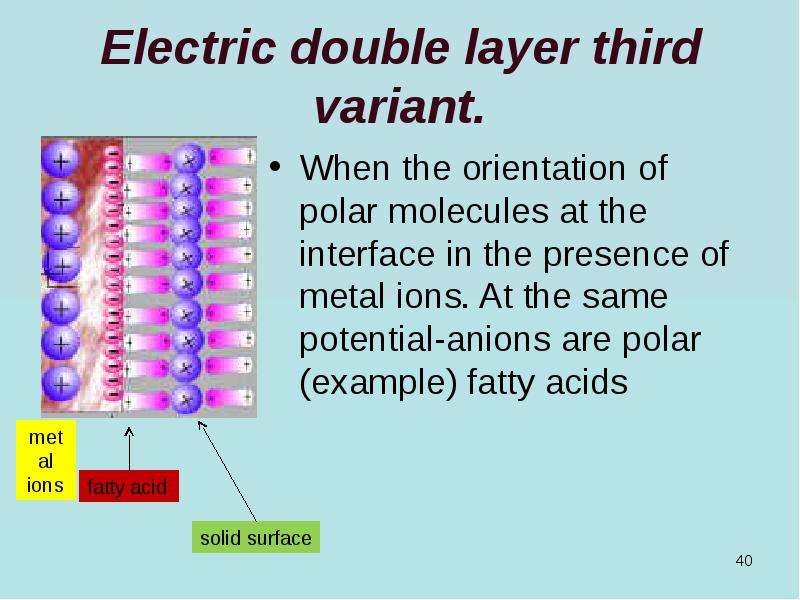
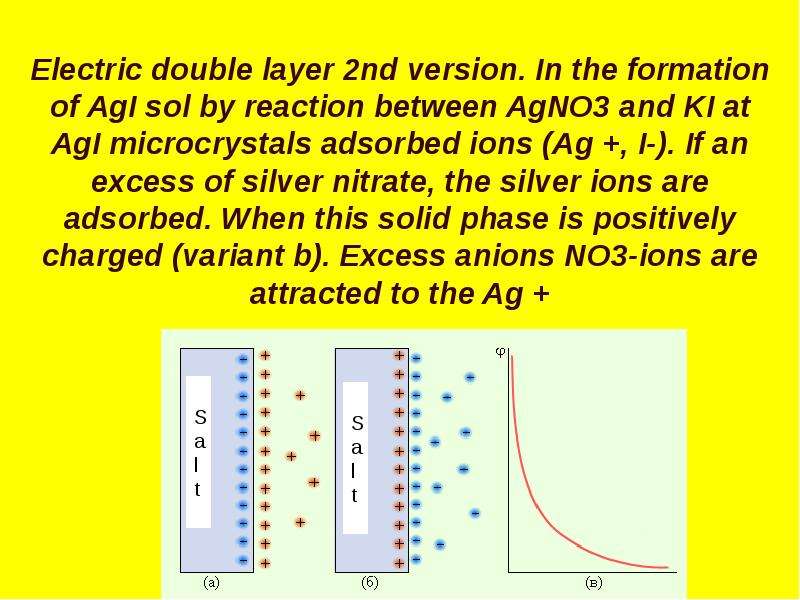
Electric double layer 2nd version. In the formation of AgI sol by reaction between AgNO3 and KI at AgI microcrystals adsorbed ions (Ag +, I-). If an excess of silver nitrate, the silver ions are adsorbed. When this solid phase is positively charged (variant b). Excess anions NO3-ions are attracted to the Ag +

Слайд 40


Electric double layer third variant. When the orientation of polar molecules at the interface in the presence of metal ions. At the same...
Описание слайда:
Electric double layer third variant. When the orientation of polar molecules at the interface in the presence of metal ions. At the same potential-anions are polar (example) fatty acids

Слайд 41


The structure of DEL. First picture of DEL was expressed Kwinke (1859) and developed in the works of Helmholtz (1879). DEL theory was developed in...
Описание слайда:
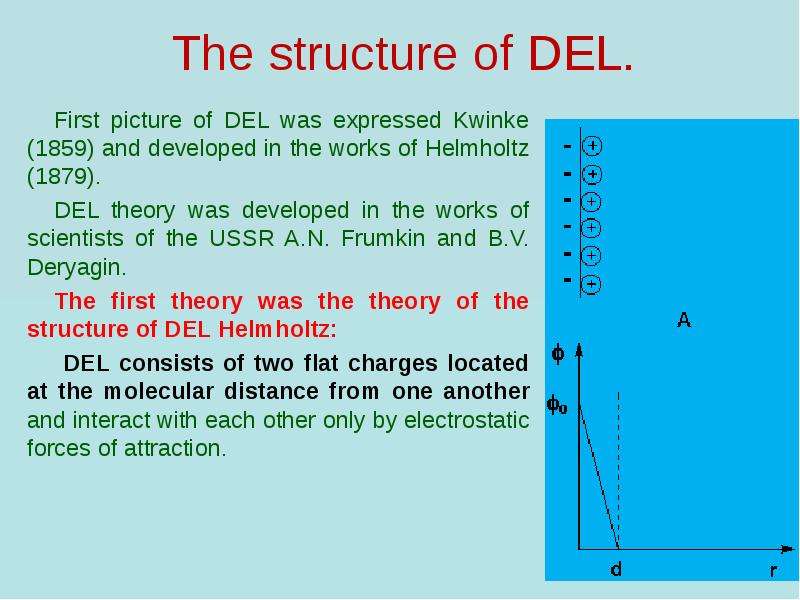
The structure of DEL. First picture of DEL was expressed Kwinke (1859) and developed in the works of Helmholtz (1879). DEL theory was developed in the works of scientists of the USSR A.N. Frumkin and B.V. Deryagin. The first theory was the theory of the structure of DEL Helmholtz: DEL consists of two flat charges located at the molecular distance from one another and interact with each other only by electrostatic forces of attraction.

Слайд 42


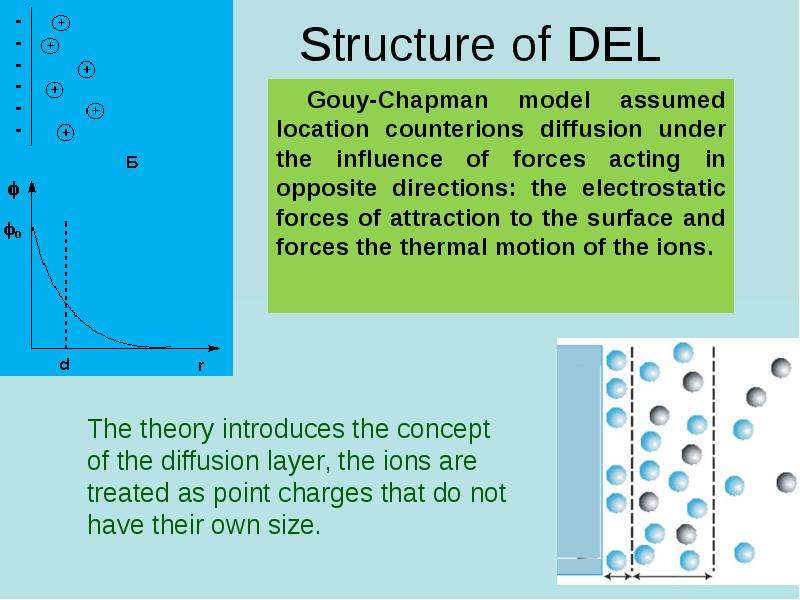
Structure of DEL Gouy-Chapman model assumed location counterions diffusion under the influence of forces acting in opposite directions: the...
Описание слайда:
Structure of DEL Gouy-Chapman model assumed location counterions diffusion under the influence of forces acting in opposite directions: the electrostatic forces of attraction to the surface and forces the thermal motion of the ions.

Слайд 43


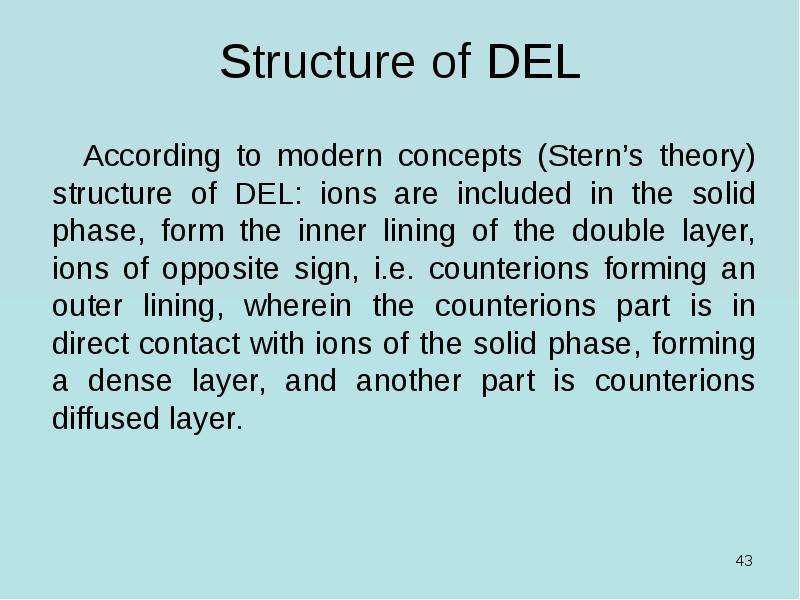
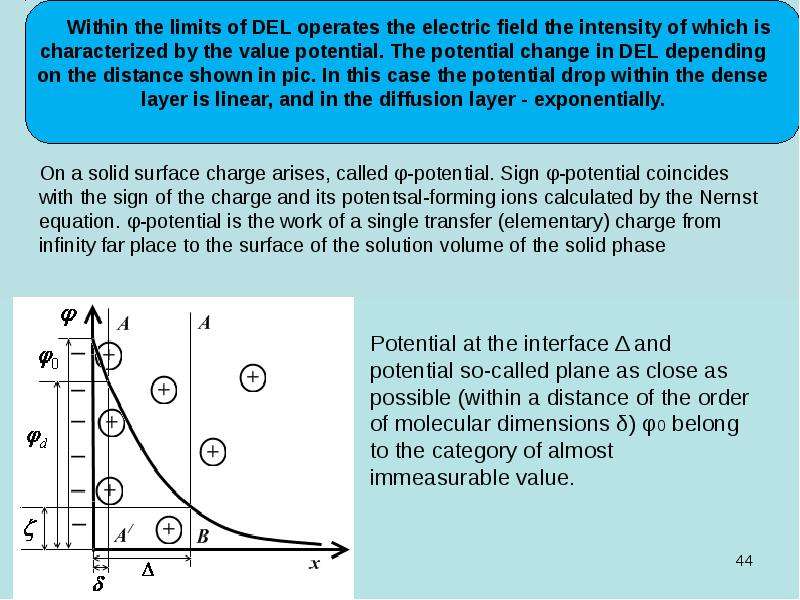
Structure of DEL According to modern concepts (Stern’s theory) structure of DEL: ions are included in the solid phase, form the inner lining of the...
Описание слайда:
Structure of DEL According to modern concepts (Stern’s theory) structure of DEL: ions are included in the solid phase, form the inner lining of the double layer, ions of opposite sign, i.e. counterions forming an outer lining, wherein the counterions part is in direct contact with ions of the solid phase, forming a dense layer, and another part is counterions diffused layer.

Слайд 44


Colloid chemistry, слайд №44
Описание слайда:

Слайд 45


Colloid chemistry, слайд №45
Описание слайда:

Слайд 46


Colloid chemistry, слайд №46
Описание слайда:

Слайд 47


Colloid chemistry, слайд №47
Описание слайда:

Слайд 48


Colloid chemistry, слайд №48
Описание слайда:

Слайд 49


Colloid chemistry, слайд №49
Описание слайда:

Слайд 50


Colloid chemistry, слайд №50
Описание слайда:

Слайд 51


Stability and coagulation of colloidal systems
Описание слайда:
Stability and coagulation of colloidal systems

Слайд 52


Colloid chemistry, слайд №52
Описание слайда:

Слайд 53


Colloid chemistry, слайд №53
Описание слайда:

Слайд 54


Colloid chemistry, слайд №54
Описание слайда:

Слайд 55


Colloid chemistry, слайд №55
Описание слайда:


Теги Colloid chemistry
Похожие презентации
Mypresentation.ru
Загрузить презентацию