🗊 Презентация Herpes - infections

Категория: Образование

Нажмите для полного просмотра!
Herpes - infections, слайд №1 Herpes - infections, слайд №2 Herpes - infections, слайд №3 Herpes - infections, слайд №4 Herpes - infections, слайд №5 Herpes - infections, слайд №6 Herpes - infections, слайд №7 Herpes - infections, слайд №8 Herpes - infections, слайд №9 Herpes - infections, слайд №10 Herpes - infections, слайд №11 Herpes - infections, слайд №12 Herpes - infections, слайд №13 Herpes - infections, слайд №14 Herpes - infections, слайд №15 Herpes - infections, слайд №16 Herpes - infections, слайд №17 Herpes - infections, слайд №18 Herpes - infections, слайд №19 Herpes - infections, слайд №20 Herpes - infections, слайд №21 Herpes - infections, слайд №22

Вы можете ознакомиться и скачать презентацию на тему Herpes - infections. Доклад-сообщение содержит 22 слайдов. Презентации для любого класса можно скачать бесплатно. Если материал и наш сайт презентаций Mypresentation Вам понравились – поделитесь им с друзьями с помощью социальных кнопок и добавьте в закладки в своем браузере.

Слайды и текст этой презентации


Слайд 1


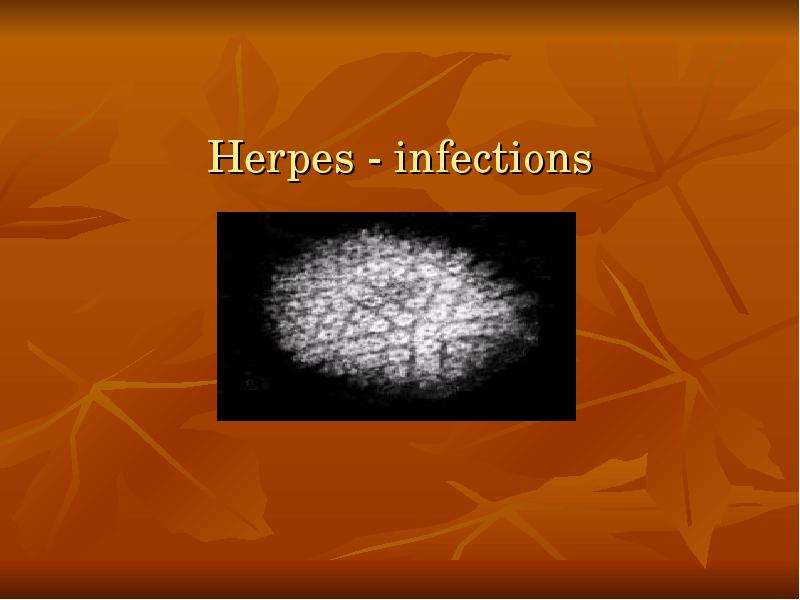
Herpes - infections
Описание слайда:

Herpes - infections

Слайд 2


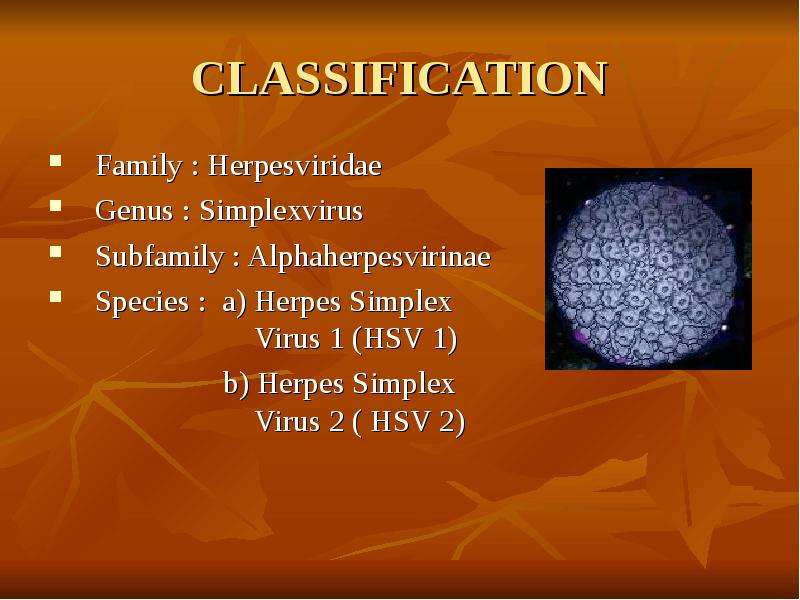
CLASSIFICATION Family : Herpesviridae Genus : Simplexvirus Subfamily : Alphaherpesvirinae Species : a) Herpes Simplex Virus 1 (HSV 1) b) Herpes...
Описание слайда:

CLASSIFICATION Family : Herpesviridae Genus : Simplexvirus Subfamily : Alphaherpesvirinae Species : a) Herpes Simplex Virus 1 (HSV 1) b) Herpes Simplex Virus 2 ( HSV 2)

Слайд 3


MORPHOLOGY Large , enveloped viruses containing double stranded DNA Virion : 120-300nm in diameter Icosadeltahedral protein capsid (average 100nm)...
Описание слайда:

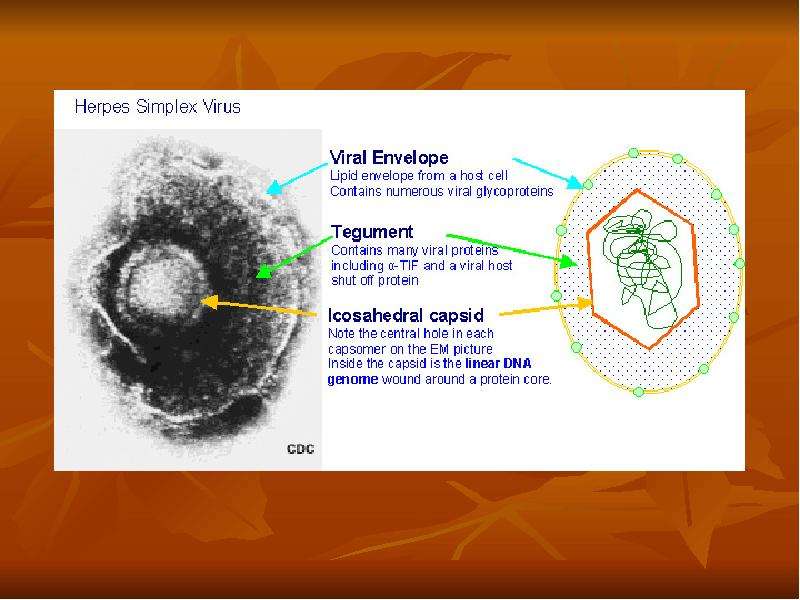
MORPHOLOGY Large , enveloped viruses containing double stranded DNA Virion : 120-300nm in diameter Icosadeltahedral protein capsid (average 100nm) consisting of 162 capsomeres, with core containg DNA genome Amorphous proteinaceous layer : the tegument Animation

Слайд 4


RESISTANCE Sensitive to: Acid Solvents Detergents Drying
Описание слайда:

RESISTANCE Sensitive to: Acid Solvents Detergents Drying

Слайд 5


ANTIGENIC STRUCTURE HSV 1 & HSV 2 differentiated by serologi typing and by DNA homology Distinguished by cultivation on chick embro, by neuro...
Описание слайда:
ANTIGENIC STRUCTURE HSV 1 & HSV 2 differentiated by serologi typing and by DNA homology Distinguished by cultivation on chick embro, by neuro virulence, clinical manisfestation, susceptibility to antiviral agents

Слайд 6


TRANSMISSION Generally transmitted by direct contact of lips or genitals when the sores are present, or also when no sores are present (known as...
Описание слайда:
TRANSMISSION Generally transmitted by direct contact of lips or genitals when the sores are present, or also when no sores are present (known as viral shedding) Present in semen, vaginal fluids, and saliva Herpes may be transmitted during childbirth, which can be fatal to the infant. Transmission occurs while passing through the birth canal and the risk of infection is minimal if there are no symptoms or exposed blisters during delivery.

Слайд 7


CELLULAR ENTRY Entry of HSV into the host cell involves interactions of several viral glycoproteins with cell surface receptors. The virus particle...
Описание слайда:
CELLULAR ENTRY Entry of HSV into the host cell involves interactions of several viral glycoproteins with cell surface receptors. The virus particle is covered by an envelope which, when bound to specific receptors on the cell surface, will fuse with the cell membrane and create an opening, or pore, through which the virus enters the host cell. The sequential stages of HSV entry are analagous to those of other viruses. At first, complementary receptors on the virus and cell surface bring the two membranes into proximity. In an intermediate state, the two membranes begin to merge, forming a hemifusion state. Finally, a stable entry pore is formed through which the viral envelope contents are introduced to the host cell.

Слайд 8


Replication In the case of Herpes virus, initial interactions occur when glycoprotein C, on the surface of the viral envelope, binds to a cell...
Описание слайда:
Replication In the case of Herpes virus, initial interactions occur when glycoprotein C, on the surface of the viral envelope, binds to a cell surface particle, heparan sulfate. Glycoprotein D binds specifically to the herpesvirus entry mediator receptor (HVEM), thus providing a strong, fixed attachment to the host cell. These interactions bring the membrane surfaces into mutual proximity and allow for other surface glycoproteins to interact. Once bound to the HVEM, glycoprotein D changes its conformation and interacts with glycoproteins H and L, which form a complex. The interaction of these membrane proteins results in the hemifusion state. Afterward, glycoprotein B interaction with the glycoprotein H and L complex creates an entry pore.Glycoprotein B interacts with host cell surface glycosaminoglycans. Animation

Слайд 9


REPLICATION After the viral envelope contents of capsid with tegument proteins has entered the cell via the entry pore, the viral particles migrate...
Описание слайда:
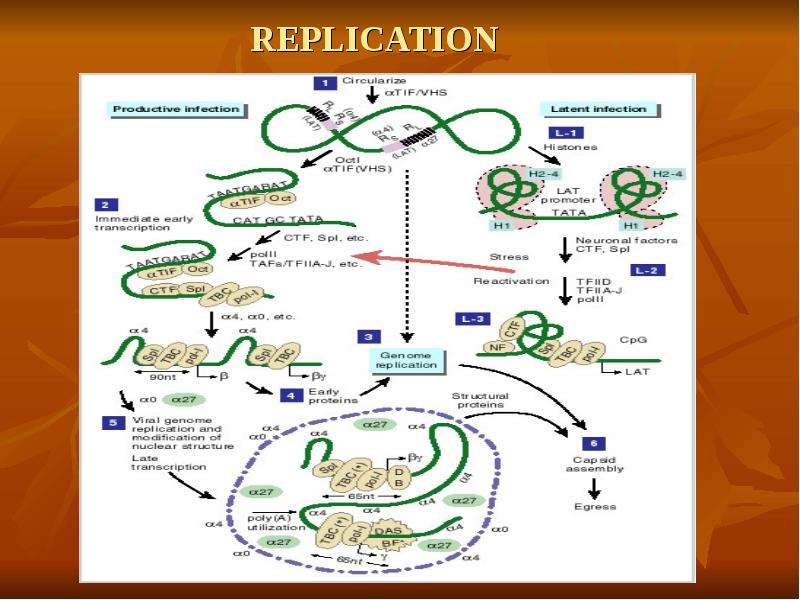
REPLICATION After the viral envelope contents of capsid with tegument proteins has entered the cell via the entry pore, the viral particles migrate to the nucleus, where the genome is replicated using enzymes from the host cell. Upon entering the cell, an α-TIF protein also joins the viral particle and aids in immediate early transcription.The virion host shutoff protein (VHF-UL41) is very important to viral replication. This enzyme shuts off protein synthesis in the host, degrades host mRNA, helps in viral replication, and regulates gene expression of viral proteins. While the viral genome immediately travels to the nucleus, the VHF protein remains in the cytoplasm. The packaging of the viral particles, which include the genome, core and the capsid, occur in the nucleus. In the nucleus, cleavage of genome concatemers occurs and these are placed into pre-formed capsids. The viral envelope is acquired from the nuclear envelope, more specifically the inner lamellae of the membrane Animation

Слайд 10


REPLICATION
Описание слайда:
REPLICATION

Слайд 11


LATENT INFECTION Especially in neurons, Herpes may persist in a quiescent but persistent form known as latent infection. During latent infection of a...
Описание слайда:
LATENT INFECTION Especially in neurons, Herpes may persist in a quiescent but persistent form known as latent infection. During latent infection of a cell, Herpes virus express Latency Associated Transcript (LAT) RNA. LAT is known to regulate the host cell genome and interferes with natural cell death mechanisms. By maintaining the host cells, LAT preserves a reservoir for the virus, which allows later recurrences to produce further infections. Animation

Слайд 12


ENCAPSIDATION AND EGRESS The procapsid proteins (UL18, UL19 and UL38) assemble around scaffolding proteins (UL26 and UL26.5) that are then digested...
Описание слайда:
ENCAPSIDATION AND EGRESS The procapsid proteins (UL18, UL19 and UL38) assemble around scaffolding proteins (UL26 and UL26.5) that are then digested away. The empty capsid incorporates DNA by means of the action of cleavage/packaging proteins The capsid migrates to the nuclear membrane and buds into the lumen between the inner and outer nuclear membrane. This enveloped virion then enters the cytoplasm through fusion with the outer nuclear membrane. Animation

Слайд 13


ENVELOPMENT & RELEASE Viral glycoproteins are translated from HSV RNA on the rough endoplasmic reticulum then transported to the golgi body in...
Описание слайда:
ENVELOPMENT & RELEASE Viral glycoproteins are translated from HSV RNA on the rough endoplasmic reticulum then transported to the golgi body in vesicles to continue the glycosylation process. The glycoproteins are then transported in vesicles to the nuclear or plasma membrane. The HSV capsid associates with tegument proteins then acquires a mature envelope by budding into an exocytotic vesicle. The enveloped infectious virion migrates to the virus modified membrane and is released outside of the cell. Animation

Слайд 14


LABORATORY DIAGNOSIS Microscopical Scrapings of lesion: examined microscopically for multinucleated giant cell whose nuclei contain eosinophilic...
Описание слайда:
LABORATORY DIAGNOSIS Microscopical Scrapings of lesion: examined microscopically for multinucleated giant cell whose nuclei contain eosinophilic inclusions (Cowdry type A inclusions)

Слайд 15


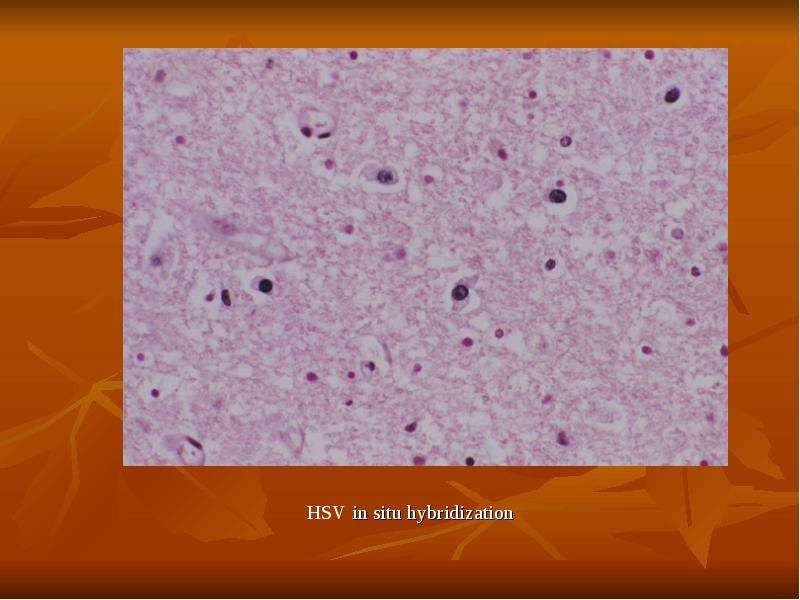
Laboratory diagnosis Virological Rapid,definitive determination HSV is made by demonstrating in tissue : a) viral antigen : - immunofluorescence -...
Описание слайда:
Laboratory diagnosis Virological Rapid,definitive determination HSV is made by demonstrating in tissue : a) viral antigen : - immunofluorescence - immunoperoxidase method b) DNA : - in situ hybridization

Слайд 16


Laboratory diagnosis Serological Only useful for diagnosing primary HSV infection & epidemiological studies Not useful for diagnosing recurrent...
Описание слайда:
Laboratory diagnosis Serological Only useful for diagnosing primary HSV infection & epidemiological studies Not useful for diagnosing recurrent disease due to a significant rise in Ab titers are not usually accompany recurrent disease

Слайд 17


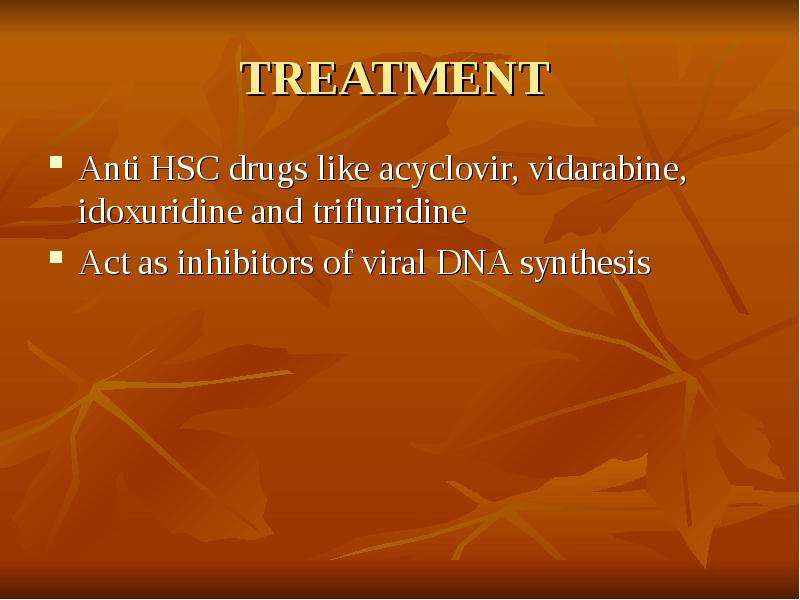
TREATMENT Anti HSC drugs like acyclovir, vidarabine, idoxuridine and trifluridine Act as inhibitors of viral DNA synthesis
Описание слайда:
TREATMENT Anti HSC drugs like acyclovir, vidarabine, idoxuridine and trifluridine Act as inhibitors of viral DNA synthesis

Слайд 18


Herpes - infections, слайд №18
Описание слайда:

Слайд 19


Herpes - infections, слайд №19
Описание слайда:

Слайд 20


Herpes - infections, слайд №20
Описание слайда:

Слайд 21


Herpes - infections, слайд №21
Описание слайда:

Слайд 22


Herpes - infections, слайд №22
Описание слайда:


Теги Herpes infections
Похожие презентации
Mypresentation.ru
Загрузить презентацию