🗊 Презентация Historical development of English and Russian parts of speech Bukhinnik Juliya FL-42

Категория: Английский язык
Нажмите для полного просмотра!
Historical development of English and Russian parts of speech Bukhinnik Juliya FL-42, слайд №1 Historical development of English and Russian parts of speech Bukhinnik Juliya FL-42, слайд №2 Historical development of English and Russian parts of speech Bukhinnik Juliya FL-42, слайд №3 Historical development of English and Russian parts of speech Bukhinnik Juliya FL-42, слайд №4 Historical development of English and Russian parts of speech Bukhinnik Juliya FL-42, слайд №5 Historical development of English and Russian parts of speech Bukhinnik Juliya FL-42, слайд №6 Historical development of English and Russian parts of speech Bukhinnik Juliya FL-42, слайд №7 Historical development of English and Russian parts of speech Bukhinnik Juliya FL-42, слайд №8 Historical development of English and Russian parts of speech Bukhinnik Juliya FL-42, слайд №9 Historical development of English and Russian parts of speech Bukhinnik Juliya FL-42, слайд №10 Historical development of English and Russian parts of speech Bukhinnik Juliya FL-42, слайд №11 Historical development of English and Russian parts of speech Bukhinnik Juliya FL-42, слайд №12 Historical development of English and Russian parts of speech Bukhinnik Juliya FL-42, слайд №13 Historical development of English and Russian parts of speech Bukhinnik Juliya FL-42, слайд №14 Historical development of English and Russian parts of speech Bukhinnik Juliya FL-42, слайд №15 Historical development of English and Russian parts of speech Bukhinnik Juliya FL-42, слайд №16 Historical development of English and Russian parts of speech Bukhinnik Juliya FL-42, слайд №17 Historical development of English and Russian parts of speech Bukhinnik Juliya FL-42, слайд №18 Historical development of English and Russian parts of speech Bukhinnik Juliya FL-42, слайд №19 Historical development of English and Russian parts of speech Bukhinnik Juliya FL-42, слайд №20 Historical development of English and Russian parts of speech Bukhinnik Juliya FL-42, слайд №21

Вы можете ознакомиться и скачать презентацию на тему Historical development of English and Russian parts of speech Bukhinnik Juliya FL-42. Доклад-сообщение содержит 21 слайдов. Презентации для любого класса можно скачать бесплатно. Если материал и наш сайт презентаций Mypresentation Вам понравились – поделитесь им с друзьями с помощью социальных кнопок и добавьте в закладки в своем браузере.

Слайды и текст этой презентации


Слайд 1


Historical development of English and Russian parts of speech Bukhinnik Juliya FL-42
Описание слайда:
Historical development of English and Russian parts of speech Bukhinnik Juliya FL-42

Слайд 2


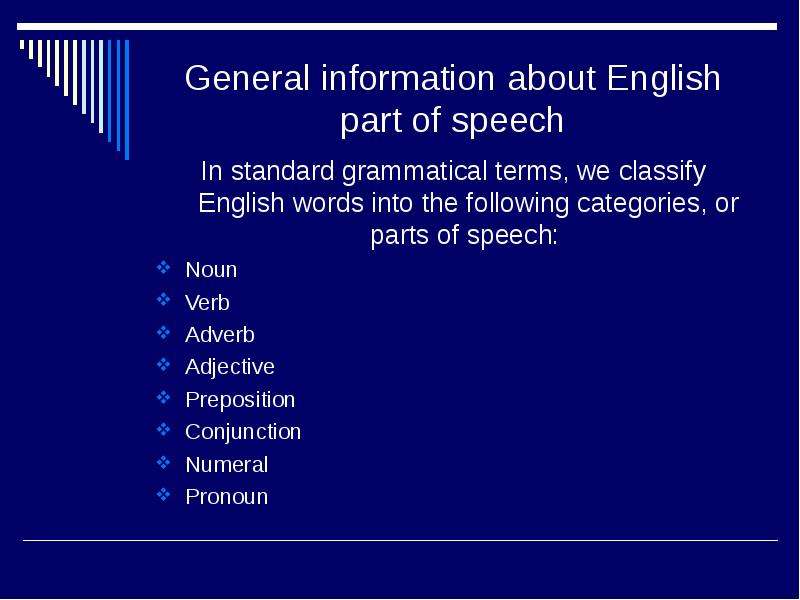
General information about English part of speech In standard grammatical terms, we classify English words into the following categories, or parts of...
Описание слайда:
General information about English part of speech In standard grammatical terms, we classify English words into the following categories, or parts of speech: Noun Verb Adverb Adjective Preposition Conjunction Numeral Pronoun

Слайд 3


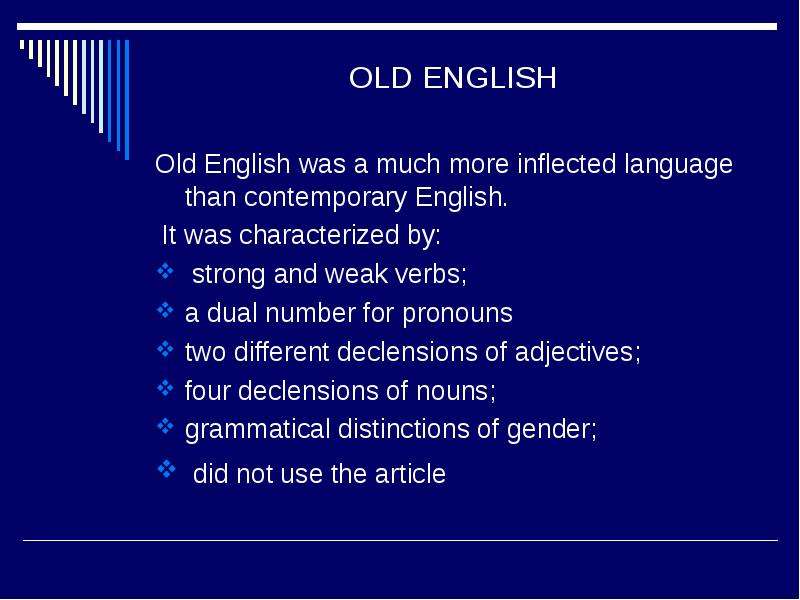
OLD ENGLISH Old English was a much more inflected language than contemporary English. It was characterized by: strong and weak verbs; a dual number...
Описание слайда:
OLD ENGLISH Old English was a much more inflected language than contemporary English. It was characterized by: strong and weak verbs; a dual number for pronouns two different declensions of adjectives; four declensions of nouns; grammatical distinctions of gender; did not use the article

Слайд 4


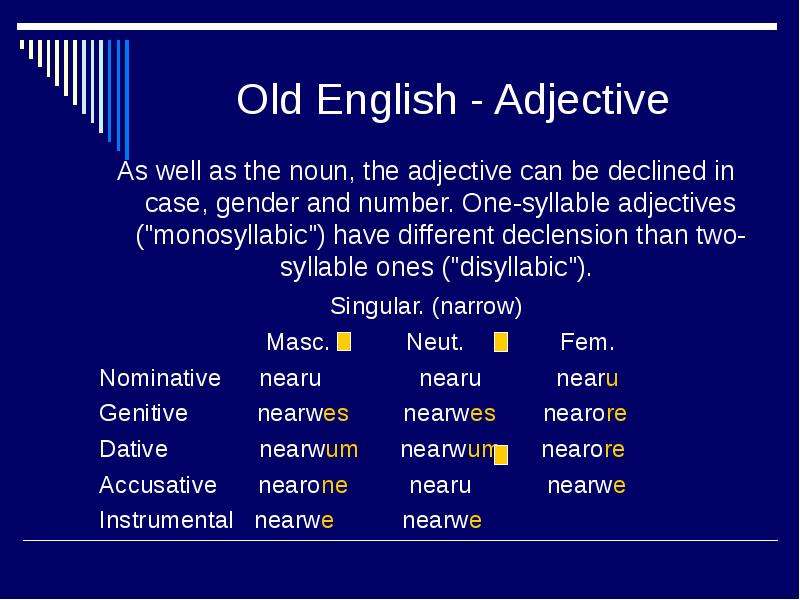
Old English - Adjective As well as the noun, the adjective can be declined in case, gender and number. One-syllable adjectives...
Описание слайда:
Old English - Adjective As well as the noun, the adjective can be declined in case, gender and number. One-syllable adjectives ("monosyllabic") have different declension than two-syllable ones ("disyllabic"). Singular. (narrow) Masc. Neut. Fem. Nominative nearu nearu nearu Genitive nearwes nearwes nearore Dative nearwum nearwum nearore Accusative nearone nearu nearwe Instrumental nearwe nearwe

Слайд 5


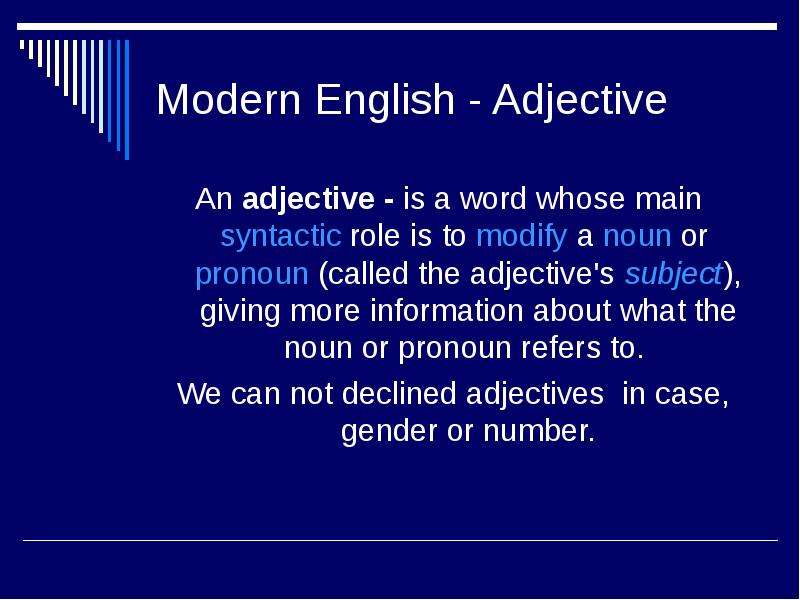
Modern English - Adjective An adjective - is a word whose main syntactic role is to modify a noun or pronoun (called the adjective's subject), giving...
Описание слайда:
Modern English - Adjective An adjective - is a word whose main syntactic role is to modify a noun or pronoun (called the adjective's subject), giving more information about what the noun or pronoun refers to. We can not declined adjectives in case, gender or number.

Слайд 6


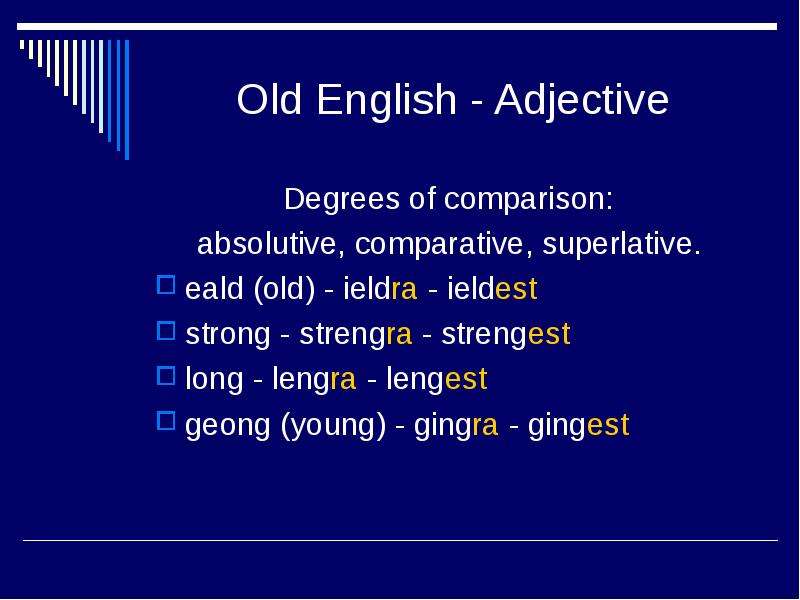
Old English - Adjective Degrees of comparison: absolutive, comparative, superlative. eald (old) - ieldra - ieldest strong - strengra - strengest long...
Описание слайда:
Old English - Adjective Degrees of comparison: absolutive, comparative, superlative. eald (old) - ieldra - ieldest strong - strengra - strengest long - lengra - lengest geong (young) - gingra - gingest

Слайд 7


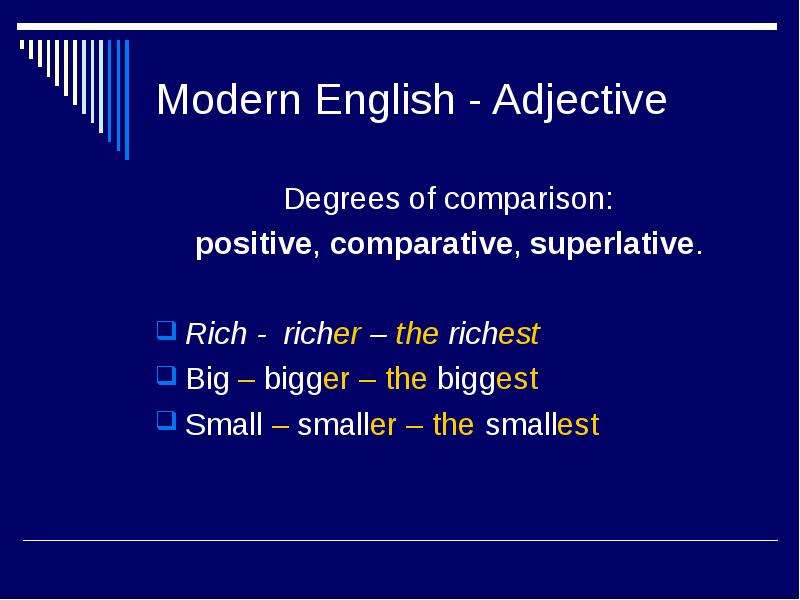
Modern English - Adjective Degrees of comparison: positive, comparative, superlative. Rich - richer – the richest Big – bigger – the biggest Small –...
Описание слайда:
Modern English - Adjective Degrees of comparison: positive, comparative, superlative. Rich - richer – the richest Big – bigger – the biggest Small – smaller – the smallest

Слайд 8


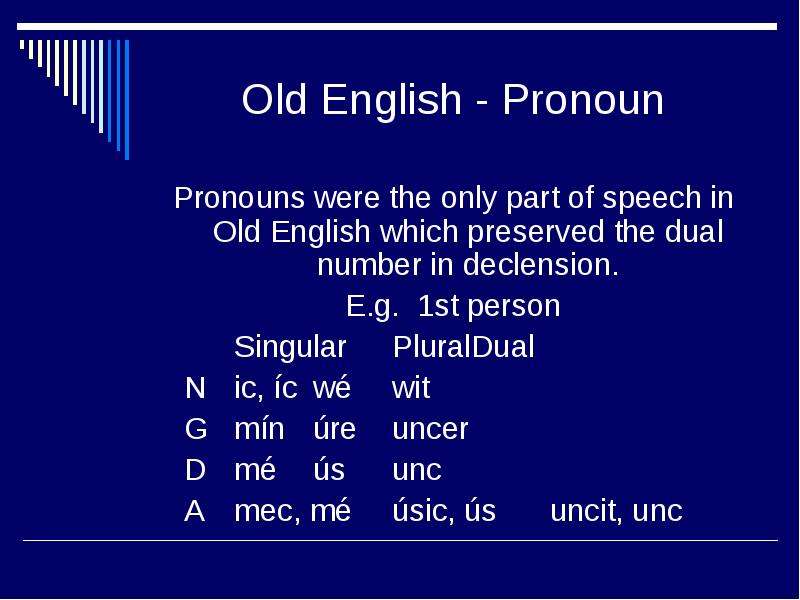
Old English - Pronoun Pronouns were the only part of speech in Old English which preserved the dual number in declension. E.g. 1st person Singular...
Описание слайда:
Old English - Pronoun Pronouns were the only part of speech in Old English which preserved the dual number in declension. E.g. 1st person Singular Plural Dual N ic, íc wé wit G mín úre uncer D mé ús unc A mec, mé úsic, ús uncit, unc

Слайд 9


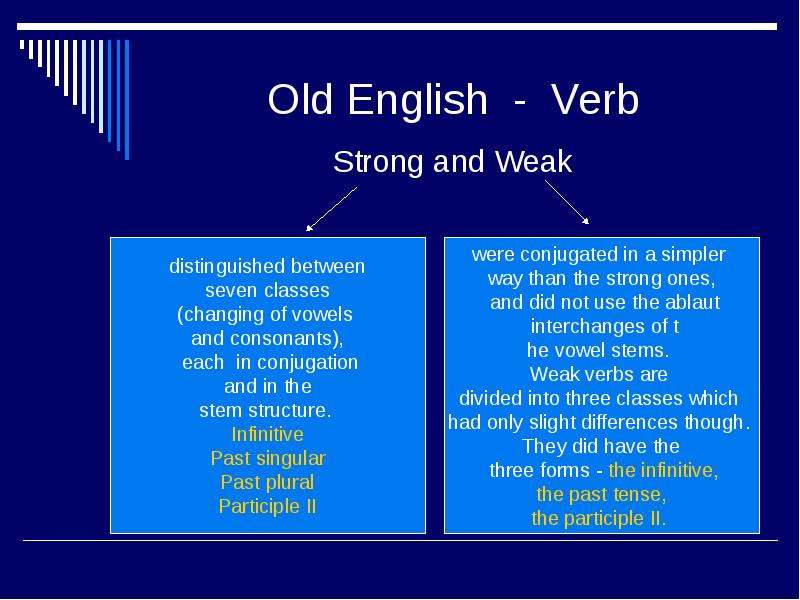
Old English - Verb Strong and Weak
Описание слайда:
Old English - Verb Strong and Weak

Слайд 10


Modern English – Verb Modern English makes a distinction between regular (changing into root – vowels and consonants) and irregular (- ed, - d)...
Описание слайда:
Modern English – Verb Modern English makes a distinction between regular (changing into root – vowels and consonants) and irregular (- ed, - d) verbs. This distinction goes back to the Old English system of strong and weak verbs.

Слайд 11


Modal Verbs in Modern and Old English (Present-Preterite) The main difference of verbs of this type in modern English is their expressing modality,...
Описание слайда:
Modal Verbs in Modern and Old English (Present-Preterite) The main difference of verbs of this type in modern English is their expressing modality, i.e. possibility, obligation, necessity. They do not require the particle to before the infinitive which follows them. In Old English in general no verb requires this particle before the infinitive. In fact, this to before the infinitive form meant the preposition of direction.

Слайд 12


Tenses in Old and Modern English Syntactically, the language had only two main tenses - the Present and the Past. No progressive (or Continuous)...
Описание слайда:
Tenses in Old and Modern English Syntactically, the language had only two main tenses - the Present and the Past. No progressive (or Continuous) tenses were used, they were invented only in the Early Middle English period. Such complex tenses as modern Future in the Past, Future Perfect Continuous did not exist either. However, some analytic construction were in use, and first of all the perfective constructions. F.G.: Hie geweorc geworhten hæfdon (they have build a fortress‘ - shows the exact Perfect tense, but at that time it was not the tense really, just a participle construction showing that the action has been done) Seldom you can also find such Past constructions, which later became the Past Perfect Tense.

Слайд 13


Conclusion English through history was very progressive and active - the whole revolution happened with it in the 15th and the 16th centuries, not...
Описание слайда:
Conclusion English through history was very progressive and active - the whole revolution happened with it in the 15th and the 16th centuries, not only taking into consideration the Great Vowel Shift, but also the major grammar changes. The result was the Modern, or New, English, which has practically no declension, lost genders, shortened words and forms, simplified the syntax.

Слайд 14


Old church Slavonic Category: Old Church Slavonic nouns Old Church Slavonic words that refer to people, places, things, qualities or ideas. Old...
Описание слайда:
Old church Slavonic Category: Old Church Slavonic nouns Old Church Slavonic words that refer to people, places, things, qualities or ideas. Old Church Slavonic nouns that are inflected to show grammatical relations other than the main form. E.g. Аблъко, братолюбьство, воѥводьство, брѣмѧ, въздрастъ, владъічьствиѥ, болѣзнь

Слайд 15


Category: Old Church Slavonic verbs Old Church Slavonic verbs: Old Church Slavonic words that indicate actions, occurrences or states. E.g. Любити,...
Описание слайда:
Category: Old Church Slavonic verbs Old Church Slavonic verbs: Old Church Slavonic words that indicate actions, occurrences or states. E.g. Любити, дъіхати, погрєбити, пити, ищєзнѫти, глаголати.

Слайд 16


Category: Old Church Slavonic adverbs: Old Church Slavonic adverbs words that modify clauses, sentences and other parts of phrases. E.g. Близъ,...
Описание слайда:
Category: Old Church Slavonic adverbs: Old Church Slavonic adverbs words that modify clauses, sentences and other parts of phrases. E.g. Близъ, въскорѣ, яко, вьчєра

Слайд 17


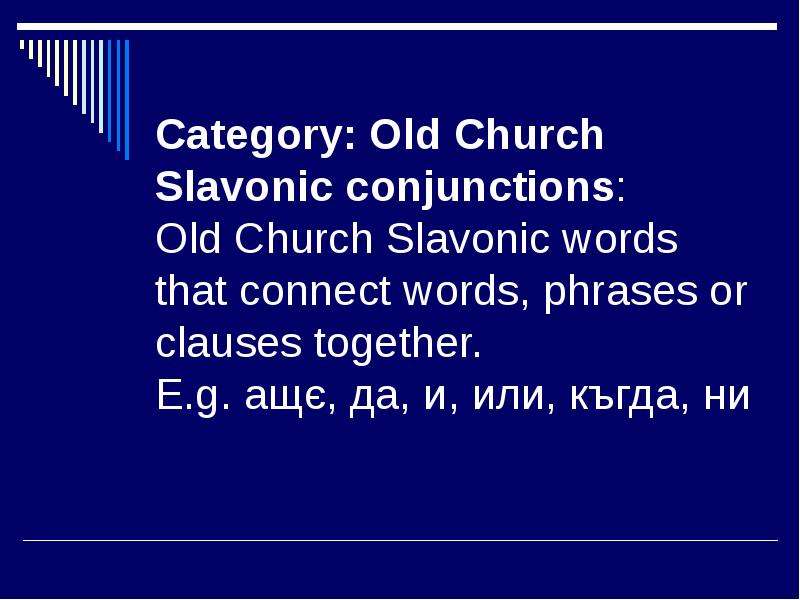
Category: Old Church Slavonic conjunctions: Old Church Slavonic words that connect words, phrases or clauses together. E.g. ащє, да, и, или, къгда, ни
Описание слайда:
Category: Old Church Slavonic conjunctions: Old Church Slavonic words that connect words, phrases or clauses together. E.g. ащє, да, и, или, къгда, ни

Слайд 18


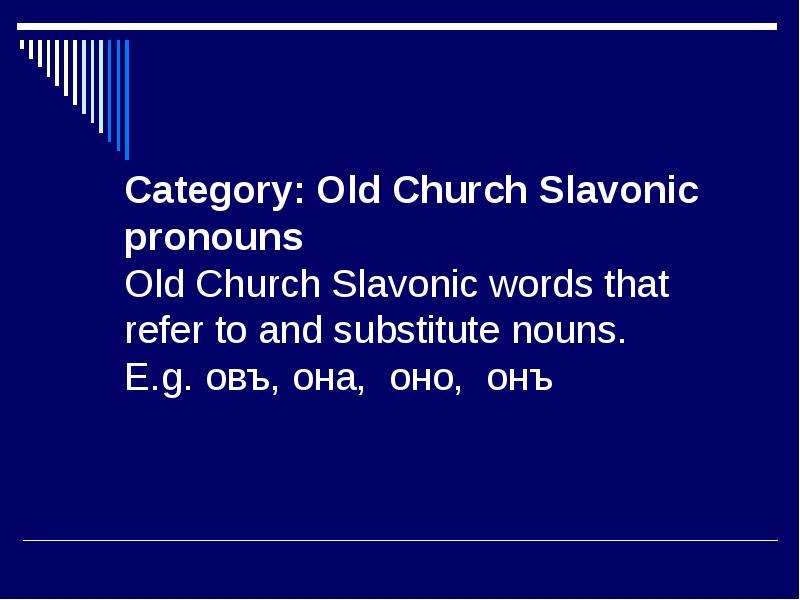
Category: Old Church Slavonic pronouns Old Church Slavonic words that refer to and substitute nouns. E.g. овъ, она, оно, онъ
Описание слайда:
Category: Old Church Slavonic pronouns Old Church Slavonic words that refer to and substitute nouns. E.g. овъ, она, оно, онъ

Слайд 19


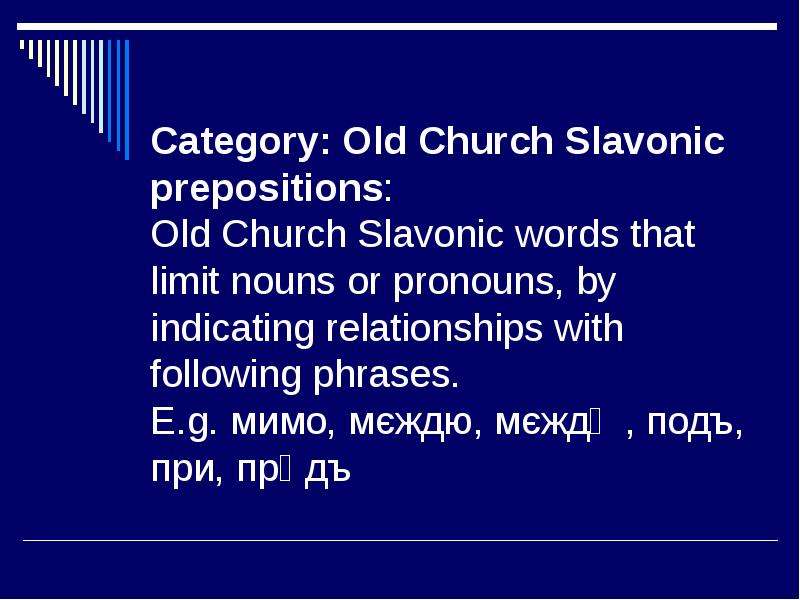
Category: Old Church Slavonic prepositions: Old Church Slavonic words that limit nouns or pronouns, by indicating relationships with following...
Описание слайда:
Category: Old Church Slavonic prepositions: Old Church Slavonic words that limit nouns or pronouns, by indicating relationships with following phrases. E.g. мимо, мєждю, мєждѹ, подъ, при, прѣдъ

Слайд 20


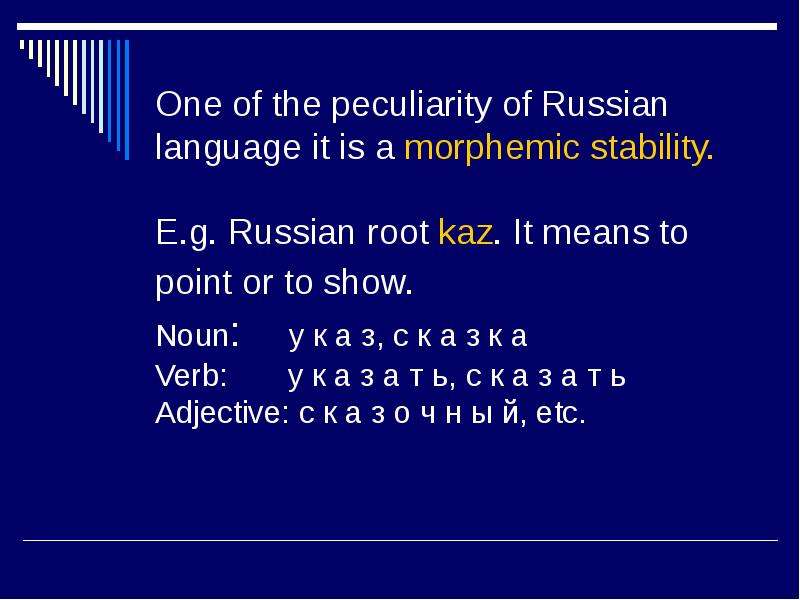
One of the peculiarity of Russian language it is a morphemic stability. E.g. Russian root kaz. It means to point or to show. Noun: у к а з, с к а з к...
Описание слайда:
One of the peculiarity of Russian language it is a morphemic stability. E.g. Russian root kaz. It means to point or to show. Noun: у к а з, с к а з к а Verb: у к а з а т ь, с к а з а т ь Adjective: с к а з о ч н ы й, etc.

Слайд 21


Conclusion Languages developed and changed rapidly during the history. All communicative processes reflects on the language grammatical and...
Описание слайда:
Conclusion Languages developed and changed rapidly during the history. All communicative processes reflects on the language grammatical and phonetically form. Intercultural relationship brings a lot of new words and enrich a vocabulary. All these processes reduce the role of declension, case, number, constrict the number of existing tense forms, people trying to make own language easy for learning.


Похожие презентации
Mypresentation.ru
Загрузить презентацию