🗊 Презентация Middle Childhood

Нажмите для полного просмотра!
Middle Childhood, слайд №1 Middle Childhood, слайд №2 Middle Childhood, слайд №3 Middle Childhood, слайд №4 Middle Childhood, слайд №5 Middle Childhood, слайд №6 Middle Childhood, слайд №7 Middle Childhood, слайд №8 Middle Childhood, слайд №9 Middle Childhood, слайд №10 Middle Childhood, слайд №11 Middle Childhood, слайд №12 Middle Childhood, слайд №13 Middle Childhood, слайд №14 Middle Childhood, слайд №15 Middle Childhood, слайд №16 Middle Childhood, слайд №17 Middle Childhood, слайд №18 Middle Childhood, слайд №19 Middle Childhood, слайд №20

Вы можете ознакомиться и скачать презентацию на тему Middle Childhood. Доклад-сообщение содержит 20 слайдов. Презентации для любого класса можно скачать бесплатно. Если материал и наш сайт презентаций Mypresentation Вам понравились – поделитесь им с друзьями с помощью социальных кнопок и добавьте в закладки в своем браузере.

Слайды и текст этой презентации


Слайд 1


Middle Childhood By Stanislav Smirnov
Описание слайда:

Middle Childhood By Stanislav Smirnov

Слайд 2


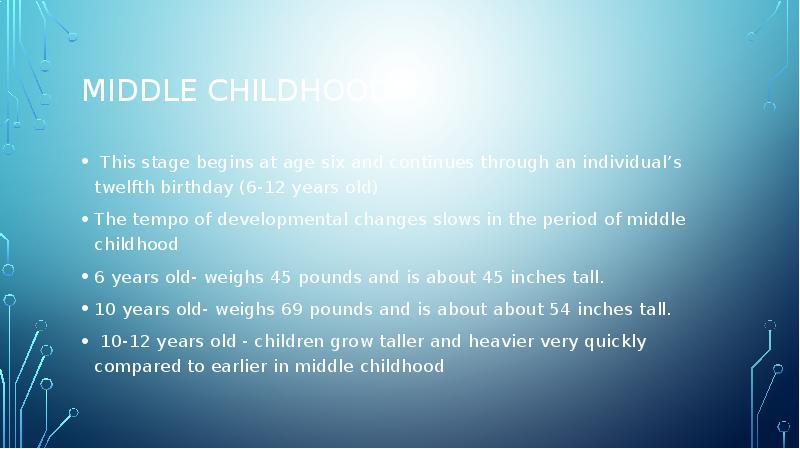
Middle Childhood This stage begins at age six and continues through an individual’s twelfth birthday (6-12 years old) The tempo of developmental...
Описание слайда:
Middle Childhood This stage begins at age six and continues through an individual’s twelfth birthday (6-12 years old) The tempo of developmental changes slows in the period of middle childhood 6 years old- weighs 45 pounds and is about 45 inches tall. 10 years old- weighs 69 pounds and is about about 54 inches tall. 10-12 years old - children grow taller and heavier very quickly compared to earlier in middle childhood

Слайд 3


Girls Because girls begin puberty earlier than boys, the prepubertal growth spurt also begins earlier for them. Thus girls are usually both taller...
Описание слайда:
Girls Because girls begin puberty earlier than boys, the prepubertal growth spurt also begins earlier for them. Thus girls are usually both taller and heavier than boys for about two years toward the end of middle childhood There is a genetic tendency for girls to have a greater proportion of body fat to muscle than boys This difference becomes more noticeable during the latter part of middle childhood Pubertal growth spurt- rapid increase in height and weight preceding puberty at about age 10 to 12

Слайд 4


Growth and Size Usually, a child who is much taller and heavier than others the same age might be expected by adults to also act much older....
Описание слайда:

Growth and Size Usually, a child who is much taller and heavier than others the same age might be expected by adults to also act much older. School-age children typically select their friends on the bases of external appearance and physical competence Girls use similar criteria choosing those who are developmentally mature for their age as leaders of groups

Слайд 5


Bone development Bone changes during middle childhood are also related to nutrition. Inadequate nutrition delays the ossification process and can...
Описание слайда:
Bone development Bone changes during middle childhood are also related to nutrition. Inadequate nutrition delays the ossification process and can even result in bone malformations. Certain physical activities also endanger bone development. For example, ballet dancing to excess and wearing poor-fitting shoes contribute to problems with foot bones As sex hormone levels increase to prepare the body for puberty, bone development slows.

Слайд 6


Muscle development Children this age are able to participate in more strenuous activities for longer periods than younger children. Because they...
Описание слайда:
Muscle development Children this age are able to participate in more strenuous activities for longer periods than younger children. Because they usually enjoy this kind of physical activity, they become more physically fit However, if the muscles of children this age are overused, there may be damage

Слайд 7


Teeth The 16 primary teeth that erupted during infancy are lost during the school-age years and 28 permanent teeth erupt to replace them. Losing...
Описание слайда:
Teeth The 16 primary teeth that erupted during infancy are lost during the school-age years and 28 permanent teeth erupt to replace them. Losing teeth in the first half of middle childhood is often a status symbol for children

Слайд 8


Motor development Changes in motor skills during middle childhood are characterized by steady improvements in coordination and performance....
Описание слайда:
Motor development Changes in motor skills during middle childhood are characterized by steady improvements in coordination and performance. School-age children become more adept at activities requiring bilateral coordination (the cooperative, integrated use of both sides of the body in performing motor acts). Strength (the ability to exert force) with boys showing greater gripping ability than girls Flexibility (the freedom to bend or move the body in various directions) with girls showing greater flexibility than boys at the trunk, wrists, and legs Impulsion (the rate at which body movement begins from a stationary position) with all school-age children showing steady improvements in reaction time

Слайд 9


Motor development Speed (the rate of movement once the body is in action) with boys improving at the rate of one foot per second faster than girls...
Описание слайда:
Motor development Speed (the rate of movement once the body is in action) with boys improving at the rate of one foot per second faster than girls each year during this stage Precision (the dexterity and accuracy of movements) with girls showing greater advances than boys Coordination- the ability to use various muscle groups together to accomplish specific actions (this factor is associated with precision to produce advances in impulsion) Balance (the ability to maintain equilibrium and stability in performing the kind of motor acts typical at this stage such as skating) with girls showing improvements earlier than boys Rhythm (the regular body movements) with girls exceeding boys throughout this stage, especially in rhythmic movements involving the feet such as dancing.

Слайд 10


sports Optimal development can be conceptualized not only physically but also mentally. Kids improve their competence, confidence, connections,...
Описание слайда:
sports Optimal development can be conceptualized not only physically but also mentally. Kids improve their competence, confidence, connections, character, and caring However, parents and coaches can place children under extreme stress to perform well. Additionally, injuries, burnout, and delinquency can sometimes plague sport participants

Слайд 11


Mental Health During Middle Childhood Oppositional defiant disorder (ODD) is a disorder that may lead to conduct disorder if left untreated ODD is a...
Описание слайда:
Mental Health During Middle Childhood Oppositional defiant disorder (ODD) is a disorder that may lead to conduct disorder if left untreated ODD is a pattern of behavior in which a child is uncooperative and hostile with authority figures. This behavior is so extreme that it interferes with the child’s ability to function in his or her daily life Oppositional defiant disorder- a mental disorder characterized by a pattern of disobedience, hostility, and deviant behavior.

Слайд 12


PIAGET’S COGNITIVE DEVELOPMENTAL THEORY AND THE CONCRETE OPERATIONAL STAGE School-age children become more sophisticated in their thought processes....
Описание слайда:
PIAGET’S COGNITIVE DEVELOPMENTAL THEORY AND THE CONCRETE OPERATIONAL STAGE School-age children become more sophisticated in their thought processes. Their advanced cognition is obvious when their ways of thinking are contrasted with those of preschoolers. The trend is toward greater use of logic and reasoning based on advanced 5-to-7 shift A transition period in cognitive development between the pre- operational and concrete operations stages; thinking is based more on intuition than logic

Слайд 13


Attention To perform learning activities, school-age children show improvements in another important cognitive skill: selective attention. This...
Описание слайда:
Attention To perform learning activities, school-age children show improvements in another important cognitive skill: selective attention. This involves tuning out distracting stimulations when performing a particular task. For example, second-grade children find it hard to concentrate on a task while music is playing Selective attention- a cognitive ability to tune out distracting stimulation while per- forming a task

Слайд 14


Metacognition and Metamemory Metacognition is the awareness of the extent of one’s knowledge. In middle childhood, many individuals improve in...
Описание слайда:
Metacognition and Metamemory Metacognition is the awareness of the extent of one’s knowledge. In middle childhood, many individuals improve in metamemory as well as metacognition. Metamemory is the awareness of the extent of what is in one’s memory

Слайд 15


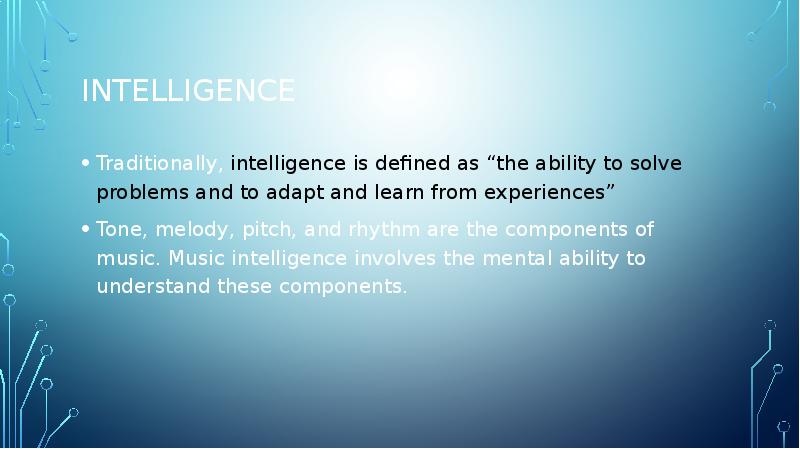
intelligence Traditionally, intelligence is defined as “the ability to solve problems and to adapt and learn from experiences” Tone, melody, pitch,...
Описание слайда:
intelligence Traditionally, intelligence is defined as “the ability to solve problems and to adapt and learn from experiences” Tone, melody, pitch, and rhythm are the components of music. Music intelligence involves the mental ability to understand these components.

Слайд 16


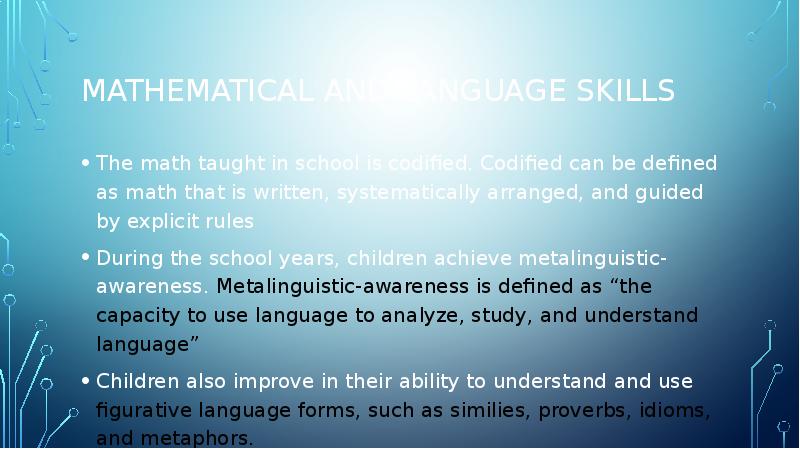
Mathematical and language skills The math taught in school is codified. Codified can be defined as math that is written, systematically arranged, and...
Описание слайда:
Mathematical and language skills The math taught in school is codified. Codified can be defined as math that is written, systematically arranged, and guided by explicit rules During the school years, children achieve metalinguistic-awareness. Metalinguistic-awareness is defined as “the capacity to use language to analyze, study, and understand language” Children also improve in their ability to understand and use figurative language forms, such as similies, proverbs, idioms, and metaphors.

Слайд 17


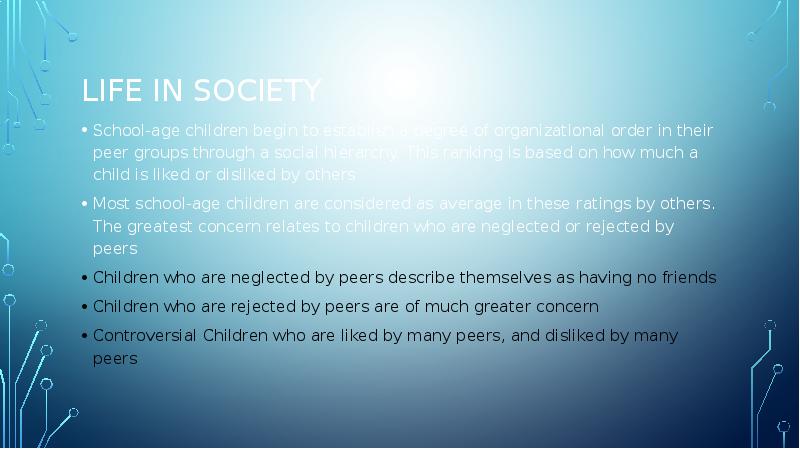
Life in society School-age children begin to establish a degree of organizational order in their peer groups through a social hierarchy. This ranking...
Описание слайда:
Life in society School-age children begin to establish a degree of organizational order in their peer groups through a social hierarchy. This ranking is based on how much a child is liked or disliked by others Most school-age children are considered as average in these ratings by others. The greatest concern relates to children who are neglected or rejected by peers Children who are neglected by peers describe themselves as having no friends Children who are rejected by peers are of much greater concern Controversial Children who are liked by many peers, and disliked by many peers

Слайд 18


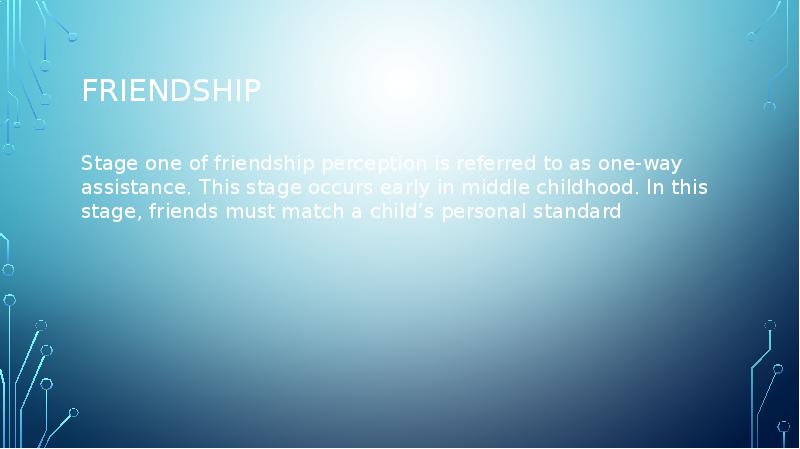
friendship Stage one of friendship perception is referred to as one-way assistance. This stage occurs early in middle childhood. In this stage,...
Описание слайда:
friendship Stage one of friendship perception is referred to as one-way assistance. This stage occurs early in middle childhood. In this stage, friends must match a child’s personal standard

Слайд 19


Developing of sense of industry School-age children focus on resolving a psychosocial conflict in acquiring a sense of industry versus inferiority. A...
Описание слайда:
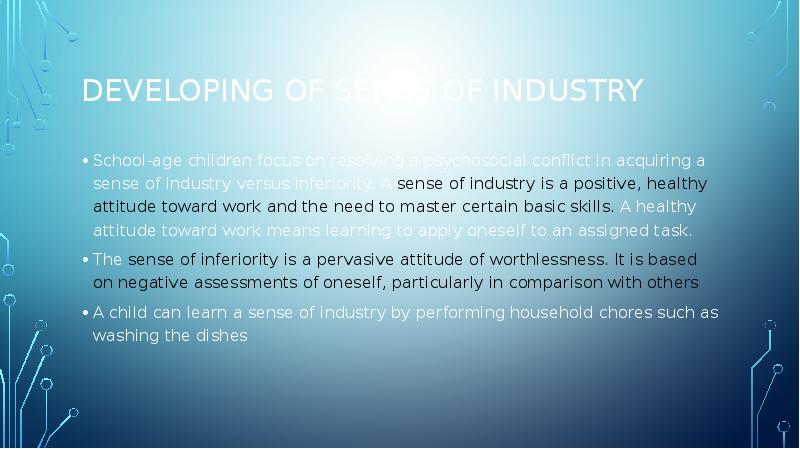
Developing of sense of industry School-age children focus on resolving a psychosocial conflict in acquiring a sense of industry versus inferiority. A sense of industry is a positive, healthy attitude toward work and the need to master certain basic skills. A healthy attitude toward work means learning to apply oneself to an assigned task. The sense of inferiority is a pervasive attitude of worthlessness. It is based on negative assessments of oneself, particularly in comparison with others A child can learn a sense of industry by performing household chores such as washing the dishes

Слайд 20


Social cognition Social cognition is knowledge of the dynamics of human interaction. It is founded on several skills that improve in middle...
Описание слайда:
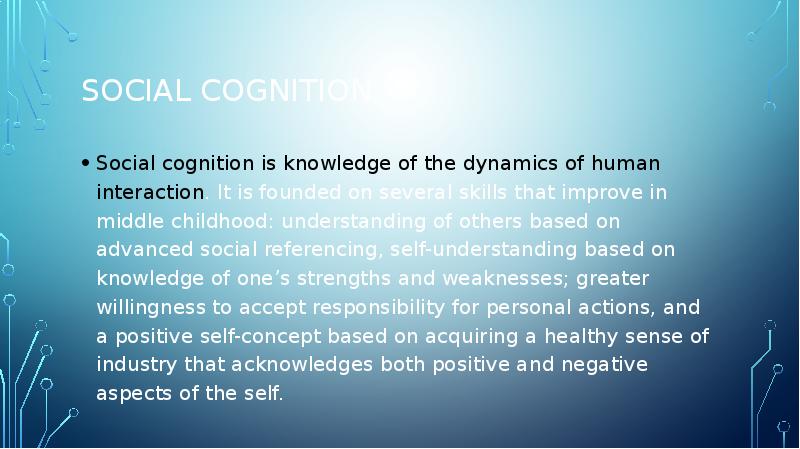
Social cognition Social cognition is knowledge of the dynamics of human interaction. It is founded on several skills that improve in middle childhood: understanding of others based on advanced social referencing, self-understanding based on knowledge of one’s strengths and weaknesses; greater willingness to accept responsibility for personal actions, and a positive self-concept based on acquiring a healthy sense of industry that acknowledges both positive and negative aspects of the self.


Теги Middle Childhood
Похожие презентации
Mypresentation.ru
Загрузить презентацию