🗊 Презентация Changes in Consonant Quality

Категория: Образование

Нажмите для полного просмотра!
Changes in Consonant Quality, слайд №1 Changes in Consonant Quality, слайд №2 Changes in Consonant Quality, слайд №3 Changes in Consonant Quality, слайд №4 Changes in Consonant Quality, слайд №5 Changes in Consonant Quality, слайд №6 Changes in Consonant Quality, слайд №7 Changes in Consonant Quality, слайд №8 Changes in Consonant Quality, слайд №9 Changes in Consonant Quality, слайд №10 Changes in Consonant Quality, слайд №11

Вы можете ознакомиться и скачать презентацию на тему Changes in Consonant Quality. Доклад-сообщение содержит 11 слайдов. Презентации для любого класса можно скачать бесплатно. Если материал и наш сайт презентаций Mypresentation Вам понравились – поделитесь им с друзьями с помощью социальных кнопок и добавьте в закладки в своем браузере.

Слайды и текст этой презентации


Слайд 1


Changes in Consonant Quality Changes in the Standard
Описание слайда:
Changes in Consonant Quality Changes in the Standard

Слайд 2


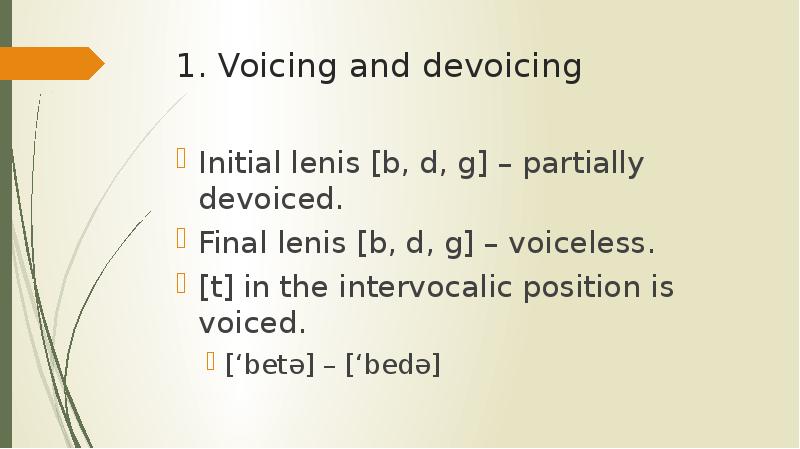
1. Voicing and devoicing Initial lenis [b, d, g] – partially devoiced. Final lenis [b, d, g] – voiceless. [t] in the intervocalic position is voiced....
Описание слайда:

1. Voicing and devoicing Initial lenis [b, d, g] – partially devoiced. Final lenis [b, d, g] – voiceless. [t] in the intervocalic position is voiced. [‘betə] – [‘bedə]

Слайд 3


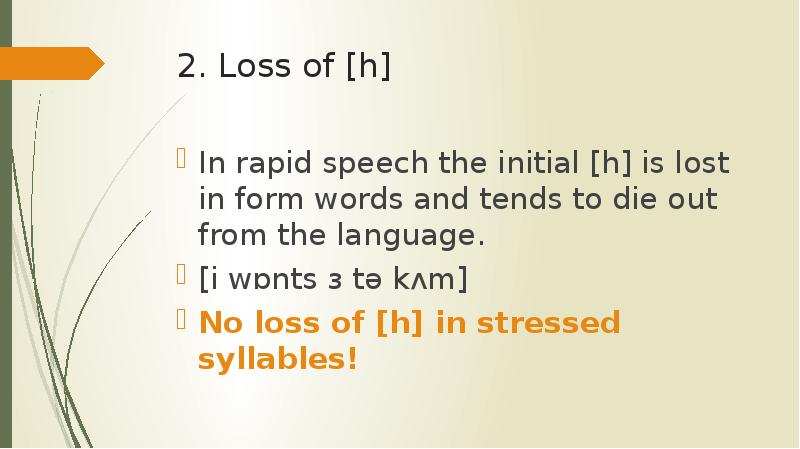
2. Loss of [h] In rapid speech the initial [h] is lost in form words and tends to die out from the language. [i wɒnts ɜ tə kʌm] No loss of [h] in...
Описание слайда:
2. Loss of [h] In rapid speech the initial [h] is lost in form words and tends to die out from the language. [i wɒnts ɜ tə kʌm] No loss of [h] in stressed syllables!

Слайд 4


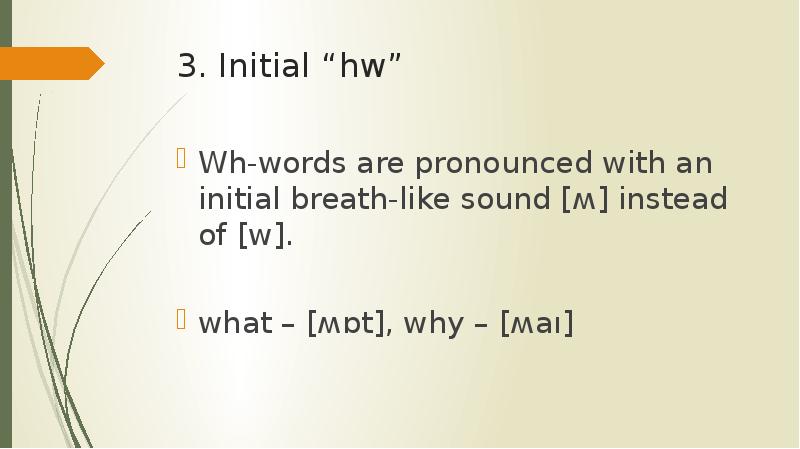
3. Initial “hw” Wh-words are pronounced with an initial breath-like sound [ʍ] instead of [w]. what – [ʍɒt], why – [ʍaı]
Описание слайда:
3. Initial “hw” Wh-words are pronounced with an initial breath-like sound [ʍ] instead of [w]. what – [ʍɒt], why – [ʍaı]

Слайд 5


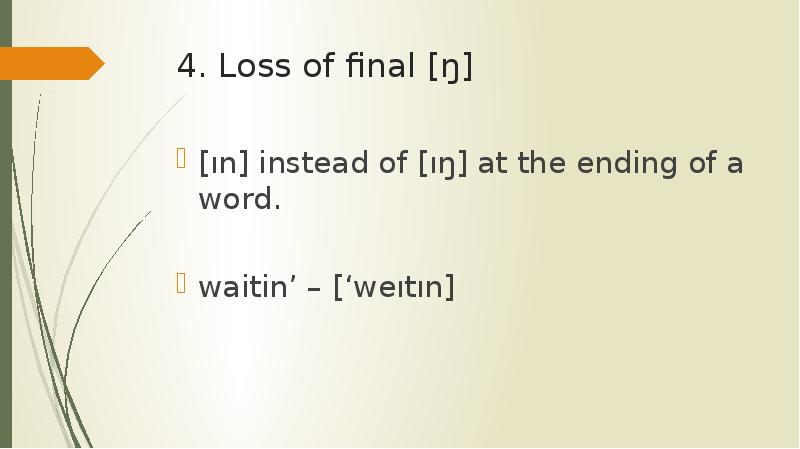
4. Loss of final [ŋ] [ın] instead of [ıŋ] at the ending of a word. waitin’ – [‘weıtın]
Описание слайда:
4. Loss of final [ŋ] [ın] instead of [ıŋ] at the ending of a word. waitin’ – [‘weıtın]

Слайд 6


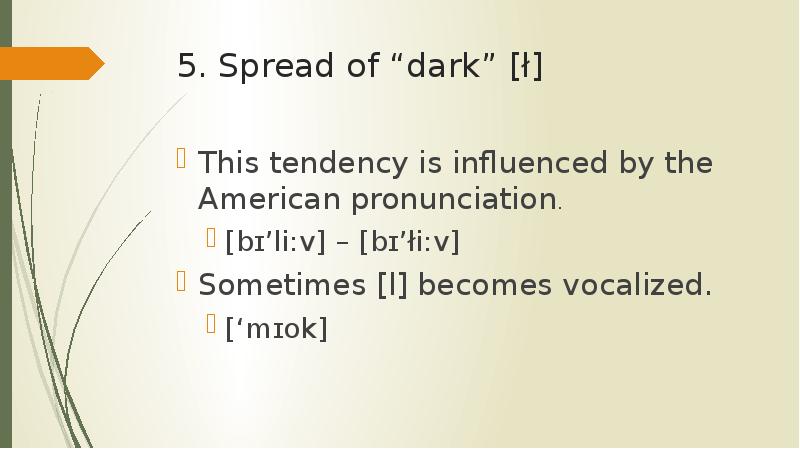
5. Spread of “dark” [ł] This tendency is influenced by the American pronunciation. [bɪ’li:v] – [bɪ’łi:v] Sometimes [l] becomes vocalized. [‘mɪok]
Описание слайда:
5. Spread of “dark” [ł] This tendency is influenced by the American pronunciation. [bɪ’li:v] – [bɪ’łi:v] Sometimes [l] becomes vocalized. [‘mɪok]

Слайд 7


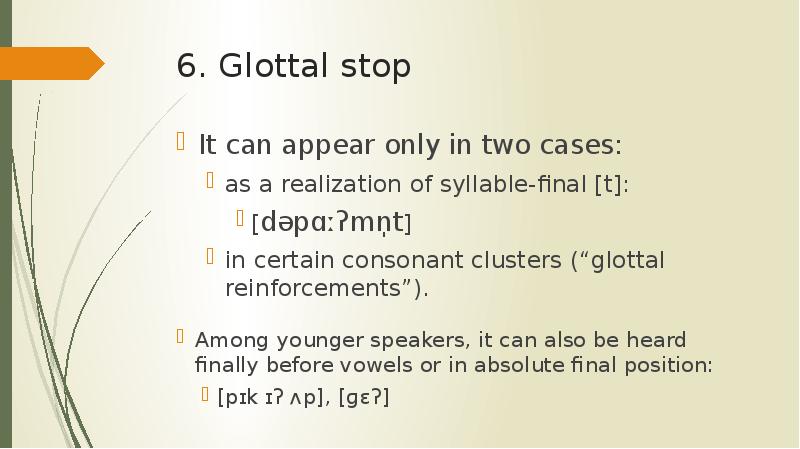
6. Glottal stop It can appear only in two cases: as a realization of syllable-final [t]: [dəpɑːʔmn̩t] in certain consonant clusters (“glottal...
Описание слайда:
6. Glottal stop It can appear only in two cases: as a realization of syllable-final [t]: [dəpɑːʔmn̩t] in certain consonant clusters (“glottal reinforcements”).

Слайд 8


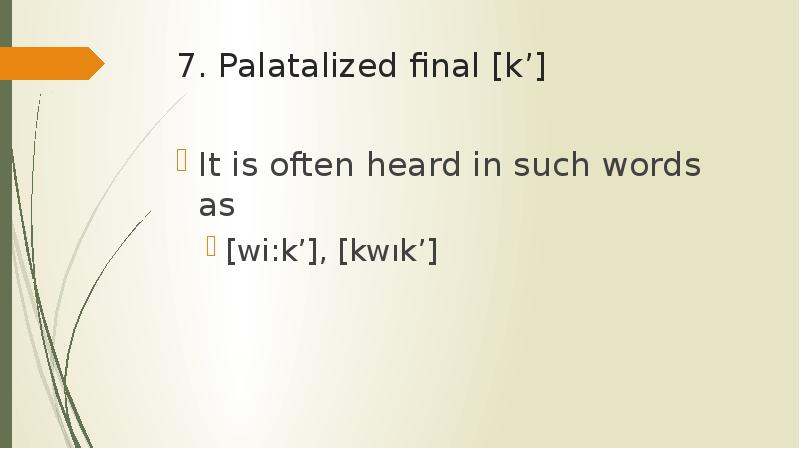
7. Palatalized final [k’] It is often heard in such words as [wi:k’], [kwık’]
Описание слайда:
7. Palatalized final [k’] It is often heard in such words as [wi:k’], [kwık’]

Слайд 9


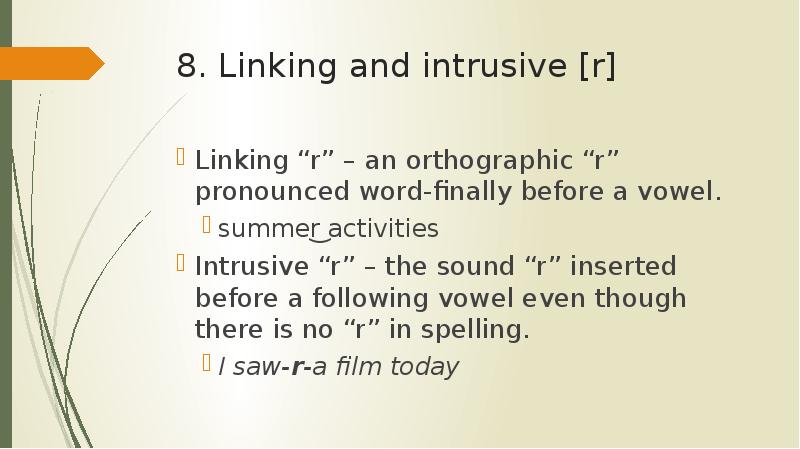
8. Linking and intrusive [r] Linking “r” – an orthographic “r” pronounced word-finally before a vowel. summer͜ activities Intrusive “r” – the sound...
Описание слайда:
8. Linking and intrusive [r] Linking “r” – an orthographic “r” pronounced word-finally before a vowel. summer͜ activities Intrusive “r” – the sound “r” inserted before a following vowel even though there is no “r” in spelling. I saw-r-a film today

Слайд 10


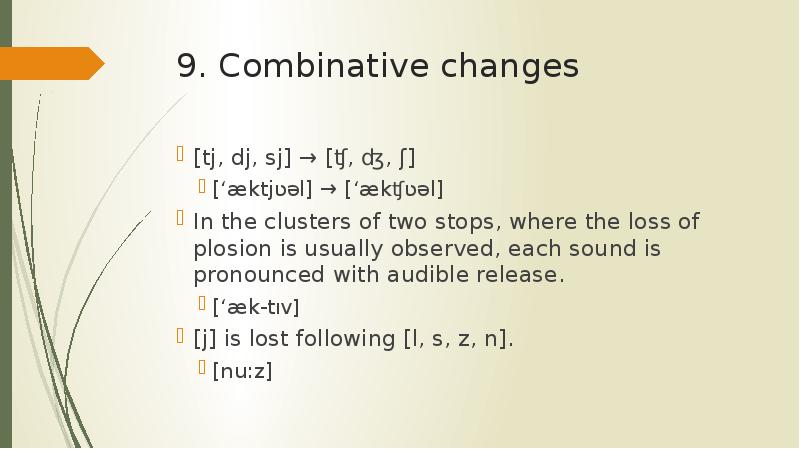
9. Combinative changes [tj, dj, sj] → [ʧ, ʤ, ʃ] [‘æktjʋəl] → [‘ækʧʋəl] In the clusters of two stops, where the loss of plosion is usually observed,...
Описание слайда:
9. Combinative changes [tj, dj, sj] → [ʧ, ʤ, ʃ] [‘æktjʋəl] → [‘ækʧʋəl] In the clusters of two stops, where the loss of plosion is usually observed, each sound is pronounced with audible release. [‘æk-tıv] [j] is lost following [l, s, z, n]. [nu:z]

Слайд 11


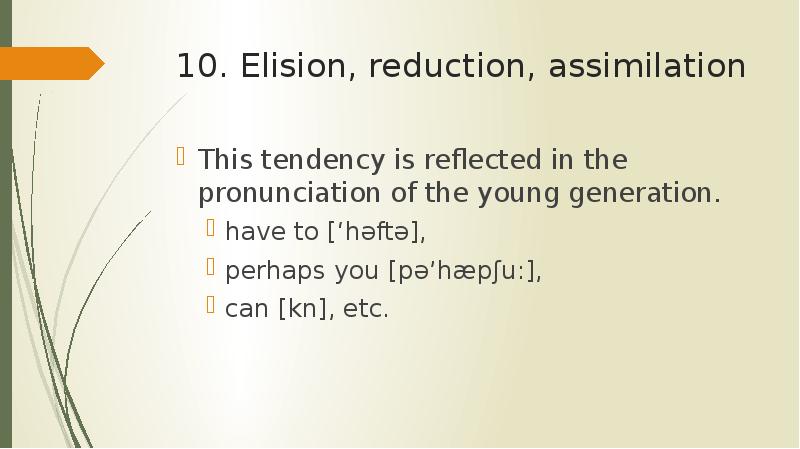
10. Elision, reduction, assimilation This tendency is reflected in the pronunciation of the young generation. have to [‘həftə], perhaps you...
Описание слайда:
10. Elision, reduction, assimilation This tendency is reflected in the pronunciation of the young generation. have to [‘həftə], perhaps you [pə’hæpʃu:], can [kn], etc.


Похожие презентации
Mypresentation.ru
Загрузить презентацию