🗊 Презентация ME Phonology. ME Morphology

Категория: Образование
Нажмите для полного просмотра!
ME Phonology. ME Morphology, слайд №1 ME Phonology. ME Morphology, слайд №2 ME Phonology. ME Morphology, слайд №3 ME Phonology. ME Morphology, слайд №4 ME Phonology. ME Morphology, слайд №5 ME Phonology. ME Morphology, слайд №6 ME Phonology. ME Morphology, слайд №7 ME Phonology. ME Morphology, слайд №8 ME Phonology. ME Morphology, слайд №9 ME Phonology. ME Morphology, слайд №10 ME Phonology. ME Morphology, слайд №11 ME Phonology. ME Morphology, слайд №12 ME Phonology. ME Morphology, слайд №13 ME Phonology. ME Morphology, слайд №14 ME Phonology. ME Morphology, слайд №15 ME Phonology. ME Morphology, слайд №16 ME Phonology. ME Morphology, слайд №17 ME Phonology. ME Morphology, слайд №18 ME Phonology. ME Morphology, слайд №19 ME Phonology. ME Morphology, слайд №20 ME Phonology. ME Morphology, слайд №21 ME Phonology. ME Morphology, слайд №22 ME Phonology. ME Morphology, слайд №23 ME Phonology. ME Morphology, слайд №24 ME Phonology. ME Morphology, слайд №25 ME Phonology. ME Morphology, слайд №26 ME Phonology. ME Morphology, слайд №27 ME Phonology. ME Morphology, слайд №28 ME Phonology. ME Morphology, слайд №29 ME Phonology. ME Morphology, слайд №30 ME Phonology. ME Morphology, слайд №31 ME Phonology. ME Morphology, слайд №32 ME Phonology. ME Morphology, слайд №33 ME Phonology. ME Morphology, слайд №34 ME Phonology. ME Morphology, слайд №35 ME Phonology. ME Morphology, слайд №36 ME Phonology. ME Morphology, слайд №37 ME Phonology. ME Morphology, слайд №38 ME Phonology. ME Morphology, слайд №39 ME Phonology. ME Morphology, слайд №40 ME Phonology. ME Morphology, слайд №41

Содержание
Вы можете ознакомиться и скачать презентацию на тему ME Phonology. ME Morphology. Доклад-сообщение содержит 41 слайдов. Презентации для любого класса можно скачать бесплатно. Если материал и наш сайт презентаций Mypresentation Вам понравились – поделитесь им с друзьями с помощью социальных кнопок и добавьте в закладки в своем браузере.
Слайды и текст этой презентации


Слайд 1


ME Phonology. ME Morphology. Lecture 3
Описание слайда:
ME Phonology. ME Morphology. Lecture 3

Слайд 2


I. Main historical events of the ME period. I. Main historical events of the ME period. II. ME dialects. Rise of the London dialect. III. ME vowel...
Описание слайда:
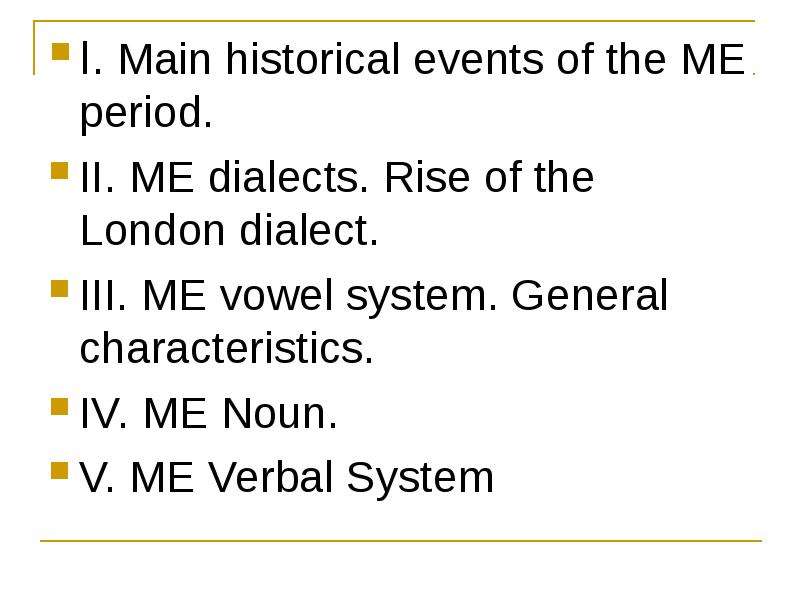
I. Main historical events of the ME period. I. Main historical events of the ME period. II. ME dialects. Rise of the London dialect. III. ME vowel system. General characteristics. IV. ME Noun. V. ME Verbal System

Слайд 3


Middle English (1066-1485) Middle English (1066-1485) 1066 the Norman Conquest. the Normans were descendants of Danish Vikings who settled in...
Описание слайда:
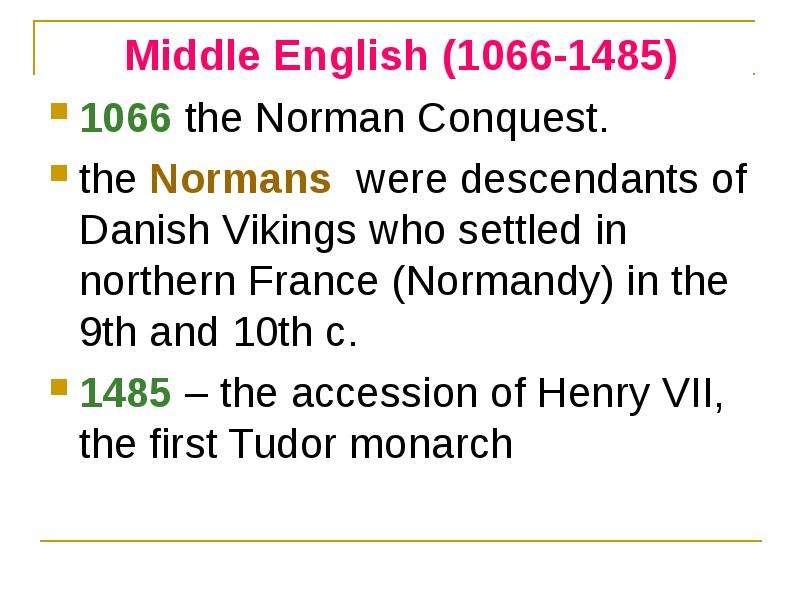
Middle English (1066-1485) Middle English (1066-1485) 1066 the Norman Conquest. the Normans were descendants of Danish Vikings who settled in northern France (Normandy) in the 9th and 10th c. 1485 – the accession of Henry VII, the first Tudor monarch

Слайд 4


1066 the Norman Conquest The new overlords spoke a dialect of Old French known as Anglo-Norman. Anglo-Saxon earls were deprived of property, killed;...
Описание слайда:
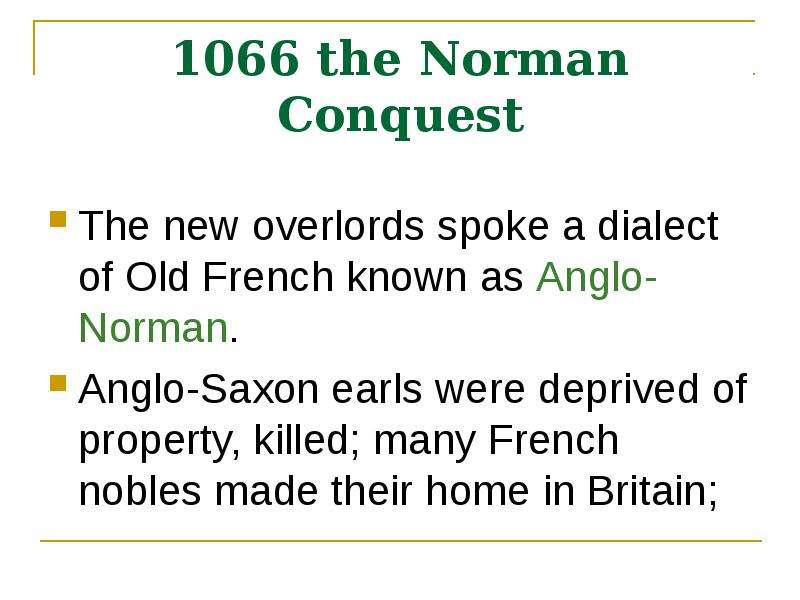
1066 the Norman Conquest The new overlords spoke a dialect of Old French known as Anglo-Norman. Anglo-Saxon earls were deprived of property, killed; many French nobles made their home in Britain;

Слайд 5


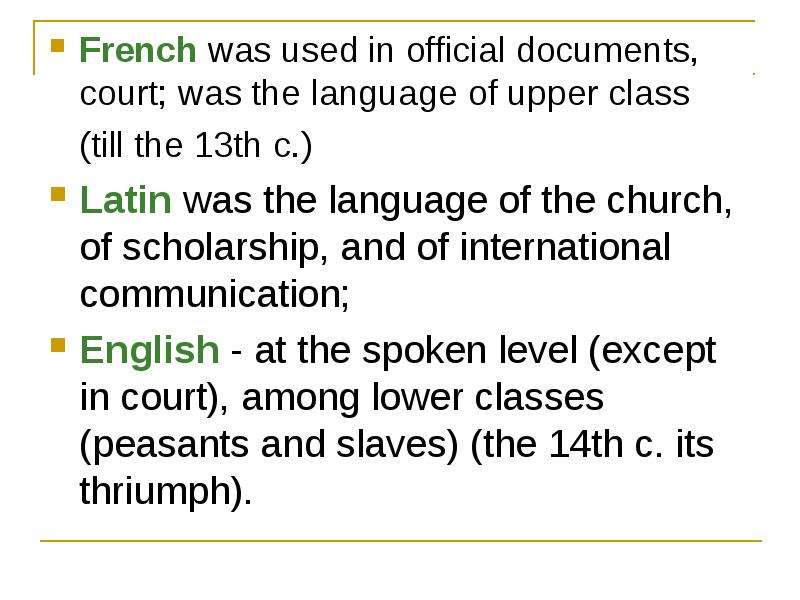
French was used in official documents, court; was the language of upper class French was used in official documents, court; was the language of upper...
Описание слайда:
French was used in official documents, court; was the language of upper class French was used in official documents, court; was the language of upper class (till the 13th c.) Latin was the language of the church, of scholarship, and of international communication; English - at the spoken level (except in court), among lower classes (peasants and slaves) (the 14th c. its thriumph).

Слайд 6


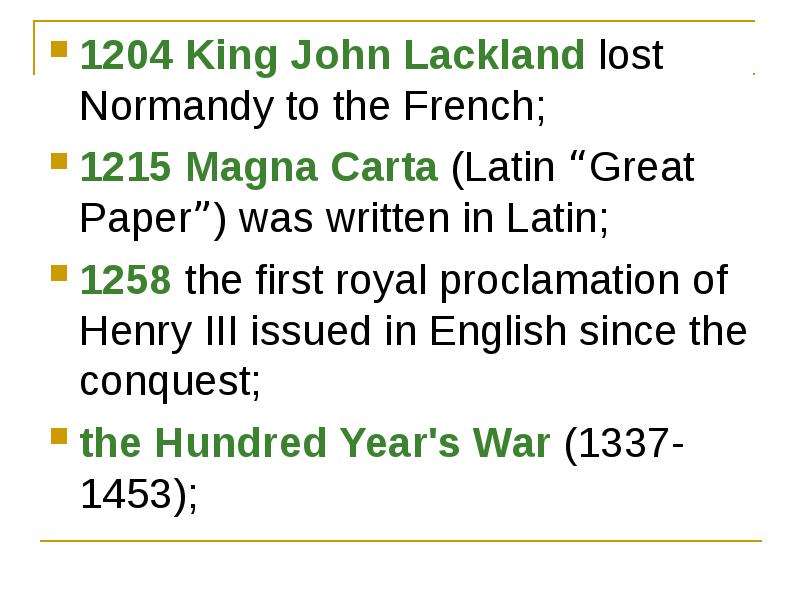
1204 King John Lackland lost Normandy to the French; 1204 King John Lackland lost Normandy to the French; 1215 Magna Carta (Latin “Great Paper”) was...
Описание слайда:
1204 King John Lackland lost Normandy to the French; 1204 King John Lackland lost Normandy to the French; 1215 Magna Carta (Latin “Great Paper”) was written in Latin; 1258 the first royal proclamation of Henry III issued in English since the conquest; the Hundred Year's War (1337-1453);

Слайд 7


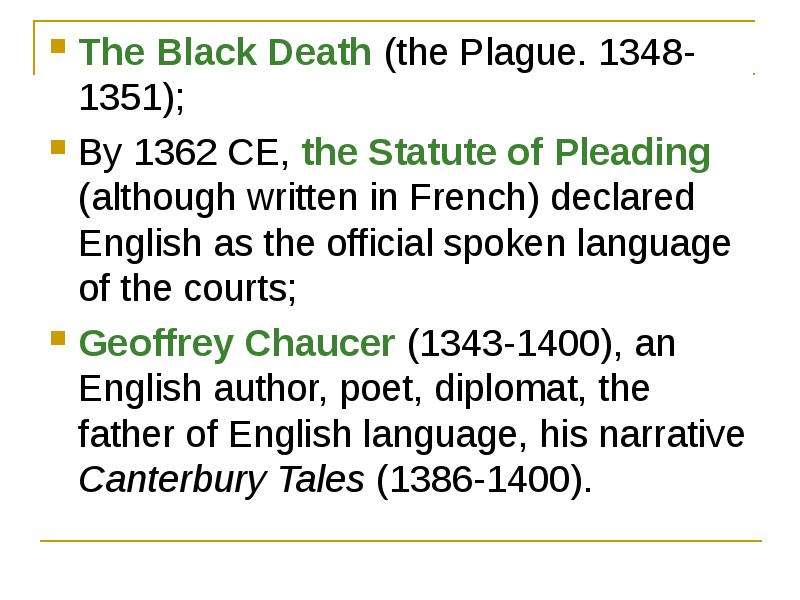
The Black Death (the Plague. 1348-1351); The Black Death (the Plague. 1348-1351); By 1362 CE, the Statute of Pleading (although written in French)...
Описание слайда:
The Black Death (the Plague. 1348-1351); The Black Death (the Plague. 1348-1351); By 1362 CE, the Statute of Pleading (although written in French) declared English as the official spoken language of the courts; Geoffrey Chaucer (1343-1400), an English author, poet, diplomat, the father of English language, his narrative Canterbury Tales (1386-1400).

Слайд 8


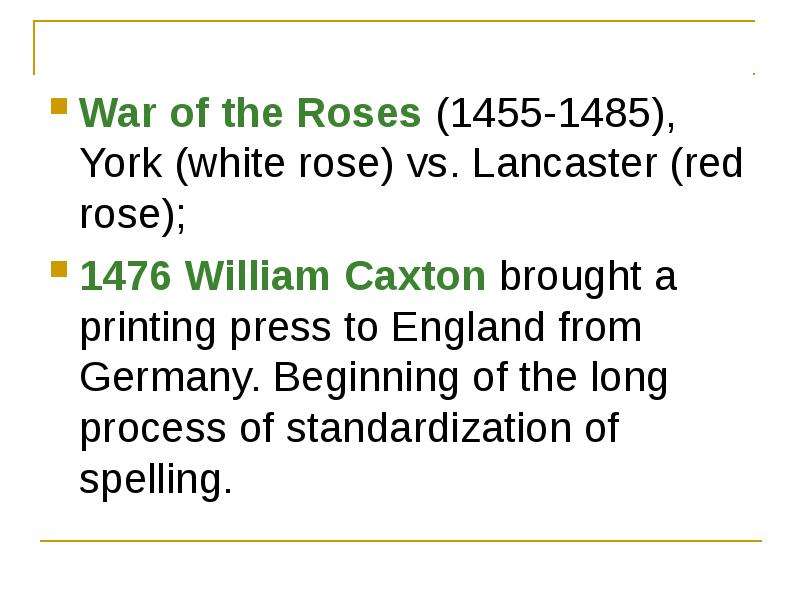
War of the Roses (1455-1485), York (white rose) vs. Lancaster (red rose); 1476 William Caxton brought a printing press to England from Germany....
Описание слайда:
War of the Roses (1455-1485), York (white rose) vs. Lancaster (red rose); 1476 William Caxton brought a printing press to England from Germany. Beginning of the long process of standardization of spelling.

Слайд 9


ME dialects. Rise of the London dialect. the Northern The Central the Southern
Описание слайда:
ME dialects. Rise of the London dialect. the Northern The Central the Southern

Слайд 10


In England the new standard language which arose in the late Middle Ages was not descended from the West Saxon literary language. It was based on the...
Описание слайда:
In England the new standard language which arose in the late Middle Ages was not descended from the West Saxon literary language. It was based on the East Midland dialect (OE Mercian)

Слайд 11


ME vowel system. General characteristics. French influence: The new diagraphs of French origin: “ou” (ME double), “ie” (ME chief), “ch”. The two-fold...
Описание слайда:
ME vowel system. General characteristics. French influence: The new diagraphs of French origin: “ou” (ME double), “ie” (ME chief), “ch”. The two-fold use of “g” and “c” owes its origin to French (ME mercy). Replacement of final –i by –y, which is more ornamental (ME very).

Слайд 12


Shortening the vowels are shortened before 2 consonants, but remain long in other environment. Exception: -ld, -nd, -mb: OE cēpan – ME kēpen OE cēpte...
Описание слайда:
Shortening the vowels are shortened before 2 consonants, but remain long in other environment. Exception: -ld, -nd, -mb: OE cēpan – ME kēpen OE cēpte – ME kepte OE wēnde – ME wēnde

Слайд 13


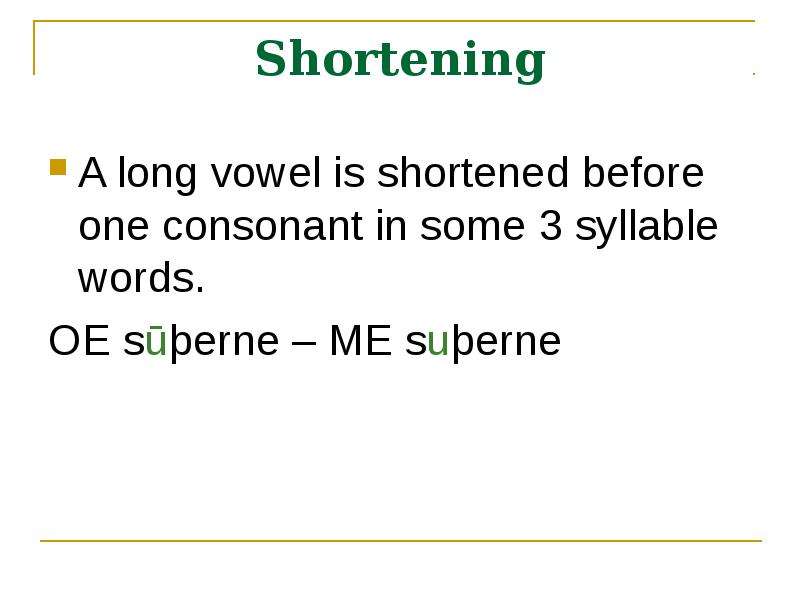
Shortening A long vowel is shortened before one consonant in some 3 syllable words. OE sūþerne – ME suþerne
Описание слайда:
Shortening A long vowel is shortened before one consonant in some 3 syllable words. OE sūþerne – ME suþerne

Слайд 14


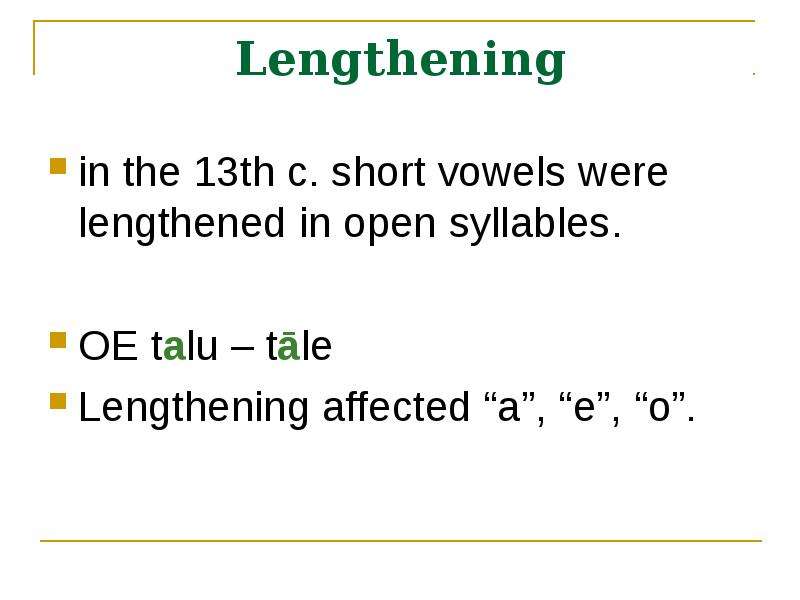
Lengthening in the 13th c. short vowels were lengthened in open syllables. OE talu – tāle Lengthening affected “a”, “e”, “o”.
Описание слайда:
Lengthening in the 13th c. short vowels were lengthened in open syllables. OE talu – tāle Lengthening affected “a”, “e”, “o”.

Слайд 15


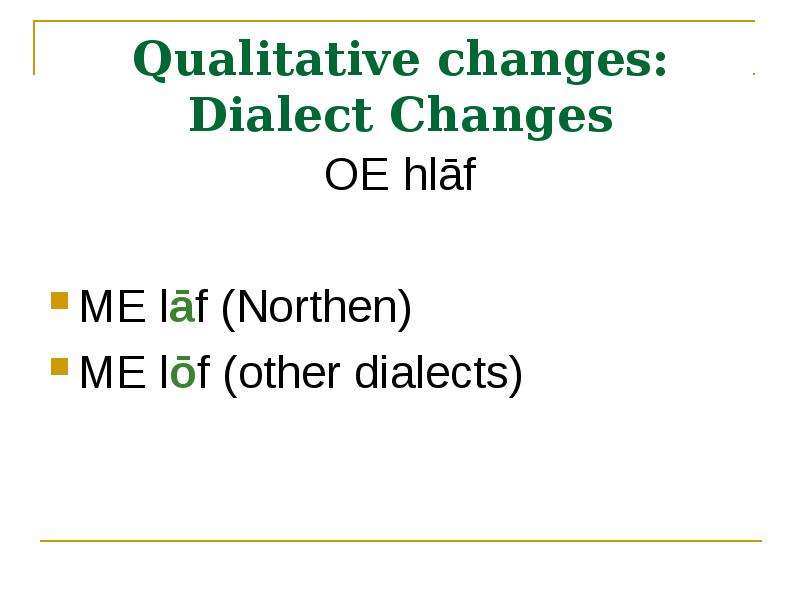
Qualitative changes: Dialect Changes OE hlāf ME lāf (Northen) ME lōf (other dialects)
Описание слайда:
Qualitative changes: Dialect Changes OE hlāf ME lāf (Northen) ME lōf (other dialects)

Слайд 16


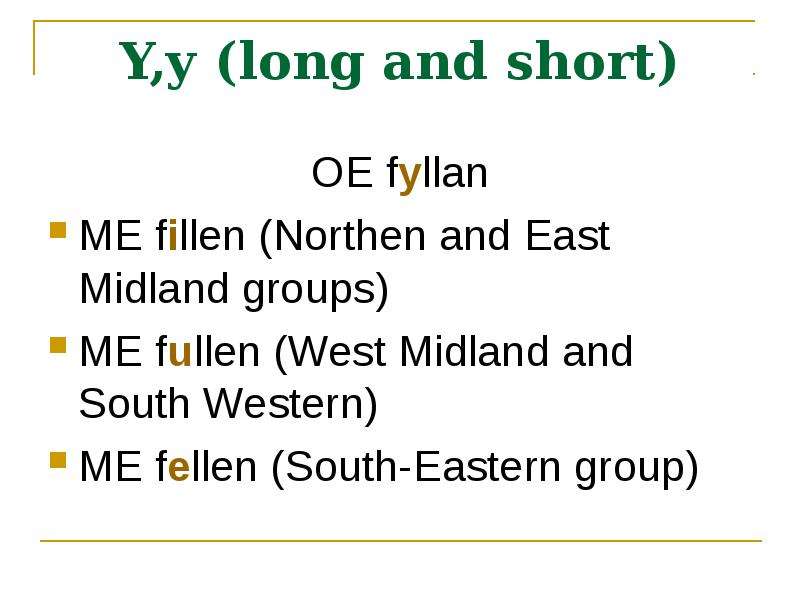
Y,y (long and short) OE fyllan ME fillen (Northen and East Midland groups) ME fullen (West Midland and South Western) ME fellen (South-Eastern group)
Описание слайда:
Y,y (long and short) OE fyllan ME fillen (Northen and East Midland groups) ME fullen (West Midland and South Western) ME fellen (South-Eastern group)

Слайд 17


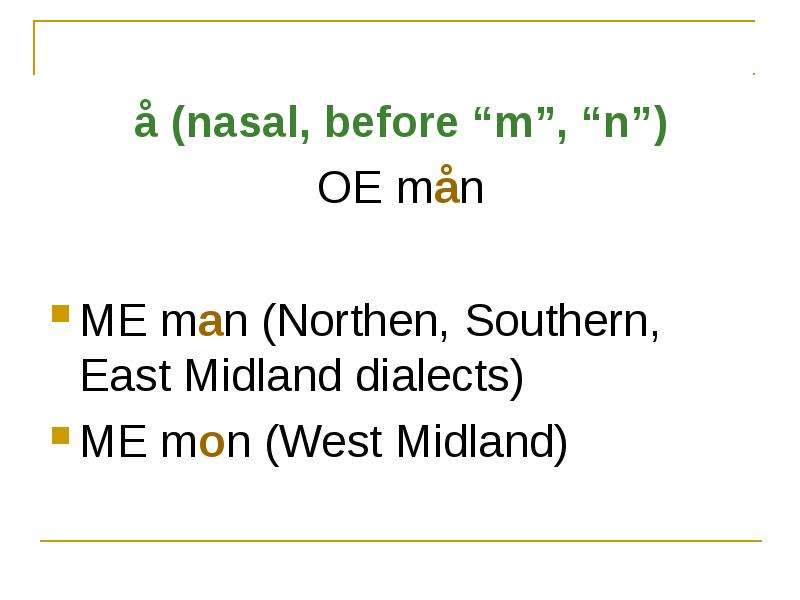
å (nasal, before “m”, “n”) OE mån ME man (Northen, Southern, East Midland dialects) ME mon (West Midland)
Описание слайда:
å (nasal, before “m”, “n”) OE mån ME man (Northen, Southern, East Midland dialects) ME mon (West Midland)

Слайд 18


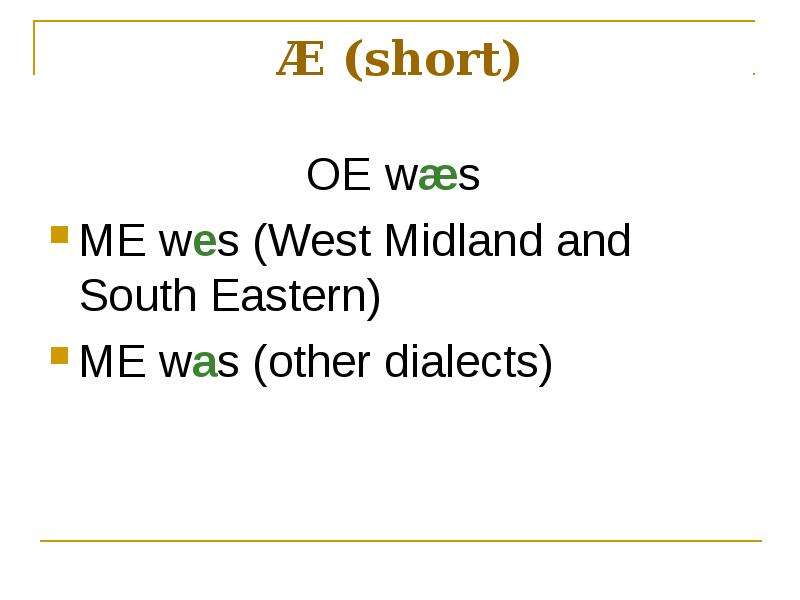
Æ (short) OE wæs ME wes (West Midland and South Eastern) ME was (other dialects)
Описание слайда:
Æ (short) OE wæs ME wes (West Midland and South Eastern) ME was (other dialects)

Слайд 19


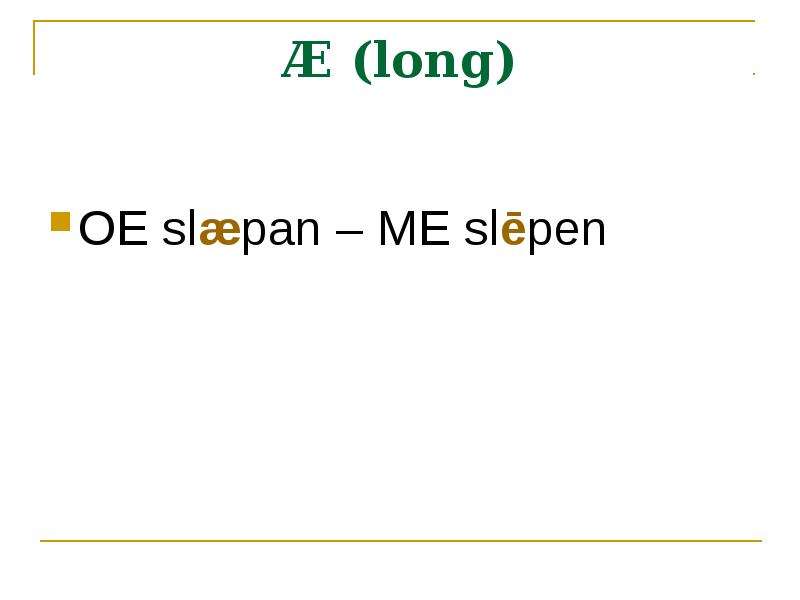
Æ (long) OE slæpan – ME slēpen
Описание слайда:
Æ (long) OE slæpan – ME slēpen

Слайд 20


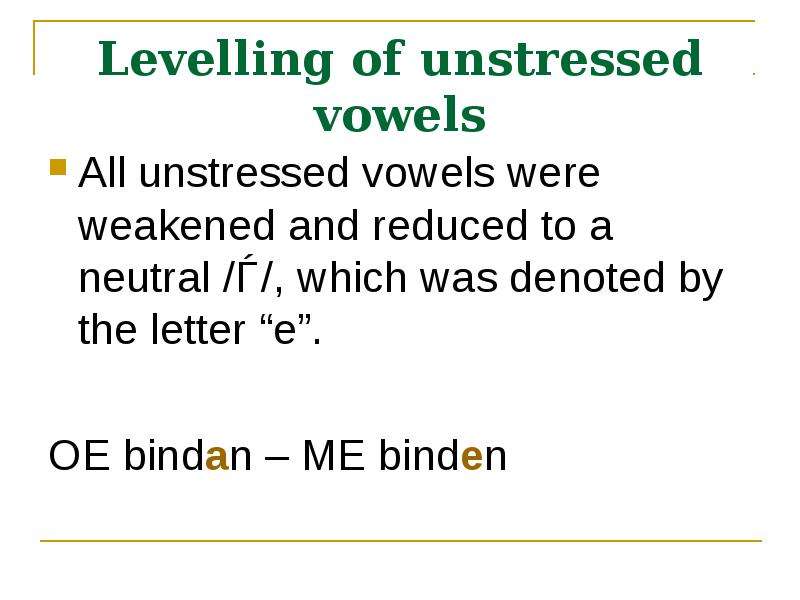
Levelling of unstressed vowels All unstressed vowels were weakened and reduced to a neutral /ǝ/, which was denoted by the letter “e”. OE bindan – ME...
Описание слайда:
Levelling of unstressed vowels All unstressed vowels were weakened and reduced to a neutral /ǝ/, which was denoted by the letter “e”. OE bindan – ME binden

Слайд 21


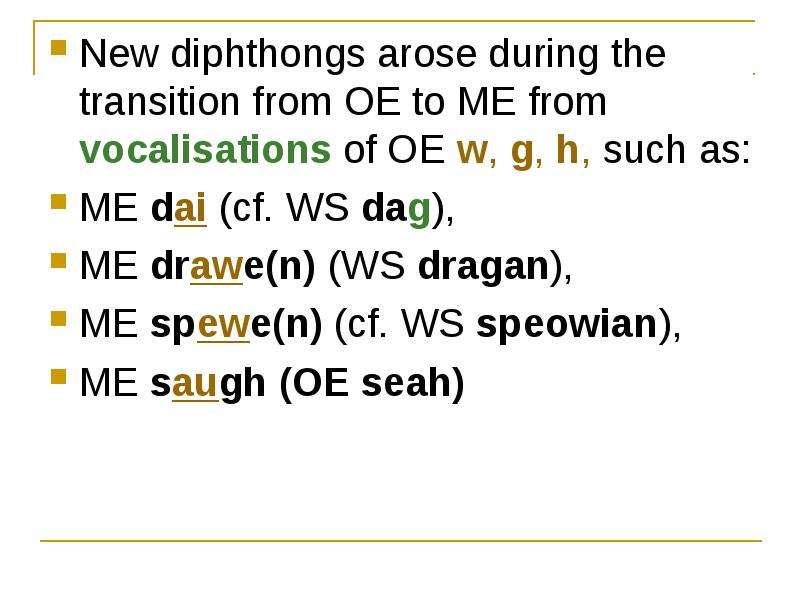
New diphthongs arose during the transition from OE to ME from vocalisations of OE w, g, h, such as: New diphthongs arose during the transition from...
Описание слайда:
New diphthongs arose during the transition from OE to ME from vocalisations of OE w, g, h, such as: New diphthongs arose during the transition from OE to ME from vocalisations of OE w, g, h, such as: ME dai (cf. WS dag), ME drawe(n) (WS dragan), ME spewe(n) (cf. WS speowian), ME saugh (OE seah)

Слайд 22


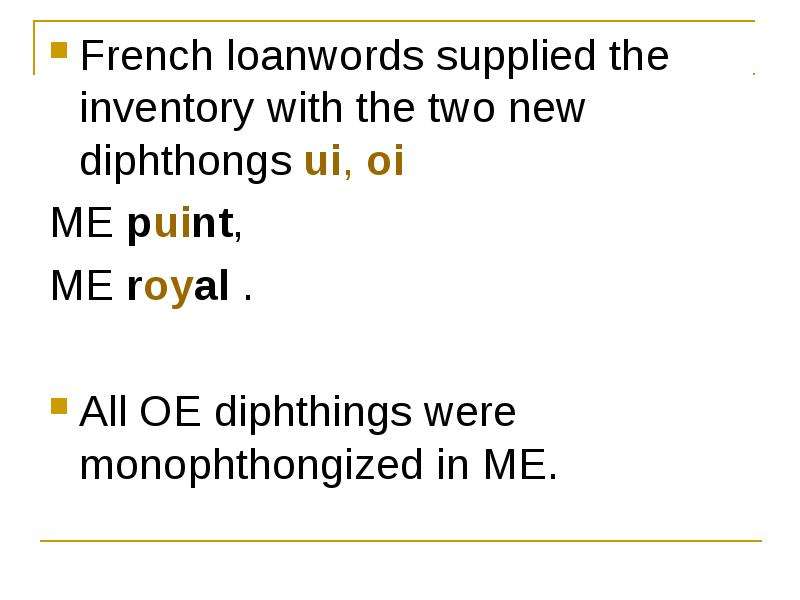
French loanwords supplied the inventory with the two new diphthongs ui, oi French loanwords supplied the inventory with the two new diphthongs ui, oi...
Описание слайда:
French loanwords supplied the inventory with the two new diphthongs ui, oi French loanwords supplied the inventory with the two new diphthongs ui, oi ME puint, ME royal . All OE diphthings were monophthongized in ME.

Слайд 23


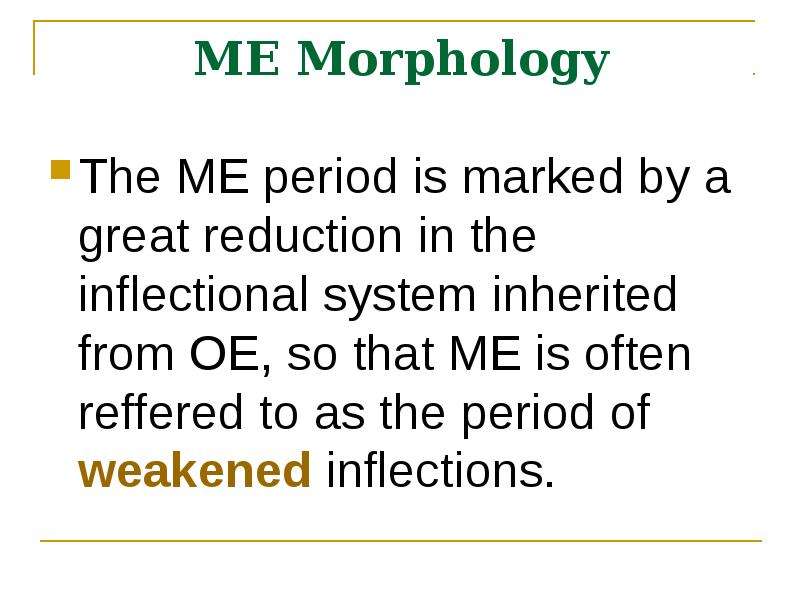
ME Morphology The ME period is marked by a great reduction in the inflectional system inherited from OE, so that ME is often reffered to as the...
Описание слайда:
ME Morphology The ME period is marked by a great reduction in the inflectional system inherited from OE, so that ME is often reffered to as the period of weakened inflections.

Слайд 24


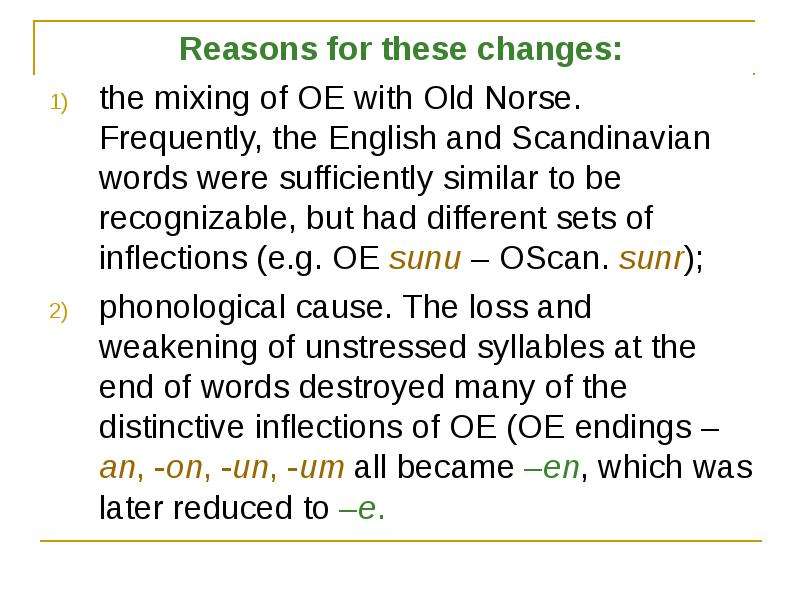
Reasons for these changes: Reasons for these changes: the mixing of OE with Old Norse. Frequently, the English and Scandinavian words were...
Описание слайда:
Reasons for these changes: Reasons for these changes: the mixing of OE with Old Norse. Frequently, the English and Scandinavian words were sufficiently similar to be recognizable, but had different sets of inflections (e.g. OE sunu – OScan. sunr); phonological cause. The loss and weakening of unstressed syllables at the end of words destroyed many of the distinctive inflections of OE (OE endings –an, -on, -un, -um all became –en, which was later reduced to –e.

Слайд 25


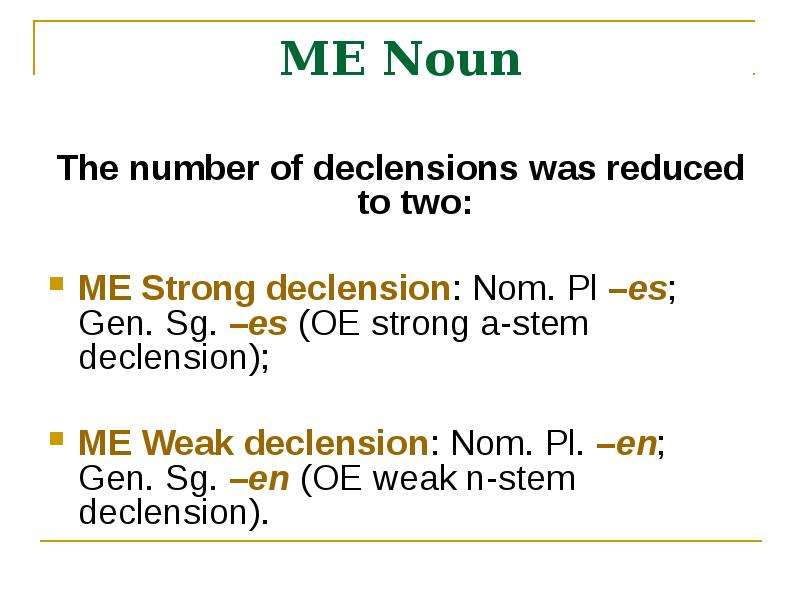
ME Noun The number of declensions was reduced to two: ME Strong declension: Nom. Pl –es; Gen. Sg. –es (OE strong a-stem declension); ME Weak...
Описание слайда:
ME Noun The number of declensions was reduced to two: ME Strong declension: Nom. Pl –es; Gen. Sg. –es (OE strong a-stem declension); ME Weak declension: Nom. Pl. –en; Gen. Sg. –en (OE weak n-stem declension).

Слайд 26


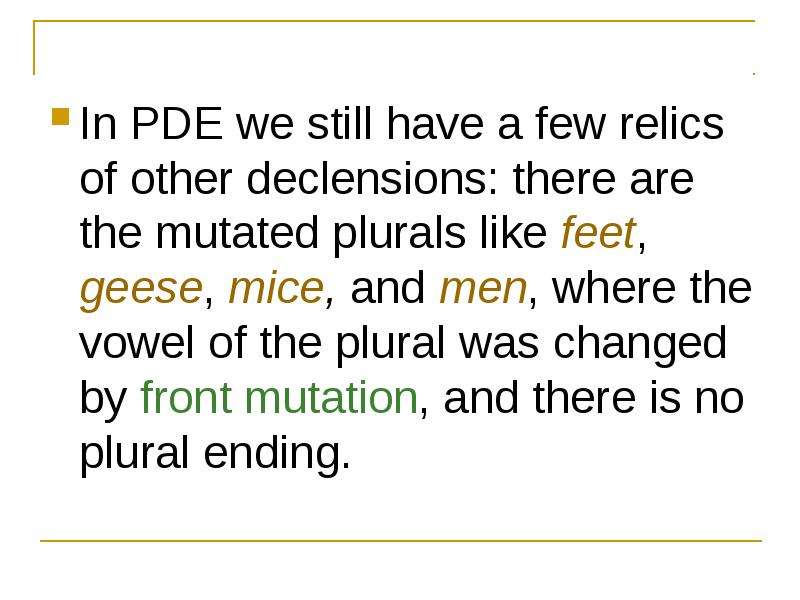
In PDE we still have a few relics of other declensions: there are the mutated plurals like feet, geese, mice, and men, where the vowel of the plural...
Описание слайда:
In PDE we still have a few relics of other declensions: there are the mutated plurals like feet, geese, mice, and men, where the vowel of the plural was changed by front mutation, and there is no plural ending.

Слайд 27


The number of cases was reduced to two: Common and Genitive. The number of cases was reduced to two: Common and Genitive.
Описание слайда:
The number of cases was reduced to two: Common and Genitive. The number of cases was reduced to two: Common and Genitive.

Слайд 28


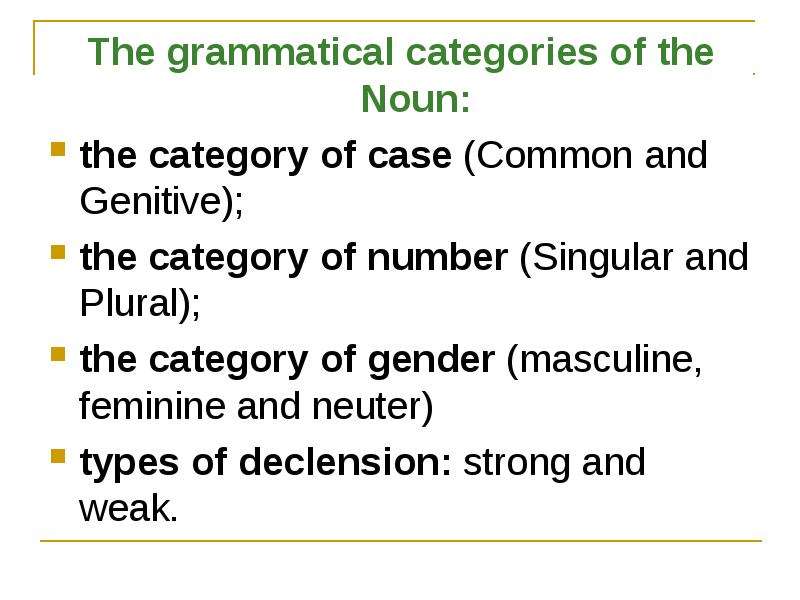
The grammatical categories of the Noun: The grammatical categories of the Noun: the category of case (Common and Genitive); the category of number...
Описание слайда:
The grammatical categories of the Noun: The grammatical categories of the Noun: the category of case (Common and Genitive); the category of number (Singular and Plural); the category of gender (masculine, feminine and neuter) types of declension: strong and weak.

Слайд 29


The category of Gender a shift from 'grammatical' to 'natural' gender;
Описание слайда:
The category of Gender a shift from 'grammatical' to 'natural' gender;

Слайд 30


The Definite Article In OE the DA showed three genders (sē masculine, sēo feminine, þæt neuter), and was declined through all four cases, singular...
Описание слайда:
The Definite Article In OE the DA showed three genders (sē masculine, sēo feminine, þæt neuter), and was declined through all four cases, singular and plural. The form the arose as Late OE þe, which supplanted sē and sēo. By the end of the ME period we have reached the modern position, in which the is the only form of the definite article.

Слайд 31


The Verb Old English marked two tenses (past vs present), three moods (indicative vs imperative vs subjunctive), and three persons (first, second,...
Описание слайда:
The Verb Old English marked two tenses (past vs present), three moods (indicative vs imperative vs subjunctive), and three persons (first, second, third) and two numbers. 4 classes of OE verbs.

Слайд 32


The principle of analogy— the tendency of language to follow certain patterns and adapt a less common form to a more familiar one—is well exemplified...
Описание слайда:
The principle of analogy— the tendency of language to follow certain patterns and adapt a less common form to a more familiar one—is well exemplified in the further history of the strong verbs. The principle of analogy— the tendency of language to follow certain patterns and adapt a less common form to a more familiar one—is well exemplified in the further history of the strong verbs.

Слайд 33


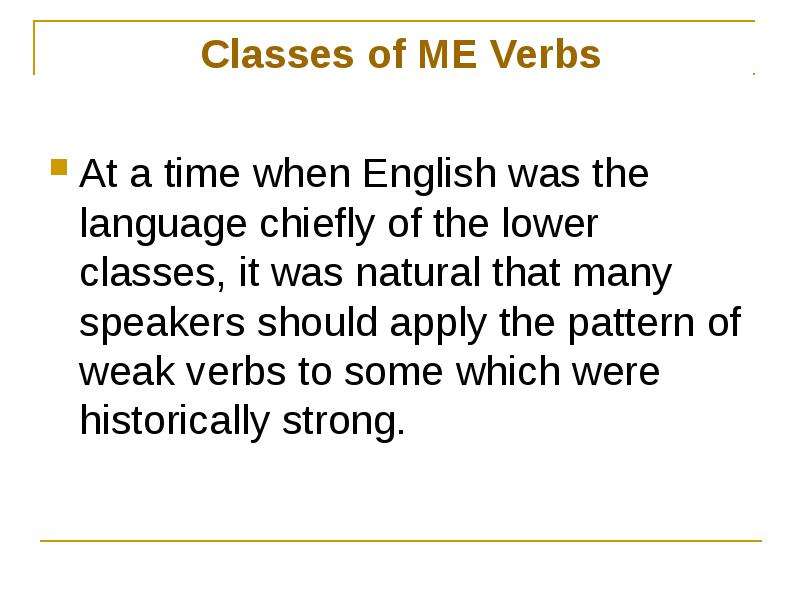
Classes of ME Verbs Classes of ME Verbs At a time when English was the language chiefly of the lower classes, it was natural that many speakers...
Описание слайда:
Classes of ME Verbs Classes of ME Verbs At a time when English was the language chiefly of the lower classes, it was natural that many speakers should apply the pattern of weak verbs to some which were historically strong.

Слайд 34


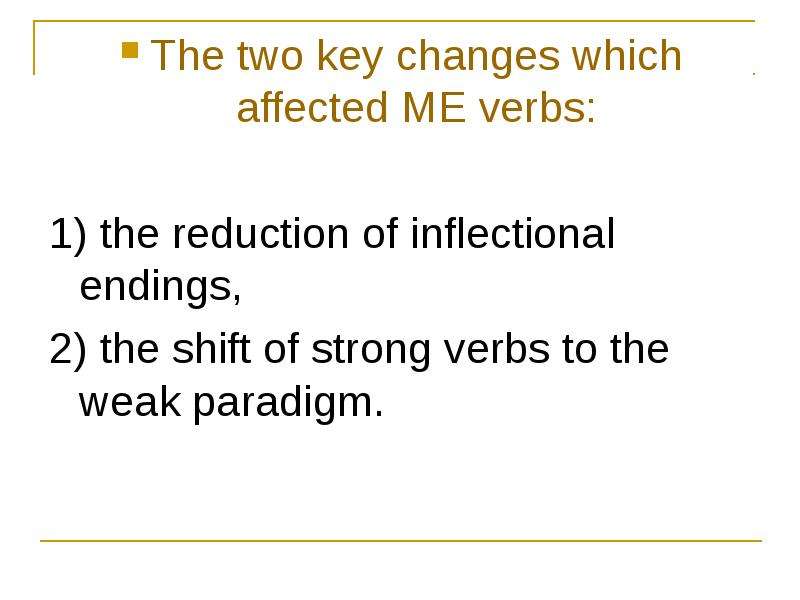
The two key changes which affected ME verbs: The two key changes which affected ME verbs: 1) the reduction of inflectional endings, 2) the shift of...
Описание слайда:
The two key changes which affected ME verbs: The two key changes which affected ME verbs: 1) the reduction of inflectional endings, 2) the shift of strong verbs to the weak paradigm.

Слайд 35


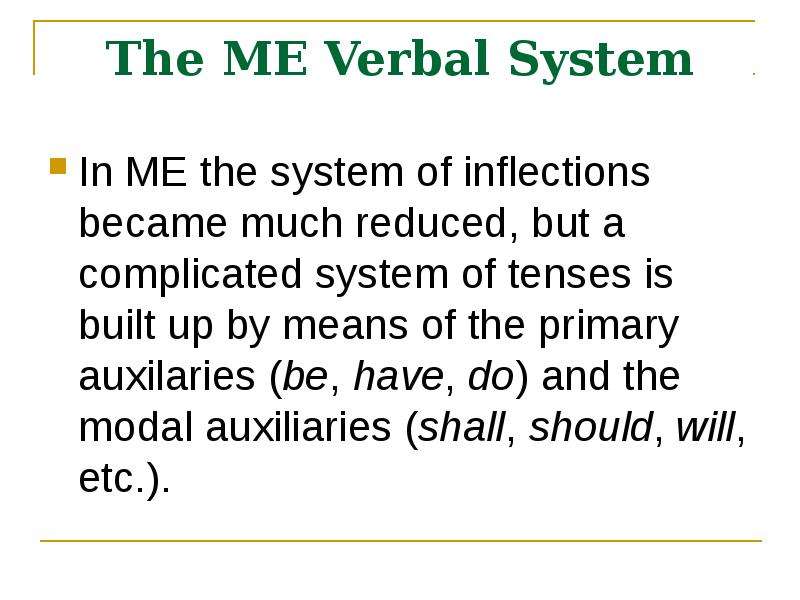
The ME Verbal System In ME the system of inflections became much reduced, but a complicated system of tenses is built up by means of the primary...
Описание слайда:
The ME Verbal System In ME the system of inflections became much reduced, but a complicated system of tenses is built up by means of the primary auxilaries (be, have, do) and the modal auxiliaries (shall, should, will, etc.).

Слайд 36


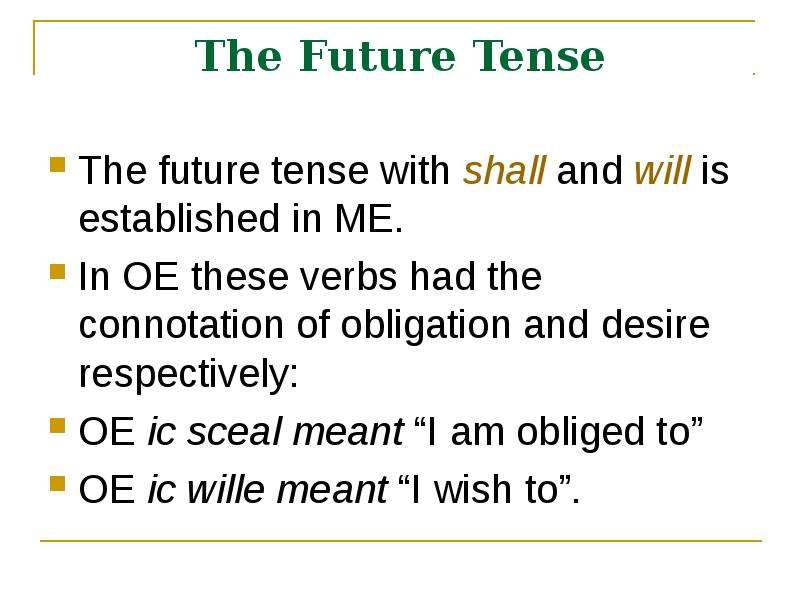
The Future Tense The future tense with shall and will is established in ME. In OE these verbs had the connotation of obligation and desire...
Описание слайда:
The Future Tense The future tense with shall and will is established in ME. In OE these verbs had the connotation of obligation and desire respectively: OE ic sceal meant “I am obliged to” OE ic wille meant “I wish to”.

Слайд 37


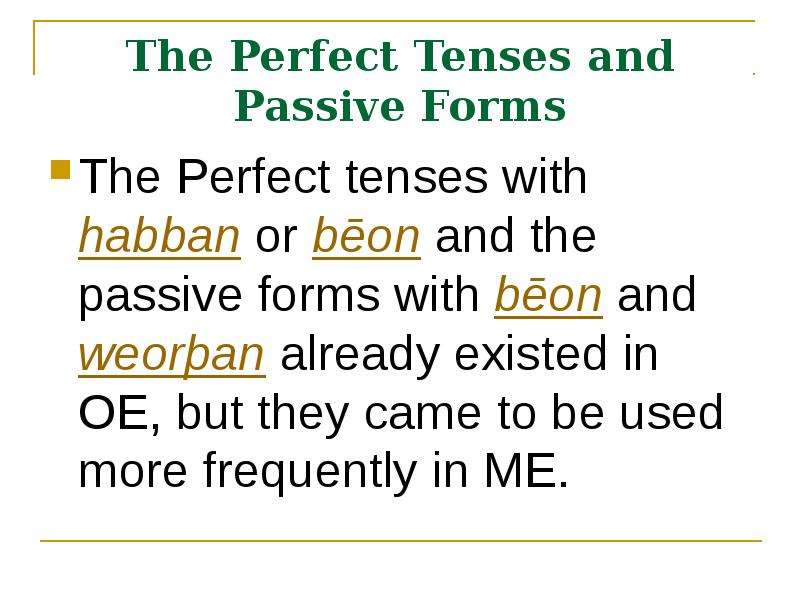
The Perfect Tenses and Passive Forms The Perfect tenses with habban or bēon and the passive forms with bēon and weorþan already existed in OE, but...
Описание слайда:
The Perfect Tenses and Passive Forms The Perfect tenses with habban or bēon and the passive forms with bēon and weorþan already existed in OE, but they came to be used more frequently in ME.

Слайд 38


The Continuous Tenses The Continuous tenses, formed with be + the present participle, also arise in ME, but are not at all common until the Modern...
Описание слайда:
The Continuous Tenses The Continuous tenses, formed with be + the present participle, also arise in ME, but are not at all common until the Modern English period.

Слайд 39


By the end of ME the perfect, passive, and continuous markings of the verb were all well established, though much less frequently used than today.
Описание слайда:
By the end of ME the perfect, passive, and continuous markings of the verb were all well established, though much less frequently used than today.

Слайд 40


ME Syntax As the inflectional system decayed, other devices were increasingly used to replace it.
Описание слайда:
ME Syntax As the inflectional system decayed, other devices were increasingly used to replace it.

Слайд 41


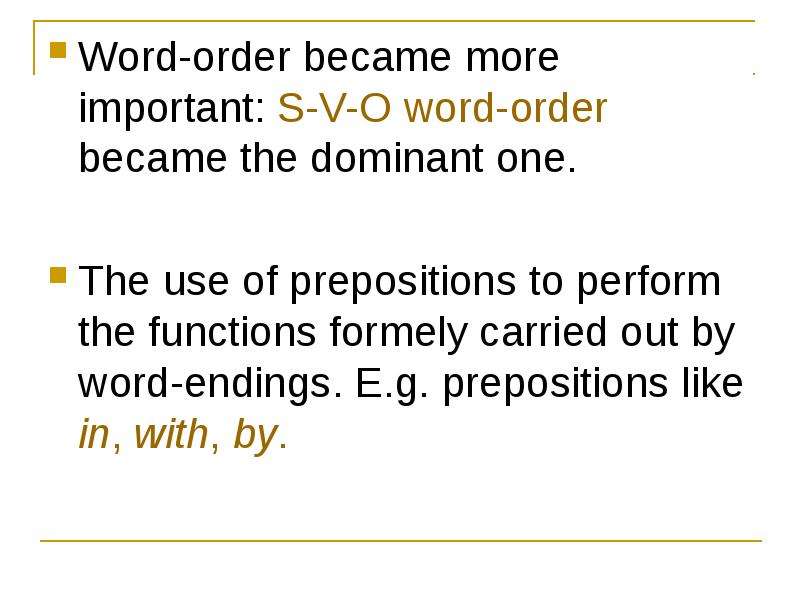
Word-order became more important: S-V-O word-order became the dominant one. Word-order became more important: S-V-O word-order became the dominant...
Описание слайда:
Word-order became more important: S-V-O word-order became the dominant one. Word-order became more important: S-V-O word-order became the dominant one. The use of prepositions to perform the functions formely carried out by word-endings. E.g. prepositions like in, with, by.


Похожие презентации
Mypresentation.ru
Загрузить презентацию