🗊 Презентация Tissue processing

Нажмите для полного просмотра!
Tissue processing, слайд №1 Tissue processing, слайд №2 Tissue processing, слайд №3 Tissue processing, слайд №4 Tissue processing, слайд №5 Tissue processing, слайд №6 Tissue processing, слайд №7 Tissue processing, слайд №8 Tissue processing, слайд №9 Tissue processing, слайд №10 Tissue processing, слайд №11 Tissue processing, слайд №12 Tissue processing, слайд №13 Tissue processing, слайд №14 Tissue processing, слайд №15 Tissue processing, слайд №16 Tissue processing, слайд №17 Tissue processing, слайд №18 Tissue processing, слайд №19 Tissue processing, слайд №20 Tissue processing, слайд №21 Tissue processing, слайд №22 Tissue processing, слайд №23 Tissue processing, слайд №24 Tissue processing, слайд №25 Tissue processing, слайд №26 Tissue processing, слайд №27 Tissue processing, слайд №28 Tissue processing, слайд №29 Tissue processing, слайд №30 Tissue processing, слайд №31 Tissue processing, слайд №32 Tissue processing, слайд №33 Tissue processing, слайд №34

Вы можете ознакомиться и скачать презентацию на тему Tissue processing. Доклад-сообщение содержит 34 слайдов. Презентации для любого класса можно скачать бесплатно. Если материал и наш сайт презентаций Mypresentation Вам понравились – поделитесь им с друзьями с помощью социальных кнопок и добавьте в закладки в своем браузере.

Слайды и текст этой презентации


Слайд 1


Tissue Processing Presented by: DAYNOVOV ABBOSJON
Описание слайда:
Tissue Processing Presented by: DAYNOVOV ABBOSJON

Слайд 2


Contents Introduction Specimen Accessioning Gross Examination Tissue Processing steps The paraffin Technique and its alternatives The freezing...
Описание слайда:
Contents Introduction Specimen Accessioning Gross Examination Tissue Processing steps The paraffin Technique and its alternatives The freezing Technique Problems in tissue processing

Слайд 3


Introduction There are 3 main techniques which are used in preparing microscopical sections from tissues: The paraffin technique (It is the most...
Описание слайда:
Introduction There are 3 main techniques which are used in preparing microscopical sections from tissues: The paraffin technique (It is the most common method) The celloidin technique (It is the most perfect method) The freezing technique (It is the most rapid method)

Слайд 4


…Introduction Tissues from the body taken for diagnosis of disease processes must be processed in the histology laboratory to produce microscopic...
Описание слайда:
…Introduction Tissues from the body taken for diagnosis of disease processes must be processed in the histology laboratory to produce microscopic slides that are viewed under the microscope by pathologists. The techniques for processing the tissues, whether Biopsies, Larger specimens removed at surgery, Or Tissues from autopsy are described below. The persons who do the tissue processing and make the glass microscopic slides are HISTOTECHNOLOGISTS.

Слайд 5


Specimen Accessioning Tissue specimens received in the surgical pathology laboratory have a request form that lists the patient information and...
Описание слайда:
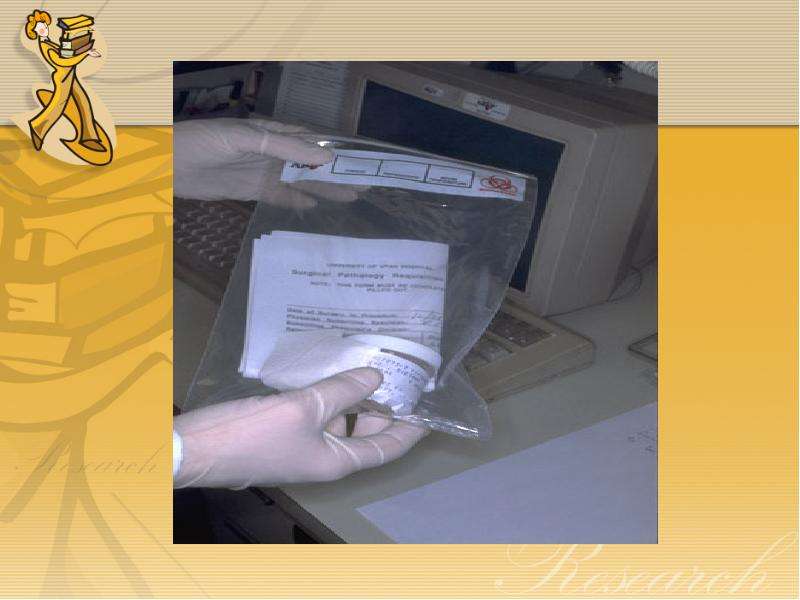
Specimen Accessioning Tissue specimens received in the surgical pathology laboratory have a request form that lists the patient information and history along with a description of the site of origin. The specimens are accessioned by giving them a number that will identify each specimen for each patient.

Слайд 6


Tissue processing, слайд №6
Описание слайда:

Слайд 7


Tissue processing, слайд №7
Описание слайда:

Слайд 8


Gross examination Tissues removed from the body for diagnosis arrive in the Pathology Department and are examined by a pathologist, pathology...
Описание слайда:
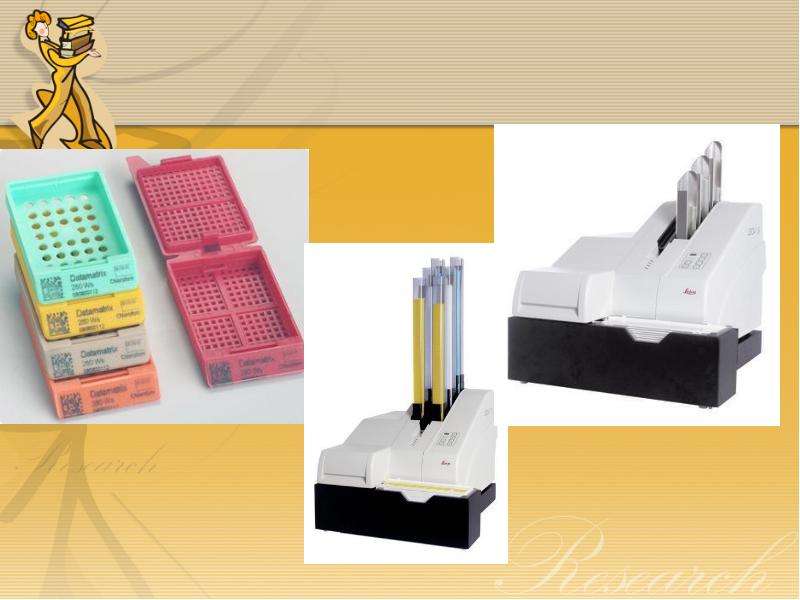
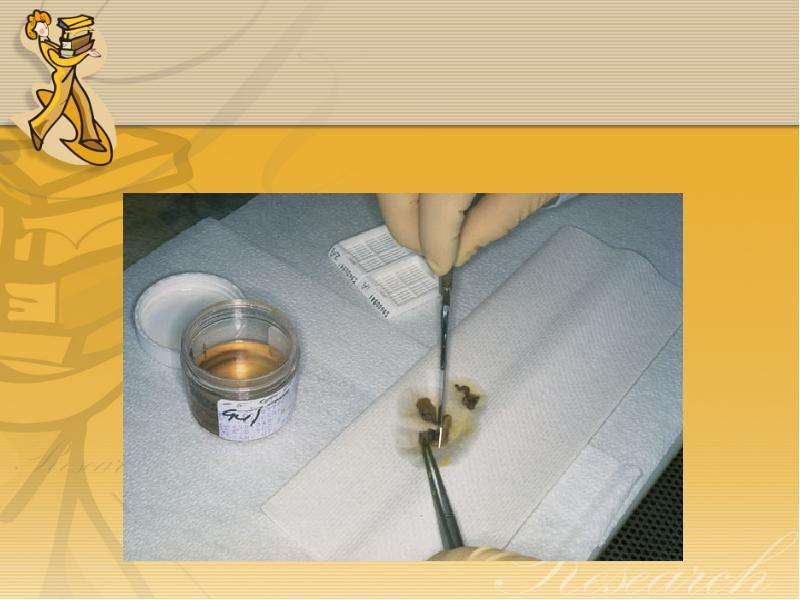
Gross examination Tissues removed from the body for diagnosis arrive in the Pathology Department and are examined by a pathologist, pathology assistant, or pathology resident. Gross examination consists of describing the specimen and placing all or parts of it into a small plastic cassette which holds the tissue while it is being processed to a paraffin block. Initially, the cassettes are placed into a fixative.

Слайд 9


Tissue processing, слайд №9
Описание слайда:

Слайд 10


…Gross examination Note: When a malignancy is suspected, then the specimen is often covered with ink in order to mark the margins of the specimen....
Описание слайда:
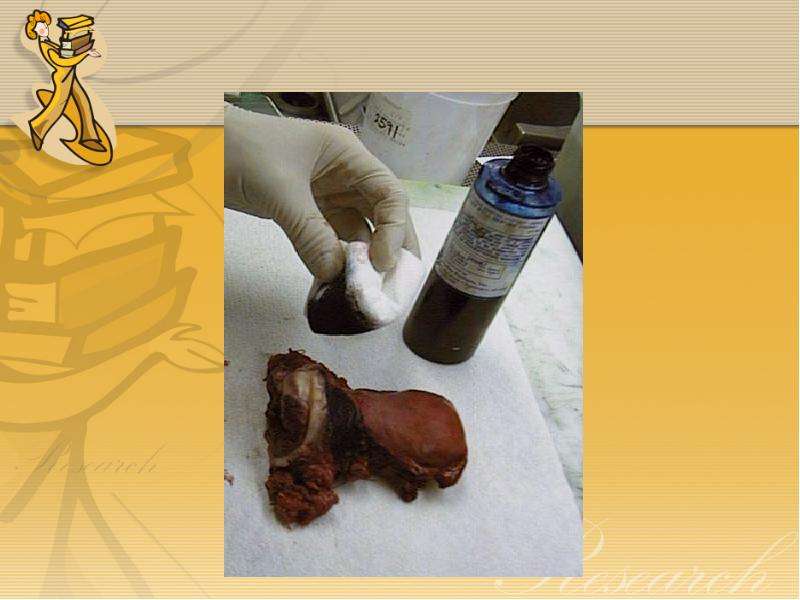
…Gross examination Note: When a malignancy is suspected, then the specimen is often covered with ink in order to mark the margins of the specimen. Different colored inks can be used to identify different areas if needed. When sections are made and processed, the ink will mark the actual margin on the slide.

Слайд 11


Tissue processing, слайд №11
Описание слайда:

Слайд 12


Tissue Processing steps Biological tissues are generally rather soft, making it quite difficult to cut acceptably thin sections directly from the...
Описание слайда:
Tissue Processing steps Biological tissues are generally rather soft, making it quite difficult to cut acceptably thin sections directly from the fresh or fixed tissues. Methods must be used to hold the tissues firm, which facilitates cutting thin sections with a sharp knife. Firmness can be achieved either by embedding the tissues in a suitable embedment or by freezing the tissue. Once the tissue has been fixed, it must be processed into a form in which it can be made into thin microscopic sections.

Слайд 13


…Tissue Processing steps The usual way this is done is with paraffin. Tissues embedded in paraffin, which is similar in density to tissue, can be...
Описание слайда:
…Tissue Processing steps The usual way this is done is with paraffin. Tissues embedded in paraffin, which is similar in density to tissue, can be sectioned at anywhere from 3 to 10 microns, usually 5-8 routinely. The technique of getting fixed tissue into paraffin is called tissue processing. The main steps in this process are dehydration and clearing.

Слайд 14


The paraffin Technique Washing Following fixation, the tissues should be washed from 15 to 30 minutes. The fixed tissues are washed in running tap...
Описание слайда:
The paraffin Technique Washing Following fixation, the tissues should be washed from 15 to 30 minutes. The fixed tissues are washed in running tap water to remove the fixative from them.

Слайд 15


...The paraffin Technique Dehydration Wet fixed tissues (in aqueous solutions) cannot be directly infiltrated with paraffin. First, the water from...
Описание слайда:
...The paraffin Technique Dehydration Wet fixed tissues (in aqueous solutions) cannot be directly infiltrated with paraffin. First, the water from the tissues must be removed by dehydration. This is usually done with a series of alcohols; say 70% to 95% to 100%. The organic solvent must replace the water gradually to prevent turbulence at the interface between water and pure ethanol Turbulence could cause damage or distortion to cellular components. The number of steps or the gradient differences should be determined by The degree of fixation The delicacy of the tissue The degree of cellular detail to be preserved Sometimes the first step is a mixture of formalin and alcohol. Other dehydrants can be used, but have major disadvantages. Acetone is very fast, but a fire hazard, so is safe only for small, hand-processed sets of tissues. Dioxane can be used without clearing, but has toxic fumes.

Слайд 16


…The paraffin technique Clearing The next step is called "clearing" and consists of removal of the dehydrant with a substance that will be...
Описание слайда:
…The paraffin technique Clearing The next step is called "clearing" and consists of removal of the dehydrant with a substance that will be miscible with the embedding medium (paraffin). The commonest clearing agent is xylene. Toluene works well, and is more tolerant of small amounts of water left in the tissues, but is 3 times more expensive than xylene. Chloroform used to be used, but is a health hazard, and is slow. Methyl salicylate is rarely used because it is expensive, but it smells nice (it is oil of wintergreen). Excessive exposure to clearing reagents may cause excessive hardness or shrinkage.

Слайд 17


…The paraffin technique Impregnation in paraffin The tissues are put from 6 – 24 hours in hot soft paraffin at 50°C, then in hot hard paraffin at 55...
Описание слайда:
…The paraffin technique Impregnation in paraffin The tissues are put from 6 – 24 hours in hot soft paraffin at 50°C, then in hot hard paraffin at 55 °C in the oven. The paraffin will penetrate in-between the cells of the tissues. This process of paraffin infiltration is a necessary step to harden the tissues before their embedding.

Слайд 18


…The paraffin technique Embedding Finally, the tissue is infiltrated with the embedding agent, almost always paraffin. In early days of microscopy...
Описание слайда:
…The paraffin technique Embedding Finally, the tissue is infiltrated with the embedding agent, almost always paraffin. In early days of microscopy histologists tried to harden tissues artificially with fixatives, in order to be able to cut suitably thin sections for microscopy. Nearly 100 years ago, the method of embedding tissues in paraffin was developed Paraffin is a derivative of crude petroleum. It is a group of variable length, long-chain hydrocarbons of the methane series Most paraffins suitable as embedding media melt between 52° and 58°C. Since most paraffin have a melting point between 52-58°C, it must infiltrate the cells while it is hot.

Слайд 19


…The paraffin technique Infiltration must be carried out at only a few degrees above the melting point of paraffin This represented a great step...
Описание слайда:
…The paraffin technique Infiltration must be carried out at only a few degrees above the melting point of paraffin This represented a great step forward in microscopic techniques. Firmness was achieved with a supporting medium (an embedment), rather than by hardening the tissue itself. For many years paraffin served as almost the only embedment. Most of our knowledge from microscopy has been gained from sections cut from paraffin-embedded tissues.

Слайд 20


…The paraffin technique Paraffin can be purchased that differ in melting point, for various hardnesses, depending upon the way the histotechnologist...
Описание слайда:
…The paraffin technique Paraffin can be purchased that differ in melting point, for various hardnesses, depending upon the way the histotechnologist likes them and upon the climate (warm vs. cold). Recently a product called Paraplast Plus was introduced into the market. It contains added plasticizers that make the paraffin blocks easier for some technicians to cut. A vacuum can be applied inside the tissue processor to assist penetration of the embedding agent. The time required for embedding tissues using ethanol dehydration and xylene clearing usually exceeds eight hours. Normally, the tissue is processed overnight with an automatic tissue processing machine.

Слайд 21


…The paraffin technique Using a completely different rationale for dehydration, Prento (1978) was able to reduce the time required for embedding...
Описание слайда:
…The paraffin technique Using a completely different rationale for dehydration, Prento (1978) was able to reduce the time required for embedding fixed tissues to less than 3 hours, using far few steps. He used Dimethoxypropane (DMP), which served as both the dehydrating and clearing agent. Acidified DMP does not simply replace the water but chemically reacts with water to form methanol and acetone which both act as dehydrants. After the block of tissue has been completely infiltrated with paraffin, it is placed in a mold containing hot paraffin and oriented in the desire manner. The paraffin is then allowed to solidify.

Слайд 22


…The paraffin technique Upon solidifying, paraffin shrinks 16.5 percent in volume. Paraplast is supposed to shrink less (14 percent by volume) No...
Описание слайда:
…The paraffin technique Upon solidifying, paraffin shrinks 16.5 percent in volume. Paraplast is supposed to shrink less (14 percent by volume) No doubt the two most objectionable aspects of paraffin as an embedding medium are: The heat required for melting- the critical shrinkage point of collagen is approximately 65°C. Exposure of collagenous tissues to this temperature must be carefully guarded against to avoid excessive shrinkage. Shrinkage upon solidification Despite these problems, paraffin has been far the most widely used embedding medium for many years, and it will probably not be readily replaced by another medium.

Слайд 23


…The paraffin technique The above processes are almost always automated for the large volumes of routine tissues processed. Automation consists of an...
Описание слайда:
…The paraffin technique The above processes are almost always automated for the large volumes of routine tissues processed. Automation consists of an instrument that moves the tissues around through the various agents on a preset time scale. The "technicon" tissue processor is one of the commonest and most reliable (a mechanical processor with an electric motor that drives gears and cams), though no longer made. Newer processors have computers, not cam wheels, to control them and have sealed reagent wells to which a vacuum and/or heat can be applied.

Слайд 24


…The paraffin technique
Описание слайда:
…The paraffin technique

Слайд 25


Tissue processing, слайд №25
Описание слайда:

Слайд 26


Alternatives to paraffin embedding Alternatives to paraffin embedding include various plastics that allow thinner sections. Such plastics include:...
Описание слайда:
Alternatives to paraffin embedding Alternatives to paraffin embedding include various plastics that allow thinner sections. Such plastics include: Methyl Methacrylate, Glycol Methacrylate (GMA), Araldite Epon. Methyl Methacrylate is very hard and therefore good for embedding undecalcified bone. Glycol Methacrylate has the most widespread use since it is the easiest to work with. Araldite is about the same as methacrylate, but requires a more complex embedding process. Epon is routinely used for electron microscopy where very thin sections are required

Слайд 27


Note: Plastics require special reagents for dehydration and clearing that are expensive. For this reason, and because few tissues are plastic...
Описание слайда:
Note: Plastics require special reagents for dehydration and clearing that are expensive. For this reason, and because few tissues are plastic embedded, the processing is usually done by hand. A special microtome is required for sectioning these blocks. Small blocks must be made, so the technique lends itself to small biopsies, such as bone marrow or liver.

Слайд 28


The freezing Technique In this method, the fresh or fixed tissues are frozen hardened and cut with a freezing microtome in the cryostat apparatus...
Описание слайда:
The freezing Technique In this method, the fresh or fixed tissues are frozen hardened and cut with a freezing microtome in the cryostat apparatus within few minutes It is a quick and simple method which is commonly used during operations for rapid diagnosis of tumors e.g. carcinoma The chemistry of tissues is preserved because we use no heat and no chemical solvents Can be used in Histochemistry to demonstrate enzymes and chemical components of tissues Disadvantage: It gives not-serial thick sections which may fragment into small pieces, so they are very difficult to be stained and to be stored.

Слайд 29


Problems in Tissue Processing "Floaters" are small pieces of tissue that appear on a slide that do not belong there--they have floated in...
Описание слайда:
Problems in Tissue Processing "Floaters" are small pieces of tissue that appear on a slide that do not belong there--they have floated in during processing. Floaters may arise from sloppy procedure on the cutting bench-- dirty towels, instruments, or gloves can have tissue that is carried over to the next case. Therefore, it is essential that you do only one specimen at a time and clean thoroughly before opening the container of the next case.

Слайд 30


Problems in Tissue Processing If reusable cassettes are employed, you must be aware that tissue may potentially be carried over and appear as...
Описание слайда:
Problems in Tissue Processing If reusable cassettes are employed, you must be aware that tissue may potentially be carried over and appear as "floaters" even several days later, when the cassette is re-used. The problem arises when, during embedding, not all the tissue is removed from the cassette. Then, in the cleaning process, not all of the wax is removed. Then, the next person using the cassette does not pay attention to the fact that there is tissue already in the cassette and puts his specimen in it. The floater that appears on the slide will look well-preserved--it should, because it was processed to paraffin.

Слайд 31


Problems in Tissue Processing Always be sure that you properly identify the tissue! This means that you make sure that the patient label on the...
Описание слайда:
Problems in Tissue Processing Always be sure that you properly identify the tissue! This means that you make sure that the patient label on the specimen container matches that of the request slip. An accession number is given to the specimen. This number must appear with the tissue at all times. You must never submit a cassette of tissue without a label.

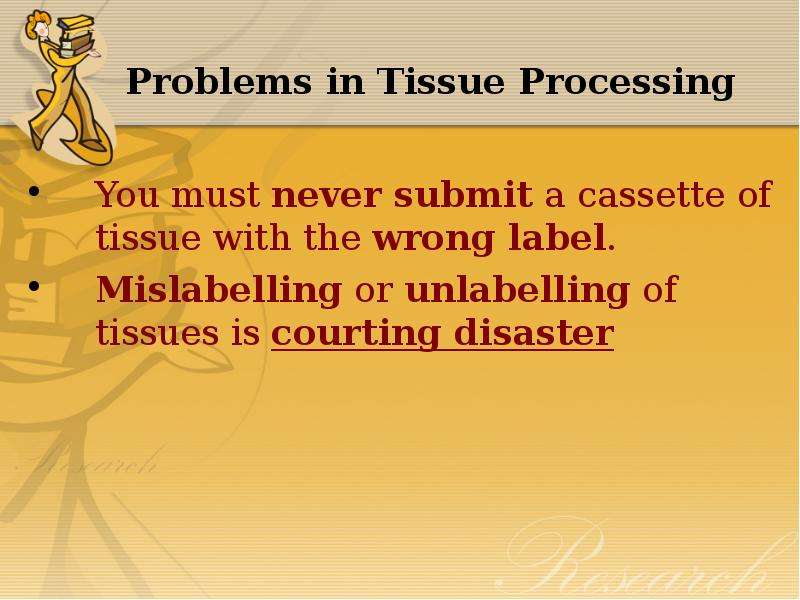
Слайд 32


Problems in Tissue Processing You must never submit a cassette of tissue with the wrong label. Mislabelling or unlabelling of tissues is courting...
Описание слайда:
Problems in Tissue Processing You must never submit a cassette of tissue with the wrong label. Mislabelling or unlabelling of tissues is courting disaster

Слайд 33


Sectioning Frozen Sections Staining H & E staining Coverslipping Decalcification Artefacts in Histologic Sections
Описание слайда:
Sectioning Frozen Sections Staining H & E staining Coverslipping Decalcification Artefacts in Histologic Sections

Слайд 34


Tissue processing, слайд №34
Описание слайда:


Теги Tissue processing
Похожие презентации
Mypresentation.ru
Загрузить презентацию