🗊 Презентация Evolution strategies

Категория: Математика
Нажмите для полного просмотра!
Evolution strategies, слайд №1 Evolution strategies, слайд №2 Evolution strategies, слайд №3 Evolution strategies, слайд №4 Evolution strategies, слайд №5 Evolution strategies, слайд №6 Evolution strategies, слайд №7 Evolution strategies, слайд №8 Evolution strategies, слайд №9 Evolution strategies, слайд №10 Evolution strategies, слайд №11 Evolution strategies, слайд №12 Evolution strategies, слайд №13 Evolution strategies, слайд №14 Evolution strategies, слайд №15 Evolution strategies, слайд №16 Evolution strategies, слайд №17 Evolution strategies, слайд №18 Evolution strategies, слайд №19 Evolution strategies, слайд №20 Evolution strategies, слайд №21 Evolution strategies, слайд №22 Evolution strategies, слайд №23 Evolution strategies, слайд №24 Evolution strategies, слайд №25 Evolution strategies, слайд №26 Evolution strategies, слайд №27 Evolution strategies, слайд №28 Evolution strategies, слайд №29 Evolution strategies, слайд №30

Вы можете ознакомиться и скачать презентацию на тему Evolution strategies. Доклад-сообщение содержит 30 слайдов. Презентации для любого класса можно скачать бесплатно. Если материал и наш сайт презентаций Mypresentation Вам понравились – поделитесь им с друзьями с помощью социальных кнопок и добавьте в закладки в своем браузере.

Слайды и текст этой презентации


Слайд 1


Chapter 4
Описание слайда:
Chapter 4

Слайд 2


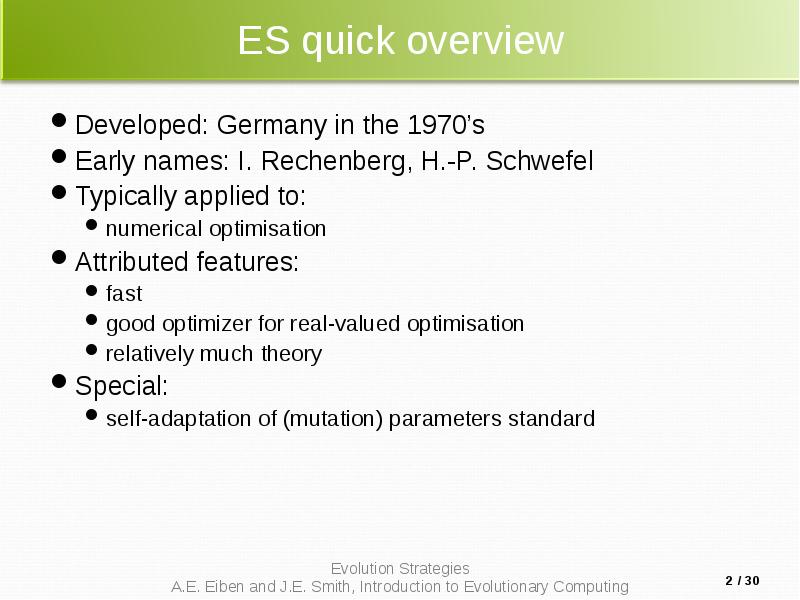
Developed: Germany in the 1970’s Developed: Germany in the 1970’s Early names: I. Rechenberg, H.-P. Schwefel Typically applied to: numerical...
Описание слайда:

Developed: Germany in the 1970’s Developed: Germany in the 1970’s Early names: I. Rechenberg, H.-P. Schwefel Typically applied to: numerical optimisation Attributed features: fast good optimizer for real-valued optimisation relatively much theory Special: self-adaptation of (mutation) parameters standard

Слайд 3


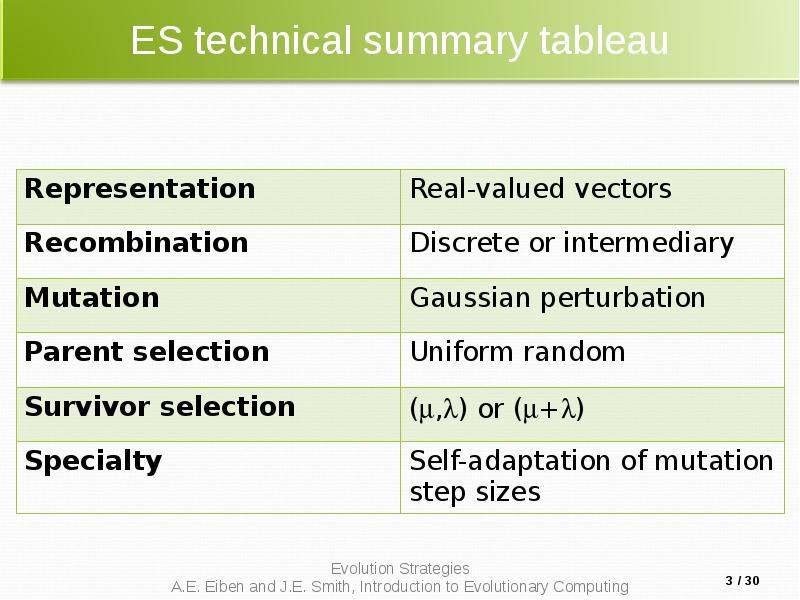
Evolution strategies, слайд №3
Описание слайда:

Слайд 4


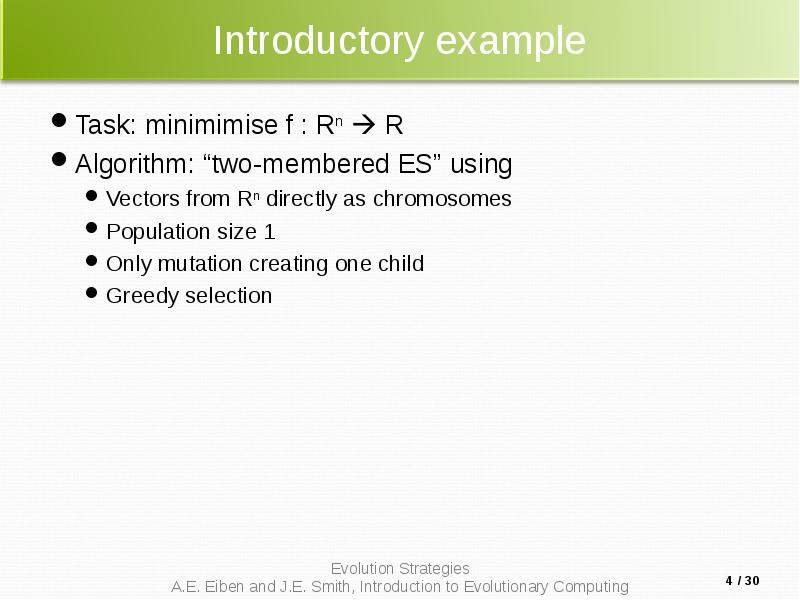
Task: minimimise f : Rn  R Task: minimimise f : Rn  R Algorithm: “two-membered ES” using Vectors from Rn directly as chromosomes Population size 1...
Описание слайда:
Task: minimimise f : Rn  R Task: minimimise f : Rn  R Algorithm: “two-membered ES” using Vectors from Rn directly as chromosomes Population size 1 Only mutation creating one child Greedy selection

Слайд 5


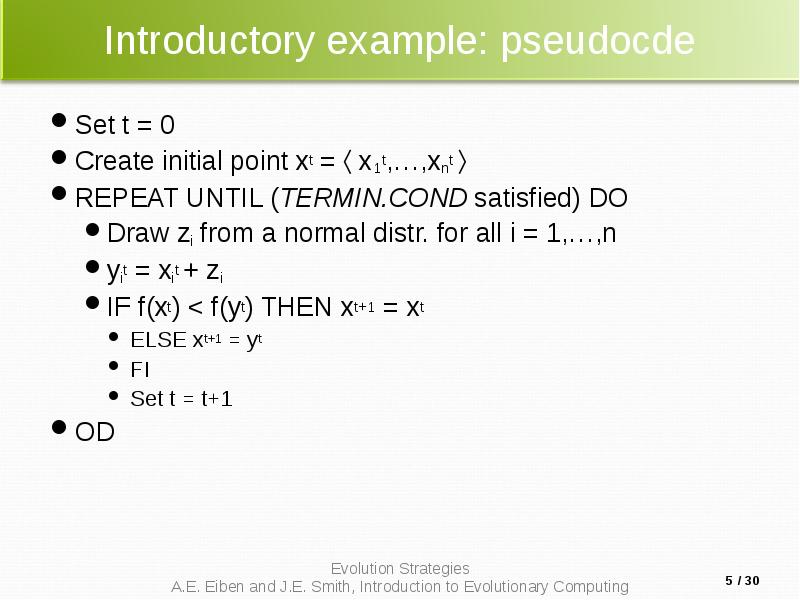
Set t = 0 Set t = 0 Create initial point xt =  x1t,…,xnt  REPEAT UNTIL (TERMIN.COND satisfied) DO Draw zi from a normal distr. for all i = 1,…,n...
Описание слайда:
Set t = 0 Set t = 0 Create initial point xt =  x1t,…,xnt  REPEAT UNTIL (TERMIN.COND satisfied) DO Draw zi from a normal distr. for all i = 1,…,n yit = xit + zi IF f(xt) < f(yt) THEN xt+1 = xt ELSE xt+1 = yt FI Set t = t+1 OD

Слайд 6


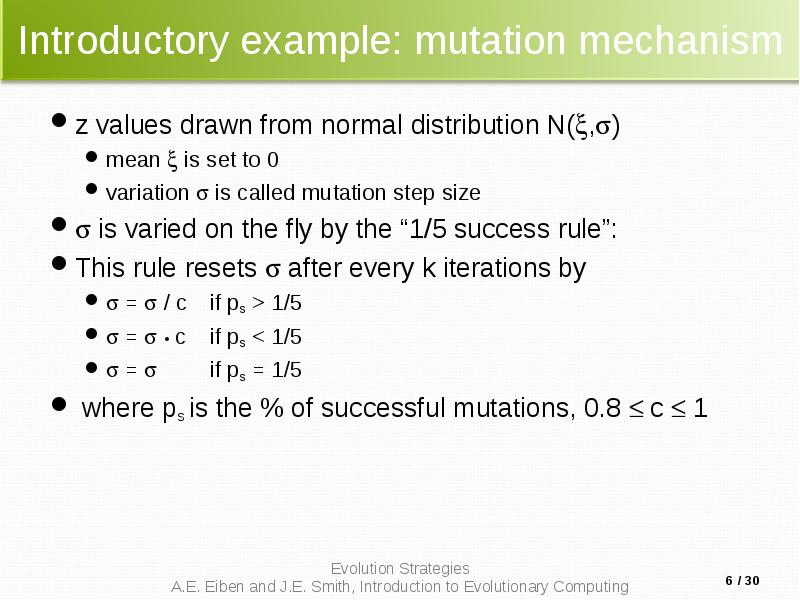
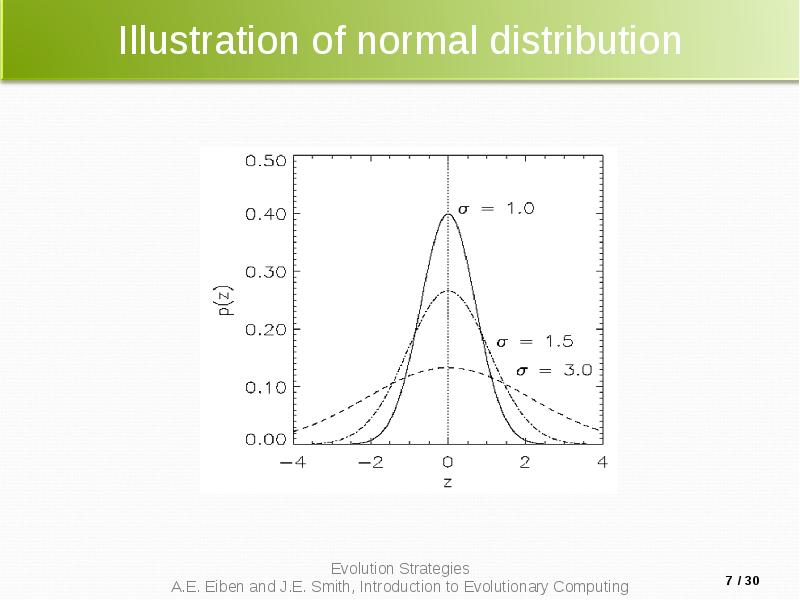
z values drawn from normal distribution N(,) z values drawn from normal distribution N(,) mean  is set to 0 variation  is called mutation step...
Описание слайда:
z values drawn from normal distribution N(,) z values drawn from normal distribution N(,) mean  is set to 0 variation  is called mutation step size  is varied on the fly by the “1/5 success rule”: This rule resets  after every k iterations by  =  / c if ps > 1/5  =  • c if ps < 1/5  =  if ps = 1/5 where ps is the % of successful mutations, 0.8  c  1

Слайд 7


Evolution strategies, слайд №7
Описание слайда:

Слайд 8


Evolution strategies, слайд №8
Описание слайда:

Слайд 9


Evolution strategies, слайд №9
Описание слайда:

Слайд 10


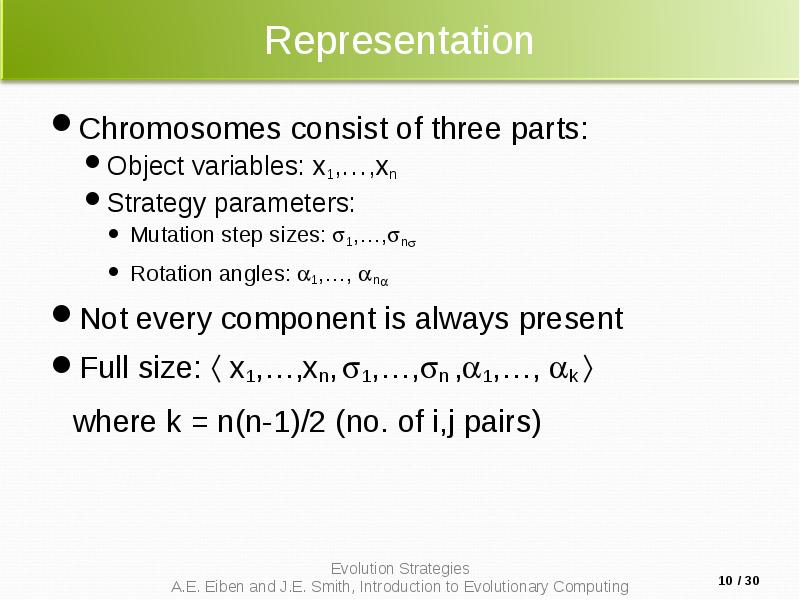
Chromosomes consist of three parts: Chromosomes consist of three parts: Object variables: x1,…,xn Strategy parameters: Mutation step sizes: 1,…,n...
Описание слайда:
Chromosomes consist of three parts: Chromosomes consist of three parts: Object variables: x1,…,xn Strategy parameters: Mutation step sizes: 1,…,n Rotation angles: 1,…, n Not every component is always present Full size:  x1,…,xn, 1,…,n ,1,…, k  where k = n(n-1)/2 (no. of i,j pairs)

Слайд 11


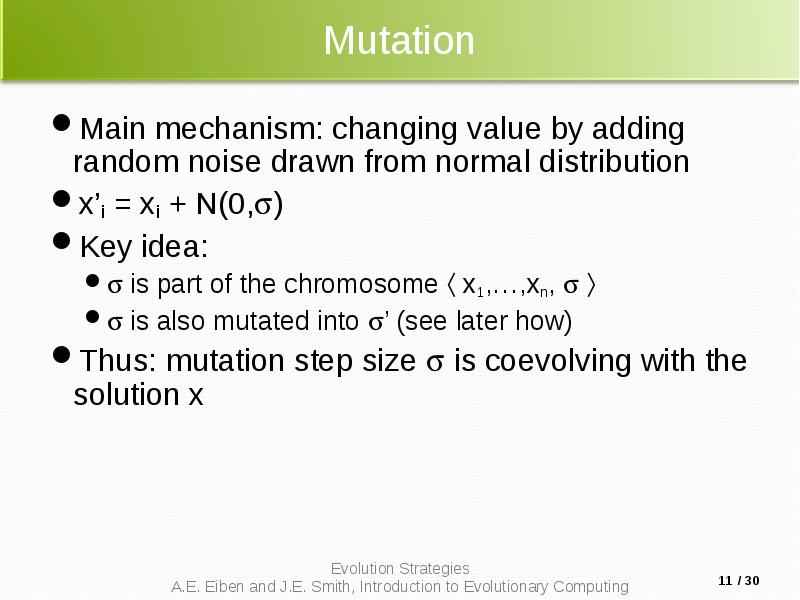
Main mechanism: changing value by adding random noise drawn from normal distribution Main mechanism: changing value by adding random noise drawn from...
Описание слайда:
Main mechanism: changing value by adding random noise drawn from normal distribution Main mechanism: changing value by adding random noise drawn from normal distribution x’i = xi + N(0,) Key idea:  is part of the chromosome  x1,…,xn,    is also mutated into ’ (see later how) Thus: mutation step size  is coevolving with the solution x

Слайд 12


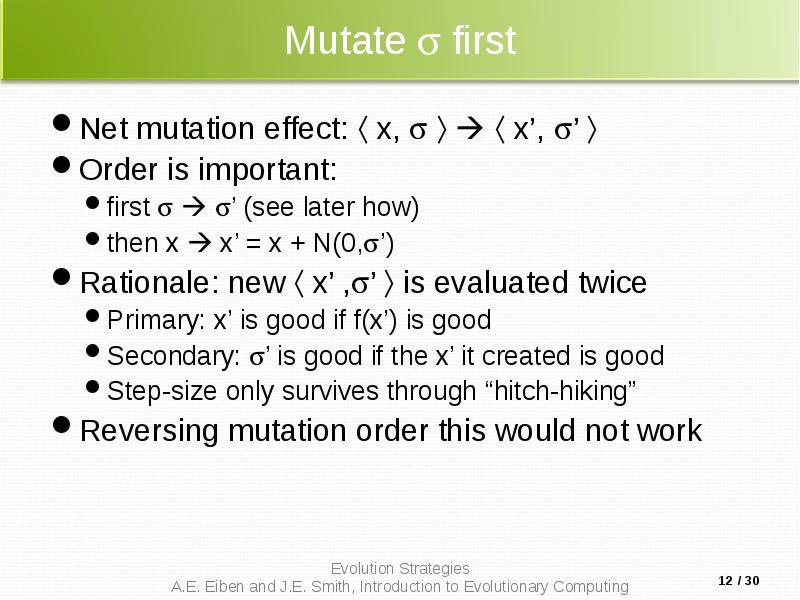
Net mutation effect:  x,     x’, ’  Net mutation effect:  x,     x’, ’  Order is important: first   ’ (see later how) then x  x’ =...
Описание слайда:
Net mutation effect:  x,     x’, ’  Net mutation effect:  x,     x’, ’  Order is important: first   ’ (see later how) then x  x’ = x + N(0,’) Rationale: new  x’ ,’  is evaluated twice Primary: x’ is good if f(x’) is good Secondary: ’ is good if the x’ it created is good Step-size only survives through “hitch-hiking” Reversing mutation order this would not work

Слайд 13


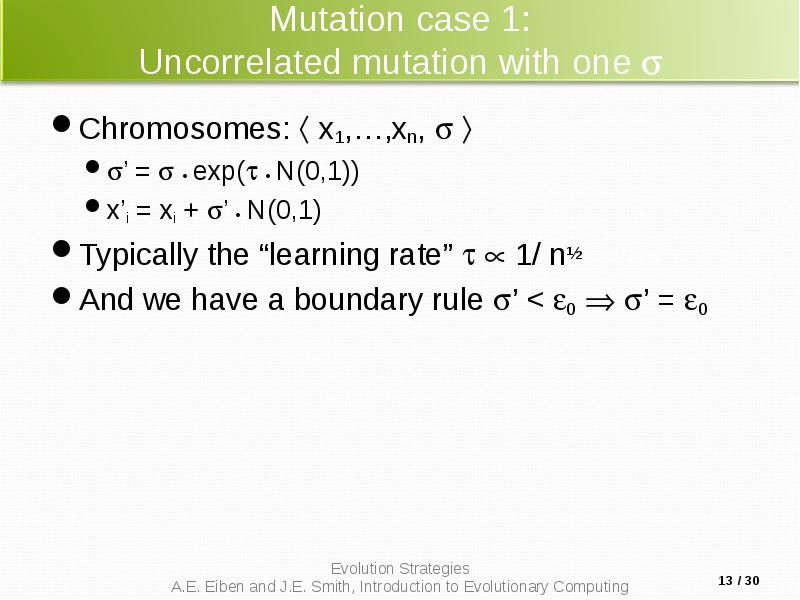
Chromosomes:  x1,…,xn,   Chromosomes:  x1,…,xn,   ’ =  • exp( • N(0,1)) x’i = xi + ’ • N(0,1) Typically the “learning rate”   1/ n½ And...
Описание слайда:
Chromosomes:  x1,…,xn,   Chromosomes:  x1,…,xn,   ’ =  • exp( • N(0,1)) x’i = xi + ’ • N(0,1) Typically the “learning rate”   1/ n½ And we have a boundary rule ’ < 0  ’ = 0

Слайд 14


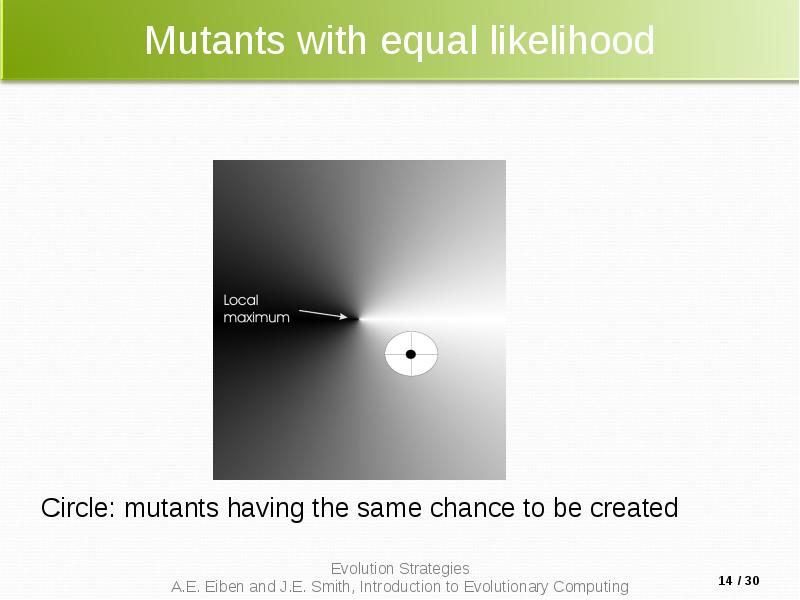
Circle: mutants having the same chance to be created Circle: mutants having the same chance to be created
Описание слайда:
Circle: mutants having the same chance to be created Circle: mutants having the same chance to be created

Слайд 15


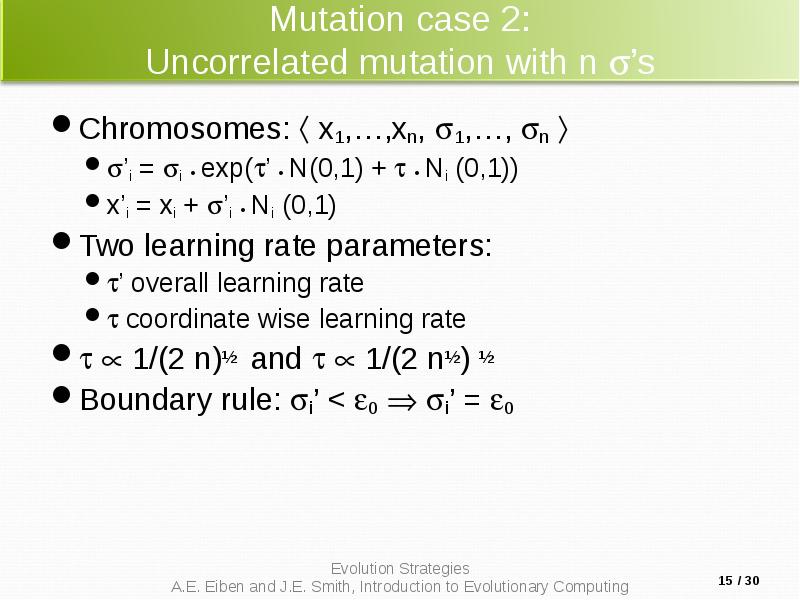
Chromosomes:  x1,…,xn, 1,…, n  Chromosomes:  x1,…,xn, 1,…, n  ’i = i • exp(’ • N(0,1) +  • Ni (0,1)) x’i = xi + ’i • Ni (0,1) Two...
Описание слайда:
Chromosomes:  x1,…,xn, 1,…, n  Chromosomes:  x1,…,xn, 1,…, n  ’i = i • exp(’ • N(0,1) +  • Ni (0,1)) x’i = xi + ’i • Ni (0,1) Two learning rate parameters: ’ overall learning rate  coordinate wise learning rate   1/(2 n)½ and   1/(2 n½) ½ Boundary rule: i’ < 0  i’ = 0

Слайд 16


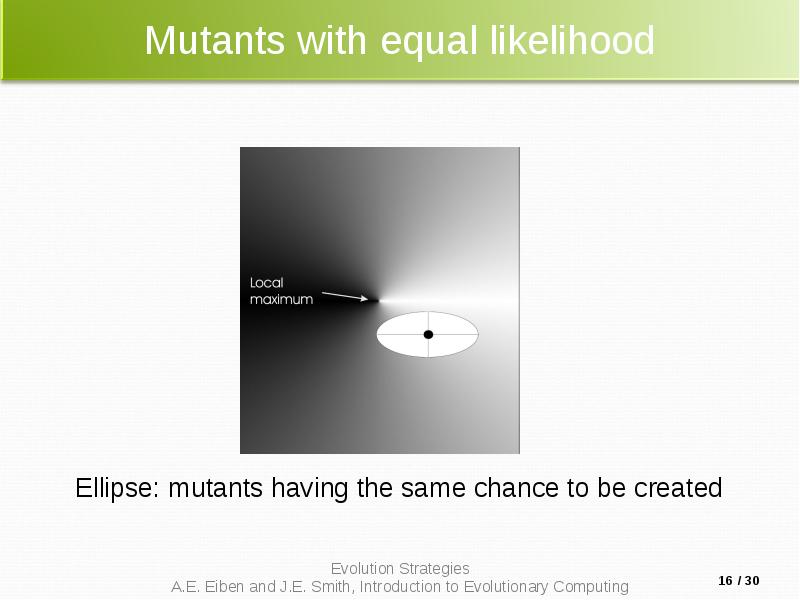
Ellipse: mutants having the same chance to be created Ellipse: mutants having the same chance to be created
Описание слайда:
Ellipse: mutants having the same chance to be created Ellipse: mutants having the same chance to be created

Слайд 17


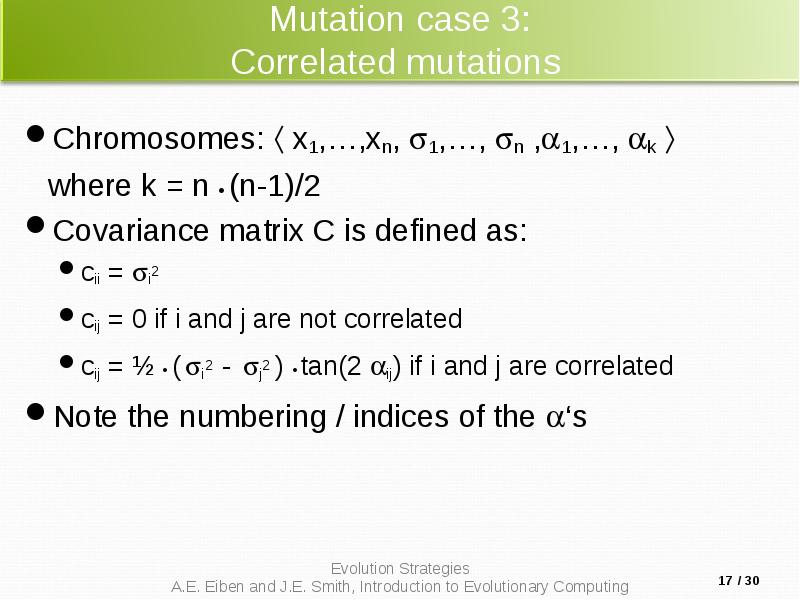
Chromosomes:  x1,…,xn, 1,…, n ,1,…, k  Chromosomes:  x1,…,xn, 1,…, n ,1,…, k  where k = n • (n-1)/2 Covariance matrix C is defined as:...
Описание слайда:
Chromosomes:  x1,…,xn, 1,…, n ,1,…, k  Chromosomes:  x1,…,xn, 1,…, n ,1,…, k  where k = n • (n-1)/2 Covariance matrix C is defined as: cii = i2 cij = 0 if i and j are not correlated cij = ½ • ( i2 - j2 ) • tan(2 ij) if i and j are correlated Note the numbering / indices of the ‘s

Слайд 18


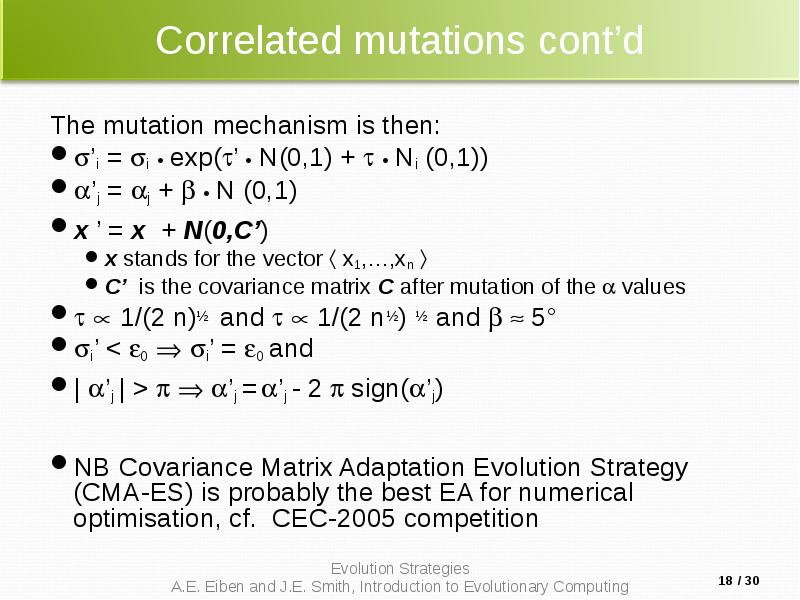
The mutation mechanism is then: The mutation mechanism is then: ’i = i • exp(’ • N(0,1) +  • Ni (0,1)) ’j = j +  • N (0,1) x ’ = x + N(0,C’) x...
Описание слайда:
The mutation mechanism is then: The mutation mechanism is then: ’i = i • exp(’ • N(0,1) +  • Ni (0,1)) ’j = j +  • N (0,1) x ’ = x + N(0,C’) x stands for the vector  x1,…,xn  C’ is the covariance matrix C after mutation of the  values   1/(2 n)½ and   1/(2 n½) ½ and   5° i’ < 0  i’ = 0 and | ’j | >   ’j = ’j - 2  sign(’j) NB Covariance Matrix Adaptation Evolution Strategy (CMA-ES) is probably the best EA for numerical optimisation, cf. CEC-2005 competition

Слайд 19


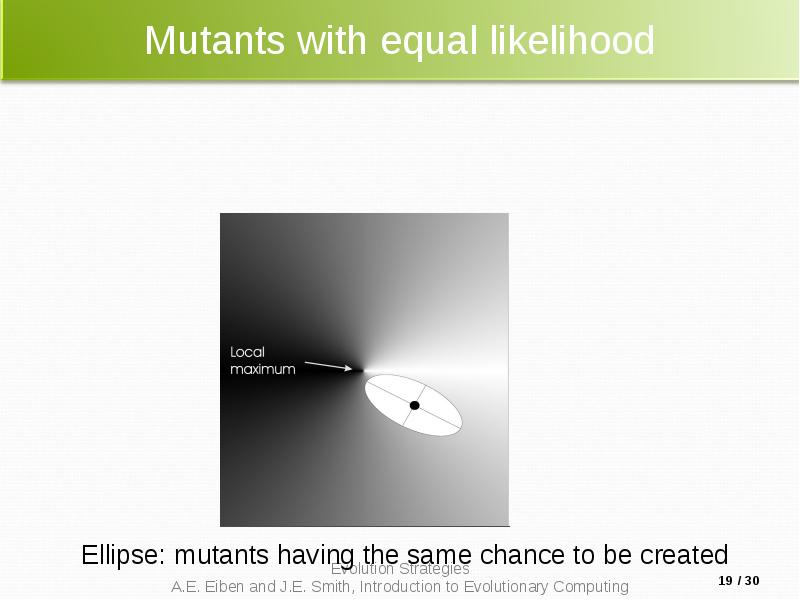
Ellipse: mutants having the same chance to be created Ellipse: mutants having the same chance to be created
Описание слайда:
Ellipse: mutants having the same chance to be created Ellipse: mutants having the same chance to be created

Слайд 20


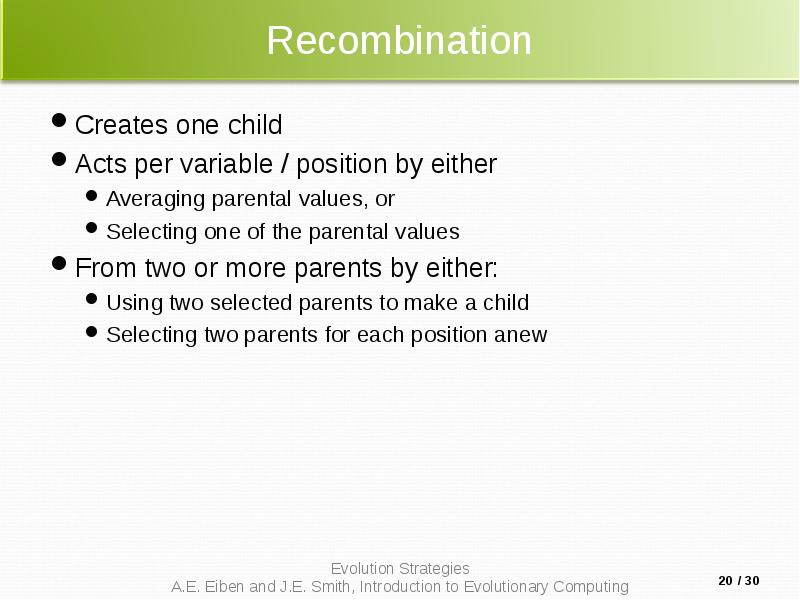
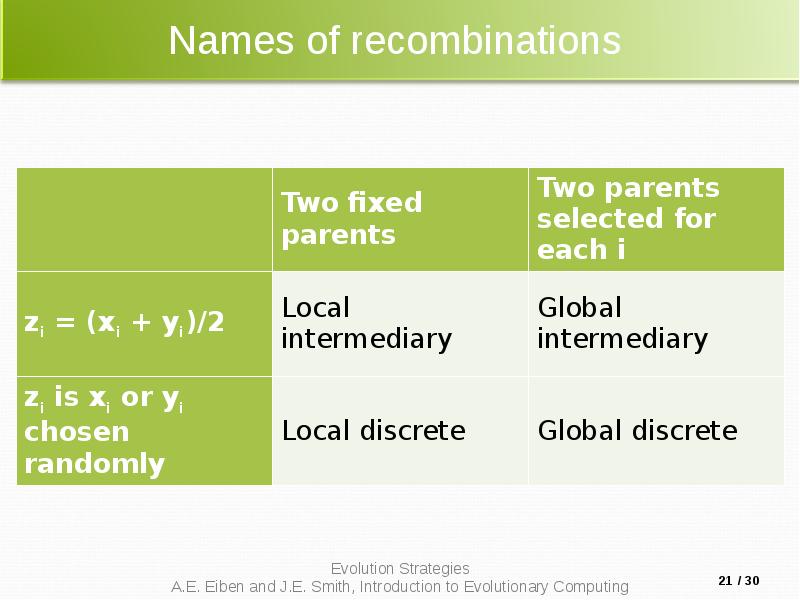
Creates one child Creates one child Acts per variable / position by either Averaging parental values, or Selecting one of the parental values From...
Описание слайда:
Creates one child Creates one child Acts per variable / position by either Averaging parental values, or Selecting one of the parental values From two or more parents by either: Using two selected parents to make a child Selecting two parents for each position anew

Слайд 21


Evolution strategies, слайд №21
Описание слайда:

Слайд 22


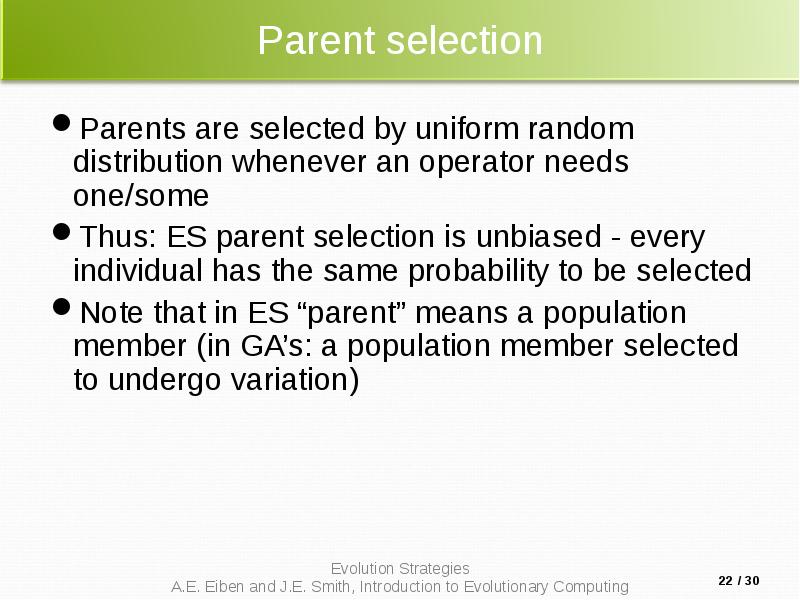
Parents are selected by uniform random distribution whenever an operator needs one/some Parents are selected by uniform random distribution whenever...
Описание слайда:
Parents are selected by uniform random distribution whenever an operator needs one/some Parents are selected by uniform random distribution whenever an operator needs one/some Thus: ES parent selection is unbiased - every individual has the same probability to be selected Note that in ES “parent” means a population member (in GA’s: a population member selected to undergo variation)

Слайд 23


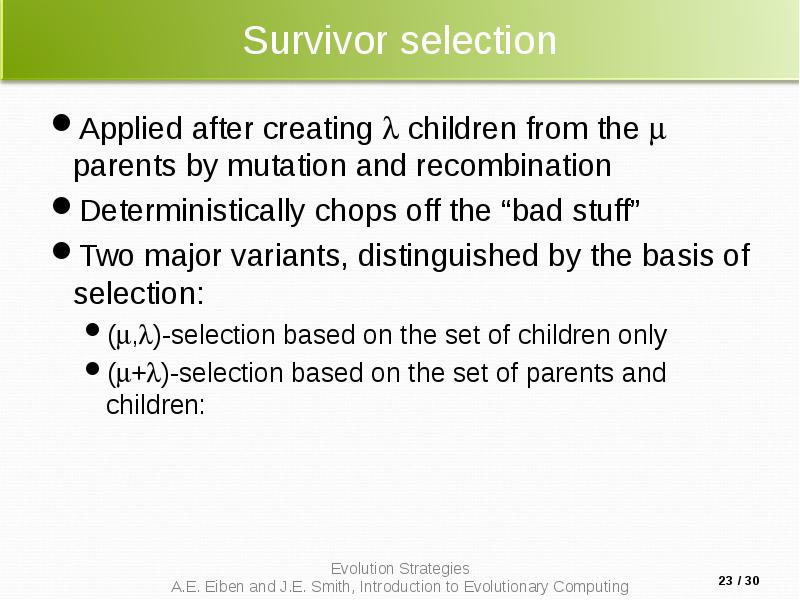
Applied after creating  children from the  parents by mutation and recombination Applied after creating  children from the  parents by mutation...
Описание слайда:
Applied after creating  children from the  parents by mutation and recombination Applied after creating  children from the  parents by mutation and recombination Deterministically chops off the “bad stuff” Two major variants, distinguished by the basis of selection: (,)-selection based on the set of children only (+)-selection based on the set of parents and children:

Слайд 24


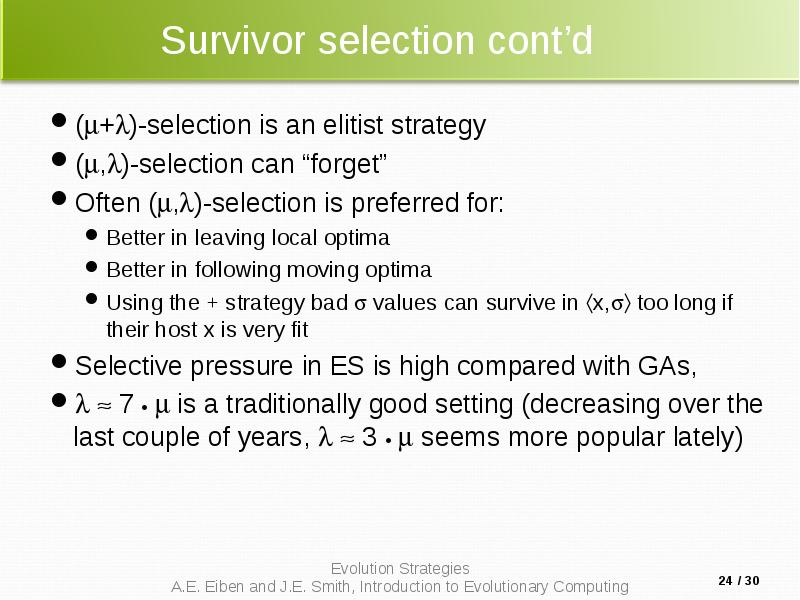
(+)-selection is an elitist strategy (+)-selection is an elitist strategy (,)-selection can “forget” Often (,)-selection is preferred for:...
Описание слайда:
(+)-selection is an elitist strategy (+)-selection is an elitist strategy (,)-selection can “forget” Often (,)-selection is preferred for: Better in leaving local optima Better in following moving optima Using the + strategy bad  values can survive in x, too long if their host x is very fit Selective pressure in ES is high compared with GAs,   7 •  is a traditionally good setting (decreasing over the last couple of years,   3 •  seems more popular lately)

Слайд 25


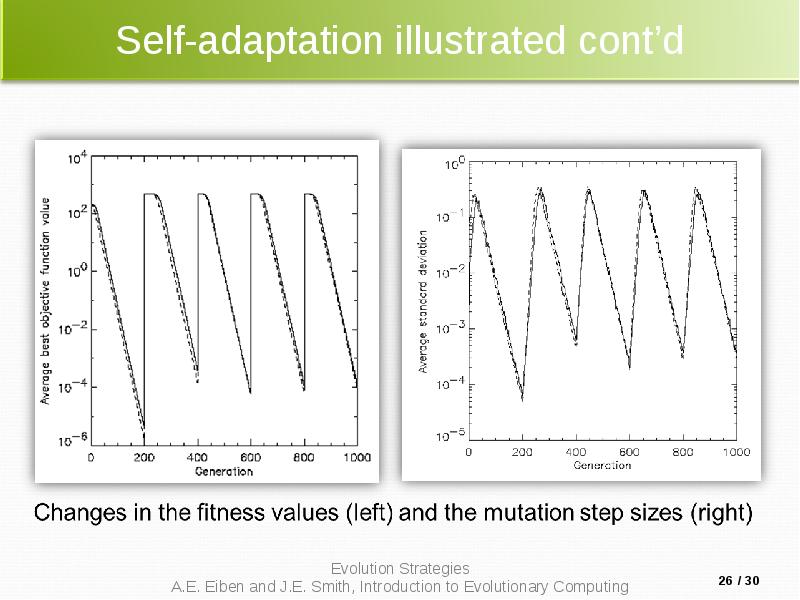
Given a dynamically changing fitness landscape (optimum location shifted every 200 generations) Given a dynamically changing fitness landscape...
Описание слайда:
Given a dynamically changing fitness landscape (optimum location shifted every 200 generations) Given a dynamically changing fitness landscape (optimum location shifted every 200 generations) Self-adaptive ES is able to follow the optimum and adjust the mutation step size after every shift !

Слайд 26


Evolution strategies, слайд №26
Описание слайда:

Слайд 27


 > 1 to carry different strategies  > 1 to carry different strategies  >  to generate offspring surplus Not “too” strong selection, e.g.,   7 •...
Описание слайда:
 > 1 to carry different strategies  > 1 to carry different strategies  >  to generate offspring surplus Not “too” strong selection, e.g.,   7 •  (,)-selection to get rid of misadapted ‘s Mixing strategy parameters by (intermediary) recombination on them

Слайд 28


Task: to create a colour mix yielding a target colour (that of a well known cherry brandy) Task: to create a colour mix yielding a target colour...
Описание слайда:
Task: to create a colour mix yielding a target colour (that of a well known cherry brandy) Task: to create a colour mix yielding a target colour (that of a well known cherry brandy) Ingredients: water + red, yellow, blue dye Representation:  w, r, y ,b  no self-adaptation! Values scaled to give a predefined total volume (30 ml) Mutation: lo / med / hi  values used with equal chance Selection: (1,8) strategy

Слайд 29


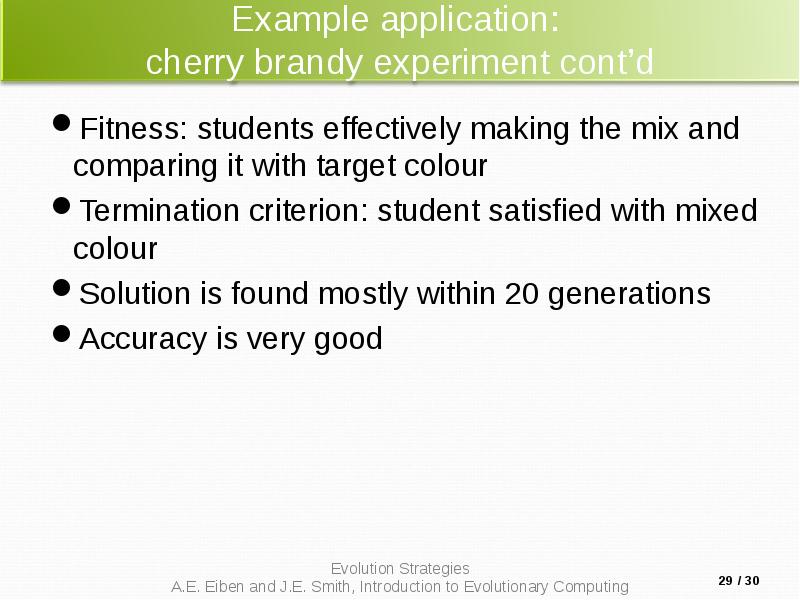
Fitness: students effectively making the mix and comparing it with target colour Fitness: students effectively making the mix and comparing it with...
Описание слайда:
Fitness: students effectively making the mix and comparing it with target colour Fitness: students effectively making the mix and comparing it with target colour Termination criterion: student satisfied with mixed colour Solution is found mostly within 20 generations Accuracy is very good

Слайд 30


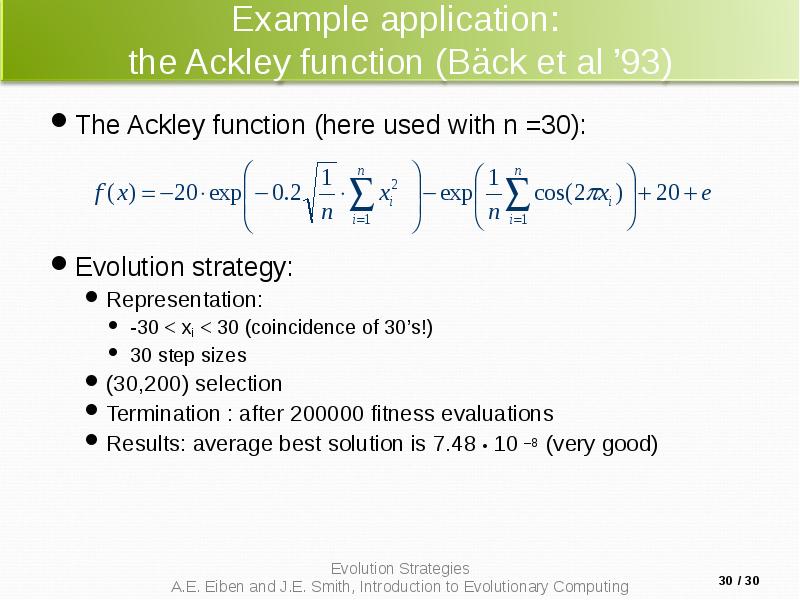
The Ackley function (here used with n =30): The Ackley function (here used with n =30): Evolution strategy: Representation: -30 < xi < 30...
Описание слайда:
The Ackley function (here used with n =30): The Ackley function (here used with n =30): Evolution strategy: Representation: -30 < xi < 30 (coincidence of 30’s!) 30 step sizes (30,200) selection Termination : after 200000 fitness evaluations Results: average best solution is 7.48 • 10 –8 (very good)


Похожие презентации
Mypresentation.ru
Загрузить презентацию