🗊 Презентация Sequential games. (Lecture 4)

Категория: Математика
Нажмите для полного просмотра!
Sequential games. (Lecture 4), слайд №1 Sequential games. (Lecture 4), слайд №2 Sequential games. (Lecture 4), слайд №3 Sequential games. (Lecture 4), слайд №4 Sequential games. (Lecture 4), слайд №5 Sequential games. (Lecture 4), слайд №6 Sequential games. (Lecture 4), слайд №7 Sequential games. (Lecture 4), слайд №8 Sequential games. (Lecture 4), слайд №9 Sequential games. (Lecture 4), слайд №10 Sequential games. (Lecture 4), слайд №11 Sequential games. (Lecture 4), слайд №12 Sequential games. (Lecture 4), слайд №13 Sequential games. (Lecture 4), слайд №14 Sequential games. (Lecture 4), слайд №15 Sequential games. (Lecture 4), слайд №16 Sequential games. (Lecture 4), слайд №17 Sequential games. (Lecture 4), слайд №18 Sequential games. (Lecture 4), слайд №19 Sequential games. (Lecture 4), слайд №20 Sequential games. (Lecture 4), слайд №21 Sequential games. (Lecture 4), слайд №22 Sequential games. (Lecture 4), слайд №23 Sequential games. (Lecture 4), слайд №24 Sequential games. (Lecture 4), слайд №25 Sequential games. (Lecture 4), слайд №26 Sequential games. (Lecture 4), слайд №27 Sequential games. (Lecture 4), слайд №28 Sequential games. (Lecture 4), слайд №29 Sequential games. (Lecture 4), слайд №30 Sequential games. (Lecture 4), слайд №31 Sequential games. (Lecture 4), слайд №32 Sequential games. (Lecture 4), слайд №33 Sequential games. (Lecture 4), слайд №34 Sequential games. (Lecture 4), слайд №35 Sequential games. (Lecture 4), слайд №36 Sequential games. (Lecture 4), слайд №37

Содержание
Вы можете ознакомиться и скачать презентацию на тему Sequential games. (Lecture 4). Доклад-сообщение содержит 37 слайдов. Презентации для любого класса можно скачать бесплатно. Если материал и наш сайт презентаций Mypresentation Вам понравились – поделитесь им с друзьями с помощью социальных кнопок и добавьте в закладки в своем браузере.
Слайды и текст этой презентации


Слайд 1


Lecture 4 Sequential Games
Описание слайда:

Lecture 4 Sequential Games

Слайд 2


Introduction Lecture 1-3: Simultaneous games: Prisoner’s dilemma (Ad, No Ad): Unique PSNE, both players defect. Games without PSNE (shirk/monitor):...
Описание слайда:
Introduction Lecture 1-3: Simultaneous games: Prisoner’s dilemma (Ad, No Ad): Unique PSNE, both players defect. Games without PSNE (shirk/monitor): MSNE is the intuitive outcome. Coordination games: 2 PSNE & 1 MSNE. Players may try to coordinate.

Слайд 3


Introduction Lecture 4-5: Sequential games. Games where players move one after another. Sequential games are asymmetric. Games we play: chess Games...
Описание слайда:
Introduction Lecture 4-5: Sequential games. Games where players move one after another. Sequential games are asymmetric. Games we play: chess Games businesses play: entry, pricing… L4: Subgame perfect equilibrium. L5: Experimental evidence, and an application to bargaining.

Слайд 4


Sequential games Looking forward: Players, when make moves, have to consider how other players will react. Reasoning backward: Given other players’...
Описание слайда:
Sequential games Looking forward: Players, when make moves, have to consider how other players will react. Reasoning backward: Given other players’ reaction, what is my optimal strategy? Asymmetry in order of play causes asymmetry in payoffs. It matters who plays first and who plays second.

Слайд 5


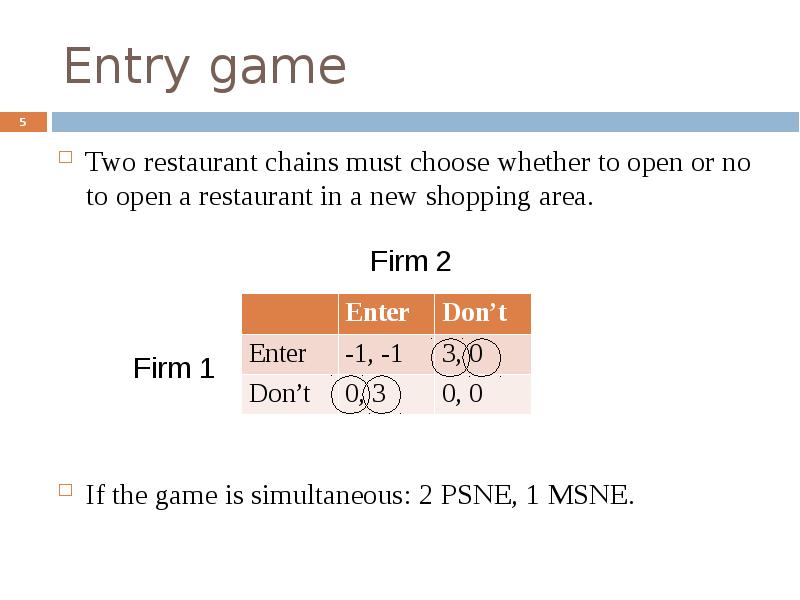
Entry game Two restaurant chains must choose whether to open or no to open a restaurant in a new shopping area. If the game is simultaneous: 2 PSNE,...
Описание слайда:
Entry game Two restaurant chains must choose whether to open or no to open a restaurant in a new shopping area. If the game is simultaneous: 2 PSNE, 1 MSNE.

Слайд 6


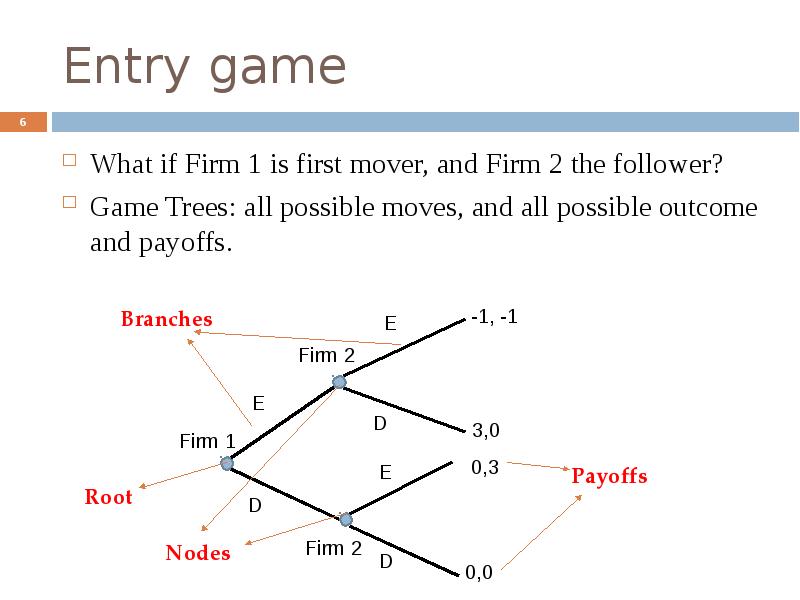
Entry game What if Firm 1 is first mover, and Firm 2 the follower? Game Trees: all possible moves, and all possible outcome and payoffs.
Описание слайда:
Entry game What if Firm 1 is first mover, and Firm 2 the follower? Game Trees: all possible moves, and all possible outcome and payoffs.

Слайд 7


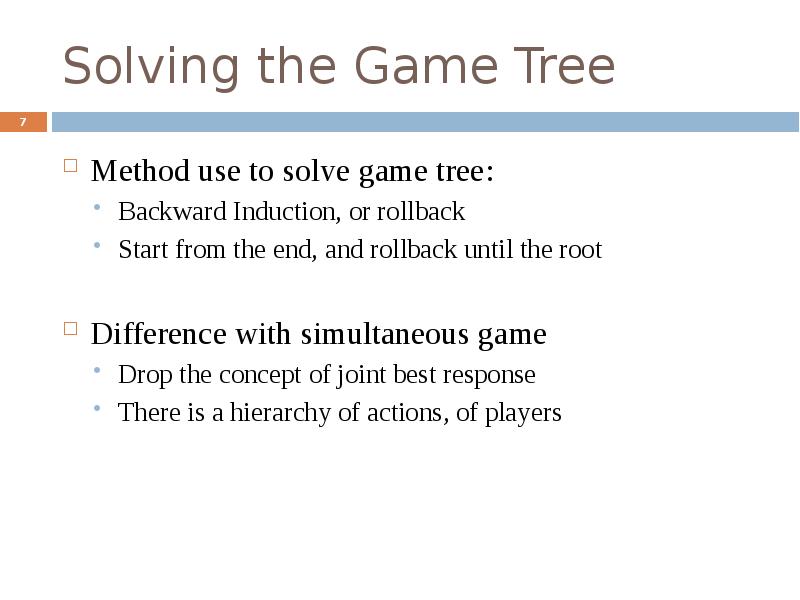
Solving the Game Tree Method use to solve game tree: Backward Induction, or rollback Start from the end, and rollback until the root Difference with...
Описание слайда:
Solving the Game Tree Method use to solve game tree: Backward Induction, or rollback Start from the end, and rollback until the root Difference with simultaneous game Drop the concept of joint best response There is a hierarchy of actions, of players

Слайд 8


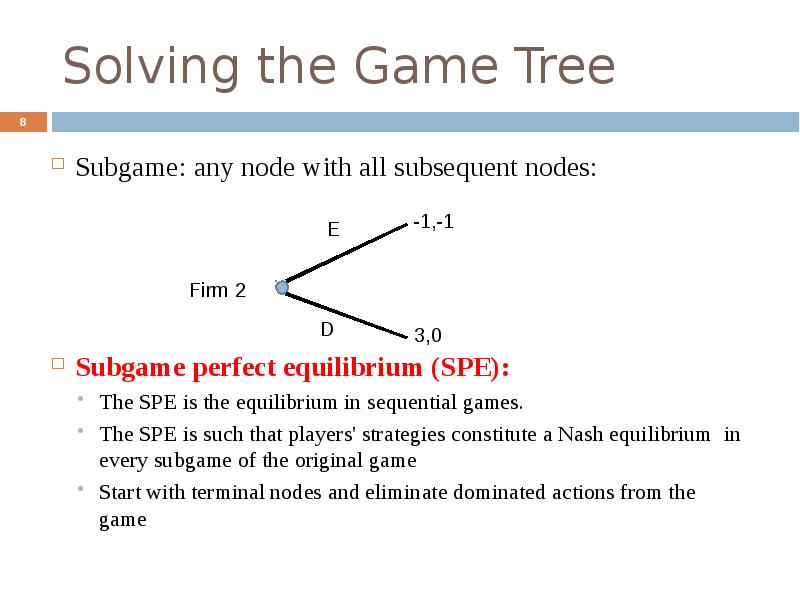
Solving the Game Tree Subgame: any node with all subsequent nodes: Subgame perfect equilibrium (SPE): The SPE is the equilibrium in sequential games....
Описание слайда:
Solving the Game Tree Subgame: any node with all subsequent nodes: Subgame perfect equilibrium (SPE): The SPE is the equilibrium in sequential games. The SPE is such that players' strategies constitute a Nash equilibrium in every subgame of the original game Start with terminal nodes and eliminate dominated actions from the game

Слайд 9


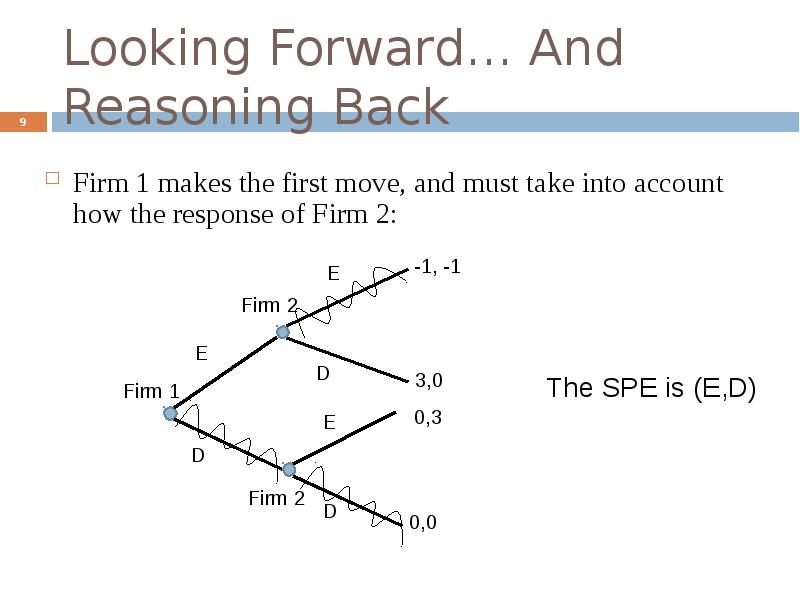
Looking Forward… And Reasoning Back Firm 1 makes the first move, and must take into account how the response of Firm 2:
Описание слайда:
Looking Forward… And Reasoning Back Firm 1 makes the first move, and must take into account how the response of Firm 2:

Слайд 10


Discussion Compared to the simultaneous version of the game, Firm 1 can obtain the outcome that yields the highest payoff (3), whereas Firm 2 obtains...
Описание слайда:
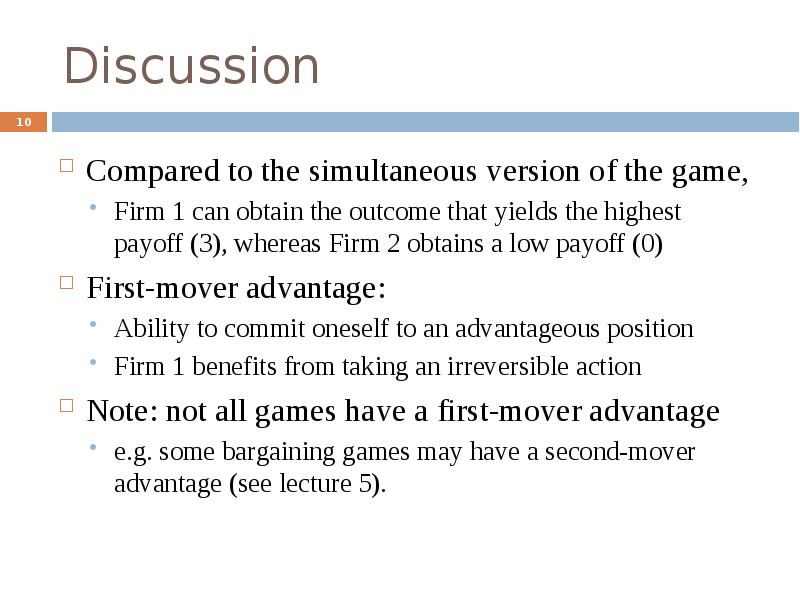
Discussion Compared to the simultaneous version of the game, Firm 1 can obtain the outcome that yields the highest payoff (3), whereas Firm 2 obtains a low payoff (0) First-mover advantage: Ability to commit oneself to an advantageous position Firm 1 benefits from taking an irreversible action Note: not all games have a first-mover advantage e.g. some bargaining games may have a second-mover advantage (see lecture 5).

Слайд 11


Sequential games and oligopoly Cournot model of oligopoly: Simultaneous game. Producers have market power (profits>0), but less than the monopolist....
Описание слайда:
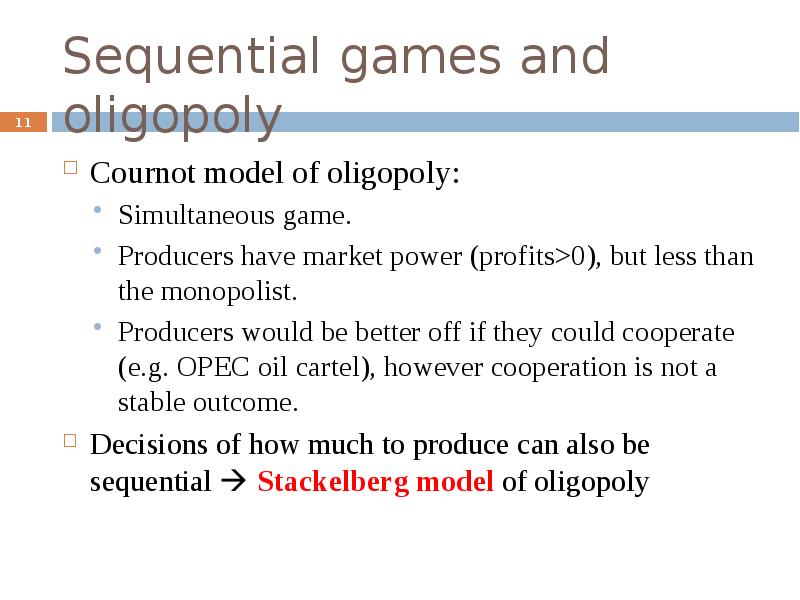
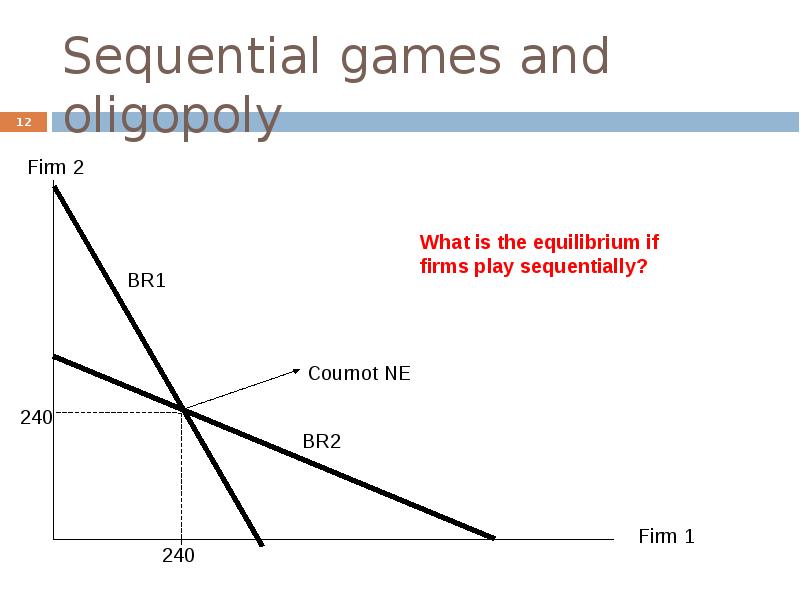
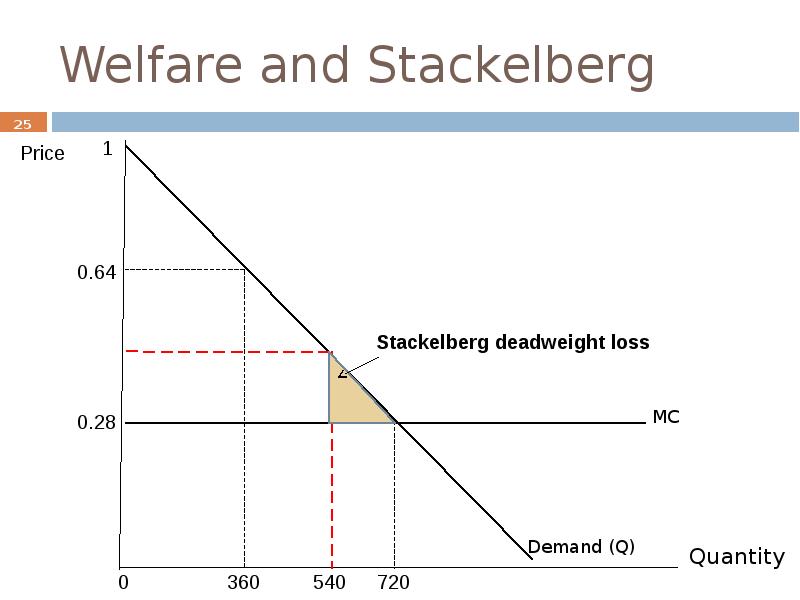
Sequential games and oligopoly Cournot model of oligopoly: Simultaneous game. Producers have market power (profits>0), but less than the monopolist. Producers would be better off if they could cooperate (e.g. OPEC oil cartel), however cooperation is not a stable outcome. Decisions of how much to produce can also be sequential  Stackelberg model of oligopoly

Слайд 12


Sequential games and oligopoly
Описание слайда:
Sequential games and oligopoly

Слайд 13


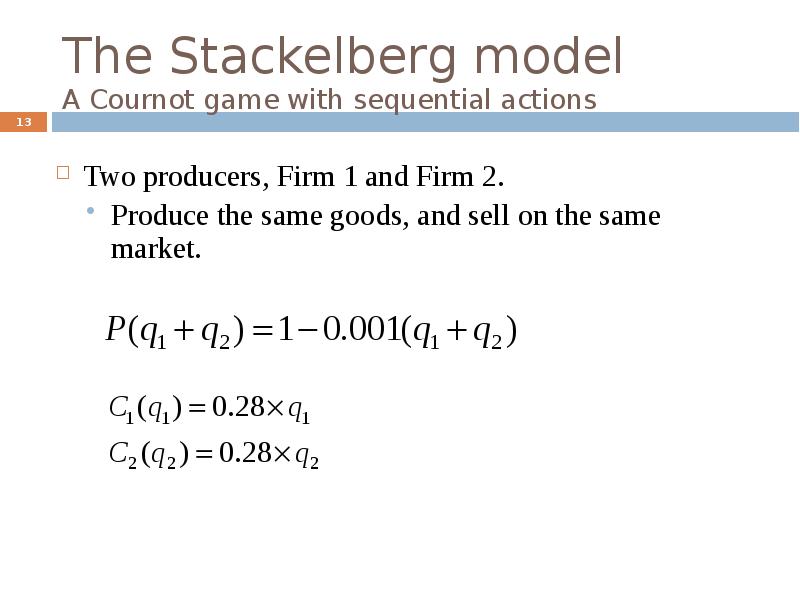
The Stackelberg model A Cournot game with sequential actions Two producers, Firm 1 and Firm 2. Produce the same goods, and sell on the same market.
Описание слайда:
The Stackelberg model A Cournot game with sequential actions Two producers, Firm 1 and Firm 2. Produce the same goods, and sell on the same market.

Слайд 14


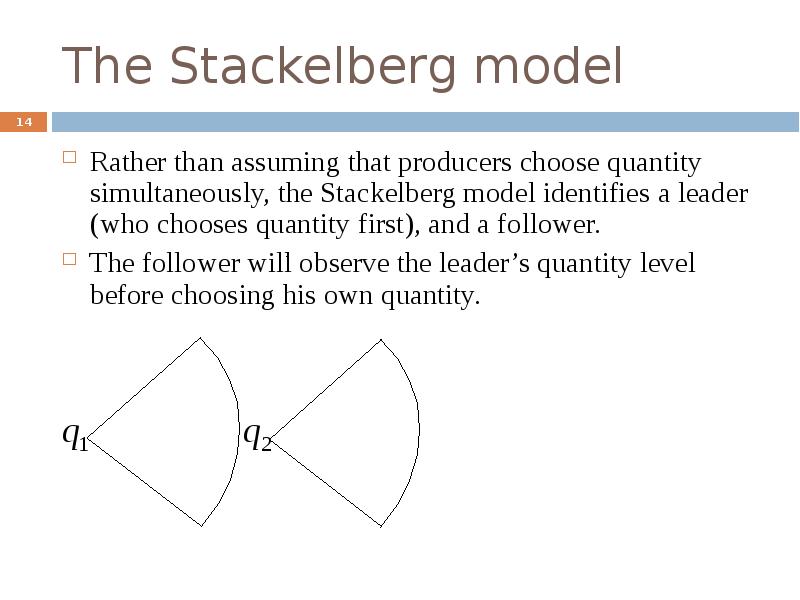
The Stackelberg model Rather than assuming that producers choose quantity simultaneously, the Stackelberg model identifies a leader (who chooses...
Описание слайда:
The Stackelberg model Rather than assuming that producers choose quantity simultaneously, the Stackelberg model identifies a leader (who chooses quantity first), and a follower. The follower will observe the leader’s quantity level before choosing his own quantity.

Слайд 15


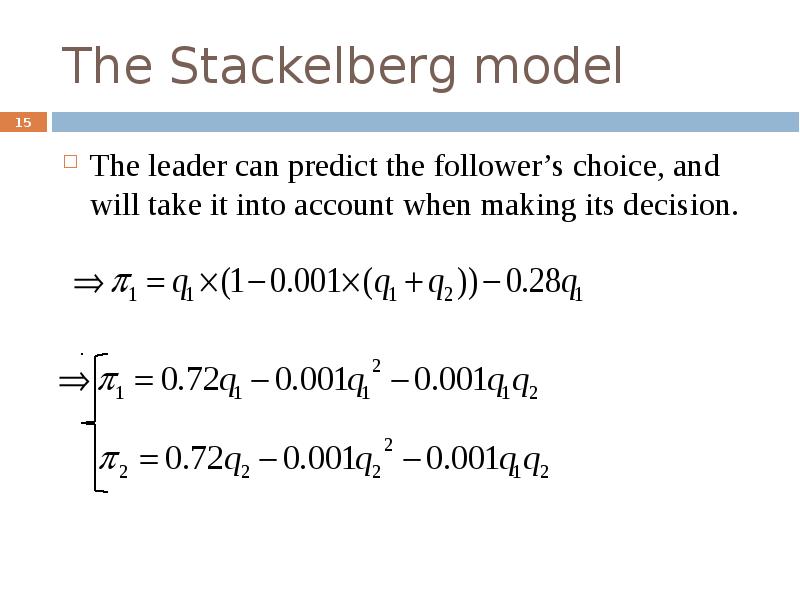
The Stackelberg model The leader can predict the follower’s choice, and will take it into account when making its decision.
Описание слайда:
The Stackelberg model The leader can predict the follower’s choice, and will take it into account when making its decision.

Слайд 16


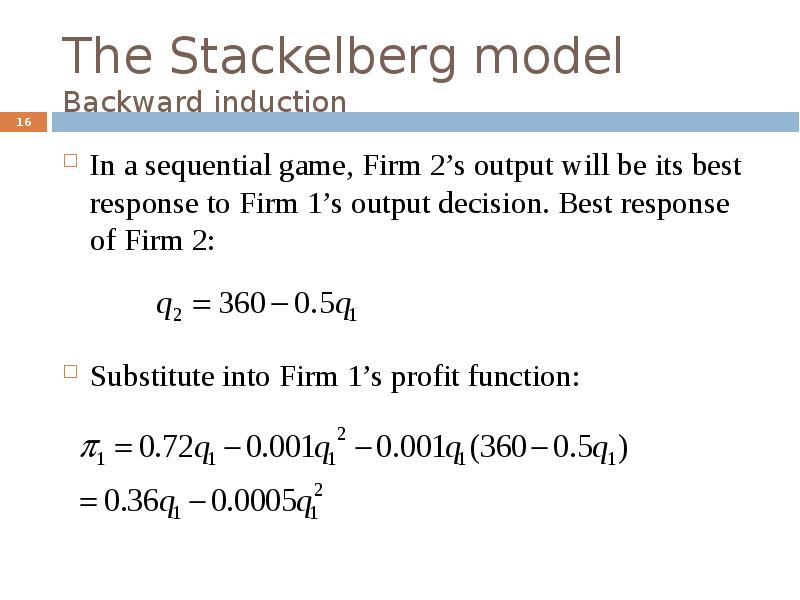
The Stackelberg model Backward induction In a sequential game, Firm 2’s output will be its best response to Firm 1’s output decision. Best response...
Описание слайда:
The Stackelberg model Backward induction In a sequential game, Firm 2’s output will be its best response to Firm 1’s output decision. Best response of Firm 2: Substitute into Firm 1’s profit function:

Слайд 17


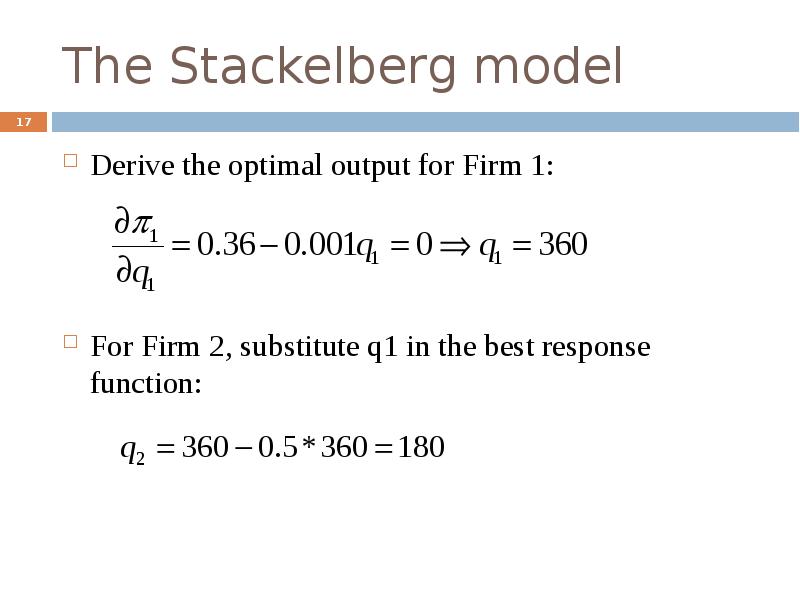
The Stackelberg model Derive the optimal output for Firm 1: For Firm 2, substitute q1 in the best response function:
Описание слайда:
The Stackelberg model Derive the optimal output for Firm 1: For Firm 2, substitute q1 in the best response function:

Слайд 18


The Stackelberg model
Описание слайда:
The Stackelberg model

Слайд 19


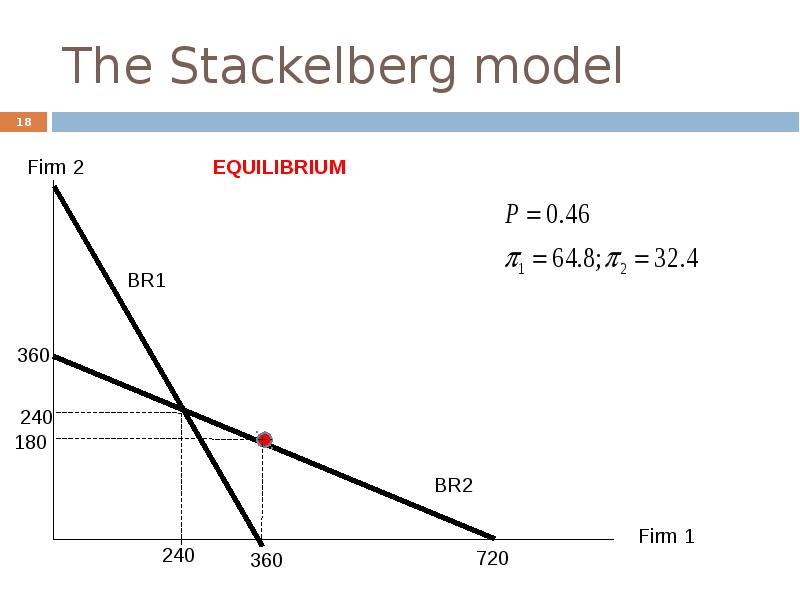
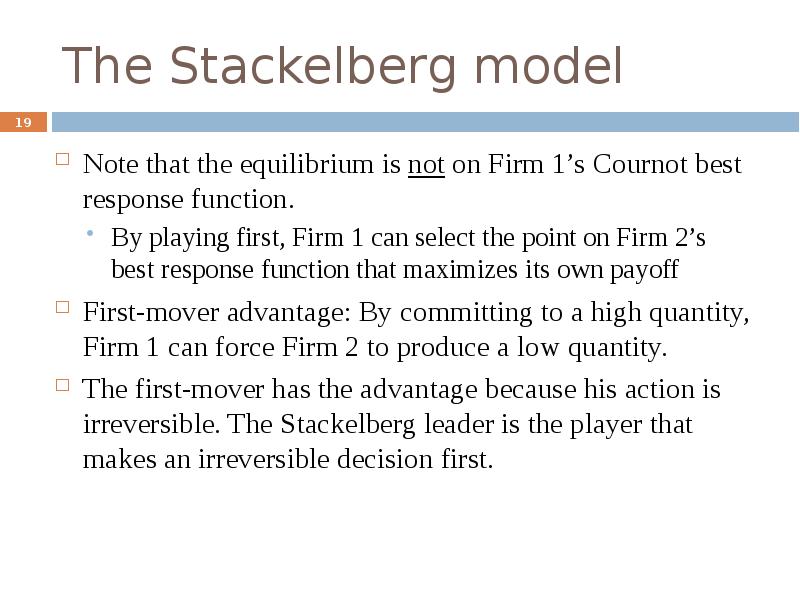
The Stackelberg model Note that the equilibrium is not on Firm 1’s Cournot best response function. By playing first, Firm 1 can select the point on...
Описание слайда:
The Stackelberg model Note that the equilibrium is not on Firm 1’s Cournot best response function. By playing first, Firm 1 can select the point on Firm 2’s best response function that maximizes its own payoff First-mover advantage: By committing to a high quantity, Firm 1 can force Firm 2 to produce a low quantity. The first-mover has the advantage because his action is irreversible. The Stackelberg leader is the player that makes an irreversible decision first.

Слайд 20


Stackelberg vs. Cournot
Описание слайда:
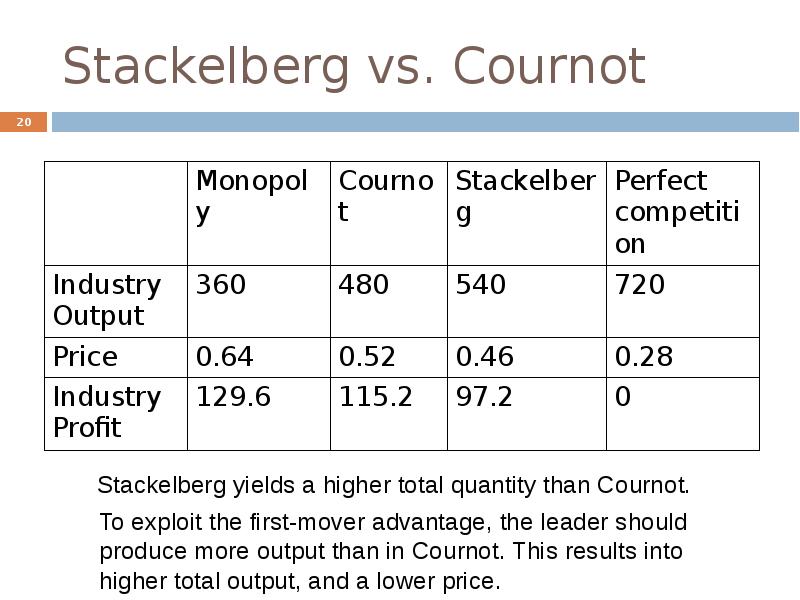
Stackelberg vs. Cournot

Слайд 21


Stackelberg in the pharmaceutical industry Patents for new drugs last up to 20-30 years. During the patent period, the firm that invented the drug...
Описание слайда:
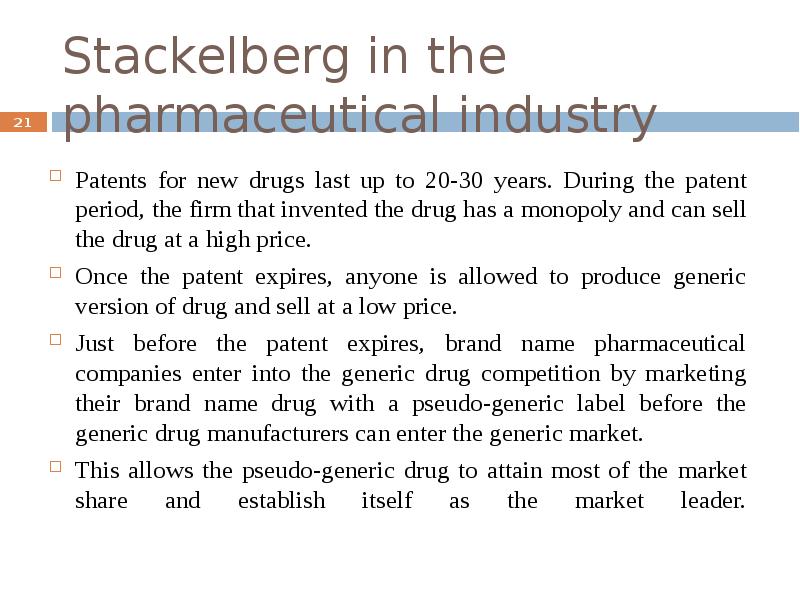
Stackelberg in the pharmaceutical industry Patents for new drugs last up to 20-30 years. During the patent period, the firm that invented the drug has a monopoly and can sell the drug at a high price. Once the patent expires, anyone is allowed to produce generic version of drug and sell at a low price. Just before the patent expires, brand name pharmaceutical companies enter into the generic drug competition by marketing their brand name drug with a pseudo-generic label before the generic drug manufacturers can enter the generic market. This allows the pseudo-generic drug to attain most of the market share and establish itself as the market leader.

Слайд 22


Sequential games. (Lecture 4), слайд №22
Описание слайда:

Слайд 23


Sequential games. (Lecture 4), слайд №23
Описание слайда:

Слайд 24


Sequential games. (Lecture 4), слайд №24
Описание слайда:

Слайд 25


Sequential games. (Lecture 4), слайд №25
Описание слайда:

Слайд 26


Entry game with incumbent Suppose that Pepsi (the incumbent) is already in the local market, and Coca-Cola is deciding whether to Enter or stay Out....
Описание слайда:
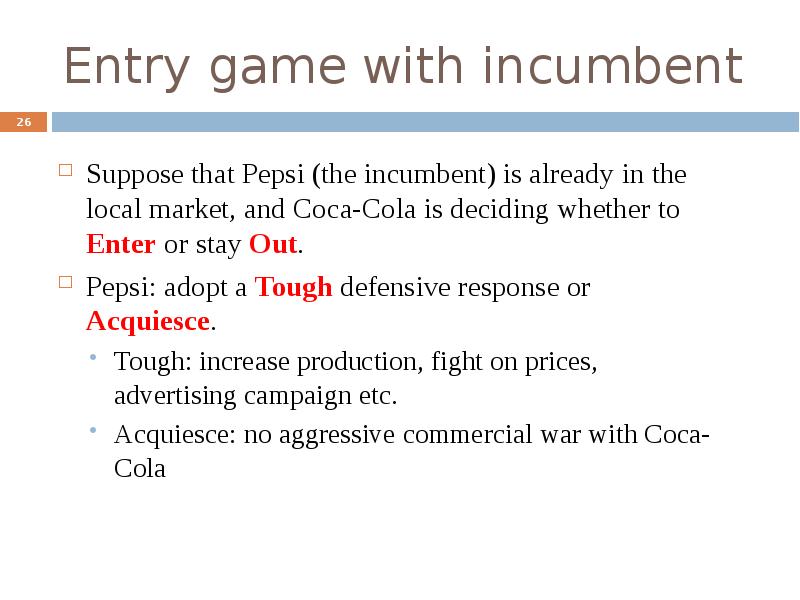
Entry game with incumbent Suppose that Pepsi (the incumbent) is already in the local market, and Coca-Cola is deciding whether to Enter or stay Out. Pepsi: adopt a Tough defensive response or Acquiesce. Tough: increase production, fight on prices, advertising campaign etc. Acquiesce: no aggressive commercial war with Coca-Cola

Слайд 27


Entry game with incumbent Pepsi will choose to acquiesce. Since Coca-Cola knows that Pepsi will Acquiesce, its best course of action is to Enter. ...
Описание слайда:
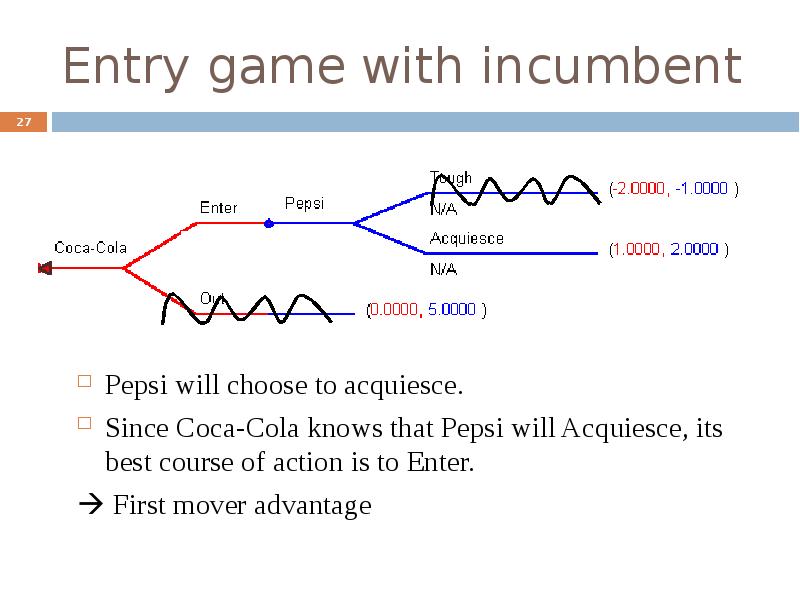
Entry game with incumbent Pepsi will choose to acquiesce. Since Coca-Cola knows that Pepsi will Acquiesce, its best course of action is to Enter.  First mover advantage

Слайд 28


Entry game with incumbent Sequential games may have more than two rounds. After observing Pepsi's stance, Coca-Cola can itself choose to be Tough,...
Описание слайда:
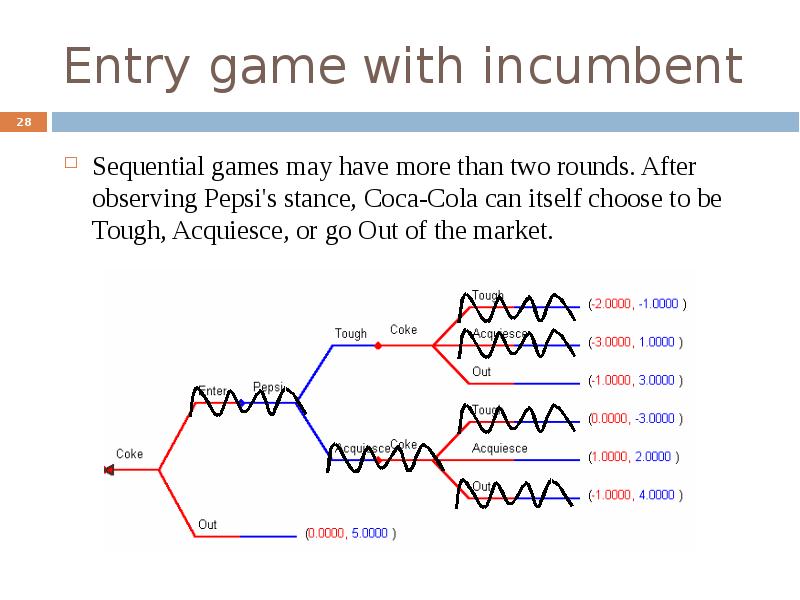
Entry game with incumbent Sequential games may have more than two rounds. After observing Pepsi's stance, Coca-Cola can itself choose to be Tough, Acquiesce, or go Out of the market.

Слайд 29


Entry game with incumbent Coca-Cola looks at Pepsi's Tough play and should choose to go Out of the market since it then only loses -$1. If Coca-Cola...
Описание слайда:
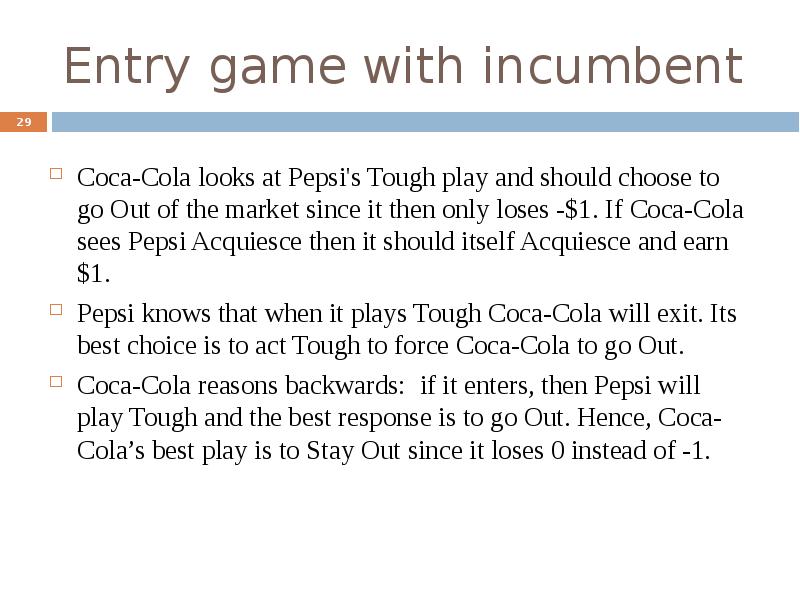
Entry game with incumbent Coca-Cola looks at Pepsi's Tough play and should choose to go Out of the market since it then only loses -$1. If Coca-Cola sees Pepsi Acquiesce then it should itself Acquiesce and earn $1. Pepsi knows that when it plays Tough Coca-Cola will exit. Its best choice is to act Tough to force Coca-Cola to go Out. Coca-Cola reasons backwards: if it enters, then Pepsi will play Tough and the best response is to go Out. Hence, Coca-Cola’s best play is to Stay Out since it loses 0 instead of -1.

Слайд 30


Strategic moves Players are rational and know how the game will be played and the subsequent payoff. What can player do to alter the predicted...
Описание слайда:
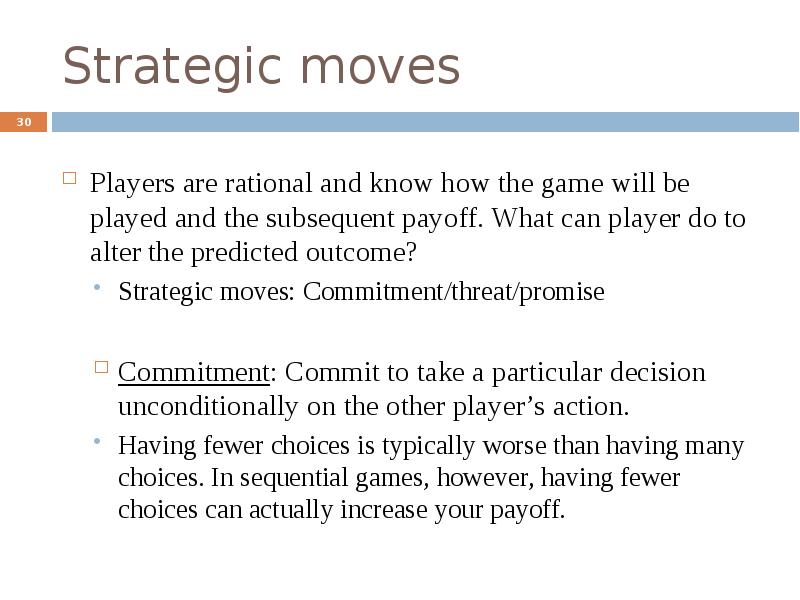
Strategic moves Players are rational and know how the game will be played and the subsequent payoff. What can player do to alter the predicted outcome? Strategic moves: Commitment/threat/promise Commitment: Commit to take a particular decision unconditionally on the other player’s action. Having fewer choices is typically worse than having many choices. In sequential games, however, having fewer choices can actually increase your payoff.

Слайд 31


Strategic moves Threat: A response rule that leads to a bad outcome for the other player if he acts contrary to your interests. Promise: A response...
Описание слайда:
Strategic moves Threat: A response rule that leads to a bad outcome for the other player if he acts contrary to your interests. Promise: A response rule by which you offer to create a good outcome for the other player if he acts in a way that promotes your interests.

Слайд 32


Threat and entry Equilibrium without strategic moves: (Enter,Acquiesce) What could Pepsi do? Threaten to be tough if Coca-Cola enters: Rollback:...
Описание слайда:
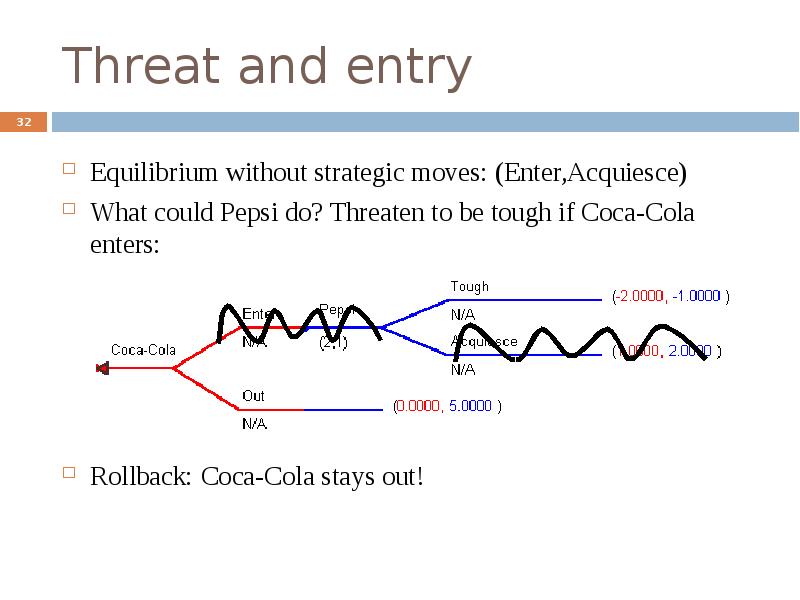
Threat and entry Equilibrium without strategic moves: (Enter,Acquiesce) What could Pepsi do? Threaten to be tough if Coca-Cola enters: Rollback: Coca-Cola stays out!

Слайд 33


Threat and entry: Credibility problem If Coca-Cola enters, it is in Pepsi’s best interest to acquiesce. Pepsi’s threat to be tough if Coca-Cola...
Описание слайда:
Threat and entry: Credibility problem If Coca-Cola enters, it is in Pepsi’s best interest to acquiesce. Pepsi’s threat to be tough if Coca-Cola enters is not credible. Coca-Cola, knowing that, will enter. “Talk is cheap”

Слайд 34


Credible strategic move How to make a credible strategic move? Binding contract between Pepsi and retailers. We will sell you Pepsi at a lower price...
Описание слайда:
Credible strategic move How to make a credible strategic move? Binding contract between Pepsi and retailers. We will sell you Pepsi at a lower price than Coca-Cola does. “Tough” becomes credible. Decide to expand capacity, in order to reduce the marginal costs of increasing quantity. Keep innovating, in order to commit to improve quality and deter entry.

Слайд 35


Credible strategic move How to make a credible strategic move? Pepsi can also make threat credible by acquiring a reputation for toughness. By being...
Описание слайда:
Credible strategic move How to make a credible strategic move? Pepsi can also make threat credible by acquiring a reputation for toughness. By being tough towards potential entrants today, it may deter other firms from entering. Being tough is not subgame perfect, however the entrant may think the incumbent will be tough if he has such a reputation. If a threat is credible, other firms won’t enter, and the threat to be tough is never materialized.

Слайд 36


Credible strategic move How to make a credible strategic move? Polaroid instant photography Refused to diversify out of its core business. With all...
Описание слайда:
Credible strategic move How to make a credible strategic move? Polaroid instant photography Refused to diversify out of its core business. With all its chips in instant photography, it was committed to fight against any intruder in the market. In 1976, after 28 years of a Polaroid monopoly on the instant photography market, Kodak entered the fray. Edwin Land, Polaroid founder: “This is our very soul we are involved with. This is our whole life…We will stay in our lot and protect that lot.”

Слайд 37


Summary Sequential games Game trees Subgame perfect equilibrium Application to oligopoly First mover advantage Strategic moves Issue of credibility
Описание слайда:
Summary Sequential games Game trees Subgame perfect equilibrium Application to oligopoly First mover advantage Strategic moves Issue of credibility


Похожие презентации
Mypresentation.ru
Загрузить презентацию