🗊 Презентация The earliest period of Germanic History

Категория: Образование

Нажмите для полного просмотра!
The earliest period of Germanic History, слайд №1 The earliest period of Germanic History, слайд №2 The earliest period of Germanic History, слайд №3 The earliest period of Germanic History, слайд №4 The earliest period of Germanic History, слайд №5 The earliest period of Germanic History, слайд №6 The earliest period of Germanic History, слайд №7 The earliest period of Germanic History, слайд №8

Вы можете ознакомиться и скачать презентацию на тему The earliest period of Germanic History. Доклад-сообщение содержит 8 слайдов. Презентации для любого класса можно скачать бесплатно. Если материал и наш сайт презентаций Mypresentation Вам понравились – поделитесь им с друзьями с помощью социальных кнопок и добавьте в закладки в своем браузере.

Слайды и текст этой презентации


Слайд 1


The earliest period of Germanic History Assel Sarsenbekova 2FLK 311
Описание слайда:
The earliest period of Germanic History Assel Sarsenbekova 2FLK 311

Слайд 2


The history of the Germanic group begins with the appearance of what is known as the Proto-Germanic (PG) language. It is supposed to have split from...
Описание слайда:
The history of the Germanic group begins with the appearance of what is known as the Proto-Germanic (PG) language. It is supposed to have split from related IE tongues sometime between the 15th and 10th с B.C. The would-be Germanic tribes belonged to the western division of the IE speech community.

Слайд 3


The earliest period of Germanic History, слайд №3
Описание слайда:

Слайд 4


PG was never recorded in written form. It is believed that at the earliest stages of history PG was fundamentally one language, though dialectally...
Описание слайда:
PG was never recorded in written form. It is believed that at the earliest stages of history PG was fundamentally one language, though dialectally coloured. In its later stages dialectal differences grew, so that towards the beginning of our era Germanic appears divided into dialectal groups and tribal dialects. Dialectal differentiation increased with the migrations and geographical expansion of the Teutons caused by overpopulation, poor agricultural technique and scanty natural resources in the areas of their original settlement. Towards the beginning of our era the common period of Germanic history came to an end. The Teutons had extended over a larger territory and the PG language broke into parts.

Слайд 5


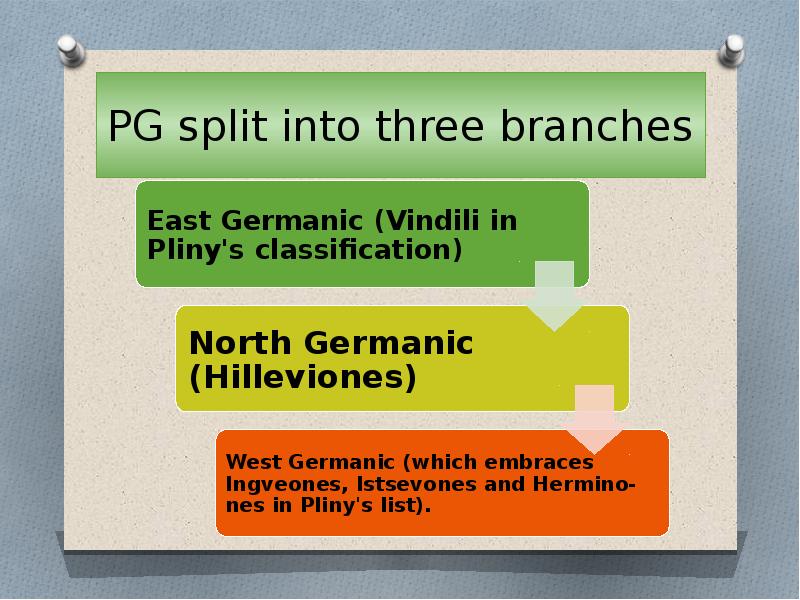
PG split into three branches
Описание слайда:
PG split into three branches

Слайд 6


East Germanic The East Germanic subgroup. was formed by the tribes who returned from Scandinavia at the beginning of our era. The most numerous and...
Описание слайда:
East Germanic The East Germanic subgroup. was formed by the tribes who returned from Scandinavia at the beginning of our era. The most numerous and powerful of them were the Goths. The Gothic language, now dead, has been preserved in written records of the 4th—6th с The Goths were the first of the Teutons to become Christian. The other East Germanic languages, all of which are now dead, have left no written traces. Some of their tribal names have survived in placenames, which reveal the directions of their migrations: Bornholm and Burgundy go back to the East Germanic tribe of Burgundians; Andalusia is derived from the tribal name Vandals; Lombardy got its name from the Langobards, who made part of the population of the Ostrogothic kingdom in North Italy.

Слайд 7


North Germanic The earliest written records in Old Danish, Old Norwegian and Old Swedish date from the 13th c. In the later Middle Ages Danish and...
Описание слайда:
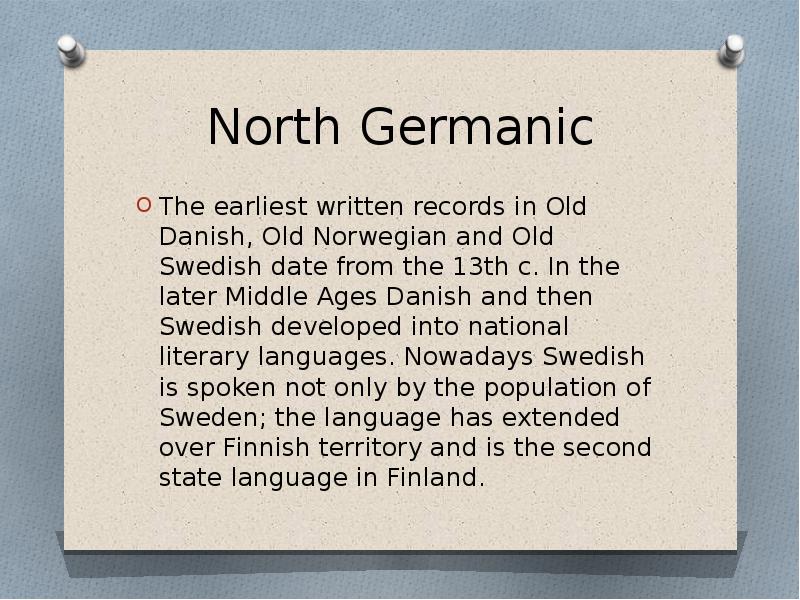
North Germanic The earliest written records in Old Danish, Old Norwegian and Old Swedish date from the 13th c. In the later Middle Ages Danish and then Swedish developed into national literary languages. Nowadays Swedish is spoken not only by the population of Sweden; the language has extended over Finnish territory and is the second state language in Finland.

Слайд 8


West Germanic The dialectal differentiation of West Germanic was quite distinct even at the beginning of our era since Pliny and Tacitus described...
Описание слайда:
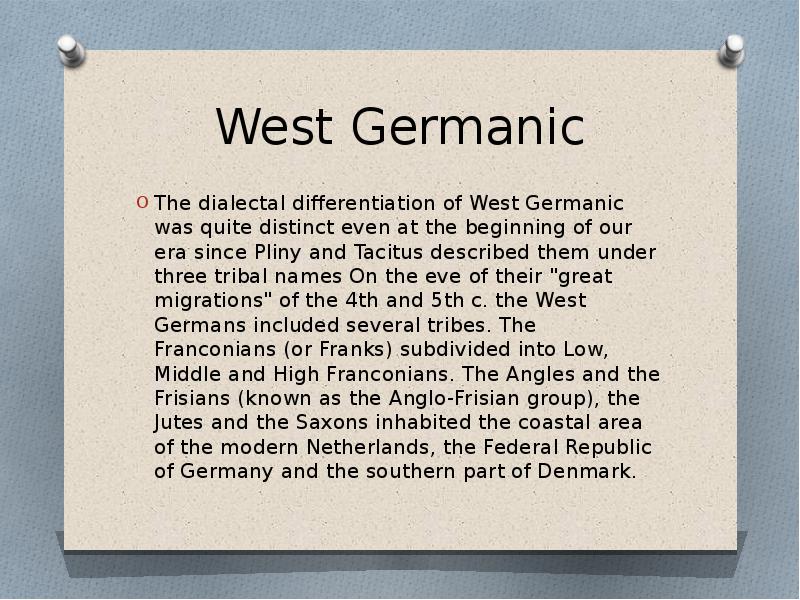
West Germanic The dialectal differentiation of West Germanic was quite distinct even at the beginning of our era since Pliny and Tacitus described them under three tribal names On the eve of their "great migrations" of the 4th and 5th c. the West Germans included several tribes. The Franconians (or Franks) subdivided into Low, Middle and High Franconians. The Angles and the Frisians (known as the Anglo-Frisian group), the Jutes and the Saxons inhabited the coastal area of the modern Netherlands, the Federal Republic of Germany and the southern part of Denmark.


Похожие презентации
Mypresentation.ru
Загрузить презентацию