🗊 Презентация Russia – Chapter 9

Категория: Политика
Нажмите для полного просмотра!
Russia – Chapter 9, слайд №1 Russia – Chapter 9, слайд №2 Russia – Chapter 9, слайд №3 Russia – Chapter 9, слайд №4 Russia – Chapter 9, слайд №5 Russia – Chapter 9, слайд №6 Russia – Chapter 9, слайд №7 Russia – Chapter 9, слайд №8 Russia – Chapter 9, слайд №9 Russia – Chapter 9, слайд №10 Russia – Chapter 9, слайд №11 Russia – Chapter 9, слайд №12 Russia – Chapter 9, слайд №13 Russia – Chapter 9, слайд №14 Russia – Chapter 9, слайд №15 Russia – Chapter 9, слайд №16 Russia – Chapter 9, слайд №17 Russia – Chapter 9, слайд №18 Russia – Chapter 9, слайд №19 Russia – Chapter 9, слайд №20 Russia – Chapter 9, слайд №21 Russia – Chapter 9, слайд №22 Russia – Chapter 9, слайд №23 Russia – Chapter 9, слайд №24 Russia – Chapter 9, слайд №25 Russia – Chapter 9, слайд №26 Russia – Chapter 9, слайд №27 Russia – Chapter 9, слайд №28 Russia – Chapter 9, слайд №29 Russia – Chapter 9, слайд №30 Russia – Chapter 9, слайд №31 Russia – Chapter 9, слайд №32 Russia – Chapter 9, слайд №33 Russia – Chapter 9, слайд №34 Russia – Chapter 9, слайд №35 Russia – Chapter 9, слайд №36 Russia – Chapter 9, слайд №37 Russia – Chapter 9, слайд №38 Russia – Chapter 9, слайд №39 Russia – Chapter 9, слайд №40 Russia – Chapter 9, слайд №41 Russia – Chapter 9, слайд №42 Russia – Chapter 9, слайд №43 Russia – Chapter 9, слайд №44 Russia – Chapter 9, слайд №45 Russia – Chapter 9, слайд №46

Содержание
Вы можете ознакомиться и скачать презентацию на тему Russia – Chapter 9. Доклад-сообщение содержит 46 слайдов. Презентации для любого класса можно скачать бесплатно. Если материал и наш сайт презентаций Mypresentation Вам понравились – поделитесь им с друзьями с помощью социальных кнопок и добавьте в закладки в своем браузере.
Слайды и текст этой презентации


Слайд 1


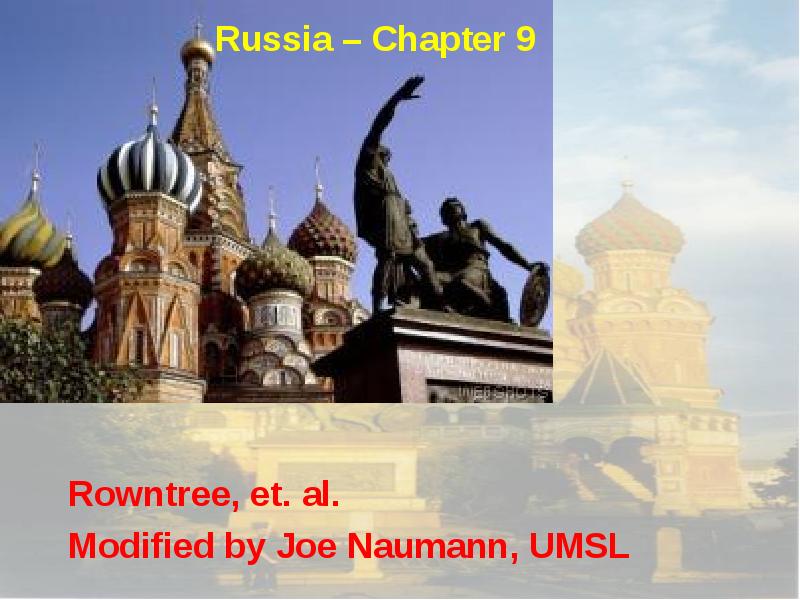
Russia – Chapter 9 Rowntree, et. al. Modified by Joe Naumann, UMSL
Описание слайда:
Russia – Chapter 9 Rowntree, et. al. Modified by Joe Naumann, UMSL

Слайд 2


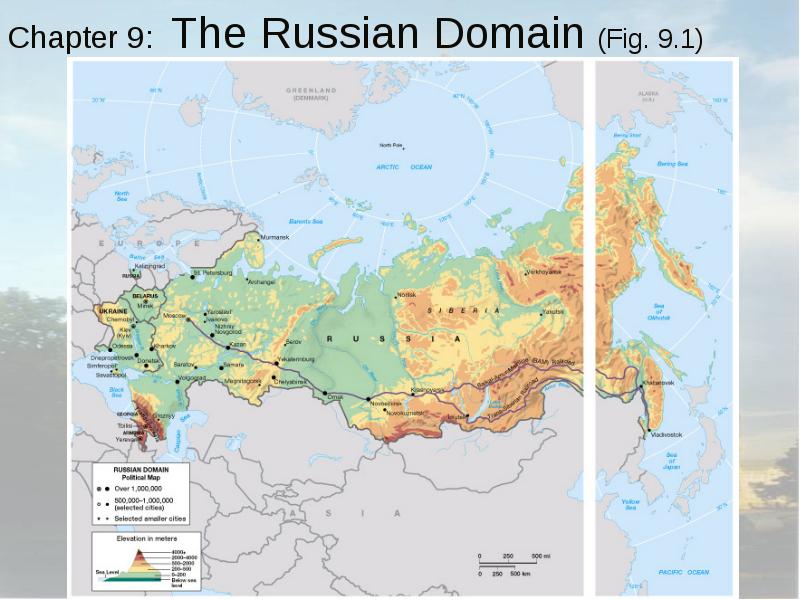
Chapter 9: The Russian Domain (Fig. 9.1)
Описание слайда:
Chapter 9: The Russian Domain (Fig. 9.1)

Слайд 3


Learning Objectives Understand the challenges of cold, northern climate that affects this region Learn about the cold war between the U.S. and...
Описание слайда:
Learning Objectives Understand the challenges of cold, northern climate that affects this region Learn about the cold war between the U.S. and U.S.S.R./Russia (1945-1990) Know the difference between a political system and an economic system Students should become familiar with the physical, demographic, cultural, political, and economic characteristics of the Russian Domain Understand these concepts and models:

Слайд 4


Introduction Russian Domain includes Russia, Belarus, Ukraine, Georgia, and Armenia (all were part of the U.S.S.R.) Russia is the largest country (in...
Описание слайда:
Introduction Russian Domain includes Russia, Belarus, Ukraine, Georgia, and Armenia (all were part of the U.S.S.R.) Russia is the largest country (in land area) on Earth; it spans 11 time zones Rich in resources, but has one of the harshest climates The Russian Domain has had extremely rapid political and economic change since 1990 From centrally planned economy to capitalism From authoritarian dictatorship to democracy Region’s economy is weak; commitment to democracy uncertain, nationalist movements threaten stability Ukraine, Belarus, Georgia, Armenia must build global relationships

Слайд 5


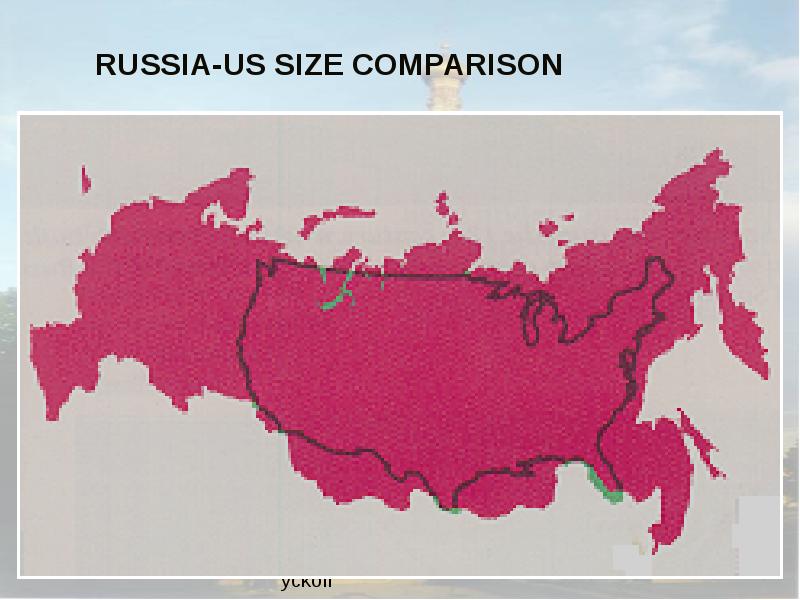
RUSSIA-US SIZE COMPARISON
Описание слайда:
RUSSIA-US SIZE COMPARISON

Слайд 6


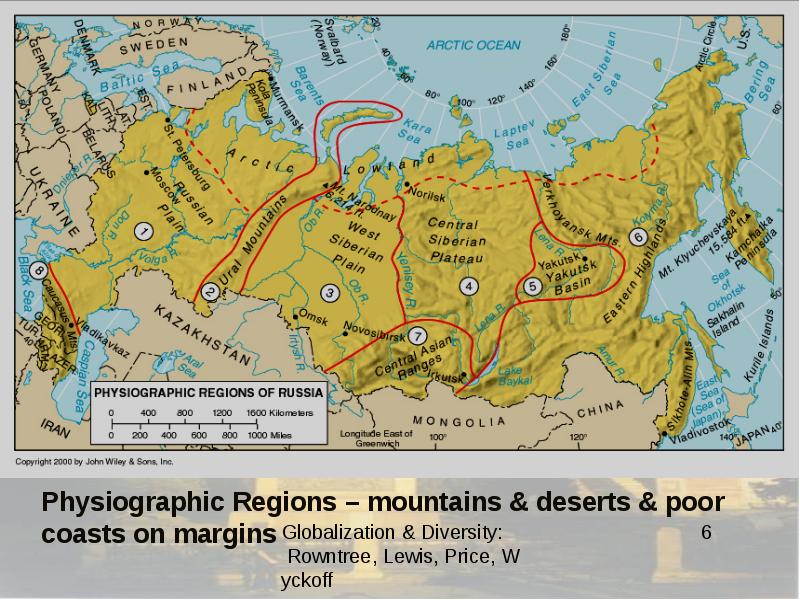
Russia – Chapter 9, слайд №6
Описание слайда:

Слайд 7


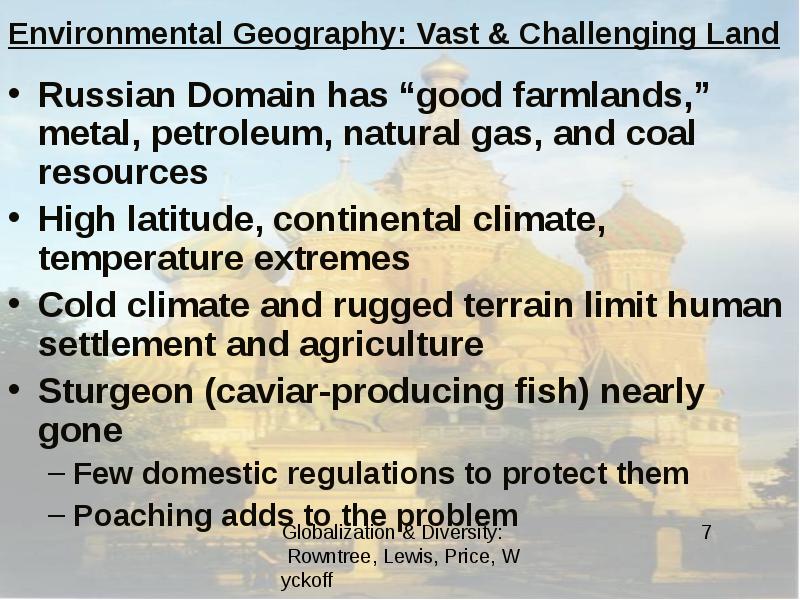
Environmental Geography: Vast & Challenging Land Russian Domain has “good farmlands,” metal, petroleum, natural gas, and coal resources High...
Описание слайда:
Environmental Geography: Vast & Challenging Land Russian Domain has “good farmlands,” metal, petroleum, natural gas, and coal resources High latitude, continental climate, temperature extremes Cold climate and rugged terrain limit human settlement and agriculture Sturgeon (caviar-producing fish) nearly gone Few domestic regulations to protect them Poaching adds to the problem

Слайд 8


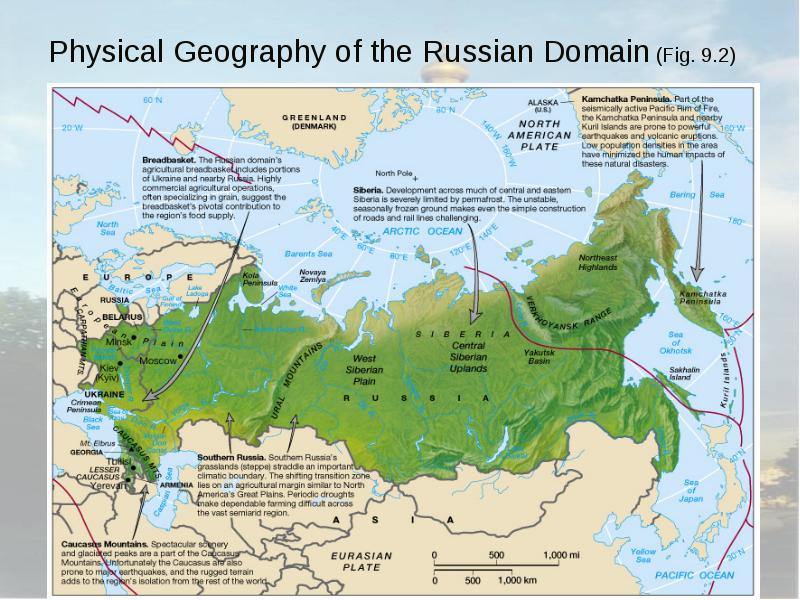
Physical Geography of the Russian Domain (Fig. 9.2)
Описание слайда:
Physical Geography of the Russian Domain (Fig. 9.2)

Слайд 9


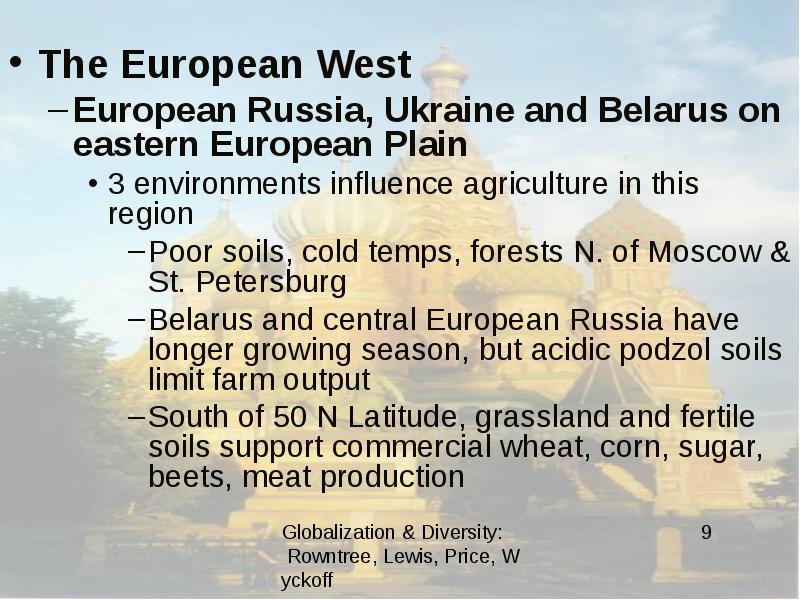
The European West The European West European Russia, Ukraine and Belarus on eastern European Plain 3 environments influence agriculture in this...
Описание слайда:
The European West The European West European Russia, Ukraine and Belarus on eastern European Plain 3 environments influence agriculture in this region Poor soils, cold temps, forests N. of Moscow & St. Petersburg Belarus and central European Russia have longer growing season, but acidic podzol soils limit farm output South of 50 N Latitude, grassland and fertile soils support commercial wheat, corn, sugar, beets, meat production

Слайд 10


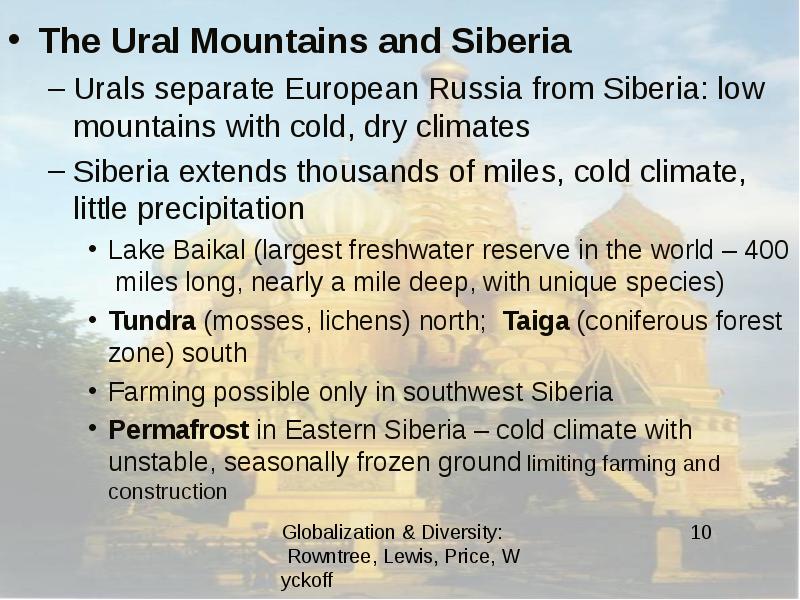
The Ural Mountains and Siberia The Ural Mountains and Siberia Urals separate European Russia from Siberia: low mountains with cold, dry climates...
Описание слайда:
The Ural Mountains and Siberia The Ural Mountains and Siberia Urals separate European Russia from Siberia: low mountains with cold, dry climates Siberia extends thousands of miles, cold climate, little precipitation Lake Baikal (largest freshwater reserve in the world – 400 miles long, nearly a mile deep, with unique species) Tundra (mosses, lichens) north; Taiga (coniferous forest zone) south Farming possible only in southwest Siberia Permafrost in Eastern Siberia – cold climate with unstable, seasonally frozen ground limiting farming and construction

Слайд 11


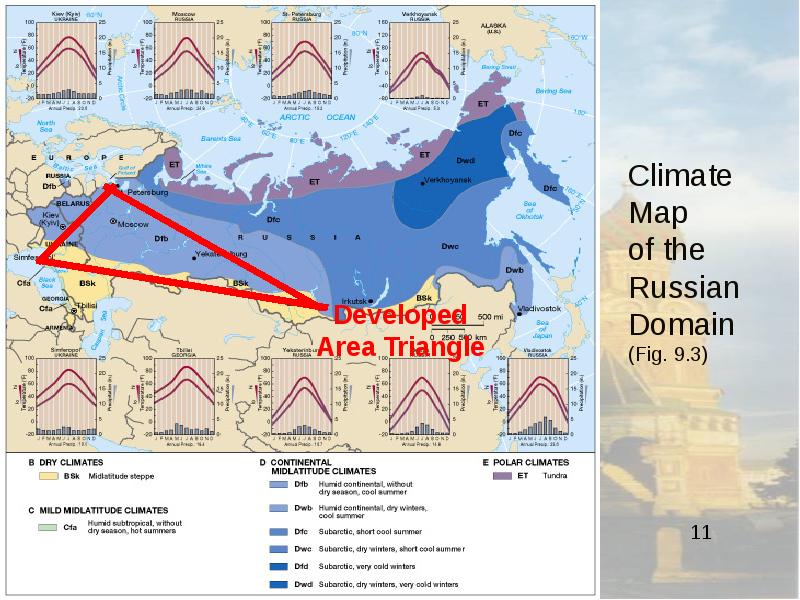
Climate Map of the Russian Domain (Fig. 9.3)
Описание слайда:
Climate Map of the Russian Domain (Fig. 9.3)

Слайд 12


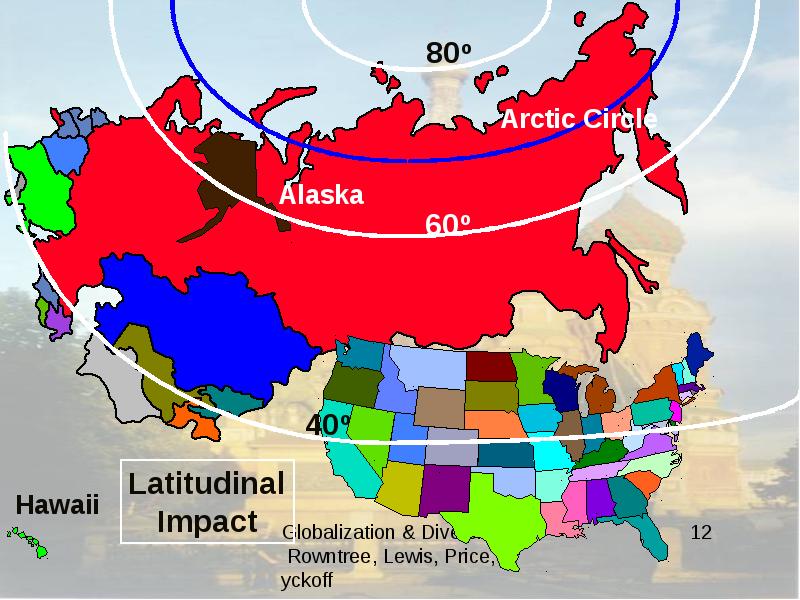
Russia – Chapter 9, слайд №12
Описание слайда:

Слайд 13


Russia – Chapter 9, слайд №13
Описание слайда:

Слайд 14


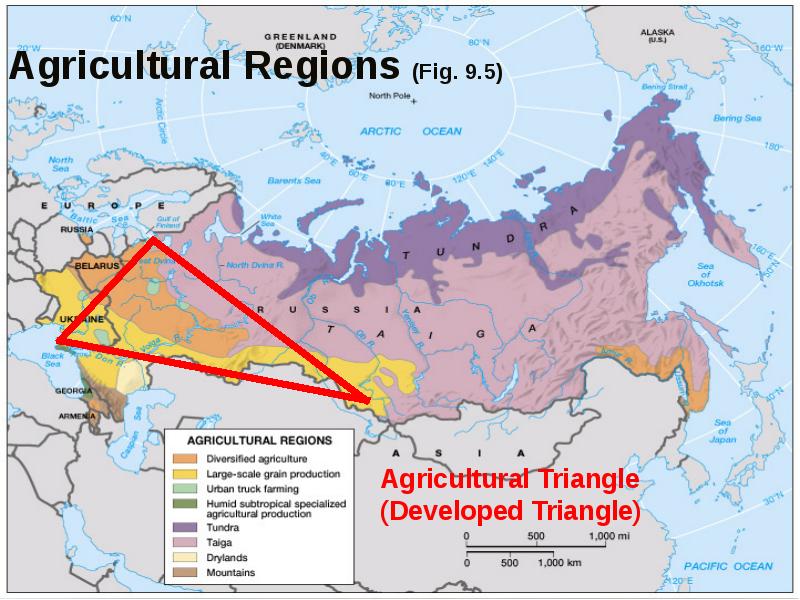
Agricultural Regions (Fig. 9.5)
Описание слайда:
Agricultural Regions (Fig. 9.5)

Слайд 15


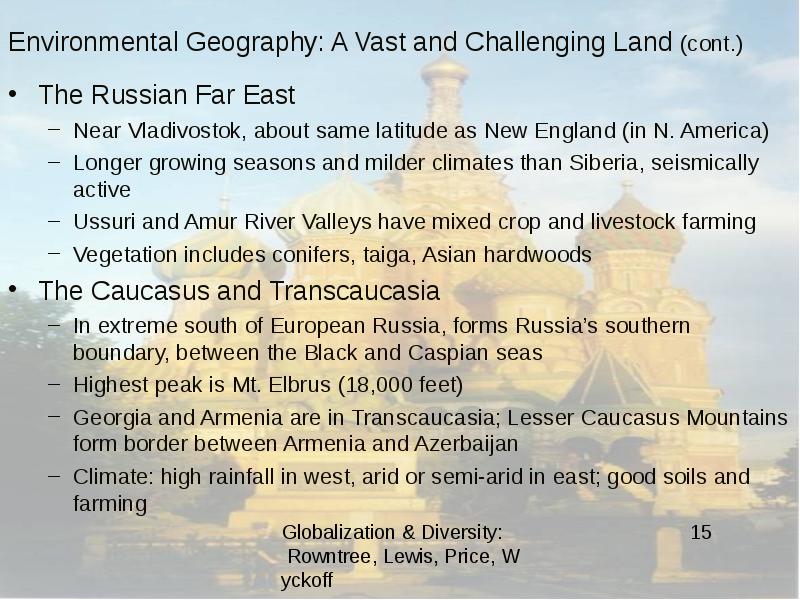
Environmental Geography: A Vast and Challenging Land (cont.) The Russian Far East Near Vladivostok, about same latitude as New England (in N....
Описание слайда:
Environmental Geography: A Vast and Challenging Land (cont.) The Russian Far East Near Vladivostok, about same latitude as New England (in N. America) Longer growing seasons and milder climates than Siberia, seismically active Ussuri and Amur River Valleys have mixed crop and livestock farming Vegetation includes conifers, taiga, Asian hardwoods The Caucasus and Transcaucasia In extreme south of European Russia, forms Russia’s southern boundary, between the Black and Caspian seas Highest peak is Mt. Elbrus (18,000 feet) Georgia and Armenia are in Transcaucasia; Lesser Caucasus Mountains form border between Armenia and Azerbaijan Climate: high rainfall in west, arid or semi-arid in east; good soils and farming

Слайд 16


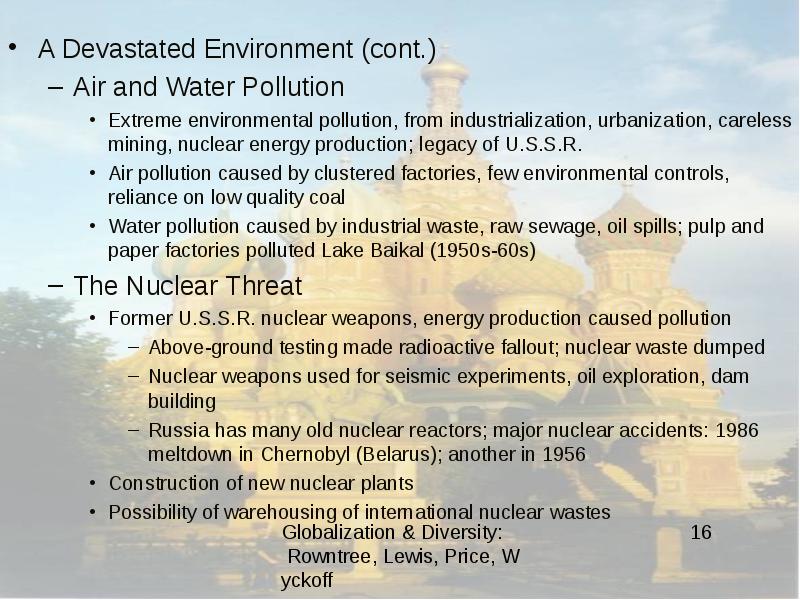
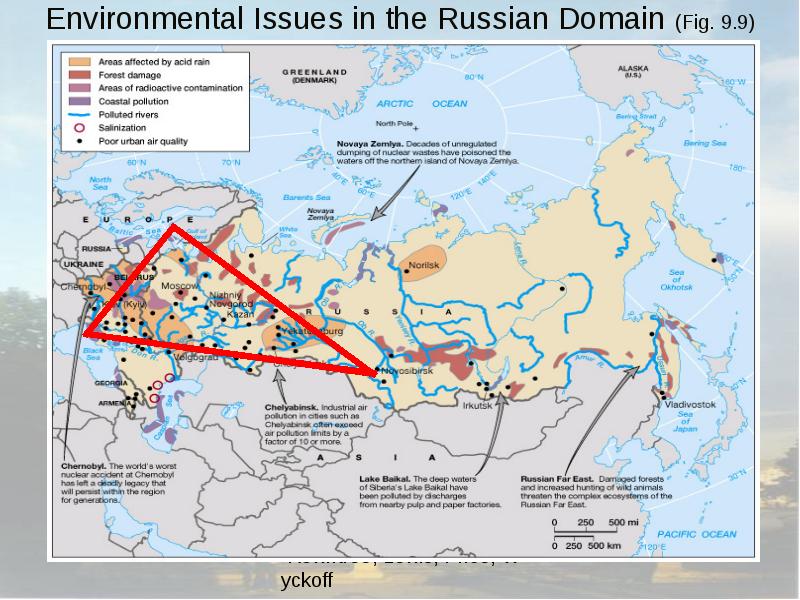
A Devastated Environment (cont.) A Devastated Environment (cont.) Air and Water Pollution Extreme environmental pollution, from industrialization,...
Описание слайда:
A Devastated Environment (cont.) A Devastated Environment (cont.) Air and Water Pollution Extreme environmental pollution, from industrialization, urbanization, careless mining, nuclear energy production; legacy of U.S.S.R. Air pollution caused by clustered factories, few environmental controls, reliance on low quality coal Water pollution caused by industrial waste, raw sewage, oil spills; pulp and paper factories polluted Lake Baikal (1950s-60s) The Nuclear Threat Former U.S.S.R. nuclear weapons, energy production caused pollution Above-ground testing made radioactive fallout; nuclear waste dumped Nuclear weapons used for seismic experiments, oil exploration, dam building Russia has many old nuclear reactors; major nuclear accidents: 1986 meltdown in Chernobyl (Belarus); another in 1956 Construction of new nuclear plants Possibility of warehousing of international nuclear wastes

Слайд 17


Environmental Issues in the Russian Domain (Fig. 9.9)
Описание слайда:
Environmental Issues in the Russian Domain (Fig. 9.9)

Слайд 18


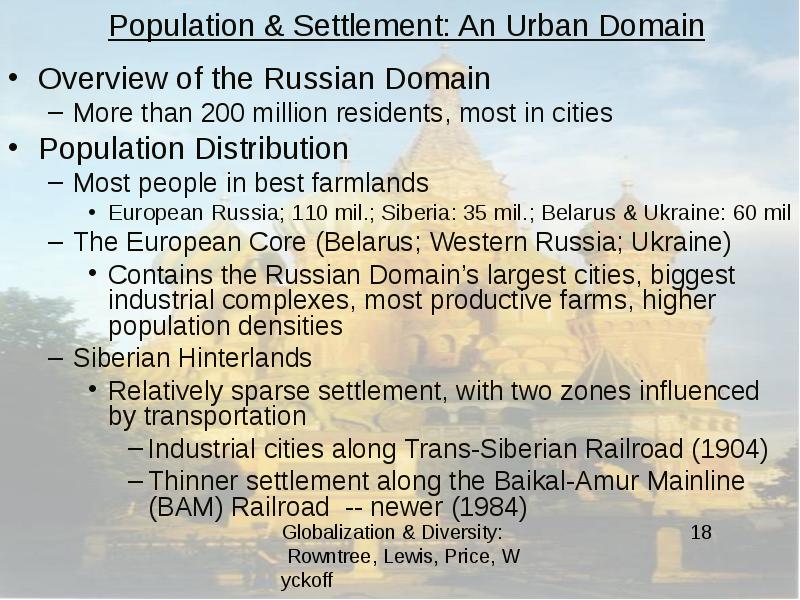
Population & Settlement: An Urban Domain Overview of the Russian Domain More than 200 million residents, most in cities Population Distribution Most...
Описание слайда:
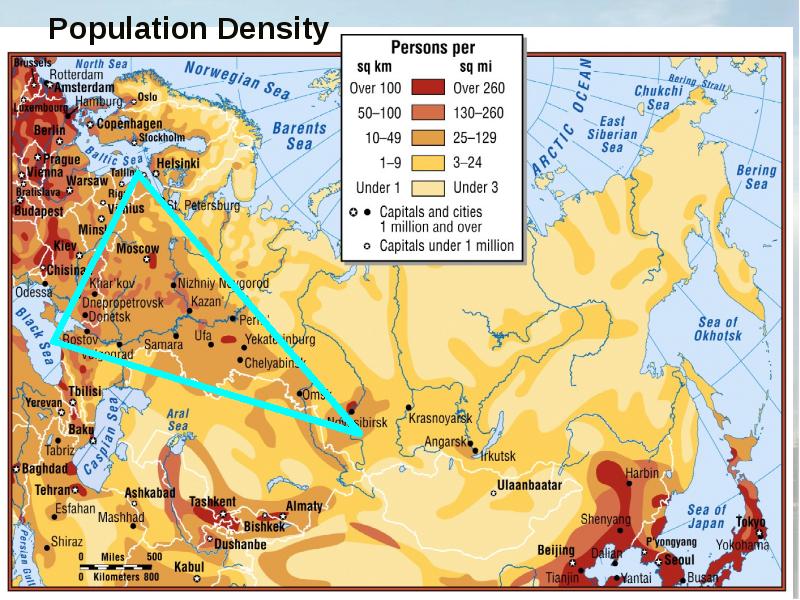
Population & Settlement: An Urban Domain Overview of the Russian Domain More than 200 million residents, most in cities Population Distribution Most people in best farmlands European Russia; 110 mil.; Siberia: 35 mil.; Belarus & Ukraine: 60 mil The European Core (Belarus; Western Russia; Ukraine) Contains the Russian Domain’s largest cities, biggest industrial complexes, most productive farms, higher population densities Siberian Hinterlands Relatively sparse settlement, with two zones influenced by transportation Industrial cities along Trans-Siberian Railroad (1904) Thinner settlement along the Baikal-Amur Mainline (BAM) Railroad -- newer (1984)

Слайд 19


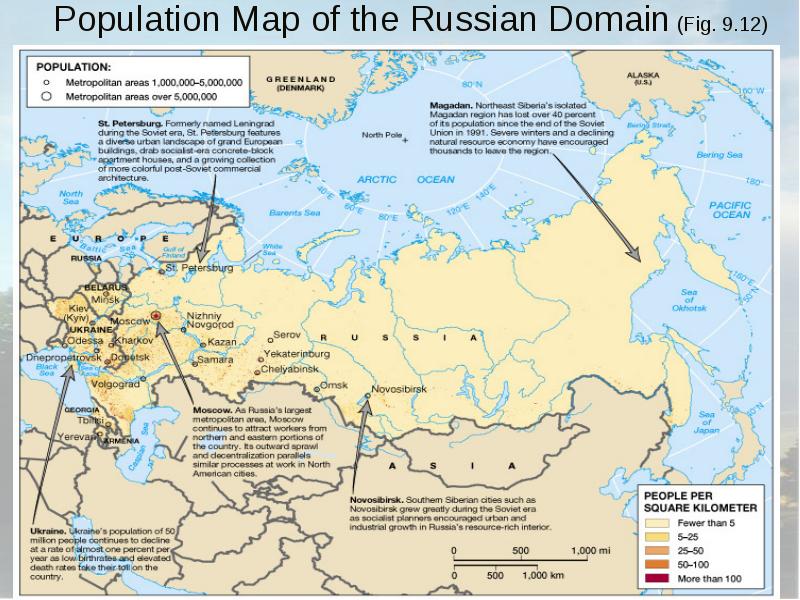
Population Map of the Russian Domain (Fig. 9.12)
Описание слайда:
Population Map of the Russian Domain (Fig. 9.12)

Слайд 20


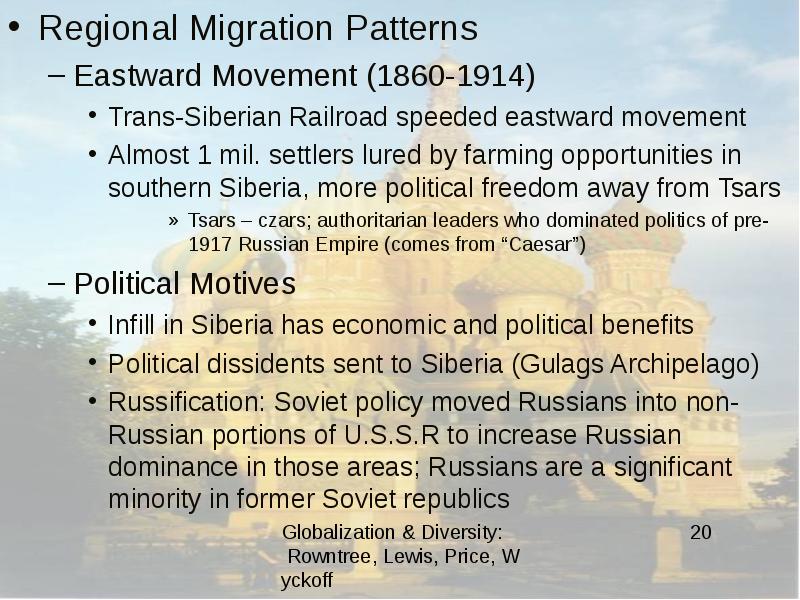
Regional Migration Patterns Regional Migration Patterns Eastward Movement (1860-1914) Trans-Siberian Railroad speeded eastward movement Almost 1 mil....
Описание слайда:
Regional Migration Patterns Regional Migration Patterns Eastward Movement (1860-1914) Trans-Siberian Railroad speeded eastward movement Almost 1 mil. settlers lured by farming opportunities in southern Siberia, more political freedom away from Tsars Tsars – czars; authoritarian leaders who dominated politics of pre-1917 Russian Empire (comes from “Caesar”) Political Motives Infill in Siberia has economic and political benefits Political dissidents sent to Siberia (Gulags Archipelago) Russification: Soviet policy moved Russians into non-Russian portions of U.S.S.R to increase Russian dominance in those areas; Russians are a significant minority in former Soviet republics

Слайд 21


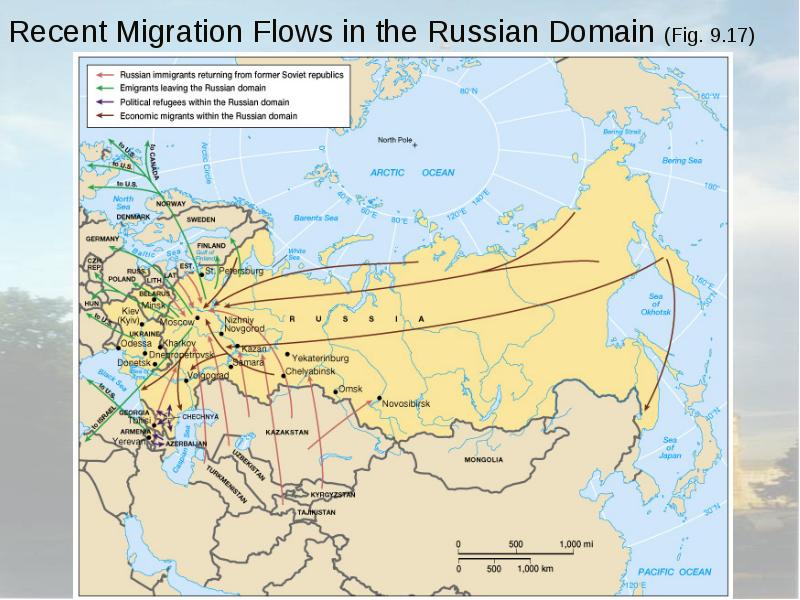
Recent Migration Flows in the Russian Domain (Fig. 9.17)
Описание слайда:
Recent Migration Flows in the Russian Domain (Fig. 9.17)

Слайд 22


Population Density
Описание слайда:
Population Density

Слайд 23


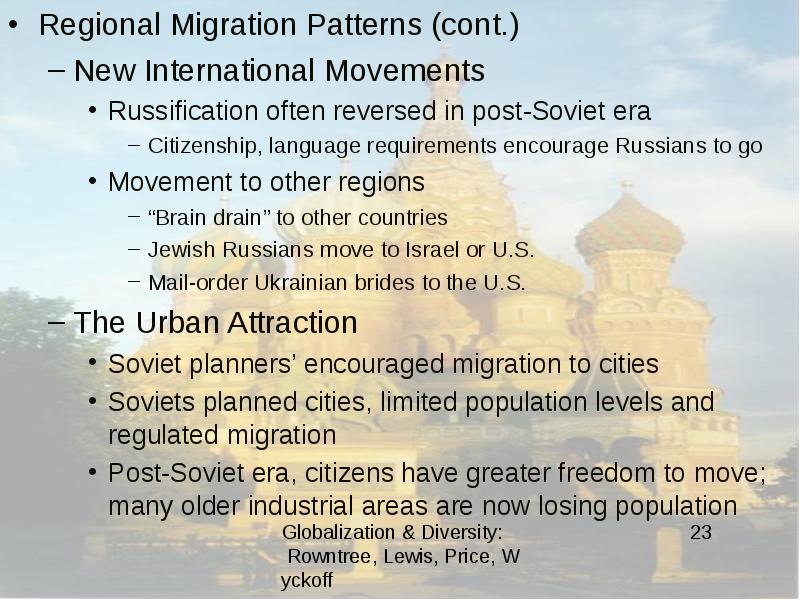
Regional Migration Patterns (cont.) Regional Migration Patterns (cont.) New International Movements Russification often reversed in post-Soviet era...
Описание слайда:
Regional Migration Patterns (cont.) Regional Migration Patterns (cont.) New International Movements Russification often reversed in post-Soviet era Citizenship, language requirements encourage Russians to go Movement to other regions “Brain drain” to other countries Jewish Russians move to Israel or U.S. Mail-order Ukrainian brides to the U.S. The Urban Attraction Soviet planners’ encouraged migration to cities Soviets planned cities, limited population levels and regulated migration Post-Soviet era, citizens have greater freedom to move; many older industrial areas are now losing population

Слайд 24


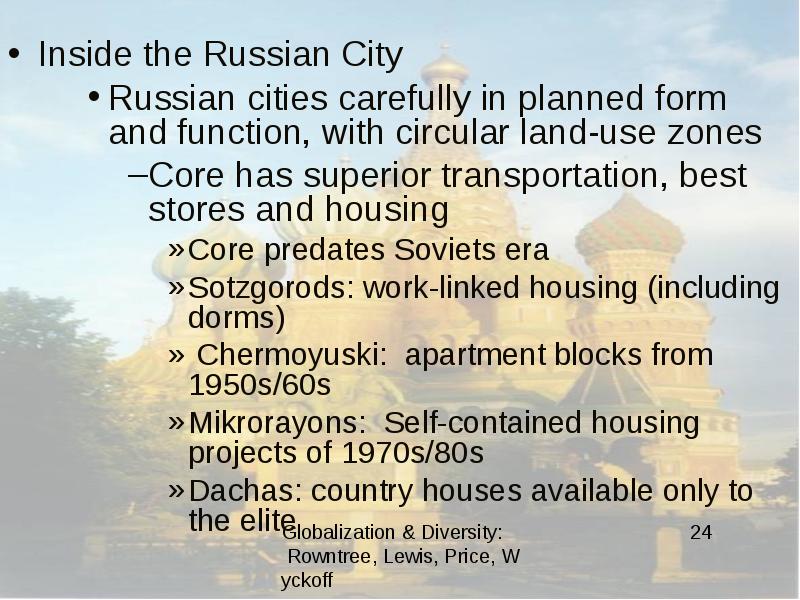
Inside the Russian City Inside the Russian City Russian cities carefully in planned form and function, with circular land-use zones Core has superior...
Описание слайда:
Inside the Russian City Inside the Russian City Russian cities carefully in planned form and function, with circular land-use zones Core has superior transportation, best stores and housing Core predates Soviets era Sotzgorods: work-linked housing (including dorms) Chermoyuski: apartment blocks from 1950s/60s Mikrorayons: Self-contained housing projects of 1970s/80s Dachas: country houses available only to the elite

Слайд 25


The Demographic Crisis The Demographic Crisis General population decline caused by low birth rates and rising death (mortality) rates, especially...
Описание слайда:
The Demographic Crisis The Demographic Crisis General population decline caused by low birth rates and rising death (mortality) rates, especially among middle-aged males Causes fraying social fabric economic uncertainty declining health among women of child-bearing age stress-related diseases rising murder and suicide toxic environments Russia’s population could fall by 3 million by 25 million by 2030

Слайд 26


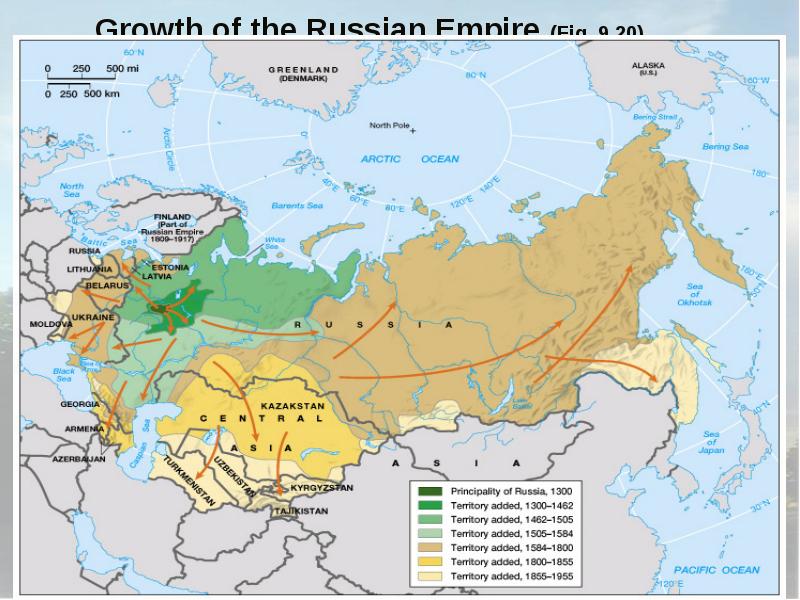
The Legacy of Slavic Dominance The Heritage of the Russian Empire Growth of the Russian Empire Slavic “Rus” in power from 900AD around Kiev Eastern...
Описание слайда:
The Legacy of Slavic Dominance The Heritage of the Russian Empire Growth of the Russian Empire Slavic “Rus” in power from 900AD around Kiev Eastern Orthodox Christianity came in 1000AD By 1400s, new and expanding Russian state after Tatar and Mongol rule Expansion eastward in 16th & 17th centuries; westward expansion slow Final expansion of Russian Empire in 19th Century in Central Asia The Significance of Empire 1900, Russians ruled from St. Petersburg to Vladivostok

Слайд 27


Growth of the Russian Empire (Fig. 9.20)
Описание слайда:
Growth of the Russian Empire (Fig. 9.20)

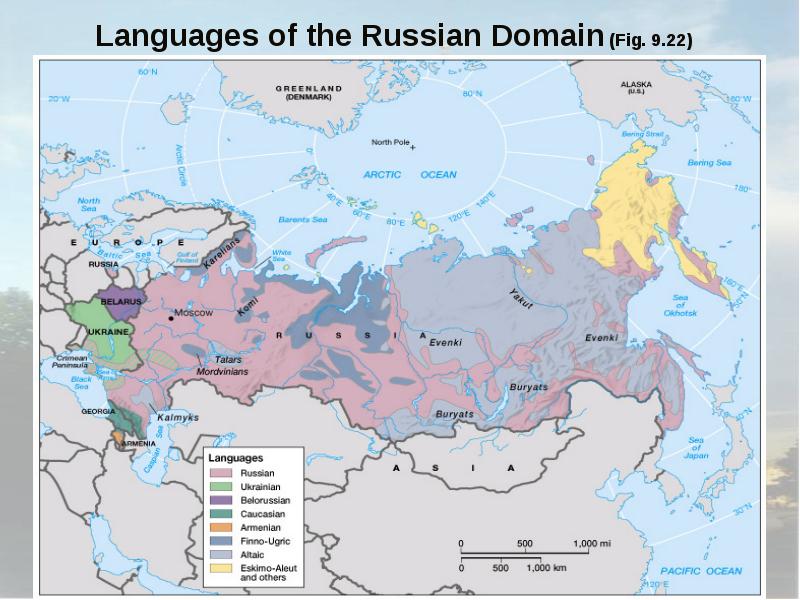
Слайд 28


Geographies of Language Geographies of Language Slavic languages dominate in the Russian Domain 80% of Russia’s people are ethnic Russians There are...
Описание слайда:
Geographies of Language Geographies of Language Slavic languages dominate in the Russian Domain 80% of Russia’s people are ethnic Russians There are other language groups Finno-Ugric (Finnish) in the north Altaic (Tatars & Turkic peoples) middle Volga Transcaucasia has many languages Yakut (Turkic) in Siberia; Buryats near Lake Baikal Similar treatment to indigenous in U.S., Canada, Australia

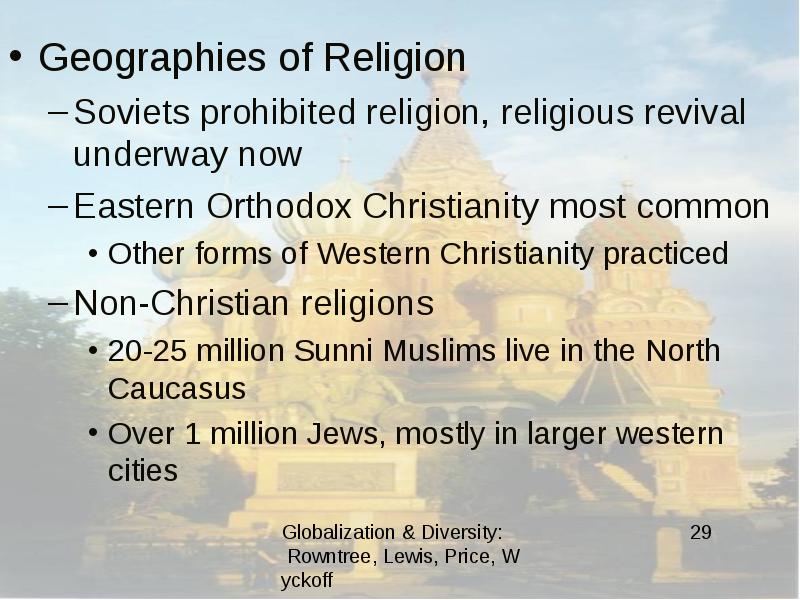
Слайд 29


Geographies of Religion Geographies of Religion Soviets prohibited religion, religious revival underway now Eastern Orthodox Christianity most common...
Описание слайда:
Geographies of Religion Geographies of Religion Soviets prohibited religion, religious revival underway now Eastern Orthodox Christianity most common Other forms of Western Christianity practiced Non-Christian religions 20-25 million Sunni Muslims live in the North Caucasus Over 1 million Jews, mostly in larger western cities

Слайд 30


Languages of the Russian Domain (Fig. 9.22)
Описание слайда:
Languages of the Russian Domain (Fig. 9.22)

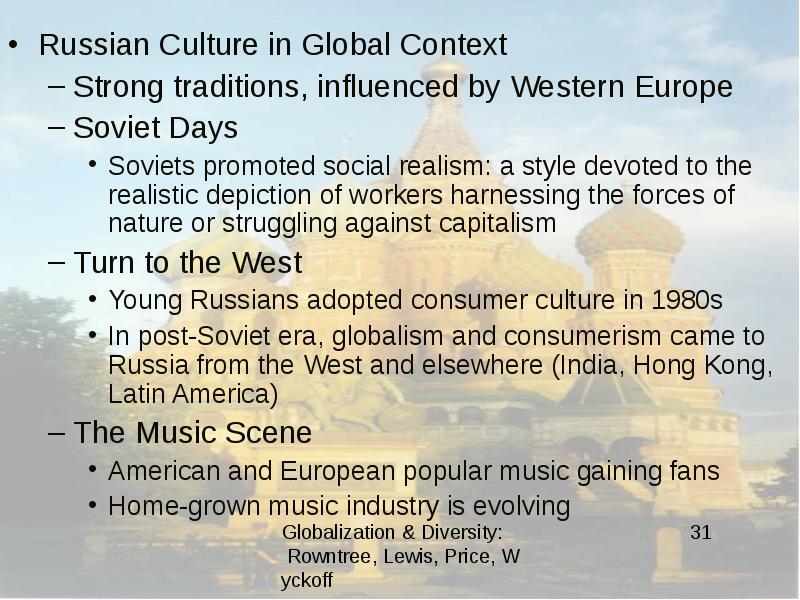
Слайд 31


Russian Culture in Global Context Russian Culture in Global Context Strong traditions, influenced by Western Europe Soviet Days Soviets promoted...
Описание слайда:
Russian Culture in Global Context Russian Culture in Global Context Strong traditions, influenced by Western Europe Soviet Days Soviets promoted social realism: a style devoted to the realistic depiction of workers harnessing the forces of nature or struggling against capitalism Turn to the West Young Russians adopted consumer culture in 1980s In post-Soviet era, globalism and consumerism came to Russia from the West and elsewhere (India, Hong Kong, Latin America) The Music Scene American and European popular music gaining fans Home-grown music industry is evolving

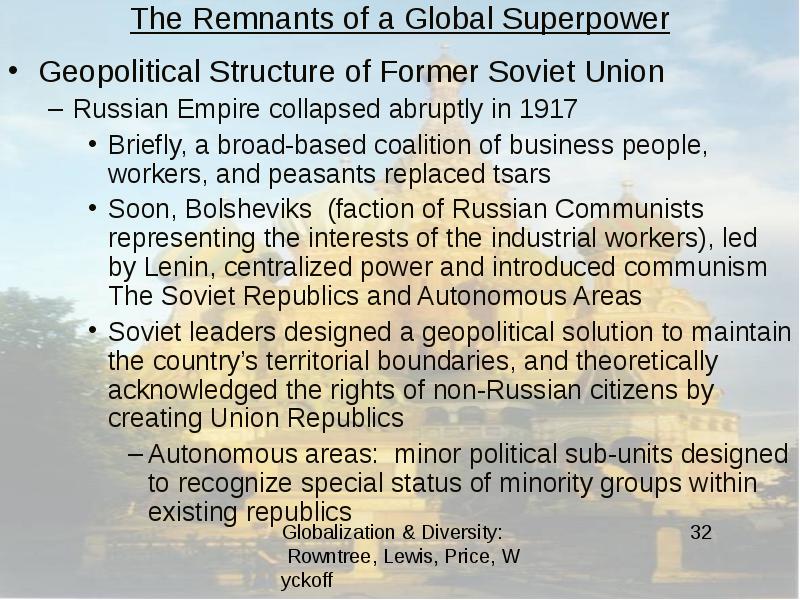
Слайд 32


The Remnants of a Global Superpower Geopolitical Structure of Former Soviet Union Russian Empire collapsed abruptly in 1917 Briefly, a broad-based...
Описание слайда:
The Remnants of a Global Superpower Geopolitical Structure of Former Soviet Union Russian Empire collapsed abruptly in 1917 Briefly, a broad-based coalition of business people, workers, and peasants replaced tsars Soon, Bolsheviks (faction of Russian Communists representing the interests of the industrial workers), led by Lenin, centralized power and introduced communism The Soviet Republics and Autonomous Areas Soviet leaders designed a geopolitical solution to maintain the country’s territorial boundaries, and theoretically acknowledged the rights of non-Russian citizens by creating Union Republics Autonomous areas: minor political sub-units designed to recognize special status of minority groups within existing republics

Слайд 33


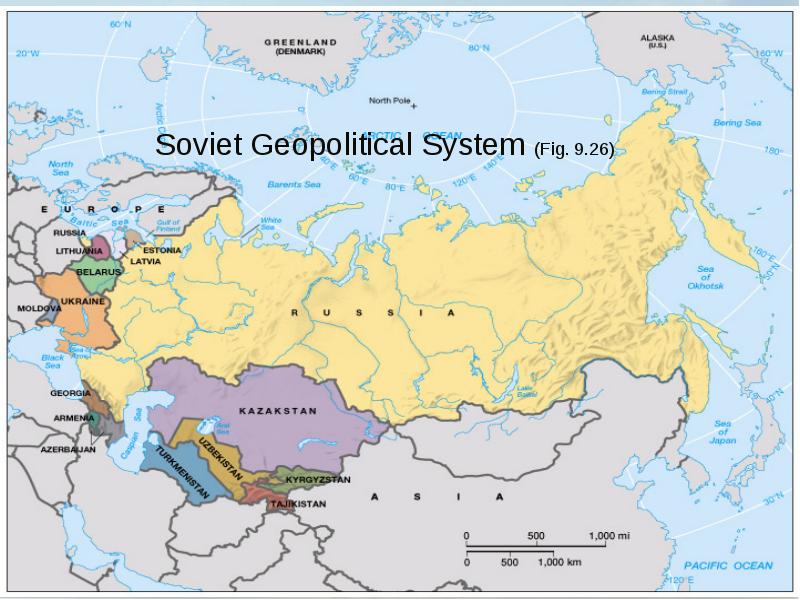
Soviet Geopolitical System (Fig. 9.26)
Описание слайда:
Soviet Geopolitical System (Fig. 9.26)

Слайд 34


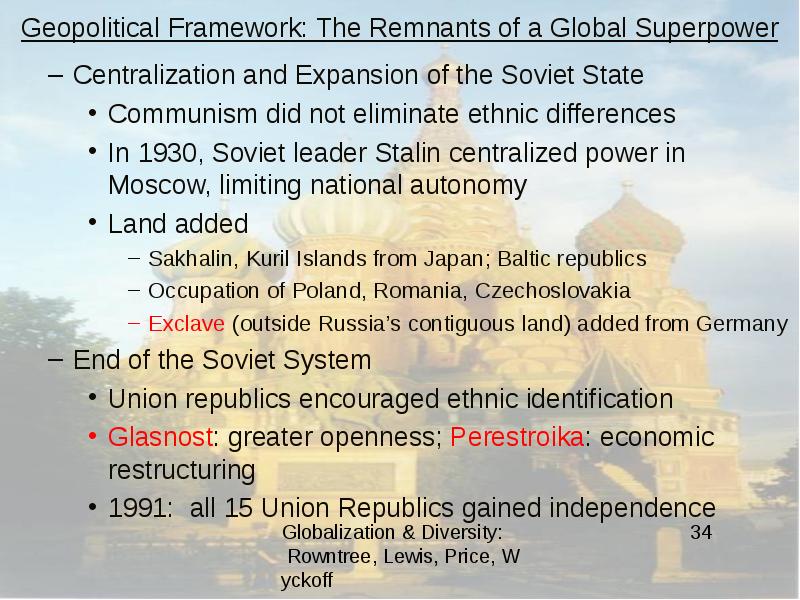
Geopolitical Framework: The Remnants of a Global Superpower Centralization and Expansion of the Soviet State Communism did not eliminate ethnic...
Описание слайда:
Geopolitical Framework: The Remnants of a Global Superpower Centralization and Expansion of the Soviet State Communism did not eliminate ethnic differences In 1930, Soviet leader Stalin centralized power in Moscow, limiting national autonomy Land added Sakhalin, Kuril Islands from Japan; Baltic republics Occupation of Poland, Romania, Czechoslovakia Exclave (outside Russia’s contiguous land) added from Germany End of the Soviet System Union republics encouraged ethnic identification Glasnost: greater openness; Perestroika: economic restructuring 1991: all 15 Union Republics gained independence

Слайд 35


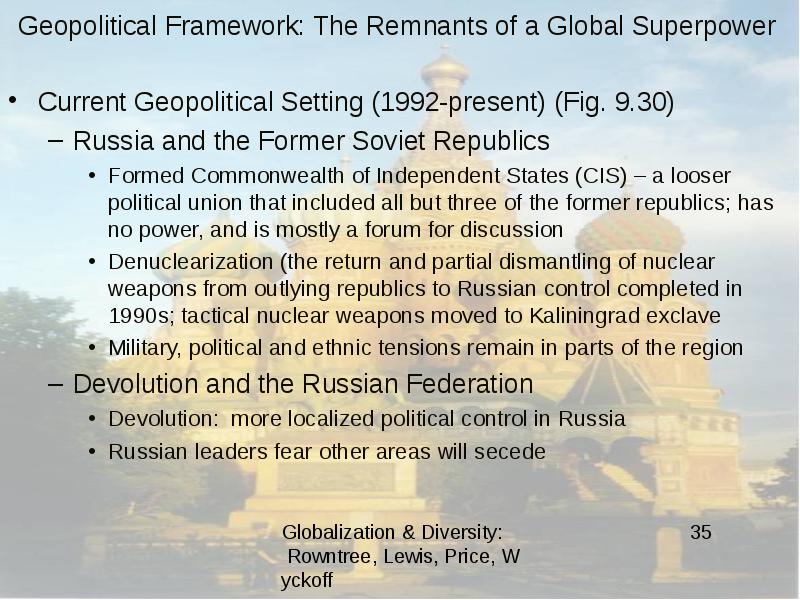
Geopolitical Framework: The Remnants of a Global Superpower Current Geopolitical Setting (1992-present) (Fig. 9.30) Russia and the Former Soviet...
Описание слайда:
Geopolitical Framework: The Remnants of a Global Superpower Current Geopolitical Setting (1992-present) (Fig. 9.30) Russia and the Former Soviet Republics Formed Commonwealth of Independent States (CIS) – a looser political union that included all but three of the former republics; has no power, and is mostly a forum for discussion Denuclearization (the return and partial dismantling of nuclear weapons from outlying republics to Russian control completed in 1990s; tactical nuclear weapons moved to Kaliningrad exclave Military, political and ethnic tensions remain in parts of the region Devolution and the Russian Federation Devolution: more localized political control in Russia Russian leaders fear other areas will secede

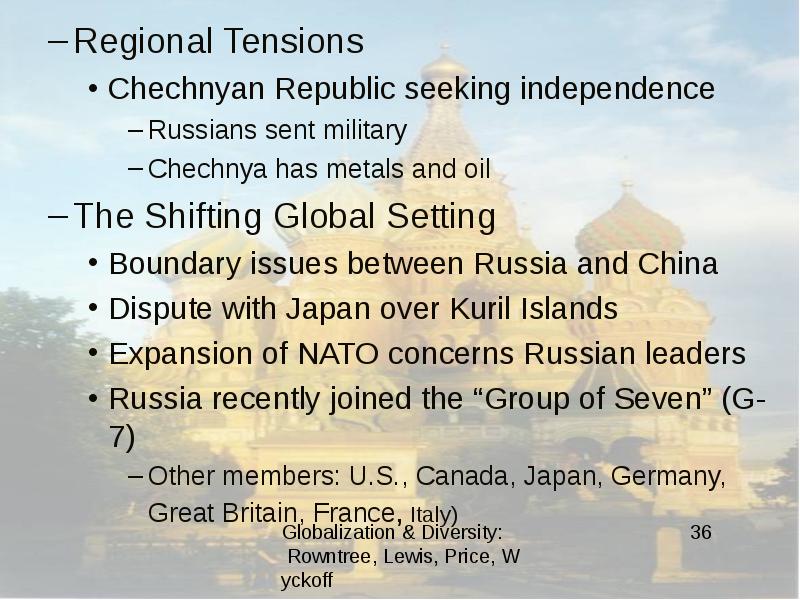
Слайд 36


Regional Tensions Regional Tensions Chechnyan Republic seeking independence Russians sent military Chechnya has metals and oil The Shifting Global...
Описание слайда:
Regional Tensions Regional Tensions Chechnyan Republic seeking independence Russians sent military Chechnya has metals and oil The Shifting Global Setting Boundary issues between Russia and China Dispute with Japan over Kuril Islands Expansion of NATO concerns Russian leaders Russia recently joined the “Group of Seven” (G-7) Other members: U.S., Canada, Japan, Germany, Great Britain, France, Italy)

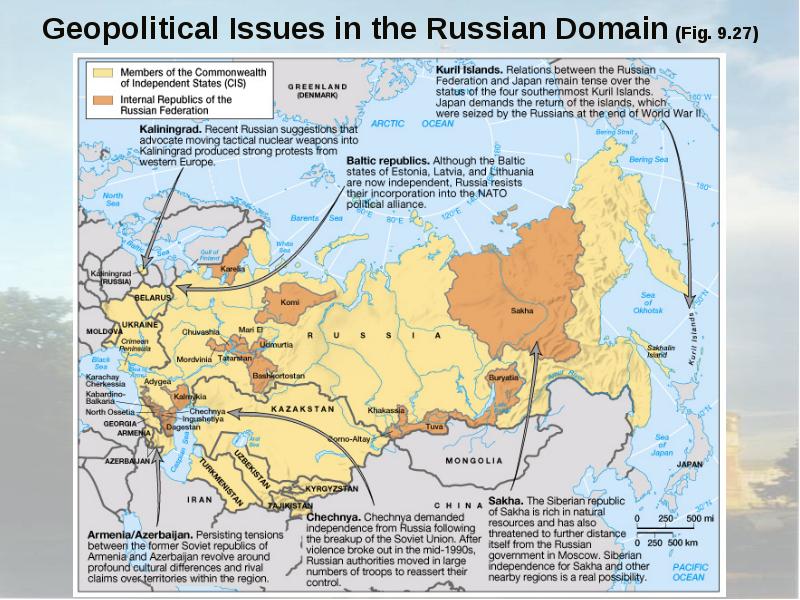
Слайд 37


Geopolitical Issues in the Russian Domain (Fig. 9.27)
Описание слайда:
Geopolitical Issues in the Russian Domain (Fig. 9.27)

Слайд 38


An Era of Ongoing Adjustment After economic decline of 40% in the 1990s, Russia’s economy stabilized in 2000 and 2004 The Legacy of the Soviet...
Описание слайда:
An Era of Ongoing Adjustment After economic decline of 40% in the 1990s, Russia’s economy stabilized in 2000 and 2004 The Legacy of the Soviet Economy Communists came to power in 1917, and instituted centralized economic planning: a situation in which the state controls production targets and industrial output Soviets nationalized agriculture, but it was inefficient Soviets expanded industrialization and transportation Industrialization more successful than collectivized agriculture Trans-Siberian Railroad, canal system Improvements in housing and education after WWII Literacy near 100% But economic and social problems increased in 1970s-’80s

Слайд 39


Soviet industry more successful than agriculture Soviet industry more successful than agriculture Soviets added major industrial zones (Fig. 9.31),...
Описание слайда:
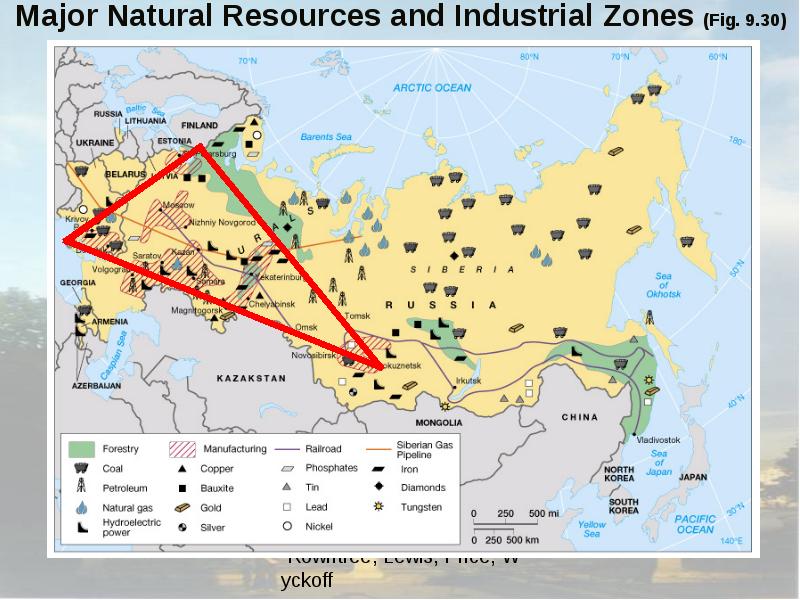
Soviet industry more successful than agriculture Soviet industry more successful than agriculture Soviets added major industrial zones (Fig. 9.31), many near energy sources and metals Moscow had fewer raw materials, but had some of Russia’s best infrastructure, large pool of skilled labor, and demand for industrial products Soviets developed a good transportation and communication infrastructure Soviets had a massive housing campaign in the 1960s Soviets made literacy virtually universal, and health care readily available; eliminated the worst of the poverty

Слайд 40


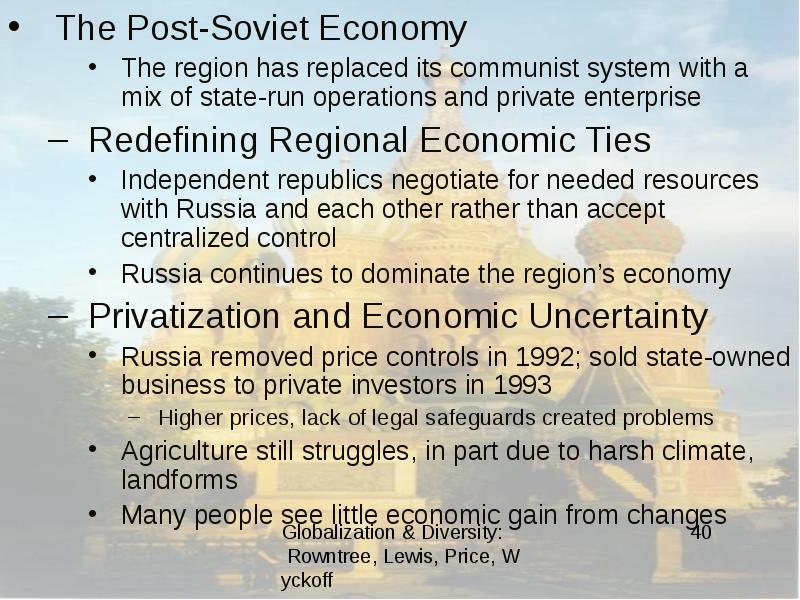
The Post-Soviet Economy The Post-Soviet Economy The region has replaced its communist system with a mix of state-run operations and private...
Описание слайда:
The Post-Soviet Economy The Post-Soviet Economy The region has replaced its communist system with a mix of state-run operations and private enterprise Redefining Regional Economic Ties Independent republics negotiate for needed resources with Russia and each other rather than accept centralized control Russia continues to dominate the region’s economy Privatization and Economic Uncertainty Russia removed price controls in 1992; sold state-owned business to private investors in 1993 Higher prices, lack of legal safeguards created problems Agriculture still struggles, in part due to harsh climate, landforms Many people see little economic gain from changes

Слайд 41


Major Natural Resources and Industrial Zones (Fig. 9.30)
Описание слайда:
Major Natural Resources and Industrial Zones (Fig. 9.30)

Слайд 42


The Russian Mafia The Russian Mafia Russia Interior Ministry estimates that Russian mafia controls 40% of the private economy & 60% of the state-run...
Описание слайда:
The Russian Mafia The Russian Mafia Russia Interior Ministry estimates that Russian mafia controls 40% of the private economy & 60% of the state-run enterprises; 80% of banks in Russia may be under mafia influence Protection money, corruption result Russian mafia has gone global Money laundering (Russia, U.K., U.S.); gambling (Sri Lanka); drugs (Colombia); legitimate Israeli high tech companies

Слайд 43


Social Problems High unemployment, rising housing costs; lower welfare spending Divorce and domestic violence increasing; prostitution increasing...
Описание слайда:
Social Problems High unemployment, rising housing costs; lower welfare spending Divorce and domestic violence increasing; prostitution increasing Health care spending dropping Vaccine shortages allow disease to return Chronic and stress-related illnesses on the rise

Слайд 44


Growing Economic Globalization Growing Economic Globalization Starting in 1970s, Soviets exported fossil fuels, imported food; ties now stronger A...
Описание слайда:
Growing Economic Globalization Growing Economic Globalization Starting in 1970s, Soviets exported fossil fuels, imported food; ties now stronger A New Day for the Consumer Western consumer goods available (e.g., McDonald’s, Calvin Klein; even some luxury items) Attracting Foreign Investment Region struggles to attract foreign investment Most investment from U.S., western Europe (esp. Germany, U.K.) Fossil fuels, food, telecommunications, consumer goods Foreign investment growing by more than 14% annually

Слайд 45


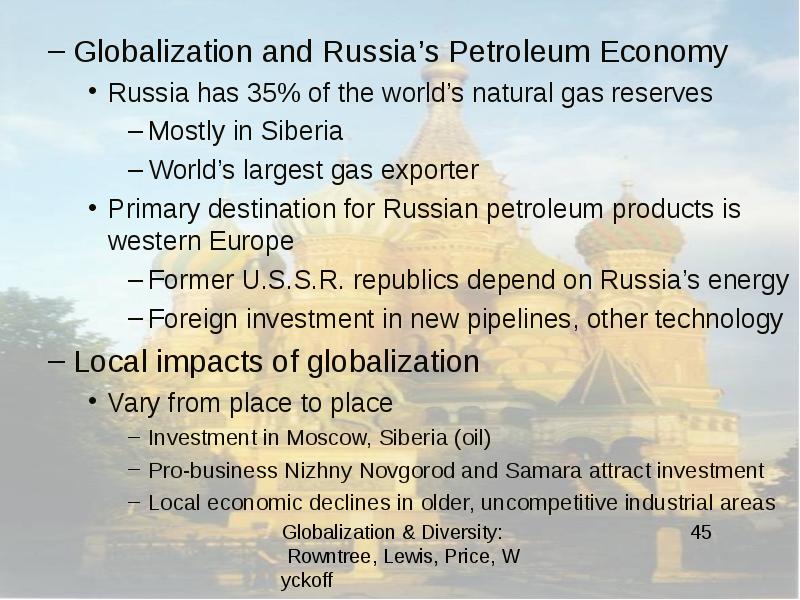
Globalization and Russia’s Petroleum Economy Globalization and Russia’s Petroleum Economy Russia has 35% of the world’s natural gas reserves Mostly...
Описание слайда:
Globalization and Russia’s Petroleum Economy Globalization and Russia’s Petroleum Economy Russia has 35% of the world’s natural gas reserves Mostly in Siberia World’s largest gas exporter Primary destination for Russian petroleum products is western Europe Former U.S.S.R. republics depend on Russia’s energy Foreign investment in new pipelines, other technology Local impacts of globalization Vary from place to place Investment in Moscow, Siberia (oil) Pro-business Nizhny Novgorod and Samara attract investment Local economic declines in older, uncompetitive industrial areas

Слайд 46


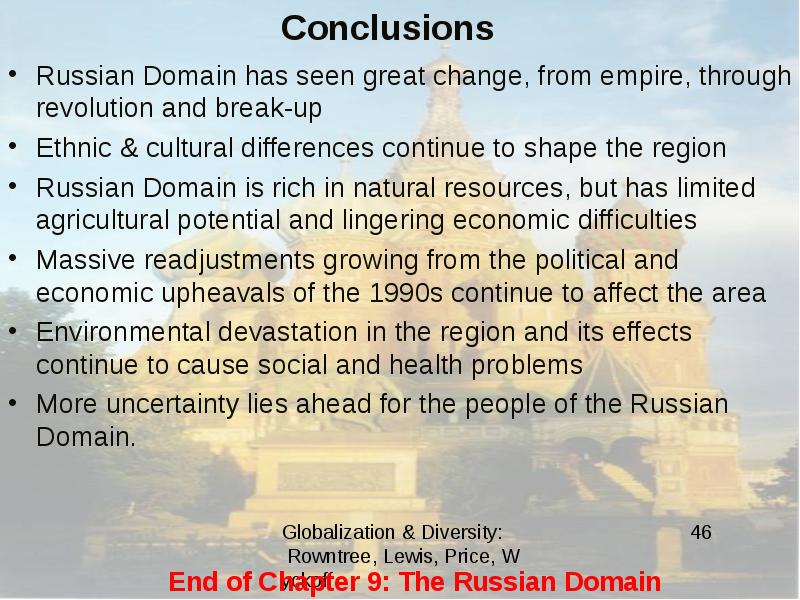
Conclusions Russian Domain has seen great change, from empire, through revolution and break-up Ethnic & cultural differences continue to shape the...
Описание слайда:
Conclusions Russian Domain has seen great change, from empire, through revolution and break-up Ethnic & cultural differences continue to shape the region Russian Domain is rich in natural resources, but has limited agricultural potential and lingering economic difficulties Massive readjustments growing from the political and economic upheavals of the 1990s continue to affect the area Environmental devastation in the region and its effects continue to cause social and health problems More uncertainty lies ahead for the people of the Russian Domain.


Теги Russia Chapter
Похожие презентации
Mypresentation.ru
Загрузить презентацию