🗊 Презентация 10 principles of economics

Нажмите для полного просмотра!
10 principles of economics, слайд №1 10 principles of economics, слайд №2 10 principles of economics, слайд №3 10 principles of economics, слайд №4 10 principles of economics, слайд №5 10 principles of economics, слайд №6 10 principles of economics, слайд №7 10 principles of economics, слайд №8 10 principles of economics, слайд №9 10 principles of economics, слайд №10 10 principles of economics, слайд №11 10 principles of economics, слайд №12 10 principles of economics, слайд №13 10 principles of economics, слайд №14 10 principles of economics, слайд №15 10 principles of economics, слайд №16 10 principles of economics, слайд №17 10 principles of economics, слайд №18 10 principles of economics, слайд №19 10 principles of economics, слайд №20 10 principles of economics, слайд №21 10 principles of economics, слайд №22 10 principles of economics, слайд №23 10 principles of economics, слайд №24 10 principles of economics, слайд №25 10 principles of economics, слайд №26 10 principles of economics, слайд №27 10 principles of economics, слайд №28 10 principles of economics, слайд №29 10 principles of economics, слайд №30 10 principles of economics, слайд №31 10 principles of economics, слайд №32 10 principles of economics, слайд №33 10 principles of economics, слайд №34 10 principles of economics, слайд №35 10 principles of economics, слайд №36 10 principles of economics, слайд №37 10 principles of economics, слайд №38 10 principles of economics, слайд №39 10 principles of economics, слайд №40 10 principles of economics, слайд №41 10 principles of economics, слайд №42 10 principles of economics, слайд №43 10 principles of economics, слайд №44 10 principles of economics, слайд №45 10 principles of economics, слайд №46 10 principles of economics, слайд №47 10 principles of economics, слайд №48 10 principles of economics, слайд №49 10 principles of economics, слайд №50 10 principles of economics, слайд №51 10 principles of economics, слайд №52 10 principles of economics, слайд №53 10 principles of economics, слайд №54 10 principles of economics, слайд №55 10 principles of economics, слайд №56 10 principles of economics, слайд №57 10 principles of economics, слайд №58 10 principles of economics, слайд №59 10 principles of economics, слайд №60 10 principles of economics, слайд №61 10 principles of economics, слайд №62 10 principles of economics, слайд №63 10 principles of economics, слайд №64 10 principles of economics, слайд №65 10 principles of economics, слайд №66 10 principles of economics, слайд №67 10 principles of economics, слайд №68 10 principles of economics, слайд №69 10 principles of economics, слайд №70 10 principles of economics, слайд №71 10 principles of economics, слайд №72 10 principles of economics, слайд №73 10 principles of economics, слайд №74 10 principles of economics, слайд №75 10 principles of economics, слайд №76 10 principles of economics, слайд №77 10 principles of economics, слайд №78 10 principles of economics, слайд №79 10 principles of economics, слайд №80 10 principles of economics, слайд №81 10 principles of economics, слайд №82 10 principles of economics, слайд №83 10 principles of economics, слайд №84 10 principles of economics, слайд №85 10 principles of economics, слайд №86 10 principles of economics, слайд №87 10 principles of economics, слайд №88 10 principles of economics, слайд №89 10 principles of economics, слайд №90 10 principles of economics, слайд №91 10 principles of economics, слайд №92 10 principles of economics, слайд №93 10 principles of economics, слайд №94 10 principles of economics, слайд №95 10 principles of economics, слайд №96 10 principles of economics, слайд №97 10 principles of economics, слайд №98 10 principles of economics, слайд №99 10 principles of economics, слайд №100 10 principles of economics, слайд №101 10 principles of economics, слайд №102 10 principles of economics, слайд №103 10 principles of economics, слайд №104 10 principles of economics, слайд №105 10 principles of economics, слайд №106 10 principles of economics, слайд №107 10 principles of economics, слайд №108 10 principles of economics, слайд №109 10 principles of economics, слайд №110 10 principles of economics, слайд №111 10 principles of economics, слайд №112 10 principles of economics, слайд №113 10 principles of economics, слайд №114 10 principles of economics, слайд №115 10 principles of economics, слайд №116 10 principles of economics, слайд №117 10 principles of economics, слайд №118 10 principles of economics, слайд №119 10 principles of economics, слайд №120 10 principles of economics, слайд №121 10 principles of economics, слайд №122 10 principles of economics, слайд №123 10 principles of economics, слайд №124 10 principles of economics, слайд №125 10 principles of economics, слайд №126 10 principles of economics, слайд №127 10 principles of economics, слайд №128 10 principles of economics, слайд №129 10 principles of economics, слайд №130 10 principles of economics, слайд №131 10 principles of economics, слайд №132 10 principles of economics, слайд №133 10 principles of economics, слайд №134 10 principles of economics, слайд №135 10 principles of economics, слайд №136 10 principles of economics, слайд №137 10 principles of economics, слайд №138 10 principles of economics, слайд №139 10 principles of economics, слайд №140 10 principles of economics, слайд №141 10 principles of economics, слайд №142 10 principles of economics, слайд №143 10 principles of economics, слайд №144 10 principles of economics, слайд №145 10 principles of economics, слайд №146 10 principles of economics, слайд №147 10 principles of economics, слайд №148 10 principles of economics, слайд №149 10 principles of economics, слайд №150 10 principles of economics, слайд №151 10 principles of economics, слайд №152 10 principles of economics, слайд №153 10 principles of economics, слайд №154 10 principles of economics, слайд №155 10 principles of economics, слайд №156 10 principles of economics, слайд №157 10 principles of economics, слайд №158 10 principles of economics, слайд №159 10 principles of economics, слайд №160 10 principles of economics, слайд №161 10 principles of economics, слайд №162 10 principles of economics, слайд №163 10 principles of economics, слайд №164 10 principles of economics, слайд №165 10 principles of economics, слайд №166 10 principles of economics, слайд №167 10 principles of economics, слайд №168 10 principles of economics, слайд №169 10 principles of economics, слайд №170 10 principles of economics, слайд №171 10 principles of economics, слайд №172 10 principles of economics, слайд №173 10 principles of economics, слайд №174 10 principles of economics, слайд №175 10 principles of economics, слайд №176 10 principles of economics, слайд №177 10 principles of economics, слайд №178 10 principles of economics, слайд №179 10 principles of economics, слайд №180 10 principles of economics, слайд №181 10 principles of economics, слайд №182 10 principles of economics, слайд №183 10 principles of economics, слайд №184 10 principles of economics, слайд №185 10 principles of economics, слайд №186 10 principles of economics, слайд №187 10 principles of economics, слайд №188 10 principles of economics, слайд №189 10 principles of economics, слайд №190 10 principles of economics, слайд №191 10 principles of economics, слайд №192 10 principles of economics, слайд №193 10 principles of economics, слайд №194 10 principles of economics, слайд №195 10 principles of economics, слайд №196 10 principles of economics, слайд №197 10 principles of economics, слайд №198 10 principles of economics, слайд №199 10 principles of economics, слайд №200 10 principles of economics, слайд №201 10 principles of economics, слайд №202 10 principles of economics, слайд №203 10 principles of economics, слайд №204 10 principles of economics, слайд №205 10 principles of economics, слайд №206 10 principles of economics, слайд №207 10 principles of economics, слайд №208 10 principles of economics, слайд №209 10 principles of economics, слайд №210 10 principles of economics, слайд №211 10 principles of economics, слайд №212 10 principles of economics, слайд №213 10 principles of economics, слайд №214 10 principles of economics, слайд №215 10 principles of economics, слайд №216 10 principles of economics, слайд №217 10 principles of economics, слайд №218 10 principles of economics, слайд №219 10 principles of economics, слайд №220 10 principles of economics, слайд №221 10 principles of economics, слайд №222 10 principles of economics, слайд №223 10 principles of economics, слайд №224 10 principles of economics, слайд №225 10 principles of economics, слайд №226 10 principles of economics, слайд №227 10 principles of economics, слайд №228 10 principles of economics, слайд №229 10 principles of economics, слайд №230 10 principles of economics, слайд №231 10 principles of economics, слайд №232 10 principles of economics, слайд №233 10 principles of economics, слайд №234 10 principles of economics, слайд №235 10 principles of economics, слайд №236 10 principles of economics, слайд №237 10 principles of economics, слайд №238 10 principles of economics, слайд №239 10 principles of economics, слайд №240 10 principles of economics, слайд №241 10 principles of economics, слайд №242 10 principles of economics, слайд №243 10 principles of economics, слайд №244 10 principles of economics, слайд №245 10 principles of economics, слайд №246 10 principles of economics, слайд №247 10 principles of economics, слайд №248 10 principles of economics, слайд №249 10 principles of economics, слайд №250 10 principles of economics, слайд №251 10 principles of economics, слайд №252 10 principles of economics, слайд №253 10 principles of economics, слайд №254 10 principles of economics, слайд №255 10 principles of economics, слайд №256 10 principles of economics, слайд №257 10 principles of economics, слайд №258 10 principles of economics, слайд №259 10 principles of economics, слайд №260 10 principles of economics, слайд №261 10 principles of economics, слайд №262 10 principles of economics, слайд №263 10 principles of economics, слайд №264 10 principles of economics, слайд №265 10 principles of economics, слайд №266 10 principles of economics, слайд №267 10 principles of economics, слайд №268 10 principles of economics, слайд №269 10 principles of economics, слайд №270 10 principles of economics, слайд №271 10 principles of economics, слайд №272 10 principles of economics, слайд №273 10 principles of economics, слайд №274 10 principles of economics, слайд №275 10 principles of economics, слайд №276 10 principles of economics, слайд №277 10 principles of economics, слайд №278 10 principles of economics, слайд №279 10 principles of economics, слайд №280 10 principles of economics, слайд №281 10 principles of economics, слайд №282 10 principles of economics, слайд №283 10 principles of economics, слайд №284 10 principles of economics, слайд №285 10 principles of economics, слайд №286 10 principles of economics, слайд №287 10 principles of economics, слайд №288 10 principles of economics, слайд №289 10 principles of economics, слайд №290 10 principles of economics, слайд №291 10 principles of economics, слайд №292 10 principles of economics, слайд №293 10 principles of economics, слайд №294 10 principles of economics, слайд №295 10 principles of economics, слайд №296 10 principles of economics, слайд №297 10 principles of economics, слайд №298 10 principles of economics, слайд №299 10 principles of economics, слайд №300 10 principles of economics, слайд №301 10 principles of economics, слайд №302 10 principles of economics, слайд №303 10 principles of economics, слайд №304 10 principles of economics, слайд №305 10 principles of economics, слайд №306 10 principles of economics, слайд №307 10 principles of economics, слайд №308 10 principles of economics, слайд №309 10 principles of economics, слайд №310

Содержание
Вы можете ознакомиться и скачать презентацию на тему 10 principles of economics. Доклад-сообщение содержит 310 слайдов. Презентации для любого класса можно скачать бесплатно. Если материал и наш сайт презентаций Mypresentation Вам понравились – поделитесь им с друзьями с помощью социальных кнопок и добавьте в закладки в своем браузере.
Слайды и текст этой презентации


Слайд 1


Macroeconomics 10 PRINCIPLES OF ECONOMICS Zharova Liubov Zharova_l@ua.fm
Описание слайда:
Macroeconomics 10 PRINCIPLES OF ECONOMICS Zharova Liubov Zharova_l@ua.fm

Слайд 2


Economy… . . . The word economy comes from a Greek word for “one who manages a household.”
Описание слайда:
Economy… . . . The word economy comes from a Greek word for “one who manages a household.”

Слайд 3


PRINCIPLES OF ECONOMICS A household and an economy face many decisions: Who will work? What goods and how many of them should be produced? What...
Описание слайда:
PRINCIPLES OF ECONOMICS A household and an economy face many decisions: Who will work? What goods and how many of them should be produced? What resources should be used in production? At what price should the goods be sold?

Слайд 4


PRINCIPLES OF ECONOMICS Society and Scarce Resources: The management of society’s resources is important because resources are scarce. Scarcity. . ....
Описание слайда:
PRINCIPLES OF ECONOMICS Society and Scarce Resources: The management of society’s resources is important because resources are scarce. Scarcity. . . means that society has limited resources and therefore cannot produce all the goods and services people wish to have.

Слайд 5


Economics Economics is the study of how society manages its scarce resources. The branch of knowledge concerned with the production, consumption and...
Описание слайда:
Economics Economics is the study of how society manages its scarce resources. The branch of knowledge concerned with the production, consumption and transfer of wealth

Слайд 6


10 PRINCIPLES OF ECONOMICS How people make decisions. People face tradeoffs. The cost of something is what you give up to get it. Rational people...
Описание слайда:
10 PRINCIPLES OF ECONOMICS How people make decisions. People face tradeoffs. The cost of something is what you give up to get it. Rational people think at the margin. People respond to incentives.

Слайд 7


10 PRINCIPLES OF ECONOMICS How people interact with each other. Trade can make everyone better off. Markets are usually a good way to organize...
Описание слайда:
10 PRINCIPLES OF ECONOMICS How people interact with each other. Trade can make everyone better off. Markets are usually a good way to organize economic activity. Governments can sometimes improve economic outcomes.

Слайд 8


10 PRINCIPLES OF ECONOMICS The forces and trends that affect how the economy as a whole works. The standard of living depends on a country’s...
Описание слайда:
10 PRINCIPLES OF ECONOMICS The forces and trends that affect how the economy as a whole works. The standard of living depends on a country’s production. Prices rise when the government prints too much money. Society faces a short-run tradeoff between inflation and unemployment.

Слайд 9


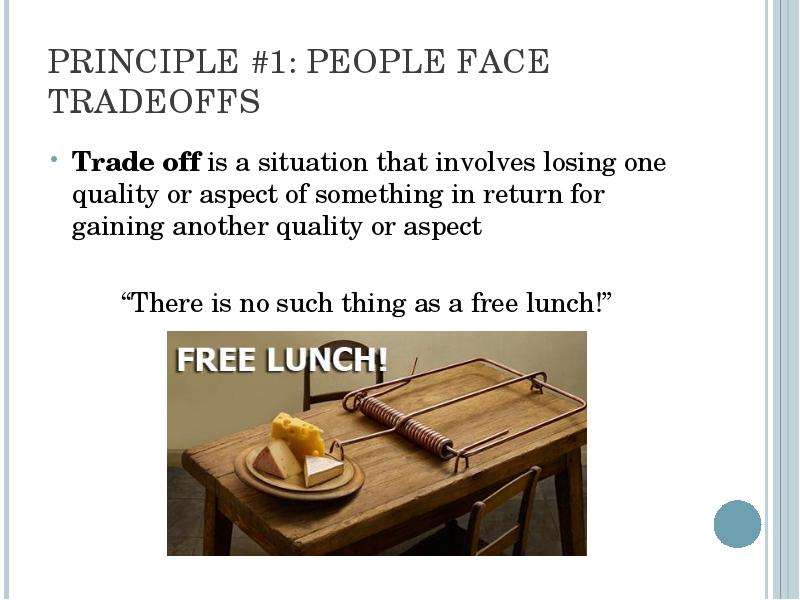
Principle #1: People Face Tradeoffs Trade off is a situation that involves losing one quality or aspect of something in return for gaining another...
Описание слайда:
Principle #1: People Face Tradeoffs Trade off is a situation that involves losing one quality or aspect of something in return for gaining another quality or aspect “There is no such thing as a free lunch!”

Слайд 10


Principle #1: People Face Tradeoffs To get one thing, we usually have to give up another thing. Food v. clothing Leisure time v. work Efficiency v....
Описание слайда:
Principle #1: People Face Tradeoffs To get one thing, we usually have to give up another thing. Food v. clothing Leisure time v. work Efficiency v. equity Making decisions requires trading off one goal against another

Слайд 11


Principle #1: People Face Tradeoffs Efficiency v. Equity Efficiency means society gets the most that it can from its scarce resources. Equity means...
Описание слайда:
Principle #1: People Face Tradeoffs Efficiency v. Equity Efficiency means society gets the most that it can from its scarce resources. Equity means the benefits of those resources are distributed fairly among the members of society.

Слайд 12


Principle #2: The Cost of Something Is What You Give Up to Get It Decisions require comparing costs and benefits of alternatives. Whether to go to...
Описание слайда:
Principle #2: The Cost of Something Is What You Give Up to Get It Decisions require comparing costs and benefits of alternatives. Whether to go to college or to work? Whether to study or go out on a date? Whether to go to class or sleep in? The opportunity cost of an item is what you give up to obtain that item.

Слайд 13


Principle #2: The Cost of Something Is What You Give Up to Get It Cricketing god Sachin Tendulkar decided to quit his education in order to play...
Описание слайда:
Principle #2: The Cost of Something Is What You Give Up to Get It Cricketing god Sachin Tendulkar decided to quit his education in order to play professional cricket for his country.

Слайд 14


Principle #3: Rational People Think at the Margin Rational people people who systematically and purposefully do the best they can to achieve their...
Описание слайда:
Principle #3: Rational People Think at the Margin Rational people people who systematically and purposefully do the best they can to achieve their objectives Marginal changes are small, incremental adjustments to an existing plan of action. People make decisions by comparing costs and benefits at the margin

Слайд 15


Principle #4: People Respond to Incentives Incentives – something that induces a person to act Marginal changes in costs or benefits motivate people...
Описание слайда:
Principle #4: People Respond to Incentives Incentives – something that induces a person to act Marginal changes in costs or benefits motivate people to respond. The decision to choose one alternative over another occurs when that alternative’s marginal benefits exceed its marginal costs!

Слайд 16


Principle #5: Trade Can Make Everyone Better Off People gain from their ability to trade with one another. Competition results in gains from trading....
Описание слайда:
Principle #5: Trade Can Make Everyone Better Off People gain from their ability to trade with one another. Competition results in gains from trading. Trade allows people to specialize in what they do best.

Слайд 17


Principle #6: Markets Are Usually a Good Way to Organize Economic Activity A market economy is an economy that allocates resources through the...
Описание слайда:
Principle #6: Markets Are Usually a Good Way to Organize Economic Activity A market economy is an economy that allocates resources through the decentralized decisions of many firms and households as they interact in markets for goods and services. Households decide what to buy and who to work for. Firms decide who to hire and what to produce

Слайд 18


Principle #6: Markets Are Usually a Good Way to Organize Economic Activity Adam Smith made the observation that households and firms interacting in...
Описание слайда:
Principle #6: Markets Are Usually a Good Way to Organize Economic Activity Adam Smith made the observation that households and firms interacting in markets act as if guided by an “invisible hand.” Because households and firms look at prices when deciding what to buy and sell, they unknowingly take into account the social costs of their actions. As a result, prices guide decision makers to reach outcomes that tend to maximize the welfare of society as a whole.

Слайд 19


Principle #7: Governments Can Sometimes Improve Market Outcomes Market failure occurs when the market fails to allocate resources efficiently. When...
Описание слайда:
Principle #7: Governments Can Sometimes Improve Market Outcomes Market failure occurs when the market fails to allocate resources efficiently. When the market fails (breaks down) government can intervene to promote efficiency and equity

Слайд 20


Principle #7: Governments Can Sometimes Improve Market Outcomes Market failure may be caused by an externality, which is the impact of one person or...
Описание слайда:
Principle #7: Governments Can Sometimes Improve Market Outcomes Market failure may be caused by an externality, which is the impact of one person or firm’s actions on the well-being of a bystander. market power, which is the ability of a single person or firm to unduly influence market prices.

Слайд 21


Principle #8: The Standard of Living Depends on a Country’s Production Standard of living may be measured in different ways: By comparing personal...
Описание слайда:
Principle #8: The Standard of Living Depends on a Country’s Production Standard of living may be measured in different ways: By comparing personal incomes. By comparing the total market value of a nation’s production.

Слайд 22


Principle #8: The Standard of Living Depends on a Country’s Production Almost all variations in living standards are explained by differences in...
Описание слайда:
Principle #8: The Standard of Living Depends on a Country’s Production Almost all variations in living standards are explained by differences in countries’ productivities. Productivity is the amount of goods and services produced from each hour of a worker’s time. Standard of living may be measured in different ways: By comparing personal incomes. By comparing the total market value of a nation’s production.

Слайд 23


Principle #9: Prices Rise When the Government Prints Too Much Money Inflation is an increase in the overall level of prices in the economy. One cause...
Описание слайда:
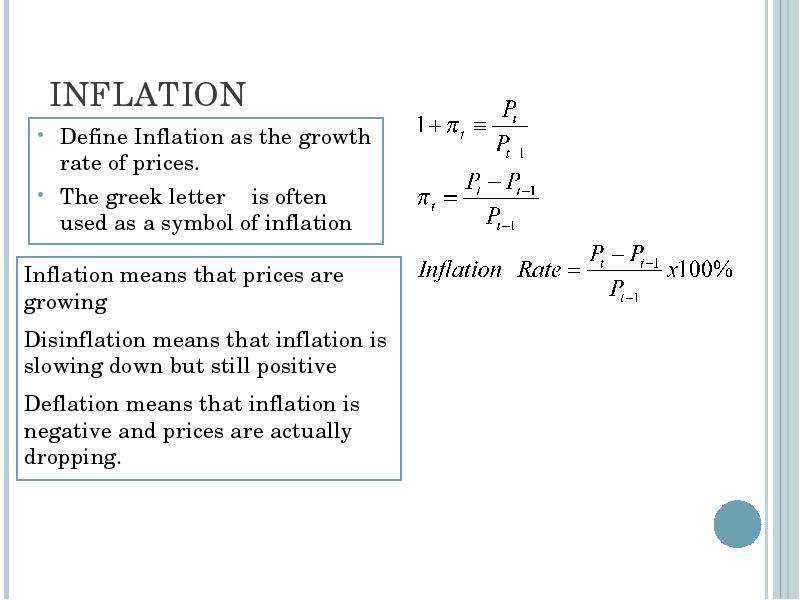
Principle #9: Prices Rise When the Government Prints Too Much Money Inflation is an increase in the overall level of prices in the economy. One cause of inflation is the growth in the quantity of money. When the government creates large quantities of money, the value of the money falls.

Слайд 24


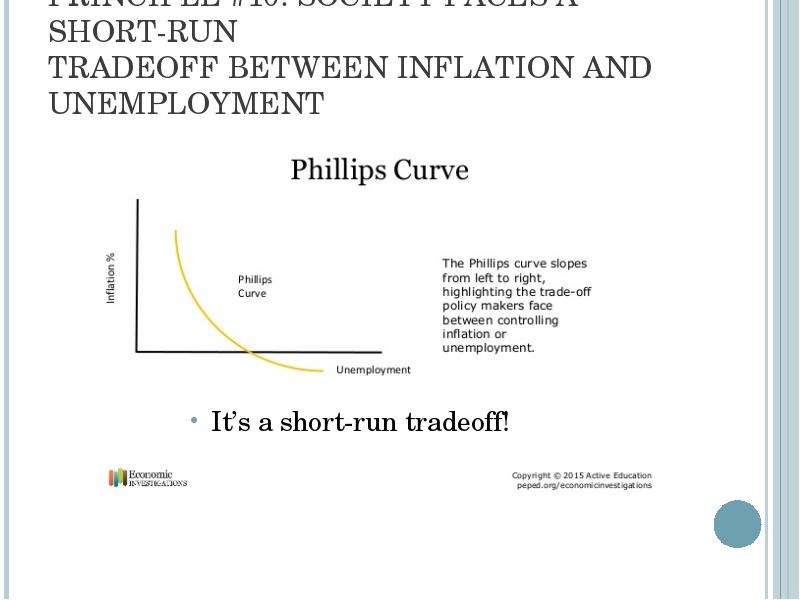
Principle #10: Society Faces a Short-run Tradeoff Between Inflation and Unemployment It’s a short-run tradeoff!
Описание слайда:
Principle #10: Society Faces a Short-run Tradeoff Between Inflation and Unemployment It’s a short-run tradeoff!

Слайд 25


Summary When individuals make decisions, they face tradeoffs among alternative goals. The cost of any action is measured in terms of foregone...
Описание слайда:
Summary When individuals make decisions, they face tradeoffs among alternative goals. The cost of any action is measured in terms of foregone opportunities. Rational people make decisions by comparing marginal costs and marginal benefits. People change their behavior in response to the incentives they face.

Слайд 26


Summary Trade can be mutually beneficial. Markets are usually a good way of coordinating trade among people. Government can potentially improve...
Описание слайда:
Summary Trade can be mutually beneficial. Markets are usually a good way of coordinating trade among people. Government can potentially improve market outcomes if there is some market failure or if the market outcome is inequitable

Слайд 27


Summary Productivity is the ultimate source of living standards. Money growth is the ultimate source of inflation. Society faces a short-run tradeoff...
Описание слайда:
Summary Productivity is the ultimate source of living standards. Money growth is the ultimate source of inflation. Society faces a short-run tradeoff between inflation and unemployment.

Слайд 28


Macroeconomics Introduction to Macroeconomics Zharova Liubov Zharova_l@ua.fm
Описание слайда:
Macroeconomics Introduction to Macroeconomics Zharova Liubov Zharova_l@ua.fm

Слайд 29


Intro individual decision-making Microeconomics examines the behavior of units—business firms and households. Macroeconomics deals with the economy...
Описание слайда:
Intro individual decision-making Microeconomics examines the behavior of units—business firms and households. Macroeconomics deals with the economy as a whole; it examines the behavior of economic aggregates such as aggregate income, consumption, investment, and the overall level of prices. Aggregate behavior refers to the behavior of all households and firms together.

Слайд 30


Intro When we study the consumption behaviour or equilibrium of a consumer; the production pattern & equilibrium of a firm, the entire analysis is...
Описание слайда:
Intro When we study the consumption behaviour or equilibrium of a consumer; the production pattern & equilibrium of a firm, the entire analysis is ‘micro’ in nature……because we study a UNIT and not the SYSTEM in which it is operating

Слайд 31


Intro Microeconomists generally conclude that markets work well. Macroeconomists, however, observe that some important prices often seem “sticky”...
Описание слайда:
Intro Microeconomists generally conclude that markets work well. Macroeconomists, however, observe that some important prices often seem “sticky” Sticky prices are prices that do not always adjust rapidly to maintain the equality between quantity supplied and quantity demanded.

Слайд 32


Intro Macroeconomists often reflect on the microeconomic principles underlying macroeconomic analysis, or the microeconomic foundations of...
Описание слайда:
Intro Macroeconomists often reflect on the microeconomic principles underlying macroeconomic analysis, or the microeconomic foundations of macroeconomics

Слайд 33


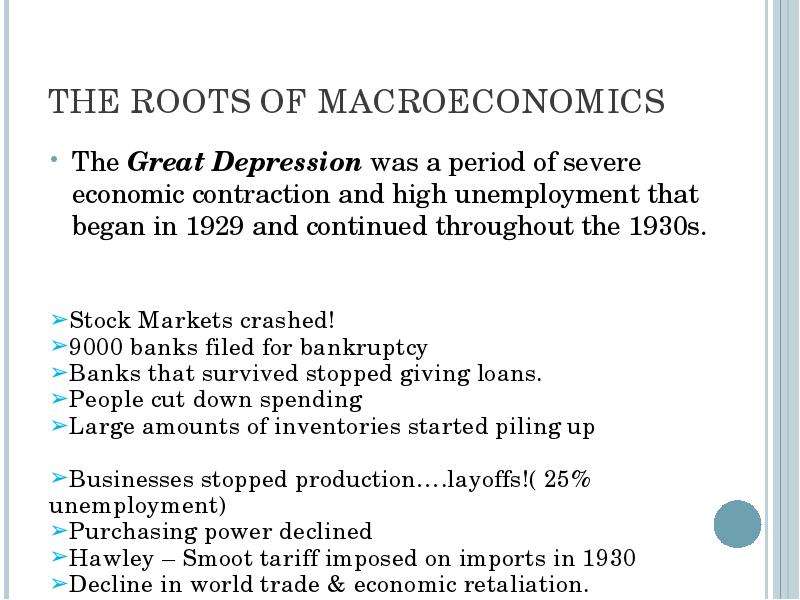
The Roots of Macroeconomics The Great Depression was a period of severe economic contraction and high unemployment that began in 1929 and continued...
Описание слайда:
The Roots of Macroeconomics The Great Depression was a period of severe economic contraction and high unemployment that began in 1929 and continued throughout the 1930s.

Слайд 34


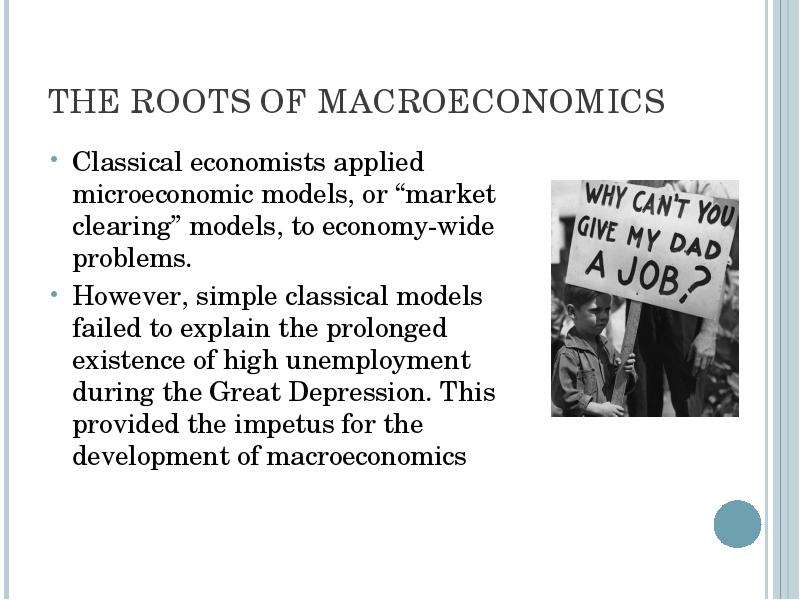
The Roots of Macroeconomics Classical economists applied microeconomic models, or “market clearing” models, to economy-wide problems. However, simple...
Описание слайда:
The Roots of Macroeconomics Classical economists applied microeconomic models, or “market clearing” models, to economy-wide problems. However, simple classical models failed to explain the prolonged existence of high unemployment during the Great Depression. This provided the impetus for the development of macroeconomics

Слайд 35


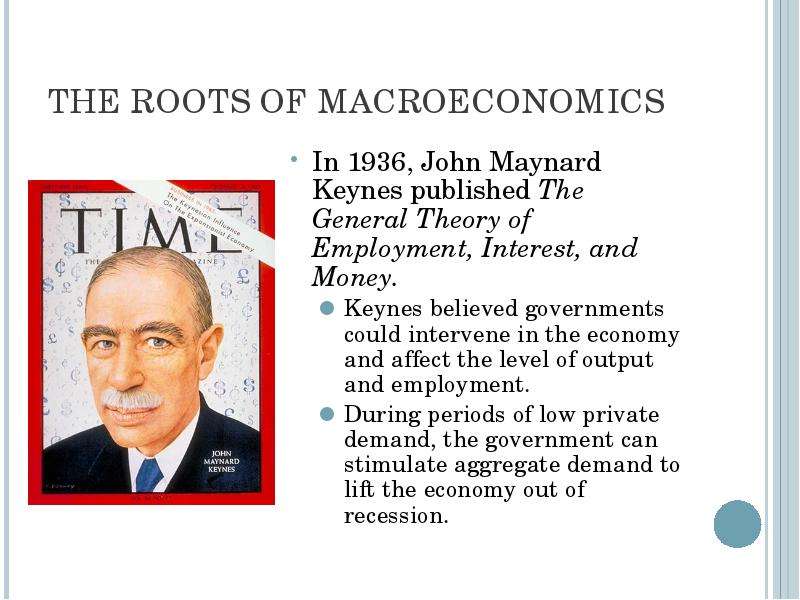
The Roots of Macroeconomics In 1936, John Maynard Keynes published The General Theory of Employment, Interest, and Money. Keynes believed governments...
Описание слайда:
The Roots of Macroeconomics In 1936, John Maynard Keynes published The General Theory of Employment, Interest, and Money. Keynes believed governments could intervene in the economy and affect the level of output and employment. During periods of low private demand, the government can stimulate aggregate demand to lift the economy out of recession.

Слайд 36


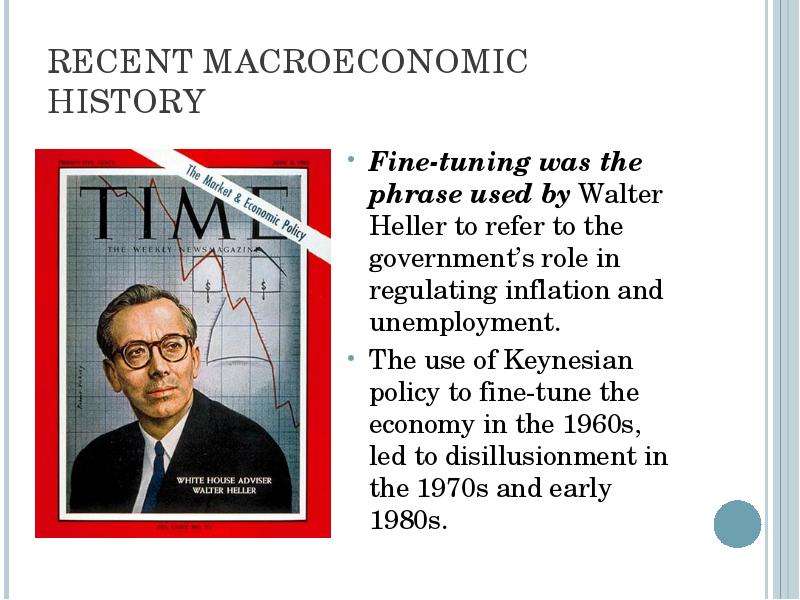
Recent Macroeconomic History Fine-tuning was the phrase used by Walter Heller to refer to the government’s role in regulating inflation and...
Описание слайда:
Recent Macroeconomic History Fine-tuning was the phrase used by Walter Heller to refer to the government’s role in regulating inflation and unemployment. The use of Keynesian policy to fine-tune the economy in the 1960s, led to disillusionment in the 1970s and early 1980s.

Слайд 37


Why to Study Macroeconomics? Macroeconomics is the study of the nation’s economy as a whole. We can use macroeconomic analysis to: Understand why...
Описание слайда:
Why to Study Macroeconomics? Macroeconomics is the study of the nation’s economy as a whole. We can use macroeconomic analysis to: Understand why economies grow. Understand economic fluctuations. Make informed business decisions.

Слайд 38


Macroeconomic Concerns Three of the major concerns of macroeconomics are: Inflation Output growth Unemployment
Описание слайда:
Macroeconomic Concerns Three of the major concerns of macroeconomics are: Inflation Output growth Unemployment

Слайд 39


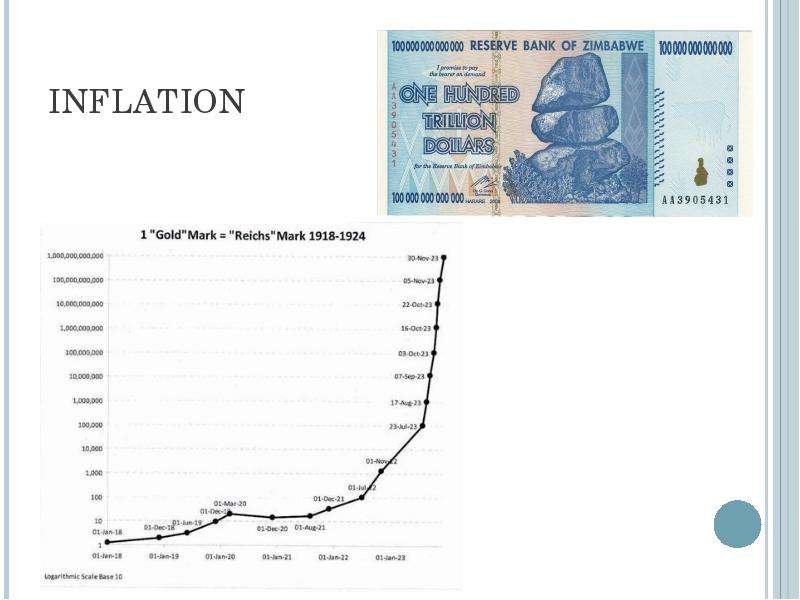
Inflation and Deflation Inflation is an increase in the overall price level. Hyperinflation is a period of very rapid increases in the overall price...
Описание слайда:
Inflation and Deflation Inflation is an increase in the overall price level. Hyperinflation is a period of very rapid increases in the overall price level. Hyperinflations are rare, but have been used to study the costs and consequences of even moderate inflation. Deflation is a decrease in the overall price level. Prolonged periods of deflation can be just as damaging for the economy as sustained inflation.

Слайд 40


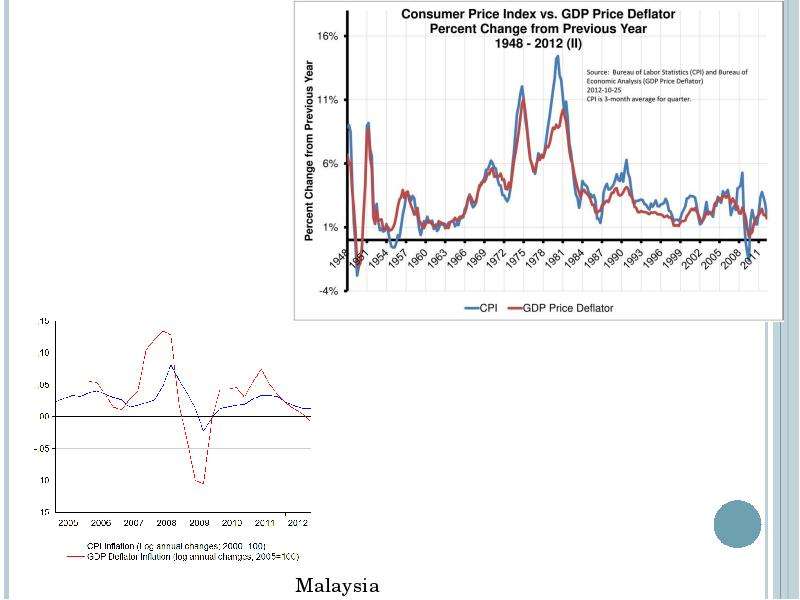
Inflation
Описание слайда:
Inflation

Слайд 41


Output Growth: Short Run and Long Run The business cycle is the cycle of short-term ups and downs in the economy. The main measure of how an economy...
Описание слайда:
Output Growth: Short Run and Long Run The business cycle is the cycle of short-term ups and downs in the economy. The main measure of how an economy is doing is aggregate output: Aggregate output is the total quantity of goods and services produced in an economy in a given period

Слайд 42


10 principles of economics, слайд №42
Описание слайда:

Слайд 43


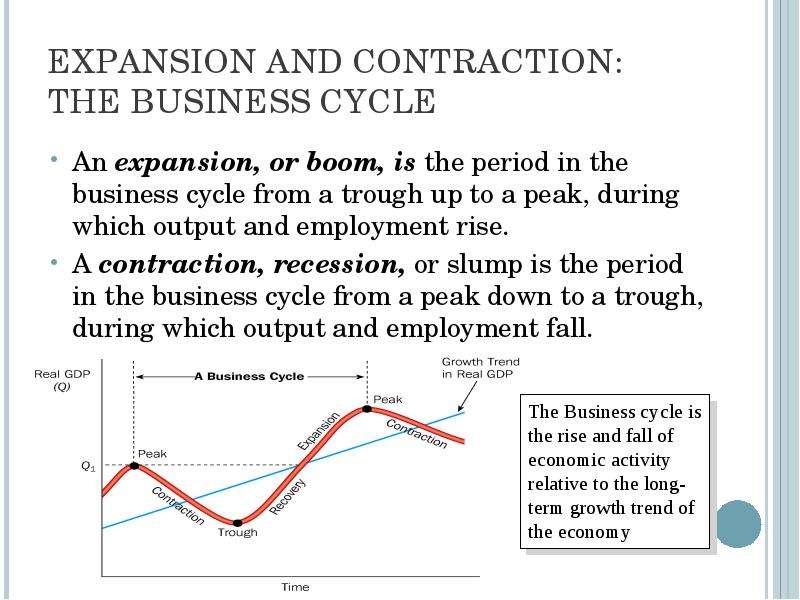
Ups and downs of the Business Cycle Peak: at the peak of the business cycle, Real GDP is at a temporary high. Contraction: A decline in the real GDP....
Описание слайда:
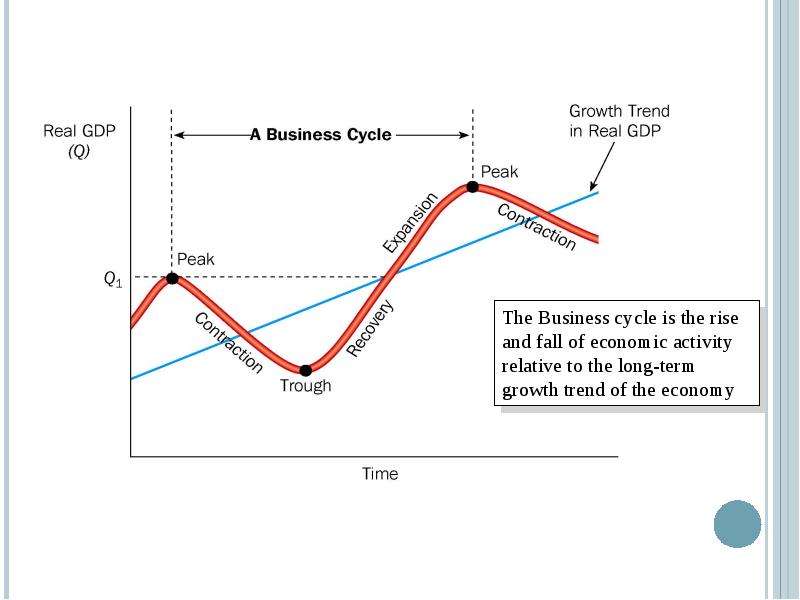
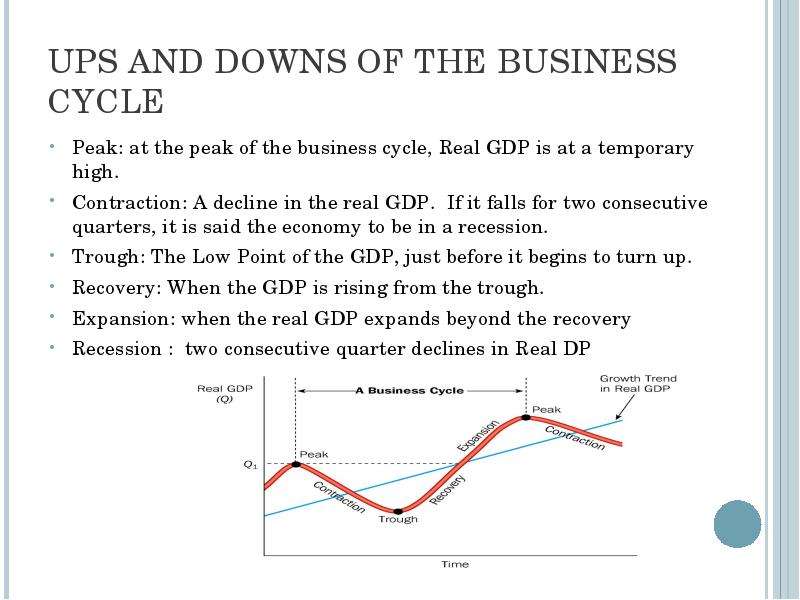
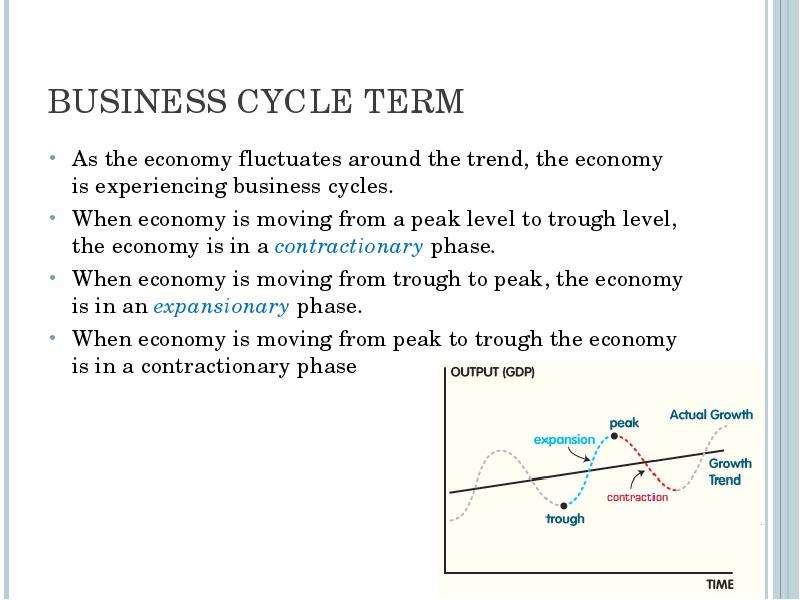
Ups and downs of the Business Cycle Peak: at the peak of the business cycle, Real GDP is at a temporary high. Contraction: A decline in the real GDP. If it falls for two consecutive quarters, it is said the economy to be in a recession. Trough: The Low Point of the GDP, just before it begins to turn up. Recovery: When the GDP is rising from the trough. Expansion: when the real GDP expands beyond the recovery Recession : two consecutive quarter declines in Real DP

Слайд 44


Recent Macroeconomic History Stagflation occurs when the overall price level rises rapidly (inflation) during periods of recession or high and...
Описание слайда:
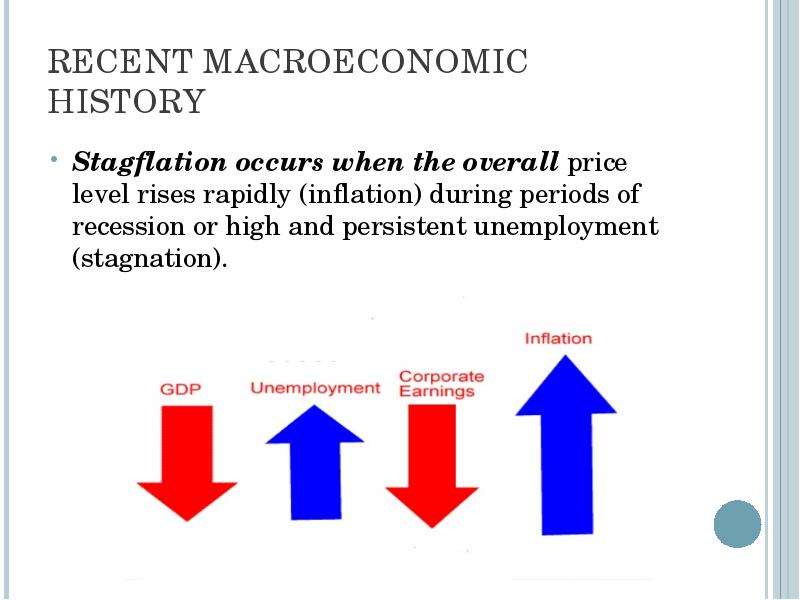
Recent Macroeconomic History Stagflation occurs when the overall price level rises rapidly (inflation) during periods of recession or high and persistent unemployment (stagnation).

Слайд 45


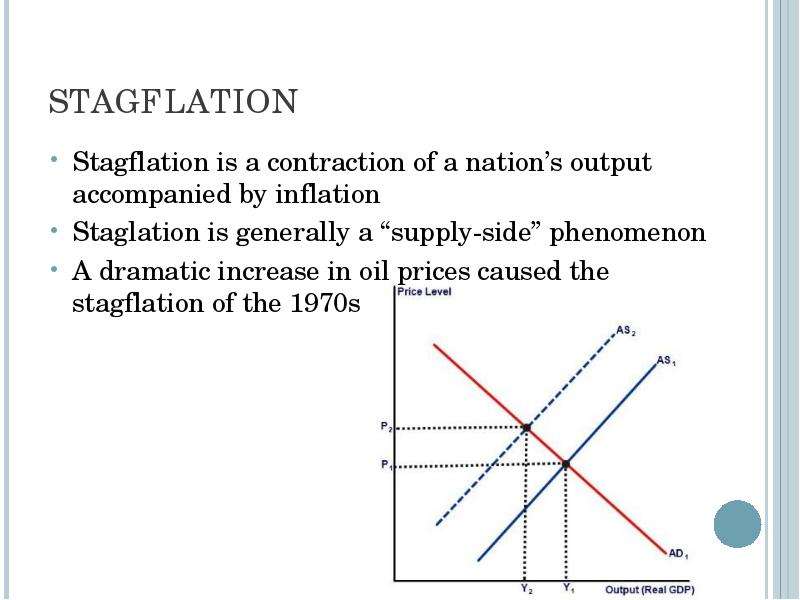
Stagflation Stagflation is a contraction of a nation’s output accompanied by inflation Staglation is generally a “supply-side” phenomenon A dramatic...
Описание слайда:
Stagflation Stagflation is a contraction of a nation’s output accompanied by inflation Staglation is generally a “supply-side” phenomenon A dramatic increase in oil prices caused the stagflation of the 1970s

Слайд 46


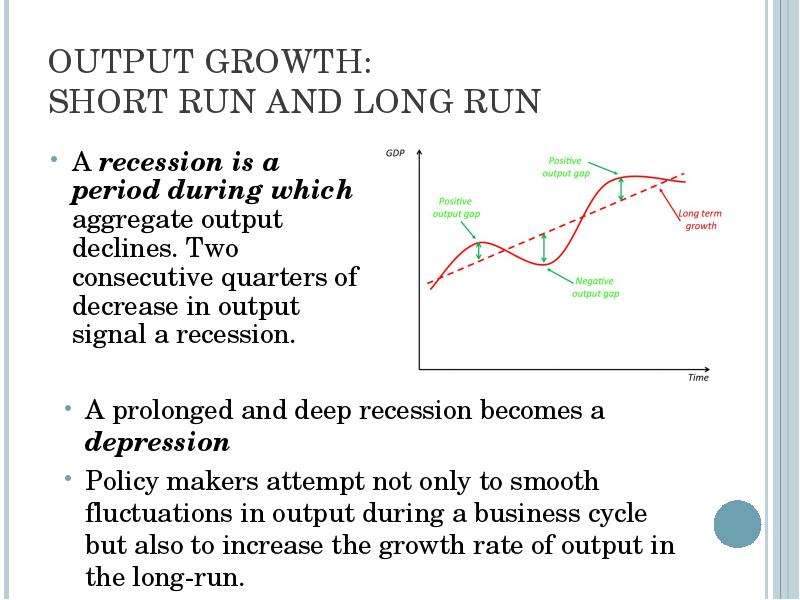
Output Growth: Short Run and Long Run A recession is a period during which aggregate output declines. Two consecutive quarters of decrease in output...
Описание слайда:
Output Growth: Short Run and Long Run A recession is a period during which aggregate output declines. Two consecutive quarters of decrease in output signal a recession.

Слайд 47


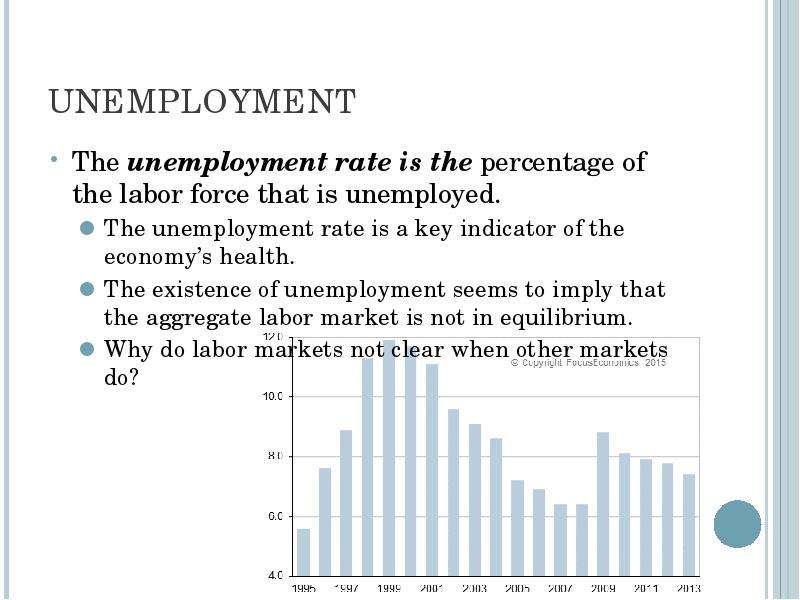
Unemployment The unemployment rate is the percentage of the labor force that is unemployed. The unemployment rate is a key indicator of the economy’s...
Описание слайда:
Unemployment The unemployment rate is the percentage of the labor force that is unemployed. The unemployment rate is a key indicator of the economy’s health. The existence of unemployment seems to imply that the aggregate labor market is not in equilibrium. Why do labor markets not clear when other markets do?

Слайд 48


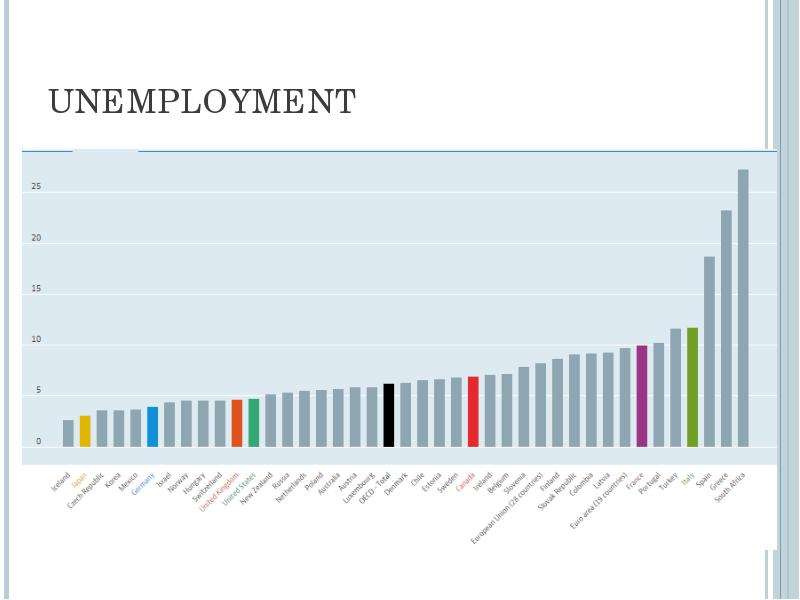
Unemployment
Описание слайда:
Unemployment

Слайд 49


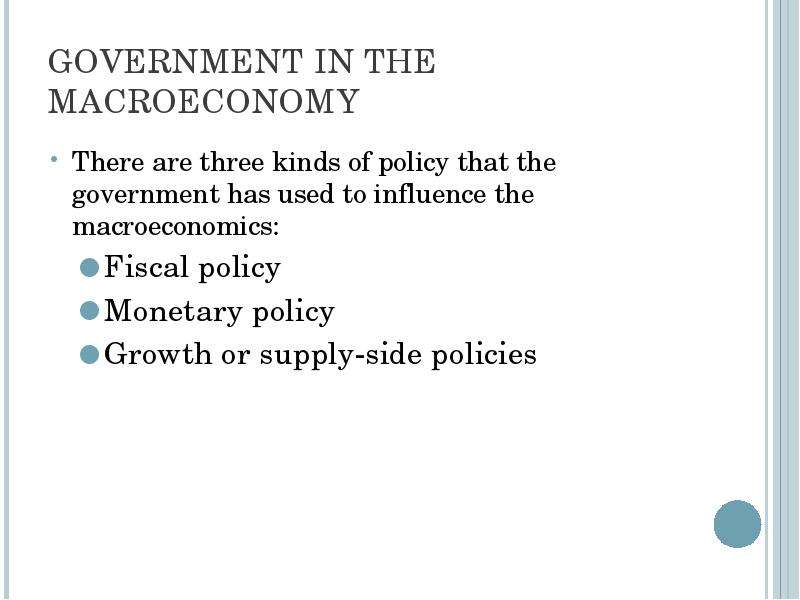
Government in the Macroeconomy There are three kinds of policy that the government has used to influence the macroeconomics: Fiscal policy Monetary...
Описание слайда:
Government in the Macroeconomy There are three kinds of policy that the government has used to influence the macroeconomics: Fiscal policy Monetary policy Growth or supply-side policies

Слайд 50


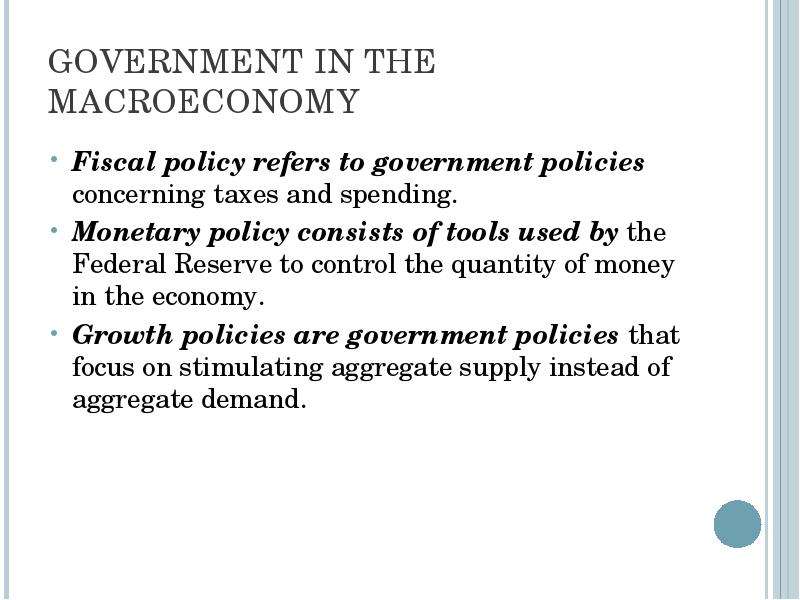
Government in the Macroeconomy Fiscal policy refers to government policies concerning taxes and spending. Monetary policy consists of tools used by...
Описание слайда:
Government in the Macroeconomy Fiscal policy refers to government policies concerning taxes and spending. Monetary policy consists of tools used by the Federal Reserve to control the quantity of money in the economy. Growth policies are government policies that focus on stimulating aggregate supply instead of aggregate demand.

Слайд 51


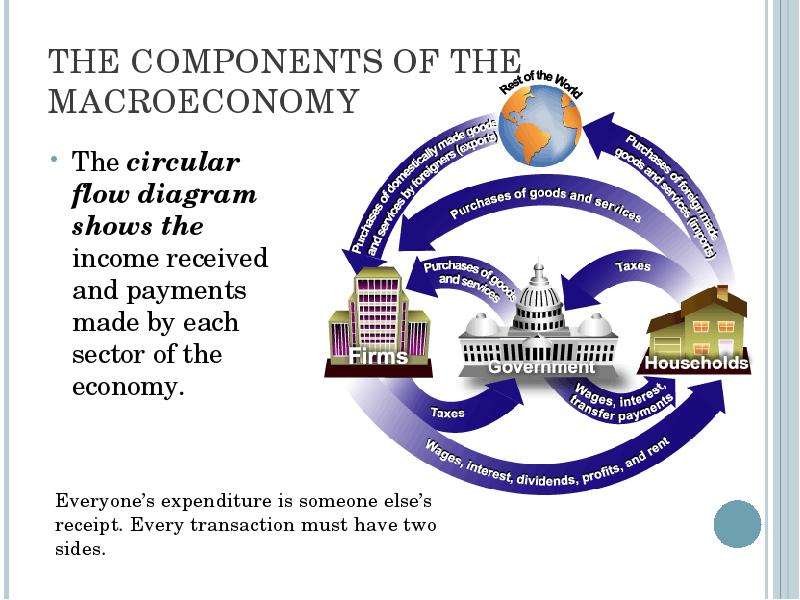
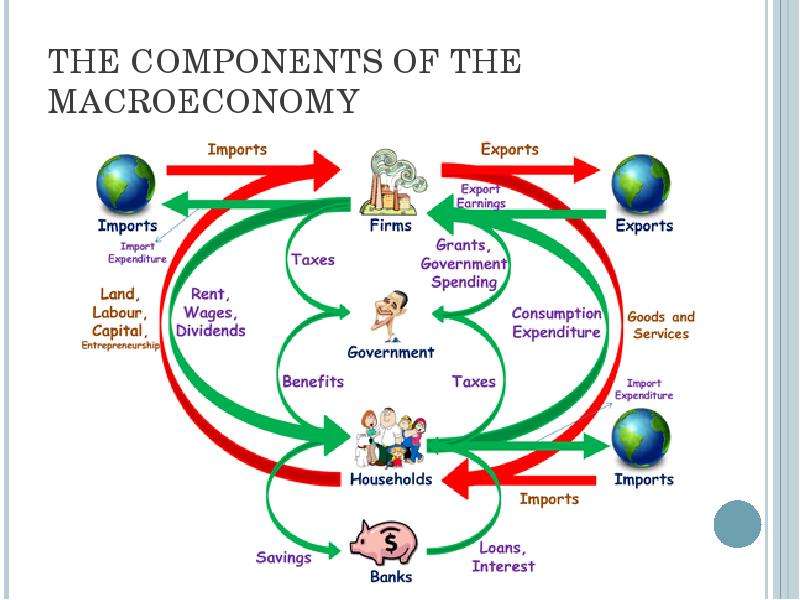
The Components of the Macroeconomy The circular flow diagram shows the income received and payments made by each sector of the economy.
Описание слайда:
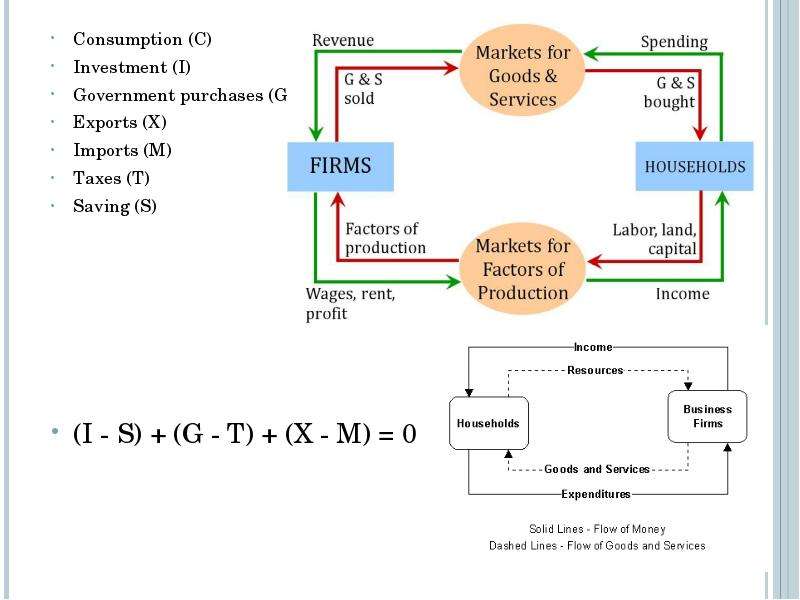
The Components of the Macroeconomy The circular flow diagram shows the income received and payments made by each sector of the economy.

Слайд 52


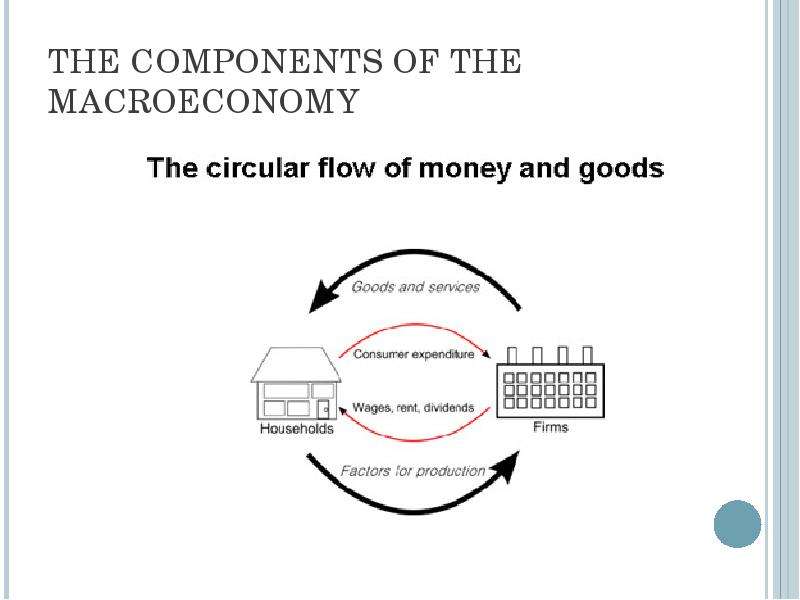
The Components of the Macroeconomy
Описание слайда:
The Components of the Macroeconomy

Слайд 53


The Components of the Macroeconomy
Описание слайда:
The Components of the Macroeconomy

Слайд 54


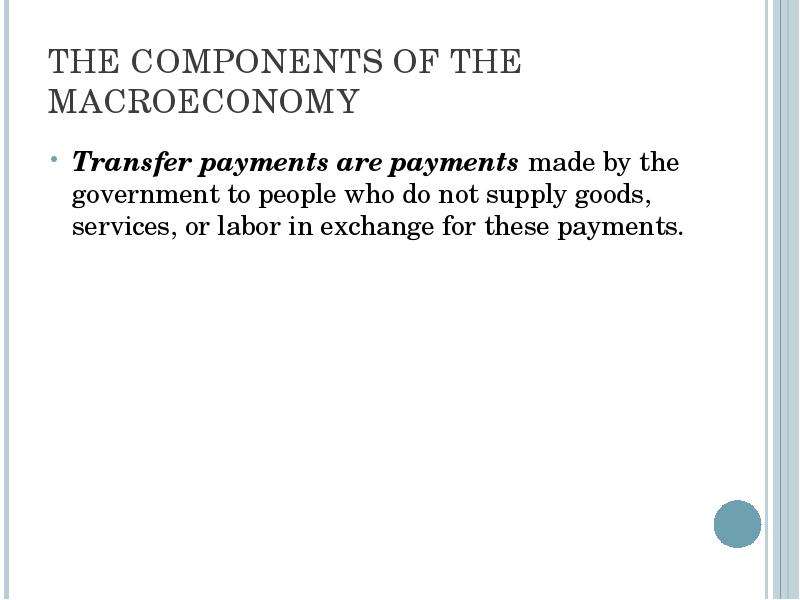
The Components of the Macroeconomy Transfer payments are payments made by the government to people who do not supply goods, services, or labor in...
Описание слайда:
The Components of the Macroeconomy Transfer payments are payments made by the government to people who do not supply goods, services, or labor in exchange for these payments.

Слайд 55


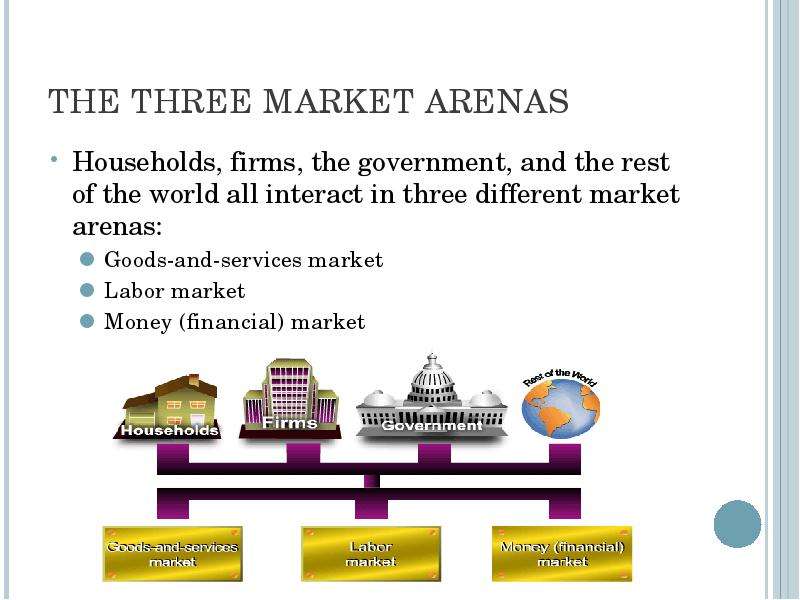
The Three Market Arenas Households, firms, the government, and the rest of the world all interact in three different market arenas:...
Описание слайда:
The Three Market Arenas Households, firms, the government, and the rest of the world all interact in three different market arenas: Goods-and-services market Labor market Money (financial) market

Слайд 56


The Three Market Arenas Households and the government purchase goods and services (demand) from firms in the goods-and services market, and firms...
Описание слайда:
The Three Market Arenas Households and the government purchase goods and services (demand) from firms in the goods-and services market, and firms supply to the goods and services market. In the labor market, firms and government purchase (demand) labor from households (supply). The total supply of labor in the economy depends on the sum of decisions made by households.

Слайд 57


The Three Market Arenas In the money market – sometimes called the financial market – households purchase stocks and bonds from firms. Households...
Описание слайда:
The Three Market Arenas In the money market – sometimes called the financial market – households purchase stocks and bonds from firms. Households supply funds to this market in the expectation of earning income, and also demand (borrow) funds from this market. Firms, government, and the rest of the world also engage in borrowing and lending, coordinated by financial institutions.

Слайд 58


Financial Instruments Treasury bonds, notes, and bills are promissory notes issued by the federal government when it borrows money. Corporate bonds...
Описание слайда:
Financial Instruments Treasury bonds, notes, and bills are promissory notes issued by the federal government when it borrows money. Corporate bonds are promissory notes issued by corporations when they borrow money Shares of stock are financial instruments that give to the holder a share in the firm’s ownership and therefore the right to share in the firm’s profits. Dividends are the portion of a corporation’s profits that the firm pays out each period to its shareholders.hen they borrow money.

Слайд 59


The Methodology of Macroeconomics Connections to microeconomics: Macroeconomic behavior is the sum of all the microeconomic decisions made by...
Описание слайда:
The Methodology of Macroeconomics Connections to microeconomics: Macroeconomic behavior is the sum of all the microeconomic decisions made by individual households and firms. We cannot understand the former without some knowledge of the factors that influence the latter.

Слайд 60


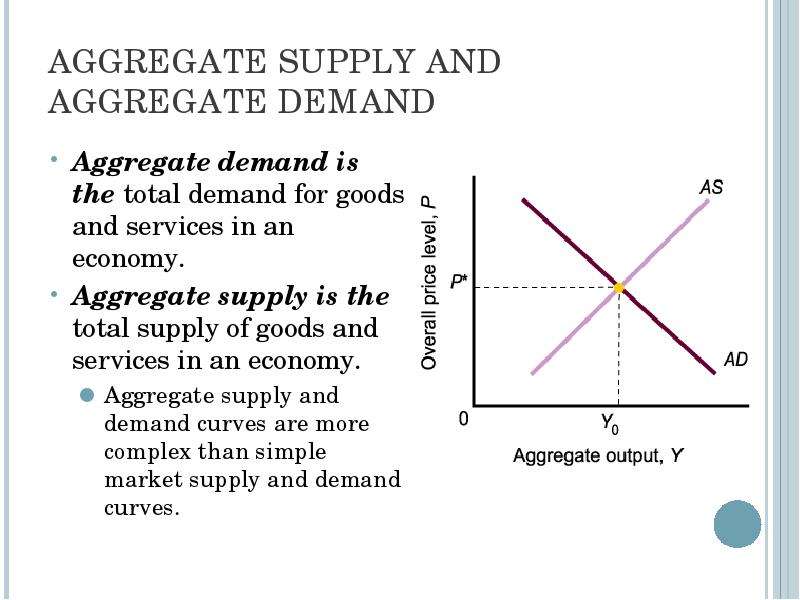
Aggregate Supply and Aggregate Demand Aggregate demand is the total demand for goods and services in an economy. Aggregate supply is the total supply...
Описание слайда:
Aggregate Supply and Aggregate Demand Aggregate demand is the total demand for goods and services in an economy. Aggregate supply is the total supply of goods and services in an economy. Aggregate supply and demand curves are more complex than simple market supply and demand curves.

Слайд 61


Expansion and Contraction: The Business Cycle An expansion, or boom, is the period in the business cycle from a trough up to a peak, during which...
Описание слайда:
Expansion and Contraction: The Business Cycle An expansion, or boom, is the period in the business cycle from a trough up to a peak, during which output and employment rise. A contraction, recession, or slump is the period in the business cycle from a peak down to a trough, during which output and employment fall.

Слайд 62


Review Terms and Concepts aggregate behavior aggregate demand aggregate output aggregate supply business cycle circular flow contraction, recession,...
Описание слайда:
Review Terms and Concepts aggregate behavior aggregate demand aggregate output aggregate supply business cycle circular flow contraction, recession, or slump corporate bonds deflation depression microeconomics monetary policy recession shares of stock stagflation sticky prices supply-side policies transfer payments Treasury bonds, notes, bills unemployment rate dividends expansion or boom fine tuning fiscal policy Great Depression hyperinflation inflation macroeconomics microeconomic foundations of macroeconomics

Слайд 63


Macroeconomics The Measurement and Structure of the National Economy Zharova Liubov Zharova_l@ua.fm
Описание слайда:
Macroeconomics The Measurement and Structure of the National Economy Zharova Liubov Zharova_l@ua.fm

Слайд 64


Outline National Income Accounting: The Measurement of Production, Income, and Expenditure Gross Domestic Product Saving and Wealth Real GDP, Price...
Описание слайда:
Outline National Income Accounting: The Measurement of Production, Income, and Expenditure Gross Domestic Product Saving and Wealth Real GDP, Price Indexes, and Inflation Interest Rates

Слайд 65


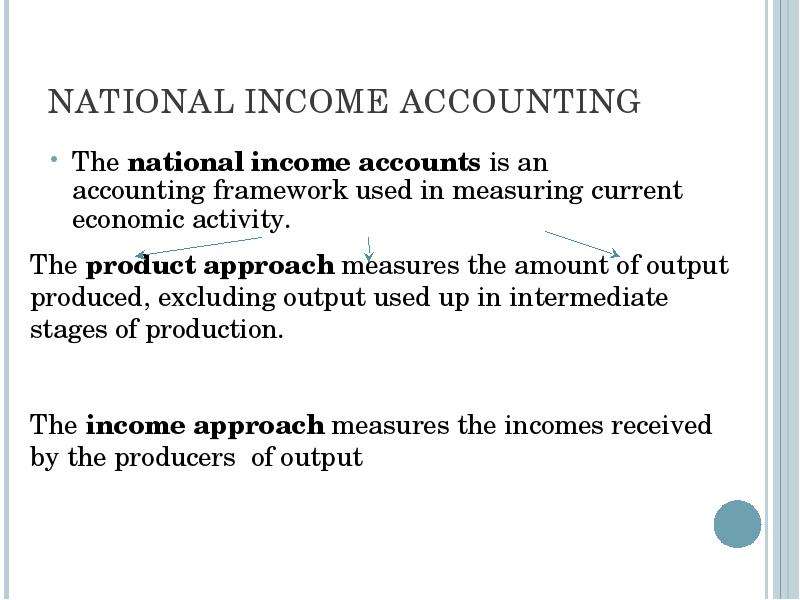
National Income Accounting The national income accounts is an accounting framework used in measuring current economic activity.
Описание слайда:
National Income Accounting The national income accounts is an accounting framework used in measuring current economic activity.

Слайд 66


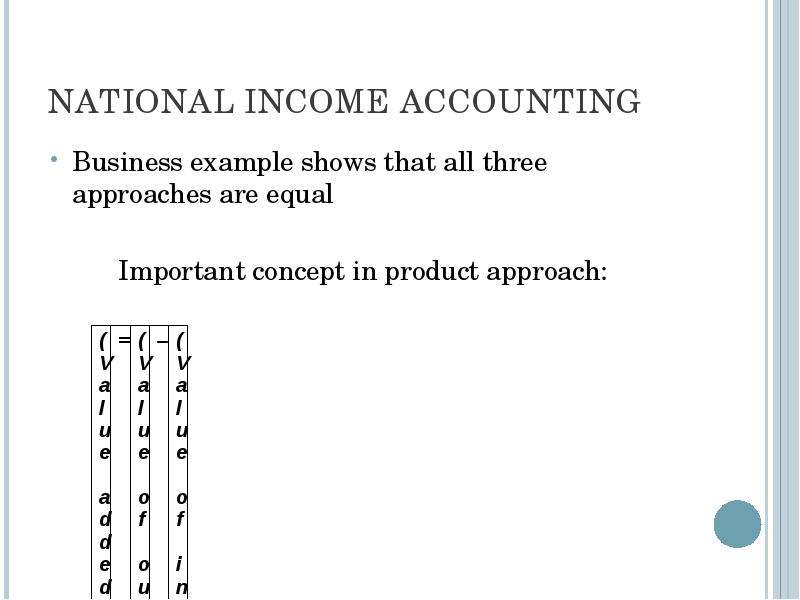
National Income Accounting Business example shows that all three approaches are equal Important concept in product approach:
Описание слайда:
National Income Accounting Business example shows that all three approaches are equal Important concept in product approach:

Слайд 67


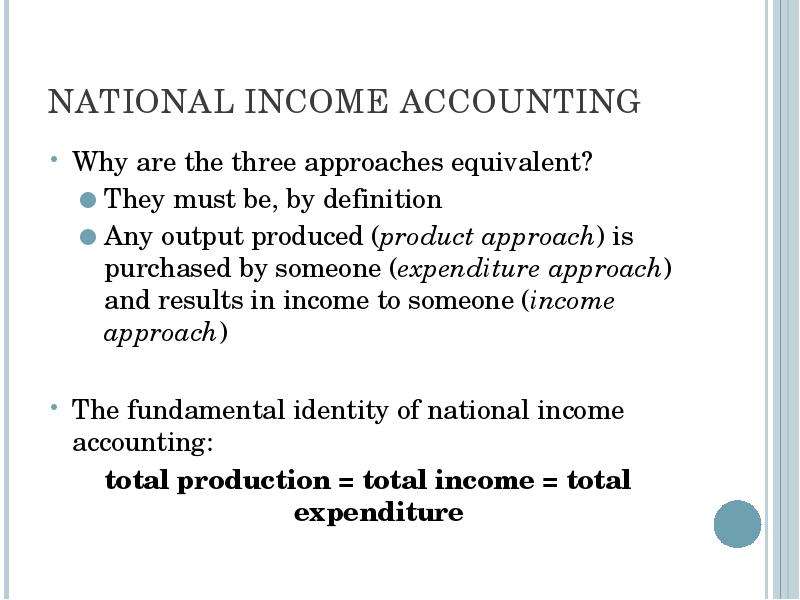
National Income Accounting Why are the three approaches equivalent? They must be, by definition Any output produced (product approach) is purchased...
Описание слайда:
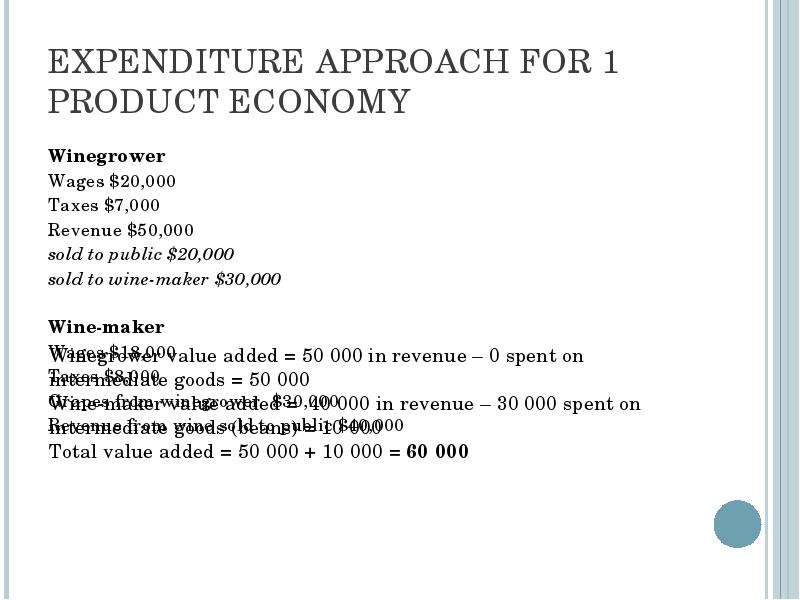
National Income Accounting Why are the three approaches equivalent? They must be, by definition Any output produced (product approach) is purchased by someone (expenditure approach) and results in income to someone (income approach) The fundamental identity of national income accounting: total production = total income = total expenditure

Слайд 68


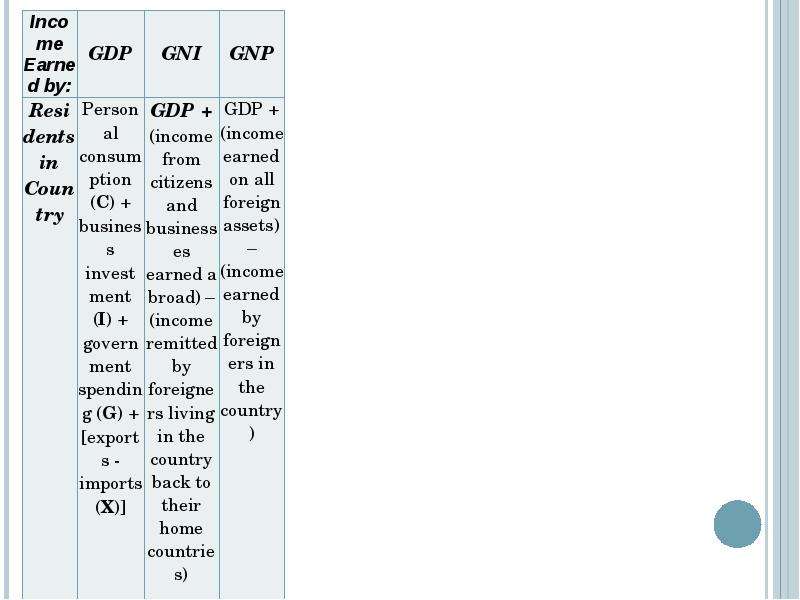
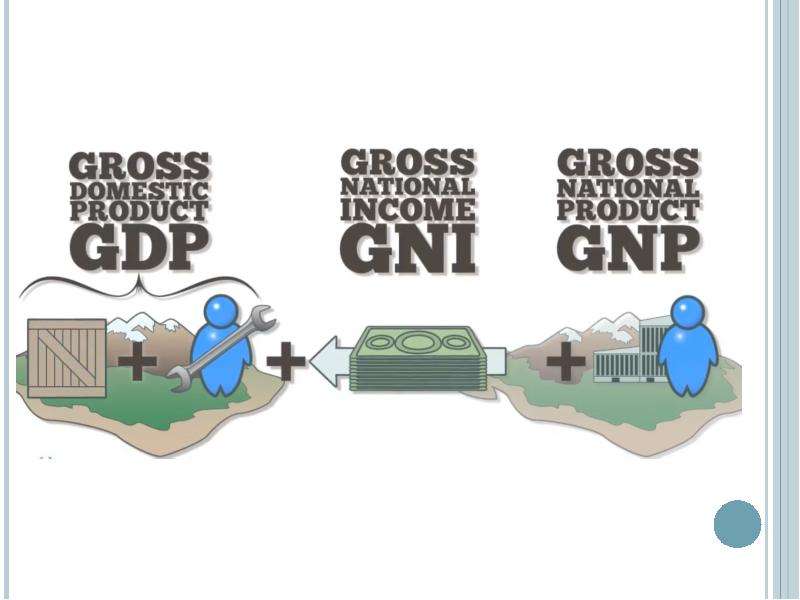
National Income Accounting Some of the metrics calculated by using national income accounting include Gross Domestic Product (GDP) Gross National...
Описание слайда:
National Income Accounting Some of the metrics calculated by using national income accounting include Gross Domestic Product (GDP) Gross National Product (GNP) Gross National Income (GNI).

Слайд 69


Gross Domestic Product The product approach to measuring GDP
Описание слайда:
Gross Domestic Product The product approach to measuring GDP

Слайд 70


Gross Domestic Product Market value: allows adding together unlike items by valuing them at their market prices Problem: misses nonmarket items such...
Описание слайда:
Gross Domestic Product Market value: allows adding together unlike items by valuing them at their market prices Problem: misses nonmarket items such as homemaking, the value of environmental quality, and natural resource depletion There is some adjustment to reflect the underground economy Government services (that aren’t sold in markets) are valued at their cost of production

Слайд 71


10 principles of economics, слайд №71
Описание слайда:

Слайд 72


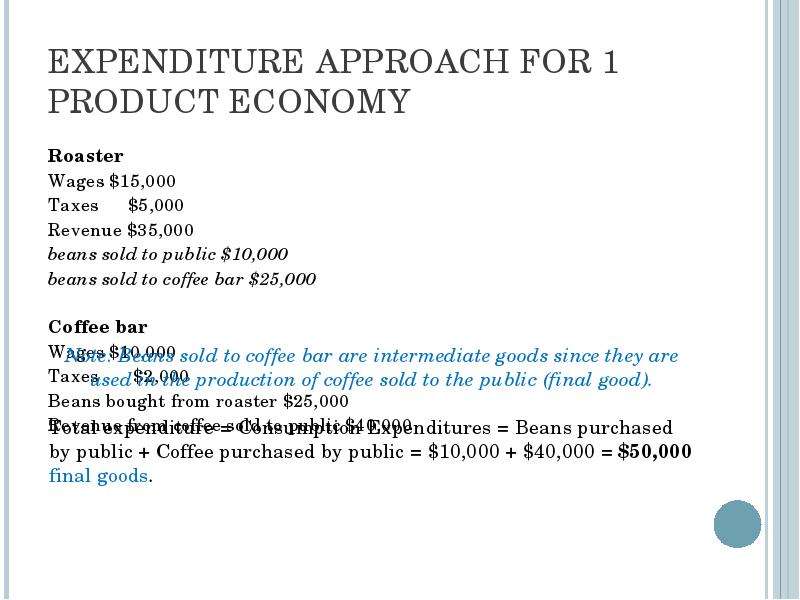
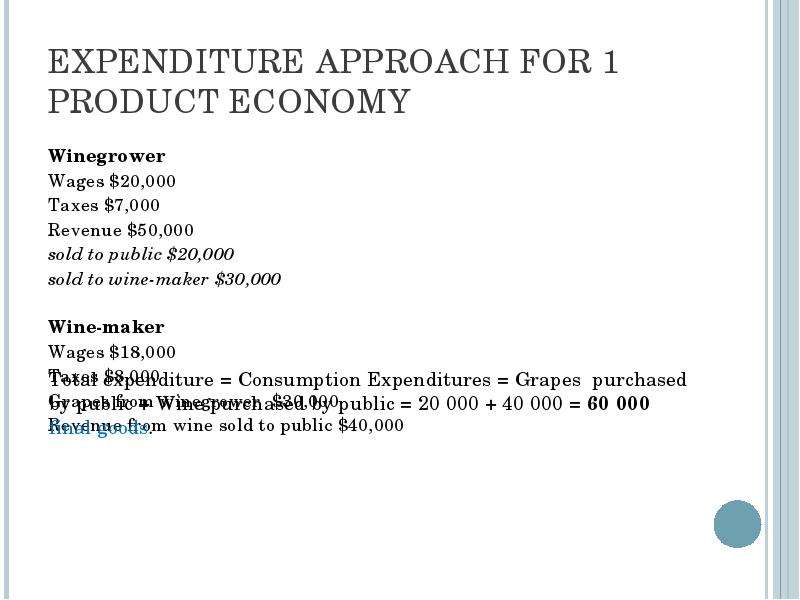
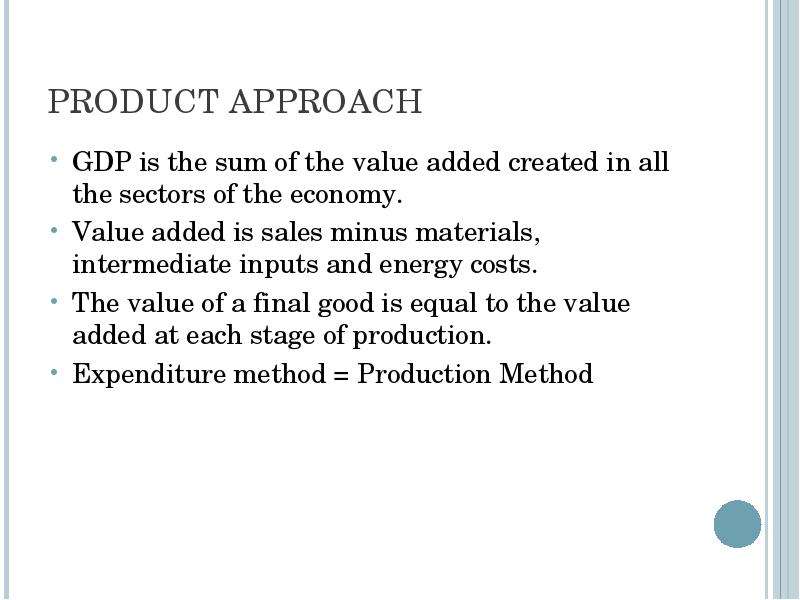
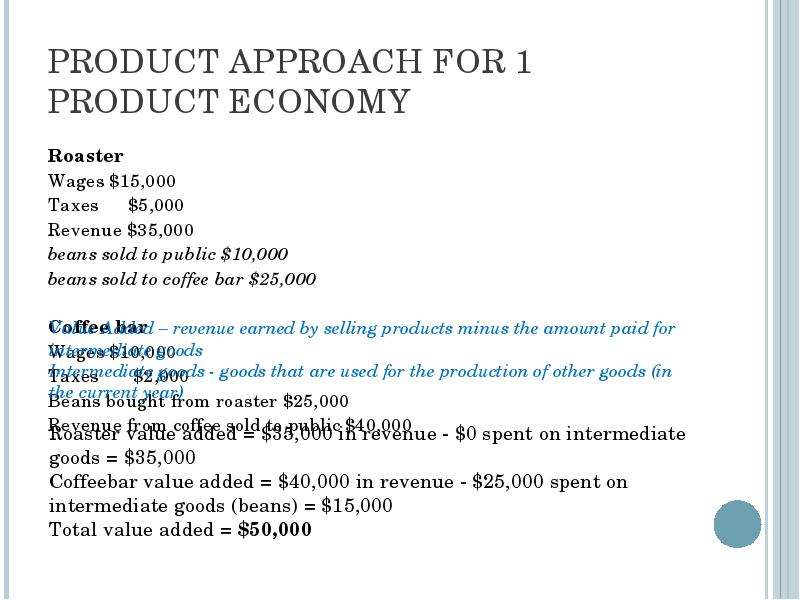
GDP Newly produced: counts only things produced in the given period; excludes things produced earlier Final goods and services* - are those that are...
Описание слайда:
GDP Newly produced: counts only things produced in the given period; excludes things produced earlier Final goods and services* - are those that are not intermediate *Don’t count intermediate goods and services (those used up in the production of other goods and services in the same period that they themselves were produced) Capital goods (goods used to produce other goods) are final goods since they aren’t used up in the same period that they are produced Inventory investment (the amount that inventories of unsold finished goods, goods in process, and raw materials have changed during the period) is also treated as a final good Adding up value added works well, since it automatically excludes intermediate goods

Слайд 73


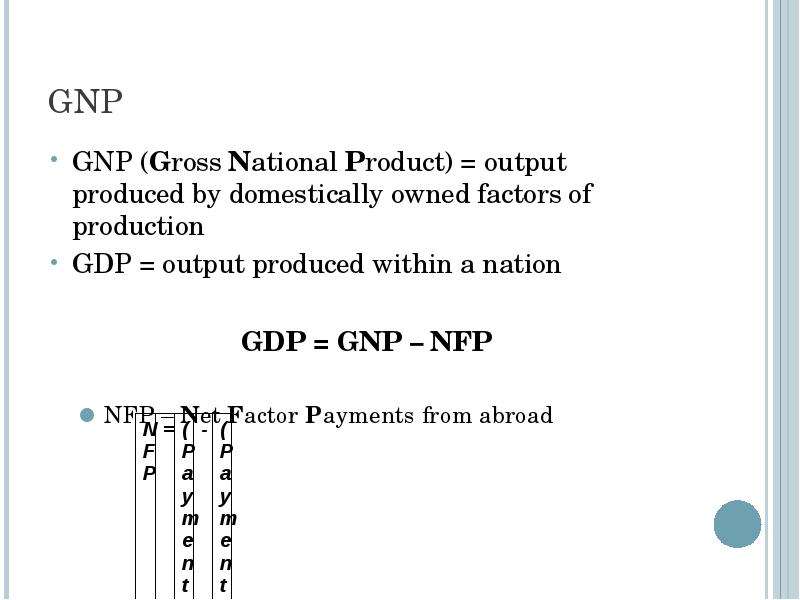
GNP GNP (Gross National Product) = output produced by domestically owned factors of production GDP = output produced within a nation GDP = GNP – NFP...
Описание слайда:
GNP GNP (Gross National Product) = output produced by domestically owned factors of production GDP = output produced within a nation GDP = GNP – NFP NFP – Net Factor Payments from abroad

Слайд 74


GNP Example: Engineering revenues for a road built by a U.S. company in Saudi Arabia is part of U.S. GNP (built by a U.S. factor of production), not...
Описание слайда:
GNP Example: Engineering revenues for a road built by a U.S. company in Saudi Arabia is part of U.S. GNP (built by a U.S. factor of production), not U.S. GDP, and is part of Saudi GDP (built in Saudi Arabia), not Saudi GNP Difference between GNP and GDP is small for the United States, about 0.2%, but higher for countries that have many citizens working abroad

Слайд 75


Example If a Japanese multinational produces cars in the UK, this production will be counted towards UK GDP. However, if the Japanese firm sends £50m...
Описание слайда:
Example If a Japanese multinational produces cars in the UK, this production will be counted towards UK GDP. However, if the Japanese firm sends £50m in profits back to shareholders in Japan, then this outflow of profit is subtracted from GNP. UK nationals don’t benefit from this profit which is sent back to Japan. If a UK firm makes a profit from insurance companies located abroad, then if this profit is returned to UK nationals, then this net income from overseas assets will be added to UK GNP. Note, if a Japanese firm invests in the UK, it will still lead to higher GNP, as some national workers will see higher wages. However, the increase in GNP will not be as high as GDP. If a county has similar inflows and outflows of income from assets, then GNP and GDP will be very similar. However, if a country has many multinationals who repatriate income from local production, then GNP will be lower than GDP. For example, Luxembourg has a GDP of $87,400 but a GNP of only $45,360.

Слайд 76


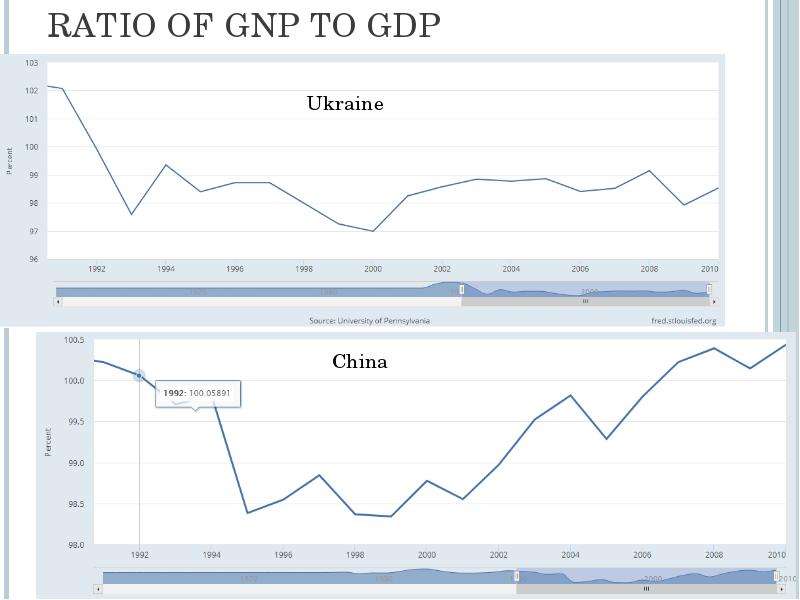
Ratio of GNP to GDP
Описание слайда:
Ratio of GNP to GDP

Слайд 77


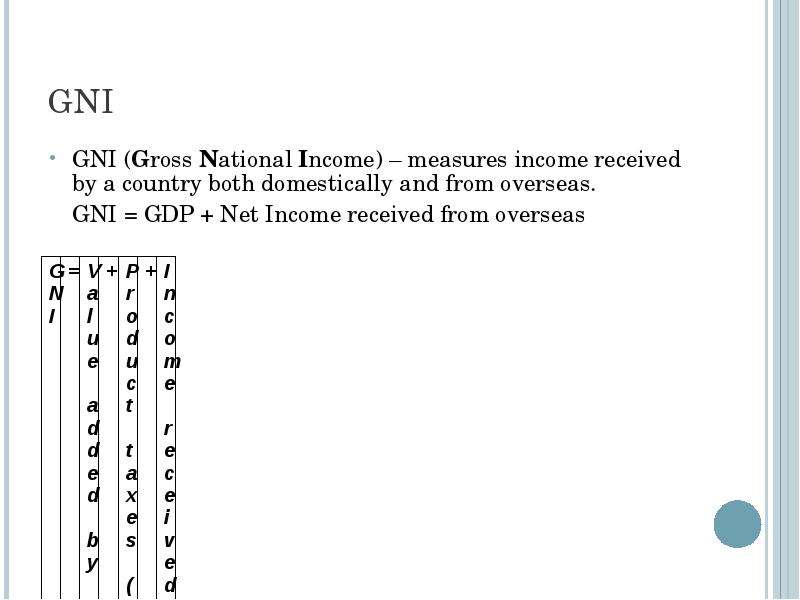
GNI GNI (Gross National Income) – measures income received by a country both domestically and from overseas. GNI = GDP + Net Income received from...
Описание слайда:
GNI GNI (Gross National Income) – measures income received by a country both domestically and from overseas. GNI = GDP + Net Income received from overseas

Слайд 78


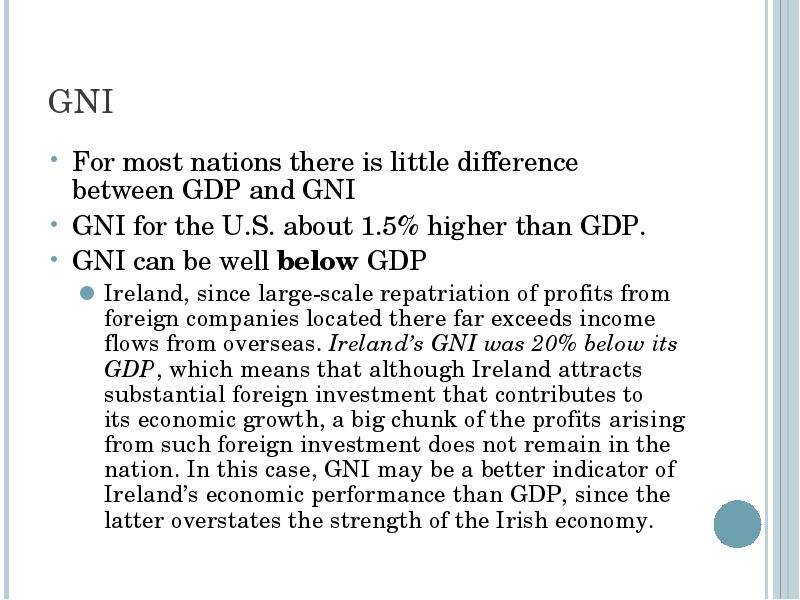
GNI For most nations there is little difference between GDP and GNI GNI for the U.S. about 1.5% higher than GDP. GNI can be well below GDP Ireland,...
Описание слайда:
GNI For most nations there is little difference between GDP and GNI GNI for the U.S. about 1.5% higher than GDP. GNI can be well below GDP Ireland, since large-scale repatriation of profits from foreign companies located there far exceeds income flows from overseas. Ireland’s GNI was 20% below its GDP, which means that although Ireland attracts substantial foreign investment that contributes to its economic growth, a big chunk of the profits arising from such foreign investment does not remain in the nation. In this case, GNI may be a better indicator of Ireland’s economic performance than GDP, since the latter overstates the strength of the Irish economy.

Слайд 79


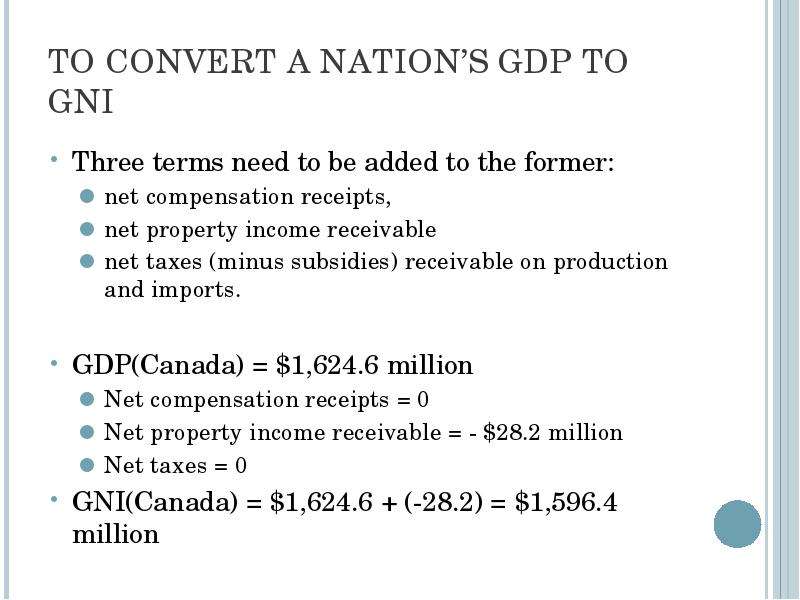
To convert a nation’s GDP to GNI Three terms need to be added to the former: net compensation receipts, net property income receivable net taxes...
Описание слайда:
To convert a nation’s GDP to GNI Three terms need to be added to the former: net compensation receipts, net property income receivable net taxes (minus subsidies) receivable on production and imports. GDP(Canada) = $1,624.6 million Net compensation receipts = 0 Net property income receivable = - $28.2 million Net taxes = 0 GNI(Canada) = $1,624.6 + (-28.2) = $1,596.4 million

Слайд 80


10 principles of economics, слайд №80
Описание слайда:

Слайд 81


10 principles of economics, слайд №81
Описание слайда:

Слайд 82


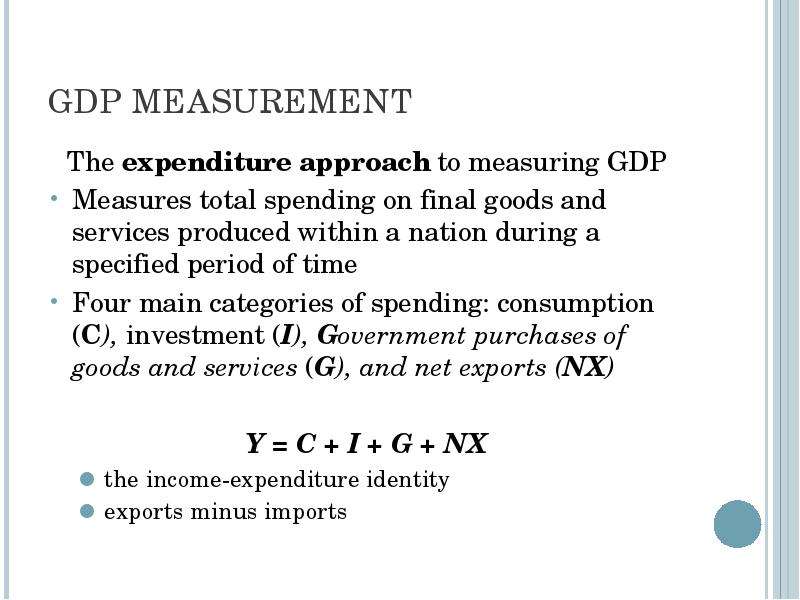
GDP measurement The expenditure approach to measuring GDP Measures total spending on final goods and services produced within a nation during a...
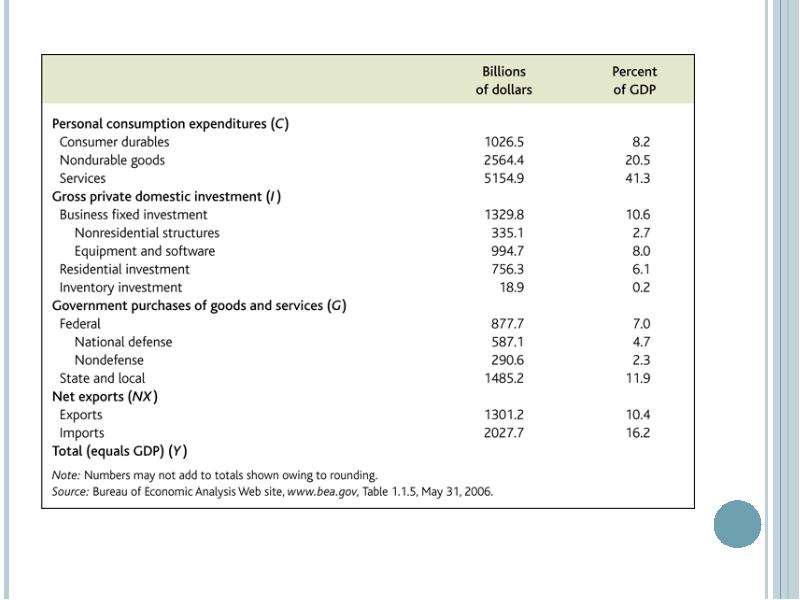
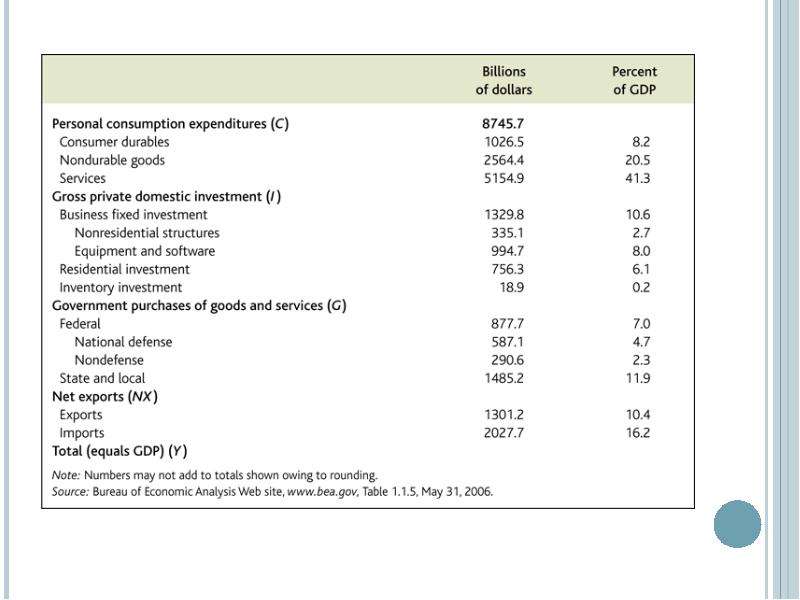
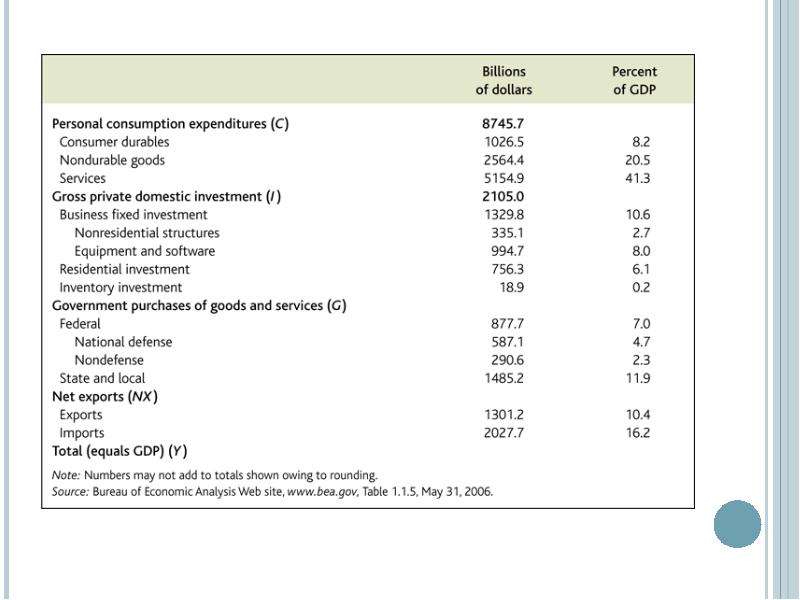
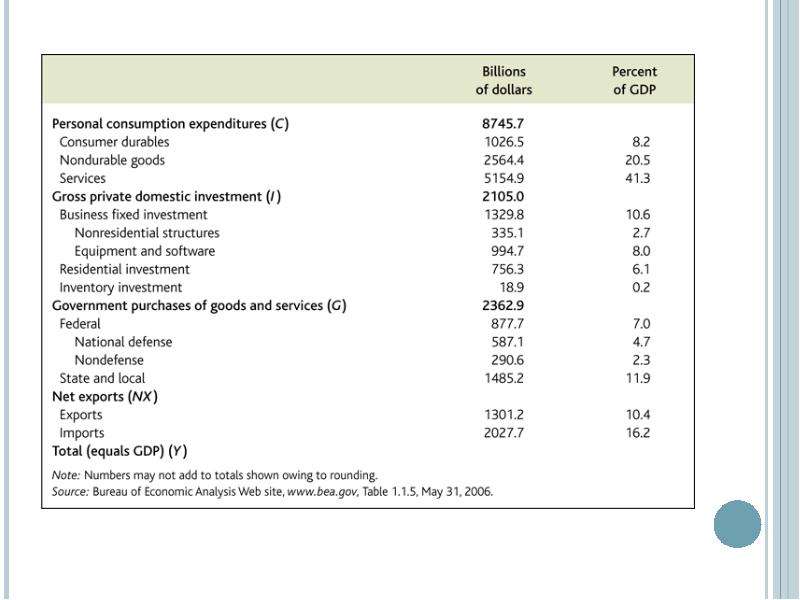
Описание слайда:
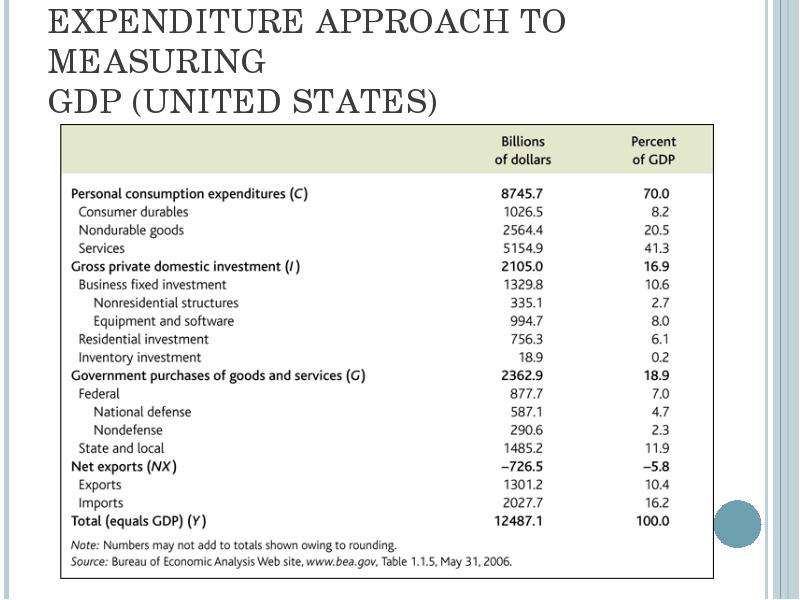
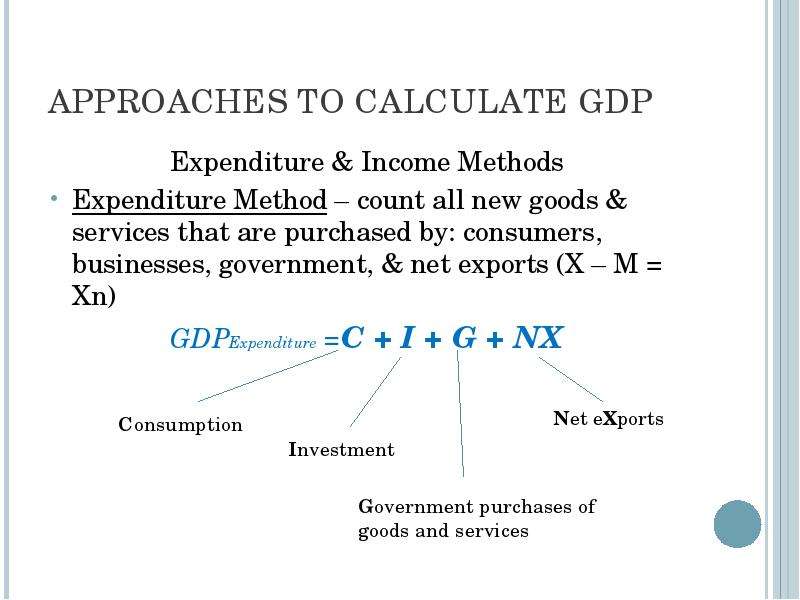
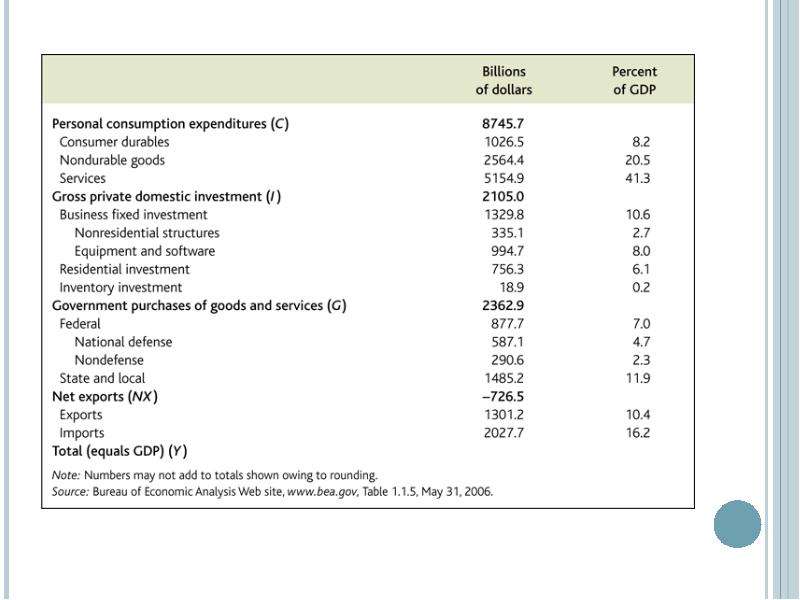
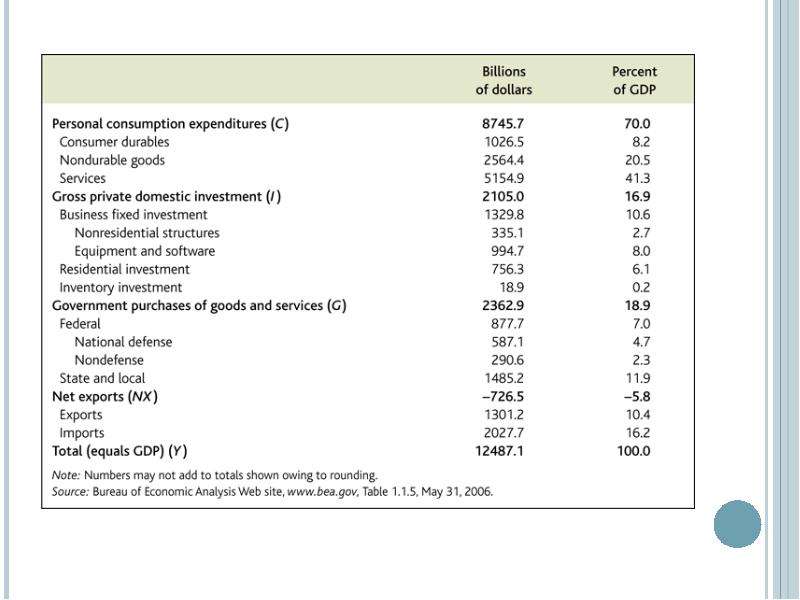
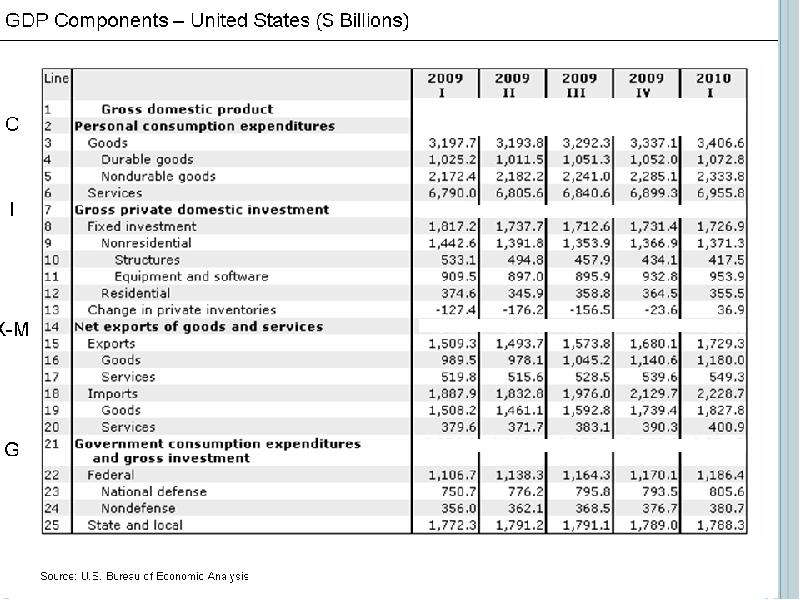
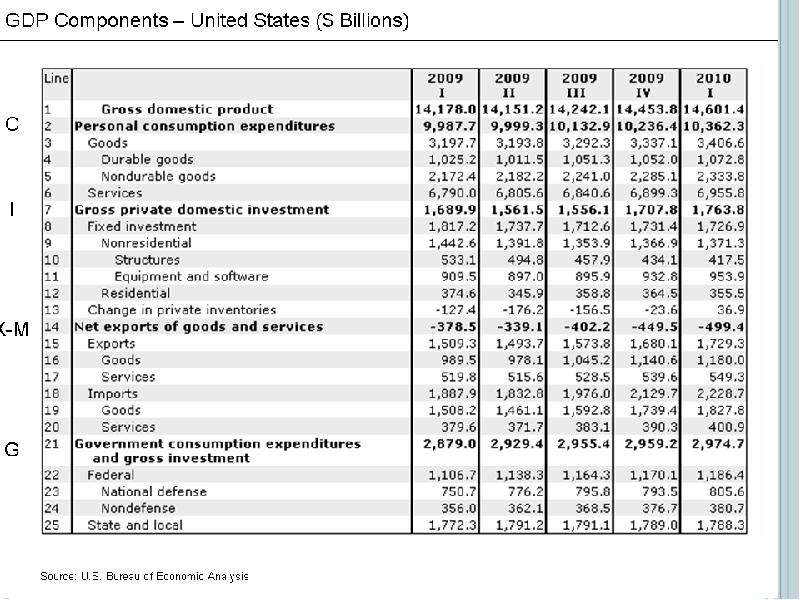
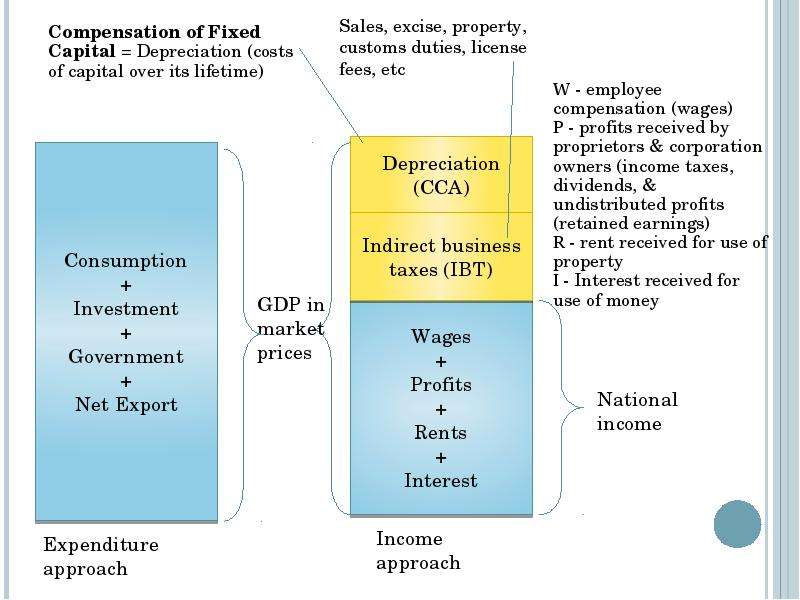
GDP measurement The expenditure approach to measuring GDP Measures total spending on final goods and services produced within a nation during a specified period of time Four main categories of spending: consumption (C), investment (I), Government purchases of goods and services (G), and net exports (NX) Y = C + I + G + NX the income-expenditure identity exports minus imports

Слайд 83


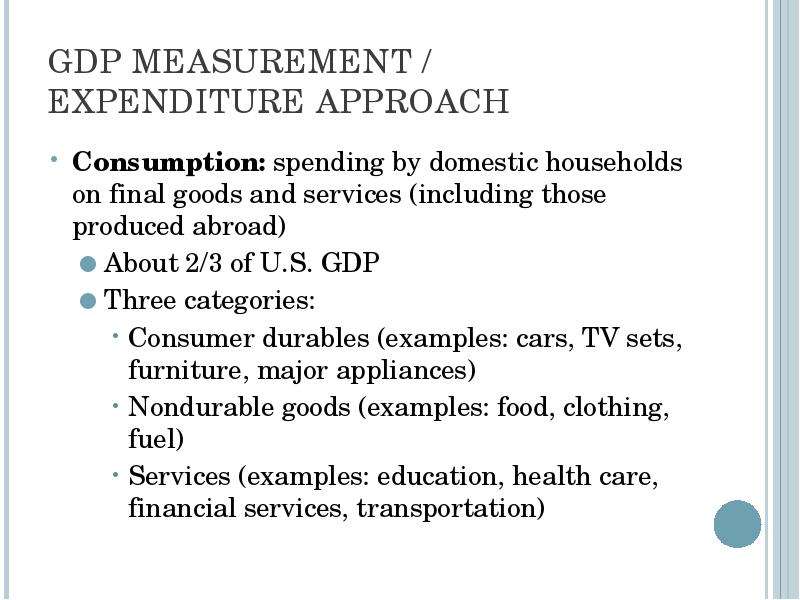
GDP measurement / expenditure approach Consumption: spending by domestic households on final goods and services (including those produced abroad)...
Описание слайда:
GDP measurement / expenditure approach Consumption: spending by domestic households on final goods and services (including those produced abroad) About 2/3 of U.S. GDP Three categories: Consumer durables (examples: cars, TV sets, furniture, major appliances) Nondurable goods (examples: food, clothing, fuel) Services (examples: education, health care, financial services, transportation)

Слайд 84


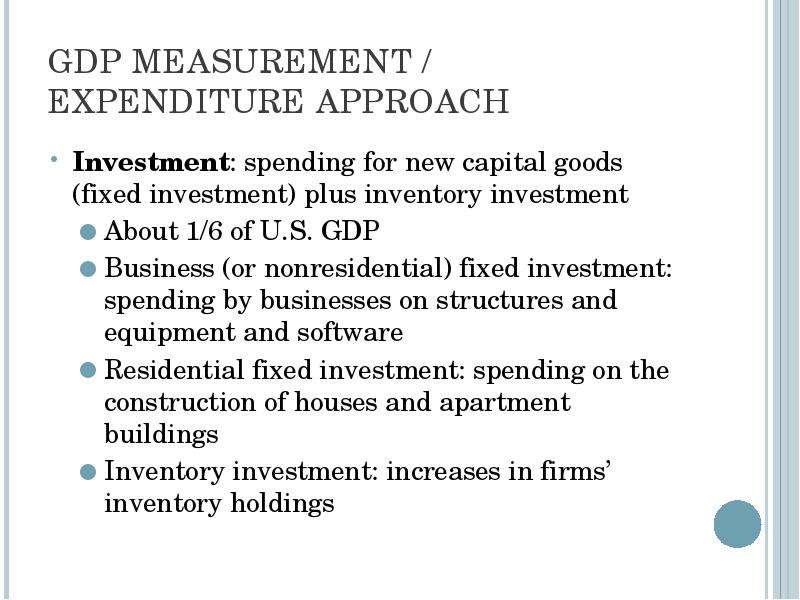
GDP measurement / expenditure approach Investment: spending for new capital goods (fixed investment) plus inventory investment About 1/6 of U.S. GDP...
Описание слайда:
GDP measurement / expenditure approach Investment: spending for new capital goods (fixed investment) plus inventory investment About 1/6 of U.S. GDP Business (or nonresidential) fixed investment: spending by businesses on structures and equipment and software Residential fixed investment: spending on the construction of houses and apartment buildings Inventory investment: increases in firms’ inventory holdings

Слайд 85


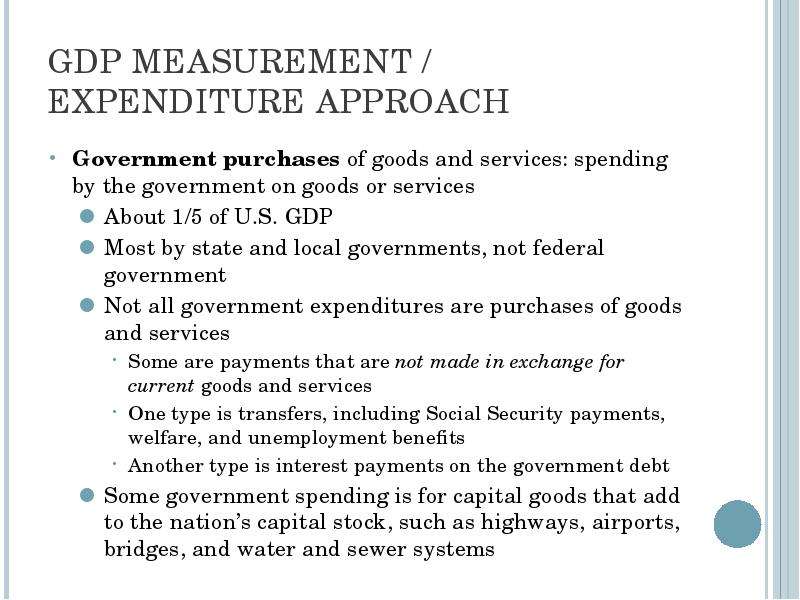
GDP measurement / expenditure approach Government purchases of goods and services: spending by the government on goods or services About 1/5 of U.S....
Описание слайда:
GDP measurement / expenditure approach Government purchases of goods and services: spending by the government on goods or services About 1/5 of U.S. GDP Most by state and local governments, not federal government Not all government expenditures are purchases of goods and services Some are payments that are not made in exchange for current goods and services One type is transfers, including Social Security payments, welfare, and unemployment benefits Another type is interest payments on the government debt Some government spending is for capital goods that add to the nation’s capital stock, such as highways, airports, bridges, and water and sewer systems

Слайд 86


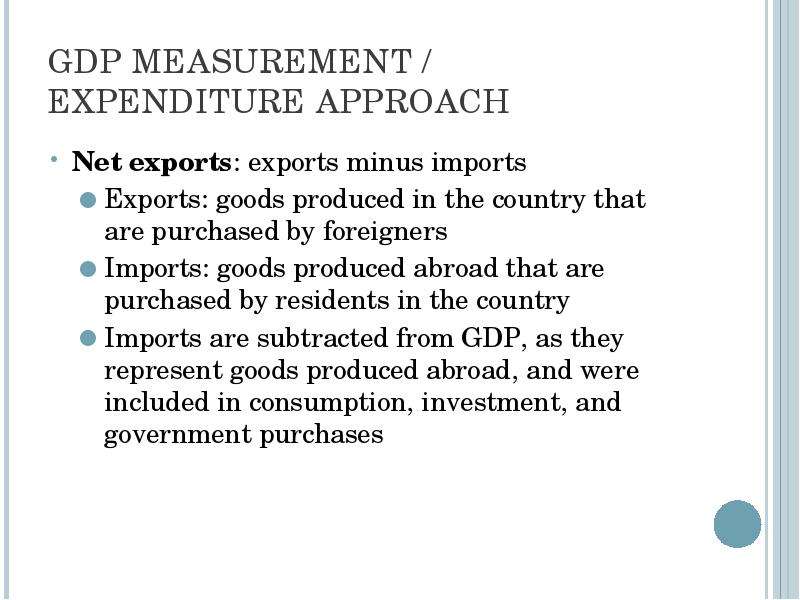
GDP measurement / expenditure approach Net exports: exports minus imports Exports: goods produced in the country that are purchased by foreigners...
Описание слайда:
GDP measurement / expenditure approach Net exports: exports minus imports Exports: goods produced in the country that are purchased by foreigners Imports: goods produced abroad that are purchased by residents in the country Imports are subtracted from GDP, as they represent goods produced abroad, and were included in consumption, investment, and government purchases

Слайд 87


Expenditure Approach to Measuring GDP (United States)
Описание слайда:
Expenditure Approach to Measuring GDP (United States)

Слайд 88


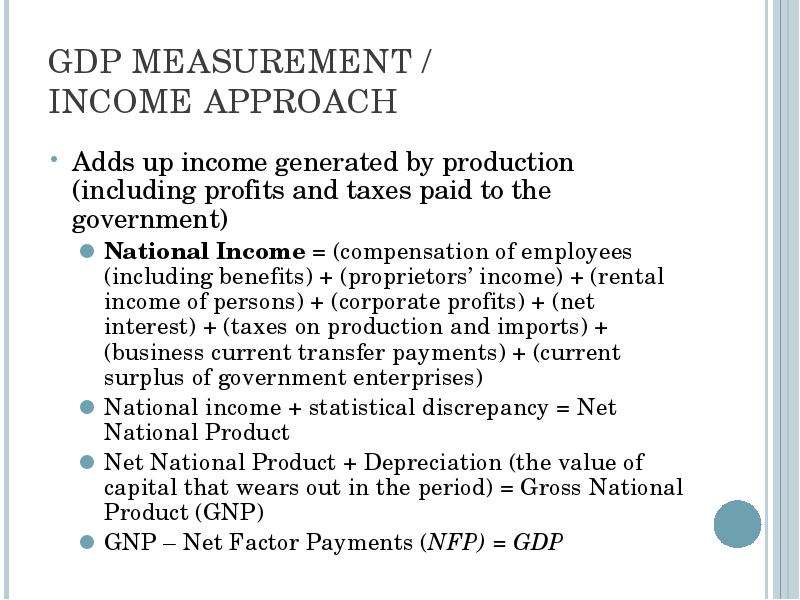
GDP measurement / income approach Adds up income generated by production (including profits and taxes paid to the government) National Income =...
Описание слайда:
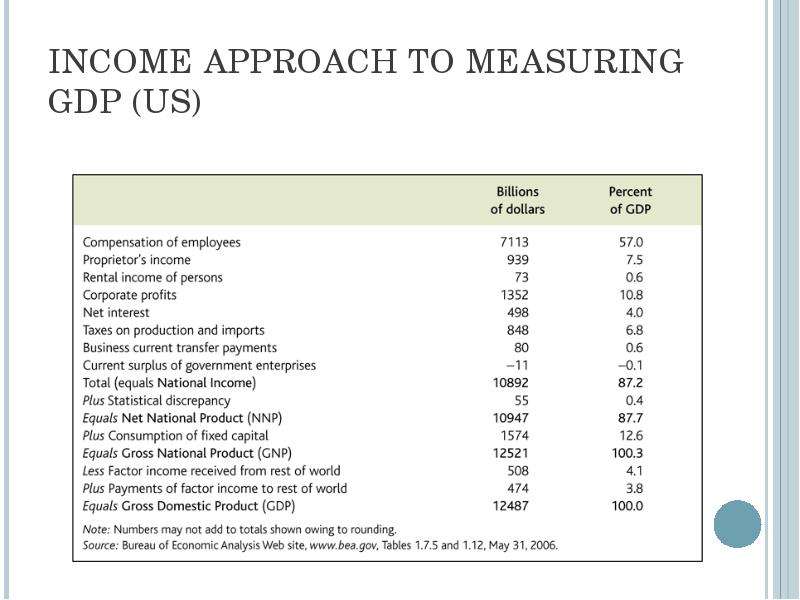
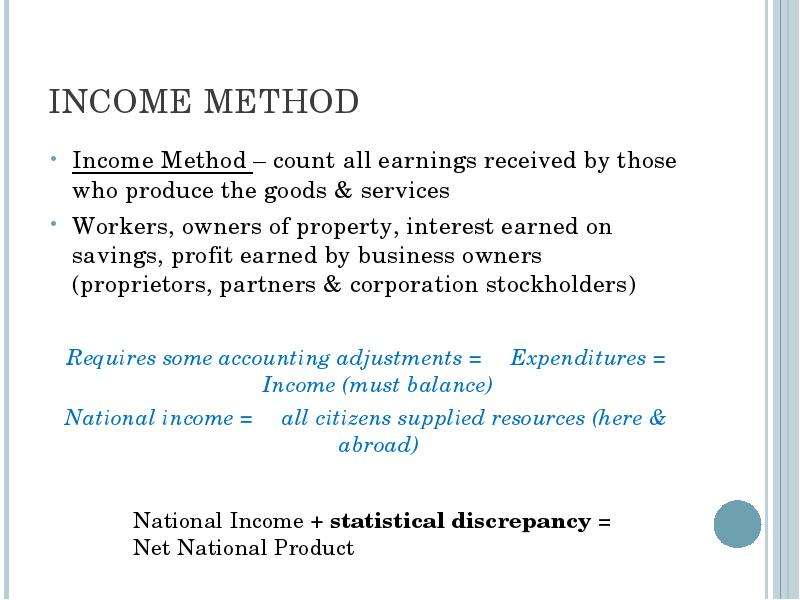
GDP measurement / income approach Adds up income generated by production (including profits and taxes paid to the government) National Income = (compensation of employees (including benefits) + (proprietors’ income) + (rental income of persons) + (corporate profits) + (net interest) + (taxes on production and imports) + (business current transfer payments) + (current surplus of government enterprises) National income + statistical discrepancy = Net National Product Net National Product + Depreciation (the value of capital that wears out in the period) = Gross National Product (GNP) GNP – Net Factor Payments (NFP) = GDP

Слайд 89


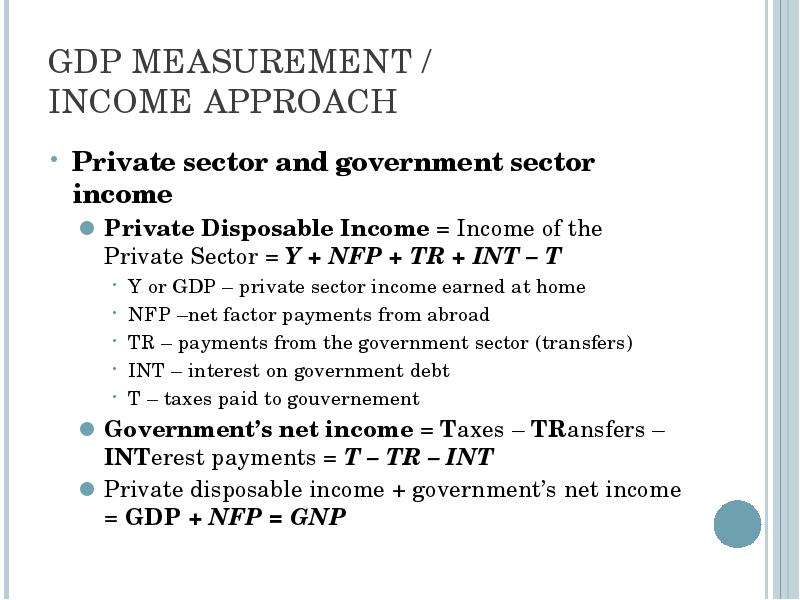
GDP measurement / income approach Private sector and government sector income Private Disposable Income = Income of the Private Sector = Y + NFP + TR...
Описание слайда:
GDP measurement / income approach Private sector and government sector income Private Disposable Income = Income of the Private Sector = Y + NFP + TR + INT – T Y or GDP – private sector income earned at home NFP –net factor payments from abroad TR – payments from the government sector (transfers) INT – interest on government debt T – taxes paid to gouvernement Government’s net income = Taxes – TRansfers – INTerest payments = T – TR – INT Private disposable income + government’s net income = GDP + NFP = GNP

Слайд 90


Income Approach to Measuring GDP (US)
Описание слайда:
Income Approach to Measuring GDP (US)

Слайд 91


Saving and Wealth Wealth Household Wealth = (Household’s Assets) – (Household’s Liabilities) National Wealth = sum of all households’, firms’, and...
Описание слайда:
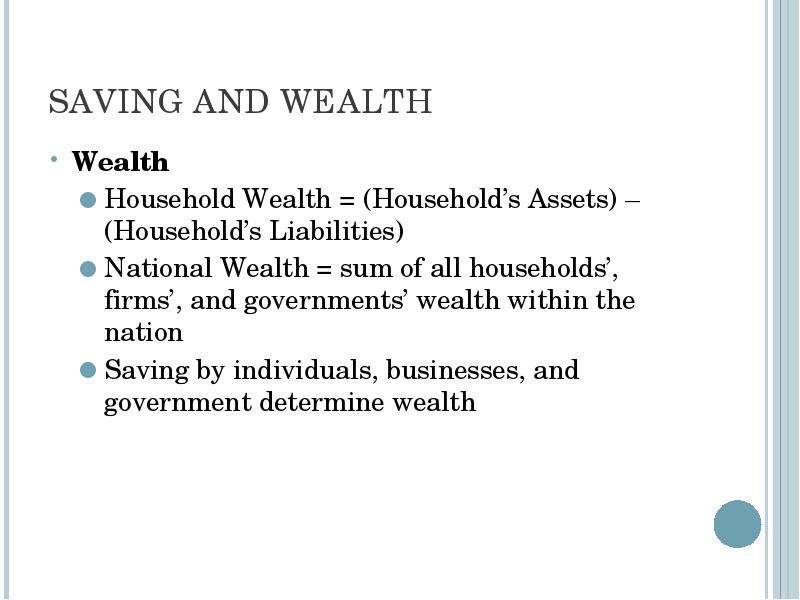
Saving and Wealth Wealth Household Wealth = (Household’s Assets) – (Household’s Liabilities) National Wealth = sum of all households’, firms’, and governments’ wealth within the nation Saving by individuals, businesses, and government determine wealth

Слайд 92


Saving and Wealth / Measures of aggregate saving Saving = Current Income – Current Spending Saving Rate = Saving / Current Income Private Saving =...
Описание слайда:
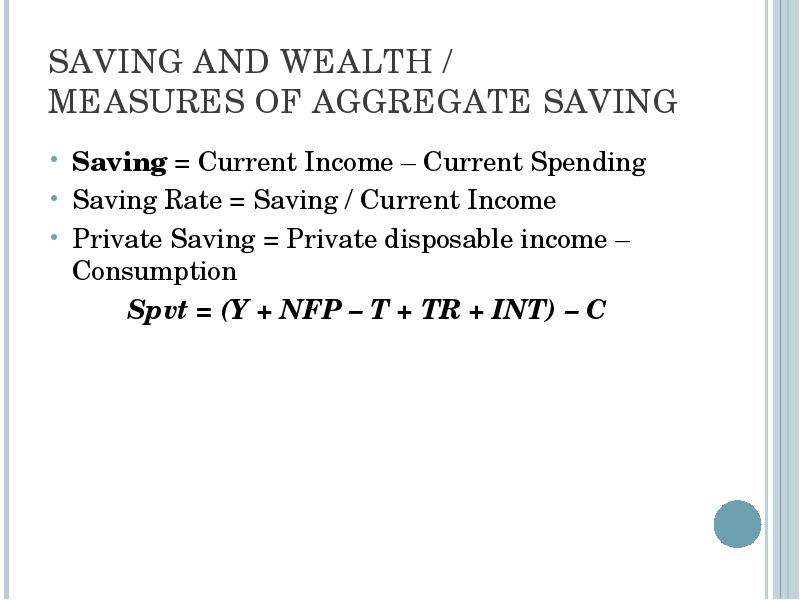
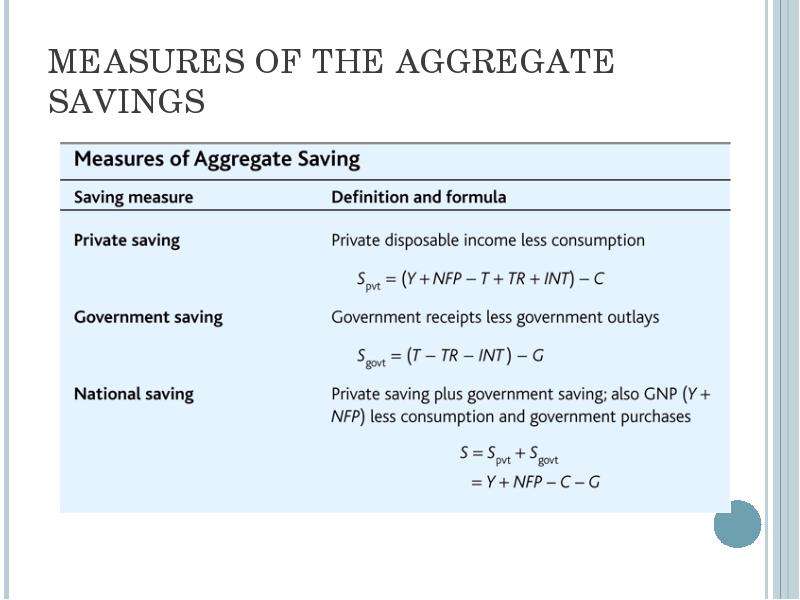
Saving and Wealth / Measures of aggregate saving Saving = Current Income – Current Spending Saving Rate = Saving / Current Income Private Saving = Private disposable income – Consumption Spvt = (Y + NFP – T + TR + INT) – C

Слайд 93


Saving and Wealth / Measures of aggregate saving Government Saving = Net Government Income – Government purchases of goods and services Sgovt = (T –...
Описание слайда:
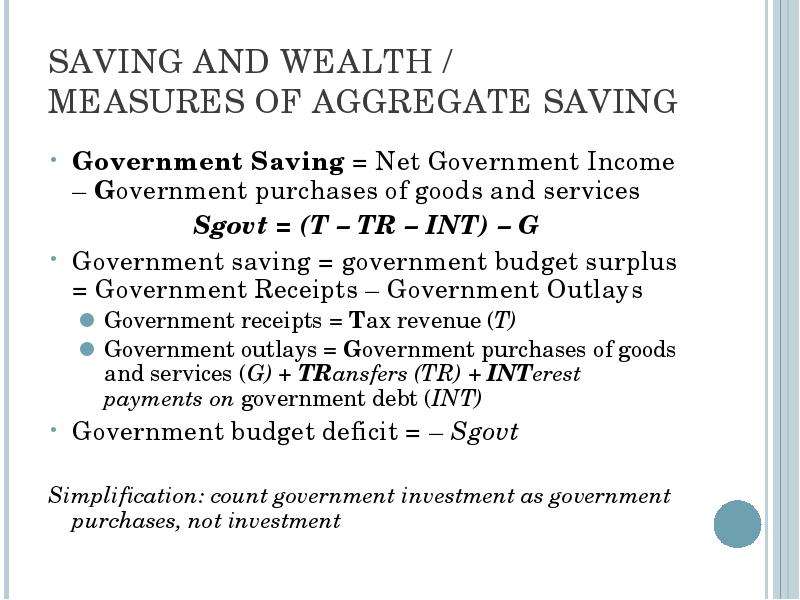
Saving and Wealth / Measures of aggregate saving Government Saving = Net Government Income – Government purchases of goods and services Sgovt = (T – TR – INT) – G Government saving = government budget surplus = Government Receipts – Government Outlays Government receipts = Tax revenue (T) Government outlays = Government purchases of goods and services (G) + TRansfers (TR) + INTerest payments on government debt (INT) Government budget deficit = – Sgovt Simplification: count government investment as government purchases, not investment

Слайд 94


Saving and Wealth / Measures of aggregate saving National saving National Saving = Private Saving + Government Saving S = Spvt + Sgovt = = [Y + NFP –...
Описание слайда:
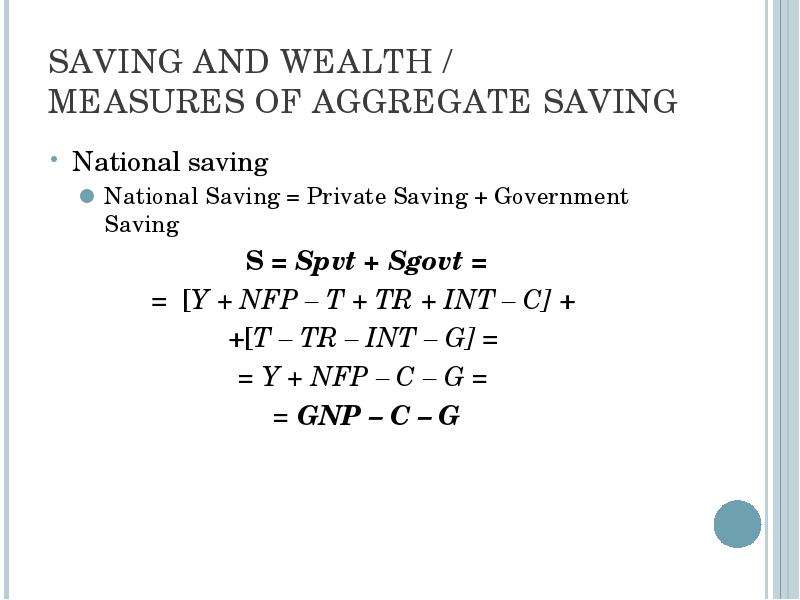
Saving and Wealth / Measures of aggregate saving National saving National Saving = Private Saving + Government Saving S = Spvt + Sgovt = = [Y + NFP – T + TR + INT – C] + +[T – TR – INT – G] = = Y + NFP – C – G = = GNP – C – G

Слайд 95


Saving and Wealth / Measures of aggregate saving The uses of private saving S = I + (NX + NFP) S = I + CA Derived from S = Y + NFP – C – G and Y = C...
Описание слайда:
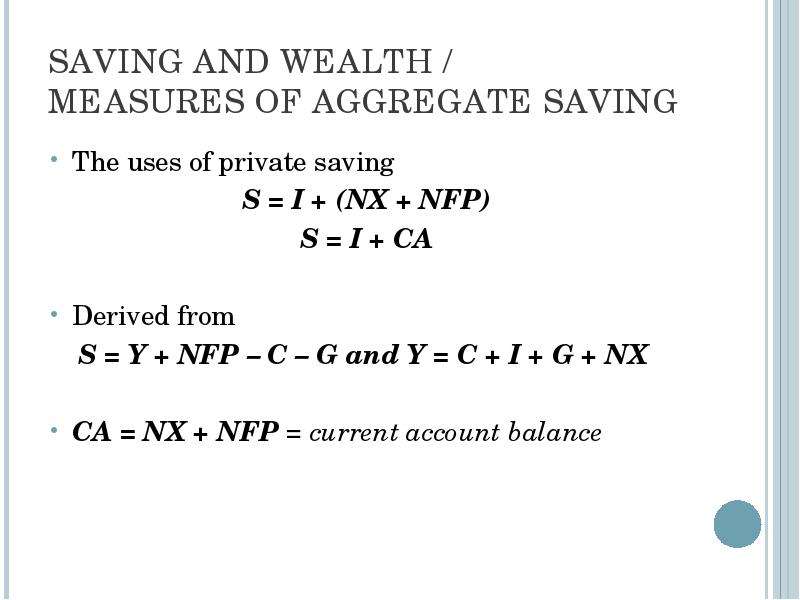
Saving and Wealth / Measures of aggregate saving The uses of private saving S = I + (NX + NFP) S = I + CA Derived from S = Y + NFP – C – G and Y = C + I + G + NX CA = NX + NFP = current account balance

Слайд 96


Saving and Wealth The uses of private saving Spvt = I + (–Sgovt) + CA (using S = Spvt + Sgovt) The uses-of-saving identity—saving is used in three...
Описание слайда:
Saving and Wealth The uses of private saving Spvt = I + (–Sgovt) + CA (using S = Spvt + Sgovt) The uses-of-saving identity—saving is used in three ways: investment (I) government budget deficit (–Sgovt) current account balance (CA)

Слайд 97


Saving and Wealth / Relating saving and wealth Stocks and flows Flow variables: measured per unit of time (GDP, income, saving, investment) Stock...
Описание слайда:
Saving and Wealth / Relating saving and wealth Stocks and flows Flow variables: measured per unit of time (GDP, income, saving, investment) Stock variables: measured at a point in time (quantity of money, value of houses, capital stock) Flow variables often equal rates of change of stock variables Wealth and saving as stock and flow (wealth is a stock, saving is a flow)

Слайд 98


Saving and Wealth / Relating saving and wealth National wealth: domestic physical assets + net foreign assets Country’s domestic physical assets...
Описание слайда:
Saving and Wealth / Relating saving and wealth National wealth: domestic physical assets + net foreign assets Country’s domestic physical assets (capital goods and land) Country’s net foreign assets = (Foreign assets (foreign stocks, bonds, and capital goods owned by domestic residents)) – (Foreign liabilities (domestic stocks, bonds, and capital goods owned by foreigners)) Wealth matters because the economic well-being of a country depends on it

Слайд 99


Saving and Wealth / Relating saving and wealth National wealth: domestic physical assets + net foreign assets Changes in national wealth Change in...
Описание слайда:
Saving and Wealth / Relating saving and wealth National wealth: domestic physical assets + net foreign assets Changes in national wealth Change in value of existing assets and liabilities (change in price of financial assets, or depreciation of capital goods) National saving (S = I + CA) raises wealth Comparison of U.S. saving and investment with other countries The United States is a low-saving country; Japan is a high-saving country U.S. investment exceeds U.S. saving, so we have a negative current-account balance

Слайд 100


Measures of the Aggregate Savings
Описание слайда:
Measures of the Aggregate Savings

Слайд 101


Real GDP, Price Indexes, and Inflation Real GDP Nominal variables are those in dollar terms Problem: Do changes in nominal values reflect changes in...
Описание слайда:
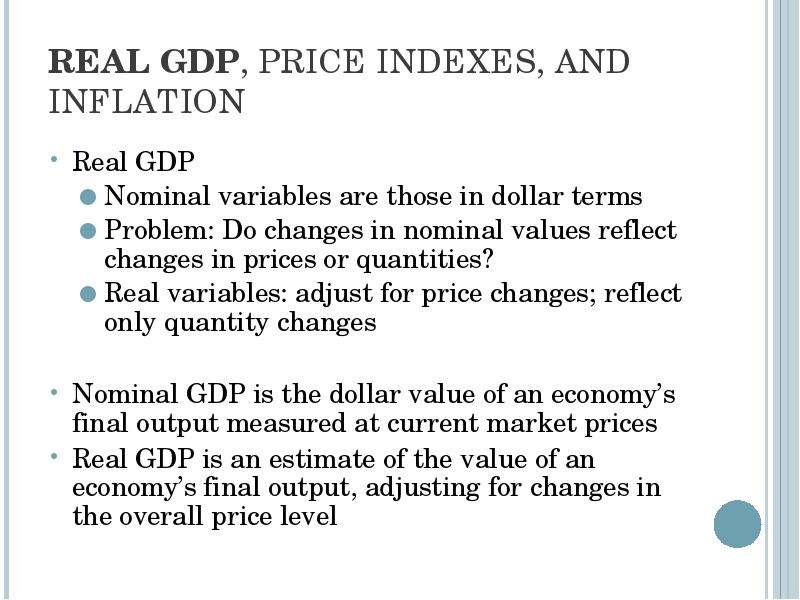
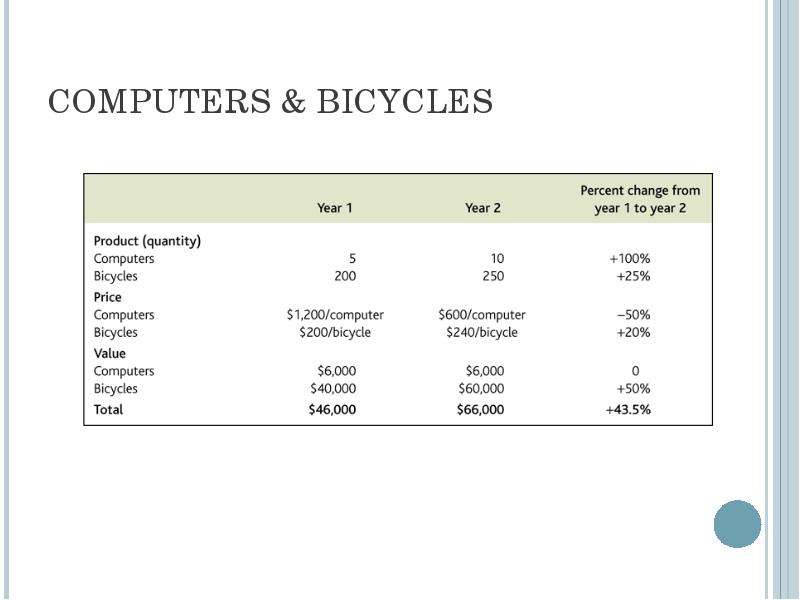
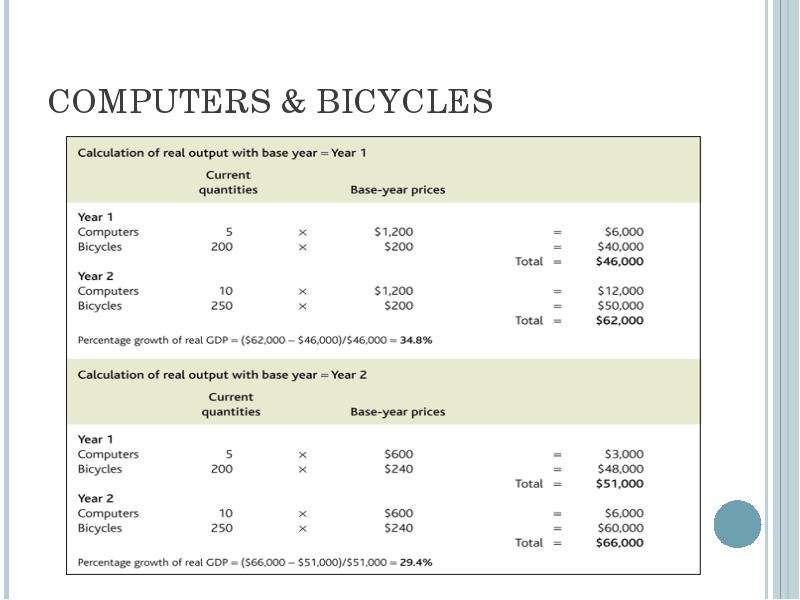
Real GDP, Price Indexes, and Inflation Real GDP Nominal variables are those in dollar terms Problem: Do changes in nominal values reflect changes in prices or quantities? Real variables: adjust for price changes; reflect only quantity changes Nominal GDP is the dollar value of an economy’s final output measured at current market prices Real GDP is an estimate of the value of an economy’s final output, adjusting for changes in the overall price level

Слайд 102


Computers & Bicycles
Описание слайда:
Computers & Bicycles

Слайд 103


Computers & Bicycles
Описание слайда:
Computers & Bicycles

Слайд 104


Real GDP, Price Indexes, and Inflation Price Indexes A price index measures the average level of prices for some specified set of goods and services,...
Описание слайда:
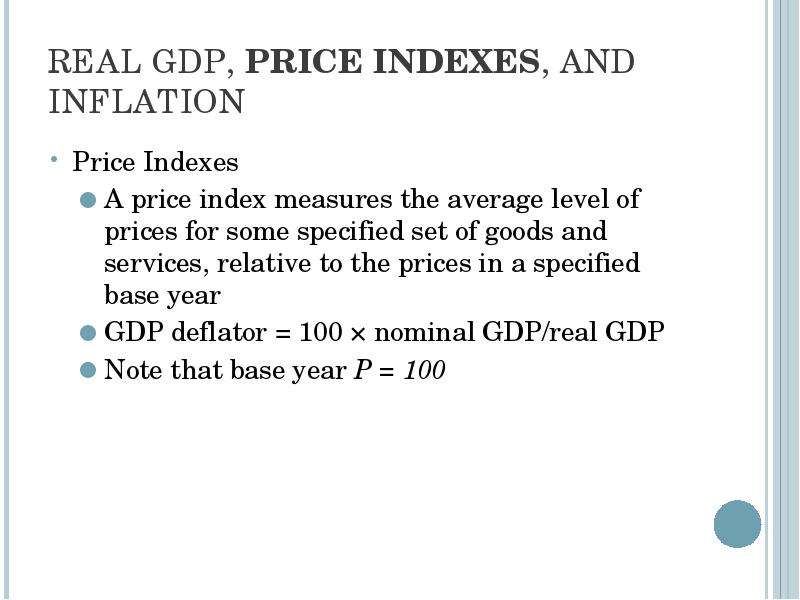
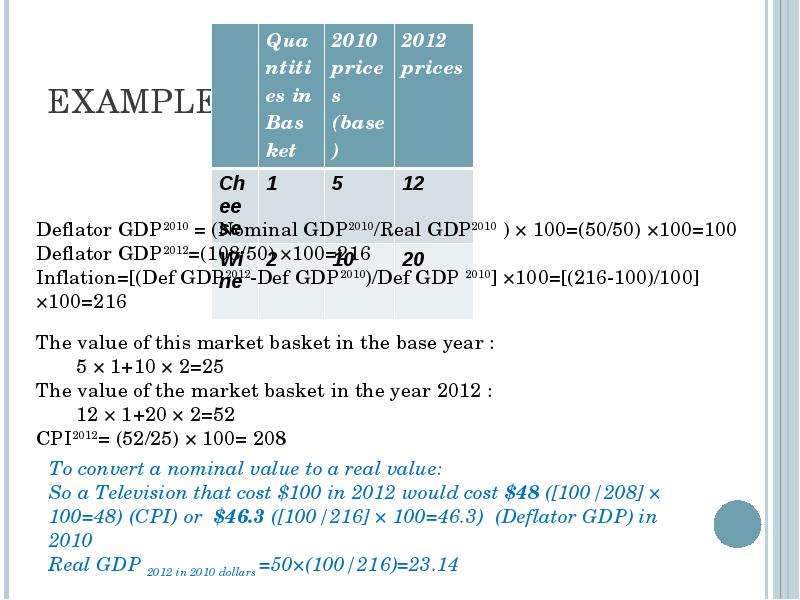
Real GDP, Price Indexes, and Inflation Price Indexes A price index measures the average level of prices for some specified set of goods and services, relative to the prices in a specified base year GDP deflator = 100 × nominal GDP/real GDP Note that base year P = 100

Слайд 105


Real GDP, Price Indexes, and Inflation Price Indexes Consumer Price Index (CPI) Price index is a normalized average (typically a weighted average) of...
Описание слайда:
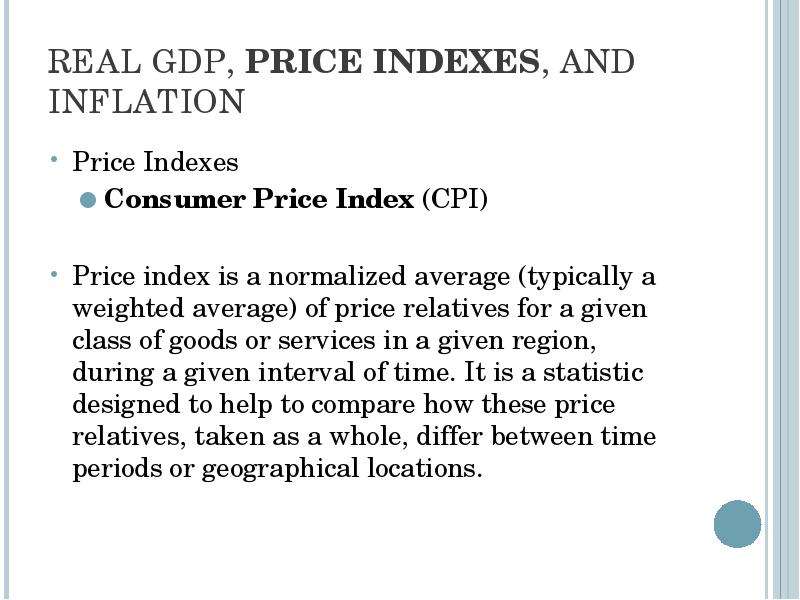
Real GDP, Price Indexes, and Inflation Price Indexes Consumer Price Index (CPI) Price index is a normalized average (typically a weighted average) of price relatives for a given class of goods or services in a given region, during a given interval of time. It is a statistic designed to help to compare how these price relatives, taken as a whole, differ between time periods or geographical locations.

Слайд 106


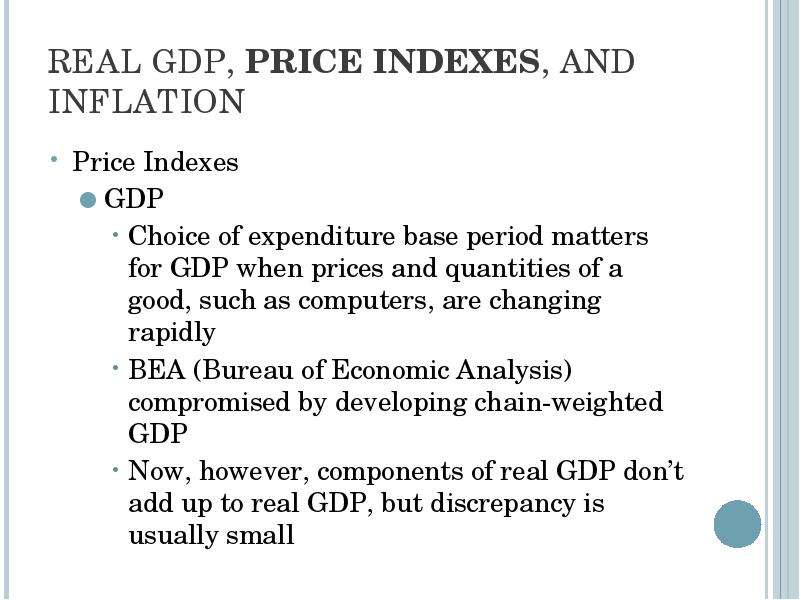
Real GDP, Price Indexes, and Inflation Price Indexes GDP Choice of expenditure base period matters for GDP when prices and quantities of a good, such...
Описание слайда:
Real GDP, Price Indexes, and Inflation Price Indexes GDP Choice of expenditure base period matters for GDP when prices and quantities of a good, such as computers, are changing rapidly BEA (Bureau of Economic Analysis) compromised by developing chain-weighted GDP Now, however, components of real GDP don’t add up to real GDP, but discrepancy is usually small

Слайд 107


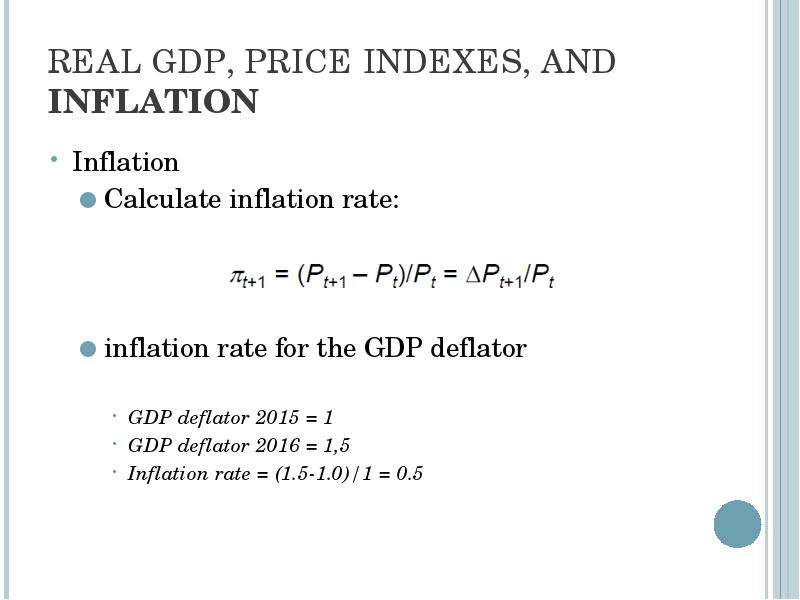
Real GDP, Price Indexes, and Inflation Inflation Calculate inflation rate: inflation rate for the GDP deflator GDP deflator 2015 = 1 GDP deflator...
Описание слайда:
Real GDP, Price Indexes, and Inflation Inflation Calculate inflation rate: inflation rate for the GDP deflator GDP deflator 2015 = 1 GDP deflator 2016 = 1,5 Inflation rate = (1.5-1.0)/1 = 0.5

Слайд 108


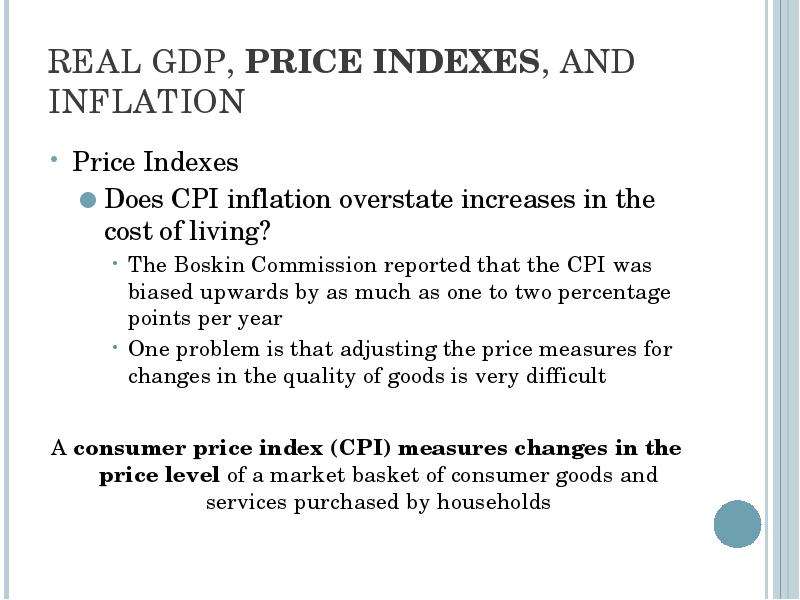
Real GDP, Price Indexes, and Inflation Price Indexes Does CPI inflation overstate increases in the cost of living? The Boskin Commission reported...
Описание слайда:
Real GDP, Price Indexes, and Inflation Price Indexes Does CPI inflation overstate increases in the cost of living? The Boskin Commission reported that the CPI was biased upwards by as much as one to two percentage points per year One problem is that adjusting the price measures for changes in the quality of goods is very difficult A consumer price index (CPI) measures changes in the price level of a market basket of consumer goods and services purchased by households

Слайд 109


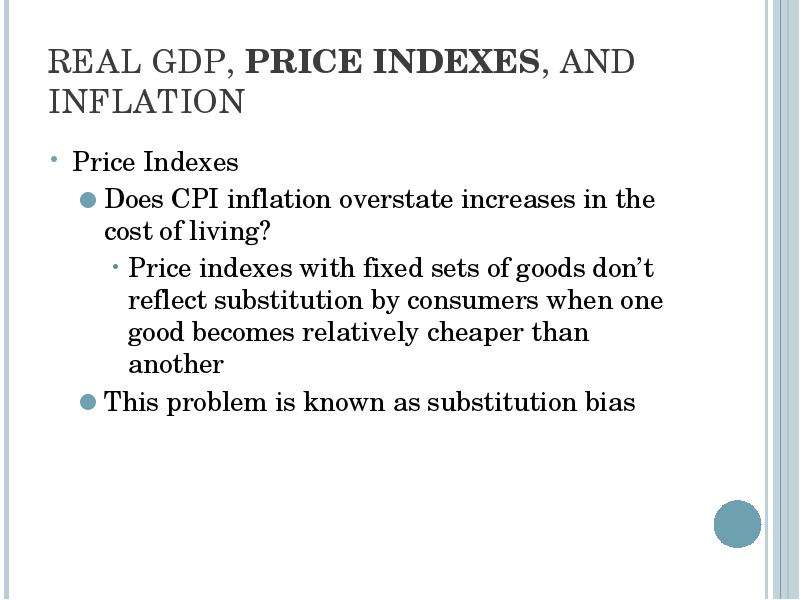
Real GDP, Price Indexes, and Inflation Price Indexes Does CPI inflation overstate increases in the cost of living? Price indexes with fixed sets of...
Описание слайда:
Real GDP, Price Indexes, and Inflation Price Indexes Does CPI inflation overstate increases in the cost of living? Price indexes with fixed sets of goods don’t reflect substitution by consumers when one good becomes relatively cheaper than another This problem is known as substitution bias

Слайд 110


Real GDP, Price Indexes, and Inflation Does CPI inflation overstate increases in the cost of living? If inflation is overstated, then real incomes...
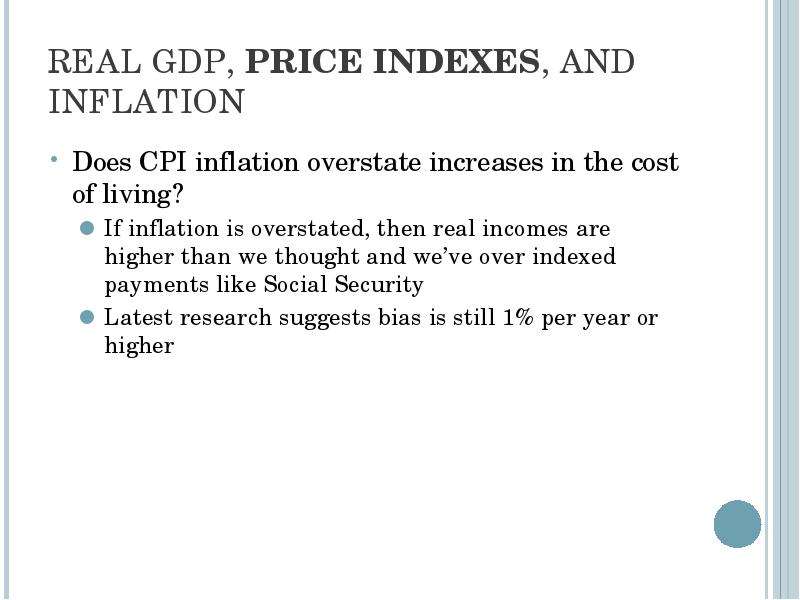
Описание слайда:
Real GDP, Price Indexes, and Inflation Does CPI inflation overstate increases in the cost of living? If inflation is overstated, then real incomes are higher than we thought and we’ve over indexed payments like Social Security Latest research suggests bias is still 1% per year or higher

Слайд 111


Interest rate Real vs. nominal interest rates Interest rate: a rate of return promised by a borrower to a lender Real interest rate: rate at which...
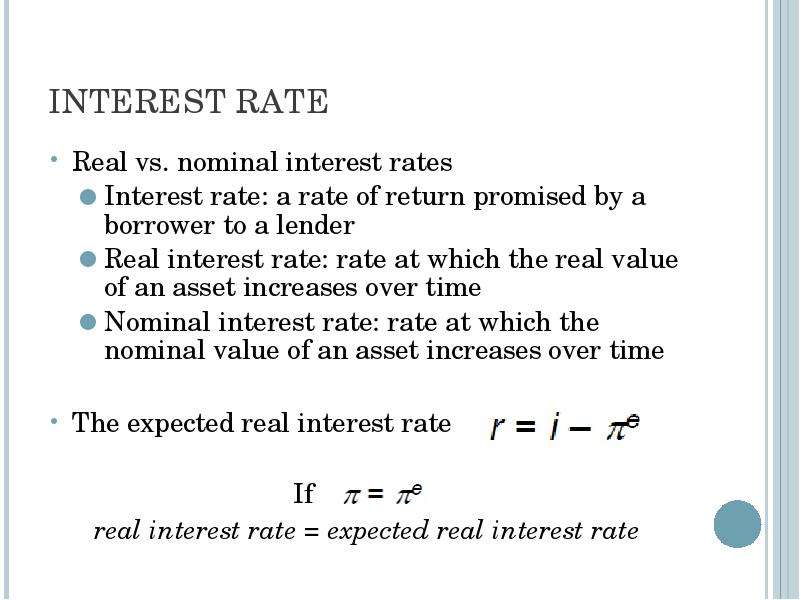
Описание слайда:
Interest rate Real vs. nominal interest rates Interest rate: a rate of return promised by a borrower to a lender Real interest rate: rate at which the real value of an asset increases over time Nominal interest rate: rate at which the nominal value of an asset increases over time The expected real interest rate If , real interest rate = expected real interest rate

Слайд 112


Gross National Product (GNP) Gross Domestic Product (GDP) Net National Product (NNP) Net National Income (NNI) Gross National Product (GNP) is the...
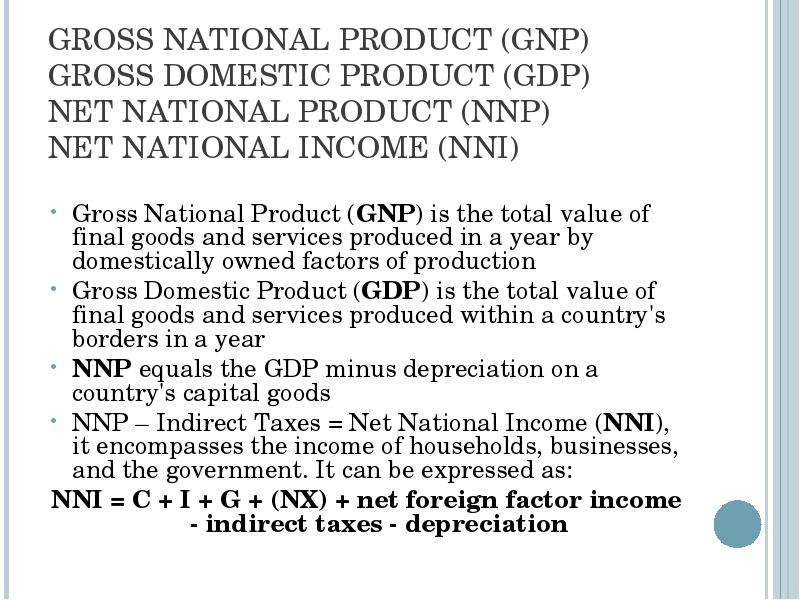
Описание слайда:
Gross National Product (GNP) Gross Domestic Product (GDP) Net National Product (NNP) Net National Income (NNI) Gross National Product (GNP) is the total value of final goods and services produced in a year by domestically owned factors of production Gross Domestic Product (GDP) is the total value of final goods and services produced within a country's borders in a year NNP equals the GDP minus depreciation on a country's capital goods NNP – Indirect Taxes = Net National Income (NNI), it encompasses the income of households, businesses, and the government. It can be expressed as: NNI = C + I + G + (NX) + net foreign factor income - indirect taxes - depreciation

Слайд 113


The balance of payments, also known as balance of international payments of a country is the record of all economic transactions between the...
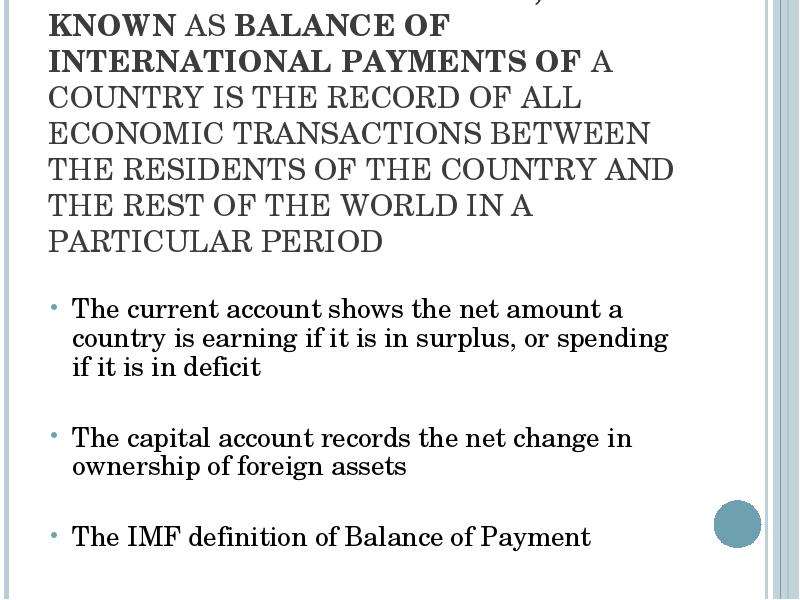
Описание слайда:
The balance of payments, also known as balance of international payments of a country is the record of all economic transactions between the residents of the country and the rest of the world in a particular period The current account shows the net amount a country is earning if it is in surplus, or spending if it is in deficit The capital account records the net change in ownership of foreign assets The IMF definition of Balance of Payment

Слайд 114


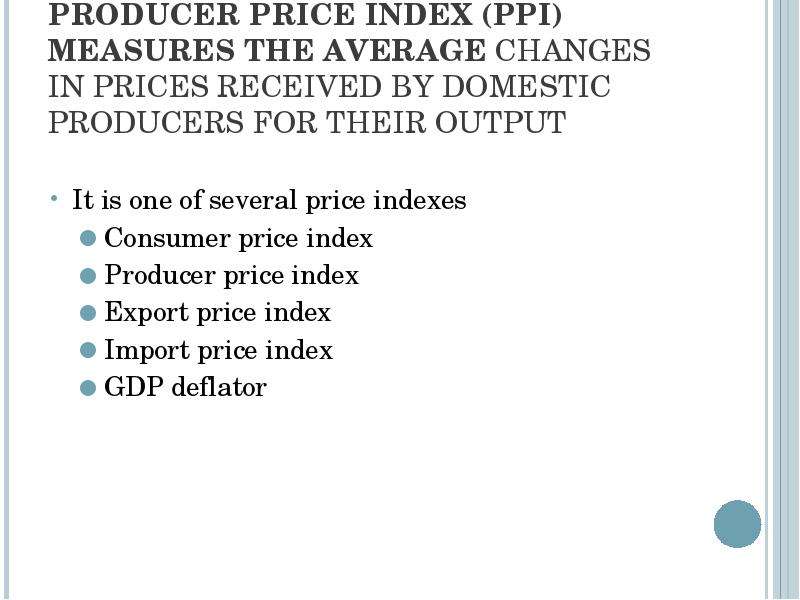
Producer Price Index (PPI) measures the average changes in prices received by domestic producers for their output It is one of several price indexes...
Описание слайда:
Producer Price Index (PPI) measures the average changes in prices received by domestic producers for their output It is one of several price indexes Consumer price index Producer price index Export price index Import price index GDP deflator

Слайд 115


Macroeconomics The Measurement and Structure of the National Economy Zharova Liubov Zharova_l@ua.fm
Описание слайда:
Macroeconomics The Measurement and Structure of the National Economy Zharova Liubov Zharova_l@ua.fm

Слайд 116


10 principles of economics, слайд №116
Описание слайда:

Слайд 117


10 principles of economics, слайд №117
Описание слайда:

Слайд 118


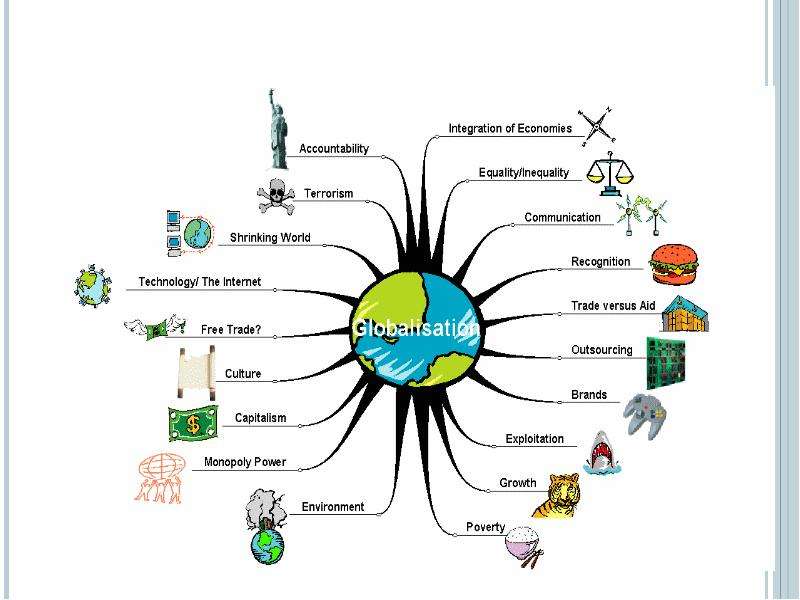
What Is Globalization Globalization is defined as a process that, based on international strategies, aims to expand business operations on a...
Описание слайда:
What Is Globalization Globalization is defined as a process that, based on international strategies, aims to expand business operations on a worldwide level, and was precipitated by the facilitation of global communications due to technological advancements, and socioeconomic, political and environmental developments. economic globalization cultural globalization political globalization

Слайд 119


basic aspects of globalization In 2000, the International Monetary Fund (IMF) identified four basic aspects of globalization: trade and transactions,...
Описание слайда:
basic aspects of globalization In 2000, the International Monetary Fund (IMF) identified four basic aspects of globalization: trade and transactions, capital and investment movements, migration and movement of people, the dissemination of knowledge. Environmental challenges (global warming, cross-boundary water and air pollution, and overfishing of the ocean)

Слайд 120


Globalization Encompasses Internationalization (trade & investment) Liberalization (freeing markets) Universalization (cultural interchange)…or…...
Описание слайда:
Globalization Encompasses Internationalization (trade & investment) Liberalization (freeing markets) Universalization (cultural interchange)…or… Westernization (Western cultural dominance) “Deterritorialization” (the severance of social, political, or cultural practices from their native places and populations)

Слайд 121


Impact Economic impact Improvement in standard of living Increased competition among nations Widening income gap between the rich and poor Social...
Описание слайда:
Impact Economic impact Improvement in standard of living Increased competition among nations Widening income gap between the rich and poor Social impact Increased awareness of foreign cultures Loss of local culture Environmental impact Environmental degradation Environmental management

Слайд 122


Focus on: Measuring globalisation STATISTICAL INDICATORS OECD Economic Globalization Indicators helps identify the economic activities of member...
Описание слайда:
Focus on: Measuring globalisation STATISTICAL INDICATORS OECD Economic Globalization Indicators helps identify the economic activities of member countries that are under foreign control, and more particularly the contribution of multinational enterprises to growth, employment, productivity, labour compensation, research and development, technology diffusion and international trade. These indicators shed new light on financial, technological and trade interdepe World Development Indicators (WDI). The WDI affords readers more than 900 indicators organized in six sections: World View, People, Environment, Economy, States and Markets, and Global Links. In each section a plethora of information is presented. ndencies within OECD countries.

Слайд 123


Focus on: Measuring globalisation STATISTICAL INDICATORS UNCTAD Development and Globalization: Facts and Figures. This publication covers subjects...
Описание слайда:
Focus on: Measuring globalisation STATISTICAL INDICATORS UNCTAD Development and Globalization: Facts and Figures. This publication covers subjects tackled by UNCTAD such as trade, investment, external finance, commodities and manufactures, together with relevant facts about population. Global Policy Forum (GPF) gathers a large number of tables and graphs providing the main features of globalization, asking what is new, what drives the process, how it changes politics, and how it affects global institutions like UN. In addition to indicators of social and economic policy, trade and capital flows, global poverty and development etc.

Слайд 124


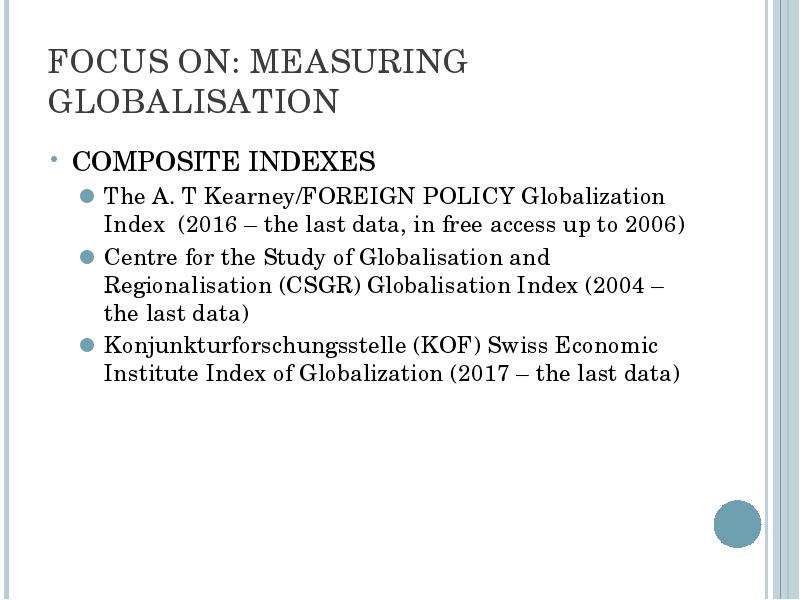
Focus on: Measuring globalisation COMPOSITE INDEXES The A. T Kearney/FOREIGN POLICY Globalization Index (2016 – the last data, in free access up to...
Описание слайда:
Focus on: Measuring globalisation COMPOSITE INDEXES The A. T Kearney/FOREIGN POLICY Globalization Index (2016 – the last data, in free access up to 2006) Centre for the Study of Globalisation and Regionalisation (CSGR) Globalisation Index (2004 – the last data) Konjunkturforschungsstelle (KOF) Swiss Economic Institute Index of Globalization (2017 – the last data)

Слайд 125


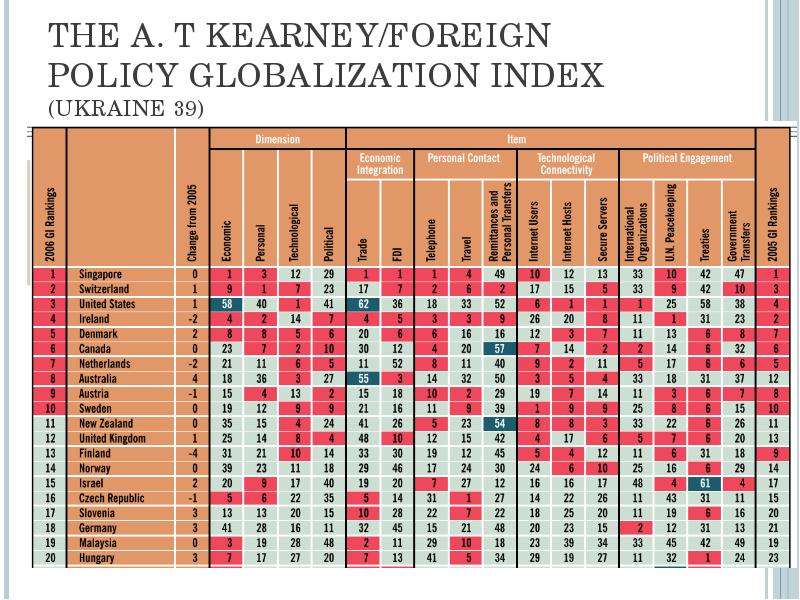
The A. T Kearney/FOREIGN POLICY Globalization Index (Ukraine 39)
Описание слайда:
The A. T Kearney/FOREIGN POLICY Globalization Index (Ukraine 39)

Слайд 126


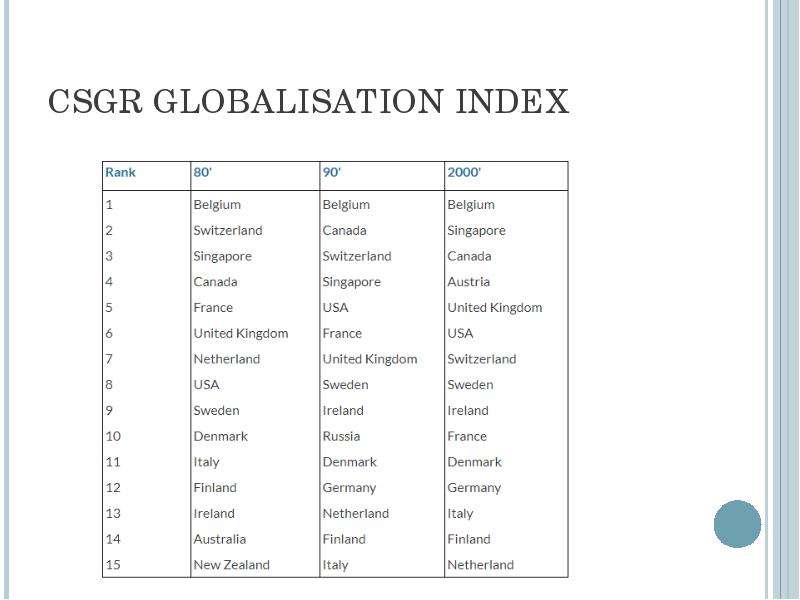
CSGR Globalisation Index
Описание слайда:
CSGR Globalisation Index

Слайд 127


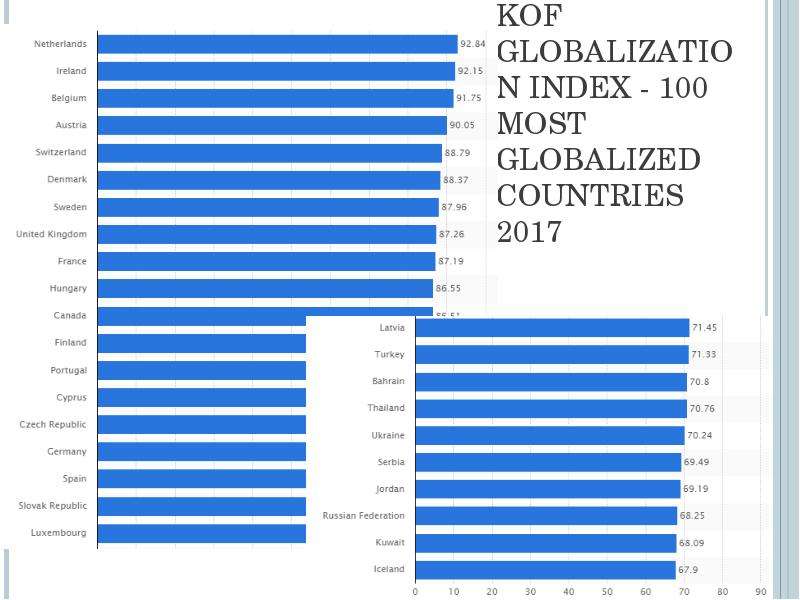
KOF Globalization Index - 100 most globalized countries 2017
Описание слайда:
KOF Globalization Index - 100 most globalized countries 2017

Слайд 128


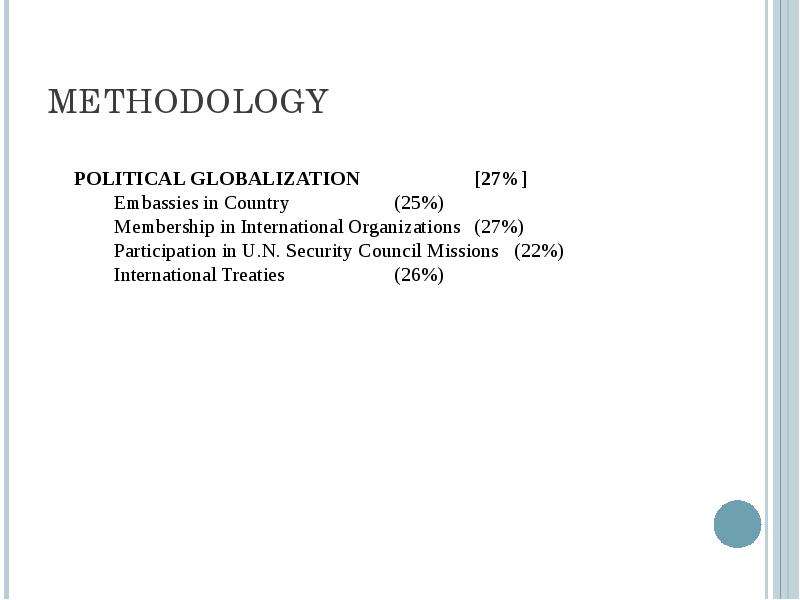
Methodology
Описание слайда:
Methodology

Слайд 129


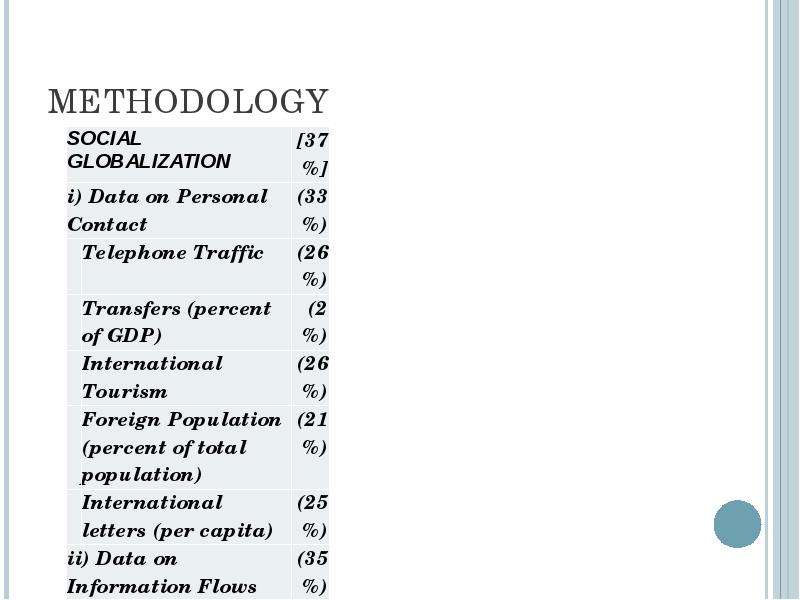
Methodology
Описание слайда:
Methodology

Слайд 130


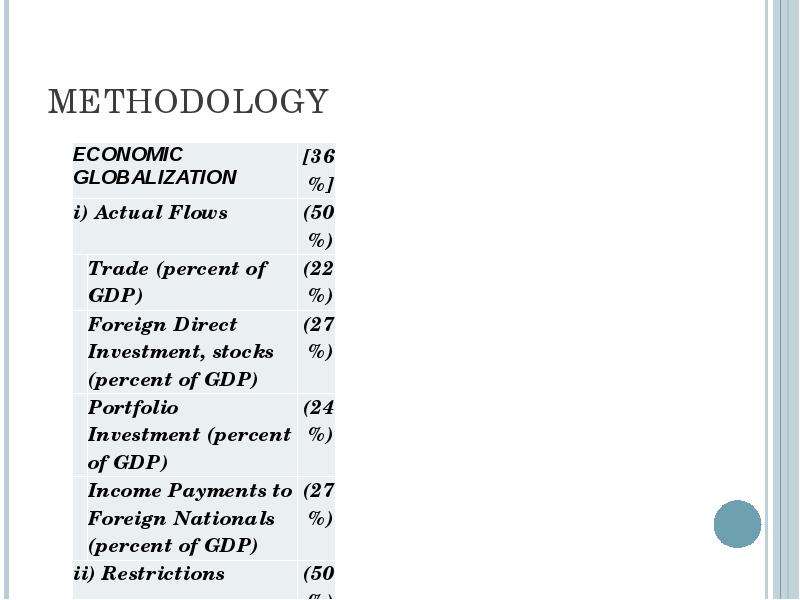
Methodology
Описание слайда:
Methodology

Слайд 131


“Arguably no other place on earth has so engineered itself to prosper from globalization - and succeeded at it. The small island nation of 5 million...
Описание слайда:
“Arguably no other place on earth has so engineered itself to prosper from globalization - and succeeded at it. The small island nation of 5 million people boasts the world's second-busiest seaport, a far higher per capita income than its former British overlord and a raft of No. 1 rankings on lists ranging from least-corrupt to most business-friendly countries.” “Arguably no other place on earth has so engineered itself to prosper from globalization - and succeeded at it. The small island nation of 5 million people boasts the world's second-busiest seaport, a far higher per capita income than its former British overlord and a raft of No. 1 rankings on lists ranging from least-corrupt to most business-friendly countries.” Singapore a 'canary in the gold mine of globalization’ Straits Times, May 24 2014

Слайд 132


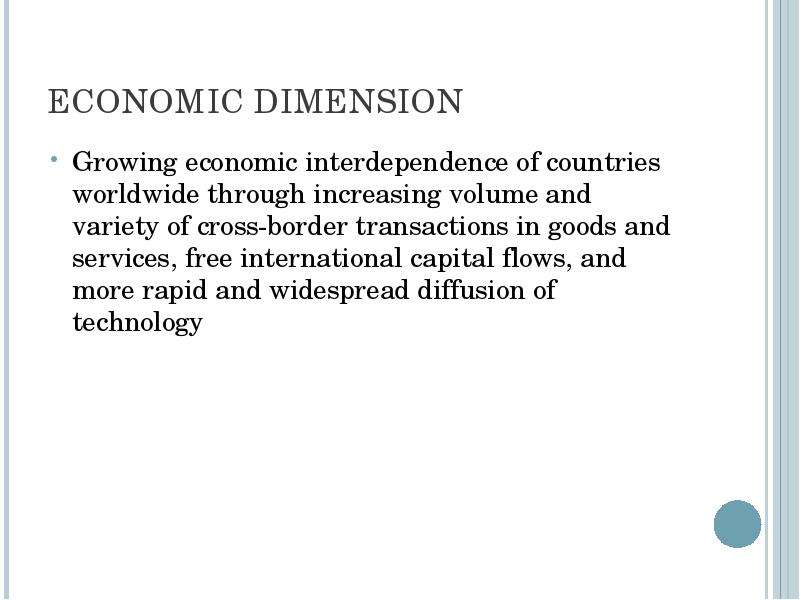
Economic dimension Growing economic interdependence of countries worldwide through increasing volume and variety of cross-border transactions in...
Описание слайда:
Economic dimension Growing economic interdependence of countries worldwide through increasing volume and variety of cross-border transactions in goods and services, free international capital flows, and more rapid and widespread diffusion of technology

Слайд 133


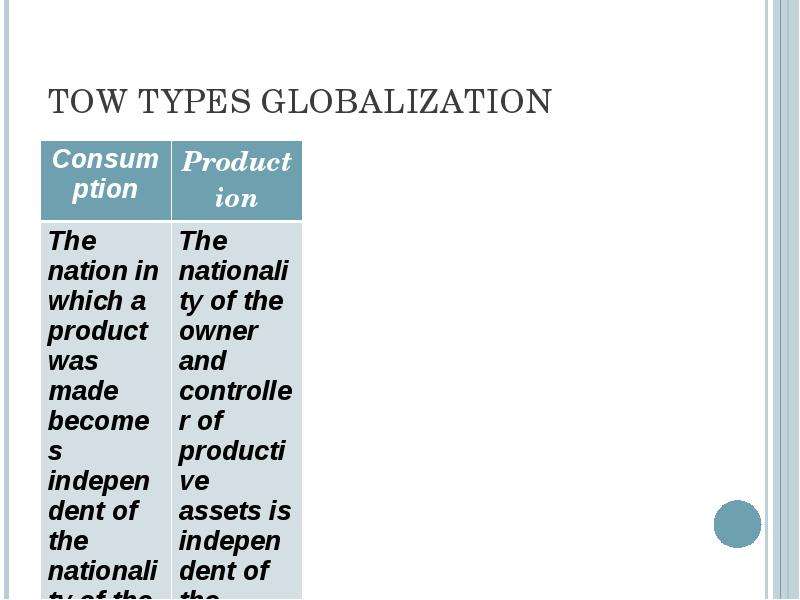
Tow types globalization
Описание слайда:
Tow types globalization

Слайд 134


Measuring globalization (economic aspects) Statistics related to trade. Total exports, total trade (imports + exports), Trade as a % of GDP...
Описание слайда:
Measuring globalization (economic aspects) Statistics related to trade. Total exports, total trade (imports + exports), Trade as a % of GDP Statistics related to FDI. Foreign Direct Investment. Money invested in a country by a foreign company. FDI inflows and outlflows.

Слайд 135


Factors which help the spread of globalisation Low transport costs, containerization Telecommunications Internet Low trade barriers Political...
Описание слайда:
Factors which help the spread of globalisation Low transport costs, containerization Telecommunications Internet Low trade barriers Political stability Increasing role of TNCs

Слайд 136


Increased competition among nations For example, many companies have shifted their production facilities to emerging markets such as China and India...
Описание слайда:
Increased competition among nations For example, many companies have shifted their production facilities to emerging markets such as China and India to enjoy lower costs of production. Benefiting from the increased revenue, these countries are able to rapidly develop their infrastructure such as road networks and industrial parks, which further increased their attractiveness to foreign investors. This poses a strong challenge for developed economies like Singapore and Taiwan and more so for less developed countries with poor infrastructure and political stability such as Cambodia and East Timor

Слайд 137


Increased competition among nations “They (economists) predict that increased competition from low-wage countries will destroy jobs in richer nations...
Описание слайда:
Increased competition among nations “They (economists) predict that increased competition from low-wage countries will destroy jobs in richer nations and there will be a “race to the bottom” as countries reduce wages, taxes, welfare and environmental controls so as to be more competitive, at enormous social cost. Pressure to compete will erode the ability of governments to set their own economic policies and the move towards deregulation will reduce their power to protect and promote the interests of their people.” World Health Organization

Слайд 138


Widening income gap For example, with improved communications and transportation, business owners in developed countries are able to outsource their...
Описание слайда:
Widening income gap For example, with improved communications and transportation, business owners in developed countries are able to outsource their operations to other countries to enjoy lower costs of production. This inevitably leads to higher retrenchment rates and loss of income among the average workers, which translates into the rich getting richer and the poor becoming poorer

Слайд 139


Pros and Cons of Globalization Free trade is supposed to reduce barriers such as tariffs, value added taxes, subsidies, and other barriers between...
Описание слайда:
Pros and Cons of Globalization Free trade is supposed to reduce barriers such as tariffs, value added taxes, subsidies, and other barriers between nations. This is not true. There are still many barriers to free trade. The Washington Post story says “the problem is that the big G20 countries added more than 1,200 restrictive export and import measures since 2008 The proponents say globalization represents free trade which promotes global economic growth; creates jobs, makes companies more competitive, and lowers prices for consumers. Competition between countries is supposed to drive prices down. In many cases this is not working because countries manipulate their currency to get a price advantage. It also provides poor countries, through infusions of foreign capital and technology, with the chance to develop economically and by spreading prosperity, creates the conditions in which democracy and respect for human rights may flourish. This is an ethereal goal which hasn’t been achieved in most countries

Слайд 140


Pros & Cons According to supporters globalization and democracy should go hand in hand. It should be pure business with no colonialist designs. There...
Описание слайда:
Pros & Cons According to supporters globalization and democracy should go hand in hand. It should be pure business with no colonialist designs. There is now a worldwide market for companies and consumers who have access to products of different countries. Gradually there is a world power that is being created instead of compartmentalized power sectors. Politics is merging and decisions that are being taken are actually beneficial for people all over the world. This is simply a romanticized view of what is actually happening. There is more influx of information between two countries, which do not have anything in common between them. There is cultural intermingling and each country is learning more about other cultures. Since we share financial interests, corporations and governments are trying to sort out ecological problems for each other.

Слайд 141


Pros & Cons Socially we have become more open and tolerant towards each other and people who live in the other part of the world are not considered...
Описание слайда:
Pros & Cons Socially we have become more open and tolerant towards each other and people who live in the other part of the world are not considered aliens. Most people see speedy travel, mass communications and quick dissemination of information through the Internet as benefits of globalization. Labor can move from country to country to market their skills. (but this can cause problems with the existing labor and downward pressure on wages). Sharing technology with developing nations will help them progress (true for small countries but stealing technologies and IP have become a big problem with larger competitors like China). Transnational companies investing in installing plants in other countries provide employment for the people in those countries often getting them out of poverty. Globalization has given countries the ability to agree to free trade agreements like NAFTA, South Korea Korus, and The TPP.

Слайд 142


Pros & Cons The general complaint about globalization is that it has made the rich richer while making the non-rich poorer. “It is wonderful for...
Описание слайда:
Pros & Cons The general complaint about globalization is that it has made the rich richer while making the non-rich poorer. “It is wonderful for managers, owners and investors, but hell on workers and nature.” Globalization is supposed to be about free trade where all barriers are eliminated but there are still many barriers. For instance161 countries have value added taxes (VATs) on imports which are as high as 21.6% in Europe. The U.S. does not have VAT. The biggest problem for developed countries is that jobs are lost and transferred to lower cost countries.” According to conservative estimates by Robert Scott of the Economic Policy Institute, granting China most favored nation status drained away 3.2 million jobs, including 2.4 million manufacturing jobs. He pegs the net losses due to our trade deficit with Japan ($78.3 billion in 2013) at 896,000 jobs, as well as an additional 682,900 jobs from the Mexico –U.S. trade-deficit run-up from 1994 through 2010.”

Слайд 143


Pros & Cons Workers in developed countries like the US face pay-cut demands from employers who threaten to export jobs. This has created a culture of...
Описание слайда:
Pros & Cons Workers in developed countries like the US face pay-cut demands from employers who threaten to export jobs. This has created a culture of fear for many middle class workers who have little leverage in this global game Large multi-national corporations have the ability to exploit tax havens in other countries to avoid paying taxes. Multinational corporations are accused of social injustice, unfair working conditions (including slave labor wages, living and working conditions), as well as lack of concern for environment, mismanagement of natural resources, and ecological damage. Multinational corporations, which were previously restricted to commercial activities, are increasingly influencing political decisions. Many think there is a threat of corporations ruling the world because they are gaining power, due to globalization. Building products overseas in countries like China puts our technologies at risk of being copied or stolen, which is in fact happening rapidly

Слайд 144


Pros & Cons The anti-globalists also claim that globalization is not working for the majority of the world. “During the most recent period of rapid...
Описание слайда:
Pros & Cons The anti-globalists also claim that globalization is not working for the majority of the world. “During the most recent period of rapid growth in global trade and investment, 1960 to 1998, inequality worsened both internationally and within countries. The UN Development Program reports that the richest 20 percent of the world's population consume 86 percent of the world's resources while the poorest 80 percent consume just 14 percent. “ Some experts think that globalization is also leading to the incursion of communicable diseases. Deadly diseases like HIV/AIDS are being spread by travelers to the remotest corners of the globe. Globalization has led to exploitation of labor. Prisoners and child workers are used to work in inhumane conditions. Safety standards are ignored to produce cheap goods. There is also an increase in human trafficking. Social welfare schemes or “safety nets” are under great pressure in developed countries because of deficits, job losses, and other economic ramifications of globalization.

Слайд 145


Documentory
Описание слайда:
Documentory

Слайд 146


GDP (2016)
Описание слайда:
GDP (2016)

Слайд 147


GDP per capita (2016)
Описание слайда:
GDP per capita (2016)

Слайд 148


Macroeconomics Productivity, Output & Employment Zharova Liubov Zharova_l@ua.fm
Описание слайда:
Macroeconomics Productivity, Output & Employment Zharova Liubov Zharova_l@ua.fm

Слайд 149


How much does the economy produce? The quantity that an economy will produce depends on two things- The quantity of inputs utilized in the production...
Описание слайда:
How much does the economy produce? The quantity that an economy will produce depends on two things- The quantity of inputs utilized in the production process and The PRODUCTIVITY of the inputs An economy’s productivity is basic to determining living standards. In this lecture we shall see how productivity affects people’s incomes by helping to determine how many workers are employed and how much they receive. Among all the inputs for production, labor is usually considered the most important input. Therefore, first we shall study the factors that determine demand and supply of labor and then the forces that bring the labor market into equilibrium. Equilibrium in the labor market determines wages and employment; and the level of employment together with other inputs and the level of productivity determines how much output en economy produces.

Слайд 150


Factors affecting productivity Technology Inputs Labor Capital Land Raw materials Machinery Power Time period
Описание слайда:
Factors affecting productivity Technology Inputs Labor Capital Land Raw materials Machinery Power Time period

Слайд 151


The production function The quantity of inputs does not completely determine the amount of output produced. How effectively the factors of production...
Описание слайда:
The production function The quantity of inputs does not completely determine the amount of output produced. How effectively the factors of production are used is also important. The effectiveness with which factors of production are used may be expressed by a relationship called the production function. Mathematically, we express production function as- Y = A f(K, N, L, …) Where, Y stands for output, A - number that indicated productivity, K - capital, N – number of labor employed, L - land. Other factors could be, machinery, energy, building etc. The symbol “A” in the equation above captures the overall effectiveness of the factors of production. We call A the “total factor productivity”

Слайд 152


Empirical example: US production function Studies show that the relationship between outputs and inputs in the US economy is described reasonably...
Описание слайда:
Empirical example: US production function Studies show that the relationship between outputs and inputs in the US economy is described reasonably well by the following production function: This type of production function is called the Cobb-Douglas production function. Historical GDP data of US for the period 1899 – 1922 showed that the production function for US followed the form:

Слайд 153


Calculating “A”
Описание слайда:
Calculating “A”

Слайд 154


Shape of the production function We can have an idea about the shape of the production function by holding one of the two factors of production and...
Описание слайда:
Shape of the production function We can have an idea about the shape of the production function by holding one of the two factors of production and the value of total factor productivity (A) constant. For example, if we want to see the relationship between capital and total output for the year 2009, then we hold the values of A and N constant for that year and treat K as variable. As a result our production function gets the shape as:

Слайд 155


Shape of the production function
Описание слайда:
Shape of the production function

Слайд 156


Shape of the production function: Properties The production function slopes upward from left to right: this means that as the capital stock increases...
Описание слайда:
Shape of the production function: Properties The production function slopes upward from left to right: this means that as the capital stock increases more output can be produced. The slope of the production function becomes flatter from left to right: this means that although more capital always leads to more output, it does so at a decreasing rate.

Слайд 157


Effect of increasing 1000 units of capital each time
Описание слайда:
Effect of increasing 1000 units of capital each time

Слайд 158


Marginal productivity The previous example shows that marginal productivity is falling as we increase the amount of capital Generally, when amount of...
Описание слайда:
Marginal productivity The previous example shows that marginal productivity is falling as we increase the amount of capital Generally, when amount of labor is high compared to the amount of capital, marginal productivity of capital is high. Alternatively, when amount of labor is low compared to the amount of capital, marginal productivity of labor is high

Слайд 159


Formal Definitions of Marginal Productivity Marginal Productivity of Capital: means additional output produced by each additional unit of capital....
Описание слайда:
Formal Definitions of Marginal Productivity Marginal Productivity of Capital: means additional output produced by each additional unit of capital. Marginal Productivity of Labor: means additional output produced by each additional unit of labor. Because of diminishing marginal productivity for both labor and capital the slope of production function becomes flatter from left to right. If the marginal productivity were increasing, slope of the production function would become steeper from left to right. If the marginal productivity were constant, the slope would be constant and the shape of the curve of production function would be a straight line.

Слайд 160


Changes in the production function The production function does not remain fixed over time. It may change. Economists use the term “supply shock” or...
Описание слайда:
Changes in the production function The production function does not remain fixed over time. It may change. Economists use the term “supply shock” or “productivity shock” to refer to change in an economy’s production function. A positive supply shock raises the amount of output, and a negative supply shock reduces the amount of output. Sources of supply shock: natural calamities, changes in governmental regulation, innovations etc.

Слайд 161


Demand for labor In contrast to the amount of capital, the amount of labor employed in the economy can change quickly. Thus, year-to-year changes in...
Описание слайда:
Demand for labor In contrast to the amount of capital, the amount of labor employed in the economy can change quickly. Thus, year-to-year changes in production can be traced to the changes in employment. Demand for labor determines the level of employment. For this reason, understanding demand for labor is important. To understand demand for labor we shall make the following assumptions to keep things simple: Workers are alike Firms have to pay competitive wage to hire workers Firms objective is to maximize profit

Слайд 162


Determination of the demand for labor Demand for labor is determined based on the marginal product of labor, cost of labor and price of the product...
Описание слайда:
Determination of the demand for labor Demand for labor is determined based on the marginal product of labor, cost of labor and price of the product that labor produces. Example: Suppose, wage rate (W) of labor is 80 per/day.

Слайд 163


Determination of demand for labor To maximize profit the firm will follow the following rules:
Описание слайда:
Determination of demand for labor To maximize profit the firm will follow the following rules:

Слайд 164


Determination of labor demand The MPN curve on the right can be thought of as the demand for labor. Because quantity of labor is determined by the...
Описание слайда:
Determination of labor demand The MPN curve on the right can be thought of as the demand for labor. Because quantity of labor is determined by the price of labor (the real wage). What happens when the MPN > w*? Firms hire more labor. What happens when MPN < w*? Firms lay-off labor What happens at point A? Equilibrium established.

Слайд 165


Factors that shift labor demand curve Changes in the wage do not shift the labor demand curve. Changes in the wage will cause movement along the...
Описание слайда:
Factors that shift labor demand curve Changes in the wage do not shift the labor demand curve. Changes in the wage will cause movement along the labor demand curve. Factors that shift labor demand curve would be something that will change the demand for labor at any given wage. A beneficial shock will shift the labor demand curve to the right. An adverse shock will shift the labor demand curve to the left.

Слайд 166


Shift of the labor demand curve A beneficial supply shock, such as invention of a new technology, will shift the MPN curve to the right. Originally,...
Описание слайда:
Shift of the labor demand curve A beneficial supply shock, such as invention of a new technology, will shift the MPN curve to the right. Originally, the firm employed N* amount of labor. Now the real wage and the new MPN curve intersects at point C up to which the firm will want to hire labor to maximize profit. As a result employment will rise and new employment level will be at X.

Слайд 167


Supply of labor We have seen that firm’s demand for labor depend on labor productivity and wage paid to labor. However, supply of labor depends on...
Описание слайда:
Supply of labor We have seen that firm’s demand for labor depend on labor productivity and wage paid to labor. However, supply of labor depends on workers’ personal choice to work. Personal choice about being a part of the labor force generally depends on the following two factors: Income-leisure trade-off Real wage

Слайд 168


Labor supply curve Labor supply curve looks the same as the supply curve we studied before. Usually, we assume that a higher real wage will increase...
Описание слайда:
Labor supply curve Labor supply curve looks the same as the supply curve we studied before. Usually, we assume that a higher real wage will increase labor supply. Labor supply curve will not shift because of a change in the wage. Any factor that changes the amount of labor supply at a given wage rate will shift the labor supply curve.

Слайд 169


Factors that shift the labor supply curve
Описание слайда:
Factors that shift the labor supply curve

Слайд 170


Labor market equilibrium
Описание слайда:
Labor market equilibrium

Слайд 171


When profit maximizing wage is higher than equilibrium wage Labor market equilibrium is at point A. But, as the profit maximizing wage is higher than...
Описание слайда:
When profit maximizing wage is higher than equilibrium wage Labor market equilibrium is at point A. But, as the profit maximizing wage is higher than the equilibrium wage, firms will hire labor that corresponds to point C, where N1 amount of labor is employed by the firms. As a result, although the potential labor supply will be at point B, N2 amount of labor will not be employed. This gives the firm the power to lower wage until equilibrium is reached at point A.

Слайд 172


Effects of adverse supply shock
Описание слайда:
Effects of adverse supply shock

Слайд 173


What if all workers are not alike? We assumed that all workers are alike. By this, we meant that all workers have the same skill level. However, if...
Описание слайда:
What if all workers are not alike? We assumed that all workers are alike. By this, we meant that all workers have the same skill level. However, if workers have different skill level then supply shocks will not affect all workers in the same way. Example: if a production process introduces computer based production, then workers who can operate computers will cope with the new process quickly. On the other hand, workers who cannot operate computers will find it difficult to cope with the process. This will create difference in the marginal productivity level of these two groups of workers. Most likely, the workers who can use computers will get higher wage at cost of those who cannot. Therefore, whether a shock will be considered beneficial or adverse depends on the skill/education level of the workers.

Слайд 174


Unemployment: the untold story of full-employment Full-employment level implies that all the workers who are willing to work at the equilibrium wage...
Описание слайда:
Unemployment: the untold story of full-employment Full-employment level implies that all the workers who are willing to work at the equilibrium wage rate will find a job. All workers in real life do not find jobs even if they want to. When workers are unemployed for a long time the sum of all such workers constitute “structural unemployment”. If workers are unemployed for a brief period (for example: the brief period in which they search for a suitable job) we call it “frictional unemployment”. The rate of unemployment that prevails when output and unemployment rate the full-employment level, we call it natural rate of unemployment. The difference between actual unemployment rate and natural unemployment rate is called cyclical unemployment. If workers are not willing to work, this will not constitute unemployment. We shall consider these workers as out of work force.

Слайд 175


Productivity / GDP per capita & GDP (PPP) Prof. Zharova Liubov Zharova_l@ua.fm
Описание слайда:
Productivity / GDP per capita & GDP (PPP) Prof. Zharova Liubov Zharova_l@ua.fm

Слайд 176


GDP Per Capita / GDP PPP (purchasing parity power) GDP per capita = GDP / Population (number of people in the country) The per capita GDP is...
Описание слайда:
GDP Per Capita / GDP PPP (purchasing parity power) GDP per capita = GDP / Population (number of people in the country) The per capita GDP is especially useful when comparing one country to another, because it shows the relative performance of the countries. A rise in per capita GDP signals growth in the economy and tends to reflect an increase in productivity.

Слайд 177


Why do we need GDP per capita? sometimes used as an indicator of standard of living, with higher per capita GDP equating to a higher standard of...
Описание слайда:
Why do we need GDP per capita? sometimes used as an indicator of standard of living, with higher per capita GDP equating to a higher standard of living. NB: A standard of living is the level of wealth, comfort, material goods and necessities available to a certain socioeconomic class or a certain geographic area. The standard of living includes factors such as income, gross domestic product, national economic growth, economic and political stability, political and religious freedom, environmental quality, climate, and safety. The standard of living is closely related to quality of life.

Слайд 178


10 principles of economics, слайд №178
Описание слайда:

Слайд 179


Why do we need GDP per capita? can also be used to measure the productivity of a country's workforce, as it measures the total output of goods and...
Описание слайда:
Why do we need GDP per capita? can also be used to measure the productivity of a country's workforce, as it measures the total output of goods and services per each member of the workforce in a given nation. (better measure of worker productivity may be GDP per hours worked (?) - per capita GDP does not take into account the influence of technology over a worker's output. If two countries each have a workforce that possesses an equal measure of per capita GDP, it appears that both nations hold an equal standard of living. However, a further examination of GDP per hours worked offers a different view of worker efficiency. The country with the lower GDP per hours worked actually enjoys more leisure time.) Methodology: Productivity is calculated by dividing each country's GDP by the average number of hours worked annually by all employed citizens. Hours worked include full-time and part-time workers, excluding holidays and vacation time.

Слайд 180


The most productive countries (2015)
Описание слайда:
The most productive countries (2015)

Слайд 181


10 principles of economics, слайд №181
Описание слайда:

Слайд 182


Labour productivity Labour productivity is defined as real gross domestic product (GDP) per hour worked. This captures the use of labour inputs...
Описание слайда:
Labour productivity Labour productivity is defined as real gross domestic product (GDP) per hour worked. This captures the use of labour inputs better than just output per employee, with labour input defined as total hours worked by all persons involved. The data are derived as average hours worked multiplied by the corresponding and consistent measure of employment for each particular country. Forecast is based on an assessment of the economic climate in individual countries and the world economy, using a combination of model-based analyses and expert judgement. This indicator is measured as an index with 2010=1.

Слайд 183


10 principles of economics, слайд №183
Описание слайда:

Слайд 184


Labour productivity and utilization Labour productivity growth is a key dimension of economic performance and an essential driver of changes in...
Описание слайда:
Labour productivity and utilization Labour productivity growth is a key dimension of economic performance and an essential driver of changes in living standards. Growth in gross domestic product (GDP) per capita can be broken down into growth in labour productivity, measured as growth in GDP per hour worked, and changes in the extent of labour utilisation, measured as changes in hours worked per capita. High labour productivity growth can reflect greater use of capital, and/or a decrease in the employment of low-productivity workers, or general efficiency gains and innovation

Слайд 185


10 principles of economics, слайд №185
Описание слайда:

Слайд 186


Multifactor productivity Multifactor productivity (MFP) reflects the overall efficiency with which labour and capital inputs are used together in the...
Описание слайда:
Multifactor productivity Multifactor productivity (MFP) reflects the overall efficiency with which labour and capital inputs are used together in the production process. Changes in MFP reflect the effects of changes in management practices, brand names, organizational change, general knowledge, network effects, spillovers from production factors, adjustment costs, economies of scale, the effects of imperfect competition and measurement errors. Growth in MFP is measured as a residual, i.e. that part of GDP growth that cannot be explained by changes in labour and capital inputs. In simple terms therefore, if labour and capital inputs remained unchanged between two periods, any changes in output would reflect changes in MFP. This indicator is measured as an index and in annual growth rates.

Слайд 187


10 principles of economics, слайд №187
Описание слайда:

Слайд 188


What Is Purchasing Power Parity? Macroeconomic analysis relies on several different metrics to compare economic productivity and standards of living...
Описание слайда:
What Is Purchasing Power Parity? Macroeconomic analysis relies on several different metrics to compare economic productivity and standards of living between countries and across time. One popular metric is purchasing power parity (PPP). Purchasing Power Parity (PPP) is an economic theory that compares different countries' currencies through a market "basket of goods" approach. According to this concept, two currencies are in equilibrium or at par when a market basket of goods (taking into account the exchange rate) is priced the same in both countries.

Слайд 189


PPP calculation Problem: To make a comparison of prices across countries that holds any type of meaning, a wide range of goods and services must be...
Описание слайда:
PPP calculation Problem: To make a comparison of prices across countries that holds any type of meaning, a wide range of goods and services must be considered. The amount of data that must be collected, and the complexity of drawing comparisons makes this process difficult. Solution: To facilitate this, the International Comparisons Program (ICP) (established in 1968 by the University of Pennsylvania and UN). Purchasing power parities generated by the ICP are based on a worldwide price survey that compares the prices of hundreds of various goods. This data, in turn, helps international macroeconomists come up with estimates of global productivity and growth. Correction & Updating: Every three years, the World Bank constructs and releases a report that compares various countries in terms of PPP and U.S. dollars. Usage: Both the International Monetary Fund (IMF) and the Organization for Economic Cooperation and Development (OECD) use weights based on PPP metrics to make predictions and recommend economic policy. These actions often impact financial markets in the short run. Some forex traders also use PPP to find potentially overvalued or undervalued currencies. Investors who hold stock or bonds of foreign companies may survey PPP figures to predict the impact of exchange-rate fluctuations on a country's economy.

Слайд 190


The Big Mac Index: an example of PPP (The Economist) Prehistory: The Economist has tracked the price of McDonald's Corp.’s (MCD) Big Mac burger in...
Описание слайда:
The Big Mac Index: an example of PPP (The Economist) Prehistory: The Economist has tracked the price of McDonald's Corp.’s (MCD) Big Mac burger in many countries since 1986.The highly publicized Big Mac Index is used to measure the purchasing power parity (PPP) between nations, using the price of a Big Mac as the benchmark. The Big Mac index suggests that, in theory, changes in exchange rates between currencies should affect the price that consumers pay for a Big Mac in a particular nation, replacing the "basket" with the famous hamburger. Example: if the price of a Big Mac is $4.00 in the U.S. as compared to 2.5 pounds sterling in Britain, we would expect that the exchange rate would be 1.60 (4/2.5 = 1.60). If the exchange rate of dollars to pounds is any greater, the Big Mac Index would state that the pound was overvalued, any lower and it would be under-valued. Flaws: (1) the Big Mac's price is decided by McDonald's Corp. and can significantly affect the Big Mac index. (2) the Big Mac differs across the world in size, ingredients, and availability.

Слайд 191


10 principles of economics, слайд №191
Описание слайда:

Слайд 192


GDP with PPP Example: One way to think of what GDP with PPP represents is to imagine the total collective purchasing power of Japan if it were used...
Описание слайда:
GDP with PPP Example: One way to think of what GDP with PPP represents is to imagine the total collective purchasing power of Japan if it were used to make the same purchases in U.S. markets. This only works after all yen are exchanged for dollars, otherwise, the comparison does not make sense. The net effect is to describe how many dollars it takes to buy $1 worth of goods in Japan as opposed to in the U.S. GDP at PPP reflects the purchasing power of a citizen in one country to a citizen of another. BUT (!) empirical evidence has shown that for many goods and baskets of goods, PPP is not observed in the short-term, and there is uncertainty over whether it applies in the long-term

Слайд 193


Transport Costs: Goods that are not available locally will need to be imported, resulting in transport costs. Imported goods will consequently sell...
Описание слайда:
Transport Costs: Goods that are not available locally will need to be imported, resulting in transport costs. Imported goods will consequently sell at a relatively higher price than the same goods available from local sources. Transport Costs: Goods that are not available locally will need to be imported, resulting in transport costs. Imported goods will consequently sell at a relatively higher price than the same goods available from local sources. Taxes: When government sales taxes, such as value-added tax (VAT), are high in one country relative to another, this means goods will sell at a relatively higher price in the high-tax country. Government Intervention: Import tariffs add to the price of imported goods. Where these are used to restrict supply, demand rises, causing the price of the goods to rise as well. In countries where the same good is unrestricted and abundant, its price will be lower. Governments that restrict exports will see a good's price rise in importing countries facing a shortage, and fall in exporting countries where its supply is increasing. Non-Traded Services: those costs are unlikely to be at parity internationally. These costs can include the cost of the storefront, and other expenses such as insurance, heating and the cost of labor. Market Competition: Goods might be deliberately priced higher in a country because the company has a competitive advantage over other sellers, either because it has a monopoly or is part of a cartel of companies that manipulate prices. The company's sought-after brand might allow it to sell at a premium price as well. Conversely, it might take years of offering goods at a reduced price to establish a brand and add a premium, especially if there are cultural or political hurdles to overcome.

Слайд 194


Venezuela case
Описание слайда:
Venezuela case

Слайд 195


From the 10 years of military dictatorship between 1948-1958 to the impeachment of Carlos Andrés Pérez for corruption in 1993, Venezuelan politics...
Описание слайда:
From the 10 years of military dictatorship between 1948-1958 to the impeachment of Carlos Andrés Pérez for corruption in 1993, Venezuelan politics have often been both rocky and eventful. From the 10 years of military dictatorship between 1948-1958 to the impeachment of Carlos Andrés Pérez for corruption in 1993, Venezuelan politics have often been both rocky and eventful. But despite these challenges throughout its history, no one has ever denied Venezuela’s economic potential. After the discovery of oil in the early 20th century, the nation quickly built its economy on back of black gold – and even today, Venezuela leads the world in proven oil reserves with 300 billion barrels.

Слайд 196


10 principles of economics, слайд №196
Описание слайда:

Слайд 197


The Downfall of Venezuela’s Economy From 1950 to the early 1980s, the Venezuelan economy experienced steady growth. By 1982, Venezuela was still the...
Описание слайда:
The Downfall of Venezuela’s Economy From 1950 to the early 1980s, the Venezuelan economy experienced steady growth. By 1982, Venezuela was still the richest major economy in Latin America. The country used its vast oil wealth to pay for social programs, including health care, education, transport, and food subsidies. Workers in Venezuela were among the highest paid in the region. However, from there things went quickly downhill. In the mid-1980s, an oil glut and a free-falling oil price ended up decimating the Venezuelan economy, which was unable to diversify away from energy. Today, Venezuela has one of the poorest major economies in Latin America – and as the current crisis rides itself out, the IMF foresees it getting far worse. By 2022, the organization predicts Venezuela’s GDP per capita (PPP) will be just $12,210, which would be a massive economic setback – the Venezuelan economy would be even poorer than it was many years before the Chávez era started.

Слайд 198


10 principles of economics, слайд №198
Описание слайда:

Слайд 199


Although oil revenues are tempting to rely on to maintain social order, they come with a degree of unpredictability. According to OPEC, Venezuela...
Описание слайда:
Although oil revenues are tempting to rely on to maintain social order, they come with a degree of unpredictability. According to OPEC, Venezuela still relies on oil for 95% of its exports, which means that any fluctuations in oil price can be the difference between immense wealth and near-poverty. Although oil revenues are tempting to rely on to maintain social order, they come with a degree of unpredictability. According to OPEC, Venezuela still relies on oil for 95% of its exports, which means that any fluctuations in oil price can be the difference between immense wealth and near-poverty. After the oil glut in the 1980s, Venezuela’s oil revenues dropped significantly. It was then that Venezuela had its first bout with inflation, where rates peaked in 1989 (84.5% inflation) and later in 1996 (99.9% inflation). Without sufficient money coming in, the country had to rely on its printing presses in an attempt to maintain living standards In 1998, Hugo Chávez was elected with the promise that Venezuela could reduce poverty and step up living standards by leaning even more heavily on its energy wealth. The recovery of oil prices helped this come true in the 2000s, and Chávez later passed away in office in 2013.

Слайд 200


10 principles of economics, слайд №200
Описание слайда:

Слайд 201


Nicolás Maduro, who took over after the death of his predecessor, saw oil prices crash almost immediately, and it was clear that Venezuela’s intense...
Описание слайда:
Nicolás Maduro, who took over after the death of his predecessor, saw oil prices crash almost immediately, and it was clear that Venezuela’s intense battle with inflation was only just beginning. The national currency, the Venezuelan bolívar, would soon be almost worthless. Nicolás Maduro, who took over after the death of his predecessor, saw oil prices crash almost immediately, and it was clear that Venezuela’s intense battle with inflation was only just beginning. The national currency, the Venezuelan bolívar, would soon be almost worthless.

Слайд 202


The details of today’s crisis and intense hyperinflation are widely shared. ( The details of today’s crisis and intense hyperinflation are widely...
Описание слайда:
The details of today’s crisis and intense hyperinflation are widely shared. ( The details of today’s crisis and intense hyperinflation are widely shared. ( The country has massive shortages of food, electricity, and other essential goods, and violence is escalating in Caracas. More recently, the government is attempting to tighten its grip around power, and mismanagement of the economy has led to people starving on the streets. People are calling the situation a humanitarian crisis, which is extremely disheartening to see in what was once one of the richest countries on the planet. And while the current condition of Venezuela is a tragedy in itself, the country’s inability to live up to its true economic potential is nearly just as devastating.

Слайд 203


Macroeconomics Consumption, Savings & Investment Zharova Liubov Zharova_l@ua.fm
Описание слайда:
Macroeconomics Consumption, Savings & Investment Zharova Liubov Zharova_l@ua.fm

Слайд 204


Consumption Consumption can be defined in different ways, but is usually best described as the final purchase of goods and services by individuals....
Описание слайда:
Consumption Consumption can be defined in different ways, but is usually best described as the final purchase of goods and services by individuals. It is also often referred to as consumer spending Every time you purchase food at the drive-thru or pull out your debit or credit card or cash to buy something, you are adding to consumption. Consumption is one of the biggest concepts in economics and is extremely important because it helps determine the growth and success of the economy. Businesses can open up and offer all kinds of great products, but if we don't purchase or consume their products, they won't stay in business very long

Слайд 205


Theories of Consumption Keynes mentioned several subjective and objective factors which determine consumption of a society. However, according to...
Описание слайда:
Theories of Consumption Keynes mentioned several subjective and objective factors which determine consumption of a society. However, according to Keynes, of all the factors it is the current level of income that determines the consumption of an individual and also of society. Since Keynes lays stress on the absolute size of income as a determinant of consumption, his theory of consumption is also known as absolute income theory. Keynes put forward a psychological law of consumption, according to which, as income increases consumption increases but not by as much as the increase in income. In other words, marginal propensity to consume is less than one.

Слайд 206


S. Kuznets vision Contrary to Keynes’s proposition that proportion of income spent on consumption declines as income increases (that is, average...
Описание слайда:
S. Kuznets vision Contrary to Keynes’s proposition that proportion of income spent on consumption declines as income increases (that is, average propensity to consume falls with the increase in income), Kuznets found from a statistical empirical study of consumption of the economy of the USA that average propensity to consume had remained constant over a long period despite the substantial increase in income. How the average propensity to consume has remained stable despite the substantial increase in income has been a great puzzle in consumption theory for a long time.

Слайд 207


10 principles of economics, слайд №207
Описание слайда:

Слайд 208


Relative Income Theory of Consumption (J.S. Duesenberry) Assumptions: the determinant of consumption is relative income of an individual rather than...
Описание слайда:
Relative Income Theory of Consumption (J.S. Duesenberry) Assumptions: the determinant of consumption is relative income of an individual rather than his absolute income the consumption of a person does not depend on his current income but on certain previously reached income level because his relative income has remained the same the individual will spend the same proportion of his income on consumption as he was doing before the absolute increase in his income. That is, his average propensity to consume (APC) will remain the same despite the increase in his absolute income.

Слайд 209


Demonstration Effect: individuals or households try to imitate or copy the consumption levels of their neighbours or other families in a particular...
Описание слайда:
Demonstration Effect: individuals or households try to imitate or copy the consumption levels of their neighbours or other families in a particular community. This is called demon­stration effect or Duesenberry effect. Demonstration Effect: individuals or households try to imitate or copy the consumption levels of their neighbours or other families in a particular community. This is called demon­stration effect or Duesenberry effect.

Слайд 210


Ratchet Effect - when income of individuals or households falls, their consumption expenditure does not fall much Ratchet Effect - when income of...
Описание слайда:
Ratchet Effect - when income of individuals or households falls, their consumption expenditure does not fall much Ratchet Effect - when income of individuals or households falls, their consumption expenditure does not fall much this is partly due to the demonstration effect. People do not want to show to their neighbours that they no longer afford to maintain their high standard of living. partly due to the fact that they become accustomed to their previous higher level of consumption and it is quite hard and difficult to reduce their consumption expenditure when their income has fallen. They maintain their earlier con­sumption level by reducing their savings. Therefore, the fall in their income, as during the period of recession or depression, does not result in decrease in consumption expenditure very much as one would conclude from family budget studies.

Слайд 211


Life Cycle Theory of Consumption ( Albert Ando & Franco Modigliani) Idea: the consumption in any period is not the function of current income of that...
Описание слайда:
Life Cycle Theory of Consumption ( Albert Ando & Franco Modigliani) Idea: the consumption in any period is not the function of current income of that period but of the whole lifetime expected income Assumptions: to plan a pattern of consumption expenditure based on expected income in their entire lifetime individual maintains a more or less constant or slightly increasing level of consumption his level of consumption is limited by his expectations of lifetime income

Слайд 212


A typical individual in this theory in his early years of life spends on consumption either by borrowing from others or spending the assets...
Описание слайда:
A typical individual in this theory in his early years of life spends on consumption either by borrowing from others or spending the assets bequeathed from his parents. A typical individual in this theory in his early years of life spends on consumption either by borrowing from others or spending the assets bequeathed from his parents. It is in his main working years of his lifetime that he consumes less than the income he earns and therefore makes net positive savings. He invests these savings in assets, that is, accumulates wealth which he consumes in the future years. In his lifetime after retirement he again dissaves, that is, consumes more than his income in these later years of his life but is able to maintain or even slightly increase his con­sumption in the lifetime after retirement.

Слайд 213


Shortcomings: Shortcomings: criticized the assumption of life cycle hypothesis that in making consumption plans, households have “a definite and...
Описание слайда:
Shortcomings: Shortcomings: criticized the assumption of life cycle hypothesis that in making consumption plans, households have “a definite and conscious vision.” theory fails to recognize the importance of liquidity constraints in determining the response of consumption to income. According to critics, even if a household has a concrete vision of future income, the opportunities to borrow from the capital mar­kets for quite a long period on the basis of expected future income are very little.

Слайд 214


Permanent Income Theory of Consumption (Milton Friedman) Assumptions: consumption is determined by long-term expected income (permanent income)...
Описание слайда:
Permanent Income Theory of Consumption (Milton Friedman) Assumptions: consumption is determined by long-term expected income (permanent income) rather than current level of income (According to Friedman, an individual who is paid or receives income only once a week, say on Friday, he would not concentrate his consumption on one day with zero consumption on all other days of the week) an individual would prefer a smooth consumption flow per day rather than plenty of consumption today and little con­sumption tomorrow. Thus consumption in one day is not determined by income received on that particular day. permanent income or expected long-term average income is earned from both “human and non-human wealth”

Слайд 215


Relationship between Consumption and Permanent Income: Cp = k(i,w,u) ×Yp Relationship between Consumption and Permanent Income: Cp = k(i,w,u) ×Yp Cp...
Описание слайда:
Relationship between Consumption and Permanent Income: Cp = k(i,w,u) ×Yp Relationship between Consumption and Permanent Income: Cp = k(i,w,u) ×Yp Cp – permanent consumption; Yp – permanent income k - the proportion of permanent income that is consumed Rate of interest (i): at a higher rate of interest the people would tend to save more and their consumption expenditure will decrease. The proportion of non-human wealth to human wealth (w): the greater the amount of wealth or assets held by an individual, the greater would be its propensity to consume and vice-versa Desire to add to one’s wealth (u): households’ preference for immediate consumption as against the desire to add to the stock of wealth or assets also determines the proportion of permanent income to be devoted to consumption

Слайд 216


In addition to permanent income (Yp), the individual’s income may contain a transitory component - transitory income (Yt). A transitory income is a...
Описание слайда:
In addition to permanent income (Yp), the individual’s income may contain a transitory component - transitory income (Yt). A transitory income is a temporary income that is not going to persist in future periods. In addition to permanent income (Yp), the individual’s income may contain a transitory component - transitory income (Yt). A transitory income is a temporary income that is not going to persist in future periods. When income of an individual increases in the current year as compared to the last year, the permanent income will be less than the current year’s income. This is because individual is not sure whether the increase in income will persist in the future and therefore does not immediately revise his estimate of permanent income by the full amount of the increase in his income in the current year

Слайд 217


Conclusions: Conclusions: Permanent income hypothesis is similar to life cycle hypothesis and differs only in details Permanent income hypothesis is...
Описание слайда:
Conclusions: Conclusions: Permanent income hypothesis is similar to life cycle hypothesis and differs only in details Permanent income hypothesis is also consistent with the evidence from the cross-sectional budget studies that high income families have low average propensity to consume than that of low- income families. A sample of high income families at a given time is likely to contain a relatively larger number of families who are having positive transitory increase in incomes. laying stress on changes in rate of interest and the wealth or assets held by the people and desire to add to one’s wealth as important determinants of consumption and savings, Friedman’s permanent income hypothesis has made an important contribution to the theory of consumption and saving.

Слайд 218


Real income vs. nominal income The term 'real' that is used in describing income refers to how your income is affected by inflation, or the natural...
Описание слайда:
Real income vs. nominal income The term 'real' that is used in describing income refers to how your income is affected by inflation, or the natural rise in prices of goods and services. So to elaborate, if your income went up 5% in a year, but the price of goods or inflation went up 5% also, your real income remained flat. You can't really buy or consume any more goods than you could before.

Слайд 219


Savings Savings, according to Keynesian economics, consists of the amount left over when the cost of a person's consumer expenditure is subtracted...
Описание слайда:
Savings Savings, according to Keynesian economics, consists of the amount left over when the cost of a person's consumer expenditure is subtracted from the amount of disposable income he earns in a given period of time. For those who are financially prudent, the amount of money left over after personal expenses have been met can be positive; for those who tend to rely on credit and loans to make ends meet, there is no money left for savings. Saving involves income that is not consumed Savings can be turned into further increased income through investing in different investment vehicles. Saving is often confused with investing, but they are not the same. Although most people think of purchases of stocks and BONDS as investments, economists use the term “INVESTMENT” to mean additions to the real stock of capital: plants, factories, equipment, and so on

Слайд 220


10 principles of economics, слайд №220
Описание слайда:

Слайд 221


Investments Definition: Money committed or property acquired for future income. “INVESTMENT” to mean additions to the real stock of capital: plants,...
Описание слайда:
Investments Definition: Money committed or property acquired for future income. “INVESTMENT” to mean additions to the real stock of capital: plants, factories, equipment, and so on. An investment is an asset or item that is purchased with the hope that it will generate income or will appreciate in the future. In an economic sense, an investment is the purchase of goods that are not consumed today but are used in the future to create wealth. In finance, an investment is a monetary asset purchased with the idea that the asset will provide income in the future or will be sold at a higher price for a profit.

Слайд 222


Leverage Firms (Companies), are the best place to invest, because it’s Earning per share is high. So, the high amount you put the more profit you...
Описание слайда:
Leverage Firms (Companies), are the best place to invest, because it’s Earning per share is high. So, the high amount you put the more profit you gain from your share or stock. Leverage Firms (Companies), are the best place to invest, because it’s Earning per share is high. So, the high amount you put the more profit you gain from your share or stock. Always invest in that firm or thing whose rate of return or profitability in future is high Fixed Investment - is spending on new capital machinery and plant, construction, housing, vehicles, etc. Working Capital - is spending on stocks/ inventories of finished goods and raw materials. The accumulation of stocks by firms, whether voluntary or involuntary, is counted as investment

Слайд 223


10 principles of economics, слайд №223
Описание слайда:

Слайд 224


Final Conclusions Consumed is what you buy or ability to pay. High consumption makes any product to stay long in market. If consumption is not high...
Описание слайда:
Final Conclusions Consumed is what you buy or ability to pay. High consumption makes any product to stay long in market. If consumption is not high then product will failed. Saving is what you have after all your expenses. Saving is not what you invest. Investment is for the future profits. Investment made when the earning per share of the company is high.

Слайд 225


Macroeconomics GDP Income Economic Growth Zharova Liubov
Описание слайда:
Macroeconomics GDP Income Economic Growth Zharova Liubov

Слайд 226


GDP = is the monetary value of all the finished goods and services produced within a country's borders in a specific time period Includes all...
Описание слайда:
GDP = is the monetary value of all the finished goods and services produced within a country's borders in a specific time period Includes all domestic production in a boarders Monetary measurement of value To avoid multiple counting – must include ONLY new production (sold to consumers) Does NOT include: intermediate goods (ex: tires for new auto) public transfer payments (welfare payment) private transfer payments (cash gifts) stock market transactions (stocks & bonds) secondhand sales (used books, cars, homes)

Слайд 227


Approaches to calculate GDP Expenditure & Income Methods Expenditure Method – count all new goods & services that are purchased by: consumers,...
Описание слайда:
Approaches to calculate GDP Expenditure & Income Methods Expenditure Method – count all new goods & services that are purchased by: consumers, businesses, government, & net exports (X – M = Xn) GDPExpenditure =C + I + G + NX

Слайд 228


10 principles of economics, слайд №228
Описание слайда:

Слайд 229


10 principles of economics, слайд №229
Описание слайда:

Слайд 230


10 principles of economics, слайд №230
Описание слайда:

Слайд 231


10 principles of economics, слайд №231
Описание слайда:

Слайд 232


10 principles of economics, слайд №232
Описание слайда:

Слайд 233


10 principles of economics, слайд №233
Описание слайда:

Слайд 234


10 principles of economics, слайд №234
Описание слайда:

Слайд 235


10 principles of economics, слайд №235
Описание слайда:

Слайд 236


Expenditure approach for 1 product economy Roaster Wages $15,000 Taxes $5,000 Revenue $35,000 beans sold to public $10,000 beans sold to coffee bar...
Описание слайда:
Expenditure approach for 1 product economy Roaster Wages $15,000 Taxes $5,000 Revenue $35,000 beans sold to public $10,000 beans sold to coffee bar $25,000 Coffee bar Wages $10,000 Taxes $2,000 Beans bought from roaster $25,000 Revenue from coffee sold to public $40,000

Слайд 237


Expenditure approach for 1 product economy Winegrower Wages $20,000 Taxes $7,000 Revenue $50,000 sold to public $20,000 sold to wine-maker $30,000...
Описание слайда:
Expenditure approach for 1 product economy Winegrower Wages $20,000 Taxes $7,000 Revenue $50,000 sold to public $20,000 sold to wine-maker $30,000 Wine-maker Wages $18,000 Taxes $8,000 Grapes from winegrower $30,000 Revenue from wine sold to public $40,000

Слайд 238


Product approach GDP is the sum of the value added created in all the sectors of the economy. Value added is sales minus materials, intermediate...
Описание слайда:
Product approach GDP is the sum of the value added created in all the sectors of the economy. Value added is sales minus materials, intermediate inputs and energy costs. The value of a final good is equal to the value added at each stage of production. Expenditure method = Production Method

Слайд 239


Product approach for 1 product economy Roaster Wages $15,000 Taxes $5,000 Revenue $35,000 beans sold to public $10,000 beans sold to coffee bar...
Описание слайда:
Product approach for 1 product economy Roaster Wages $15,000 Taxes $5,000 Revenue $35,000 beans sold to public $10,000 beans sold to coffee bar $25,000 Coffee bar Wages $10,000 Taxes $2,000 Beans bought from roaster $25,000 Revenue from coffee sold to public $40,000

Слайд 240


Expenditure approach for 1 product economy Winegrower Wages $20,000 Taxes $7,000 Revenue $50,000 sold to public $20,000 sold to wine-maker $30,000...
Описание слайда:
Expenditure approach for 1 product economy Winegrower Wages $20,000 Taxes $7,000 Revenue $50,000 sold to public $20,000 sold to wine-maker $30,000 Wine-maker Wages $18,000 Taxes $8,000 Grapes from winegrower $30,000 Revenue from wine sold to public $40,000

Слайд 241


Income method Income Method – count all earnings received by those who produce the goods & services Workers, owners of property, interest earned on...
Описание слайда:
Income method Income Method – count all earnings received by those who produce the goods & services Workers, owners of property, interest earned on savings, profit earned by business owners (proprietors, partners & corporation stockholders) Requires some accounting adjustments => Expenditures = Income (must balance) National income => all citizens supplied resources (here & abroad)

Слайд 242


Consumption (C) Consumption (C) Investment (I) Government purchases (G) Exports (X) Imports (M) Taxes (T) Saving (S) (I - S) + (G - T) + (X - M) = 0
Описание слайда:
Consumption (C) Consumption (C) Investment (I) Government purchases (G) Exports (X) Imports (M) Taxes (T) Saving (S) (I - S) + (G - T) + (X - M) = 0

Слайд 243


10 principles of economics, слайд №243
Описание слайда:

Слайд 244


10 principles of economics, слайд №244
Описание слайда:

Слайд 245


10 principles of economics, слайд №245
Описание слайда:

Слайд 246


Income approach for 1 product economy Roaster Wages $15,000 Taxes $5,000 Revenue $35,000 beans sold to public $10,000 beans sold to coffee bar...
Описание слайда:
Income approach for 1 product economy Roaster Wages $15,000 Taxes $5,000 Revenue $35,000 beans sold to public $10,000 beans sold to coffee bar $25,000 Coffee bar Wages $10,000 Taxes $2,000 Beans bought from roaster $25,000 Revenue from coffee sold to public $40,000

Слайд 247


Income approach for 1 product economy Winegrower Wages $20,000 Taxes $7,000 Revenue $50,000 sold to public $20,000 sold to wine-maker $30,000...
Описание слайда:
Income approach for 1 product economy Winegrower Wages $20,000 Taxes $7,000 Revenue $50,000 sold to public $20,000 sold to wine-maker $30,000 Wine-maker Wages $18,000 Taxes $8,000 Grapes from winegrower $30,000 Revenue from wine sold to public $40,000

Слайд 248


GDP – by sum of Spending, Factor Incomes or Output
Описание слайда:
GDP – by sum of Spending, Factor Incomes or Output

Слайд 249


10 principles of economics, слайд №249
Описание слайда:

Слайд 250


GDP (BEA commentaries) The entries on the right side of account 1 show the approach used by BEA for deriving GDP: It is measured using the...
Описание слайда:
GDP (BEA commentaries) The entries on the right side of account 1 show the approach used by BEA for deriving GDP: It is measured using the expenditures approach – that is, as the sum of purchases by final users. The left (income) side – the sum of all the incomes earned and costs incurred in production. Specifically, the left side shows GDI as the sum of the income earned by labor, governments and entrepreneurs and the consumption of fixed capital. In theory, GDI should be equal to GDP. In practice, differences in the source data used to estimate the two measures result in a “statistical discrepancy,” which, in the NIPAs ( national income and product accounts), is calculated as GDP less GDI. Because the source data used to develop the product-side estimates of the account are based on more comprehensive surveys and censuses, BEA considers them more reliable. Therefore, the statistical discrepancy appears as a component on the income side of the account to equate GDI with GDP.

Слайд 251


10 principles of economics, слайд №251
Описание слайда:

Слайд 252


GDP – Nominal vs. Real Nominal = current year prices Real = prices adjusted for inflation Nominal > Real (in the most cases) Nominal GDP is used when...
Описание слайда:
GDP – Nominal vs. Real Nominal = current year prices Real = prices adjusted for inflation Nominal > Real (in the most cases) Nominal GDP is used when comparing different quarters of output within the same year. When comparing the GDP of two or more years, real GDP is used because, by removing the effects of inflation, the comparison of the different years focuses solely on volume.

Слайд 253


USA GDP Nominal and Real
Описание слайда:
USA GDP Nominal and Real

Слайд 254


10 principles of economics, слайд №254
Описание слайда:

Слайд 255


Example
Описание слайда:
Example

Слайд 256


10 principles of economics, слайд №256
Описание слайда:

Слайд 257


Deflator GDP GDP deflator is an index of the price level relative to some base year. It is the cost of purchasing the goods that represent GDP...
Описание слайда:
Deflator GDP GDP deflator is an index of the price level relative to some base year. It is the cost of purchasing the goods that represent GDP relative to the cost of purchasing the exact same goods if they had been sold at the prices prevailing in the base year

Слайд 258


10 principles of economics, слайд №258
Описание слайда:

Слайд 259


What is the relationship between GDP deflator & CPI?
Описание слайда:
What is the relationship between GDP deflator & CPI?

Слайд 260


10 principles of economics, слайд №260
Описание слайда:

Слайд 261


Example
Описание слайда:
Example

Слайд 262


Inflation
Описание слайда:
Inflation

Слайд 263


Macroeconomics GDP /Business Cycle Unemployment Zharova Liubov
Описание слайда:
Macroeconomics GDP /Business Cycle Unemployment Zharova Liubov

Слайд 264


Example In 1966, Howard Hughes was forced to sell TWA (trans world airlines) and received a single check for US$650 million. How much is that in 2004...
Описание слайда:
Example In 1966, Howard Hughes was forced to sell TWA (trans world airlines) and received a single check for US$650 million. How much is that in 2004 dollars? The GDP deflator in USA in 1966 was 22.855. The deflator in 2004 was 107.958. In 2004 dollars this is

Слайд 265


Trends and cycles We observe that real GDP is growing over time but at a non-constant rate. We call the growth path, if the economy were always...
Описание слайда:
Trends and cycles We observe that real GDP is growing over time but at a non-constant rate. We call the growth path, if the economy were always growing at its average rate, the trend path. Fluctuations around the trend are called business cycles.

Слайд 266


Business Cycle term As the economy fluctuates around the trend, the economy is experiencing business cycles. When economy is moving from a peak level...
Описание слайда:
Business Cycle term As the economy fluctuates around the trend, the economy is experiencing business cycles. When economy is moving from a peak level to trough level, the economy is in a contractionary phase. When economy is moving from trough to peak, the economy is in an expansionary phase. When economy is moving from peak to trough the economy is in a contractionary phase

Слайд 267


10 principles of economics, слайд №267
Описание слайда:

Слайд 268


North American Free Trade Agreement (NAFTA) It is a piece of regulation implemented January 1, 1994 simultaneously in Mexico, Canada and the United...
Описание слайда:
North American Free Trade Agreement (NAFTA) It is a piece of regulation implemented January 1, 1994 simultaneously in Mexico, Canada and the United States that eliminates most tariffs on trade between these nations. The essence of a free trade measure, NAFTA’s purpose is to encourage economic activity between the three major economic powers of North America. NAFTA has two supplements: the North American Agreement on Environmental Cooperation (NAAEC) and the North American Agreement on Labor Cooperation (NAALC). About 1/4 of all U.S. imports (especially crude oil, machinery, gold, vehicles, fresh produce, livestock and processed foods) comes from Canada and Mexico, which are the United States’ second- and third-largest suppliers of imported goods. In addition, about one-third of U.S. exports, particularly machinery, vehicle parts, mineral fuel/oil and plastics are destined for Canada and Mexico.

Слайд 269


10 principles of economics, слайд №269
Описание слайда:

Слайд 270


Recession and booms Business cycle positions are sometimes characterized as booms and recessions. These names have many definitions a boom occurs...
Описание слайда:
Recession and booms Business cycle positions are sometimes characterized as booms and recessions. These names have many definitions a boom occurs roughly when real output is above the trend growth path (detrended output is positive). A recession occurs roughly when real output is below trend growth. In the USA, recessions are sometimes defined as 2 consecutive periods of negative growth.

Слайд 271


Hong Kong Business Cycle
Описание слайда:
Hong Kong Business Cycle

Слайд 272


Business Cycles & Co-movement Business cycles are fluctuations in the economy as a whole. Different sub-categories of GDP tend to co-move with...
Описание слайда:
Business Cycles & Co-movement Business cycles are fluctuations in the economy as a whole. Different sub-categories of GDP tend to co-move with business cycles though to different degree. Business cycles tend to co-move across countries though not as strongly as within countries.

Слайд 273


Business Cycles & Sub-Categories Expenditure. Consumption and Investment co-move with output. Investment is more volatile than consumption. Consumer...
Описание слайда:
Business Cycles & Sub-Categories Expenditure. Consumption and Investment co-move with output. Investment is more volatile than consumption. Consumer durables are most volatile part of consumption. Production – Production sectors co-move with business cycles. Manufacturing & Construction most volatile. Services least volatile. Income – Worker Compensation & Capital Income are both pro-cyclical. Capital Income tends to be more volatile.

Слайд 274


Hong Kong Expenditure Cycle
Описание слайда:
Hong Kong Expenditure Cycle

Слайд 275


Corporate Profits Corporate profits are strongly pro-cyclical and volatile. When the economy is doing well, corporations tend to earn high real...
Описание слайда:
Corporate Profits Corporate profits are strongly pro-cyclical and volatile. When the economy is doing well, corporations tend to earn high real profits. Corporate profits fluctuate far more than the economy as a whole

Слайд 276


Using financial market data to predict business cycles
Описание слайда:
Using financial market data to predict business cycles

Слайд 277


The traditional business cycle frequency is around one to eight years. By contrast, the financial cycles that matter most for banking crises and...
Описание слайда:
The traditional business cycle frequency is around one to eight years. By contrast, the financial cycles that matter most for banking crises and major macroeconomic dislocations last 10-20 years. Focusing on medium-term frequencies is appropriate for two reasons. First, credit and property prices move much more closely together at these frequencies than at higher ones. Second, these medium-term cycles are an important driver of overall fluctuations in these two series, much more so than medium cyclical fluctuations are for real GDP. Financial cycles identified in this way are closely associated with systemic banking crises and serious economic damage. This holds irrespective of whether they are identified with a turning point approach or a statistical filter The traditional business cycle frequency is around one to eight years. By contrast, the financial cycles that matter most for banking crises and major macroeconomic dislocations last 10-20 years. Focusing on medium-term frequencies is appropriate for two reasons. First, credit and property prices move much more closely together at these frequencies than at higher ones. Second, these medium-term cycles are an important driver of overall fluctuations in these two series, much more so than medium cyclical fluctuations are for real GDP. Financial cycles identified in this way are closely associated with systemic banking crises and serious economic damage. This holds irrespective of whether they are identified with a turning point approach or a statistical filter

Слайд 278


10 principles of economics, слайд №278
Описание слайда:

Слайд 279


Level of Unemployment (HK)
Описание слайда:
Level of Unemployment (HK)

Слайд 280


Unemployment Is defined by the International Labor Organization (ILO) as a situation in which people are without jobs and they have actively looked...
Описание слайда:
Unemployment Is defined by the International Labor Organization (ILO) as a situation in which people are without jobs and they have actively looked for a job for the past four weeks. According to this definition, people who do not look for a job will not be considered unemployed.

Слайд 281


Unemployment
Описание слайда:
Unemployment

Слайд 282


Employment dynamics
Описание слайда:
Employment dynamics

Слайд 283


Example Who is counted as employed? On vacation Ill Experiencing child care problems On maternity or paternity leave Taking care of some other family...
Описание слайда:
Example Who is counted as employed? On vacation Ill Experiencing child care problems On maternity or paternity leave Taking care of some other family or personal obligation Involved in a labor dispute Prevented from working by bad weather

Слайд 284


Example Garrett is 16 years old, and he has no job from which he receives any pay or profit. However, Garrett does help with the regular chores...
Описание слайда:
Example Garrett is 16 years old, and he has no job from which he receives any pay or profit. However, Garrett does help with the regular chores around his parents’ farm and spends about 20 hours each week doing so. Lisa spends most of her time taking care of her home and children, but she helps in her husband's computer software business all day Friday and Saturday. Both Garrett and Lisa are considered employed. They fall into a group called unpaid family workers, which includes any person who worked without pay for 15 hours or more per week in a business or farm operated by a family member with whom they live. Unpaid family workers comprise a small proportion of total employment. Most of the employed are either wage and salary workers (paid employees) or self-employed (working in their own business, profession, or farm). In addition to estimating the number of employed people, the survey collects information about the job characteristics of the employed. For example, the survey gathers and provides data about workers’ industry and occupation, hours worked, usual earnings, and union membership.

Слайд 285


Types of Unemployment
Описание слайда:
Types of Unemployment

Слайд 286


Underemployment Underemployment is a measure of employment and labor utilization in the economy that looks at how well the labor force is being...
Описание слайда:
Underemployment Underemployment is a measure of employment and labor utilization in the economy that looks at how well the labor force is being utilized in terms of skills, experience and availability to work. Labor that falls under the underemployment classification includes those workers who are highly skilled but working in low paying jobs, workers who are highly skilled but working in low skill jobs and part-time workers who would prefer to be full time. This is different from unemployment in that the individual is working but is not working at his full capability.

Слайд 287


Disguised (hidden) Unemployment Disguised unemployment exists where part of the labor force is either left without work or is working in a redundant...
Описание слайда:
Disguised (hidden) Unemployment Disguised unemployment exists where part of the labor force is either left without work or is working in a redundant manner where worker productivity is essentially zero. It is unemployment that does not affect aggregate output. An economy demonstrates disguised unemployment when productivity is low and too many workers are filling too few jobs. exists frequently in developing countries whose large populations create a surplus in the labor force. It can be characterized by low productivity and frequently accompanies informal labor markets and agricultural labor markets, which can absorb substantial quantities of labor. can refer to any segment of the population not employed at full capacity, but it is often not counted in official unemployment statistics within the national economy. This can include those working well below their capabilities, those whose positions provide little overall value in terms of productivity, or any group that is not currently looking for work but is able to perform work of value

Слайд 288


Alternative Measures U-1 People who have been unemployed for 15 weeks or longer, expressed as a percentage of the labor force. U-2 People who lost...
Описание слайда:
Alternative Measures U-1 People who have been unemployed for 15 weeks or longer, expressed as a percentage of the labor force. U-2 People who lost their jobs, or whose temporary jobs ended, as a percentage of the labor force. U-4 Unemployed people, plus discouraged workers, as a percentage of the labor force (plus discouraged workers). Discouraged workers are those who are available to work and would like a job, but have given up actively looking for one.**

Слайд 289


Alternative Measures U-5 Unemployed people, plus those who are marginally attached to the labor force, as a percentage of the labor force (plus the...
Описание слайда:
Alternative Measures U-5 Unemployed people, plus those who are marginally attached to the labor force, as a percentage of the labor force (plus the marginally attached). People who are marginally attached to the labor force include discouraged workers and anyone else who would like a job and has looked for one in the past 12 months, but have given up actively searching. As with U4, the denominator is expanded to include the marginally attached, who are not technically part of the labor force.

Слайд 290


Alternative Measures U-6 Unemployed people, plus people who are marginally attached to the labor force, plus those who are employed part-time for...
Описание слайда:
Alternative Measures U-6 Unemployed people, plus people who are marginally attached to the labor force, plus those who are employed part-time for economic reasons, as a percentage of the labor force (plus marginally attached). This metric is the Bureau of Labor Statistics (BLS) most comprehensive. In addition to the categories included in U5, it accounts for people who have been forced to settle for part-time work even though they want to work full-time. This category is often referred to as "underemployed," although that label arguably includes full-time workers who are overqualified for their jobs. The denominator for this ratio is the same as in U5.

Слайд 291


10 principles of economics, слайд №291
Описание слайда:

Слайд 292


Tightly regulated labor markets increase structural unemployment. Tightly regulated labor markets increase structural unemployment. High social...
Описание слайда:
Tightly regulated labor markets increase structural unemployment. Tightly regulated labor markets increase structural unemployment. High social welfare benefits increase frictional costs as workers have little incentive to search diligently until the benefits work out.

Слайд 293


How to solve the problem There are two ways the government can help the unemployed. There are passive programs, such as unemployment insurance, that...
Описание слайда:
How to solve the problem There are two ways the government can help the unemployed. There are passive programs, such as unemployment insurance, that help the unemployed make ends meet and stabilize the economy by providing funds that are generally spent immediately. Then there are active programs, such as might help the unemployed meet the skills requirements of available jobs. Active labor market policies (ALMP). They can be divided into six categories: Training programs to help workers move from one industry and occupation to another. Job-search assistance to help match the unemployed with employers. Employment incentives for employers. Supported employment to subsidize cost of new hires. Direct job creation of government spending programs. Other policies, which can be diverse, including entrepreneurship incentives

Слайд 294


Macroeconomics aggregated supply and demand Zharova Liubov
Описание слайда:
Macroeconomics aggregated supply and demand Zharova Liubov

Слайд 295


Aggregate Demand (AD) Aggregate demand is the total demand for goods and services is an economic measurement of the sum of all final goods and...
Описание слайда:
Aggregate Demand (AD) Aggregate demand is the total demand for goods and services is an economic measurement of the sum of all final goods and services produced in an economy, expressed as the total amount of money exchanged for those goods and services.

Слайд 296


AD shifts AD = C+I+G+NX change in consumption (eg cut tax)
Описание слайда:
AD shifts AD = C+I+G+NX change in consumption (eg cut tax)

Слайд 297


Components of AS Consumer goods. Private consumer goods and services, such as motor vehicles, computers, clothes and entertainment, are supplied by...
Описание слайда:
Components of AS Consumer goods. Private consumer goods and services, such as motor vehicles, computers, clothes and entertainment, are supplied by the private sector, and consumed by households. Capital goods. Capital goods, such as machinery, equipment, and plant, are supplied to other firms. Public and merit goods. Goods and services produced by private firms for use by central or local government, such as education and healthcare, are also a significant component of aggregate supply. Traded goods. Goods and services for export, such as chemicals, entertainment, and financial services are also a key component of aggregate supply.

Слайд 298


10 principles of economics, слайд №298
Описание слайда:

Слайд 299


Sort-run Aggregate Supply (SRAS) Rising the price – labor pool, work more, less vacation… Decreasing price – more leisure time…
Описание слайда:
Sort-run Aggregate Supply (SRAS) Rising the price – labor pool, work more, less vacation… Decreasing price – more leisure time…

Слайд 300


Summirising Aggregate supply is the total quantity of output firms will produce and sell – in other words, the real GDP. The upward-sloping aggregate...
Описание слайда:
Summirising Aggregate supply is the total quantity of output firms will produce and sell – in other words, the real GDP. The upward-sloping aggregate supply curve – also known as the short run aggregate supply curve – shows the positive relationship between price level and real GDP in the short run. The aggregate supply curve slopes up because when the price level for outputs increases while the price level of inputs remains fixed, the opportunity for additional profits encourages more production. Potential GDP, or full-employment GDP, is the maximum quantity that an economy can produce given full employment of its existing levels of labor, physical capital, technology, and institutions. Aggregate demand is the amount of total spending on domestic goods and services in an economy. The downward-sloping aggregate demand curve shows the relationship between the price level for outputs and the quantity of total spending in the economy.

Слайд 301


Equilibrium in the aggregate demand/aggregate supply model At a relatively low price level for output, firms have little incentive to produce,...
Описание слайда:
Equilibrium in the aggregate demand/aggregate supply model At a relatively low price level for output, firms have little incentive to produce, although consumers would be willing to purchase a high quantity. As the price level for outputs rises, aggregate supply rises and aggregate demand falls until the equilibrium point is reached.

Слайд 302


Price level: aggregate demand/aggregate supply
Описание слайда:
Price level: aggregate demand/aggregate supply

Слайд 303


Example Bebebe. The imaginary country of Bebebe has the aggregate supply and aggregate demand curves given in the table below. Plot an AD/AS diagram...
Описание слайда:
Example Bebebe. The imaginary country of Bebebe has the aggregate supply and aggregate demand curves given in the table below. Plot an AD/AS diagram from the data above. Identify the equilibrium. Would you expect unemployment in this economy to be relatively high or low? Would you expect concern about inflation in this economy to be relatively high or low? Imagine that consumers begin to lose confidence about the state of the economy, so AD becomes lower by 275 at every price level. Identify the new aggregate equilibrium. How will the shift in AD affect the original output, price level, and employment?

Слайд 304


How productivity growth shifts the AS curve Over time, productivity grows so that the same quantity of labor can produce more output. Historically,...
Описание слайда:
How productivity growth shifts the AS curve Over time, productivity grows so that the same quantity of labor can produce more output. Historically, the real growth in GDP per capita in an advanced economy like the United States has averaged about 2% to 3% per year, but productivity growth has been faster during certain extended periods. A higher level of productivity shifts the SRAS curve to the right because with improved productivity, firms can produce a greater quantity of output at every price level.

Слайд 305


10 principles of economics, слайд №305
Описание слайда:

Слайд 306


Summary The aggregate demand/aggregate supply model is a model that shows what determines total supply or total demand for the economy and how total...
Описание слайда:
Summary The aggregate demand/aggregate supply model is a model that shows what determines total supply or total demand for the economy and how total demand and total supply interact at the macroeconomic level. Movements of either the aggregate supply or aggregate demand curve in an AD/AS diagram will result in a different equilibrium output and price level. The aggregate supply curve shifts to the right as productivity increases or the price of key inputs falls, making a combination of lower inflation, higher output, and lower unemployment possible. The aggregate supply curve shifts to the left as the price of key inputs rises, making a combination of lower output, higher unemployment, and higher inflation possible. When an economy experiences stagnant growth and high inflation at the same time it is referred to as stagflation.

Слайд 307


How do changes by consumers and firms affect AD? When consumers feel more confident about the future of the economy, they tend to consume more. If...
Описание слайда:
How do changes by consumers and firms affect AD? When consumers feel more confident about the future of the economy, they tend to consume more. If business confidence is high, then firms tend to spend more on investment, believing that the future payoff from that investment will be substantial. On the other hand, if consumer or business confidence drops, then consumption and investment spending decline. Consumer and business confidence often reflect macroeconomic realities. For example, confidence is usually high when the economy is growing briskly and low during a recession. However, economic confidence can sometimes rise or fall due to factors that do not have a close connection to the immediate economy, like a risk of war, election results, foreign policy events, or a pessimistic prediction about the future by a prominent public figure.

Слайд 308


10 principles of economics, слайд №308
Описание слайда:

Слайд 309


During a recession, when unemployment is high and many businesses are suffering low profits or even losses, the US Congress often passes tax cuts....
Описание слайда:
During a recession, when unemployment is high and many businesses are suffering low profits or even losses, the US Congress often passes tax cuts. During the recession of 2001, for example, a tax cut was enacted into law. At such times, the political rhetoric often focuses on how people going through hard times need relief from taxes. The aggregate supply and aggregate demand framework, however, offers a complementary rationale. During a recession, when unemployment is high and many businesses are suffering low profits or even losses, the US Congress often passes tax cuts. During the recession of 2001, for example, a tax cut was enacted into law. At such times, the political rhetoric often focuses on how people going through hard times need relief from taxes. The aggregate supply and aggregate demand framework, however, offers a complementary rationale.

Слайд 310


Summary The aggregate demand/aggregate supply model is a model that shows what determines total supply or total demand for the economy and how total...
Описание слайда:
Summary The aggregate demand/aggregate supply model is a model that shows what determines total supply or total demand for the economy and how total demand and total supply interact at the macroeconomic level. The aggregate demand curve shifts to the right as the components of aggregate demand–consumption spending, investment spending, government spending, and spending on exports minus imports–rise. The AD curve will shift back to the left as these components fall. AD components can change because of different personal choices–like those resulting from consumer or business confidence–or from policy choices like changes in government spending and taxes. If the AD curve shifts to the right, then the equilibrium quantity of output and the price level will rise. If the AD curve shifts to the left, then the equilibrium quantity of output and the price level will fall. Whether equilibrium output changes relatively more than the price level or whether the price level changes relatively more than output is determined by where the AD curve intersects with the AS curve.


Похожие презентации
Mypresentation.ru
Загрузить презентацию