🗊 Презентация Neurocognitive disorders

Нажмите для полного просмотра!
Neurocognitive disorders, слайд №1 Neurocognitive disorders, слайд №2 Neurocognitive disorders, слайд №3 Neurocognitive disorders, слайд №4 Neurocognitive disorders, слайд №5 Neurocognitive disorders, слайд №6 Neurocognitive disorders, слайд №7 Neurocognitive disorders, слайд №8 Neurocognitive disorders, слайд №9 Neurocognitive disorders, слайд №10 Neurocognitive disorders, слайд №11 Neurocognitive disorders, слайд №12 Neurocognitive disorders, слайд №13 Neurocognitive disorders, слайд №14 Neurocognitive disorders, слайд №15 Neurocognitive disorders, слайд №16 Neurocognitive disorders, слайд №17 Neurocognitive disorders, слайд №18 Neurocognitive disorders, слайд №19 Neurocognitive disorders, слайд №20 Neurocognitive disorders, слайд №21 Neurocognitive disorders, слайд №22 Neurocognitive disorders, слайд №23 Neurocognitive disorders, слайд №24 Neurocognitive disorders, слайд №25 Neurocognitive disorders, слайд №26 Neurocognitive disorders, слайд №27 Neurocognitive disorders, слайд №28 Neurocognitive disorders, слайд №29 Neurocognitive disorders, слайд №30 Neurocognitive disorders, слайд №31 Neurocognitive disorders, слайд №32 Neurocognitive disorders, слайд №33 Neurocognitive disorders, слайд №34 Neurocognitive disorders, слайд №35 Neurocognitive disorders, слайд №36 Neurocognitive disorders, слайд №37 Neurocognitive disorders, слайд №38

Содержание
Вы можете ознакомиться и скачать презентацию на тему Neurocognitive disorders. Доклад-сообщение содержит 38 слайдов. Презентации для любого класса можно скачать бесплатно. Если материал и наш сайт презентаций Mypresentation Вам понравились – поделитесь им с друзьями с помощью социальных кнопок и добавьте в закладки в своем браузере.
Слайды и текст этой презентации


Слайд 1


Chapter 15 Neurocognitive Disorders
Описание слайда:
Chapter 15 Neurocognitive Disorders

Слайд 2


Outline Delirium Clinical Description and Statistics Treatment and Prevention Major and Mild Neurocognitive Disorders Clinical Description and...
Описание слайда:

Outline Delirium Clinical Description and Statistics Treatment and Prevention Major and Mild Neurocognitive Disorders Clinical Description and Statistics Neurocognitive Disorder Due to Alzheimer’s Disease Vascular Neurocognitive Disorder Other Medical Conditions That Cause Neurocognitive Disorder Substance/Medication-Induced Neurocognitive Disorder Causes of Neurocognitive Disorder Treatment and Prevention

Слайд 3


Neurocognitive disorders, слайд №3
Описание слайда:

Слайд 4


Neurocognitive disorders, слайд №4
Описание слайда:

Слайд 5


Memory Quiz Which color is on top of a stoplight? Whose image is on a penny? Is he wearing a tie? What five words besides “In God We Trust” appear on...
Описание слайда:
Memory Quiz Which color is on top of a stoplight? Whose image is on a penny? Is he wearing a tie? What five words besides “In God We Trust” appear on most U.S. coins? When water goes down the drain, does it swirl clockwise or counterclockwise? What letters, if any, are missing on a telephone dial?

Слайд 6


Which color is on top of a stoplight? (Answer: red) Which color is on top of a stoplight? (Answer: red) Whose image is on a penny? (Answer: Lincoln);...
Описание слайда:
Which color is on top of a stoplight? (Answer: red) Which color is on top of a stoplight? (Answer: red) Whose image is on a penny? (Answer: Lincoln); Is he wearing a tie? (Answer: yes, a bow tie) What five words besides “In God We Trust” appear on most U.S. coins? (Answer: United States of America and Liberty) When water goes down the drain, does it swirl clockwise or counterclockwise? (Answer: counterclockwise in the Northern Hemisphere; clockwise in the Southern Hemisphere) What letters, if any, are missing on a telephone dial? (Answer: Q, Z)

Слайд 7


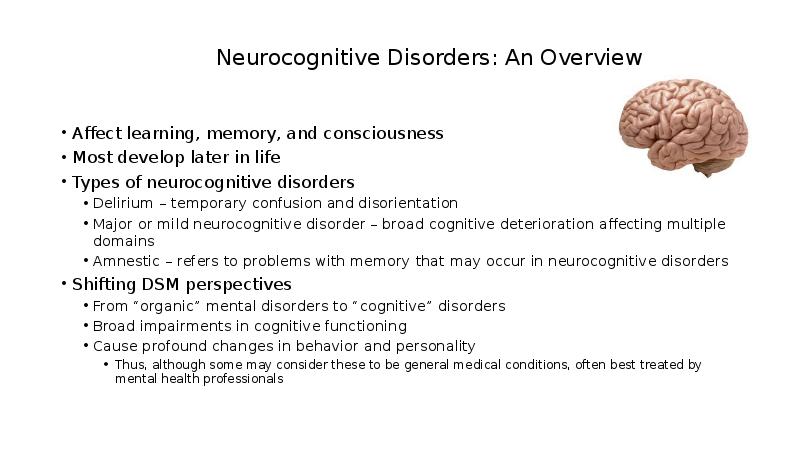
Neurocognitive Disorders: An Overview Affect learning, memory, and consciousness Most develop later in life Types of neurocognitive disorders...
Описание слайда:
Neurocognitive Disorders: An Overview Affect learning, memory, and consciousness Most develop later in life Types of neurocognitive disorders Delirium – temporary confusion and disorientation Major or mild neurocognitive disorder – broad cognitive deterioration affecting multiple domains Amnestic – refers to problems with memory that may occur in neurocognitive disorders Shifting DSM perspectives From “organic” mental disorders to “cognitive” disorders Broad impairments in cognitive functioning Cause profound changes in behavior and personality Thus, although some may consider these to be general medical conditions, often best treated by mental health professionals

Слайд 8


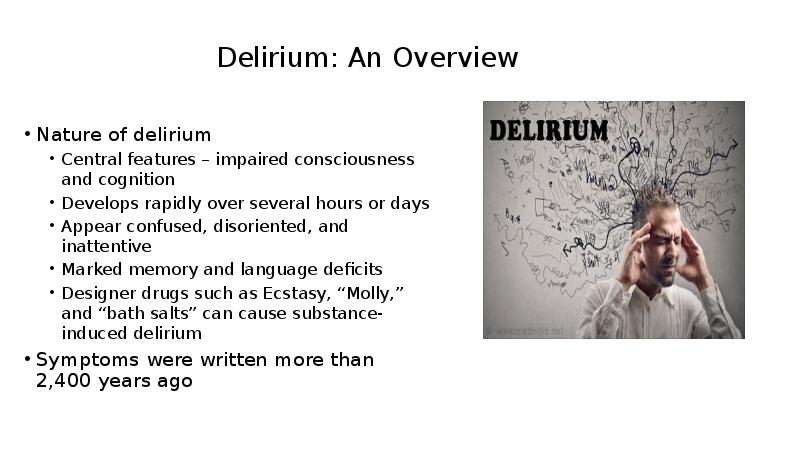
Delirium: An Overview Nature of delirium Central features – impaired consciousness and cognition Develops rapidly over several hours or days Appear...
Описание слайда:
Delirium: An Overview Nature of delirium Central features – impaired consciousness and cognition Develops rapidly over several hours or days Appear confused, disoriented, and inattentive Marked memory and language deficits Designer drugs such as Ecstasy, “Molly,” and “bath salts” can cause substance-induced delirium Symptoms were written more than 2,400 years ago

Слайд 9


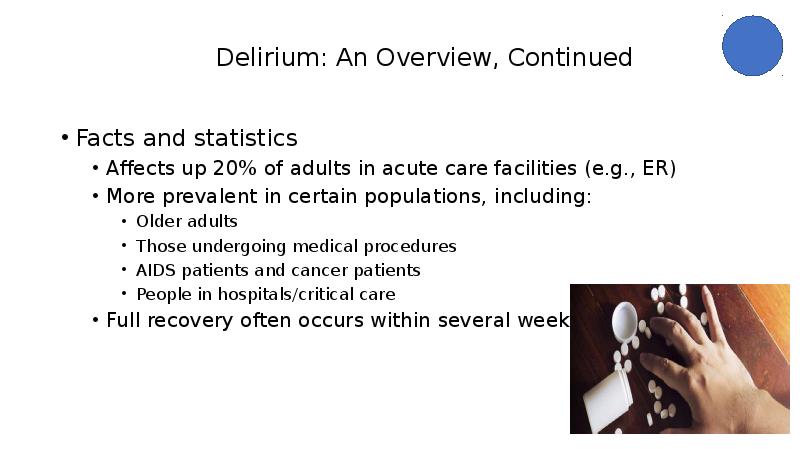
Delirium: An Overview, Continued Facts and statistics Affects up 20% of adults in acute care facilities (e.g., ER) More prevalent in certain...
Описание слайда:
Delirium: An Overview, Continued Facts and statistics Affects up 20% of adults in acute care facilities (e.g., ER) More prevalent in certain populations, including: Older adults Those undergoing medical procedures AIDS patients and cancer patients People in hospitals/critical care Full recovery often occurs within several weeks

Слайд 10


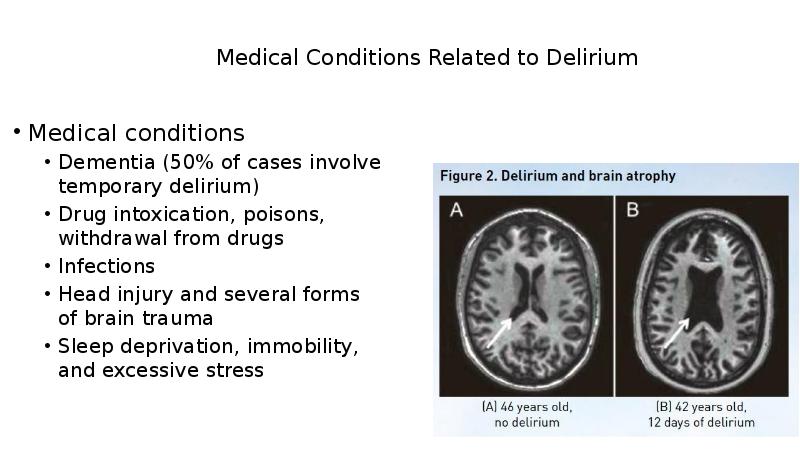
Medical Conditions Related to Delirium Medical conditions Dementia (50% of cases involve temporary delirium) Drug intoxication, poisons, withdrawal...
Описание слайда:
Medical Conditions Related to Delirium Medical conditions Dementia (50% of cases involve temporary delirium) Drug intoxication, poisons, withdrawal from drugs Infections Head injury and several forms of brain trauma Sleep deprivation, immobility, and excessive stress

Слайд 11


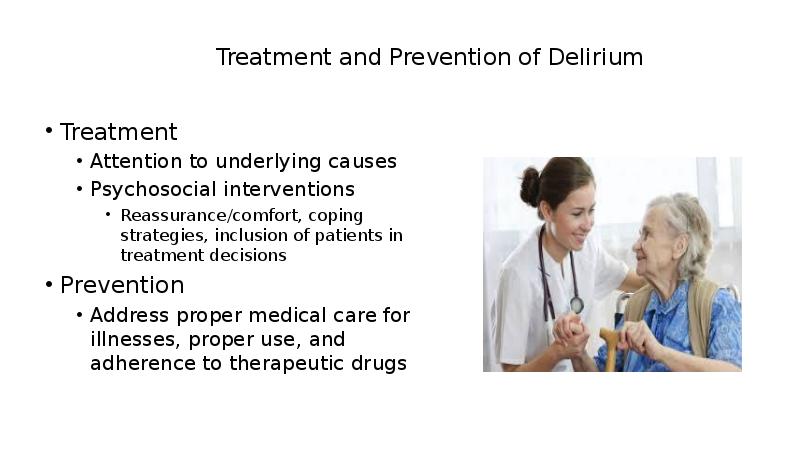
Treatment and Prevention of Delirium Treatment Attention to underlying causes Psychosocial interventions Reassurance/comfort, coping strategies,...
Описание слайда:
Treatment and Prevention of Delirium Treatment Attention to underlying causes Psychosocial interventions Reassurance/comfort, coping strategies, inclusion of patients in treatment decisions Prevention Address proper medical care for illnesses, proper use, and adherence to therapeutic drugs

Слайд 12


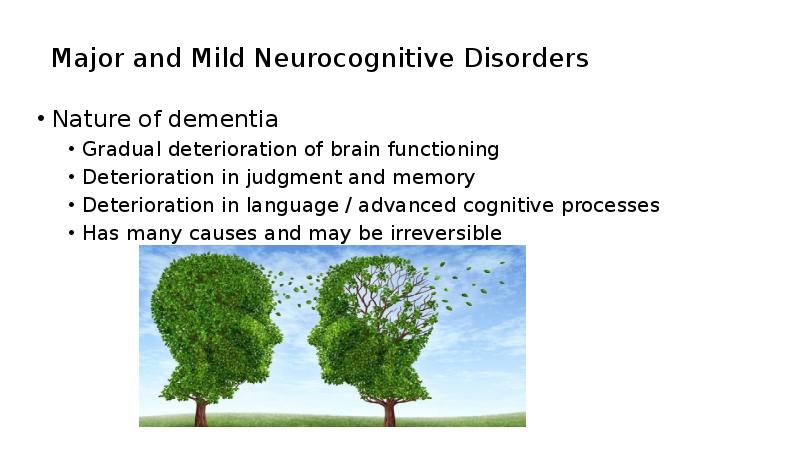
Major and Mild Neurocognitive Disorders Nature of dementia Gradual deterioration of brain functioning Deterioration in judgment and memory...
Описание слайда:
Major and Mild Neurocognitive Disorders Nature of dementia Gradual deterioration of brain functioning Deterioration in judgment and memory Deterioration in language / advanced cognitive processes Has many causes and may be irreversible

Слайд 13


Major and Mild Neurocognitive Disorders: DSM Criteria Major neurocognitive disorder: The new DSM-5 term for dementia Individual is not able to...
Описание слайда:
Major and Mild Neurocognitive Disorders: DSM Criteria Major neurocognitive disorder: The new DSM-5 term for dementia Individual is not able to function independently Mild neurocognitive disorder: New DSM-5 classification for early stages of cognitive decline Individual is able to function independently with some accommodations (e.g., reminders/lists)

Слайд 14


Major Neurocognitive Disorder: DSM-5 DSM-5 criteria One or more cognitive deficits that represent a decrease from previous functioning complex...
Описание слайда:
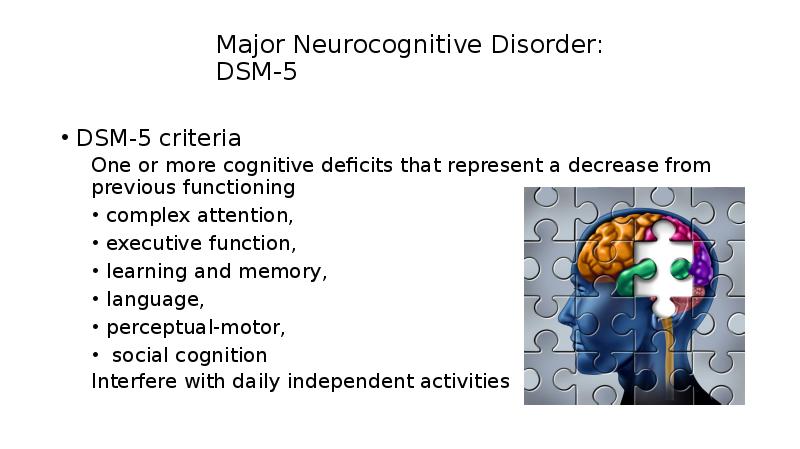
Major Neurocognitive Disorder: DSM-5 DSM-5 criteria One or more cognitive deficits that represent a decrease from previous functioning complex attention, executive function, learning and memory, language, perceptual-motor, social cognition Interfere with daily independent activities

Слайд 15


Major Neurocognitive Disorder Prevalence and Statistics Prevalence and statistics New case identified every 7 seconds 5% prevalence in adults 65+;...
Описание слайда:
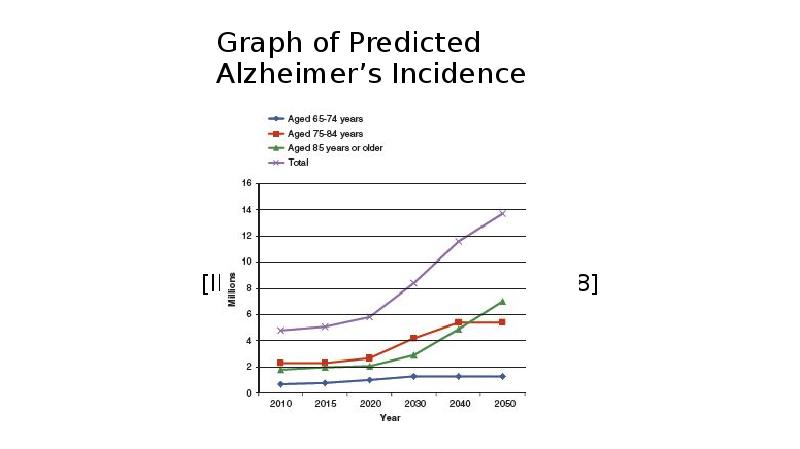
Major Neurocognitive Disorder Prevalence and Statistics Prevalence and statistics New case identified every 7 seconds 5% prevalence in adults 65+; 20% prevalence in adults 85+ 5 million people Methodology for estimating number of those suffering from major neurocognitive disorder has resulted in diverging numbers Dramatic rise in Alzheimer’s predicted through 2050; more people expected to live > 85 years

Слайд 16


Major Neurocognitive Disorder: Early Stages Initial stages Memory and visuospatial skills impairments Facial agnosia – inability to recognize...
Описание слайда:
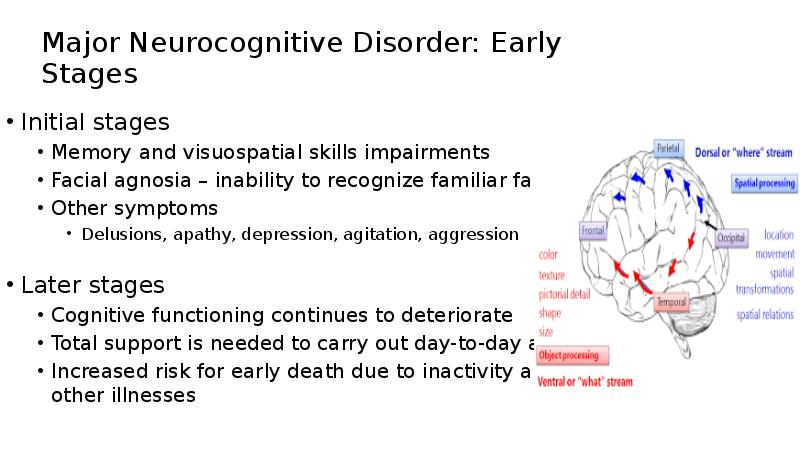
Major Neurocognitive Disorder: Early Stages Initial stages Memory and visuospatial skills impairments Facial agnosia – inability to recognize familiar faces Other symptoms Delusions, apathy, depression, agitation, aggression Later stages Cognitive functioning continues to deteriorate Total support is needed to carry out day-to-day activities Increased risk for early death due to inactivity and onset of other illnesses

Слайд 17


DSM-5 Types of Major and Mild Neurocognitive Disorder Due to Alzheimer’s Disease Frontotemporal Vascular With Lewy bodies Due to traumatic brain...
Описание слайда:
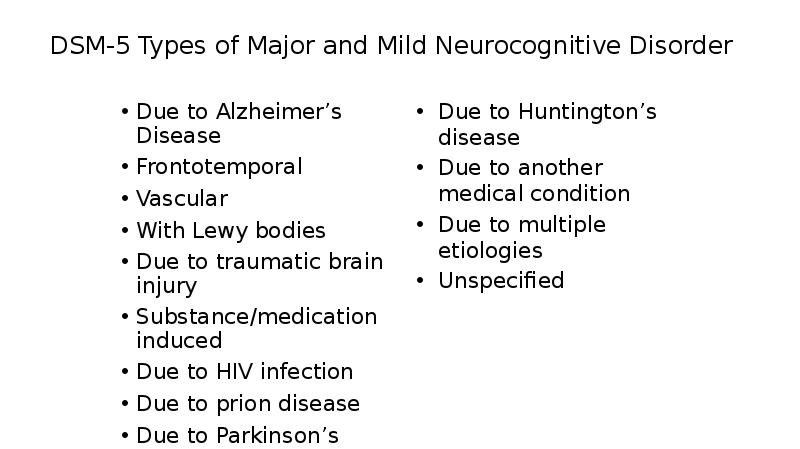
DSM-5 Types of Major and Mild Neurocognitive Disorder Due to Alzheimer’s Disease Frontotemporal Vascular With Lewy bodies Due to traumatic brain injury Substance/medication induced Due to HIV infection Due to prion disease Due to Parkinson’s Disease

Слайд 18


Neurocognitive Disorder Due to Alzheimer’s Disease Accounts for nearly half of neurocognitive disorders Clinical Features Typically develop gradually...
Описание слайда:
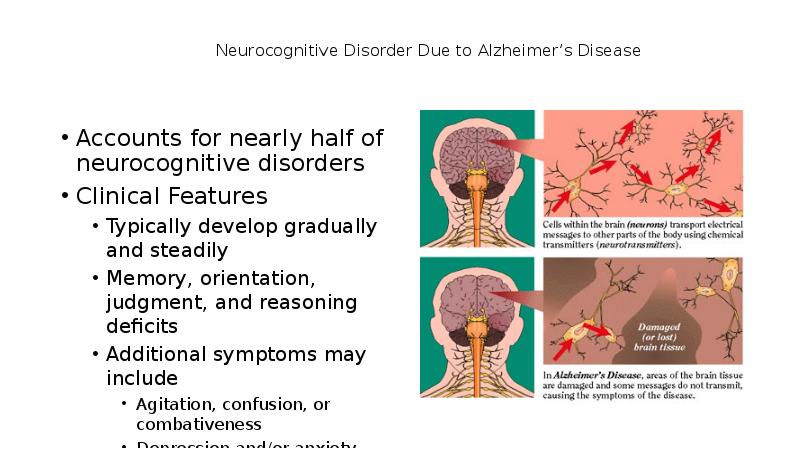
Neurocognitive Disorder Due to Alzheimer’s Disease Accounts for nearly half of neurocognitive disorders Clinical Features Typically develop gradually and steadily Memory, orientation, judgment, and reasoning deficits Additional symptoms may include Agitation, confusion, or combativeness Depression and/or anxiety

Слайд 19


Causes of Neurocognitive Disorder: The Example of Alzheimer’s Disease, Continued Multiple genes are involved in Alzheimer’s disease Include genes on...
Описание слайда:
Causes of Neurocognitive Disorder: The Example of Alzheimer’s Disease, Continued Multiple genes are involved in Alzheimer’s disease Include genes on chromosomes 21, 19, 14, 12 Chromosome 14 Associated with early onset Alzheimer’s Chromosome 19 Associated with late onset Alzheimer’s

Слайд 20


Causes of Neurocognitive Disorder: The Example of Alzheimer’s Disease, Part 3 Deterministic genes Rare genes that inevitably lead to Alzheimer’s...
Описание слайда:
Causes of Neurocognitive Disorder: The Example of Alzheimer’s Disease, Part 3 Deterministic genes Rare genes that inevitably lead to Alzheimer’s Beta-amyloid precursor gene Presenilin-1 and Presenilin-2 genes Susceptibility genes Make it more likely but not certain to develop Alzheimer’s

Слайд 21


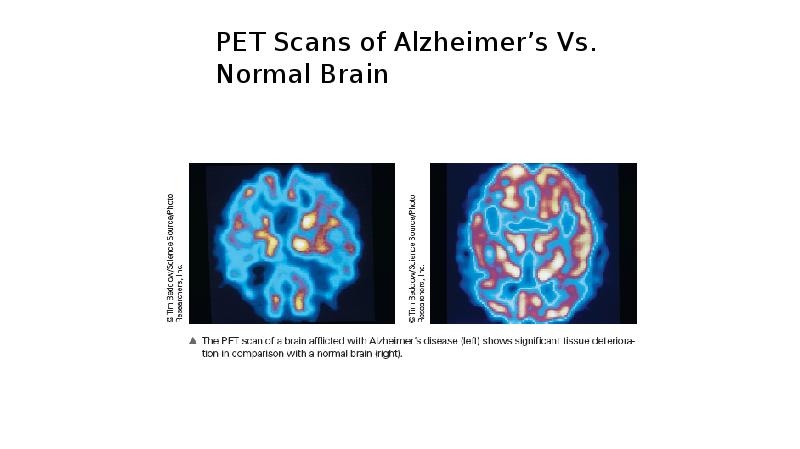
PET Scans of Alzheimer’s Vs. Normal Brain
Описание слайда:
PET Scans of Alzheimer’s Vs. Normal Brain

Слайд 22


Causes of Neurocognitive Disorder: The Example of Alzheimer’s Disease Features of brains with Alzheimer’s disease Neurofibrillary tangles (strandlike...
Описание слайда:
Causes of Neurocognitive Disorder: The Example of Alzheimer’s Disease Features of brains with Alzheimer’s disease Neurofibrillary tangles (strandlike filaments) Amyloid plaques (gummy deposits between neurons) Brains of Alzheimer’s patients tend to atrophy

Слайд 23


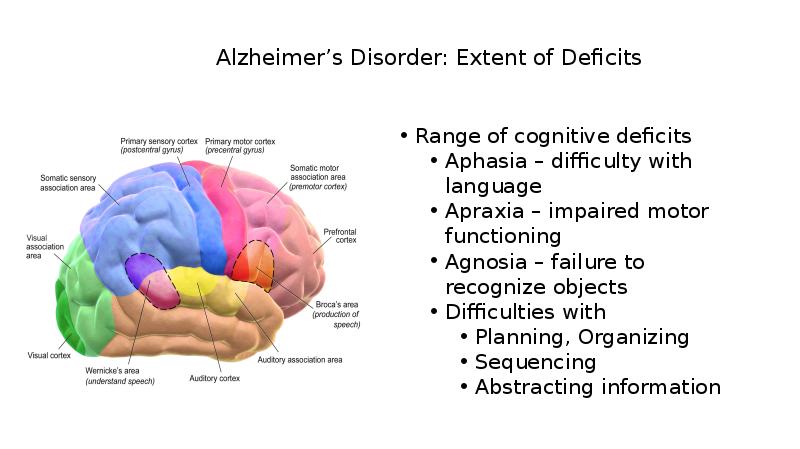
Alzheimer’s Disorder: Extent of Deficits Range of cognitive deficits Aphasia – difficulty with language Apraxia – impaired motor functioning Agnosia...
Описание слайда:
Alzheimer’s Disorder: Extent of Deficits Range of cognitive deficits Aphasia – difficulty with language Apraxia – impaired motor functioning Agnosia – failure to recognize objects Difficulties with Planning, Organizing Sequencing Abstracting information

Слайд 24


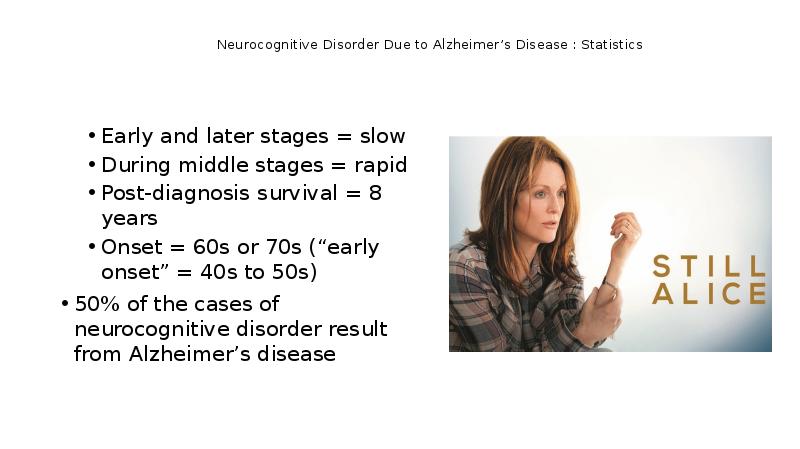
Neurocognitive Disorder Due to Alzheimer’s Disease : Statistics Early and later stages = slow During middle stages = rapid Post-diagnosis survival =...
Описание слайда:
Neurocognitive Disorder Due to Alzheimer’s Disease : Statistics Early and later stages = slow During middle stages = rapid Post-diagnosis survival = 8 years Onset = 60s or 70s (“early onset” = 40s to 50s) 50% of the cases of neurocognitive disorder result from Alzheimer’s disease

Слайд 25


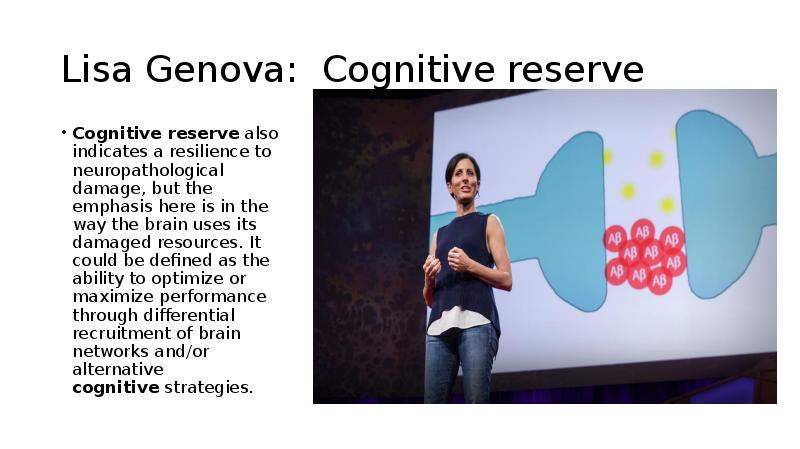
Lisa Genova: Cognitive reserve Cognitive reserve also indicates a resilience to neuropathological damage, but the emphasis here is in the way the...
Описание слайда:
Lisa Genova: Cognitive reserve Cognitive reserve also indicates a resilience to neuropathological damage, but the emphasis here is in the way the brain uses its damaged resources. It could be defined as the ability to optimize or maximize performance through differential recruitment of brain networks and/or alternative cognitive strategies.

Слайд 26


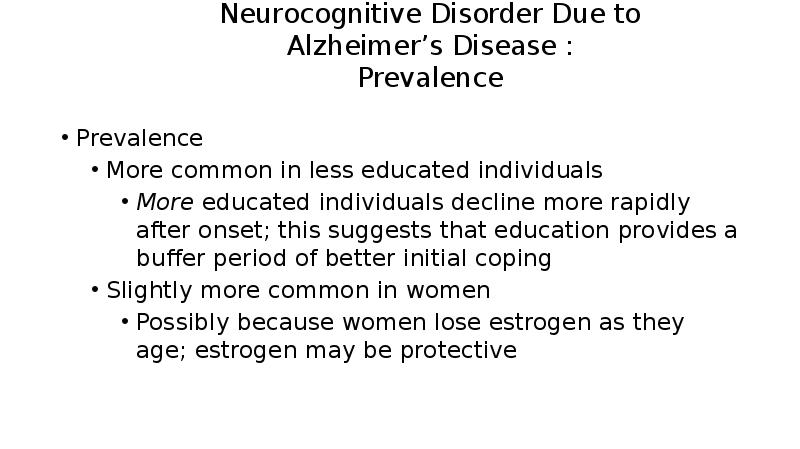
Neurocognitive Disorder Due to Alzheimer’s Disease : Prevalence Prevalence More common in less educated individuals More educated individuals decline...
Описание слайда:
Neurocognitive Disorder Due to Alzheimer’s Disease : Prevalence Prevalence More common in less educated individuals More educated individuals decline more rapidly after onset; this suggests that education provides a buffer period of better initial coping Slightly more common in women Possibly because women lose estrogen as they age; estrogen may be protective

Слайд 27


Graph of Predicted Alzheimer’s Incidence [INSERT Figure 15.1 HERE, p. 548]
Описание слайда:
Graph of Predicted Alzheimer’s Incidence [INSERT Figure 15.1 HERE, p. 548]

Слайд 28


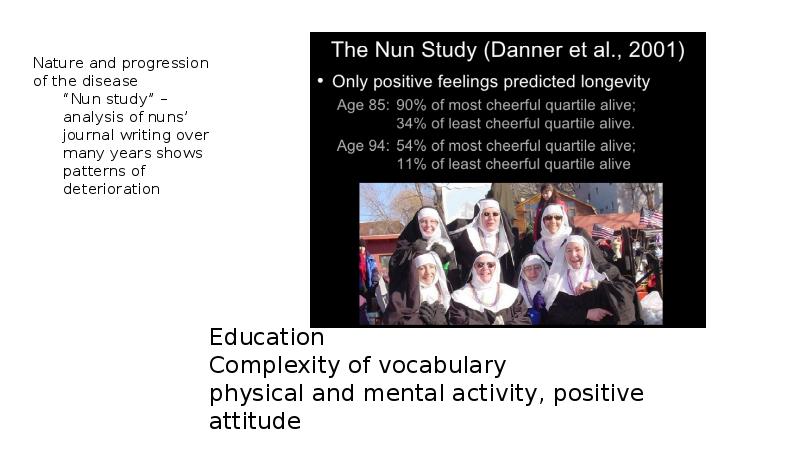
Education Complexity of vocabulary physical and mental activity, positive attitude
Описание слайда:
Education Complexity of vocabulary physical and mental activity, positive attitude

Слайд 29


Vascular Neurocognitive Disorder Caused by blockage or damage to blood vessels Second leading cause of neurocognitive disorder after Alzheimer’s...
Описание слайда:
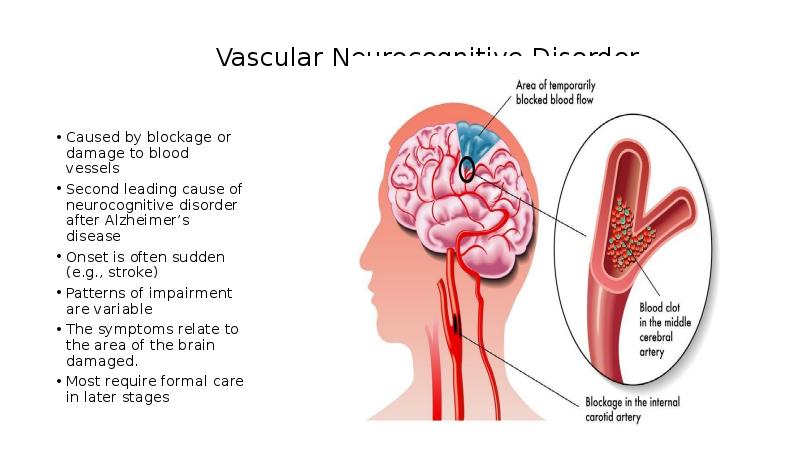
Vascular Neurocognitive Disorder Caused by blockage or damage to blood vessels Second leading cause of neurocognitive disorder after Alzheimer’s disease Onset is often sudden (e.g., stroke) Patterns of impairment are variable The symptoms relate to the area of the brain damaged. Most require formal care in later stages

Слайд 30


Vascular Neurocognitive Disorder: Features Features Cognitive disturbances – identical to dementia Obvious neurological signs of brain tissue damage...
Описание слайда:
Vascular Neurocognitive Disorder: Features Features Cognitive disturbances – identical to dementia Obvious neurological signs of brain tissue damage Prevalence 1.5% in people 70 to 75 and 15% for people over 80 Risk slightly higher in men

Слайд 31


Vascular Neurocognitive Disorder Caused by blockage or damage to blood vessels Second leading cause of neurocognitive disorder after Alzheimer’s...
Описание слайда:
Vascular Neurocognitive Disorder Caused by blockage or damage to blood vessels Second leading cause of neurocognitive disorder after Alzheimer’s disease Onset is often sudden (e.g., stroke) Patterns of impairment are variable Most require formal care in later stages

Слайд 32


Prevention of Neurocognitive Disorders Reducing risk in older adults Use of anti-inflammatory medications Control blood pressure, don’t smoke, and...
Описание слайда:
Prevention of Neurocognitive Disorders Reducing risk in older adults Use of anti-inflammatory medications Control blood pressure, don’t smoke, and lead active social life Other targets of prevention efforts Increasing safety behaviors to reduce head trauma Reducing exposure to neurotoxins and use of drugs

Слайд 33


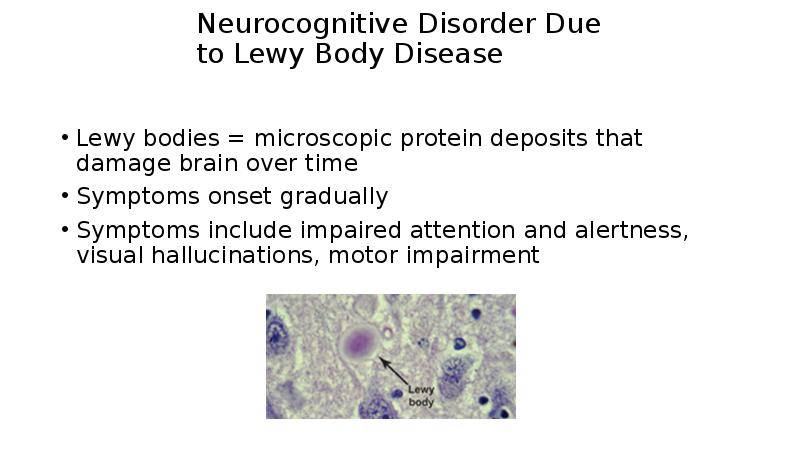
Neurocognitive Disorder Due to Lewy Body Disease Lewy bodies = microscopic protein deposits that damage brain over time Symptoms onset gradually...
Описание слайда:
Neurocognitive Disorder Due to Lewy Body Disease Lewy bodies = microscopic protein deposits that damage brain over time Symptoms onset gradually Symptoms include impaired attention and alertness, visual hallucinations, motor impairment

Слайд 34


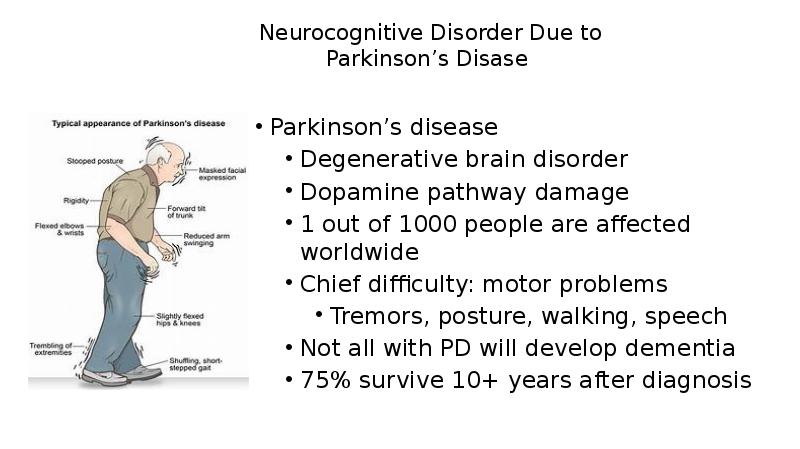
Neurocognitive Disorder Due to Parkinson’s Disase Parkinson’s disease Degenerative brain disorder Dopamine pathway damage 1 out of 1000 people are...
Описание слайда:
Neurocognitive Disorder Due to Parkinson’s Disase Parkinson’s disease Degenerative brain disorder Dopamine pathway damage 1 out of 1000 people are affected worldwide Chief difficulty: motor problems Tremors, posture, walking, speech Not all with PD will develop dementia 75% survive 10+ years after diagnosis

Слайд 35


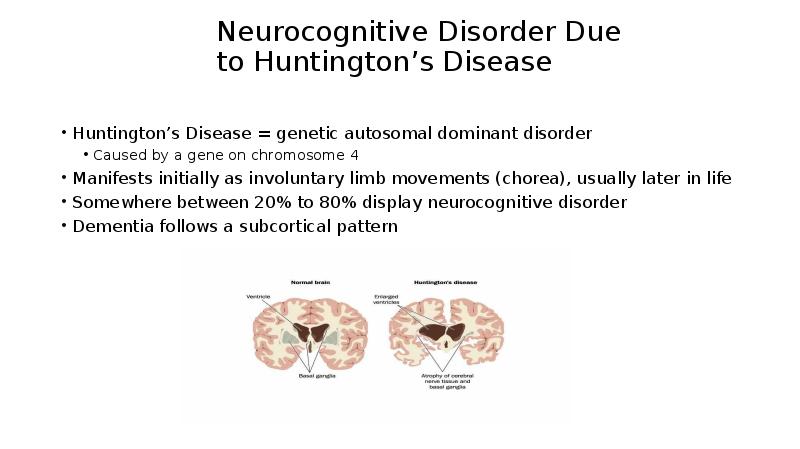
Neurocognitive Disorder Due to Huntington’s Disease Huntington’s Disease = genetic autosomal dominant disorder Caused by a gene on chromosome 4...
Описание слайда:
Neurocognitive Disorder Due to Huntington’s Disease Huntington’s Disease = genetic autosomal dominant disorder Caused by a gene on chromosome 4 Manifests initially as involuntary limb movements (chorea), usually later in life Somewhere between 20% to 80% display neurocognitive disorder Dementia follows a subcortical pattern

Слайд 36


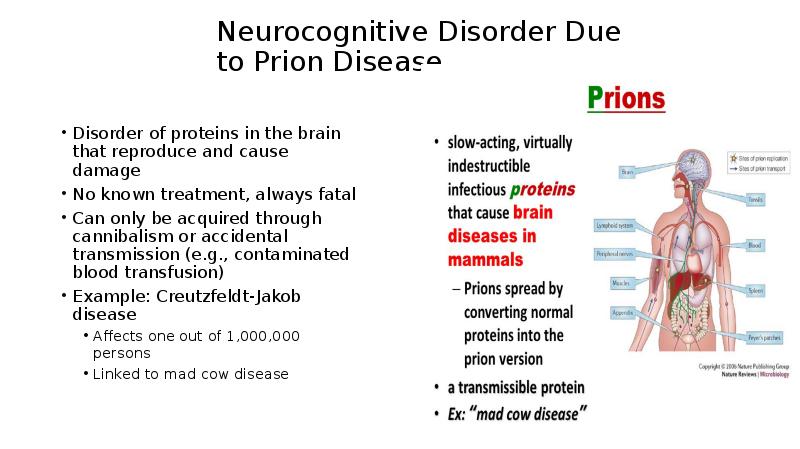
Neurocognitive Disorder Due to Prion Disease Disorder of proteins in the brain that reproduce and cause damage No known treatment, always fatal Can...
Описание слайда:
Neurocognitive Disorder Due to Prion Disease Disorder of proteins in the brain that reproduce and cause damage No known treatment, always fatal Can only be acquired through cannibalism or accidental transmission (e.g., contaminated blood transfusion) Example: Creutzfeldt-Jakob disease Affects one out of 1,000,000 persons Linked to mad cow disease

Слайд 37


Summary of Neurocognitive Disorders Cognitive disorders span a range of deficits Affect attention, memory, language, and motor behavior Causes...
Описание слайда:
Summary of Neurocognitive Disorders Cognitive disorders span a range of deficits Affect attention, memory, language, and motor behavior Causes include Aging Medical conditions Abnormal brain structures Drug use Environmental factors

Слайд 38


Summary of Neurocognitive Disorders Cognitive disorders span a range of deficits Affect attention, memory, language, and motor behavior Causes...
Описание слайда:
Summary of Neurocognitive Disorders Cognitive disorders span a range of deficits Affect attention, memory, language, and motor behavior Causes include Aging Medical conditions Abnormal brain structures Drug use Environmental factors Most result in progressive deterioration of functioning Few treatments exist to reverse damage and deficits, but progression may be slowed


Похожие презентации
Mypresentation.ru
Загрузить презентацию